Owners: Fife Coal Co. Ltd.
NCB
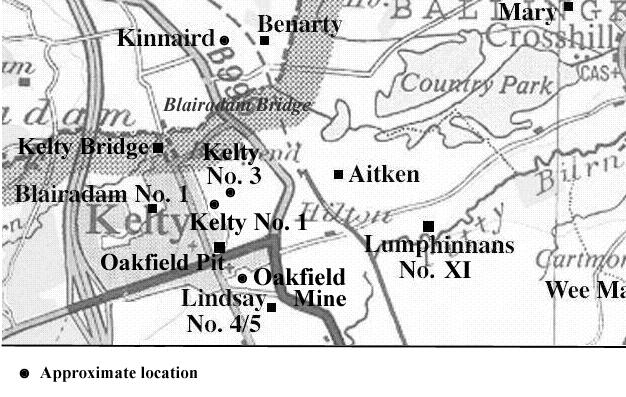
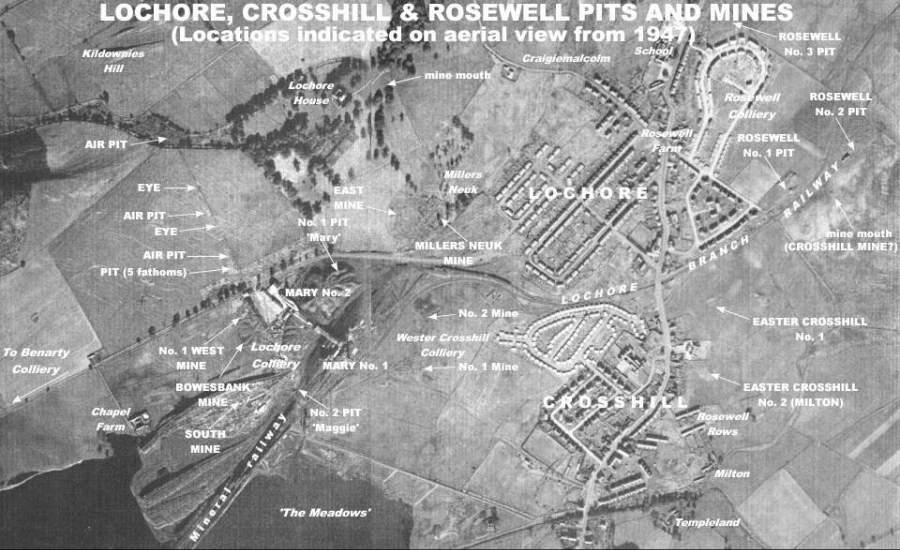
The pits of the Mary Colliery worked the basin of the
Lochore Coalfield, the Mary No. 1 shaft being sunk around
1902/3 to 300 fathoms close to the locations of even older
workings of the Lochore and Wester Crosshill Collieries of
the 19th century.
The site of the 'big' Mary No. 2 shaft, sunk in 1923
to around 280 fathoms, just to the west of Lochore, is marked
by its reinforced-concrete, pithead frame monument which is
today a great attraction for all those visiting the Lochore
Meadows Country Park. It is one of only two such structures
in Fife serving to remind the public of the Kingdom's
great mining history.
The Mary Bowesbank Mine was struck in 1933 just to the west
of the main colliery but this mine appears to have been
worked only for around two years.
 |
 |
 |
 |
 |
 |
The above photograph (left) was taken from Benarty Hill looking south towards Lochore Meadows Country Park - on the left, in the distance, you can see the headgear of the Mary Pit. The other photograph shows part of the Chapel Farm buildings and the smouldering bing at the 'Meedies' prior to the clearance programme which led to the creation of the Meadows Country Park. ...
-------------------------------------------
 |
... and just when we thought that no more photographs of the
Mary Nos. 1, 2 Pits, Lochore, would ever turn up, Duncan Rolland,
Glenrothes, sent this one to us, in September 2009, with permission to display it
on the website. Duncan's grandfather, Frank Rolland, served Fife's mining
industry for many years, retiring as an under-manager from Seafield Colliery,
Kirkcaldy, in the 1980s.
M. Martin & Webmasters.
-------------------------------------------
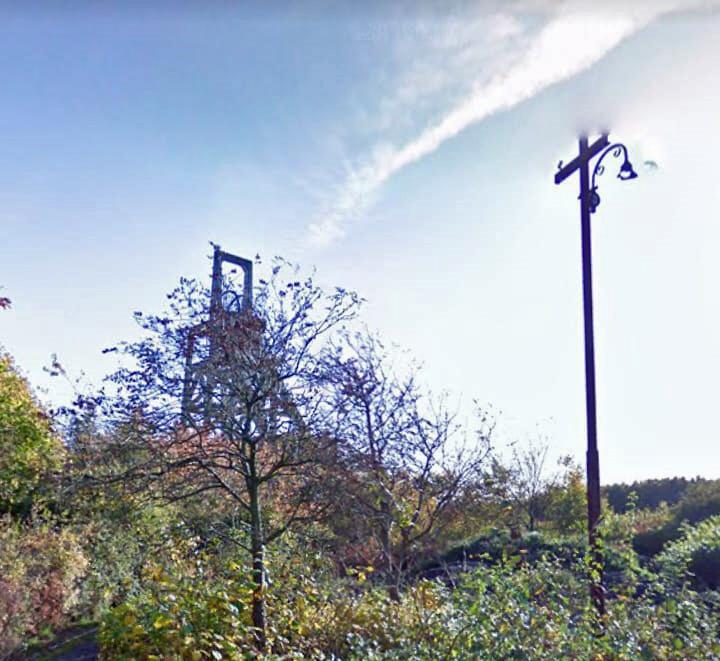
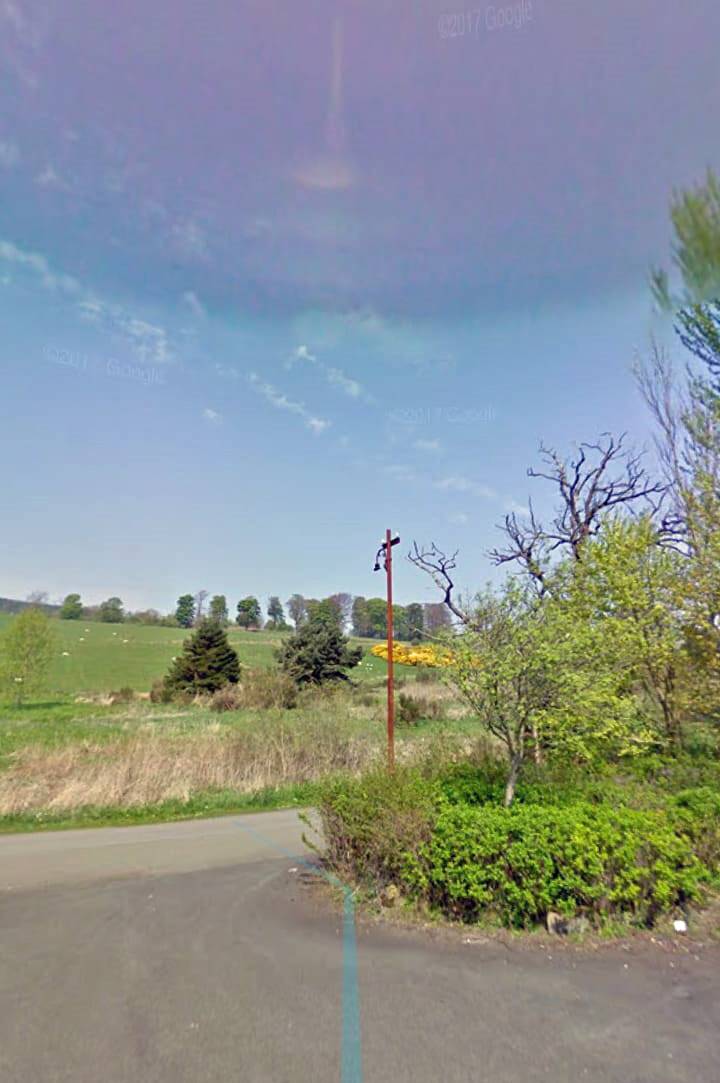
Another surviving structure from the Lochore mining era
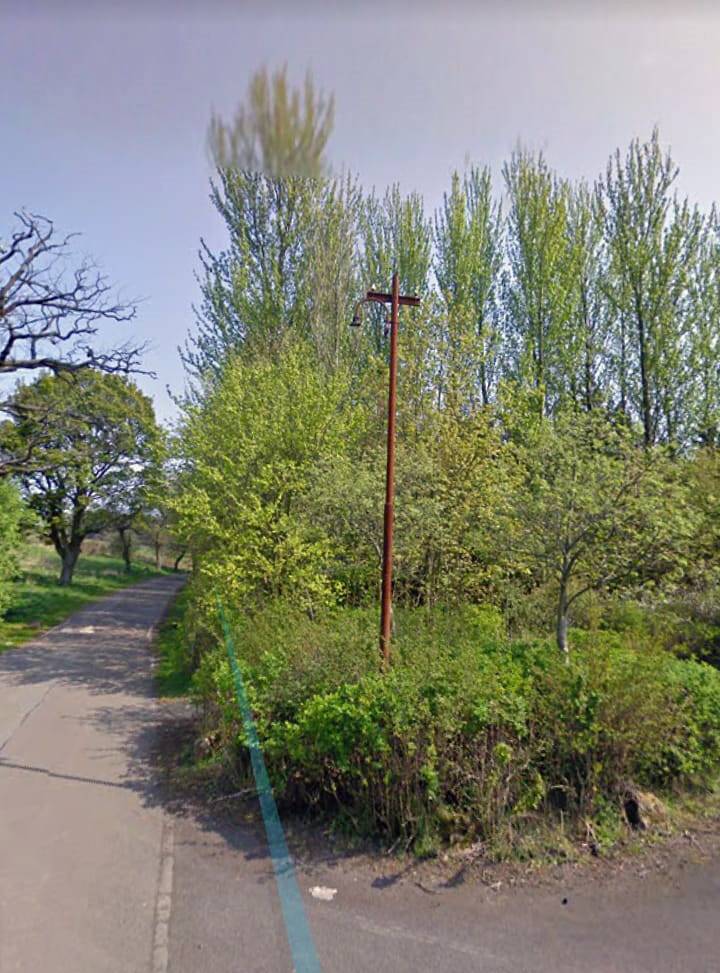
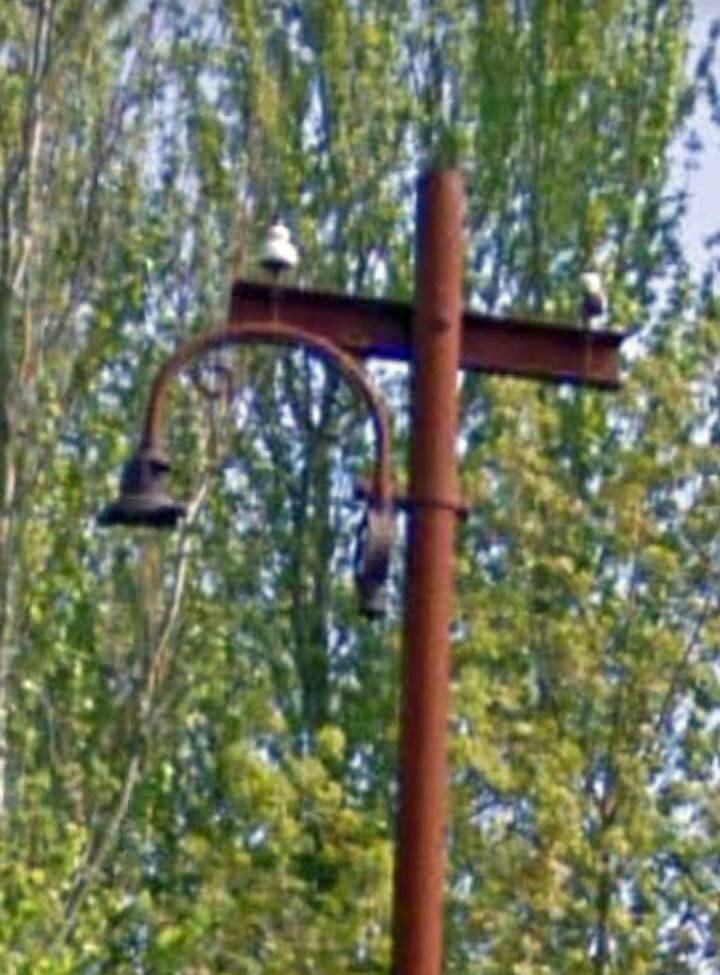
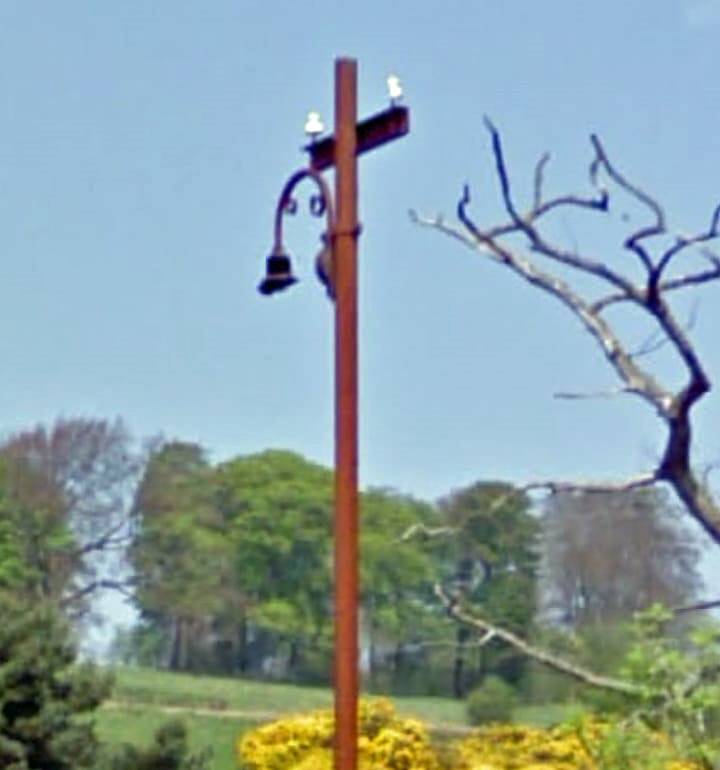
In 2018, former Glencraig man, John Carson, now residing in Glenrothes, sent webmaster, Chris Sparling, a series of pics showing what might be the last of its kind in the Lochore area. John spotted a lamp standard, carrying the remains of a lamp mounting and two insulators, at the north end of the Lochore Meadows Country Park, just beyond the reinforced concrete headgear. John says that the whole of Mannering Street leading from the village of Lochore down to the Mary Colliery entrance would have been lit by a series of these lamps which probably also carried telephone communication cables.
Hopefully, John's pics (see below) will enable you to find and admire this rare old structure.
M. Martin & Webmasters.
 |
 |
 |
 |
 |
-------------------------------------------
| See Lochore Colliery entry for information on the 19th century pits and mines. |
|---|
-------------------------------------------
| Pits opened: No. 1 (1904); No. 2 (1924) | Pits closed: August 1966 |
|---|---|
| Source Date of Information Supplied | |
| Manager / Under- Manager / Men underground / Men above ground / Coal seams worked | |
| 1904 (Fife Coal Company) | |
| John Allan / ------------ / 92 / 80 / Gas and steam coals. | |
| 1905 | |
| John Allan / ------------ / 37 / 56 | |
| 1906 | |
| John Allan, manager. | |
| 1908 | |
| January: Andrew Ramsay, Under-manager | |
| David Beveridge / Archibald Spiers / 414 / 120 | |
| 1910 | |
| Mr David Baird, under-manager. | |
| 1911 | |
| Mr William Lang / Mr D. Baird / 747 / 154 | |
| 1912 | |
| July: Mr Wm. Lang,
late manager, leaving for Low Valleyfield position James Roden, manager; Mr David Baird, under-manager November: James Paterson, oversman, appointed under-manager at Benarty Pit. |
|
| 1913 | |
| James Roden, manager. | |
| 1915 | |
| Jul: Departure of
Mr James Macfarlane, under-manager, to a post at Leven Collieries. Mr W. McM. Campbell, Lochore, appointed under-manager. |
|
| 1917 | |
| Jun: James Roden, manager; William McMillan Campbell, under-manager. | |
| 1918 | |
| Aug: Departure of Mr Roden,
colliery manager, to Blairadam and Blairenbathie. Mr Robert Stewart / ------------ / 479 / 134 Sep: Mr Robert Penman, former oversman Aitken Pit, appointed to the Mary Colliery. | |
| 1919 | |
| Robert Stewart / Robert Penman / ----- / ----- | |
| 1920 | |
| Mary No. 1 Pit: 610 / 170 : No. 2 Pit:
45 / 36 May: Mr John Fleming, oversman, appointed manager at Lassodie Mill Colliery. | |
| 1921 | |
| Jan: Mr William Peat, assistant
manager, Aitken Pit, Kelty, appointed manager. Mr Kirkwood McNeill, colliery manager, appointed manager at the Aitken Pit. Oct: Mr William Peat, appointed manager at Foulford and No. 9 pits, Cowdenbeath. Mr Clarke, section oversman, appointed under-manager, Cowdenbeath No. 9 Pit. Mr Robert Stewart, manager, Nos. 1, 2 Pits. Mr John Brown, appointed oversman, No. 2 Pit. Mr Alex. Davidson, appointed oversman, to replace Mr J. Brown. | |
| 1923 | |
| Oct: Mr K. McNeill appointed agent at Mary and Aitken Collieries. | |
| 1924 | |
| July: Robert Stewart, manager, promoted to Agent at Leven Colliery. | |
| 1926 | |
| Mar: Robert Penman, under-manager. | |
| 1927 | |
| Mr William
Armstrong, manager. September: Mr Armstrong departs post to a colliery in England. Mr W. Monaghan appointed manager from No. 11 Pit, Lumphinnans. |
|
| 1928 | |
| James B. Nelson / John Armstrong / 773 / 159 | |
| Household and steam coals. Jewel, Glassee, Dunfermline Splint, Five Feet, Mynheer and Main. | |
| 1930 | |
| Aug: Mr J. B. Nelson, manager. | |
| 1932 | |
| Oct: Mr George Hutchison, manager. | |
| 1934 | |
| March: Mr George Hutchison, manager. | |
| 1937 | |
| Nov: Mr George Hutchison, manager. | |
| 1938 | |
| Alex. Clark /
William Kay (No. 1) : Archibald Banks (No. 2) / 640 /
198 Apr: Mr John Edie, undermanager, No. 2 Pit, Mary Pit, Lochore. May: Mr William Hunter, undermanager. |
|
| 1945 | |
| Alex. Clark / Charles Frew : Robert Crichton / 421 / 166 | |
| Gas, household and steam coals. Jersey, Jewel, Glassee and Main. | |
| 1947 (NCB) | |
| Alex. Clark / ---------- / 496 / 181 | |
| Gas,
household, industrial and navigation coals.
Approx. annual output = 207,600 tons |
|
| 1948 (NCB) | |
| Alex. Clark / Robert Crichton / 488 / 196 | |
| Gas, household and steam coals. Main, Lower Jersey, Glassee and Jewel. | |
| 1949 (NCB) | |
| A. Clark / R.
Crichton / --- / --- Gas, household, manufacturing and navigation coals. Jersey and Kelty Main. |
|
| 1950 (NCB) | |
| A. Clark / D.
Wilson / 552 / 135 Gas, household, manufacturing and navigation coals. Jewel, Jersey and Kelty Main. |
|
| 1951 (NCB) | |
| A. Clark / D.
Wilson / 571 / 143 Gas, household, manufacturing and navigation coals. Jewel, Jersey and Kelty Main. |
|
| 1952 (NCB) | |
| A. Clark / D.
Wilson / 563 / 135 Gas, household, manufacturing and navigation coals. Jewel, Jersey and Kelty Main. |
|
| 1953 (NCB) | |
| A. Clark /
James Dunsmore / 563 / 135 Gas, household, manufacturing and navigation coals. Jewel, Jersey and Kelty Main. |
|
| 1954-56 (NCB) | |
| M. M. McGugan /
James Dunsmore / 563 / 135 Gas, household, manufacturing and navigation coals. Jewel, Jersey and Kelty Main. |
|
| 1957 (NCB) | |
| M. M. McGugan /
A. Walker / 625 / 141 Gas, household, manufacturing and navigation coals. Jersey, Kelty Main, Lochgelly Splint, Little Splint, Seven Foot. |
|
| 1958 (NCB) | |
| M. M. McGugan / A. Walker / 640 / 140 | |
| Gas, household, industrial, steam coals and blaes. Jersey, Lochgelly Splint, Little Splint and Seven Foot. | |
| 1959 (NCB) | |
| M. M. McGugan / A. Walker / 536 / 110 | |
| Gas, household, industrial, steam coals and blaes. Jersey, Lochgelly Splint, Little Splint and Seven Foot. | |
| 1961 (NCB) | |
| M. M. McGugan / A. Walker / 429 / 97 | |
| Gas, household, industrial, steam coals and blaes. Jersey and Little Splint. | |
| 1964 (NCB) | |
| M. M. McGugan / A. W. Harrower / 318 / 66 | |
| Gas,
household, industrial, navigation and steam coals and
blaes.
Jersey, Top Lochgelly Splint, Lower Lochgelly Splint. |
|
| This mine had a system of ventilation partly in common with the Aitken Nos. 1, 2 Pits at Kelty. | |
Information on coals worked at the Mary Nos. 1, 2 Pits, Lochore
(based on reports from 1930-34)
This colliery had two shafts (the first being sunk around
1902) and lay close to the north-east corner of what is now
the Meadows Country Park, a lovely area reclaimed from the
dirty, flooded, areas of pit waste which once lay to the west
of Lochore and Crosshill.
East of the pit, numerous troubles were encountered with the
Dunfermline Splint seam and little of the coal was drawn from
this pit although good reserves were known to lie in a small
area below Lochore Castle, which lay to the south.
The Five Foot Coal worked around the 1930s recorded 9 in. to
1 ft. of coal separated from a lower coal of 4 ft. 6 in. to 5
ft. with a mid blackband ironstone of 3 in. to 6 in.
A section of Jewel Coal cut to the east of No. 2 Mary Pit
(sunk 1923/24) had wild parrot coal (4 in.), ironstone (2
in.), gas coal (2 in.), clean coal (6 in.), gas coal (10 in.)
and clean coal (10 in.). At first, the name "Parrot
Coal" was given to this seam because of its composition
but this name was dropped because it led to confusion with
the Lochgelly Parrot Coal.
Huge reserves of Mynheer Coal were identified in this area,
a 3 ft. 4 in. coal overlain by a 6 in. ironstone being cut at
the No. 2 Mary Pit but approaching the 1930s, only small
sections of the coal had been taken out.
In the pit shafts, 7 ft. 6 in. to 8 ft. 2 in. of Glassee
Coal was also recorded and, although the coal thickness may
have been exaggerated by the steep dip, there is no doubt
that the actual thickness of coal here was thicker than in
other parts of the coalfield. Records show that when the coal
was being opened out westwards from the pit, 3 ft. 4 in. to 4
ft. 2 in. of coal, with an ironstone roof, was detected.
The Bank Coal here was 4 ft. to 4 ft. 6 in. thick with a
sandy pavement and a blaes roof. A whinstone intruding into
the overlying sediments to the east affected the seam but
large reserves of good coal were present to the west and
south-west. In pit workings, the Lower Jersey seam, with
variable partings, was close to 8 ft. thick. The upper part,
a fair quality coal, was probably the true Lower Jersey Coal,
while the poorer lower leaf was probably the equivalent of
the Swallowdrum Coal of Lumphinnans No. XI Pit.
Kelty Main Coal, around 8 ft., was recorded just to the east
of the pit while burnt areas were encountered in workings to
the west.
The Rough Coal measured 9 ft. thick and was in seven leaves
separated by thin stone ribs. To the east of the pit, the
Little Splint Coal was thick but much faulted, while a great
deal of coal was raised from the workings to the west. Two
thin ribs of ironstone, with a total thickness of 8 in.
associated with shaly blaes, represented the Lochgelly
Blackband Ironstone in the Lochore area.
The best known development of the Cardenden Smithy Coal was
at the Mary No. 1 Pit where three leaves of 4 ft. 6 in., 6
in. and 1 ft. respectively, were recorded with partings.
Workings in the Mary No. 1 Pit recorded finding Blairhall
Main Coal burnt by underlying whinstone.
The Bowesbank Coal lay 6 to 20 fathoms above the Index
Limestone of the Upper Limestone Group and was variable in
thickness and in quality. In the Cowdenbeath-Lochore
syncline, where it rested on a thin bed of fireclay and was
overlain by fakes or faky blaes, the Bowesbank Coal generally
exceeded 2 ft. and may have reached 3 ft. 9 in. It was
variously described in bores as "foul coal",
"parrot coal" and "splint coal". In the
deepest part of the Cowdenbeath-Lochore syncline near the
Mary Pit, the seam was 3 ft. to 3 ft. 9 in. thick and
included a median band of splint coal.
Plans of Abandoned Seams & DatesNote: abandonment dates do not relate to individual pit closures but to the abandonment of seams which had ceased to be worked. Not worked for a period of time, it was quite normal for some coal seams to be re-opened for working at a later date or at a different location. |
|---|
| Plans of Abandoned Seams for Mary, Lochore | Pits or Mines designated in Abandonment Plans |
|---|---|
| COAL; Lower Bank; Upper Bank (February, 1914)
Diamond (September, 1914); Seam between Glassee and Bank (November, 1915) |
LOCHORE: Mary |
| COAL; Jewel; Wee (November, 1922) | LOCHORE: Mary |
| COAL; Rough or Gorman (November, 1923) | LOCHORE: Mary |
| COAL; Jewel (December, 1930) | LOCHORE: Mary Nos. 1, 2 |
| COAL; Little Splint; Gorman or Rough (April, 1932) | LOCHORE: Mary |
| COAL; Bowersbank (February, 1935) | LOCHORE: Mary |
------------------------------------
A Few Notes on the Early Days
by
CHARLES AUGUSTUS CARLOW
1900: This year saw the acquisition of Benarty and the Estate of Lochore, on which Mary Pit is sunk. Benarty must have been a good-paying proposition, because when Mr. Rowan and I went to see the Manager, old Mr. Ferguson, before we bought the place, we were directed to his house at about 2 o'clock in the afternoon. When we went there and knocked on the door, Mr. Ferguson himself appeared - in gold-embroidered smoking cap and carpet slippers. Things were different then!
1902: This year saw the start of the Mary Pit, and the cutting of the first sod by my mother. It was a big undertaking. The pumping engine was of the compound condensing bell-crank type, with three forcing sets of pumps, each 100 fathoms head and 30" diameter rams. Below the 300 fathoms there was a bucket lift, in accordance with usual practice. The pithead frame and winding engine were built in Fife, but no British firm could supply pithead pulleys to my satisfaction, and it is interesting to note that I had to get the pulleys from Krupps Works, Essen, Germany. All this plant is doing good service except the pumping engine, which was replaced by all-conquering electricity many years ago. The second shaft of the Mary was sunk much later.
1902-1906: Within these years Kirkford was brought
up to full production, the Company acquired Lassodie Mill,
Blairadam and Blairenbathie Collieries, and sunk Kinnaird.
In these years I made some very good friends - Mr. John
Allan, who was Manager at Blairenbathie when we took it over,
and Mr. James Hendrie, who sunk Lassodie Mill, and as he
often told me, he "sunk the pits and had an output of
200 tons per day coming, all within twelve
months."
--------------------------------------------
"Dunfermline Press"
8 March, 1902
The ceremony of cutting the first sod of a great
new pit at Lochore emphasises the extent of the undertaking of the
Fife Coal Company. The pit is to be one of the deepest in Scotland.
Cannel coal has been worked on the estate of Lochore for thirty
years, but the field is an extensive one, and is capable of great
development. Valuable minerals lie at a depth of 300 fathoms from
the surface. It is estimated that the cost of the latest
undertaking on which the Fife Coal Company has embarked will not be
less than £100,000.
[The sod-cutting ceremony is believed to
have taken place on Saturday, 1st March,
1902.]
--------------------------------------------
"Dunfermline Press"
28 June, 1902
A LARGE CASTING
Messrs Douglas & Grant on Tuesday successfully cast at their works Dunnikier Foundry, Kirkcaldy, the cylinder of one of the largest pumping engines yet constructed, and which was ordered by the Fife Coal Company, Limited, for the new Mary Pit at Lochore. The engine is of the compound type, with cylinders 58 inches and 100 inches in diameter and 12 feet stroke. The larger cylinder was cast on Thursday, about 27 tons of metal being used in the process.
--------------------------------------------
"The Scotsman"
20 September, 1902
PIT SINKERS. - The FIFE COAL COMPANY, LTD., are prepared
to receive OFFERS for SINKING a PIT at LOCHORE, near KELTY.
Intending Contractors will get particulars and Copies of Specification by
applying to the Company's Office in Cowdenbeath, and Offers
are to be lodged not later than Friday the 26th inst.
--------------------------------------------

"Dunfermline Press"
4 July, 1903
On Thursday morning, David Rennie, thirty-nine years of age, labourer, Victoria Place, Kelty, met with his death at the pithead of the Mary Pit, Lochore, belonging to the Fife Coal Company. Rennie, along with others, was engaged lifting a water pump from the crank seat when the end of the pump slipped and crushed him against the sole plate. Death was instantaneous.
--------------------------------------------
"Dunfermline Press"
18 July, 1903
James Ogilvie, pumpman, Mary Place, Lochore, was working with three sinkers at the new Mary Pit, near Lochgelly, belonging to the Fife Coal Company, yesterday, and was ascending to another platform when, through a misunderstanding of the bell call, the kettle was prematurely raised. Ogilvie was precipitated to the bottom of the shaft, a distance of about thirty fathoms. Besides receiving injuries to his head, he had several ribs fractured, and these penetrated the lung. His left arm was also broken. The unfortunate man died in the ambulance van while being conveyed to Dunfermline Cottage Hospital. Ogilvie, who was thirty-two years of age, leaves a widow and young family, some of whom are at present suffering from the prevailing typhoid fever.
--------------------------------------------
"Dunfermline Press"
1 August, 1903
Under the Fatal Accidents Inquiry Act, an inquiry was held in the Sheriff Court, Dunfermline, on Thursday - before Sheriff Gillespie and a jury - into the circumstances attending the death of David Rennie, labourer, Kelty, at Mary Pit, Lochore, on 2 July. Those giving evidence included:- William Skinner, engineer, Moss-side Road, Cowdenbeath; William Russell, labourer, Queich Place, Kinross; and John Hutton, blacksmith, Curate Wynd, Kinross. A formal verdict was returned by the jury.
--------------------------------------------
"Dunfermline Press"
1 August, 1903
Under the Fatal Accidents Inquiry Act, an inquiry was held in the Sheriff Court, Dunfermline, on Thursday - before Sheriff Gillespie and a jury - into the circumstances attending the death of James Ogilvie, pumpman, Lochore, at the Mary Pit on Friday 17th July. Those giving evidence included:- John Allan, Blairadam, colliery manager; Peter McKelvie, pitsinker, Berry Street, Lochgelly; Charles McCarron, pitsinker, Bonnyrigg; George Wilson, pitsinker, High Street, Lochgelly; Henry Knox, engineman, Dewar's Row, Kelty; William Craig, pitsinker, Mary Place, Lochore; and George Smith, Mary Place, Lochore. A formal verdict was returned by the jury.
--------------------------------------------
"Dunfermline Press"
24 October, 1903
Shortly after one o'clock on Tuesday morning, James Brown, pitsinker, of no fixed place of abode, met with his death as the result of a fall from the kettle in the shaft of the Mary Pit, Lochore. While in the act of handing out tools to another pitsinker, the kettle, by some means or other, capsized, and Brown was precipitated to the bottom of the shaft, a distance of eighty feet. Striking a hard rocky substance, he was instantaneously killed. Brown was about fifty years of age.
-------------
"Dunfermline Press"
21 November, 1903
Under the Fatal Accidents Inquiry Act, an inquiry was held in the Sheriff Court, Dunfermline, on Friday - before Sheriff Gillespie and a jury - into the circumstances attending the death of a pitsinker named James Brown, on 20th October, at the Mary Pit, Lochore. Those giving evidence included:- John Allan, manager; George Smith, Mary Place, Lochore (leading sinker); Peter Sweenie, sinker; Matthew Bamphrey, pitheadman, 18 Berry Street, Lochgelly. A formal verdict was returned by the jury.
-------------------------------------------------
"Dunfermline Press"
7 May, 1904
VISIT OF MINING STUDENTS
A party of mining students from Falkirk,
numbering twenty-five, paid a visit to the Aitken Pit, Kelty, and
the Mary Pit, Lochore, on Saturday. At the Aitken Pit the visitors
were taken underground by Mr David Beveridge, the
manager.
Mr Allan led the visitors in their inspection of
the Mary Pit. Mr Henry Rowan, the general manager, was also in
attendance. The company afterwards dined together in the dining
room of the Gothenburg Public-House.
-------------------------------------------------
"The Scotsman"
29 August, 1904
A very serious pit accident occurred on Saturday night at the Mary pit, Lochore, which is at present being sunk by the Fife Coal Company. The shaft has reached a depth of between 140 and 150 fathoms, and is being worked by three shifts of sinkers. On Saturday night eleven men were in the pit, and the engineman discovered that something was wrong when he found it impossible to move the kettle from the bottom. The alarm was given, and on rescue men going down, it was found that one of the sides of the shaft had fallen in, entombing the sinkers. A few of them had extricated themselves, and were clinging to the "buntons", some fathoms above the fall, while three or four others, who had been severely injured, had also struggled through, and were in the open shaft. One, however, had been killed by the fall of rubbish. The men were quickly brought to the surface, and their injuries attended to.
-------------------------------------------------
"Dunfermline Press"
3 September, 1904
On Saturday evening, at the Fife Coal
Company's new pit at Lochore, one man was killed and six others
were more or less seriously injured by the collapse of the shaft,
which is in course of being constructed. ... Eleven men were
entombed, and while four of them ultimately reached the surface
practically scatheless, seven were for a time left in a state of
deathly peril, and one was proved to be past human aid. ... As
already stated, there were eleven men in the shaft, and at five
minutes to nine o'clock they were preparing to make an ascent
by turn to the pithead in the kettle, which serves the double
purpose of raising men and excavated material to the surface, the
kettle being raised about six times an hour. ... The names of the
eleven men in the shaft were:- James Mitchell, Union Street,
Cowdenbeath; James McKay, Lochore; Thomas French, Lochgelly;
Charles Kelly, Lochgelly; Patrick Campbell, Lochore; James Fox,
Lochgelly; Donald Devine, Kelty; Patrick Sweeney, George Smith,
Thomas Rush, and Edward Burns. ... There were weary vigils during
the night, and it was nine o'clock on Sunday morning ere the
tension was relieved by Mitchell's mangled body being raised to
the pithead. McKay, French, Kelly, Campbell, as well as Devine,
were more or less seriously injured, Devine's case being the
worst.
A remarkable feature of the accident is the
similarity of the nature of the injuries, a distinct indication
being given that there had not been a direct blow, but that severe
pressure had been felt on the parts affected.
McKay and French had their right collar-bones
broken, Campbell and Fox had several fractured ribs, all on the
right side; and Kelly had an injured elbow. Drs Dickson and
Wallwork, Lochgelly, were early upon the scene, and rendered
valuable assistance to the injured men. Mr Henry Rowan, the Fife
Coal Company's general manager, was at the pit late and early
giving practical advice, while Mr John Weir, the Fife and Kinross
Miners' Secretary, visited the scene of the accident on Sunday
afternoon. ... Donald Devine, who was the most seriously injured of
the survivors, was fixed as in a vice, and his companions were
powerless to help him. ... An incident of a touching nature
occurred during the time of rescuing the men. P. Campbell was
jammed with a lot of wood lying on top of him, and was calling on
the rescuers to come and take him out of that, when he was told he
was not the worst. He replied, "Take the worst first
then."
[The Scotsman of 29 August, 1904, carried a full story
of this pit accident.]
M. Martin & Webmasters.
-------------------------------------------
"The Scotsman"
9 September, 1904
TRAGIC AFFAIR AT A FIFE PIT. - About a score of men who were employed as sinkers on the night shift had not been many minutes down the shaft of the Fife Coal Company's Mary Pit, Lochore, on Wednesday night when they were alarmed by a strange noise above, and immediately afterwards by a mangled corpse falling amongst them. Thomas Smith, miner, Lochore, had attempted to commit suicide earlier in the evening by cutting his throat, and after receiving surgical attention he was placed under observation. Not long afterwards he succeeded in escaping from his house, and ran in the direction of the Mary Pit, down the shaft of which he is supposed to have thrown himself. The present depth of the pit is about 150 fathoms. He was thirty years of age, and leaves a widow and one child.
-------------------------------------------------
"Dunfermline Press"
24 September, 1904
Under the Fatal Accidents Inquiry Act, an inquiry was held in the Sheriff Court, Dunfermline, on Thursday - before Sheriff Shennan and a jury - into the circumstances attending the death of James Mitchell, pit sinker, Union Street, Cowdenbeath, killed at Mary Pit, Lochore, on 27 August by a portion of the shaft falling in. Among those giving evidence were:- Thomas Martin, pit sinker; John Allan, manager, Lochore House, Ballingry; John Toole, pit sinking contractor, Cowdenbeath; and Peter Sweeney, pit sinker, Minto Street, Lochgelly. A formal verdict was returned by the Jury.
-------------------------------------------------
"Dunfermline Press"
24 September, 1904
Enquiries were held before Sheriff Shennan at Dunfermline Sheriff Court into no fewer than six fatal pit accidents locally. One of the enquiries related to a somewhat alarming occurrence at the Melgund Pit at Lochgelly, where men were overcome by black damp. One man died and others were seriously injured. A second enquiry looked at the collapse of a shaft at the Mary Pit, Lochore, which killed one and injured several.
-------------------------------------------------
"Dunfermline Press"
Saturday, 17 March, 1906
James McCall (33), pit sinker, living at Crosshill, met with his death early on Monday morning at the new Mary Pit, Lochore, belonging to the Fife Coal Company. He was engaged in the shaft examining a pump, and while sitting or standing on a plank he lost his balance and fell a distance of about twenty fathoms, death being instantaneous. Deceased was married, and leaves a widow and seven of a family.
-------------
"Dunfermline Press"
28 April, 1906
Under the Fatal Accidents Inquiry Act, an inquiry was held in the Sheriff Court, Dunfermline, on Thursday - before Sheriff Shennan and a Jury - into the circumstances attending the death of a pitsinker named James Hudson McCall, lately residing at Park Street, Crosshill, who was killed on 12th March in the Mary Pit, Lochore, by falling down the shaft from a temporary platform. Those giving evidence included:- John Allan, manager; William Russell, engineer, Mary Rows, Lochore; and Thomas Martin, pitsinker, Mary Rows, Lochore. The Jury returned a verdict in accordance with the evidence led.
-----------------------------------------------
"Dunfermline Press"
21 July, 1906
MINING DEVELOPMENT IN FIFE.
For many years Dunfermline was the centre of mining activity in the
county of Fife. About a quarter of a century ago the "Auld Grey Toun"
was compelled to take second place to Cowdenbeath, and now Kelty, Lochgelly,
Bowhill, Cardenden, and Wemyss are districts which bulk most largely in the
eyes of the miner and the coal exporter. Kelty has leapt from a village of a
few hundred inhabitants to a town of 6000 in twenty-five years; Lochgelly
is growing leaps and bounds; Bowhill is spoken of in some circles as the
"Fife Chicago"; Cardenden and Dundonald have in recent years
added to their house accommodation; Glencraig has only a short history,
and now Lochore promises to become a second Kelty.
The great Mary pit of the Fife Coal Company will strike the five feet coal in
a comparatively short time. A mine has been run in the five feet seam from
the Aitken pit to a point beyond the Mary - a distance of nearly one and a
half miles - and the seam is being opened out to such an extent that a
short time will elapse between the striking of the five feet, and the
employment of a considerable number of coal hewers.
Fully alive to the fact that the efficient staffing of a great pit depends on
the housing of a district, the directors of the Fife Coal Company have
arranged for the erection of from 500 to 1000 houses.
Whin rock peeps out at every turn on the fields of Lochore and Capledrae.
Here and there the whin bullets, which have lain for ages, are being torn
to pieces by dynamite, and houses are being rushed up with all possible
speed. Quite alive to the wants of the district, the private speculator in
house property is also very near, if not on the ground, and is preparing for
building.
Lochore is certainly destined to become a village of considerable
dimensions, and in view of this, perhaps it would be well that an effort
should be made to feu according to a well-defined plan. The houses
which have been put up at Lochore and Crosshill during the past ten years
do not strike the visitor as being the beginnings of well laid out streets.
An irregular system of feuing need not be persisted in now that it is
apparent that modern Lochore is to be a village of some size.
The Mary pit is situated on a site a little to the north-west of the ruined
Castle of Lochore. In 1790, when Captain Park acquired the estate
of Lochore, the ancient keep stood in the centre of a loch which
was two miles in circumference. Captain Park hit upon the idea of
draining the loch in the hope of adding to his land. A cutting was
completed in 1798, and the shallow sheet of water rushed one
morning down the Orr, and for some hours swelled the flow of
water which fell into the Forth at the mouth of the Leven.
Today the centre of the loch is the site of the Mary pit, which
is the deepest pit in Scotland and will some day have a daily
output of coals of more than 2000 tons.
In days gone by old residents used to look sorrowfully on the
meadow which was the bottom of the loch and argued that the
gain in land was not a sufficient compensation for the cost of
drainage. If the loch had not been drained, the Mary pit could
not have been sunk in the basin of the Kelty-Lochore field.
Only now are the fruits of the drainage scheme to be reaped.
In the days of Captain Park the loch was famed for its pike
and perch. Now Lochore is famed for its navigation coal, and
on the railways throughout Scotland the traveller may read
on hundreds of wagons "Lochore Navigation".
[It was actually the mining town of Cowdenbeath that was referred
to as the "Chicago of Fife".
M. Martin & Webmasters.]
-----------------------------------------------
"Dunfermline Press"
4 August, 1906
The Fife Coal Company's new pit at Lochore, which will be the largest in the County of Fife, is rapidly nearing completion - only about seven fathoms of sinking requiring to be undertaken. It is expected that the work will be finished about the end of this month, when it is expected that some formal ceremony may take place.
-----------------------------------------------
"The Scotsman"
31 August, 1906
THE DEEPEST PIT IN SCOTLAND. - A correspondent writes:- When the Fife Coal Company (Limited) was formed in 1872, the output of the colliery which they acquired was 70,000 tons a year. The company's works today are so extensive that it is computed that the output for 1906 will be nearly 3,000,000 tons. The latest acquisition to the company's works is the Mary pit, which has been sunk in the centre of the valley which at one time formed the bed of the lake of Lochore. This is by far the deepest pit in Scotland, and, the management have taken care to fit up machinery which will cope with the flood of water which will be met with in a shaft 666 yards from the surface, and which will meet every requirement in connection with the coal-winning operations. The sinking and fitting of the Mary pit will mean an expenditure of £150,000.
-----------------------------------------------
"Dunfermline Press"
1 September, 1906
It is understood that the management of the new Mary Pit, at Lochore, is to be offered to Mr David Beveridge, who for a number of years has had charge of the Aitken Pit, Kelty. Mr Beveridge will be succeeded at Kelty by Mr Gray, who is the manager of No. 11 Pit, Lumphinnans Colliery.
-----------------------------------------------
"Dunfermline Press"
8 September, 1906
THE MARY PIT, LOCHORE.
ONE OF THE DEEPEST PITS IN SCOTLAND.
When the Fife Coal Company was formed in 1872, the coal output was
not more than 70,000 tons a year. The Company's works today are
the greatest mining works in Scotland, with an annual output of nearly 3,000,000 tons.
The latest acquisition to the Company's works is the Mary Pit, which has been
sunk within the shadow of Lochore Castle, and in the centre of the valley which formed
the site of the loch. The first sod of the new pit was cut on the 1st March, 1902, by Mrs
Carlow, the wife of the Managing Director.
The pit is sunk to the five feet seam, the second lowest seam in the County of Fife. The
Mary Pit strikes the coal at a depth of 331 fathoms - 662 yards. The shaft is 28 feet by 11 feet -
more than double the size of the pits of forty years ago - and in the course of the sinking as
much as 100 fathoms of whinstone have been passed through. Forty years ago, the great
layers of whin which overlie the coal beds of the Lochore district were supposed to be
impregnable, and at various points the parrot coal seams which lie immediately above the
ordinary coal beds were attacked by 'in-going-eyes', rather than attempt to
sink pits through a bed of perhaps ten fathoms of whin.
In a pit of 331 fathoms the water will be enormous, and the management are taking care
to provide for every contingency in this connection. The pumps have still to be placed in
the pit so far as the second and third lifts are concerned, a work which will take about
six months to complete, but because of the size of the shaft the management will be
able to set temporary winding apparatus to work to draw a small output while the pumps
are being put in position.
Narrow mines have been driven in the five-feet seam from the Aitken Pit at Kelty to a
point to the east of the bottom of the Mary shaft - a distance of nearly a mile and a half -
and this provides the new pit with an outlet and the advantage of taking in a considerable
number of hands on an early date. The five-feet coal is nearly five feet in thickness at the
bottom of the Mary. This is the seam which is producing the Navigation Coal in the Kelty
and Lochore districts, which has become so popular in recent years. In the part of the field
which immediately surrounds the shaft the coal has much less volatile matter in it than it
has in the major section of the field, and resembles the Welsh dry coals or semi-anthracite
more than it does the Aitken Navigation.
The Dunfermline splint coal, or lowest seam in Fife, has been struck by a bore at a depth
of fourteen fathoms below the five feet. The splint is four feet in thickness, and will be
tapped by running a cross-cut through the metals from the bottom of the Mary Pit to the
rise. In the area immediately surrounding the shaft, the splint seam, like the five feet, is
of a dry nature.
In the drier and non-volatile portion of the seams the coals will be most valuable for the
markets where smokeless, high-carbon coals are in use. With the advent of stoves,
markets are opening up daily for non-smoking coals.
Taking the seams usually worked in Fife as passed through in the shaft in their order, the following is the journal (after three seams not usually worked in Fife, 4, 5, and 3 feet in thickness):-
Main Coal		10 feet thick.
Jersey Coal		 8       "
Lochgelly Splint	 4½      "
Glasseye		 6       "
Mynheer		         4       "
Little Coal		 4       "
Five Foot		 5       "
Dunfermline Splint	 4       "
The Little Coal, the Mynheer, the Glasseye, Lochgelly Splint, Jersey, and Main
seams are all of excellent quality of their respective kinds, and the quantity of coal
in the fields, because of the abnormal thickness, is very large.
The permanent pumping and winding engines are very powerful, the pumping
engine being compound, with cylinders 65 ins. and 100 ins. in diameter, and the
winding engines 38 inch cylinders, with 20 ft. winding drums.
The engines were made by Messrs Douglas & Grant, Kirkcaldy, and show
excellent workmanship; while the pithead frame, made by Messrs Henry Balfour &
Co., Durie Foundry, of steel, angle and lattice work, on which are steel-built pulley-wheels,
does that firm great credit.
The pithead banking and screening arrangements are
being proceeded with, but being as elaborate as they will be efficient for handling an
enormous output, they will not be complete for at least six months.
The cost of the undertaking cannot be less than £150,000. This in the eyes
of most people will mean that a fortune has been sunk on the site of the old loch; but
it should not be a particularly serious matter for a Company whose shares, of a nominal
value of £830,000, are standing on the stock markets at considerably over
£3,000,000. The concern is undoubtedly a valuable one; but coal, as the
Dunfermline Town Council as superiors of the Townhill and Muirbeath fields are finding
out at present, is an exhausting property, which when once torn from the bowels of the
earth cannot be replaced.
It is expected the output of the Company for this year will be at least 3,000,000 tons,
which is a great contrast to the 70,000 tons gotten when the Company was started in 1872.
The Board of Management has always been strong and progressive - the concern is
well-managed in every department - and the acquisition of large new mineral fields
proves that the Managing Director and his co-workers on the Board seem determined
that the output shall be maintained. The new fields taken extend from the eastern
march of the Mary Pit to the railway at Leslie.
In some parts of the fields the minerals lie at enormous depths, and the expenditure
connected with development will be large. But developments must be faced if the
output is to be maintained.
-----------------------------------------------
"Dunfermline Press"
22 September, 1906
THE MARY PIT, LOCHORE.
CELEBRATING COMPLETION OF THE SINKING.
In the Wood Hall, at Kelty, on Tuesday night, the completion of the work of sinking
the Mary Pit, Lochore, was signalled by a dinner given by the Fife Coal Company to the
sinking staff.
Mr C. Augustus Carlow, Leven, occupied the chair, and was
accompanied by Messrs H. Rowan, D. Beveridge, Allan, Beith, and John Toole (contractor, for
the Mary sinking). The croupiers' chairs were filled by Messrs J. Christie, James Curley,
and Berry. Covers were laid for eighty guests, and, after ample justice had been done to the
good things provided, Mr Rowan in proposing the health of Mr and Mrs C. Carlow, of Linnwood Hall,
Leven, read a telegram from Mrs Carlow who had the honour four and a half years ago of
cutting the first sod of the pit. Mrs Carlow, from whom the pit gets its name, hoped the
company would spend an enjoyable night. She had all through taken a great interest in the
work, and congratulated the sinkers on the completion of their arduous task.
Mr Rowan
paid Mr and Mrs Carlow a splendid compliment, and his remarks were reciprocated all round.
The Chairman thanked the company for the way they had received the names of Mr and Mrs
Carlow. He need not say anything to them about the Mary Pit, and the general public was
kept well informed by the Press. In consequence of the depth of whinstone they had to pierce,
the sinking of the Mary Pit had been a tough job. They had conquered difficulties, however,
and they were in no small degree indebted to the sinkers for the success which had attended
the work. (Applause).
Mr David Beveridge proposed "the health of Mr John Toole, the contractor for the sinking".
Mr Toole was a thoroughly practical man, and had the distinction of having sunk the largest pit in
Scotland. (Applause).
Mr Toole replied, and said he had pleasure in the work.
Mr Allan, who is the manager of the Mary Pit, proposed "Success to the Fife Coal Company".
He referred to the success which had attended the Company under the able guidance of Mr Carlow,
the managing director, and hoped that the success of the future would be as great as the past.
He coupled the name of the Chairman with the toast. The Chairman replied. Other toasts were
proposed, and during the evening songs were rendered at intervals.
NOTES ON THE NEW PIT.
The pit cages are to be of the double-decker order - four on a deck. When it is borne in mind
that a cage weighs nearly four tons, and the laden hutches at least 15 cwt each, and that the load
of ten tons must be drawn from a depth of 332 fathoms every minute, it will at once be realised that
the machinery required must be exceptionally powerful, and the management have taken care to
make every provision for power.
The great winding engines have 38 in. cylinders, 6 ft. stroke, and a 20 ft. drum. They are fitted with
Corliss valves, which make them safer and easier to work. The winding engines are said to be the
finest in Scotland.
The pumping engine cylinders are 58 in. high pressure and 100 in. low pressure. The engine
will raise 1000 gallons of water to the surface every minute, but provision is made for going
beyond this quantity if required. The pump rods are 29 in. square and from 60 ft. to 70 ft. in length.
The pithead frame rises to a height of eighty feet. The pulley wheels are eighteen feet in diameter,
being two feet larger than those at the Aitken pit.
At present seven boilers are in use for motive power, but these will be added to as necessity
demands, until at least a dozen are laid down. Of Lancashire design, the boilers are wrought at
120 lb. pressure, and they measure thirty feet by eight feet. The chimney stalk is 180 feet in height.
The Mary Pit is in the basin of 1000 acres, 700 of which are on Lochore estate, while over 200
belong to the estate of Rosewell. In that area it is computed that there are 30,000,000 tons of coal
of the best known kinds. Even with an output of from 3000 to 4000 tons every twenty-four hours,
the Mary Pit should be puffing in the valley at the foot of Benarty Hill nearly half a century after this.
Until the pumping gear is completed and the slides are fitted into the shaft, the output will be small, but
1000 men will ultimately be employed, and the daily output of the Mary will far exceed that of the
Aitken Pit, from which nearly 2000 tons are raised daily.
THE HOUSING.
The whole aspect of the village of Lochore is being changed. The Company originally
arranged for building as many as 500 houses, and the work of building goes on by the
sides of the highway which ran through the parish of Ballingry.
In addition to the houses
built by the Company, private speculators are at work, and are rattling up many tenements
in the district. Shops are also on the increase, and the religious denominations are keeping
a watchful eye on the probable needs of the community.
-----------------------------------------------
H. M. Inspector of Mines Report 1907
Mr. Robert McLaren's Report
Fatal Accident at Lochore, Fife
Owner: Fife Coal Co., Ltd.
4 January, 1907
Barclay Gaffney, 37, Sinker. The shaft sinking had been completed, and deceased with three other sinkers were engaged putting in the permanent pumps; a service engine was in use to lower the material required, and the cage on being raised to the surface was taken up to the pulley, striking a crossbeam, and causing the chain connecting the rope to cage to break, and cage went back down the shaft; in it's descent it wrecked the woodwork surrounding the shaft at the surface, and part of the wood fell down the shaft, and deceased who was standing on a "bunton" was struck and thrown off, falling to the bottom.
------------------------------------------
"Dunfermline Press"
12 January, 1907
Another fatality falls to be recorded in connection with the sinking of the new Mary Pit at Lochore. On Friday night last week a cage containing two hutches was being drawn up the shaft when the rope was over-wound. The strain was too great upon the rope, which snapped, releasing the cage, which fell down the shaft. A sinker named Barclay Gaffney, residing at Mary Rows, Lochore, was engaged in the shaft, and he was either knocked or fell down into the "sump". Having dropped from a height of several hundreds of feet, he was killed instantaneously. Deceased was thirty-seven years of age, and was married.
-----------------------------------------
"Dunfermline Press"
26 January, 1907
Under the Fatal Accidents Inquiry Act, an inquiry was held in the Sheriff Court, Dunfermline, on Thursday - before Sheriff Shennan and a Jury - into the circumstances attending the death of Barclay Gaffney, pit sinker, lately residing at Mary Rows, Lochore, who met with fatal injuries on 4th January in the Mary Pit, Lochore, by being knocked down by a bunton on which he was standing, in consequence of a cage falling from the shaft. Those giving evidence at the inquiry included Robert McEwan, engineman. The jury, after a short absence, returned a verdict in which they found "that the cause of the accident was the falling of the cage down the shaft in consequence of over-winding, thus causing the material to fall down the shaft, part of which material struck the deceased; and that the cause of the over-winding is not satisfactorily proved."
-----------------------------------------------
"Dunfermline Press"
26 January, 1907
A pitworker named McVittie was badly injured under peculiar circumstances at Mary Pit, Lochore, Lochgelly, early on Tuesday morning. Several shots for blasting had been placed, and, as usual, the men took shelter behind the nearest trapdoor. The concussion, however, of the explosion burst the door open, and a small piece of stone struck McVittie in the fleshy part of his leg. He was removed to the Dunfermline and West Fife Hospital.
-----------------------------------------------
H. M. Inspector of Mines Report 1907
Mr. Robert McLaren's Report
Fatal Accident at Lochore, Fife
Owner: Fife Coal Co., Ltd.
11 November, 1907
John McCabe, 42, Repairer. Deceased was laying rails on main dook road, when a piece of ironstone from the side fell, and striking his head, killed him instantly.
----------------------
"Dunfermline Press"
16 November, 1907
A distressing fatality occurred on Monday evening at the Mary Pit, Lochore, belonging to the Fife Coal Company. John McCabe, a miner of about forty-two years of age, who lived at Zetland Place, Lochgelly, was engaged at his usual work, when a quantity of stone came away from the face. He was struck on the head and was instantaneously killed.
----------------------
"Dunfermline Press"
7 December, 1907
Under the Fatal Accidents Inquiry Act, an inquiry was held in the Sheriff Court, Dunfermline, on Thursday - before Sheriff Shennan and a Jury - into the circumstances attending the death of a pit repairer, John McCabe, jun., lately residing at Raith Cottage, Zetland Street, Lochgelly, who was killed on11 November in the Mary Pit, Lochore, by a quantity of material falling upon him from the side of a stoop. Those giving evidence included Thomas Rankine, pit repairer, 141 New Colliery Houses, Lochore; and Alexander McCluskey, pit fireman, New Colliery Houses, Lochore. A formal verdict was returned by the jury.
-----------------------------------------------
"Dunfermline Press"
18 January, 1908
... Another fatality occurred on Thursday. John Bauld, 14 Park Street, Crosshill, was at work as a pit shanksman in the Mary Pit, Lochore, when about two tons of material came away and partly fell upon him. His spine was injured, and he succumbed while being conveyed in the ambulance waggon to the Dunfermline and West Fife Hospital.
---------------------------
"Dunfermline Press"
25 January, 1908
Under the Fatal Accidents Inquiry Act, an inquiry was held in the Sheriff Court, Dunfermline, on Thursday - before Sheriff Shennan and a Jury - into the circumstances attending the death of John Bauld, shanksman, lately residing at 14 Park Street, Crosshill, who was injured on 15 January in the pit bottom of the Mary Pit, Lochore, by a quantity of material falling upon him from the roof, and who died in an ambulance waggon while being conveyed to the Dunfermline and West Fife Hospital. Those giving evidence at the inquiry included:- Andrew Ramsay, under-manager, the Hynds, Lochore; Andrew Brown, bottomer, 83 New Colliery Houses, Lochore; James Brady, bottomer, Mary Row, Lochore; and John Nelson, miner, Crosshill. The Jury returned a formal verdict the Sheriff remarking that it was a case of a man doing another a friendly turn, with, unfortunately, too much vigour.
-----------------------------------------------
Explosions at the Mary Pit, Lochore, on 2 February, 1908
| Due to the size of these reports we have installed additional links to notes on the explosions at the pit when three miners were killed and five more were seriously burned and injured. | |
|---|---|
|
Cowdenbeath & Lochgelly Times & Advertiser
Wednesday 5 February 1908 Report of Inspectors of Mines 
|
West
Fife Echo
Wednesday 5 February 1908 |
| For further information click on the links above. | |
---------------------------------------------
"Dunfermline Press"
15 February, 1908
The five men who were so seriously injured in the Mary Pit explosion a fortnight ago are still patients in the Dunfermline and West Fife Hospital. None of the men have recovered sufficiently to enable statements to be taken from them by the police authorities.
---------------------------------------------
"Dunfermline Press"
30 May, 1908
This issue carried the news that Mr Spiers, late manager, Lassodie Mill Colliery, had been promoted to the position of manager of the Mary Pit, Lochore.
---------------------------------------------
"Dunfermline Press"
19 September, 1908
Andrew Symon, a pithead oversman, residing at Moraybank House, Kelty, met with a serious accident at the Mary Pit, Lochore, on Thursday morning. He was examining, at one of the sidings, a screen that had been damaged the previous day, and failed to notice the approach of several waggons which were being shunted. He was struck and knocked down by the foremost vehicle, one of the wheels of which passed over his right arm, lacerating it severely. But for the prompt action of William McAndrew, a pithead worker, in dragging the oversman off the line, the injuries sustained would not but have been more serious still. The services of Dr W. J. N. Todd were obtained, and Symon was conveyed to Dunfermline and West Fife Hospital, where it was found necessary to amputate the injured arm at the shoulder.
---------------------------------------------
"Dunfermline Press"
14 November, 1908
BLASTING ACCIDENT AT LOCHORE
TWO LIVES LOST
A terrible disaster occurred on Thursday afternoon in the Fife Coal Company's Mary Pit,
Lochore, which, the latest and largest of the pits wrought by the Company, has already been the
scene of one dreadful catastrophe, besides numerous minor accidents. The victims on this occasion
were Daniel Wells or Robertson (32), miner, Windsor Road, Kelty, and John McLaren (26), inspector,
Montrose Street, Lochore.
The men were engaged at a face in the five feet seam. In the course
of their operations, blasting was found necessary, and it is stated that, without any warning, the men
received the full force of one of the shots. Wells was killed on the spot. Dr Arnott Dickson and Dr
Todd, who had been hastily summoned, found that the poor fellow's neck had been dislocated,
and that his head was terribly injured. By miners from other parts of the workings it was seen that McLaren
was still alive, although very seriously hurt. With the utmost promptitude he was conveyed to the pithead,
where an ambulance was in waiting to transport him to the Dunfermline and West Fife Hospital.
From the first, the man's condition was regarded as precarious, and he succumbed in the course
of yesterday forenoon. Both men were married, and have left widows and children.
---------------------------------------------
"Dunfermline Press"
5 December, 1908
Under the Fatal Accidents Inquiry Act, an inquiry was held in the Sheriff Court, Dunfermline,
on Thursday - before Sheriff Shennan and a Jury - into the circumstances attending the death of
Daniel McQueen Robertson, miner, Station Road, Kelty, and John McLaren, fireman, Montrose
Street, Lochore, who were the victims of an accident in the Mary Pit, Lochore, on 12 November.
The men received the full force of a charge of Saxonite, Robertson being killed outright and
McLaren dying from the effect of his injuries in the Dunfermline and West Fife Hospital two
days later. Those giving evidence at the inquiry included:- David Beveridge, manager;
John Mitchell, miner; James Alfred Doyle; John Mahan, drawer; and James Campbell,
drawer.
The jury adopted the Sheriff's suggestion as to the form of the verdict,
which was in the following terms:- "That prior to the accident three shots had been
charged, but only two had gone off, and the accident occurred through the deceased
going back too soon to their working place in the belief that the third shot had gone off." The
Sheriff remarked that while they were exceedingly sorry for the men, he hoped it would be
taken as a warning by all miners not to go back to a shot within thirty minutes if the shot
had misfired.
[See Daniel Wells - Memorial Book entry.]
---------------------------------------------
"Dunfermline Press"
17 July, 1909
Under the Fatal Accidents Inquiry Act, an inquiry was held in the Sheriff Court, Dunfermline, on Thursday - before Sheriff Shennan and a Jury - into the circumstances attending the death of Francis Patrick Connor, miner, lately residing at 46 Waverley Street, Lochore, who was injured on 25th November in the Mary Pit, Lochore, by a stone falling upon him from the roof, and who died on 22 June 1909 in his residence, from the effect of said injuries. Those giving evidence included:- Francis Connor, miner, a cousin of deceased; David Beveridge, colliery manager; John Anderson, drawer, Lower Milton; and John Hamilton, pit fireman.
---------------------------------------------
We are very grateful to have been contacted, in April 2009, by a relative of Francis Connor - Pat Connor
Coogan, Rockville, MD, near Washington DC - who has kindly provided some family background
information.
"Thank you for your email. The Francis Connor who was paralyzed in the accident was a
cousin of my grandfather. My grandfather was the Francis Connor mentioned who gave evidence
about the accident. My grandmother told me about the younger Francis living with them on Waverley
Street and she had to take care of him for the time he lived and how embarrassed she was to take
care of a man who was not her husband.
Francis Patrick Connor was born in 1882 in England. So he was 27 when he died. He was a soldier
in the Boer War and was wounded twice and taken prisoner. He used to play the accordion to
entertain the other prisoners. That is about all I know about him. His father was Francis Connor, born in
Scotland in 1858. You can see Francis was a popular name in our family. My dad was a miner in
Fife too. He was born in Lumphinnans. I heard many stories about the mines growing up.
Thanks for sending me the information on the accident that you did. I am into genealogy and every
little bit helps.
.. By the way, my grandfather, Francis Connor, b 1881, was killed in the mines here in Carbondale, PA,
at age 46. I don't know if I gave you the date of death for Francis P. Connor who was hurt in the pits?
His death date was June 22, 1909.
My dad, Charles Connor, died at the age of 93 several years ago. He never lost his Scottish accent
or his love for Fife and all things Scottish. He played the piano and the accordion and it was always
Scottish music. He told me of these places that he lived - don't know if any are still there?
He remembers living in Lumphinnans - 128 Main Street. Born in that house.
Waverley Place. 1906-1909.
Ballingry 1910-1911 - Near Bennett's store, 4th or 5th house up from there - cottages in rows.
Jim born there.
Crosshill 1911-1917. Henderson Place across the street form Penton [Paton's?] Shop. Francis born there.
Felling, England - Behind the theatre (Koronen Theatre).
Lochgelly 1916-1925. 42 Main Street - Tom born there."
---------------------------------------------
"The Scotsman"
23 October, 1909
SEQUEL TO A FIFE COLLIERY EXPLOSION. - Sheriff Shennan issued his interlocutor in Kirkcaldy Sheriff Court yesterday in an action at the instance of John McGinn, repairer, Lochore, in a claim for £500 damages against the Fife Coal Company in respect of injuries sustained by him by an explosion of gas in their Mary Pit, Lochore, in February 1908. .. He finds defenders liable in damages, which he assessed at £350. ...
---------------------------------------------
"Dunfermline Press"
27 November, 1909
William Bauld, Peveril Place, and Mitchell Forrest, 1 Waverley Street, Lochore, were seriously injured in the Mary Pit on Sunday afternoon. They were engaged at the sump at the foot of the shaft when the cage descended upon them, and crushed them severely. Bauld received a fracture of the right leg. Forrest's right thigh was fractured, and he was also internally injured. Dr Todd had the men conveyed to the Dunfermline and West Fife Hospital.
---------------------------------------------
"Dunfermline Press"
12 February, 1910
An oncost worker named Samuel Nicol, residing at Peveril Place, Lochore, was struck by a large stone which fell from the roof in the Mary Pit on Tuesday. The injured man was conveyed to the Dunfermline and West Fife Hospital, where he was found to be suffering from bruises about the body.
---------------------------------------------
"Dunfermline Press"
12 February, 1910
Under the Fatal Accidents Inquiry Act, an inquiry was held in the Sheriff Court, Dunfermline,
on Thursday - before Sheriff Shennan and a Jury - into the circumstances attending the death of
Robert Hood, colliery oversman, lately residing at 23 Waverley Street, Lochore, who died in the
Dunfermline and West Fife Hospital on 13 January from injuries sustained in the Mary Pit, Lochore,
two days before. Deceased was struck by a haulage rope which sprung out of position and lacerated
his left which eventually led to blood poisoning.
Those giving evidence included:- Dr Sturrock; David Baird, colliery under-manager; and Andrew Boyne,
trap-door keeper. The jury returned a verdict in accordance with the evidence.
---------------------------------------------
"Dunfermline Press"
8 October, 1910
John Fleming, a stone miner, residing at 5 Park Street, Crosshill, was admitted to the Dunfermline and West Fife Hospital suffering from injuries sustained in the Mary Pit. Fleming was driving a heading when a stone fell from the roof. The stone struck him about the legs, one of which was fractured. Dr Todd, Lochcraig, ordered Fleming's removal to the hospital.
---------------------------------------------
"Dunfermline Press"
6 May, 1911
James Orr (26) met with his death at the Mary Pit, Lochore, on Monday. He had been at the foot of a brae when he was crushed by a hutch, and before he could be removed to the pit bottom he expired. Dr Todd found that death was due to internal abdominal haemorrhage. The deceased, who was well-known and respected in Kelty, leaves a widow and two of a family to mourn his death.
------------------------
"Dunfermline Press"
3 June, 1911
Under the Fatal Accidents Inquiry Act, an inquiry was held in the Sheriff Court, Dunfermline, on Monday - before Sheriff Umpherston and a Jury - into the circumstances attending the death of James Orr, drawer, lately residing at Dewar's Row, Kelty, who was killed in the Mary Pit, Lochore, on 1 May, by a runaway loaded hutch. Those giving evidence included:- Joseph O'Neill, coal filler; James Wilson, miner, Lochore; Andrew Cairns, miner; and William Brown, fireman.
---------------------------------------------
"Dunfermline Press"
17 June, 1911
At the Mary Pit, Henry Grossett, pitheadman, received an ugly wound on the
arm through a piece of heavy plate-glass falling from the roof.
A miner named Alexander Strachan, residing at Crosshill, fell in a shop there, and
broke his leg.
---------------------------------------------
"Dunfermline Press"
9 September, 1911
LOCHORE
PIT INSPECTORS AT SUPPER
The inspectors employed at the Fife Coal Company's Mary Pit. Lochore,
assembled for supper in the Gothenburg Hall, Lochore, on Saturday evening.
Mr Wm. Lang, the manager, presided over a company of thirty inspectors, and
there were present Mr David Baird, under-manager, and Mr James McDonald,
under-manager, Benarty Pit.
In the course of his remarks the Chairman expressed the pleasure it afforded
him to have under him such an excellent body of inspectors, whose duties,
he said, were onerous and hard. Incidentally he referred to the fact that so
many of the inspectors were availing themselves of the opportunity to improve
their knowledge by attendance at the Fife Mining School at Cowdenbeath. In
proposing the Fife Coal Company, Mr Baird said that the Company had made
Fife what it was, namely, the largest coal-producing county in the world. (Applause.)
Mr H. Graham, inspector, replied. Other toasts followed, and an enjoyable
social programme was performed.
---------------------------------------------
"Dunfermline Press"
13 April, 1912
It was announced in this issue that Mr Robert J. Rankin, miner, Mary Pit, Lochore, was leaving for Sydney.
---------------------------------------------
"Dunfermline Press"
29 June, 1912
It was reported that Mr Jas. Roden is now the new manager of the Mary Pit, Lochore, following the departure of Mr Lang to Valleyfield Colliery.
---------------------------------------------
"Cowdenbeath & Lochgelly Times"
3 July, 1912
LOCHORE - PRESENTATION
It was announced in this issue that Mr Lang, late manager, Mary Pit, was leaving the district to take up the important charge at Lowvalleyfield. Mr Lang had managed the Mary Pit for 2½ years. Mr David Baird was under-manager at the Mary Colliery.
---------------------------------------------
"Cowdenbeath & Lochgelly Times"
28 August, 1912
On Saturday afternoon and evening there was lowered safely into position and fixed in the shaft of the Mary Pit, Lochore, in the remarkable short time of eight hours, one of the largest electrical cables in Scotland, if not in Great Britain. The cable is a three core, double armour, high tension one, measuring over 702 yards long, and weighing over eleven tons.
---------------------------------------------
"Cowdenbeath Mail & West Fife Record"
14 September, 1912
A miner named William Morley, 48 years of age, was killed on Tuesday night in the Mary Pit, Lochore, belonging to the Fife Coal Company, Ltd. The cause of the accident was a heavy fall of stone from the roof. Morley was severely crushed about the head, his skull being fractured and death being instantaneous. Deceased belonged to Airdrie and has been in the Lochore district for eleven years. He was unmarried, and resided in lodgings at Ballingry Place.
---------------
"Cowdenbeath & Lochgelly Times"
18 September, 1912
On Tuesday afternoon, Wm Morley, miner, residing at Ballingry Place, Lochore, met with his death in the Mary Pit while working at the coal face in company with another miner named Patrick Kelly. A huge stone, part of the brushing, came away suddenly. It struck Kelly a severe blow on the left temple, and completely buried Morley. The stone was about three feet broad by two feet long and eighteen inches thick, and weighed fully five cwts. The alarm was quickly raised and men rushed to Morley's assistance, removing the stone off the body to find, however, that life was extinct. The body was brought to the surface, and Dr Todd being in attendance examined it and found that death was caused by a compound fracture of the base of the skull. Much sympathy is felt in the pit and village, where Morley was well known and respected. He was unmarried and was about forty-seven years of age.
---------------
"Cowdenbeath Mail & West Fife Record"
12 October, 1912
This issue carries the Report of the Fatal Accident Inquiry, at Dunfermline Sheriff Court, on Monday, before Sheriff Umpherston and a jury, into the death of William Morley, miner, Ballingry Place, who died on 10th September in the Mary Pit, Lochore, from injuries received in a stone fall. Those giving evidence included:- James Roden, colliery manager; Patrick Kelly, miner, Caravan Row, Lochore; and Peter Ker, fireman, Bridge Row, Crosshill. A formal verdict was returned by the jury.
----------------------------------------------
"Cowdenbeath & Lochgelly Times"
20 November, 1912
Mr James Paterson, who has been oversman in the Glassee and Mynheer sections of the Mary Pit for the past three years, has received the important appointment of under-manager at Benarty, and was met by a large number of his fellow-workers and friends on Saturday night in the Gothenburg Hall, Lochore.
-------------------------------------------------
"Cowdenbeath & Lochgelly Times"
27 November, 1912
Mary pithead workers at Lochore held a presentation for Mr Thomas Bisset, who was leaving for Australia.
-------------------------------------------------
"Cowdenbeath & Lochgelly Times"
18 December, 1912
It was announced that Mr David Baird, under-manager at the Mary Colliery nearly five years, was leaving to fill a more important appointment at the Manor Collieries, near Causewayhead.
-------------------------------------------------
"Cowdenbeath & Lochgelly Times"
8 January, 1913
A rather unfortunate accident happened at the Mary Pit in the early hours of Friday morning, when Henry Grossett was caught in the machinery of the pump, and before assistance could be got his left arm was dragged in, with the result that the collar bone and two ribs were broken, and a rather severe flesh wound inflicted on the left side. Grossett was speedily removed to the Hospital at Dunfermline. Much sympathy is felt at the pit and in the district for Harry and his family, who are held in the highest esteem by fellow-workers and a large circle of friends.
-------------------------------------------------
"Cowdenbeath & Lochgelly Times"
29 January, 1913
A rather sad accident occurred at the Mary Pit during the early hours of Thursday morning, when John Armstrong, Lochore, got his right ankle broken. A race of hutches through some unknown reason having got off the rails, the pulley wheel flew out and struck Armstrong. James McCall, who has recently gone through successfully a course of ambulance training, was speedily on the spot, and had the injured limb bandaged, etc., and the man brought to the surface. Dr Todd was quickly on the spot, and after dressing the injury, had him removed home, but during the day it was considered advisable to send Armstrong to Dunfermline Hospital.
-------------------------------------------------
"Cowdenbeath & Lochgelly Times"
5 February, 1913
James Wilson, miner, Ballingry Place, Lochore, met with a rather serious accident on Monday. About 2 pm, while working at the coal face, a heavy fall of coal came away and partly buried Wilson. He was speedily brought to the surface, and Dr Todd on examining him found him to be suffering from a severely crushed back and side, and he has been removed to the Dunfermline Cottage Hospital.
-------------------------
"Cowdenbeath & Lochgelly Times"
12 February, 1913
FATAL RESULT OF AN ACCIDENT
Much regret is expressed in and around Lochore at the fatal termination on Sunday afternoon of an accident to Jas. Wilson in the Mary Pit last Monday. Wilson's wife died some years ago, and six young children are now left orphans, the oldest a boy only 13, and the youngest about four.
-------------------------------------------------
"Cowdenbeath & Lochgelly Times"
12 February, 1913
During shunting operations John Wilkie (22), shunter, residing at 3 Waverley Street, Lochore, met with a serious accident on Wednesday forenoon. While in the act of sticking past some waggons the stick slipped, and he was crushed between the engine and the waggons. Dr Sinclair was speedily on the spot, and examined Wilkie, who was suffering from shock and a very severe crush to the chest. He was removed home on a stretcher, but ultimately sent to the Dunfermline Cottage Hospital.
-------------------------------------------------
"Cowdenbeath & Lochgelly Times"
19 February, 1913
FATAL RESULT OF AN ACCIDENT
Universal regret was expressed by a very large circle of friends and fellow-workers on Wednesday when it became known that Mr Henry Grossett, pitheadman, Mary Pit, and residing at Chapel Farm Cottages, had succumbed, in the Cottage Hospital, Dunfermline, to his injuries. It will be remembered Grossett met with a serious accident to his left arm on 3 January, when he was sent to the hospital. After some time it was found necessary to amputate the arm at the shoulders, but almost from the first the doctors had little hope of his recovery. The end came, however, suddenly, and as a great shock and surprise to a host of his friends. Harry has been connected with the Mary Pit over seven years, acting as pitheadman from the start of the pit, and was a well-known figure in and around the district. Grossett having devoted his spare time to doing shepherding work. He has left a widow and six of a family, for whom the utmost sympathy is felt in their sad bereavement.
-------------------------------------------------
"Cowdenbeath & Lochgelly Times"
26 February, 1913
A rather serious accident happened at the Mary Pit about 2 pm on Monday at the changing of the shifts in the Diamond seam, whereby George Macdonald, miner, aged about 50 (sic), and married, residing at Rattray's Buildings, Lochore, got his left leg broken at the ankle, a compound fracture. It seems the squad had resolved to take out a tub of coal from a disused siding, and in doing so the tub left the rails, knocking out a tree and fetching down the roof, which caught Macdonald, pinning him down and causing the fracture. It is feared the man may have internal injuries also. Macdonald was speedily brought to the surface, and Dr Todd had the injured limb dressed. He was removed in the ambulance to Dunfermline Hospital.
-------------------------------------------------
"Cowdenbeath & Lochgelly Times"
26 February, 1913
FATAL RESULT OF AN ACCIDENT
Under the Fatal Accidents Inquiry Act, an inquiry was held in the Sheriff Court, Dunfermline, on Thursday into the circumstances attending the death of James Wilson, lately residing at 5 Ballingry Place, Lochore, who on 9 February died in the Dunfermline and West Fife Hospital from injuries received on 3 Feb in the Mary Pit, Lochore, by a stone falling upon him from the roof. Those giving evidence included:- William Wilson, miner, 26 Waverley Street, Lochore; George McAndrew, oversman, Montrose Street, Lochore; William Cordin, fireman, Montrose Street, Lochore; and Nurse Moffat (who proved death). A formal verdict was returned.
-------------------------------------------------
"Dunfermline Press"
1 March, 1913
George Macdonald (30), miner, residing at Rattray's Building's, Lochore, was the victim of a peculiar accident in the Fife Coal Company's Mary Pit, on Monday. Macdonald and another man were in the act of conveying a hutch down a brae on which there were no rails. The hutch had reached a point near the bottom, when the men lost control of it. The hutch bumped violently against a tree supporting the roof. The support giving way, a large fall of roof took place. Part of the fall caught Macdonald, who was practically buried. He received a compound fracture and dislocation of the left leg, in addition to bruises about the back. The injured man was conveyed to the Dunfermline and West Fife Hospital, where it was found necessary to amputate the left leg at the ankle.
-------------------------------------------------
"Cowdenbeath & Lochgelly Times"
5 March, 1913
On Thursday evening Andrew Boyne or Dickson (19), a tail runner in the east Mynheer section, and residing with Wm. Davidson, Ferguson's Buildings, Crosshill, while turning some hutches, slipped and fell, the hutch passing over his leg, causing a simple fracture, and bruising the right ankle. The lad was speedily brought to the surface, where Dr Todd, who had been sent for, met him, and set the leg, having him conveyed home afterwards.
-------------------------------------------------
"Dunfermline Press"
10 May, 1913
A few friends, headed by Messrs John Gilfillan and William Russell, waited on Mr Thomas Lawrie at his home on Friday evening last week, and presented him with a purse of sovereigns on the occasion of his leaving the district for Australia. Lawrie has been engaged as oncostman at the Mary Pit for a number of years, and has made quite a host of friends, who could not allow him to go without some token of their goodwill.
-------------------------------------------------
"The Scotsman"
12 May, 1913
PUBLIC PARK AND READING ROOMS FOR LOCHORE. - Mr Charles Carlow, chairman of the Fife Coal Company, on Saturday afternoon formally opened a public park and reading and recreation rooms at Lochore, near Lochgelly. The park is at the foot of Benarty, and extends to eleven acres. The institute has a billiard room with three tables, reading and recreation rooms, and a library. Mrs Carlow, who declared the park open, was presented with a gold padlock. She said she hoped the villagers would take full advantage of the facilities they were now to have for recreation. Mr Carlow, in opening the institute and accepting a gold key, said Lochore had a great future. At the Mary Pit the Fife Coal Company had already spent £200,000 which was double what they anticipated when the first sod was cut by Mrs Carlow in 1902. But they expected soon to get over their difficulties and gain a return for that enormous expenditure. Referring to the coal trade in general, he said he thought the present boom had reached its zenith. Pig-iron, which was selling just now at 68s., was quoted for three months hence at 61s., which was a sign that things were likely to go back. Mr Carlow was afterwards entertained by the Lochore Public-House Society.
-------------------------------------------------
"Cowdenbeath & Lochgelly Times"
4 June, 1913
A deplorable accident happened at the Mary Pit, Lochore, late on Tuesday evening whereby
Hamilton Bartie, a young married man with two of a family and aged 28 years, met with very serious
injury and George Leadbetter, aged 33, married, with four of a family, was killed. A third shaftsman,
Thos. Strachan, who also might have been on the cage, was fortunately prevented from going.
The Mary Pit is one of the deepest in Scotland, being 325½ fathoms deep. The engine is the
most powerful in the country (by Douglas & Grant, Kirkcaldy), while the steel rope on the cage is 2¼ inches
thick or 6¾ inches in diameter (circumference?).
On Tuesday night, after the men had been all drawn, the cage was loaded with pit-wood necessary for
the upkeep of the roof, then there were twp large but light rhones put on the top of the cage and lashed
to the chains, etc. Bartie and Leadbetter were on the top of the cage to further steady the rhones, a
position the shaftsmen are nightly accustomed to.
In descending all went well till about mid-shaft, when the speed had gradually increased. The engineman
did all that human power could do to prevent the accident, without avail. The cage dashed to the bottom,
and the two unfortunate men when found were practically buried with chain, rider and wire rope, over 20 or
30 fathom of which had also fallen on top of the cage. McOwat, the bottomer, had to fly for his life, but
soon got many willing helpers to extricate the unfortunate men, Messrs R. Robertson and Frank Gallacher
being especially active in this direction. The men were got out, but both were unconscious. Leadbetter
had suffered most, both legs being broken, his skull fractured, and severe facial injuries. Bartie had his leg
dislocated and a severe skull fracture. Improvised stretchers were speedily got, and as no egress
could be got up the shaft the mournful and painful procession set out for the Aitken Pit via No. 5 Brae.
Meantime doctors had been summoned, and Dr Sinclair, speedier than the others, cycled to Kelty,
descended the Aitken shaft, and set out to meet the injured men. They were met on No. 5 Brae and a
halt called, where Dr Sinclair did yeoman service to the men under the most painful and trying conditions,
and soothed considerably and made them more comfortable. Unfortunately, Leadbetter expired shortly afterwards.
Drs Todd, Dickson, and Moir, Kelty, were in waiting at the Aitken bottom, and after a brief examination and
further help to Bartie ordered his removal to Dunfermline Hospital, Dr Todd and Mr Strachan accompanying
the ambulance waggon.
The upward cage, having gone to the pulley wheels, the chain broke, causing considerable damage to the
engine room and leaving the cage athwart the pithead. The engineman, amid a perfect shower of bricks
and flying debris, stuck manfully to his post. The damage done is considerable, and will take a good while
to repair.
Meantime close on 600 men are thrown idle. Work, however, progresses very favourably, and it is confidently
hoped work in the pit will be resumed today.
During Tuesday, the manager of the Fife Coal Coy., Mr Augustus Carlow, Messrs Rowan and Reid, Cowdenbeath,
and Beveridge, Kelty, were very busy arranging details of repair.
The funeral of Leadbetter took place on Saturday, and was very largely attended. Along the whole route
sympathetic groups of spectators were seen. A most impressive service was conducted at the grave by
Messrs Rev. Chas. Mason and Rev. W. H. McDairmid. Much sympathy is expressed in the whole district
at the sad accident.
The engineman, John McEwan, has been an engineman over 30 years, and this is his first mishap. A steady,
most reliable, and painstaking man, having the entire confidence of masters and men, he was at the sinking
of the Mary pit, and with the exception of being two years away has been there ever since.
-------------------------------------------------
"Cowdenbeath & Lochgelly Times"
11 June, 1913
THE MARY PIT ACCIDENT
DEATH OF HAMILTON BARTIE
We regret to state that Hamilton Bartie, who was so seriously injured in the recent shaft accident at the Mary Pit,
Lochore, died in the West of Fife Hospital yesterday. Only at short intervals has he shown signs of consciousness.
Deceased, who was 28 years of age, and resided at Lochcraig, leaves a widow and two children. He was leading
shaftsman at the Mary pit for a number of years. Deceased was a member of Minto Lodge of Freemasons, Lochgelly,
and the night of the accident received one of the craft degrees. He left the lodge to go to his work on the night
shift.
-------------------------------------------------
"Cowdenbeath & Lochgelly Times"
11 June, 1913
HUGE FAN AT THE MARY PIT, LOCHORE
At the Mary Pit there is at present in course of erection a huge fan which, when completed, will be
the foremost ventilating plant in the country. The fan is a Walker patent, indestructible type, made of
steel, and is made for forcing or exhausting, as the case may be. The same is fitted with their
anti-vibration shutter to enable the fan to run at a very high speed, and to do away with all
shock and vibration thereto. The whole is built up with fitted bolts, the vanes all riveted to arms
and secured to the shaft with eight stud keys, and is driven by ten cotton ropes 1¾ inches in
diameter. The engine is of the Corliss compound type, fitted with Dobson's valve gear,
the driving pulley being 16 feet in diameter, 13 tons in weight. In case of breakdown each
engine is made to run separate, and is capable of taking full load. The fan is capable of giving
300,000 cubic feet of air per minute at 5 inch water gauge.
The engine, etc., is supplied by Messrs Walker Bros., Limited, Wigan. A small pit is sunk from
the surface to a depth of 84 feet, 16 feet in diameter, bricked throughout, from the bottom
of which a stone drift is driven 12 ft. by 15 ft., and finishing at the main shaft 20 ft. high and
9 ft. wide. The drift is bricked on either side with 18 inch brickwork, and girdered on the top
every 18 inches. The shaft is protected longitudinally with girders built into brick walls. The
drift itself is sloped one third of its distance in a downward direction leading to the main shaft,
which facilitates the passing of the air to the pit.
The result of this great improvement will avoid the necessity of the fan at the Mary bottom and
the altering of several of the principal main air ways leading to the Aitken and Benarty pits,
and will have a very soothing effect on the workers in the Mary itself, as air will be in abundance.
The cost of this undertaking means thousands of pounds to the Fife Coal Coy., Ltd. This is nothing
compared with the great good that will accrue to the men. The engine has had a very
satisfactory trial, and, barring accidents, the whole plant will be going in the course
of a few weeks now.
--------------------------------
[This article certainly caught the interest of William MacLeod, Guardbridge, formerly chief engineer
at the Guardbridge Paper Works, and a steam-enthusiast, who forwarded the following correspondence:]
"... Details of the fan installation are interesting. Walker Brothers were famed for their
fans. They also
did steam winding and other engines. Later on they manufactured railcars. They were eventually absorbed
by Walmsleys of Bury - possibly the largest manufacturer of paper machines and related equipment in the UK.
I finished my apprenticeship in the drawing office and there worked for a draughtsman called George Ellis.
George left Glasgow to join Walker Brothers and terminated his career as Managing Director of the Walmsley
Group.
I am puzzled by the reference to "either engine". As it was a compound engine with a high pressure
cylinder passing out low pressure steam to the lp cylinder, I wonder if the arrangement was such that in abnormal
circumstances either lp or hp sections could be run independently. I have not heard of such an arrangement
but otherwise am puzzled by reference to a second engine.
I have been in touch with two gentlemen who are experts on all aspects of steam engine design, evolution and history.
In this case they have studied a contemporary Walker Brothers catalogue, which confirms the report that the
two parts of the engine would each carry the full load. They state that "fan engines were often built for a much
greater output than would be needed in the early life of a pit. There would be no difficulty in carrying the initial load
with either half of the engine, if necessary. As the pit was developed and the normal load on the engine increased, this would
become impossible."
In modern practice it was usual for the fan drift to run down at a uniform angle to enter the shaft at a point well
below the surface. In this arrangement it seems that the air descended the "small pit" and then ran
horizontally along a level drift nine feet wide by fifteen feet high to a point two thirds of the distance to the main shaft
where the floor of the drift sloped downwards and dropped five feet so that at the point of entry to the shaft the
vertical dimension of the drift had increased to twenty feet thus providing a vertically divergent drift over the last third
of its length. As it was stated to be lined with eighteen inches brickwork on either side, although the drift itself was
driven at a width of twelve feet the effective width would be nine feet throughout. The aperture in the small pit lining
would be twelve feet wide and fifteen feet high whilst the aperture in the shank lining would be twelve feet wide and twenty
feet high. Perhaps this layout was adopted to fit in to the surface structures already adjacent to the head gear and winding
facilities, etc. Alternatively, it may have been selected to avoid the need for a long fan-drift with a uniform gradient.
I am assuming that the fan was located on the surface. A right angle direction change at the small pit bottom seems
undesirable. Perhaps they fitted curved metal blades in the bottom of the small pit and across the mouth of the drift to
turn the airflow through this right angle change of direction.
I am uncertain as to what is meant by shutter. High speed machines would now be mounted on antivibration mountings
incorporating rubber elements. Perhaps they used special packers on the foundation such as wood though I doubt that.
It might be possible that by shutter they meant a set of blades at the fan inlet which regulate the air in-flow to cater for a situation
where air-throughput increased violently for some unforeseen reason and placed an unduly high load on the engine, but
more information would be required before commenting on that.
Riveting the blades to the arms is sound practice . Stud keys are a new term to me. The fan hub would be keyed to the
shaft with sunk keys or feathers. Perhaps studs were fitted through the boss to bear on the back of the feathers for total
security against vibration induced movement."
-------------------------------------------------
"Cowdenbeath & Lochgelly Times"
18 June, 1913
Under the Fatal Accidents Inquiry Act, an inquiry was held in the Sheriff Court, Dunfermline, on
Thursday - before Sheriff Umpherston and a Jury - into the circumstances attending the deaths of George
Leadbetter, lately residing at Waverley Street, Lochore, and Hamilton Bartie, lately residing at Shaw's Cottages,
Glencraig, both shaftsmen, who died from injuries received in consequence of a cage on which they were
descending the Mary Pit, Lochore, not being lowered at a proper speed and carefully stopped at the landing
place at the pit bottom. Those giving evidence at the inquiry included:- James McOwat, pit bottomer; David Proudfoot,
pitheadman; John Morrison, furnaceman; James Roden, colliery manager; John Russell, winding engineman;
David Lawden, police constable, Crosshill; John McEwan, engineman; and David Beveridge, Kelty, Agent for
the Fife Coal Company.
The Jury recommended the abolition of the practice of sending down material with men on the top of the cage.
They made no recommendation with regard to a contrivance for over-winding.
-------------------------------------------------
"Cowdenbeath & Lochgelly Times"
9 July, 1913
Early on Saturday morning, while in the act of making a clearance in some brushing in McConnell's dook, a sudden fall came away and partially buried John Miller, brusher, residing at 80 Waverley Street, Lochore. Considerable difficulty was experienced in getting him out, and when brought to the surface Miller was very much exhausted. Dr Sinclair, who was in waiting, had the man carefully examined, and it is wonderful to say no bones were broken. With the exception of a severe shaking and several rather nasty cuts on the face and in the armpit, which were cleaned and dressed by the doctor, Miller was able to be removed home on a stretcher.
-------------------------------------------------
"Cowdenbeath & Lochgelly Times"
23 July, 1913
HUGE FAN SET IN MOTION
In the presence of the chief officials of the Fife Coal Co., Ltd., Mr Augustus Carlow, Mr Beveridge, &c., the huge fan recently erected at the Mary Colliery, a description of which recently appeared in these columns, was on Tuesday morning set in motion. The officials devoted the whole day to the careful examination of the effects of the working of the fan. The fan's revolutions at present are 120 per minute, but this will be greatly increased when the whole roads, airways, &c., are in proper working order. Several of the workers on the main haulages felt the great benefit of the fan almost immediately, and many men at the face acknowledge that this will make a great improvement in the conditions of their employment.
-------------------------------------------------
"Dunfermline Press"
26 July, 1913
John Dunkin, oncost worker at the conveyor in the West Mynheer section of the Mary Pit, was married in the Institute Hall, Glencraig, on Friday evening last week, when there was a very large and brilliant assembly. Mr Dunkin was presented, on behalf of his friends and acquaintances, with a well-filled purse of sovereigns.
-------------------------------------------------
"Dunfermline Press"
2 August, 1913
Work after the holidays was resumed at the Mary Pit on Friday, when there was a fair turn-out of workers. During the holidays, at both pits in the district, the opportunity was taken to finish the work in connection with the patent cut-off and over-winding gear, in accordance with the Coal Mines Act, 1911.
-------------------------------------------------
"Cowdenbeath & Lochgelly Times"
5 November, 1913
A very unfortunate fatal accident occurred in the Mary Pit, Lochore, on Friday evening about nine o'clock,
when Wm. Lawrenson, aged 32, a roadsman, in the west Mynheer section, married, and residing at 11 Waverley
Street, was electrocuted. During the latter part of the shift it became known in that part of the mine that there
was a leakage, and an electrician had been sent for, and all the workers, Lawrenson specifically, warned to
be very careful and keep clear of all wires, or from touching anything dangerous. The warning had scarcely
been given when Lawrenson was seen to collapse, and on the oversman rushing to his assistance he was
horrified to find him dead. Artificial respiration was immediately begun and the doctor summoned. Dr Sinclair
was on the spot in a few minutes and descended the pit, going forward to the unfortunate man in the
section, only to discover that he was dead.
Lawrenson, it is conjectured, must have touched a girder (rail) overhead, which unfortunately was fully
charged, the wires passing close to it, either with his head or his lamp, when it is supposed he was looking
for the leakage.
Lawrenson was a native of Leith, and leaves a widow and four young children, for whom much sympathy
is felt. He was of a very quiet and unassuming nature, and had been here for the last four years,
being highly respected.
-------------------------------------------------
"Cowdenbeath & Lochgelly Times"
12 November, 1913
This issue carried news of the death of Mr James Wood, shaftsman and general oncost worker, Mary Pit, who resided at No. 1 Peveril Place, Lochore. He had volunteered his services and did yeoman work to succour and rescue the poor men entombed in the Donibristle Disaster of December, 1901. He was only 57 years of age and leaves a widow and twelve of a family - five daughters and seven sons.
-------------------------------------------------
"Dunfermline Press"
15 November, 1913
A large number of the oncost workers and enginemen of the Mary Pit presented Mr James McEwan, turbine electric engineman of the colliery, with a number of gifts on the occasion of his marriage. Mr Andrew Symons, surface foreman, presided.
-------------------------------------------------
"Dunfermline Press"
13 December, 1913
Under the Fatal Accidents Inquiry Act, an inquiry was held in the Sheriff Court, Dunfermline, on Thursday - before Sheriff Umpherston and a Jury - into the circumstances attending the death of William Lawrenson, junior, pit roadsman, lately residing at Waverley Street, Lochore, who died on 31st October in the Mary Pit, Lochore, from shock received by coming into contact with an iron roof girder, which was in contact with an abraded lighting cable charged with electricity. Those giving evidence included:- David Beveridge, district agent of the Fife Coal Company; George Adams, electrician; Peter Flannigan, oversman; John Butler, oversman; Joseph Bell, bogey-man; Martin Halliday, assistant electrician; Michael O'Neill, oversman; John Wood, chief electrician; and James Roden, manager. The jury added to their verdict a rider in which they adopted the suggestions with regard to the three points referred to by the Sheriff.
-------------------------------------------------
"Dunfermline Press"
7 March, 1914
In the Gothenburg Hall, Lochore, on Saturday evening, Mr Andrew Lindsay, electrician, Mary Pit, was presented on behalf of his fellow-workers at the colliery with a kit bag, umbrella, and pocket book on the occasion of his leaving to fill a more responsible position in South Ayrshire. ...
-------------------------------------------------
"Dunfermline Press"
4 April, 1914
A very unfortunate accident occurred in the Mary Pit last week, when James Calder, a brusher, residing at 11 Waverley Street, Lochore, received a fracture of his left leg below the knee. Calder had been boring for brushing purposes in No. 9 section, and before he could get clear a heavy stone came away and crushed him, causing a compound fracture of the leg. Calder was speedily brought to the surface, where Dr Sinclair was in attendance and did all he could to alleviate the man's sufferings, and had him promptly removed to the Dunfermline and West Fife Hospital.
-------------------------------------------------
"Dunfermline Press"
2 May, 1914
Joseph Baillie, aged 21, residing at 30 Park Street, Crosshill, met with an unfortunate accident while at work in the Glassee Section of the Mary Pit on Tuesday morning. His left leg was caught in a kink of the tail rope, and the limb was broken at the ankle. Assistance was speedily got, and Baillie was taken to the surface where Dr Sinclair attended to him, and made arrangements for conveying him to his home.
-------------------------------------------------
"Dunfermline Press"
9 May, 1914
An accident occurred at the Mary Pit on Monday morning, when Robert Stewart, engineer's labourer, aged about sixty years, and residing at Kirkha', Lochcraig, was injured. Stewart was working a crane loading beams into a railway waggon, when he lost hold of the handle and it swung round and struck him on the head, causing a severe wound. He was removed home, and medically attended to.
-------------------------------------------------
"Dunfermline Press"
16 May, 1914
In the Mary Pit office on Friday afternoon last week, a very agreeable function took place in the presentation of a handsome sum of money to Miss Bridget King, who has been connected with the Mary Pit for the last five years, first as pithead worker and latterly as office employee, etc., and who is leaving to be married. ...
-------------------------------------------------
"Dunfermline Press"
23 May, 1914
At the Mary Pit early on Saturday morning, James Paterson, motorman, working in No. 1 Mine of the West Mynheer, while helping to remove an iron plate, accidentally slipped and fell. The plate came down on his right leg, causing a fracture between the knee and ankle. Paterson was speedily taken to the surface, where Dr Todd attended to him. The injured man was removed to his home at North Glencraig.
-------------------------------------------------
"Dunfermline Press"
13 June, 1914
Between 10 and 11 o'clock on Monday night, when James McCusker, aged 46, an oncost worker, residing at Crosshill, was proceeding to his work in the Mynheer Dook, he accidentally slipped and fell heavily on his right leg fracturing it at the ankle. He was speedily taken to the surface, where Dr Sinclair examined him and ordered his removal to the Dunfermline and West Fife Hospital.
-------------------------------------------------
"Dunfermline Press"
8 August, 1914
ACCIDENTS AT MARY PIT
On Tuesday forenoon about 10, while working at some machinery at the end of
No. 13 haulage, Roderick Miller (22), an engineer, met with an accident. He was
speedily brought to the surface, where Dr Dickson, who had been summoned, found
him to be suffering from a compound fracture of the forearm. The doctor ordered Miller's
removal to the Dunfermline and West Fife Hospital.
The same afternoon about 3 o'clock, while John Stewart (40), a miner, residing at 62
Waverley Street, Lochore, was working at the coal face in No. 5 section, a sudden burst of
coal came away and before Stewart could clear himself a large piece of coal fell on his right
ankle. Stewart was speedily brought to the surface, where Dr Todd saw him and found he
was suffering from a compound fracture of the right ankle. Stewart was also removed to the
Dunfermline and West Fife Hospital.
-------------------------------------------------
"Dunfermline Press"
15 August, 1914
FATAL RESULT OF PIT ACCIDENT
Roderick Miller (22), an engineer, who received a compound fracture of his right arm while at work in the Mary Pit, Lochore, last week, has died in the Dunfermline and West Fife Hospital as the result of his injuries.
-------------------------------------------------
"Dunfermline Press"
5 September, 1914
Work continues fairly steady at the Mary and Glencraig Collieries. This week five days' work was afforded. The collieries are being depleted by men volunteering for active service. It is estimated that from this district last week close on 100 men enlisted. Good miners are in great demand at Glencraig - 120 to 150 could be employed, while the Mary Pit could easily find work for other 100 men.
-------------------------------------------------
"Dunfermline Press"
3 October, 1914
Work continues good in this district. The Mary Colliery, under its esteemed manager, Mr James Roden, is doing well, and with the rapid development of the splendid new seam, the Dunfermline Splint, recently struck on the east side, it may be expected to employ many more men. ...
-------------------------------------------------
"Dunfermline Press"
23 January, 1915
Practically 50 per cent. of the workmen of Mary Pit (Fife Coal Company) have been called up or enlisted in His Majesty's Forces since the issue of the mobilisation notices.
-------------------------------------------------
"Dunfermline Press"
13 February, 1915
A young pitworker named Suttie, residing at Park Street, Crosshill, received a fracture of the collar bone as the result of an accident at the revolving doors of the Mary Pithead, Lochore. He was attended to by Dr Sinclair.
-------------------------------------------------
"Dunfermline Press"
31 July, 1915
Mr James Macfarlane, for several years under-manager of Mary Pit, Lochore, has received a more important appointment at the Leven Collieries of the Fife Coal Company, Ltd. Mr Macfarlane, during his stay in Lochore, took an active interest in all that pertained to the well-being of the employees. He was an energetic vice-president of the Workmen's Institute. He is succeeded at the colliery by Mr W. Campbell, Lochore.
-------------------------------------------------
"Dunfermline Press"
4 September, 1915
It was reported that Mr Jas. Macfarlane, late under-manager, Mary Pit, Lochore, was presented with a roll top desk and umbrella at a social gathering in Lochore Institute.
-------------------------------------------------
"Dunfermline Press"
16 October, 1915
On Saturday forenoon, John Nelson, jun. (15), son of John Nelson, miner, 36 Main Street, Lochgelly, met with an accident in the machine brae, Mynheer section, Mary Pit, where he was engaged as a hanger-on. A runaway hutch on the brae struck an empty tub at the bottom, jamming Nelson against the lower working. The lad received a fractured thigh. He was attended to by Dr Todd, Crosshill, and afterwards removed to the Dunfermline and West Fife Hospital.
-------------------------------------------------
"Dunfermline Press"
1 January, 1916
William Dacey, miner, 22 years of age, who resided at Hunter's Buildings, South Glencraig, was the victim of an accident at the revolving doors of the Mary Pithead while returning from the night shift on Thursday morning. Dr Todd was speedily summoned, and found Dacey suffering from severe bruises to back and shoulders. He was conveyed to his lodgings.
-------------------------------------------------
"Dunfermline Press"
8 April, 1916
Joseph Kane, miner, residing at 87 Waverley Street, Lochore, as the result of a fall of material from the roof in the Mary Pit on Thursday morning, received a fracture of the leg.
-------------------------------------------------
"Dunfermline Press"
6 May, 1916
DOUBLE FATALITY AT LOCHORE.
An unfortunate accident took place in the Mary Pit early on Wednesday morning, resulting in
the death of two men, namely James McLachlan, Waverley Street, Lochore, and Matthew Anderson,
Whitehouse, Crosshill. In the course of their duties they were caught by a fall of coal and completely
buried. Strenuous efforts were made to extricate the men, but it was ultimately found that life was
extinct in both cases.
Dr Todd, who was in attendance at the colliery, certified the deaths as having been caused by
suffocation.
Anderson had not been long in the district, and resided in lodgings. McLachlan had resided in the
village for seven years, and was well known. He was W. M. of Lodge 320 (Orangemen), Lochore,
and had been for five years secretary of District 65. He was re-appointed to that position a week
or two ago, and was presented with a gold badge in recognition of his good services. He served in
the South African War with the Royal Scots Fusiliers, and possessed the Queen's and King's
medals, with six clasps. Much sympathy is being extended to the widow. Deceased's only
brother is at present lying seriously wounded in a hospital in France.
-------------------------------------------------
"Dunfermline Press"
24 February, 1917
Under the Fatal Accidents Inquiry Act, an inquiry was held in the Sheriff Court, Dunfermline,
on Thursday - before Sheriff Umpherston and a Jury - into the circumstances attending the death of
Peter Torley, junior, drawer, lately residing at 23 Milton Rows, Crosshill, who died in the Dunfermline
and West Fife Hospital on 13 January from injuries received on 20 November 1916 in the Mary Pit,
Lochore, by being struck by a race of descending loaded hutches.
Those giving evidence included:- James Roden, colliery manager; and David Ostler, hanger-on.
A formal verdict was returned by the jury.
-------------------------------------------------
"Dunfermline Press"
26 May, 1917
Edward William Austin (21), miner, 4 Lochleven Road, Lochore, was fatally injured by a fall from the face in the five feet seam, No. 7 section, Mary Pit, Lochore, on Thursday afternoon. Death took place within a couple of hours after the accident. John Bell, miner, 20 Waverley Street, Lochore, who was working along with Austin, was slightly injured by the fall.
------------------------------
"Dunfermline Press"
9 June, 1917
James McIntyre (31), pit repairer, residing at Bridge Row, Crosshill, met with an accident in the Mary Pit, Lochore, on Thursday evening. In course of his work, he was buried by a heavy fall and severely injured internally. He died in the ambulance waggon while being conveyed to the Dunfermline and West Fife Hospital.
-------------------
"Dunfermline Press"
16 June, 1917
Under the Fatal Accidents Inquiry Act, an inquiry was held in the Sheriff Court, Dunfermline, on Thursday - before Sheriff Umpherston and a Jury - into the circumstances attending the death of James McIntyre, fireman, residing at Bridge Row, Crosshill, who died on 7 June in an ambulance on the public road at Lumphinnans, from injuries received on that date in the Mary Pit, Lochore, by a fall of material on him from the roof. Those giving evidence included:- James Roden, colliery manager; Peter Lynch, wheeler, 30 Park Street, Crosshill; John Potts, roadsman; James Donlevy, rope splicer; and John Ilwain, pit oversman. A formal verdict was returned.
------------------------------
"Dunfermline Press"
16 June, 1917
Under the Fatal Accidents Inquiry Act, an inquiry was held in the Sheriff Court, Dunfermline, on Thursday - before Sheriff Umpherston and a Jury - into the circumstances attending the death of Edward William Austin, miner, lately residing at 4 Lochleven Road, Lochore, who died on 24 May at his residence from injuries received that day in the Mary Pit, Lochore, by a stone falling on him from the roof. Those giving evidence included:- Robert Menzies, miner, Crosshill; William McMillan Campbell, under-manager; James Roden, colliery manager; and Robert Crawford, pit fireman. To a formal verdict the jury added an expression that temporary props ought to have been set.
-------------------------------------------------
"Dunfermline Press"
8 September, 1917
Under the Fatal Accidents Inquiry Act, an inquiry was held in the Sheriff Court, Dunfermline, on Thursday - before Sheriff Umpherston and a Jury - into the circumstances attending the death of a miner named Dominic Sherry, lately residing at 150 Waverley Cottages, Lochore, who died on 29 August in the Dunfermline and West Fife Hospital from injuries received on 16 August in the Mary Pit, Lochore, by a fall of material on him from the roof. Those giving evidence at the inquiry included: James Roden, manager; John Bonar (40), miner, 77 Waverley Street, Lochore; Patrick Kelly (60), miner, 32 Waverley Street, Lochore; and William Rayburn, fireman, 37 Park Street, Crosshill. The jury returned a formal verdict.
-------------------------------------------------
"Dunfermline Press"
15 September, 1917
A young girl named McGuinness, residing in Lochore, had her right arm very severely injured in an accident at the Mary Pit. She was removed to Dunfermline and West Fife Hospital.
-------------------------------------------------
"Dunfermline Press"
6 October, 1917
The female pithead workers of the Mary Pit have presented a demand for an eight hours' day. To facilitate the scheme, they are prepared to accept an all-round decrease of 2d per shift.
-------------------------------------------------
"Cowdenbeath & Lochgelly Times & Advertiser"
16 January, 1918
PROPOSED NEW PIT
It is in contemplation to sink another pit in Lochore district, adjacent to the famous Mary Colliery. The proposed pit will not be sunk to the same depth as the Mary, but will only tap some of the higher seams. It will have a communication to the larger pit, and will be a big help to the ventilation.
-------------------------------------------------
"Dunfermline Press"
31 August, 1918
On Friday evening last week, Mr Roden, manager of the Mary Pit, Lochore, was the guest of the employees at a social gathering held in the Institute Hall, on the occasion of his removing from the district. ...
-------------------------------------------------
"Dunfermline Press"
14 September, 1918
Mr Robert Penman, oversman in Aitken Pit for nearly twenty years, has transferred to Mary Pit, Lochore.
-------------------------------------------------
"Dunfermline Press"
21 September, 1918
Mr Robert Aitchison, who has been manager at Blairadam and Blairenbathie Collieries for some time, has been transferred to a similar position at Donibristle. His place at Kelty is being taken up by Mr Roden from the Mary Pit, Lochore.
-------------------------------------------------
"Cowdenbeath & Lochgelly Times & Advertiser"
21 May, 1919
FATAL ACCIDENT
A fall of debris occurred in No. 13 Section, Mary Pit, in the early hours of Monday morning, as the result of which Joseph Bryn [sic], brusher, Waverley Street, received fatal injuries. After being examined by Dr Sinclair, he was conveyed home, where he later succumbed to his injuries. The deceased leaves a widow and young family to mourn their loss.
-------------------------------------------------
"Cowdenbeath & Lochgelly Times & Advertiser"
11 June, 1919
PIT ACCIDENT
A distressing accident occurred on the Mary pithead on Saturday, as the result of which Agnes Bruce (18), residing in Montrose Street, now lies in a serious condition. It appears that the girl attempted to pass through the revolving doors, situated at the pit-mouth, while they were in motion, and became wedged against an adjoining building.
After being extricated, the girl was conveyed home where, on being examined by Dr Todd, she was found to be suffering from serious injuries to the side and hands.
-------------------------------------------------
"Cowdenbeath & Lochgelly Times & Advertiser"
2 July, 1919
FATAL ACCIDENT
William Craigie, residing at Kinnesswood, died in Dunfermline Cottage Hospital on Saturday morning as the result of injuries received in the Mary Colliery the previous day.
It seems that while Craigie was working at the coal face a large fall from the roof occurred, pinning him beneath the debris. A large number of workmen immediately began to remove the material, and after some arduous work their efforts proved successful. The deceased leaves a widow and grown-up family.
---------------------------
"Dunfermline Press"
5 July, 1919
William Craigie (39), miner, residing at Kinnesswood, died in the Dunfermline and West Fife Hospital on Saturday from the effects of an accident which he received in the Mary pit, Lochore. He was caught by a heavy roof fall, which caused serious injuries to his body and legs.
----------------------------------
"The Scotsman"
9 July, 1919
STRIKE AT A FIFE COLLIERY
UNION OFFICIALS' ADVICE IGNORED.
The miners employed at the Mary Pit, Lochore, belonging to the Fife Coal Company - one of the largest pits in the country - are on strike. The dispute concerns a section of the pit where the men, it is alleged, can earn only 6s. a day, exclusive of bonus, on account of the bad conditions of the roads precluding them getting their coal to the pit bottom. Several meetings have taken place, but so far no settlement has been arrived at. Mr Carlow Reid, manager, offered to give fair consideration to their claims, as a result of which two Union officials, Messrs Robertson and Lee, advised the men to return to work. The men, however, decided to remain idle. They have a further claim for wage arrears which they state is due to them.
-------------------------------------------------
"Dunfermline Press"
12 July, 1919
Under the Fatal Accidents Inquiry Act, an inquiry was held in the Sheriff Court, Dunfermline, on Thursday - before Sheriff Umpherston and a Jury - into the circumstances attending the death of a miner named William Craigie, lately residing at Kinnesswood, who died on 28 June at the Dunfermline and West Fife Hospital from injuries received on 27 June in the Mary pit, Lochore, by stones falling on him from the roof. Those giving evidence at the inquiry included:- Robert Penman, under-manager; Alexander Craigie (16), son of deceased; Robert Wyse, bencher, Waverley Street, Lochore; and Thomas Lynch, fireman. A formal verdict was returned by the jury.
-------------------------------------------------
"Dunfermline Press"
12 July, 1919
Under the Fatal Accidents Inquiry Act, an inquiry was held in the Sheriff Court, Dunfermline, on Thursday - before Sheriff Umpherston and a Jury - into the circumstances attending the death of Joseph Birrane, brusher, lately residing at 27 Waverley Street, Lochore, who died on 19 May from injuries or shock caused on 18th and 19th May in the Mary pit, Lochore, by falls of material on him. Those giving evidence included:- Robert Penman, under-manager; George Austin, brusher; Robert Robertson, pit repairer; John Kelly, brushing contractor; and John Sandilands, fireman. The Sheriff suggested to the jury that they should add to their formal verdict an expression of opinion that, in the removal of the prop which was being carried out in this case and in similar cases, the method of drawing with a suitable apparatus should have been and should be used, as being safer than the hammer. The jury agreed with his Lordship's suggestion.
-------------------------------------------------
"Dunfermline Press"
12 July, 1919
Mr Wm. Campbell, late oversman and subsequently under-manager of the Mary Pit, Lochore, has been promoted as manager of Blairenbathie Colliery, Kelty.
-------------------------------------------------
"Cowdenbeath & Lochgelly Times & Advertiser"
27 August, 1919
MARY PIT ACCIDENT
A pithead worker, named Mrs Sarah Garry, was engaged at the Mary Pit on Monday afternoon. A piece of iron flung from the scaffold struck her on the side. She was taken to her home in Well Road in the ambulance van, and was attended to by Dr Dickson.
-------------------------------------------------
"Cowdenbeath & Lochgelly Times & Advertiser"
27 August, 1919
NEW PIT
After being in abeyance during the past few weeks, sinking operations have again started at the new pit belonging to the Fife Coal Co. Mr Andrew Pettie, Crosshill, is in charge. The pit-head framework is built of re-inforced concrete, and is considered to be the first of its kind in Scotland.
-------------------------------------------------
"Dunfermline Press"
27 September, 1919
A distressing accident occurred in the Mary Pit last weekend, in consequence of which Charles Boyle (15), residing with his parents at Fairport Road, received serious injuries to his neck and body. It does not seem clear how the accident happened, but it appears that the lad was caught by the neck between a running rope and coupling. Boyle's father has been in indifferent health for some time, and is at present undergoing treatment at Bangour Hospital.
-------------------------------------------------
"Cowdenbeath & Lochgelly Times & Advertiser"
8 October, 1919
Andrew Martin (19), residing in Waverley Street, met with serious injuries last Wednesday while following his employment at the local colliery. While driving down an incline he noticed that his horse, which was strange to the surroundings, taking the wrong road, and while in the act of jumping off the hutch to lead the animal aright, his foot slipped on the rail and he fell in front of the ongoing hutches, one of which passed partially over his body. After being extricated, Martin was conveyed home and medically attended to.
-------------------------------------------------
"T H E E N G I N E E R"
January 9, 1920
(page 48)
REINFORCED CONCRETE PIT HEADGEAR AT LOCHORE
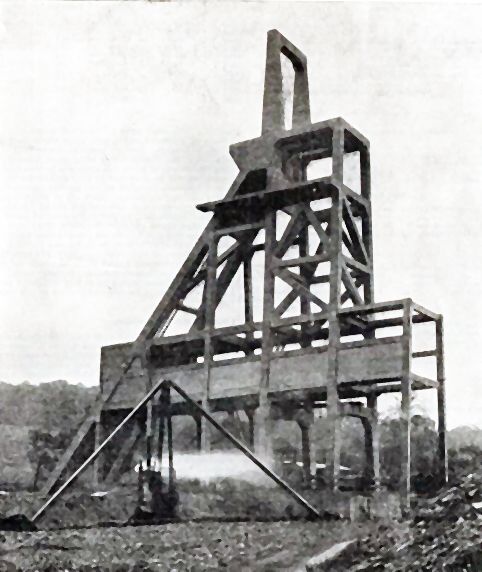 |
The accompanying particulars and illustration refer to a reinforced concrete pit headgear which has recently been constructed at the Mary Pit of the Fife Coal Company at Lochore, near Lochgelly, Fifeshire. It is the first reinforced concrete headframe to be erected in Scotland. The whole structure was specially designed to give great stability. The foundations, which were carried down to a depth of 11 ft. below ground level, are 109 ft. long and 41 ft. wide, and consist of a series of massive longitudinal and cross beams supporting the various vertical and inclined members.
The shaft tower foundation consists of a raft 41 ft. square and 4 ft. thick, which in turn supports a smaller raft 30 ft. square and 7 ft. 6 in. thick. This form of foundation was adopted in order to distribute the load on the shaft tower evenly over the ground, at as great a distance away from the shaft as possible, and so to minimise the tendency for the earth below to squeeze out when the shaft was sunk.
The four main columns round the pit shaft spring from this raft, and rise 89 ft. to the level of the pulley platform, from which there is a further vertical extension of 25 ft. This latter construction is arranged to enable the rope pulleys to be erected or lifted from their bearings for repairs, &c.
At a height of 26 ft. above ground level is a platform and decking to carry the lines of rails for receiving and discharging the coal hutches as they are taken off or put on to the cages. It was found necessary to arrange the tie beams between the columns to the shaft tower 5 ft. below the decking level in order to accommodate the kep gear, the mechanism required to assure that the rails in the main cages are in line with those in the drop cages on either side.
Hardwood blocks were bolted down on the top of the tie beams at each end, and on them rolled steel joists carrying the kep gear were supported. This arrangement was adopted as being considered the most effective method of absorbing the shock caused by the cages being lowered on to the keps. Holes 14 ft. 8 in. by 11 ft. 6 in. were left in the floor and roof at each side of the shaft tower to allow movement up and down of the drop cages.
14 ft. above, this decking is roofed over, and the whole of the space between is closed in with windows and walls, so that that portion of the structure is totally enclosed and weatherproof. The shaft being a downcast one, it was not required to enclose the space between the decking and the ground.
The detaching platform, 73 ft. above the ground, consists of 6 ft. lengths of 18 in. by 7 in. rolled steel joists supported on reinforced concrete beams. The guide ropes, ten in number, of a total weight of 110 tons, are suspended from these joists. During the operation of sinking the shaft the detaching platform is to be utilised for carrying the sinking gear.
At the level of the pulley shaft is a platform 30 ft. by 16 ft., designed to give accommodation for carrying out any repairs to the gear, and also to carry the pulley wheel, which weighs 10 tons. Holes 20 ft. by 2 ft. wide have been left in the pulley platform to allow free rotation of the 18 ft. diameter pulley wheels.
The whole of the construction shown is of reinforced concrete on the Kahn system, and was designed by the Trussed Concrete Steel Company on the following basis:- Breaking stress on one winding rope, 195 tons; deadweight of other winding rope, 20 tons; two cages each weighing 20 tons, 40 tons; two pulley wheels, &c., each weighing 12 tons, 24 tons; roof, live load, 56 lb. per square foot.
First-floor load: Two tracks considered simultaneously packed with loaded coal hutches, remainder of floor 1½ cwt. per square foot. Loaded hutches, 1 ton each.
Allowance has been made for a future second floor, loaded similarly to first floor. The contractors were Messrs. Clark and Chapman, of Aberdeen.
-------------------------------------------------
"Cowdenbeath & Lochgelly Times & Advertiser"
14 January, 1920
COLLIERY ACCIDENT
While following his employment in the Mary Pit last Wednesday, Jack Gray, Waverley Street, received grievous facial injuries. It appears that while Gray was drawing a hutch of rails up an incline with a motor the rails capsized, and coming in contact with the motor belt, caused it to strike Gray a severe blow in the face.
His son, Thomas, received slight injuries to his shoulder two days later as the result of a fall of coal.
-------------------------------------------------
"Cowdenbeath & Lochgelly Times & Advertiser"
7 April, 1920
COLLIERY ACCIDENT
James Dempster, roadsman, residing at Waverley Street, has been admitted to Dunfermline Hospital suffering from serious head injuries received in the Mary Pit last Wednesday afternoon. He was temporarily engaged breaking in a young horse which, becoming restless, curvetted, causing Dempster to come into violent contact with a girder overhead. He now lies in a critical condition.
-------------------------------------------------
"Dunfermline Press"
1 May, 1920
On the occasion of his leaving the Mary Colliery to become manager of the Flower Pit, Kelty, Mr John Fleming, oversman, was presented with a handsome solid oak roll-top desk by a number of friends in the Gothenburg Hall on Saturday evening. ..
-------------------------------------------------
"Dunfermline Press"
15 May, 1920
Under the Fatal Accidents Inquiry Act, an inquiry was held in the Sheriff Court, Dunfermline, on Thursday - before Sheriff Umpherston and a Jury - into the circumstances attending the death of miner Robert Thornton, lately residing at Capledrae Row, Auchterderran, who died on 27th March in consequence of an injury to his right leg on 9th March in the Mary Pit, Lochore. Those giving evidence included:- Dr Sinclair, Crosshill; William Docherty (16); John Bell; and John Thomson. The jury returned a formal verdict.
-------------------------------------------------
"Dunfermline Press"
16 October, 1920
While employed as a drawer in the Mary Colliery on Friday afternoon last week, John Geddes, residing in Glencraig, received serious injuries to one of his legs. He was pushing a hutch, when his foot was caught in the roadway, and the sudden jerk injured and dislocated his leg.
-------------------------------------------------
"Dunfermline Press"
20 November, 1920
Under the Fatal Accidents Inquiry Act, an inquiry was held in the Sheriff Court, Dunfermline, on Thursday - before Sheriff Umpherston and a Jury - into the circumstances attending the death of Michael Lynch, labourer, lately residing at Rose Lane, Lochgelly, who died in the Dunfermline and West Fife Hospital, on 31st October, in consequence of injuries received on 28th September, by falling from a scaffold at a pit being sunk near the Mary Pit, Lochore. A formal verdict was returned.
-------------------------------------------------
"Dunfermline Press"
18 December, 1920
In the Mary Pit on Saturday morning, Clark Reid, a brusher, residing in Crosshill,
was caught by a heavy fall of stone from the roof. His injuries were so severe that
he was removed to Dunfermline and West Fife Hospital. At the time of the mishap,
Reid was engaged erecting a bar to support the roof, when a stone came away,
pinning him partially beneath it. About a score of men quickly set about removing the
stone, and when extricated Reid was found to be suffering from serious injuries to the
face and legs. Two men working in the vicinity had a narrow escape, their retreat
from the falling debris being timely.
A somewhat similar accident occurred in Glencraig Colliery last week, when a man
named Allan had his legs crushed by a large piece of redd which fell from the roof.
He was removed to hospital, where it was found necessary to amputate the right foot.
-------------------------------------------------
1921 STRIKE
The effects of the 1921 strike were felt at the Mary Pit which had experienced some difficulties in returning to normal production due to the flood damage coupled with the need to repair many pit roadways. Only the upper workings of the Mynheer seam had been re-opened there. In addition, the deeper workings of the No. 1 shaft at the colliery had long had a reputation for being uncomfortably warm - the men there working the coal seams wearing only shorts!
---------------------------------------------
"Dunfermline Press"
2 April, 1921
Under the Fatal Accidents Inquiry Act, an inquiry was held in the
Sheriff Court, Dunfermline, on Thursday - before Sheriff Umpherston and
a Jury - into the circumstances attending the death of William Kilgallon, pit
sinker, lately residing at New Huts, Lochore, who died in the West Fife
Infectious Diseases Hospital on 5th February in consequence of having
been immersed on 23rd January in water in the sump of No. 2 Pit, Lochore,
in course of being sunk.
Those giving evidence included:- Dr A. J. Macgregor, Dunfermline;
William Milner Peat, manager; Andrew Leitch, winding engineman; and
James Forkin, pit sinker. The jury returned a formal verdict.
---------------------------------------------
"Dunfermline Press"
21 May, 1921
Under the Fatal Accidents Inquiry Act, an inquiry was held in the Sheriff Court, Dunfermline, on Thursday - before Sheriff Umpherston and a Jury - into the circumstances attending the death of Charles O'Donnell, pumping engineman, Erin Cottage, Crosshill, who died on 8th April, at his residence, in consequence of injuries received on 24th March at the Mary Pit, Lochore, by falling to the ground from a stair leading to the pumping engine-house. Those giving evidence at the inquiry included:- Police Constable John Hugh Campbell, Glencraig; and James Chalmers McEwan, electric engineman. The Jury returned a formal verdict in which they found that the cause of the accident was the decayed condition of the woodwork of the stair.
---------------------------------------------
"Dunfermline Press"
18 June, 1921
The condition of the Fife Coal Company's Mary Pit, Lochore - one of the largest in Scotland - is giving cause for anxiety owing to flooding caused by the temporary stoppage of the pumps. It is thought that it may be necessary to sink another pit shaft, which, if proceeded with, will entail an expenditure of many thousands of pounds.
---------------------------------------------
"Dunfermline Press"
2 July, 1921
... There is no blinking the fact, however, that serious flooding has taken place,
at least in the dip or dook workings at the majority of the collieries. At those collieries
at which pumping apparatus is installed to drain an area where a number of pits are
sunk, it will doubtless be found that damage of so serious a nature has resulted that
the reinstatement of the coal getters and drawers will be a gradual process.
Sunk to a depth of 335 fathoms, the Fife Coal Company's Mary Pit at Lochore
drains the whole of the pits in the Kelty area, including No. 11 Pit, Lumphinnans Colliery.
While work at most of the pits in the Kelty area will be resumed on Monday, it will not
be possible to reach the coal in the Mary Pit until special apparatus has been installed
to cope with the water accumulation which has flooded the whole of the lower seams.
Moreover, the roof and side falls in the roadways which have taken place since the
pit was closed in the early days of April is a factor which will retard the resumption of
operations.
---------------------------------------------
"Dunfermline Press"
9 July, 1921
THE MARY PIT
The Mary Pit, Lochore, is reported to be in a very bad condition, especially the
lower workings which are inundated with water. This pit, which is one of the deepest
in Scotland, received a heavy inflow of water from the collieries in the Kelty area,
and special pumping plant will probably be required to cope with the extensive
flooding. Possibly, six or eight months will elapse before work is resumed in the low
bottom, but a number of the men previously engaged there will be given employment
at a seam mid-way down the shaft, after the regular workers in that section have
been reinstated in their former jobs.
Some of the men employed in the low workings left their tools and graith in the pit
at the beginning of the dispute, and, as a result of the flooding, the tools have been
lost. The colliery management, who disclaim all responsibility in the matter, have
agreed to provide new tools, the price of which is to be deducted from the men's
wages by weekly instalments. The necessity of shortening the winding rope has delayed
an early resumption of work at the colliery, but quite a large number of the men,
mostly repairers, were able to make a start on Wednesday and Thursday. Previous
to the stoppage, about 1000 men were employed at the Mary Pit.
THE NEW PIT.
At the sinking shaft, Lochore, there is also a heavy accumulation of water, which is being brought to the surface in large bucketfuls. This process will take about a fortnight, after which work will be resumed on a more extensive scale.
---------------------------------------------
"Dunfermline Press"
23 July, 1921
THE MINERS. - Close upon 200 men have been reinstated at the Mary Colliery, Lochore, and this number is likely to be appreciably increased during next week. At Glencraig, nearly 500 men have resumed work, mostly in the "Wee" Pit. With a view to relieving distress among those who are still unemployed, the miners of Glencraig and Lochore have agreed to the imposition of a levy of six pence per shift upon all full Union members and threepence on half members who have restarted work.
---------------------------------------------
"Dunfermline Press"
13 August, 1921
MINERS AND UNEMPLOYMENT DOLE - The appeal of the Mary Pit miners for unemployment benefit was dismissed by a court of referees sitting at Kirkcaldy on Tuesday. This decision affects over six hundred men, who, it will be remembered were thrown idle two or three days previous to the recent stoppage by a breakdown of the pumping machinery at the Mary Colliery.
---------------------------------------------
"Dunfermline Press"
27 August, 1921
Due to the lack of orders, the Mary Pit, Lochore, was idle three days last week,
and also on Tuesday and Wednesday this week. The colliery sidings are stocked
with coal, with little prospect of an early clearance. Short time is also being experienced
at the Glencraig collieries.
The local unemployment problem has been rendered slightly less acute by the
restarting of work at Benarty Pit, where a few of the Lochore and Crosshill men are engaged.
---------------------------------------------
"Dunfermline Press"
24 September, 1921
Out of work benefit is to be paid to the unemployed men in this district who, previous to the recent coal stoppage, were employed in the low workings of the Mary Colliery, Lochore. Payment will be retrospective as from 4th July, and will affect over 500 persons. It is computed that the maximum amount payable to date will be over £7 per adult worker.
---------------------------------------------
"Dunfermline Press"
8 October, 1921
Idle time is proving the rule rather than the exception at the Mary Pit, Lochore, where an average of three days per week is being worked. Conditions are slightly improved at the Glencraig collieries.
---------------------------------------------
"Dunfermline Press"
8 October, 1921
... Mr Clarke, section oversman at the Mary Pit, Lochore, has been appointed under-manager at the Fife Coal Company's No. 9 Pit, in succession to Mr David Scott.
---------------------------------------------
"Dunfermline Press"
29 October, 1921
Mr John Brown, oversman at the Mary Colliery, Lochore, has been appointed to a similar position at the sinking pit, Lochore, under Mr Robert Stewart, who is now in charge of both these pits. Mr Brown's place at the Mary Pit will be filled by Mr Alex. Davidson, Lochore.
---------------------------------------------
"Dunfermline Press"
24 December, 1921
A Cowdenbeath miner named Robert Fyfe, was seriously injured in the Mary Pit, Lochore, on Monday forenoon, as the result of his being pinned under a heavy fall of coal. The unfortunate man had his collar bone injured, and two of his ribs were broken. He was removed to Dunfermline and West Fife Hospital.
---------------------------------------------
"Cowdenbeath & Lochgelly Times"
18 January, 1922
Mr George Adams, for many years foreman electrician at the Mary Colliery, Lochore, left the district to take up a new appointment under the Cowdenbeath Picture Company.
---------------------------------------------
"Cowdenbeath & Lochgelly Times"
18 January, 1922
While a man named John Ryan, residing at Lumphinnans, was at work in the Mary Pit, Lochore, on Thursday last, he was taken ill in his working place. The lad who usually worked with him not being out, he was drawing his own hutches, but not coming out for his turn, he was missed by the others at the lie, and on some of the men going to his place to ascertain the cause, found him sitting unable to move. He was conveyed to the pit head with all haste, where the doctor ordered his removal to Dunfermline Hospital suffering from pneumonia.
---------------------------------------------
"Cowdenbeath & Lochgelly Times"
25 January, 1922
At the Mary Colliery on Friday afternoon a surface worker named Isa Doulan was badly hurt by the revolving doors at the pit head, which are part of the pit's ventilation system. The girl was passing out through the doors when her foot slipped, and before she could recover her balance she was caught by the moving doors. Her right side and arm were hurt, and she also received some facial injuries.
----------------------------------------------
"Cowdenbeath & Lochgelly Times"
1 March, 1922
Yesterday forenoon a miner named Archibald Kirkland, residing at Ballingry Road, Lochore, was badly injured in the main coal section of the Mary Pit. Kirkland was working at the coal face when a fall of coal occurred, seriously injuring his back and head.
------------------------------------

"Cowdenbeath &
Lochgelly Times"
12 July, 1922
A local miner named Patrick Murphy, 35 years of age, was killed in the main coal section of the Mary Pit on Thursday evening by a fall of coal from the roof. Murphy was working at the coal face when the roof unexpectedly gave way, burying him beneath the debris. His drawer, a lad named Robert Young, who had himself narrowly escaped injury, endeavoured to extricate Murphy, but his efforts proving of no avail, he ran for assistance, and a number of workmen were soon engaged in removing the fallen material. The dangerous condition of the roof greatly obstructed the work of rescue, and fully two hours elapsed before the unfortunate man was released. When extricated Murphy was found to be dead, his skull being fractured, in addition to injuries to his body. The remains were interred in Ballingry Cemetery on Sunday afternoon, when a large and representative gathering of the general public paid their last respects to the dead. Deceased leaves a widow and two of a family. Mrs Murphy is at present in ill health, and was recuperating at Dalkeith when she was acquainted of her husband's sad end.
------------------------------------
"Cowdenbeath & Lochgelly Times"
23 August, 1922
A local lad, named William Gray, son of Jack Gray, Cumnor Place, Lochore, was badly injured in the east mine section of the Mary Pit last Thursday morning, by a fall of stone from the roof. Fortunately Gray did not receive the full impact of the stone, but as it was, his chest and back were badly bruised, while the thumb and forefinger of the left hand were also injured.
------------------------------------
"Cowdenbeath & Lochgelly Times"
30 August, 1922
A start has now been made to unwater the low
workings of the Mary Colliery, Lochore. A special pumping apparatus
was installed some time ago, and although the accumulation of water
is very heavy, the management hope to have the workings entirely
clear within the next few months, probably in February or March. It
is the intention of the colliery management to utilise the low
workings of the Mary Pit for development and ventilation purposes
in connection with the new pit which is being sunk
nearby.
The sinking shaft has reached a depth of 220
fathoms, leaving only about seventy fathoms still to be pierced, so
that in the very near future a large number of men will find
employment here in opening out new roadways, and in the work of
general development. Prior to the mining dispute nearly 700 men
were employed in the low working of the Mary Colliery. The majority
of these men are now engaged in the upper seams of the pit, or have
found work elsewhere.
------------------------------------
"Cowdenbeath & Lochgelly Times"
6 September, 1922
James Cassidy, pit roadsman, lies seriously ill at his home in Montrose Street, Lochore, as the result of injuries sustained in the Mary Colliery on Friday morning last. As to how the accident actually happened is a matter of conjecture. Cassidy, along with others, was working on a wheel brae in the Splint section of the pit. He went up the incline alone to the brake wheel to set the hutches on the brae in motion. Unfortunately one of the hutches went off the rails and became jammed into the building at the side. A workman going up the brae a few minutes later found Cassidy lying unconscious beside the brake wheel, and it is assumed that the sudden strain on the haulage rope, consequent upon the hutch becoming jammed into the building had caused one of the beams which support the brake wheel to give way, striking Cassidy heavily on the head as it fell. He was conveyed home suffering from a fractured skull. Several hours elapsed before he regained consciousness.
----------------------------------------------
"Cowdenbeath & Lochgelly Times"
18 October, 1922
In the Mary Pit on Friday evening a rather unusual accident befell Peter Dunn, an eighteen years old youth, employed as underground pony driver. Dunn was jumping off a hutch when his left foot descended upon an upturned nail, some six inches long. The nail entered his boot, and penetrated his big toe.
----------------------------------------------
"Cowdenbeath & Lochgelly Times"
29 November, 1922
On Tuesday afternoon of last week a Lochore girl named Nan Robertson was severely injured by the revolving doors at the Mary pithead. One of her legs was crushed, while the other was badly bruised.
----------------------------------------------
"The Scotsman"
29 January, 1923
ELECTRICAL ENGINEERS' VISIT OF INSPECTION TO FIFE PITS. - Members
of the Association of Mining Electrical Engineers to the number of 80 paid a visit on Saturday
to collieries belonging to the Fife Coal Company (Ltd.) in the Kelty and Lochore districts. They
examined the electrically-driven plant at the Lindsay Pit, Kelty, and the large electric generating
station at the Aitken Pit, Kelty, which includes two 3000 K.W. turbines and one 1500 K.W. turbine.
The present load is 4800 K.W.
The company then proceeded to the Mary Pit, Lochore, which has now reached its full depth of
290 fathoms. Here the electric winding machinery was examined as well as the re-inforced concrete
pulley frame. The company were afterwards entertained to tea. Mr J. R. Copping, chief electrical
engineer, Fife Coal Co., welcomed the visitors, and Mr Muirhead, president of the Association,
replied.
----------------------------------------------
"Dunfermline Press"
17 March, 1923
Under the Fatal Accidents Inquiry Act, an inquiry was held in the Sheriff Court, Dunfermline, on Thursday - before Sheriff Umpherston and a Jury - into the circumstances attending the death of brushing contractor John Johnstone, lately residing at Craigie Malcolm, Lochore, who died on 9th February in the Infectious Diseases Hospital at Colinton, Midlothian, from erysipelas resulting from injuries to his left ear received on 21st September 1922 in No. 1 Mary Pit, Lochore, by a stone falling on him from the roof. Those giving evidence included Dr Frank Duncan Beaton, Colinton Infectious Diseases Hospital. The jury returned a formal verdict.
----------------------------------------------
"Dunfermline Press"
14 April, 1923
THE MINERS. - The erection of baths at the Mary Colliery is at present being considered by the Lochore miners, and the local officials of the Reform Union have been instructed to interview the colliery management in regard to the matter. ...
----------------------------------------------
"Dunfermline Press"
16 June, 1923
A miner named Andrew Duncan, residing in Montrose Street, Lochore, received slight injuries to his back and one of his legs on Monday afternoon, as a result of being struck by a falling stone in the east splint section of the Mary Colliery. Duncan was working at the coal face when the accident occurred. He had resumed work only a few weeks ago, after having been idle for a considerable time owing to injuries received in an accident in the same pit.
----------------------------------------------
"Dunfermline Press"
18 August, 1923
... Idle time is again being experienced at the Mary Colliery, Lochore. The pit was idle two days last week, and also Tuesday and Thursday of this week. Glencraig collieries are going steady.
----------------------------------------------
"Dunfermline Press"
1 September, 1923
The second accident in the district within a fortnight occurred on
Monday at the Mary Colliery, Lochore, and resulted in the death of a
local lad named John Traynor, the sixteen-year-old son of Mr James
Traynor, 142 Waverley Cottages, Lochore.
Traynor was employed as a coal-filler in the splint section of the pit,
and at the time of the accident he was engaged in filling a hutch with
coal, when a large stone fell from the roof, jamming him against the
partly-filled hutch. He was conveyed home, but the gravity of his injuries,
which were of an internal character, necessitated his removal to the
Dunfermline and West Fife Hospital. He died several hours after
being admitted.
----------------------------------------------
"Dunfermline Press"
15 September, 1923
In the Mary Pit, Lochore, on Tuesday, a worker named Robert
Robertson had one of his legs injured as a result of being jammed
by a hutch. Robertson was lifting a hutch on to the rails, when the
pony, which was harnessed to a race of hutches, unexpectedly
moved off, pinning Robertson's leg between the buffer end
of a hutch and a large batten, which was nailed to the roadway.
On the previous day, a Crosshill miner, Charles Schoolbread, had
one of his legs broken as a result of an accident in Glencraig Colliery.
----------------------------------------------
"Dunfermline Press"
29 September, 1923
Under the Fatal Accidents Inquiry Act, an inquiry was held in the Sheriff Court, Dunfermline, on Thursday - before Sheriff Umpherston and a Jury - into the circumstances attending the death of John Traynor, filler, lately residing at 142 Waverley Street, Lochore, who died in hospital on 27th August from injuries received on the same day in No. 1 Mary Pit, Lochore, by a stone falling on him from the roof. The jury adopted the Sheriff's suggestion in the formation of their verdict.
----------------------------------------------
"Dunfermline Press"
6 October, 1923
Mr Kirkwood McNeill, who has been manager of the Fife Coal Company's Aitken Colliery, Kelty, for some time, has been appointed agent of that colliery and of the Mary Colliery, Lochore.
----------------------------------------------
"Dunfermline Press"
20 October, 1923
THE MINERS. - The Mary Pit workers, Lochore, at a meeting on Sunday, appointed Mr Philip Hodge, general secretary of the Fife Miners' Reform Union, and Mr John Mellon, Crosshill, as accident inspectors for the colliery.
----------------------------------------------
"Dunfermline Press"
1 December, 1923
Under the Fatal Accidents Inquiry Act, an inquiry was held in the Sheriff Court, Dunfermline, on Thursday - before Sheriff Umpherston and a Jury - into the circumstances attending the death of Hugh Whellan Turner, miner, lately residing at 5 Glenallan Street, Lochore, who died on 3 October, having on 15th March in No. 1 Mary Pit, Lochore, strained himself while replacing a derailed loaded hutch. Dr Sinclair, Glencraig, gave evidence at the inquiry.
----------------------------------------------
"Cowdenbeath & Lochgelly Times"
16 January, 1924
Mr John Brown, who acted as undermanager at the New Pit, Lochore, for upwards of two years, has been appointed manager of the Seafield Mines, Kirkcaldy.
----------------------------------------------
"Cowdenbeath & Lochgelly Times"
12 March, 1924
PITHEAD GIRL SERIOUSLY
INJURED
A pithead girl, named Mary Cook, residing with
Mrs Dickson, 18 Park Street, Crosshill, was seriously injured
yesterday while working at the Mary Colliery, Lochore. The girl,
who is 19 years of age, was working at the tables which convey the
coal from the pithead to the waggons when her dress was caught in
the machinery which drives the tables. The pithead gear was
instantly stopped, and when extricated, one of the girl's legs
was found to be terribly lacerated above the knee.
After receiving attention from Dr Todd, she was
removed to Dunfermline Hospital. The accident occurred during the
morning shift, shortly before dinner time.
It is stated that Mary Cook was acting as deputy
for another girl who was off work through illness.
----------------------------------------------
"Cowdenbeath & Lochgelly Times"
26 March, 1924
Great interest was taken in the unveiling of a War Memorial at Lochore on Saturday, in memory of seventy-six Mary Pit workers who sacrificed their lives in defence of their country's honour. The memorial is in the form of a huge white marble tablet in Lochore Workmen's Institute, placed on the interior east wall of the reading room. ...
----------------------------------------------
"Cowdenbeath & Lochgelly Times"
9 April, 1924
HOUSES FOR COLLIERY WORKERS
The houses built at the south end of Waverley Street, Lochore, to the order of the Fife Coal Company for the Mary Colliery workers are now nearing completion, and last week a start was made with a second batch of dwellings a few hundred yards to the north west. The houses are mostly of the three apartment type, with bathroom, a convenience which will be generally approved of by the miners.
----------------------------------------------
"Cowdenbeath & Lochgelly Times"
7 May, 1924
NEW DRESS FOR PITHEAD GIRLS
The girls employed at the Mary Colliery pithead have been provided with brown overalls, consisting of trousers and jacket, with a tight fitting belt.
----------------------------------------------
"Cowdenbeath & Lochgelly Times"
7 May, 1924
On Tuesday evening of last week a Crosshill miner, named Arthur McInally, was seriously injured while at work in the main coal section of the Mary Pit. McInally was engaged at the coal-face, when he was struck by a piece of redd falling from the roof of his working place. His injuries were of such a character that he was conveyed to Dunfermline and West Fife Hospital the following day.
----------------------------------------------
"Cowdenbeath & Lochgelly Times"
21 May, 1924
On Thursday of last week a mineworker named John Walls, Waverley Street, Lochore, was admitted to the Dunfermline and West Fife Hospital suffering from injuries sustained that day in the east splint section of the Mary Colliery, Lochore. Walls was employed at the foot of a wheel brae running one full hutch at a time. The weight of the down-coming hutch takes the empty hutch up the brae, and it is stated that at the time of the accident the full hutch broke away from the controlling rope and crashed against the empty hutch, which ran back down the brae and pinned Walls against an adjoining building. His right leg was broken, and after receiving attention from Dr Sinclair, Crosshill, he was conveyed to hospital.
----------------------------------------------
"Cowdenbeath & Lochgelly Times"
2 July, 1924
In the east side section of the Mary Pit, on Friday afternoon, a local mineworker named Alexander Pryde, was preparing to fire a shot when one of the gelatine cartridges in the drilled hole partially exploded. Pryde, who was sitting in a stooping position near the hole, received some of the flying debris full in the face, completely blinding him, while a workmate named George Reid was partially buried. Happily Reid escaped with some slight bruises, but it was found necessary to remove Pryde to Edinburgh Royal Infirmary. On Monday it was learned he had regained the sight of one of his eyes.
----------------------------------------------
"Cowdenbeath & Lochgelly Times"
23 July, 1924
Mr Robt. Stewart, manager of Lochore Colliery, has been promoted to be agent of the Leven Colliery of the Fife Coal Company, Ltd. He takes up duty there early in August. Considerable developments have taken place at Mary Pit during his managership, which has extended over six years. ...
----------------------------------------------
"Cowdenbeath & Lochgelly Times"
13 August, 1924
In the east side section of the Mary Colliery on Monday morning, a local miner named James Harrower sustained serious injury to his right leg while engaged in clearing away a fall of debris. He was caught under some redd which fell from the roof, and on examination by Dr Sinclair showed that his leg was badly bruised above the knee, while his ankle was broken. Harrower was conveyed home, but was subsequently removed to Dunfermline and West Fife Hospital.
----------------------------------------------
"Cowdenbeath & Lochgelly Times"
10 September, 1924
Mr Robert Stewart, who was recently promoted from the management of the Mary Colliery, Lochore, to take charge of the Fife Coal Companies collieries in the Leven district, was, on Friday evening, entertained in the Lochore Gothenburg Hall by the officials and workmen of the Mary Pit. ...
----------------------------------------------
"Cowdenbeath & Lochgelly Times"
Wednesday, 15 October, 1924
As the result of an accident in the Mary Colliery on Monday evening, a mine-worker named John Nicoll, residing at Waverley Street, Lochore, had one of his legs broken in two places, in addition to other injuries. He has been admitted to Dunfermline and West Fife Hospital.
----------------------------------------------
"Cowdenbeath & Lochgelly Times"
12 November, 1924
MARY COLLIERY CLERICAL STAFF DANCE
The clerical staff of the Mary Colliery and several friends held a most enjoyable dance in the Institute on Friday evening.
----------------------------------------------
"Cowdenbeath & Lochgelly Times"
28 January, 1925
FATAL RESULT OF AN ACCIDENT
An accident occurred in the Mary Pit, Lochore, two weeks ago, which was looked on as of a slight nature. Robert Reid, son of David Reid, Park Street, Crosshill, had his leg pricked by a broken wire from a haulage rope. It was attended at the time, but poison had got there. He was removed to the Royal Infirmary, Edinburgh, where he was operated on, but no hope was entertained, and he passed away on Sabbath afternoon. He was 22 years of age, and leaves a widow and one child, for whom much sympathy is felt.
--------------------------------------------
"Cowdenbeath & Lochgelly Times"
4 February, 1925
LOCHORE - WHAT CAUSED DEATH?
The death of James Chisholm McGalloway, miner, lately residing at Ballingry, was enquired into at Dunfermline on Thursday. It was stated in the petition that he died on 8th December, 1924, in the Royal Infirmary, Edinburgh, from hyperthyroidism and heart failure, following upon an injury on 4th January, 1924, in No. 1 Mary Pit, Lochore, by a stone falling on him from the roof, and knocking his head against another stone. ... His Lordship suggested that the jury should find that the man died in the Royal Infirmary, and that the cause of death was hypothyroidism, following an operation for goitre, which might have been connected with a injury recorded on 4th January, 1924. The jury accepted the suggestion of his Lordship.
----------------------------------------------
"Cowdenbeath & Lochgelly Times"
18 February, 1925
This issue contains a report of statements made, and action raised, under the Workmen's Compensation Act, in the Dunfermline Sheriff Court on Thursday. It was an action in which Mrs Annie Henderson or Whyte, Ballingry Place, Lochore, sued the Fife Coal Company, Ltd., for payment of £292 14s 4d of compensation, for herself and children, in respect of her late husband, John Whyte, brusher, who died from the effects of an accident which he sustained through a roof fall in the Mary Pit, Lochore, on 30th October, 1923.
----------------------------------------------
"Cowdenbeath & Lochgelly Times"
18 March, 1925
An enquiry was held before the Sheriff at Dunfermline on Thursday into the death of Robert Wood Reid, drawer, lately residing at 5 Park Street, Crosshill, who died 25 January in the Edinburgh Royal Infirmary, as a result of injuries received in the accident on 12 January, in No. 1 Mary Pit, Lochore. Among those giving evidence were:- Dr Thomas Bonar, Edinburgh; Alfred Bell (16), tail runner, 3 Montrose Crescent, Lochore; and Janet Whyte or Reid, Park Street, Crosshill (mother of deceased). A formal verdict was returned.
--------------------------------------------------
"Cowdenbeath & Lochgelly Times"
30 September, 1925
While engaged at hosing a new winding rope to the cage at the Mary Pit on Sunday afternoon, James Wood and Thos. Young, both residing at Montrose Street, Lochore, met with rather severe injuries. Both men were crushed about the body.
--------------------------------------------------
"Dunfermline Press"
2 January, 1926
Christopher Bell (33), a miner, who resided at Waverley Street, Lochore, died in Dunfermline and West Fife Hospital on Wednesday. Bell, who was married, met with an accident in the Mary Pit, Lochore, about three months ago, when his spine was fractured.
----------------------------
"Dunfermline Press"
16 January, 1926
Under the Fatal Accidents Inquiry Act, an inquiry was held in the Sheriff Court, Dunfermline, on Thursday - before Sheriff Umpherston and a Jury - into the circumstances attending the death of a miner named Christopher Bell, lately residing at 22 Waverley Street, Lochore, who died on 30 December, in the Dunfermline and West Fife Hospital, from injuries received on 16 March 1925, in No. 1 Mary Pit, Lochore, Fife Coal Company, Ltd., by a fall of material upon him from the roof. Those giving evidence included:- George Drummond, constable, Dunfermline; and William Armstrong, Lochore House, colliery manager. A formal verdict was returned by the jury.
--------------------------------------------------
"The Scotsman"
3 February, 1926
FIFE PIT EXPLOSION.
ONE MAN KILLED ; TWO INJURED.
One man was killed and two injured (one severely) by an explosion on the
surface at the Mary Pit, Lochore, belonging to the Fife Coal Company (Ltd).
The journal boxes and main engine shaft in the engine-house were being cleaned and
examined. The workmen were using naphtha for cleaning purposes, and it is thought
that the naphtha gases had accumulated in the wheel-guard recess.
The men were using a light for examination, when a loud explosion took place. The roof
of the engine-house was blown off.
Peter King, residing at Lochgelly, was killed. His body was discovered between the
drums of the winding engine and the floor.
James Miller, engineer, Crosshill, Glencraig, was removed to his home in the ambulance
waggon, while the third man, Leitch, although suffering severely, was able to walk to his
home at Lochore.
------------------------------
"The Scotsman"
6 February, 1926
PITHEAD EXPLOSION AT LOCHORE.
ONE MAN KILLED : TWO INJURED.
An alarming accident, involving the death of one man and injuries to two others,
occurred at the pithead of the Fife Coal Company's Mary Pit, Lochore, early
on Tuesday morning. Several of the Company's employees were engaged
in overhauling the winding engine at No. 2 Pit. Naphtha was used in connection
with the operations. Without warning, there was a terrific explosion, shattering
the engine house roof, and causing damage to machinery and other parts of the
building. Peter King (33), engineman, residing at Mid Row, Lochgelly, received
the full force of the explosion. He was driven under the winding drum with such
violence that death must have been instantaneous.
James Miller (22), engineer, Crosshill, and Andrew Leitch, the winding engineman,
residing at 72 Montrose Street, were seriously injured. Miller was conveyed to the
Dunfermline and West Fife Hospital. Leitch was taken to his home. Officials
of the Fife Coal Company, Ltd., were early on the scene and rendered the
necessary aid.
The explosion, which was heard over a distance of about two miles, is
supposed to have been caused by the ignition of an accumulation of naphtha
fumes. The men in the engine house had been engaged all night cleaning
the winding machinery. In preparation for the day shift starting at five o'clock,
Leitch, the winding engineman, entered the lever-room of the engine-room
for the purpose of testing the winding apparatus. Immediately he put the
engine into operation, the whole room burst into flames, accompanied by a
loud report.
That Miller and a fourth man, Hugh Smith, labourer, who escaped almost
without injury, did not share the fate of King is due to the fact that at the
time of the explosion they were behind the engine.
------------------------------
"Dunfermline Press"
13 February, 1926
Wm. McCormack, junr., residing at Mowbray Place, Lochore, had one of his legs broken while he was at work in the east side section, No. 1 Mary Colliery, on Monday morning. He was removed by ambulance to Dunfermline and West Fife Hospital.
------------------------------
"Dunfermline Press"
27 February, 1926
FORMER COLLIERY OFFICIAL'S DEATH.
THE LATE MR WILLIAM LANG.
The death took place, suddenly, at Gullane, on Sunday morning, of Mr
William Lang, who had for many years been a prominent official of the Fife
Coal Company, Ltd. Receiving his early training in the Lanarkshire
coalfield, Mr Lang came to Fife as manager of the Wellsgreen Colliery.
From there he was transferred to the Company's Mary Pit at Lochore.
From 1912 to 1921, he was manager of the Valleyfield Colliery which he
left to become agent of a group of the Company's pits in the Kelty district.
In Lanarkshire, and to a lesser extent in the East of Fife, he had a long
experience of gas conditions underground; and it was because of the
knowledge he possessed of these conditions that he was called as
manager to Valleyfield Colliery. ...
------------------------------
"The Scotsman"
12 March, 1926
FIFE PITHEAD EXPLOSION.
DANGERS OF NAPHTHA.
A public inquiry was held in Dunfermline Sheriff Court yesterday in regard to the death
of Peter King, lately residing at 29 Mid Street, Lochgelly, who was accidentally killed on 2nd
February in the winding engine-house of No. 2 Mary pit, Lochore, belonging to the Fife Coal
Company (Ltd.), as a result of an explosion of shale naphtha spirit. It appeared that the
deceased and other engineers had been using naphtha to clean out an oil well in the gear-case
of the engine prior to refilling it with fresh lubricating oil. As about a gallon and a half of naphtha
was used, there must, according to one of the witnesses, have been a considerable quantity of
naphtha vapour confined in the gear casing. One of the men, it is stated, had lit a match, which
caused the explosion, the effect of which was to kill King, seriously injure two other men, and
blow off the roof and break the whole of the window glass of the engine-house.
During the hearing of the evidence, Mr E. H. Frazer, H. M. Inspector of Mines, demonstrated in
Court the explosive properties of naphtha and paraffin oil.
To a formal verdict, the jury added a rider to the effect that they were of opinion that naphtha
ought not to be used for cleaning purposes unless in the hands of a person who was conversant
with its properties and the dangerous character of naphtha spirit.
------------------
"Dunfermline Press"
13 March, 1926
Under the Fatal Accidents Inquiry Act, an inquiry was held in the Sheriff Court,
Dunfermline, on Thursday - before Sheriff Umpherston and a Jury - into the circumstances
attending the death of Peter King, engineer, lately residing at 29 Mid Street, Lochgelly,
who died on 2 February in the winding engine-house, No. 2 Mary Pit, Lochore, Fife
Coal Company Ltd., from injuries received by an explosion of shale naphtha spirit.
Those giving evidence included:- William Armstrong, electrical engineer;
Robert Penman, undermanager; Andrew Leitch, Montrose Cottages, Lochore;
and James Miller, engineer.
To a formal verdict, the jury added a rider to the effect that they were of opinion
that naphtha ought not to be used for cleaning purposes unless in the hands
of a person who was conversant with its properties and the dangerous character
of naphtha spirit.
--------------------------------------------------
"The Scotsman"
29 March, 1926
LOCHORE PIT DISPUTE.
WORK TO BE RESUMED.
As a result of a meeting which was held at the Colliery last night, the troubles attending the dispute at the Mary Pit, Lochore, has been overcome, and the men are to return to work today. Over 1000 miners were concerned. The trouble originated over the alleged dismissal without notice of two of the employees. The manager was approached by the Pit Committee in connection with the matter, but is said to have refused to listen to that body in view of the fact that one of its members was not employed at the colliery. The men "downed tools" on Wednesday evening, and the Fife Coal Company subsequently refused to discuss their grievances with them until they returned to work. Yesterday afternoon a ballot vote was taken, 387 voting in favour of the resumption of work to enable negotiations to be opened, while 131 voted against this proposal. In view of the fact that less than half of the men affected had voted, it was decided to hold a further meeting in the evening. A larger number of men attended, and, after some discussion, it was ultimately decided to resume work.
--------------------------------------------------
"Cowdenbeath & Lochgelly Times"
12 January, 1927
A young man, William Gray, residing at Cumnor Place, Lochore, was severely crushed while working as a pit bottomer in the Mary Colliery on Thursday. The injured lad was removed in the ambulance waggon to the Dunfermline and West Fife Hospital.
--------------------------------------------------
"Cowdenbeath & Lochgelly Times"
16 March, 1927
A distressing accident occurred in the Mary Pit on Friday when Robert Nelson, an elderly man, and an old residenters in the district, was severely injured. "Bobbie", as he was familiarly called, had only resumed work a week previously, having been on the dole for a considerable period. He was caught by a fall of stone from the roof, and so severely crushed that he succumbed while being removed home by the ambulance motor.
--------------------------------------------------
"Dunfermline Press"
2 April, 1927
John Duffin, a miner, who resided at 9 Lochleven Road, Lochore, died in Dunfermline and West Fife Hospital on Thursday night as a result of injuries received in an accident in the Mary Pit, Lochore, that day. He was caught by a fall of material from the roof and suffered a compound fracture of the skull. Duffin, who was forty-five years of age, was married.
--------------------------------------------
"Dunfermline Press"
14 May, 1927
FATAL ACCIDENT INQUIRIES
This edition carried brief reports concerning a number of fatal accident inquiries including Robert Neilson, miner, Ballingry Place, Lochore, who died 11th March in the ambulance room at Lochore Colliery. He died as a result of stone falling on him in the Mary No. 1 Pit, manager, William Armstrong.
--------------------------------------------
"Lochgelly Times"
Wednesday 18 May, 1927
This issue carried the Report of the Fatal Accident Inquiry held on Thursday, at Dunfermline Sheriff Court, into the death of Robert Neilson, miner, Ballingry Place, Lochore, who died 11 March, in the ambulance room at Lochore Colliery as the result of injuries received in a stone fall at No. 1 Pit.
--------------------------------------------
"Lochgelly Times"
Wednesday 18 May, 1927
This issue carried the Report of the Fatal Accident Inquiry held on Thursday, at Dunfermline Sheriff Court, into the death of John Duffin, brusher, 9a Lochleven Road, Lochore, who died in hospital on 31 March. Those giving evidence included:- John Durham, contract brusher, Park Street, Crosshill; Edward Mullarkey, brusher, Russell Street, Lochgelly; Stephen Duffy, brusher, Montrose Street, Lochore; and James Patrick, fireman, Mungall Street, Cowdenbeath. A formal verdict was returned by the jury.
--------------------------------------------
"Lochgelly Times"
Wednesday 18 May, 1927
The Mary Pit, Lochore, has been unsteady lately, and Glencraig Colliery very bad. The men working in No. 2 Pit have suffered most. Many have only one shift for Saturday's pay, which will leave many of them in debt in the office. Prospects look no better, both pits having been idle on Tuesday.
--------------------------------------------
"Lochgelly Times"
20 July, 1927
A pit bottomer named Samuel Wilson had his hand severely injured when trying to snibble a hutch. It got jammed in the switch. Later it was found necessary to amputate the middle finger, the operation being performed by Drs Dickson and Sinclair. The injured man resided at 13 Mannering Street, Lochore.
--------------------------------------------
"Lochgelly Times"
2 November, 1927
ACCIDENT AT BIG MARY
A mining accident, involving injuries to three men, occurred in the Mary Colliery, Lochore, on Friday morning. The men were at work and came to a lipe in the seam and it was then the three men were injured. J. Easton, Main Street, Lochgelly, received minor injuries, and suffered from shock. T. Johnston, Cowdenbeath, had his left knee wrenched, and Edward Flood, Waverley Cottages, Lochore, had a bruised leg. After being attended to at the pit the men were taken home. Flood has resumed work.
--------------------------------------------
"Lochgelly Times"
7 December, 1927
George Donaldson, a young man residing in Montrose Street, had his right knee severely injured on Thursday while at work at the pan runs in No. 1 Pit, Mary Colliery. He was removed to his home by ambulance motor.
--------------------------------------------
"Cowdenbeath Advertiser"
30 December, 1927
ACCIDENT
Hugh Cullen, a brusher, residing at Kirkford, was caught by a fall of stone while engaged at work at the Mary Pit, Lochore, on Tuesday. He was conveyed home in an ambulance suffering from injuries to the back.
--------------------------------------------
"Cowdenbeath & Lochgelly Times"
18 January, 1928
LOCHORE - FATALITY AT MARY PIT
A shocking fatality occurred at No. 2 Pit, Mary Colliery, on Monday morning, when Edward Smith, a middle-aged man, residing in Waverley Street, Lochore, and employed on the pithead as a jigger engineman, was caught in some revolving machinery. On extrication, the unfortunate man was found to be dead and shockingly mutilated. His remains were removed to his home later in the day. Smith, who was predeceased by his wife six years ago, leaves a family of five, two of whom are married.
--------------------------------------------
"Cowdenbeath & Lochgelly Times"
22 February, 1928
Under the Fatal Accidents Inquiry Act, an inquiry was held in the Sheriff Court, Dunfermline, on Thursday - before Sheriff Umpherston and a Jury - into the circumstances attending the death of Edward Smith, jigger engineman, lately residing at 55 Waverley Street, Lochore, who died on 16 January in the endless chain haulage motor room at No. 2 Pit, Lochore Colliery, from injuries received by his clothing coming in contact with the main shaft, and causing him to be whirled round by the shaft. Thos giving evidence included:- James Brunton Nelson, Lochore House, manager of Lochore Colliery; James McCann, engineer, 69 Montrose Street, Lochore; John Farmer, pitheadman, 17 Peveril Place, Lochore; Alexander Binnie (15), snibbler, 55 Montrose Cottages, Lochore; Thomas Mutter, ambulance attendant, Keltyhill Row, Kelty; and William Macdonald, engineman, Lochore Lodge. A rider stating something about the fencing of a projecting set-stud was added to the formal verdict on the suggestion from Sheriff Umpherston.
--------------------------------------------
"Cowdenbeath & Lochgelly Times"
14 March, 1928
George Young, miner, 79 Waverley Street, Lochore, while at work in No. 1 Pit, Mary Colliery, had his right leg broken below the knee on Friday, and was removed to Dunfermline and West Fife Hospital by ambulance motor.
--------------------------------------------
"Lochgelly Times"
26 September, 1928
William Masterton, 8 Ballingry Place, Lochore, was admitted to Kirkcaldy Hospital suffering from severe injuries to his right foot. He had been at the coal face when a bar slipped and jammed his foot against the ground.
--------------------------------------------
"Lochgelly Times"
26 September, 1928
John Reddington, employed at the pan runs in the Mary Colliery, was met on Saturday evening by some of his fellow workers and presented with a gold watch. Mr Reddington intends leaving for the United States at an early date, and the gift was a mark of his workmates' appreciation.
--------------------------------------------
"Lochgelly Times"
2 February, 1929
Under the Fatal Accidents Inquiry Act, an inquiry was held in the Sheriff Court, Dunfermline, on Thursday - before Sheriff Umpherston and a Jury - into the circumstances attending the death of William Kennedy, pit pumpman, 55 Montrose Cottages, Lochore, who died on 6th November, in No. 1 Pit, Lochore, who was killed by falling from the high bottom to the low bottom of the pit, a distance of one hundred fathoms. Those giving evidence included:- James Macdonald, mining surveyor, Cowdenbeath; Mr Malcolm S. Macgregor, representing Fife Coal Company, Ltd.; William Baxter, oversman; William Blakey, pumpman, 63 Montrose Street, Lochore; Robert Penman, under-manager; and Charles Steel, fireman. The jury, by the direction of the Sheriff, agreed to leave the verdict open as to whether it was an accident or not, his Lordship adding that probably the circumstances would be dealt with by another kind of inquiry.
--------------------------------------------
"Dunfermline Press"
16 February, 1929
A fatal accident occurred at the Mary Pit, Lochore, on Thursday morning. John McPherson Potts (48), residing at Montrose Cottages, was knocked down by a bogie attached to a race of hutches and killed instantaneously. Potts, who was a wire rope splicer, was often engaged on other work, and was one of the colliery "handymen". The deceased is survived by a widow and two sons.
--------------------------------------------
"Dunfermline Press"
23 February, 1929
Work was temporarily suspended at the new Mary Pit, Lochore, on Thursday, owing to a very unusual occurrence. It is thought that the thaw had dislodged some ice from the top of the pit shaft. This, with some brickwork, had crashed down on to the ascending cage, which fortunately was laden with coal at the time. The roof of the cage was badly damaged, and the necessary repairs are being expeditiously carried out.
--------------------------------------------
"Dunfermline Press"
16 March, 1929
Under the Fatal Accidents Inquiry Act, an inquiry was held in the Sheriff Court, Dunfermline, on Thursday - before Sheriff Umpherston and a Jury - into the circumstances attending the death of John McPherson Potts, colliery roadsman, lately residing at 72 Montrose Cottages, Lochore, who died on 14th February in No. 1 Mary Pit, Lochore (Fife Coal Company, Limited) having been crushed between the bogie of a race of hutches which had been derailed and the pavement. Those giving evidence included:- Robert Penman, under-manager; and, Michael Dignan, colliery motorman, 24 Montrose Crescent, Lochore. A formal verdict was returned by the jury.
--------------------------------------------
"Dunfermline Press"
28 September, 1929
As the result of an accident received in the Mary Pit, Lochore, some time ago, Archibald Greenlees, 60 North Glencraig, has had one of his legs amputated.
--------------------------------------------
"Dunfermline Press"
12 October, 1929
COLLIERY ACCIDENT. - John Hutchison, a lad about 17 years of age, residing with his parents at Montrose Crescent, Lochore, was severely crushed while at work in the Mary Pit on Monday afternoon. He was removed to the Dunfermline and West Fife Hospital.
--------------------------------------------
"Lochgelly Times"
12 February, 1930
While working on the day-shift in the Mary colliery yesterday, Alexander McKnight, a miner aged 55, residing in Montrose Crescent, sustained a broken collar-bone. He was conveyed to the pithead, examined and taken to Dunfermline and West Fife Hospital in the ambulance waggon.
--------------------------------------------
"Dunfermline Press"
15 February, 1930
Alexander McKnight, miner, aged 55, and residing at Montrose Crescent, Lochore, received somewhat serious injuries on Tuesday while at work in the Mary Pit. On examination at the pithead, after his removal to the surface, it was discovered that McKnight's collar bone had been broken. He was also badly bruised about the body. He was removed by ambulance to the Dunfermline and West Fife Hospital.
--------------------------------------------
"Dunfermline Press"
19 April, 1930
While Robert Smart (52), a miner, residing at 49 Montrose Cottages, Lochore, was working in the Glassee heading of No. 2 Mary Pit, Lochore, on Wednesday, a piece of stone fell on him from the roof, fracturing his right leg below the knee. After being attended to by Dr Sinclair at the pithead, he was removed to the Dunfermline and West Fife Hospital.
--------------------------------------------
"Dunfermline Press"
24 May, 1930
Hugh Burns, a young married man residing in Montrose Street, Lochore, was severely injured on Saturday morning while at work at the Mary Colliery. Burns was caught by a fall from the roof in No. 2 Pit and received injuries to the head and body. He was removed to his home by ambulance.
--------------------------------------------
"Dunfermline Press"
9 August, 1930
Mr John Ford addressed a well-attended meeting of colliery fireman and other officials of the Mary Colliery at Lochore on Tuesday evening - Mr Nelson, colliery manager, presiding. ...
--------------------------------------------
"Dunfermline Press"
8 November, 1930
UNDERGROUND FIRE AT MARY PIT.
The fire in one of the coal seams of the No. 2 Mary Pit, Lochore, which has been causing the colliery officials serious anxiety, is gradually being checked. Liquid cement is being constantly pumped into the glowing mass, and the energetic methods adopted are showing signs of ultimate success. One of H.M. Inspectors descended the pit on Thursday and made an examination of the workings, which have been closed for a fortnight. He submitted his report at a meeting of the miners in the Lochore Institute in the evening, and it is understood that the hundreds of men who were thrown idle, will resume work on Monday.
--------------------------------------------
"Dunfermline Press"
9 May, 1931
John Copeland (45), a miner who resided at 5 John Street, Crosshill,
met with a fatal accident while at work in No. 2 Mary Pit, Lochore Colliery,
at about one o'clock on Saturday afternoon. He was struck by a
fall of material from the roof of his working-place and received a fracture
of the skull and other injuries. After being attended to at the pithead by
Dr Sinclair, he was removed to the Dunfermline and West Fife Hospital,
where he succumbed to his injuries at about six o'clock the same
evening.
Deceased leaves a widow and a family of eight.
------------------------
"Dunfermline Press"
13 June, 1931
Under the Fatal Accidents Inquiry Act, an inquiry was held in the Sheriff
Court, Dunfermline, on Thursday - before Sheriff Umpherston and a Jury - into the
circumstances attending the death of a miner named John Copeland, 3 John Street,
Crosshill, who died on 2nd May, in the Dunfermline and West Fife Hospital from
injuries received by him that day in No. 2 Mary Pit, Lochore Colliery, of the Fife
Coal Company, Limited, as the result of a roof fall.
Those giving evidence included:- Thomas Connor, miner, 19 Shamrock Street,
Kirkford, Cowdenbeath; Alexander McKenzie Lawrie, underground fireman, 60
Garry Park, North Glencraig; and Wm. Gibson Strachan, mining contractor,
Wester Crosshill. A formal verdict was returned by the jury.
--------------------------------------------
"Dunfermline Press"
29 August, 1931
Joseph Garritty, miner, who resided at 30 Richmond Place, Lochgelly,
was fatally injured while at work in the Mary Pit, Lochore, on Thursday evening.
He was engaged in brushing operations when a stone fell on him from the roof
of his working-place, fracturing both legs.
Garritty was removed to the Dunfermline and West Fife Hospital where he
died yesterday morning. Deceased was 51 years of age.
--------------------------------------------
"Dunfermline Press"
19 September, 1931
On Tuesday morning an elderly man, Gavin Currie, residing at 23 Durward Street, Lochore, was fatally injured during shunting operations at the Mary Pit. Currie was the colliery locomotive driver, and immediately before the accident was engaged in shunting empty waggons into a siding. The unfortunate man was found lying between the rails badly mutilated. It is not definitely known how the accident occurred.
----------------------
"Dunfermline Press"
3 October, 1931
Under the Fatal Accidents Inquiry Act, an inquiry was held in the Sheriff Court, Dunfermline, on Thursday - before Sheriff Umpherston and a Jury - into the circumstances attending the death of Gavin Currie, locomotive driver, 23 Durward Street, Lochore, who died on 15th September at Lochore Colliery, belonging to the Fife Coal Company, Limited, from injuries received there on that date by his being run over by a number of railway waggons. Those giving evidence included John Gilmour, 27 Mannering Street, Lochore. The jury returned a formal verdict.
--------------------------------------------
"Dunfermline Press"
3 October, 1931
Under the Fatal Accidents Inquiry Act, an inquiry was held in the Sheriff Court, Dunfermline, on Thursday - before Sheriff Umpherston and a Jury - into the circumstances attending the death of Joseph Garritty, coal miner, 30 Richmond Place, Lochgelly, who died on 28th August in the Dunfermline and West Fife Hospital from injuries received by him on 27th August as the result of a fall from the roof of his working-place in No. 2 Mary Pit, Lochore Colliery, of the Fife Coal Company, Limited. Those giving evidence at the inquiry included Alexander Blair Burdon, brusher, 19a Hunter Street, Lochgelly, and Robert Paisley Gillespie, brusher, 88 Bridge Street, Cowdenbeath. A formal verdict was returned by the jury.
--------------------------------------------
"Dunfermline Press"
21 November, 1931
LOCHORE MINERS. - A meeting of miners was held on Sunday in Lochore Institute, at which a resolution was passed demanding that any vacancies occurring at the Mary Pit be filled entirely by local men, failing which, a strike is to be called.
--------------------------------------------
"Dunfermline Press"
12 December, 1931
The Mary Pit is working at full capacity and what is believed to be a record for No. 2 Pit was achieved on Monday, when 1000 tons of coal were drawn on a single shift.
--------------------------------------------
"Dunfermline Press"
6 February, 1932
LOCHORE PIT SECTION CLOSED.
Work in the high main section of the No. 1 Pit, Mary Colliery, Lochore, has been suspended, resulting in over fifty men being thrown idle. It is understood that several weeks may elapse before work is resumed. Meanwhile some of the men are finding employment in other sections.
--------------------------------------------
"Dunfermline Press"
5 March, 1932
On Wednesday afternoon, William Mullen (34), pan shifter, 12 Loanhead Avenue, Lochore, was at work in No. 1 Pit, Lochore Colliery, when a large stone fell on his left leg, fracturing it above the knee. Both men were removed to the Dunfermline and West Fife Hospital.
--------------------------------------------
"Dunfermline Press"
6 August, 1932
LOCHORE MINER'S DEATH.
While engaged in lifting pans in the Mary Colliery, Lochore, on Saturday, George Graham (40), blacksmith, became suddenly ill, evidently the result of strain. He was conveyed to his home at Currie's Buildings, Glencraig, and afterwards to the Dunfermline and West Fife Hospital, where he passed away. He leaves a widow and young family.
--------------------------------------------
"Dunfermline Press"
20 August, 1932
MINERS AND CO-OPERATIVE WORKING.
PREFERRED TO CONTRACTING SYSTEM.
The Executive Board of the Fife, Kinross, and Clackmannan Miners' Union,
at a meeting at Dunfermline on Thursday, had under consideration the question
of the establishment of the Co-operative system of machine-run working at the Mary
Pit, Lochore.
After considerable discussion, it was decided that Mr William Adamson, the general
secretary, should get in touch with the Fife Coal Company, Limited, and arrange a
meeting as soon as possible to discuss the putting into operation of this method of
working at that colliery. The contracting system is at present in operation at the
colliery and there is a strong desire on the part of the men, and also on the part
of the Executive Board of the Union, that the contracting system should be
abolished and the co-operative system substituted. The co-operative system is
already in operation at a number of the larger collieries in Fife, including Bowhill,
the Aitken, and Kinglassie.
--------------------------------------------
"Dunfermline Press"
20 August, 1932
LOCHORE PIT FATALITY.
YOUNG MINER KILLED.
Joseph Morton, a young lad of sixteen years, who resided with his widowed
mother at Waverley Cottages, Lochore, was killed on Tuesday night while at
work in the Mary Colliery. Deceased was engaged in the Low Main section of
the No. Pit, when a fall from the roof occurred, death being instantaneous.
At a meeting of the Executive Board of the Fife, Kinross, and Clackmannan Miners' Union
on Thursday, Mr Charles Toner, the president, referred in sympathetic terms to the
young lad's tragic death, and mentioned that he was the son of a former
Chairman of the Lochore branch of the Union.
--------------------------------------------
"The Scotsman"
10 October, 1932
STRIKE AT FIFE PIT
During the week-end unsuccessful efforts have been made to extend the strike of miners at the Mary Pit, Lochore, belonging to the Fife Coal Company (Limited) by bringing out the workers employed at their Bowhill and Kinglassie Collieries. Meetings at these places yesterday were addressed by members of the Lochore Strike Committee. At both meetings no more than 15 per cent. of the men employed voted. The decision at Kinglassie was that in the event of the other collieries belonging to the Fife Coal Company coming out on strike, they would also cease work. At Bowhill the decision was in favour of a ballot vote being taken at all the collieries. The strike, which involves 850 miners, has lasted for nearly five weeks.
--------------------------------------------
"The Scotsman"
20 October, 1932
RESUMPTION AT LOCHORE COLLIERY
The latest developments in the mining situation at the Mary Colliery, Lochore, where 850 miners have been on strike for six weeks, indicate that work will be resumed within the next few days, probably on Monday morning. The Fife Coal Company (Ltd.) have posted notices at the colliery intimating that preparations are being made for the reopening of the pit, and stating that over 300 men have already registered for re-employment. It has been resolved that certain sections of the colliery will not be reopened.
--------------------------------------------
"Dunfermline Press"
22 October, 1932
Under the Fatal Accidents Inquiry Act, an inquiry was held in the Sheriff Court, Dunfermline, on Thursday - before Sheriff Umpherston and a Jury - into the circumstances attending the death of a miner named Joseph Sharp Morton, coal miner, 138 Waverley Cottages, Lochore, who was killed on 16th August in the underground workings of No. 1 Pit, Lochore Colliery, of the Fife Coal Company, Ltd., as the result of a fall from the roof. Those giving evidence included: Charles Delap, miner, 2 Castle Avenue, Crosshill; Thomas Harper, miner, 6 Benarty Avenue, Crosshill; Thomas Delap, colliery fireman, 2 Castle Avenue, Crosshill; and George Hutchison, Lochore House, colliery manager. A formal verdict was returned by the jury.
--------------------------------------------
"Dunfermline Press"
7 October, 1933
Alexander Jones, an underground fireman, who resided at 111 Waverley Street,
Lochore, was killed on Tuesday in an accident in the Mary Pit, Lochore Colliery,
belonging to the Fife Coal Co., Ltd.
Jones, who was acting as a fireman and shot-firer, was in the Diamond seam
when, it is understood, a shot went off prematurely. Deceased was 59 years
of age, was married, and leaves a family.
-------------------------
"Dunfermline Press"
16 December, 1933
Under the Fatal Accidents Inquiry Act, an inquiry was held in the Sheriff Court, Dunfermline, on Thursday - before Sheriff Umpherston and a Jury - into the circumstances attending the death of a miner named Alexander Jones, 111 Waverley Street, Lochore, who died on 3rd October in the underground workings of the Mary Pit, Lochore Colliery, of the Fife Coal Company, Limited, from injuries received there in the course of his employment as a shot-firer, caused by the premature explosion of a cartridge of explosive. Those giving evidence included: William Blair, miner, 18 Thistle Street, Cowdenbeath; James Currie Howie, miner, Mannering Street, Lochore; William Baxter, 17 Castle Avenue, Crosshill; and John Hancock, Ardrossan. The jury returned a formal verdict, and, on the advice of the Sheriff, expressed no opinion as to the cause of the explosion.
--------------------------------------------
"Dunfermline Press"
30 December, 1933
William McGirr (52), miner, 13 McGinley Terrace, Lochore, was seriously injured as the result of an accident in No. 1 Pit, Lochore Colliery, on Monday afternoon. McGirr was at work in the new section at about two o'clock when a piece of coal, weighing about a hundredweight, fell from the side of the dook and struck his back, inflicting severe spinal injuries. After being attended to by Dr Sinclair, he was removed to the Dunfermline and West Fife Hospital, where he lies in a critical condition.
[William McGirr died later in 1935. See later report of 9th February,
1935.
M. Martin & Webmasters.]
--------------------------------------------
"Dunfermline Press"
17 February, 1934
James Grant, junior (19), 11 Montrose Street, Lochore, who was employed as a drawer in the Main Coal Section of No. 1 Pit, Mary Colliery, Lochore, was the victim of a fatal accident on Thursday. He had been engaged pushing an empty hutch at the foot of the wheel brae when a runaway loaded hutch collided with it. As a result of the impact, the empty hutch struck Grant with great force, fracturing his skull. Death was instantaneous.
--------------------
"Dunfermline Press"
24 March, 1934
Under the Fatal Accidents Inquiry Act, an inquiry was held in the Sheriff Court, Dunfermline, on Thursday - before Sheriff Umpherston and a Jury - into the circumstances attending the death of a miner named James Grant, junior, 11 Montrose Street, Lochore, who was killed on 15 February in the underground workings of No. 1 Pit, Lochore Colliery, by a runaway hutch striking a hutch which he was pushing. Those giving evidence included: Charles Delap, miner, 3 Castle Avenue, Crosshill; Daniel Masterton, miner, 7 Balbedie Terrace, Lochore; Joseph Rankine, miner, Rosebank, Lochore; William Baxter, miner, Blackhall Terrace, Kelty; and George Hutchison, colliery manager, Lochore House. A formal verdict was returned by the jury.
--------------------------------------------
"Dunfermline Press"
9 June, 1934
PIT ACCIDENT. - Robert Strachan, Wester Crosshill, an old resident in the district, and well-known in musical and football circles, was severely injured on Thursday morning last week at the Mary Colliery. He had just descended the pit and was proceeding to the coal face when a large stone suddenly detached itself from the roof and struck him in its fall, inflicting spinal injuries. He was removed to Dunfermline and West Fife Hospital.
--------------------------------------------
"Dunfermline Press"
23 June, 1934
... John Hutchison Langlands, electrician, 145 Waverley Street, Lochore, received a fracture of the left leg when he was struck by a derailed hutch in No. 1 Pit, Lochore Colliery, on Saturday afternoon.
--------------------------------------------
"Dunfermline Press"
15 September, 1934
John Laurie, a young married man, residing at McGinlay Terrace, Lochore, was severely injured on Tuesday when finishing his shift in No. 1 Pit, Mary Colliery. He was caught by a fall from the roof. After receiving medical attention, he was removed by ambulance to the Dunfermline and West Fife Hospital.
--------------------------------------------
"Dunfermline Press"
9 February, 1935
LOCHORE MINER'S FATAL INJURIES.
William McGirr, miner, whose home was at 13 McGinley Terrace, Lochore,
died in the Dunfermline and West Fife Hospital on Wednesday as the result of
injuries received in a pit accident fourteen months ago.
On Christmas Day 1933, McGirr was working in a new section in No. 1 Pit,
Lochore Colliery, when a piece of coal weighing about a hundredweight fell
from the side of the dook and struck his back, causing a fracture of the spine.
McGirr had been in hospital ever since the accident.
The family have suffered a double bereavement, a daughter having died
only a week ago.
------------------------
"Dunfermline Press"
23 March, 1935
Under the Fatal Accidents Inquiry Act, an inquiry was held in the Sheriff Court, Dunfermline, on Thursday - before Sheriff Umpherston and a Jury - into the circumstances attending the death of a miner named William McGirr, 13 McGinley Terrace, Lochore, who died on 6th February 1935, in the Dunfermline and West Fife Hospital, from the effects of injuries received by him on 25th December 1933 in No. 1 Pit, Lochore Colliery, of the Fife Coal Company, Limited, caused by a fall of coal in his working-place. Those giving evidence included: Christopher Nicholls, miner, 151 Waverley Street, Lochore; Samuel Burnside, underground fireman, 149 Waverley Street, Lochore, and, Dr Sinclair, Lochore. A formal verdict was returned by the jury.
--------------------------------------------
"Dunfermline Press"
1 June, 1935
LOCHORE PIT FATALITY
An unusual accident involving the death of James Orr, thirty-five years of
age, 15 Inchgall Avenue, Glencraig, occurred at the Fife Coal Company's
Mary Colliery, Lochore, on Thursday afternoon.
Deceased, who had been employed at the pit for fifteen or sixteen years as
a boiler fireman, was engaged at his usual employment. He had crawled beneath
one of the apertures with a view to bringing forward the "duff" when,
it is presumed, a large mass came away and buried him. He was discovered by
the engineman, and although artificial respiration was resorted to, he was found
to be dead through suffocation.
-----------------------
"Dunfermline Press"
27 July, 1935
Under the Fatal Accidents Inquiry Act, an inquiry was held in the Sheriff Court, Dunfermline, on Thursday - before Sheriff Umpherston and a Jury - into the circumstances attending the death of James Orr, boiler fireman, 5 Inchgall Avenue, Crosshill, who, on 30th May, died from asphyxia in the fireholes at Lochore Colliery, Glencraig, by being buried by a fall of firing material. Those giving evidence included: James Johnston, boiler fireman; James Cumming, winding engineman; and Robert Johnston, pithead foreman. A formal verdict was returned by the jury.
--------------------------------------------
"Dunfermline Press"
3 August, 1935
John O'Donnell (19), son of Mr and Mrs E. O'Donnell, Durward Street, Lochore, was injured on Wednesday in the Mary Colliery, by being crushed between two hutches. He was removed to the Dunfermline and West Fife Hospital for X-ray examination.
--------------------------------------------
"Dunfermline Press"
24 August, 1935
... A largely attended meeting of the workers of Lochore Colliery was held in the Welfare Institute Hall, Lochore, on Sunday, to consider a proposal to have baths erected at the colliery. ...
--------------------------------------------
"Dunfermline Press"
24 August, 1935
PITHEAD BATHS.
BALLOT AT LOCHORE.
A ballot of the workers at the Mary Colliery, Lochore, in connection with the question of the installation of pithead baths took place on Thursday. The vote, which amounted to 96 per cent of the miners, was one of the biggest taken in the West Fife coalfield. By an overwhelming majority the men expressed themselves in support of the immediate installation of the baths, only 17 per cent voting against the proposal.
--------------------------------------------
"Dunfermline Press"
26 October, 1935
Under the Fatal Accidents Inquiry Act, an inquiry was held in the Sheriff Court, Dunfermline, on Thursday - before Sheriff Umpherston and a Jury - into the circumstances attending the death of Peter Drylie, miner, 7 Durward Street, Lochore, who died on 11th October in Dunfermline and West Fife Hospital from injuries received by him that day in the underground workings of No. 2 Pit, Lochore Colliery, of the Fife Coal Company, Limited, in course of his employment as a conveyor shifter, caused by his being crushed under a conveyor engine which he was getting into position. Those giving evidence included Richard Rankine, 42 Montrose Street, Lochore. A formal verdict was returned by the jury.
--------------------------------------------
"Cowdenbeath Advertiser"
1 November, 1935
PITHEAD BATHS.
ACCIDENT TO LOCAL BRICKLAYER
Thomas McDonald, son of Thomas McDonald, 30 East Park Street, Cowdenbeath, had his right hand badly injured while following his employment as a bricklayer in the Mary Pit, Lochore, on Wednesday. He was conveyed to Dunfermline and West Fife Hospital, where it was found necessary to amputate two fingers.
--------------------------------------------
"Dunfermline Press"
13 June, 1936
William Baxter (40), oversman, who resided at 17 Castle Avenue, Crosshill, was
fatally injured while at work in No. 1 Pit, Mary Colliery, Lochore, on Thursday morning.
Shortly after eight o'clock he was examining the roof of one of the workings
when a fall came away, and with great difficulty, he was released by workers in the
section. He was removed to the Dunfermline and West Fife Hospital, where he
succumbed to his injuries at about three o'clock in the afternoon. Baxter,
who was an office-bearer in Lodge Ballingry, No. 1083, leaves a widow and a
family of four young sons.
----------------------
"The Scotsman"
19 June, 1936
MINERS' HEROISM PRAISED AT
FATAL ACCIDENT INQUIRY
The jury at a fatal accident inquiry at Dunfermline Sheriff Court yesterday expressed admiration
for the heroism of several Fife Miners who had gone to the rescue of a companion who was partly
buried by a fall of stones. The inquiry was with regard to the death of William Baxter, miner, 17
Castle Avenue, Crosshill, who died on June 11 in the Dunfermline and West Fife Hospital from
injuries received that day as the result of a fall of stones from the roof in the underground workings
of No. 1 Pit, Lochore Colliery.
Thomas Ferrier, colliery fireman, 36 Montrose Crescent, Lochore, said that after Baxter had been
buried under the material and another fall was threatening, he called for volunteers to get him out.
Two miners, Archibald Davidson, Tushielaw, Lochore, and Robert Gibson, 103 Waverley Street,
Lochore, went in and helped to get Baxter clear, and another man named Harrower removed
some stones that were lying on Baxter's feet. It was at great personal risk that they got him
out. Other witnesses stated that Ferrier had also exposed himself to great danger in leading the
rescue operations.
Sheriff-Substitute Umpherston said he thought the jury would like to add to their formal verdict
their recognition of the way in which the men had behaved, undergoing personal risk in trying to
save Baxter.
--------------------------------------------
"Dunfermline Press"
4 July, 1936
ACCIDENT AT MARY PIT.
James Duncan, a young miner, residing at Shank of Navity, Lochore, had his leg broken in the Mary Pit on Wednesday. This was Duncan's first shift after resuming work following a considerable period on compensation due to a former accident. He was removed to the Dunfermline and West Fife Hospital.
--------------------------------------------
"Dunfermline Press"
11 July, 1936
LOCHORE PIT FATALITY.
John Pratt (58), a brusher who resided at 25 Montrose Street, Lochore, died in the Dunfermline and West Fife Hospital on Saturday as the result of injuries received the previous day in an accident in No. 2 Pit, Lochore Colliery. Pratt was at work in the bank seam conveyor section, and it had been found necessary to move forward several hutches to be loaded. While the conveyor was in motion, Pratt's head was inadvertently caught between the belting and the pulley, and his arm was dragged in. Some of his workmates stopped the conveyor and got him clear, but by that time he had received severe injuries. After being attended to by a doctor underground, he was removed to hospital, where he died early the following morning.
--------------------------
"Dunfermline Press"
1 August, 1936
Under the Fatal Accidents Inquiry Act, an inquiry was held in the Sheriff Court, Dunfermline, on Thursday - before Sheriff Umpherston and a Jury - into the circumstances attending the death of a miner named John Pratt, 25 Montrose Street, Lochore, who died on 4th July in the Dunfermline and West Fife Hospital from injuries received by him on 3rd July in underground workings of No. 2 Pit, Lochore Colliery, of the Fife Coal Company, Limited, caused by his left arm being dragged over a conveyor belt pulley. Those giving evidence included Alexander Amos, brusher, 8 Balfour Street, Lochore. A formal verdict was returned by the jury.
--------------------------------------------
"Dunfermline Press"
19 June, 1937
LOCHORE PIT FATALITY.
Robert Lawson Ferguson, miner, 5 Ivanhoe Avenue, Lochore, was killed yesterday as the result of an accident in the Mary Colliery, Lochore. He was at work in No. 2 Pit, when a large stone fell on him from the roof. Deceased, who was forty years of age, was married.
------------------
"The Scotsman"
19 June, 1937
FIFE MINER KILLED
Robert Ferguson, miner, aged 40, Ivanhoe Avenue, Lochore, Fife, was fatally injured yesterday in an accident at the Mary Colliery, Lochore, belonging to the Fife Coal Co. He was working in the Mynheer section when he was trapped by a fall of coal. He leaves a widow and family.
------------------
"Dunfermline Press"
26 June, 1937
Under the Fatal Accidents Inquiry Act, an inquiry was held in the Sheriff Court, Dunfermline, on Thursday - before Sheriff Umpherston and a Jury - into the circumstances attending the death of a miner named Robert Lawson Ferguson, 5 Ivanhoe Avenue, Lochore, who was killed on 18th June as the result of a roof fall in the underground workings of the Mary Colliery, Lochore, of the Fife Coal Company, Limited. Those giving evidence included Thomas McLeod, machineman, 16 Gordon Street, Cowdenbeath. A formal verdict was returned by the jury.
--------------------------------------------
"Dunfermline Press"
26 June, 1937
Robert Kay (62), who resided at Ballingry Road, Lochore, was fatally injured in an accident in No. 2 Pit, Mary Colliery, Lochore, on Thursday morning. He was carrying out his duties as an underground supervisor in the Bank Seam section when a large stone fell on him from the roof of the workings, and on being extricated, he was found to be dead. Deceased leaves a widow and family.
--------------------
"Dunfermline Press"
23 October, 1937
Under the Fatal Accidents Inquiry Act, an inquiry was held in the Sheriff Court, Dunfermline, on Thursday - before Sheriff Umpherston and a Jury - into the circumstances attending the death of Robert Laughtamour Kay, colliery supervisor, 33 Ballingry Road, Lochore, who was killed on 24th June in the underground workings of No. 2 Pit, Mary Colliery, Lochore, of the Fife Coal Company, Ltd. Those giving evidence included: Robert Smart, colliery motorman, 49 Montrose Street, Lochore; and David Seaman, colliery oversman, 7 Montrose Crescent, Lochore. A formal verdict was returned by the jury.
--------------------------------------------
"The Scotsman"
21 October, 1937
SCOTTISH PIT DISPUTES
Boys' Sudden Strike at Lochore
900 MEN THROWN IDLE
An unofficial strike by 60 pithead boys at the Mary Colliery, Lochore, belonging to the
Fife Coal Company (Ltd.), threw 900 miners idle yesterday. The boys want a flat rate increase
in their wages for every grade of surface work, and for three weeks negotiations have been
going on in an endeavour to find a settlement.
The boys met at the pit and decided to have a lightning strike. As the pit cannot be worked
without them, the miners, who had come out ready for work, had to return home.
Last night a position of deadlock was reached. The boys decided to remain on strike, against
the advice given to them by Mr Peter Ness, secretary of the Fife, Clackmannan, and Kinross Miners'
Union, and by Mr William Marshall, local delegate of the Union. Both men asked the boys to return
to work, so that Union representatives could negotiate for a final settlement at a meeting which was
arranged for today with Mr C. C. Reid, general manager of the Fife Coal Co. The Coal Company
refuse to negotiate until the boys return to work.
A meeting of the men thrown idle as a result of the boys' strike was also held last night.
On the advice of the Union, they agreed, whether or not the boys remain on strike, to go
back to work if the pits are opened for this purpose.
The boys claim that farmers pay as much as 5s per day for potato lifters, while at the pithead
the boys' gross daily wage is 2s 6½d.
--------------------------------------------
"The Scotsman"
22 October, 1937
Threw 900 Miners Idle
The sixty pithead boys employed at the Mary Colliery, Lochore, Fife, who have been on strike
for two days, demanding bigger wages, yesterday decide to return to work this morning.
As a result of the dispute, 900 miners, who had no direct interest in the affair, were thrown idle.
At a meeting of the boys held yesterday Mr William Marshall, local delegate of the Fife, Clackmannan,
and Kinross Miners' Union, reported that he had been in communication with the Fife Coal Co.
(Ltd.), owners of the pit. He said that the boys were to have received an increase in their wages as
from Tuesday of this week, but they had broken their agreement that they would work on day-to-day
notice. In spite of this, the Coal Company were still prepared to pay an increase in wages to the boys,
provided that they returned to work this morning.
Mr Marshall said he understood that the Scottish Coalowners' Association would not allow the
Fife Coal Company to pay the full increase demanded by the boys, but they were prepared to grant
a considerable concession.
After hearing the report, the boys accepted the advice of the delegate, and decided the issue by ballot
vote. There were 37 in favour of returning to work and 14 against. Today the pit will be open for
work as usual.
--------------------------------------------
"Dunfermline Press"
13 November, 1937
LECTURE BY LOCHORE COLLIERY MANAGER.
The inaugural lecture in the series arranged for practical mining men by the Fife Education
Committee and the Miners' Welfare Committee was given in the Lochore Miners' Welfare
Institute on Thursday by Mr George Hutchison, manager, Lochore Colliery.
There was a large enrolment. Mr Hutchison's subject was "A Historical Review of Coal Mining."
The early developments in Fife were racily described and reference was made to the important influences
of the Church in coal-mining during the period from the 13th to the 16th centuries.
Mr Hutchison concluded by saying that, as mining men, they might feel justly proud of the mining industry
of this county.
--------------------------------------------
"Dunfermline Press"
27 November, 1937
LOCHORE PITWORKER'S SUDDEN DEATH.
Less than an hour after completing his shift, James Cummings, 8 Mannering Street, Lochore, who was employed as a winding engineman at the Mary Pit, Lochore, died with tragic suddenness in his home on Sunday morning. He had finished work at 6 am and was returning home along with a pitheadman when he took a fainting turn and had to be assisted to his house. A doctor was summoned, but before his arrival, Cummings had expired. Deceased, who was married, was 49 years of age.
--------------------------------------------
"Dunfermline Press"
26 February, 1938
LOCHORE MINER FATALLY INJURED.
Caught by an unexpected fall of coal in his working place in the Mary Pit, Lochore, George Harrower, miner, 126 Waverley Cottages, Lochore, was severely injured. He was removed to Dunfermline and West Fife Hospital, where he died on Saturday morning.
-----------
LOCHORE MINER'S DEATH.
On Saturday, while at work in the Mynheer section of No. 2 Pit, Lochore Colliery,
George Harrower, stripper, residing at 126 Waverley Street, Lochore, was struck by a
fall of roof and received a frontal fracture of the skull.
Normally, four strippers are employed in the small unit where Harrower worked, but on
Saturdays, because of the shorter working day, an extra stripper is allotted. At about 11
am the face was completely stripped except for a small portion of coal where Harrower
was working. The extra stripper, Thomas McLeod, went to Harrower's assistance.
After a further ten minutes, this coal had been filled away, and Harrower then began
preparing to erect what was to be his last strap. He was on his knees, "stamping"
a hole in the pavement when, without warning, a piece of roof about seven inches thick fell
and struck him on the back of the head, knocking off his safety helmet. His brow struck a
piece of coal on the pavement. His workmates, McLeod and John McCormack, quickly
released him, and the oversman, Andrew Duncan, and others were soon at the scene.
After first-aid, Harrower was immediately conveyed to the surface, where he was examined
by Dr Sinclair, who ordered his removal in the waiting ambulance to Dunfermline and West
Fife Hospital. Harrower died on Monday at about 1 am. He was thirty-two years of age.
He had been employed at Lochore Colliery for many years, and was held in high respect
by both officials and men. He is survived by a widow and two young children.
The Fife Coal Company very much regret the occurrence, the first fatal accident at their
numerous pits this year, and they extend their deepest sympathy to the bereaved family.
--------------------------------------------
"Dunfermline Press"
19 March, 1938
GLENCRAIG MINER INJURED AT LOCHORE.
James Brennan (42), Bird's Buildings, Glencraig, was involved in an accident
which occurred yesterday forenoon at the Fife Coal Company's Mary Colliery, Lochore.
He was in the act of driving a steel pin into the face of the North Mine, No. 1 Pit, when a
quantity of coal burst from the face, inflicting head and facial injuries to Brennan. He
was removed to the Dunfermline and West Fife Hospital, where his condition was stated
to be critical.
------------------
"Glasgow Herald"
21 March, 1938
Stone Miners Death: Accident In Mine - A stone miner, James Brennan (44), Main Street, Glencraig, died in Dunfermline and West Fife Hospital on Saturday following injuries received in an accident at the Mary Colliery, Lochore, belonging to the Fife Coal Company, Ltd. Brennan leaves a widow and two of a family. Two other men - George Hunter, stone miner, 22 South Glencraig, and Alec Weavil, mine supervisor, Kilsyth [sic], had a narrow escape. The three men were working in the North Stone Mines when, it is understood, an explosion occurred. Coal was hurled from the face and struck the men down. An investigation is being made into the cause of the accident.
------------------
"Dunfermline Press"
26 March, 1938
James Brennan (42), Bird's Buildings, Glencraig, who, as reported in last week's Press, was involved in an accident in the Mary Colliery, Lochore, on Friday 18th inst., died in the Dunfermline and West Fife Hospital on Saturday morning. He had been engaged driving a steel pin into the face of the North Mine, No. 1 Pit, when a quantity of coal burst from the face, inflicting severe head and facial injuries.
------------------
"Kinross-shire Advertiser"
26 March, 1938
WEST FIFE COLLIERY FATALITY
James Brennan, aged 42, residing at Bird's Buildings, Glencraig, died in Dunfermline and West Fife Hospital on Saturday following injuries received in an accident at Mary Colliery, Lochore, belonging to Fife Coal Company.
Two other men, George Hunter, residing at 22 South Glencraig, and Alex Weavil, mine supervisor, Rosyth, had a narrow escape.
The three men were working in the North Mine, No. 1 Pot [Pit], when an explosion occurred. Brennan was in the act of driving a steel pin into the face when the accident happened.
In an interview, Hunter said- "The force of the explosion was so great that it blew the coal from the fact [face] and knocked us down. Brennan was struck by coal on the face and chest.
I was standing next to him and was struck on the body. We had a lucky escape. Usually there are six of us working there, but fortunately the other three were just coming forward at the time."
------------------
"The Scotsman"
20 May, 1938
EXPLOSION MYSTERY
Miner Killed While Hammering Steel Pin
WITNESSES' THEORY
What was described as a mysterious fatal accident was the subject of an inquiry in Dunfermline Sheriff Court yesterday.
The victim of the accident was James Brennan, miner, Bird's Buildings, North Glencraig, who died on March 19 in Dunfermline and West Fife Hospital from injuries received the previous day in the underground workings of Lochore Colliery, as a result of being struck by a quantity of material projected by an explosion from the coal-face of his working-place.
It was explained by witnesses that Brennan was one of a number of men who were engaged driving a stone mine in the colliery. After a number of shot-holes in the "pavement" had been fired, it was found that a steel pin driven into the face, which was used as an anchorage for a mechanical scraper, had become loose owing to the concussion.
Brennan was told to tighten it up by driving it farther into the face. At the first or second blow of his hammer on the pin there was an explosion. Brennan was fatally injured, and another man who was standing close behind him received slight injuries.
Witnesses stated that the steel pin was about seven feet from the ground, somewhere near the line of the shots that had been fired by the nightshift, and they agreed that the pin might have been driven into part of an unexploded charge.
Sheriff-Substitute F. A. Umpherston, addressing the jury, said that it seemed a very mysterious accident, but he did not think there was anything they could suggest which could prevent the same thing happening again.
The jury returned a formal verdict.
------------------
"Dunfermline Press"
21 May, 1938
Under the Fatal Accidents Inquiry Act, an inquiry was held in the Sheriff Court, Dunfermline, on Thursday - before Sheriff Umpherston and a Jury - into the circumstances attending the death of a miner named James Brennan, Bird's Buildings, North Glencraig, who died on 19th March in Dunfermline and West Fife Hospital from injuries received by him the previous day in the underground workings of Lochore Colliery, of the Fife Coal Company, Ltd., caused by being struck by a quantity of material projected by an explosion from the coal face of his working-place. Those giving evidence included: Alexander Wivell, 75 Queensferry Road, Rosyth; George Hunter, stone miner, 22 South Glencraig; George McInnes, underground fireman, 21 Montrose Crescent, Lochore; and Patrick Macfarlane, 63 Waverley Street, Lochore. A formal verdict was returned by the jury.
--------------------------------------------
"Dunfermline Press"
21 May, 1938
Under the Fatal Accidents Inquiry Act, an inquiry was held in the Sheriff Court, Dunfermline, on Thursday - before Sheriff Umpherston and a Jury - into the circumstances attending the death of a miner named George Ramsay Hodge Harrower, 12b Waverley Street, Lochore, who died on 21st February in Dunfermline and West Fife Hospital as the result of injuries received on 19th February caused by a roof fall in the underground workings of No. 2 Pit, Lochore Colliery, of the Fife Coal Company, Ltd. Those giving evidence included: John McCormack, miner, Dick's Buildings, North Glencraig; Thomas B. McLeod, miner, 16 Gordon Street, Cowdenbeath; Thomas Delop, 2 Castle Avenue, Crosshill; and William Hunter, undermanager. A formal verdict was returned by the jury.
--------------------------------------------
"Dunfermline Press"
21 May, 1938
LOCHORE COLLIERY UNDERGROUND FIRE.
250 Men Thrown Idle.
A fire, which broke out in the underground workings of the Fife Coal Company's Mary Colliery,
Lochore, at the end of last week has resulted in 250 men being thrown idle. The scene is the Lower Jersey
Seam, No. 1 Pit, and throughout the week three shifts of men have been engaged daily in attempting to
extinguish the fire.
A commencement has also been made with the work of "building off" the affected section,
and yesterday an official of the Coal Company stated that they were hopeful that work would be resumed
in the Mary Colliery on Monday.
The Mary Colliery at Lochore and the Aitken Colliery, Kelty, are connected underground, but working
operations at the Kelty Colliery have not been interfered with, this being explained by the fact that the
return air goes through the Mary, with the result that the smoke and fumes have been drawn through
that colliery, while the Aitken Colliery workings have been unaffected.
--------------------------------------------
"The Scotsman"
24 May, 1938
There was good news last night for 250 Fife miners who have been out of work for a week owing to an underground fire in the High Diamond section of No. 1 Pit at St Mary Colliery, Lochore. Mr William Marshall, delegate, reported to a meeting of the miners that the Fife Coal Company, owners of the pit, hoped to have a general resumption of work within a week or ten days.
--------------------------------------------
"The Scotsman"
31 May, 1938
PIT FIRE EXTINGUISHED
The majority of the 250 Fife miners who have been out of work for a fortnight because
of an underground fire in the High Diamond section of No. 1 Pit at the Mary Colliery, Lochore,
resumed work yesterday. The efforts which have been made night and day to subdue the
outbreak have now been successful, and the fire is under control.
The Aitken Colliery, Kelty, is the intake airway to the affected workings, and the fire has been
fought from the Aitken side.
--------------------------------------------
"The Scotsman"
4 June, 1938
WORK RESUMED AT LOCHORE COLLIERY.
The bulk of the 250 men who, nearly a fortnight ago, were thrown idle as a result of an outbreak of fire in the Lower Jersey Seam of No. 1 Pit, Mary Colliery, Lochore, commenced work on Monday. Three shifts of men were employed daily in extinguishing the outbreak by sand and water flooding, and only when every possibility of danger to workers had been averted were normal operations resumed.
--------------------------------------------
"The Scotsman"
26 June, 1939
FIFE PIT FATALITY
Damages for Miner's Widow
£2200 AWARDED
Lord Patrick and a jury, in the Court of Session on Saturday concluded the trial of an action by the widow
and family of a Fife miner who met his death on March 18, 1938, as the result of a shot-firing accident in No. 1
Pit, Mary Colliery, Lochore, Fife, owned by the Fife Coal Co., Ltd., Leven.
The jury, by a majority of 9 to 2, found for the pursuers, and awarded damages totalling £2200.
The pursuers, who claimed sums amounting to £3750 from the Coal Company, were the dead man's wife,
Mrs Elizabeth Deas Bird or Brennan, Bird's Buildings, Glencraig, Fife; his 20-years-old daughter, Margaret
Thomson Brennan, of the same address; and his 12-years-old son, George Bird Brennan, for whom Mrs
Brennan sued as tutrix and administratrix-in-law.
They averred that at the time of the accident the defenders were driving a mine from the locomotive road in No.
1 Pit through a seam of coal known as the bank seam. The mine was approximately 12 feet in width, and its face
consisted of a seam of sandstone approximately three feet in height from the floor, with the coal above also
approximately three feet in height, and with from one to three feet of blaes above the coal seam.
DIED ON DAY AFTER ACCIDENT
On March 18, 1938, James Brennan proceeded along with other men to clear away material brought down
by shots fired on the night shift. In that connection he was ordered to fix up certain machinery, and he found
that in order to do so it was necessary to hammer in a steel pin which was loose on the right-hand side of the
coal face. As soon as he struck the pin a severe explosion occurred, and he received injuries from which
he died in Dunfermline and West Fife Hospital on the following day.
The explosion, the pursuers averred, was caused by the pin coming into contact with one of ten shots on
the night shift of March 17-18 which had missed fire.
They averred that the accident was due to the fault of the defenders, and was caused by the firing of ten
shots in lots of two, two, one, three, and two, as a result of which the shot firer was unable to tell by the
number of explosions that all of the ten shots had duly detonated, as he could have done had the shots
been fired singly. The fireman was thus unaware that one of the shots had, in fact, missed fire, and it
was that shot which exploded and injured Brennan.
FAULT DENIED BY DEFENDERS
The defenders, who denied fault, explained that, before the day shift began work, a careful examination
of the face was made by the fireman of that shift, and by the supervisor of the day shift, and no trace of a
shot which had misfired or which had exploded only partially was observed by them. Thereafter Brennan
bored the hole into which the pin was driven.
Between the time that the pin hole was bored and the time when the accident occurred, they averred, a
round of shots was fired in the stone at the working place. It was after the return of workmen, including
Brennan, to the working place, following the interruption of work caused by the firing of a round of shots in
the stone, that Brennan struck the pin. It was accordingly his duty to make a careful examination of his
working place prior to recommencing work.
Counsel for the Pursuers - Mr G. R. Thomson, K.C., and Mr H. R. Leslie. Solicitors - J. & A. Hastie, S.S.C.,
and Macbeth, Currie, & Co., Dunfermline.
Counsel for the Defenders - Mr A. G. Erskine Hill, K.C., and Mr C. D. L. Murray. Solicitors - Wallace
Begg & Co., W.S., and J. A. McAra, Glasgow.
--------------------------------------------
A personal tale
"My grandfather, Andrew Leitch, worked at the Mary pit from 1922 when the new shaft was sunk until his death in 1940. He's buried in the old cemetery at Kinross (beside Loch Leven) and his headstone is engraved 'colliery winding engineer'. As winding engineer, he had to work through the miners' strike of 1926 and had a police escort to get him from his home in Montrose Crescent to the Mary and back. At the time, my aunt was going to Crosshill school and she could remember being taunted and called a scab. Fortunately, that was before my father started at the Mary in 1928, aged 14."
Gordon Leitch, Weston-Super-Mare, formerly of Ballingry.
--------------------------------------------
"Dunfermline Press"
13 January, 1940
LOCHORE PITWORKER'S DEATH.
AN UNUSUAL ACCIDENT.
Duncan McGalloway (54), colliery washerman, Tushielaw, Lochore, met his death in
an unusual accident at Lochore Colliery on Saturday forenoon.
McGalloway had been employed as washerman at the Mary Pit for many years, and it is
presumed that on Saturday he had occasion to inspect some part of the plant. At about 11.30
am, a fellow-workman discovered that McGalloway was missing. Search was made and
McGalloway was found drowned in the channel conveying water from the washing plant.
In falling he had received injuries to his arms.
--------------------------------------------
"Dunfermline Press"
10 February, 1940
SUDDEN DEATH IN LOCHORE PIT.
Robert Murdoch Morton (49), colliery repairer, who resided at 13 Loanhead Avenue, Lochore, died with tragic suddenness on Saturday night at the pit bottom in No. 1 Pit, Lochore. Morton had just finished his shift and made his way to the pit bottom when he had a sudden seizure and collapsed. He was taken to the surface and examined by a doctor, who pronounced life extinct. Death was certified as being due to natural causes.
--------------------------------------------
"The Scotsman"
4 October, 1940
PITHEAD FIRE AT LOCHORE
Cages Crash to Bottom of Shaft
Considerable damage was done by an outbreak of fire early yesterday morning at the Mary Colliery,
Lochore, belonging to the Fife Coal Company, Ltd. The origin of the fire is not known, but investigations
are being made into the matter.
The outbreak took place at No. 1 pithead shaft and quickly developed into big proportions. As a result
of the fire the two cages crashed to the pit bottom. No men were in the cages at the time. Kirkcaldy
Fire Brigade were promptly on the scene and the fire was subdued within an hour. Dunfermline Fire
Brigade was also summoned and helped in the work.
The miners who were working in No. 1 Pit were conveyed to the surface by way of No. 2 Pit shaft.
As a result of the damage caused by the fire, the 250 men employed at No. 1 Pit will be idle for
some time.
---------------------
"Dunfermline Press"
5 October, 1940
FIRE AT LOCHORE COLLIERY.
A fire which occurred at the pithead of the Fife Coal Company's Mary Pit, Lochore, on Thursday morning, caused serious damage, and will mean the unemployment, for some months, of at least 253 pit workers. ...
--------------------------------------------
"Dunfermline Press"
1 March, 1941
LOCHORE PIT FATALITY.
Workman Falls Down Shaft.
Patrick Gilsenan (33), a pit shaftsman, who resided at Tempe Lodging House, Station Road, Lochgelly, was killed on Saturday as the result of an accident at No. 1 Pit, Mary Colliery, Lochore. Along with three other workmen he was engaged in repair work in the shaft at a depth of 250 feet. A platform became dislodged and he fell down the shaft, a distance of about 1200 feet.
--------------------
"Dunfermline Press"
29 March, 1941
Under the Fatal Accidents Inquiry Act, an inquiry was held in the Sheriff Court, Dunfermline,
on Thursday before Sheriff MacLean into the circumstances attending the death of Patrick Gilsenan,
who was killed on 22nd February by falling down the shaft of No. 1 Pit, Lochore Colliery, in course
of his employment by the Francois Cementation Company, Ltd., Doncaster.
Those giving evidence included Winston M. Linklater, mining engineer, Francois Cementation
Company, and Robert Wood, colliery shaftsman, 6 Mannering Street, Lochore.
Up till now the body had not been recovered. There was about 70 feet of water at the foot of the
shaft. A formal verdict was recorded by the Sheriff.
--------------------------------------------
"Dunfermline Press"
17 April, 1943
SUDDEN DEATH IN LOCHORE COLLIERY
John L. Marr (48), colliery machineman, 17 Rosewell Drive, Lochore, died suddenly on Sunday morning in No. 2 Pit, Mary Colliery, Lochore. Although feeling unwell and complaining of pains in his chest, Marr left home at the usual time to go to his work, and descended the pit. He was unable to start work, however, and decided to return home. While still underground, Marr collapsed and died almost immediately.
--------------------------------------------
"Dunfermline Press"
22 December, 1945
Thomas Ferrier (47), colliery shot firer, 36 Montrose Crescent, Lochore, died suddenly on Tuesday morning in the underground workings of No. 2 Pit, Mary Colliery, Lochore. Ferrier was making his usual rounds when he had a sudden seizure and collapsed. A doctor was summoned, but on his arrival Ferrier was found to be dead.
--------------------------------------------
"Dunfermline Press"
15 June, 1946
LOCHORE PIT FATALITY.
Hector McDonald ( 46), colliery packer, 11 Montrose Street, Lochore, was killed by a fall of material from the roof in No. 2 Pit, Mary Colliery, Lochore, on Thursday evening.
----------------------
"Dunfermline Press"
24 August, 1946
FATAL ACCIDENT INQUIRY.
LOCHORE MINER'S DEATH.
Before Sheriff Hamilton in Dunfermline Sheriff Court on Thursday afternoon,
a public inquiry was conducted by the Procurator-Fiscal (Mr R. S. Henderson) into
the circumstances of the death of Hector McDonald, coal miner, 11 Montrose
Street, Lochore, who died on 13th June in No. 2 Pit, Mary Colliery, Lochore.
After hearing evidence, the Sheriff returned a formal verdict to the effect that
McDonald died while engaged in his industrial occupation as a colliery packer
from asphyxia by being buried by a fall from the roof of the colliery.
--------------------------------------------
"Dunfermline Press"
26 April, 1947
Andrew Sharp (50), 15 Garry Park, Glencraig, died in Dunfermline and West Fife Hospital as a result of injuries received while working underground in the Mary Pit, Lochore, on Sunday afternoon.
--------
"Dunfermline Press"
7 June, 1947
The suggestion that a roll of conveyor belt,
which fell from a bogey being taken down a steep gradient in the
Mary Colliery, Lochore, might have been better secured by means of
a wire or chains, was made by an agent for relatives of Andrew
Brown Kemp Sharp, 15 Garry Park, Glencraig, when a public inquiry
into the circumstances of his death in the colliery on
20th April was heard in Dunfermline Sheriff Court on
Thursday.
Sheriff Hamilton returned a formal verdict that
Sharp died in the ambulance room of the Mary Colliery, Lochore,
from a lacerated wound of the right scalp and laceration of the
brain, sustained in the course of his industrial employment as a
miner by the National Coal Board, by his being struck by a roll of
conveyor belt, which had fallen from a bogey.
Thomas Bain Graham (36), 4 Durward Street,
Lochore, said that the roll was loaded on to a bogey, which had a
piece of angle iron at each corner and a ledge along the bottom at
the front and back. The roll was held in position by jamming trees
at each side of the bogey between the roll of conveyor belt and the
angle irons. The roll was not tied to the bogey. While the bogey
was being let down it hit an irregularity in the rails and became
upset. The roll fell from the bogey and rolled down the dook and
hit Sharp, who was walking in front. A formal verdict was returned
by the jury.
--------------------------------------------
"Lochgelly Times"
7 August, 1947
FOR MINERS ONLY
The new township of 850 houses at Ballingry is to be reserved entirely for miners. They will be employed at the Mary Pit, Lochore, and at Glencraig Colliery. At present there is much overcrowding in the area.
----------------------------------------------
"Dunfermline Press"
23 August, 1952
PIT VETERAN RETIRES
A well-known Mary Colliery employee retired last week. He is
Mr William McKean, 24 Lochleven Terrace, Lochore. Mr McKean
has worked at the Mary Pit for the last 42 years. He started work
in the pits at Burnbank when he was ten years of age, and came
to the Mary Colliery when he was ten years of age, in 1910. Until
five years ago when he met with a slight accident, he had never
been injured in his work at the face.
Mr McKean, as a youth, was a junior footballer and played for Vale
of Clyde and Tollcross. Now at the age of 69 he proposes to take
up bowling. He is a member of the Lochore Old Men's Shelter.
Mr McKean's brother, Mr Joe McKean, Glasgow, is a well-known
Scottish boxing promoter and recently spent a holiday in Lochore.
----------------------------------------------
"Dunfermline Press"
25 October, 1952
The opening of the new pithead baths at the Mary Colliery, Lochore, on 8th November, will bring the total number of such installations in Fife up to twenty. ...
----------------------------------------------
"Dunfermline Press"
7 November, 1953
Electrician Killed in Lochore Colliery
John Hutchison, electrician, 8 Montrose Crescent, Lochore, was
killed while working underground at the Mary Colliery, Lochore, on Thursday
night.
Along with two shaftsmen, Nairn Farmer, 1 Ivanhoe Avenue, Lochore, and
John Robertson, 25 Kirkland Avenue, Ballingry, he was repairing a turbine
water pump in the bottom section of the colliery.
Farmer and Robertson were only slightly injured, and were allowed home
after treatment. Hutchison leaves a widow and two children.
------------------
"Dunfermline Press"
30 January, 1954
... Formal verdicts were returned in the cases of John Hutchison (41), colliery electrician, 8 Montrose Crescent, Lochore, who died on 5th November 1953 underground in Mary Colliery from multiple injuries sustained in the course of his work when there was a seizure of the rotor shaft of an electrical motor and its housing, whereby the housing revolved and struck him; and of George Kellichan (33), miner, 3 West Lane, Cowdenbeath, who died on 9th December in the underground workings of No. 10 Colliery, Kirkford, Cowdenbeath, from multiple injuries to his head, a fractured skull, and asphyxiation, sustained in the course of his occupation, when he was struck by a large stone which fell from the roof.
----------------------------------------------
"Dunfermline Press"
4 June, 1955
Mary Colliery Fatality
Thomas Burton (45), oncost worker, residing c/o Paterson, 5 Flockhouse Avenue, Ballingry, was killed on Tuesday morning in an accident in the Jewel Section of the Mary Colliery, Lochore.
----------------------------------------------
"Lochgelly Times"
9 June, 1955
A fire in the timber yard at the Mary Colliery sawmill caused damage estimated at over £2000. A strong wind fanned the flames and the blaze spread from the sawmill to stacks of timber nearby. An employee raised the alarm and rounded up 12 miners to help along with three fire brigade crews.
----------------------------------------------
"Dunfermline Press"
11 February, 1956
Subsidence Near Lochore Prefabs
An alarming subsidence occurred in a field near the Mary
Colliery, Lochore, at the weekend. The field is part of Annfield Farm,
Crosshill, which is farmed by Mr Andrew Farmer.
The hole which is 12 feet square and is believed to be about 60 feet
deep, appeared at what is thought to have been the site of an old colliery
airshaft. It is just over 100 yards from the prefab. houses at St Ronan's
Crescent. ... The N.C.B. have fenced off the hole temporarily.
----------------------------------------------
"Lochgelly Times"
26 July, 1956
On the first day after the holidays three miners had narrow escapes from death while working at the Mary Colliery, Lochore. George Hewitt, William Veitch jr., and Dan Condie, all brushers, were working on the main road at the Jersey section of the pit when a fall occurred. Stones, coal and rubble hailed down on the three men as they tried to scramble to safety. They were partially buried but their workmates pulled them to safety.
----------------------------------------------
"Dunfermline Press"
28 July, 1956
Three Men Injured in Pit Accident
On the first day back after a fortnight's holiday three miners had a narrow escape at the Mary Colliery, Lochore, on Monday night. George Hewitt, Dan Condie, and William Veitch, jun., employed as brushers, were working in the Jersey section of the pit when a fall occurred at the coal face. All three men were removed to Bridge of Earn Hospital, two with head injuries and the other with lacerations to his legs and arms.
----------------------------------------------
"Dunfermline Press"
4 January, 1958
Pit Developments in West Fife
MODERNISATION SCHEMES ARE PLANNED
A progress report on reconstruction and modernisation schemes at several West Fife collieries,
which have been estimated to involve expenditure of £10 million, has been issued by the
Scottish Divisional headquarters of the National Coal Board.
The report deals with the major reconstruction projects at Valleyfield, Blairhall, Glencraig and Bowhill
Collieries, and concludes by stating that the work being carried out in the West Fife area will make
provision for the stabilisation of the present output position as several pits will be closed, due to
exhaustion in the next few years. ...
No. 1 pit steam winder has been electrified at Mary Colliery.
----------------------------------------------
"Dunfermline Press"
10 May, 1958
Colliery Chimney Demolished
On Sunday, steeplejacks demolished the 190-feet chimney at the Mary Colliery as it is no longer required
now that the winding has been made all-electric.
The tall stack was dropped to the ground with the removing of bricks and the building of wood which was
then burnt out from below the stack. After it had been demolished and the "all-clear" given there
were many souvenir hunters who took away the glazed bricks with which the chimney had been built.
There could be no doubt as to the age of the chimney for painted on the side of it in letters three-feet high
was the date of erection - 1902.
----------------------------------------------
"Lochgelly Times"
11 September, 1958
There was anxiety among the working men at the Mary Colliery, Lochore. A hundred miners were told at the weekend that their job at the pit will end soon and that they have to accept work at other pits in Fife. The situation annoyed local representative on Fife County Council Norman Graham who said, "I am angry because the County Council as housing authority, has been told nothing about the proposal to send the breadwinners for 100 families seeking their livelihood far from their doorstep."
----------------------------------------------
Coal from the Mary Colliery, Lochore, was used in the boilers at Guardbridge Paper Mill, near St Andrews. William MacLeod, former chief engineer at the mill, has kindly sent analysis details on the incoming coal which was evaluated on its arrival.
| COAL REPORT
Fuel: Mary Supplier: N.C.B. |
Laboratory
Reference: 85/58
Sampled from: Wagons |
Date
received: 2.10.1958
Date Tested: 3.10.1958 |
THERMAL
VALUES
Calorific Value: 10,240 B.T.U's/lb. Evaporative Power: 10.60 lbs |
|---|---|---|---|
| Moisture: 18.4 % | Volatile Matter (less Moisture): 26.6 % | Fixed Carbon: 44.4 % | Ash: 10.6 % |
----------------------------------------------
A personal note: One of the last winding enginemen to work at the Mary No. 2 Pit
was a Mr. MacGregor from Kirkland Gardens, Ballingry, whose son, Charlie, was
a boyhood friend of 'webmaster' Chris Sparling.
Where are you now, Charlie?
----------------------------------------------
"Dunfermline Press"
24 January, 1959
Retired After 50 Years in Pits
Last week Mr William Neilson, Ballingry, a 65-year-old miner, retired from the Mary Colliery after 51 years in the mining industry. ... Mr Neilson, who was forty years underground in the pits and worked the remaining eleven years on the surface, has been employed in Kinglassie, Bowhill, Lumphinnans No. 1, and Mary Collieries during his half century in the mining industry. ...
----------------------------------------------
"Dunfermline Press"
28 February, 1959
Colliery First-Aid Attendant's Death
Mr Robert Graham, 63 Balbedie Avenue, Lochore, whose death occurred on Saturday at the age of 62, had been first-aid attendant at the Mary Colliery for twenty years. He had been off duty for the last eighteen months after being involved in an accident while travelling to work on his motor cycle. ...
----------------------------------------------
"Dunfermline Press"
2 May, 1959
Death of Former Colliery Manager
The death occurred on Monday in Bridge of Earn Hospital of Mr Alex. Clark, Muir Avenue, Kinross, who was for many years manager of the Mary Colliery, Lochore. He retired five years ago. Mr Clark took a keen interest in local affairs and was an elder in Ballingry Parish Church. He was in his seventies and is survived by his wife.
----------------------------------------------
"Dunfermline Press"
23 January, 1960
Miner Trapped In West Fife Colliery
A Ballingry miner, Adam McLean, who resides at Kirktoun Park, is still seriously ill in Edinburgh
Royal Infirmary following an underground accident at Mary Colliery, Lochore, on Tuesday. McLean
was trapped from the waist down by a heavy fall of stone from the roof.
It was some time before his workmates, Daniel McCalloway, Joseph Whalan, and Patrick McGurk,
all of Lochore, were able to free him. They had all been working together in a seven-foot section
on prop drawing.
They heard the roof crack and, as they realised it was collapsing, all four started to run for safety.
McLean did not get out in time and was trapped by a block of stone, which was described by the
others as being "as big as a bus." He was trapped below the stone, which weighed
several tons. Only a few inches of steel girder had saved him from being crushed to death.
The three men who escaped were joined by another miner, and, directed by officials, they started
to dig to release McLean who was still conscious and who talked to the rescuers as they worked
to set him free.
When he was finally released Mr McLean collapsed, and after medical attention he was removed
by ambulance to Dunfermline and West Fife Hospital, where an emergency operation was carried
out. He is stated to be suffering from severe pelvic and abdominal injuries. He was transferred to
Edinburgh Royal Infirmary on Thursday.
----------------------------------------------
"Dunfermline Press"
12 March, 1960
Over Fifty Years In The Mines
Mr John Mackie, 33 Montrose Crescent, Lochore, who has been employed at the Mary Colliery
since the first ton of coal came up the pit, retired this week.
Mr Mackie, who is 67 years of age, began work in the mining industry in 1905 at Glencraig Colliery
and went to the Mary Colliery the following year. Since then he has worked at the face and at most
jobs in the pit. ...
----------------------------------------------
"Cowdenbeath Advertiser"
30 December, 1960
There was a £2300 payroll robbery at the Mary Colliery, Lochore, and despite exhaustive enquiries by CID officers the money was still untraced. It was the Christmas pay for the 180 night shift miners employed at the colliery. The money disappeared in mysterious fashion. The wages were made up and locked in a burglar-proof safe in the office. The clerks left at 5 pm and returned four hours later to find the office and safe still secure but the money vanished. The mystery remains unsolved.
----------------------------------------------
"Dunfermline Press"
8 April, 1961
Miner Killed
A Ballingry miner, David Bruce, 13 Kirktoun Park, was fatally injured by a
roof-fall at Mary Colliery, Lochore, on Thursday night. The accident occurred
in the Little Splint section of the underground workings.
Mr Bruce, who was 52 years of age and was employed as a prop drawer, is
survived by his wife and a family of four.
---------------------
"Lochgelly Times"
13 April, 1961
A 50-year-old Ballingry miner received fatal injuries in an underground
accident at Mary Colliery, Lochore, last Thursday.
David Bruce, Kirktoun Park, a prop drawer, was working in the number 10
section when a fall occurred. It appears he was struck on the nape of the
neck by a 6 ft. steel strap. Mr Bruce leaves a widow and four of a family.
------------------------
"Dunfermline Press"
24 June, 1961
'Man Died From Shock' - Doctor
An inquiry, at Dunfermline Sheriff Court on Wednesday, into the death of a Ballingry
miner was told by a doctor that he believed that the man had died from shock when
he was trapped by a roof fall. None of his other injuries were sufficient to have caused death.
The man who died was David Clark Bruce (51), prop drawer, 13 Kirktoun Park, Ballingry.
The jury returned a formal verdict, stating that Bruce died on 6th April in the underground
workings of the Mary Colliery, Lochore, from shock and asphyxia when he was trapped
by the collapse of part of the roof where he was working.
Those giving evidence included: Dr James C. Begg (33), Fife District Laboratory,
Windygates; and, George O. Graham (50), colliery packer, 9 Capledrae Cottages,
Cardenden.
----------------------------------------------
"Lochgelly Times"
27 July, 1961
Well-known Lochore citizen George Macdonald died at the age of 80. Mr Macdonald came to Fife at the end of the 19th century to work in the pits and was employed at Benarty and latterly the Mary Colliery. He was involved in an underground accident at the Mary in 1913 and as a result lost a leg. In his younger days he was a keen athlete and good footballer.
----------------------------------------------
"Dunfermline Press"
8 December, 1962
Sudden Death
The death occurred suddenly this week of Mr Atkinson, 31 Loch Leven Road, Lochore, at the age of 47. Mr Atkinson, who was a miner in the Mary Colliery, felt ill at his work and died at home after he had returned from the pit. He is survived by his wife and daughter.
----------------------------------------------
"Dunfermline Press"
13 July, 1963
Killed By A Roof Fall
A Lochore miner was killed outright when a section of roof collapsed on him as
he was engaged in withdrawing steel arches from a disused section of the Mary Colliery,
Lochore.
The circumstances of the accident were related at Dunfermline Sheriff
Court on Monday during an inquiry into the death of Richard McGuinness (57), 21
Rosewell Drive, Lochore.
Those giving evidence included: Thomas Scott (40), 47 Balbedie Avenue, Lochore,
and John T. Murphy, oversman, 15 McGinlay Terrace, Lochore.
The jury returned a formal verdict finding that McGuinness died on 28th May in the
underground workings of the Mary Colliery from injuries sustained by him in the
course of his duties as a colliery salvage worker when he was crushed under
material which fell from the roof.
----------------------------------------------
"Dunfermline Press"
18 January, 1964
Effect Of Pit Closures In Fife Area
... Mary Colliery (Ballingry), had a bad year in 1962, but due to a concentration scheme, productivity increased from 19.5 cwts to over 24 cwts in 1963. ...
----------------------------------------------
"Dunfermline Press"
2 April, 1966
Mary Colliery's Safety Record
The Mary Colliery, Lochore, has had the most improved
safety record in Fife during the past year, accidents having been
reduced by 12 per cent. Last week, the manager, Mr Malcolm
McGugan, was presented with a diploma to mark the occasion.
The presentation was made to Mr McGugan by Mr William McLean,
Fife district secretary of the National Union of Mineworkers.
Mr McLean suggested that it was difficult for management and
men to have their minds fully on the safety factor when the threat
of closure was constantly hanging over their heads.
----------------------------------------------
"Dunfermline Press"
28 May, 1966
... One of the working sections of the Mary Colliery has had to be sealed off, due to an
underground fire this week, and a notice has been posted at the colliery asking for
names of those willing to transfer to other pits in the area.
Dr Bray [Parliamentary Secretary to the Ministry of Power] said the Ministry wanted
to make sure the miner knew he was working in an
industry where his prospects were as good as anywhere else. He believed the miner
should have the same choice of jobs as any other worker. The Ministry could not
afford the present drain in manpower out of the industry nor could it afford to keep men
less productively employed in obsolete pits. He was confident that the mining industry
in Fife had an essential part to play in a diversified industrial economy.
----------------------------------------------
"Dunfermline Press"
4 June, 1966
Last Of Mary Colliery Galas
What will be the last of the Mary Colliery Social Club's children's galas
will take place in the grounds of Lochore House on 18th June. An official told the Dunfermline
Press that there had been children&~39;s galas since the opening of the pit, but since
1954 these had been run by the Social Club. Due to the run-down of the pit, some of the
men having left to work in Seafield Colliery, this would be the last of the series.
The official said the gala was always a great day for the children and some of the older
members of the community who had attended the galas down through the years would
have nostalgic thoughts of former galas.
Mr Michael McGugan, manager of the Colliery, and chairman of the Social Club, will
start the gala off with a short speech. Music during the afternoon will be played by
Lochore Pipe and Silver Bands.
----------------------------------------------
"Dunfermline Press"
20 August, 1966
Mary Colliery May Close
A meeting to discuss the future of the Mary Colliery is to be held in Lochore Miners'
Welfare Institute on Wednesday between Coal Board officials and Union representatives.
The fate of the colliery was sealed by the closure of Glencraig Colliery last month and at
that time it was believed that the Mary could not continue for very long without the pumping
assistance that had been received from Glencraig.
For the past few months there has been a partial run-down of manpower from the colliery,
there being only 220 men there as against the 450 before the run-down started. This partial
closure has allowed the men from Glencraig to be redistributed among other pits in the area.
----------------------------------------------
"Dunfermline Press"
27 August, 1966
Closure of Colliery
A meeting between representatives of the National Coal Board and union officials about
the future of the Mary Colliery, Lochore, took place in Lochore Institute on Thursday afternoon.
Agreement was reached on the closure of the Colliery.
No closing date was issued after the meeting, as it was stated that further discussions are to
be held. These will concern the redeployment of the men from the Mary to other pits in the
area. At the moment there are still 650 men placed in Class C (exhaustion of reserves) in a
review of Scottish pits in 1962.
----------------------------------------------
"Dunfermline Press"
1 October, 1966
'The Mary' Made Lochore
The Mary Colliery, which gave employment to almost every family in Lochore for over 60 years,
closed on Saturday, and the manpower is now scattered over pits throughout Fife.
When the Colliery was opened in March 1902, by Mrs Carlow, wife of Mr Charles Carlow, of the Fife
Coal Company, and named after her, Lochore was but a few houses in a hollow below Benarty Hill.
In a few years the village had spread out and now the houses built by Fife County Council stretch
out in all directions from the old centre of Lochore.
One man who has seen many changes in both Lochore and the Colliery in the intervening years, is
Mr D. Dunn, 2 McGinley Terrace, who retired in June after 50 years at the Mary.
Mr Dunn started work in 1916 as a boy during the First World War when the people employed
at the Colliery were only men over military age and boys beginning work in the pit. So few of these
were there, that women did all the work at the pithead, sorting out the stones, putting hutches in
the cage, piling wood to be taken to the pit bottom and working the tumblers.
He remembers as a boy in the village, having to carry water from near Lochore House to his home
at the Dumbiedykes. The water came from the shaft at the Mary and, if for some reason the pumps
did not work, water had to be carried in pails from another well near the present Police Station.
"When I started work, Lochore was only a small village with about 400 or 500 of a population.
The Dumbiedykes has been knocked down and there are other houses built on the ground. Where
I live now was a children's play park and the children's gala was held there. During the
First World War this was laid out in plots so that the older miners could grow vegetables."
Mr Dunn must have learned his gardening from some of these men, for he still grows his own vegetables
and, as he says, he has had plenty to do since he retired.
Gas lamps lit the streets in his boyhood and the last lamp in the village used to be across the street
from his present home at McGinley Terrace. A favourite walk used to be from that lamp up to the
manse at Ballingry, down by the cemetery to the Shank, back to the school and so into Lochore
to the next lamp. If someone said - "Let's go for a walk round the Stip" - this was the route.
Now, there are houses all the way and electric lighting.
A WARM PIT
When he started his mining career, the Mary was one of the deepest pits in Scotland,
and one of the warmest. So warm that the miners wore only a singlet, shorts or trousers and
boots without socks. As there was only a single shaft sunk in 1902, the workings were
connected to those of the Aitken Colliery at Kelty to provide an air inlet. A large fan provided
the power to draw the air.
"We used to strip at the pit bottom because of the heat and then walk to our work
maybe a mile along the bottom. If anything happened, you had to walk to the Aitken before
you could get out. I remember there was an accident in the Mary when the cage fell down
the pit and the men who were killed or injured had to be taken to the Aitken Colliery before
they could be brought to the surface.
"During the strike years, part of the pit was flooded when the pumps were not worked
and the miners then worked what was called the High Bottom, half way up the shaft. That
was in the old pit. During that time the new pit was begun and, after that, the Aitken air
duct ceased to be used."
In the early years there were pits all round the district, the Mary, Glencraig, Nellie, Brigghills,
the Wee Mary, Benarty Mine, Aitken, the Peewit and many more.
Now, most of these are closed and those that are not, Kinglassie, Minto and Lumphinnans
No. XI will be closed depending on the build-up in developing pits.
Those pits belonged to different companies and only a company's own pits would be
connected by air passages. The railway line running through Lochore to Kelty was a
boundary between the pits of two companies.
This was waived during the last war when a connection was made between the Mary and
Glencraig Colliery, because of what might have happened in an air raid. The shafts at
Glencraig were both together and this was a risk if the Colliery had been bombed.
Both Mr and Mrs Dunn remember when the Meadows, now a loch between Lochore and
Kelty, were meadows. Mr Dunn's father used to be the head engineer at the Mary
during the First World War. The pit ponies, which were still used when Mr Dunn started
work, were put out to grass in the Meadows in the summer, and in one week's holiday
that the boys used to get, the Meadows was a playfield when the ponies could be fed with
bread and used for riding expeditions.
Mr Dunn contends that the loch was formed only after a washer was built at the Colliery,
the water from it flooding the low-lying land.
Cows used to graze in the Meadows. "It was a lovely place at that time," said
Mrs Dunn, "before it was spoiled by the waste bings and the water. We used to
cross it to get to Kelty, although it was always marshy in places."
Before trams were brought to the village, people either walked to Lochgelly and boarded
a train there for Dunfermline - 6d return or, if money was plentiful, went by "machine"
to the station, the "machine" being a horse-drawn carriage.
Girls in the village worked in the linen mills in Dunfermline and walked to Lochgelly station
to board a train. The train returned at six o'clock and then they had to walk home.
Mrs Dunn said she remembered as a girl walking into Lochgelly to board a tram car for
Dunfermline.
Another long walk was to Leslie, where some of the girls from the village worked in a
factory. The walk was by way of Skellyhead and on to the Leslie Road. There are ruins
of houses on the way and people in the village say this is a right-of-way, but in recent
years it has been closed.
The miners of Lochore no longer congregate at the Mary Colliery. Buses leave the village
for the Michael, Seafield and other pits and the mines at Solsgirth and Bogside, but life
goes on in this mining village as it did before and no one thinks of an exodus to pastures
new. Lochore is home.
Mr Michael McGugan comes from the west, but he has been manager in the Mary for 14
years. In that time he has become part of the village, with his work for the Institute and
for the Lochore House Youth Club. He has an interest in young and old and a gesture
by him at the closing of the Colliery is much appreciated by many of the old people
and retired miners in the village.
Mr McGugan got permission for some of the retired men to gather up a quantity of old
railway sleepers at the Mary and distribute them as firewood to the old folk.
Mr Dunn, and Messrs James Mackie, Archie Ferguson, David Rodger and Donald Carrie,
got together and, with the help of a tractor from the Youth Club, made four journeys to
the pit for the sleepers, cut them into shorter lengths on a circular saw and distributed
them. Not to be outdone, members of the Youth Club lent their aid and gathered and
distributed the sleepers in the evenings.
The community spirit still rides high in Lochore.
----------------------------------------------
"Dunfermline Press"
18 May, 1968
Pithead To Be Preserved?
The skeletal outline of the pithead at the disused Mary Colliery may provide a permanent landmark in Fife County Council's ambitious scheme of land reclamation at Lochore Meadows. …
----------------------------------------------
"Dunfermline Press"
23 May, 1975
WARNING!
The pithead of the Mary Pit, Lochore, which is to remain as a monument to
mining in the Lochore Meadows Scheme is being cleaned up this week.
Scaffolding 40 feet high has been erected round the structure and Police warn
parents to keep their children away from the area as it could prove dangerous.
----------------------------------------------
"Central Fife Times"
3 August, 2000
Park's tribute to King Coal
A piece of mining gear could wind up becoming a scheduled ancient monument if a proposal by Historic Scotland gets the go-ahead.
And the move regarding the Mary Colliery winding gear head frame at Lochore Meadows could be just the catalyst needed to establish a museum dedicated to Fife's rich heritage.
The area to be scheduled is a circle of 55m diameter centred on the head frame. All surface features are excluded from the scheduling apart from the head frame, which is now the only upstanding relic of the Mary Colliery, and is of national importance as it was one of the first reinforced concrete head frames to be built for the winding gear of a British colliery.
The agency also stated that the concrete frame belonged to the colliery's second shaft which was sunk in 1923 in an attempt to solve ventilation problems as well as to improve productivity in the deeper seams.
It is one of the few visible relics of coal mining in central Fife, which was at one time a powerful area as far as the industry was concerned.
The area disfigured by the surrounding coal workings was subsequently the subject of the first major exercises in land reclamation to form the much-visited Lochore Meadows Country Park. The head frame has been retained next to the first green of the golf course as a reminder of the industrial history of the site.
Fife Mining Community Culture Group is seeking to establish a mining and heavy industry museum in the area of the park, which stretches from Kelty to Lochore.
Dan Imrie of the Community Culture Group said while the proposal is a step forward in maintaining the mining history of the area, he hoped that it will not end there.
He explained that a meeting is to be held on 1st September at Lochgelly Centre to discuss ways in which all of Fife's rich heritage - from mining to agriculture and railways to farming - can be preserved and presented in an interesting way for future generations.
"We cannot go backwards - just forwards - and museums are seen as dead ducks now," said Dan. "The way forward is to establish a Fife heritage centre."
The Culture Group recently enlisted the backing of local MSP Helen Eadie who is keen that the plans get as much support as possible. She feels that the National Lottery could be a way ahead of getting necessary funds to help get the project underway.
Last month the group mounted an exhibition in the Kingdom Services facility at Halbeath which attracted a lot of public attention.
Former miners back scheme
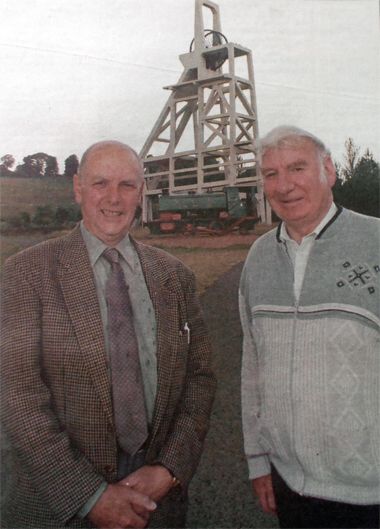 |
- A way of life no more - former miners Councillor Willie Clarke and Benarty Community Council secretary, Joe Paterson, are seen pictured at the Mary Colliery winding gear frame. Mr Clarke, who worked at the nearby Glencraig Colliery told the Times the move by Historic Scotland could be seen as the first step towards retaining the area's proud history. Mr Paterson, who worked at the Mary Pit between 1949 and 1962, added his support to a museum being established in the park. "The time is now right to get something done," he said.
----------------------------------------------
