"Cowdenbeath & Lochgelly Times & Advertiser"
Wednesday 5 February 1908
DEADLY FIREDAMP
Lochore Colliery Explosion
3 MEN KILLED : 5 TERRIBLY INJURED
Another falls to be added to the list of catastrophes which have befallen the mining community of West Fife. At about midnight on Sunday, the Fife Coal Company's Mary Pit, at Lochore, was the scene of a disaster which, though attended by loss of life, was less serious in its results than many of the tragedies which have from time to time occurred in connection with the mining industry in the county.
An accumulation of fire damp, which by some untoward circumstance had become ignited, caused an explosion - or to be more correct, a series of four consecutive explosions - the result being that three men lost their lives, and the lives of five others were seriously endangered.
Shortly after ten o'clock on Sunday night a number of men descended the shaft, some to work the Mynheer seam and others in the five-foot seam, the former being situated at a point 21 fathoms higher up than the Mynheer section. The men who left the cage at the mid-bottom were-
| NAME | AGE | JOB | LIVED |
|---|---|---|---|
| William Gibson | 17 | Miner | Lochore |
| John Stein | 18 | Drawer | Lochore |
| James Law | 18 | Miner | Lochore |
| Stephen Peggie | 26 | Miner | Lochore |
| John McGinn | - | Pit inspector | Lochore |
| John Thomson | - | Miner | Lochore |
| William Abel | 19 | Drawer | Lochore |
| Thomas Bell | 32 | Miner | Lower Milton |
Just as these men were about to proceed to their working places, they were informed that an accumulation of fire-damp had been discovered in the section, and they were requested to remain at the mid-working until the gas accumulation had been dispelled.
Various theories have been advanced as to what actually caused the explosion. It is known that, with a view to clearing the workings of the noxious gas, a fan driven by an electric motor had been set in operation, and the suggestion is offered that, since none of the men were using exposed lights - safety lamps being compulsory in the pit - a spark generated by friction in the motor had ignited the fire-damp. At all events, the eight men received the full force of the explosions, each of which was accompanied by dense choking smoke.
HURLED DOWN THE SHAFT
Gibson, Law and Stein were hurled with tremendous force down the shaft to the five feet shaft bottom, whither the men employed in that section at once proceeded to render assistance.
Gibson's lifeless body was found on the plates; Law, suffering terribly from burns and shock, was found lying on top of the cage; and Stein, whose condition was at once regarded as critical, was also quickly discovered.
In the five-foot section upwards of 80 men were employed. Among these men the greatest consternation naturally prevailed. Recognising, however, that something serious was amiss, and calling into requisition that heroism which the Fife miner has displayed in cases of serious emergency, a number of the men, as soon as the winding engineman could be communicated with, entered the cage and proceeded up the shaft to the scene of the accident.
There they were confronted by a terrible spectacle. The whole of the five men were seen to have been badly injured by the force of the explosions as well as by the flames which accompanied them. Information was communicated to the surface and while the brave miners busily employed themselves improving service stretchers and applying what first-aid attention was possible, arrangements were being made at the pit bank for attending to the injured men.
Among those early on the scene were Dr. Dickson, Lochgelly, Dr. A. Dickson, Lochore, and Dr. Todd, Lochore. Soon the medical appliances were requisitioned, and three ambulance waggons were summoned to the pithead. Stein and Law, who were regarded as the most seriously injured, were despatched first. Stein, however, succumbed before the ambulance reached the Dunfermline and West Fife Hospital.
Peggie, McGinn, and Abel were next sent off; and although the condition of the other men, Thomson and Bell, was seen to be equally critical, it was deemed advisable by the doctors to send them home, in view of the time which would expire ere the return of the ambulance waggons. Both men were subsequently taken to hospital.
During Sunday night and the early part of Monday the resources of the mining staff, and practically the whole of the medical gentlemen in Dunfermline, were drawn upon.
A third death occurred shortly before three o'clock on Monday afternoon, the victim being James Law, who was one of the men blown down the shaft, and whose condition from the first was regarded as hopeless.
PATHETIC SCENES
Hundreds of people were attracted to the pithead during the night, and there were many pathetic demonstrations as the bodies of the dead and the injured were being brought up the shaft.
Mr. Henry Rowan, the General Manager of the Fife Coal Company, was early on the scene, and Mr. Robert McLaren, Chief Inspector of Mines for the Eastern Division of Scotland, who was accompanied by an assistant, made a visit of inspection in the course of the forenoon.
The Mary Pit was the scene of a disaster when the shaft was being sunk several years ago, by which the lives of three men were lost.
MESSAGE TO HOME SECRETARY
In the course of the day, McLaren, H.M. Inspector of Mines, forwarded the following wire to the Home Secretary:-
"Regret to inform you that an explosion of gas occurred last night at the Mary Pit, Lochore, Fife, by which three men lost their lives and five were seriously injured."
When McLaren and others returned to the surface in the afternoon, it was reported that all the safety lamps had been found, and that these were in perfect order. Several were somewhat damaged as a result of the explosion, but none showed any sign of having been in any way connected with the cause of the explosion.
On inquiring at the hospital at a late hour, it was ascertained that the five men were in a precarious condition.
What caused the Explosion
********************
INTERVIEW WITH MINERS
Work proceeded as usual yesterday at the Mary Pit. It was learned from Mr. Allan, manager, that while the whole of the workers had not commenced operations, about 86 men had descended the pit, and were engaged in their customary work.
Mr. Robert McLaren, H. M. Inspector of Mines for East Scotland, was practically the whole of Monday at the pit. It is understood that as a result of his investigations the theory that the explosion was caused by a spark from the electric dynamo igniting the fire-damp has not been dispelled. Mr. Allan was particularly interrogated in regard to this, and he stated that while the correct circumstances would come out at the inquiry, the supposition which he had already formed still held ground. The lamps of the miners were found lying about the Mynheer Seam, and while two were broken, it was believed that they were not the cause of the disaster.
On Monday night about half a dozen men descended the pit and were engaged in clearing away the fire-damp.
CONDITION OF THE INJURED
At the hospital yesterday it was learned that the five injured were progressing as favourably as could be expected. A visit was paid to the institution on Monday night by an official of the Fife and Kinross Miners' Association, and it was learned through him that the five men following on the explosion had scrambled to the shaft and signalled for the cage. This story was corroborated by George McAndrew, overman, who was interviewed during the day.
DISCOVERING THE BODIES
George McAndrew, who was employed as an overman in the five-foot seam, stated that he was at the pit bottom when he heard the report of an explosion. This was the first intimation he received, and then he heard a man crying for help. He went to the cage, which was at the bottom, and found Law lying on it. They laid him on a heap of clothes and made him as comfortable as they could. Following on this he heard another report, and then two men came tumbling down the shaft. These were Stein and Gibson. The latter was killed outright, and they did what they could for the other. A large number of the men were not acquainted with the passage to the Aitken pit, and he sent John Cross to lead them. They were successful in getting to the Aitken shaft. He stated that he would never forget the explosion, and he found great difficulty from preventing the men from rushing into danger.
"Cowdenbeath & Lochgelly Times & Advertiser"
Wednesday 19 February 1908
LINES
IN MEMORY OF THE MARY PIT DISASTER, LOCHORE
|
Within a short distance of Lochore's ancient castle Stands the Big Mary Pit, a great sight to be seen, But her beauty will not now uphold her character, For the subject I write on will ever be green. |
|
It is of an explosion that happened within her On the second of February, in the year nineteen - eight, When she blasted on eight of her inmates that evening, Of which three have died, we are sorry to state. |
|
As the tenth hour approached on that fatal evening, Those eight gallant lads to their work did descend; Ah! but little they thought that ere the next hour That some of their trouble would be at an end. |
|
Just as they had started the fatal dynamo A spark from its drum caused the gas to ignite, Which resulted in the death of three of those heroes, While five were sore burned on that Sunday night. |
|
Those three gallant lads, I may now here mention, All bore good characters as plain may be seen, Through the sympathy held for the sad bereaved parents Of those heroes, William Gibson, James Law, and John Stein. |
|
Just a word to their parents and friends - Bare it patient, For God's ever near with a heart full of love; He saw a brighter future for the souls he has taken To rest in His bosom in Heaven above. And though their death it was very painful, And affliction sore they all bore, There never was bad but might be worse, Our Saviour He suffered far more. |
Francis D. Stewart
117 South Glencraig
"Cowdenbeath & Lochgelly Times & Advertiser"
Wednesday 1 April 1908
MARY PIT EXPLOSION
ENQUIRY AT DUNFERMLINE
An inquiry was held at Dunfermline on Wednesday last with respect to the Mary Pit explosion, as a result of which three men, William Gibson, drawer; John Stein, drawer; and James Murray Law, miner, lost their lives. Great interest was manifested in the proceedings.
Robert Thomson, miner, who appeared in the witness-box, stated that he was still a patient of the Dunfermline Hospital, suffering from the effects of the explosion. On the night of the accident, he said, he and the others went down to the main bottom, for the reason that they did not see the fireman at the pithead. By the force of the explosions, of which there were four altogether, witness was thrown in the direction of the shaft.
By Mr McLaren - After the first explosion the motor which drove the fan continued to work. The men were frightened to go near it for the purpose of stopping it. He could not say what had caused the explosion. None of the men were smoking, and he did not think the lamps were responsible.
By Mr Macbeth - McGinn, who was the fireman on the night in question, was a lad under twenty years of age.
Thomas Bell, who was also one of the injured, expressed the opinion that the explosion was caused by a spark from the dynamo.
By Mr Smillie - After a shot had been fired, he has seen the fireman's lamp showing the presence of gas. On the night in question, so far as he knew, no inspection was made by the fireman.
John McGinn (still an inmate of the hospital) stated that at the request of one of the men, named Cross, he undertook the duty of inspection.
Witness started the motor and sat down beside it. He intended afterwards to go round the workings and return to the men to report as to the condition. He got no instructions from anybody about the motor. He knew when there was gas because his lamp showed its presence. He did not know what rules provided in respect to the discovery of gas by an inspector. Nobody had asked him any questions before he was appointed to do inspection duty. He knew nothing of electric motor machinery at all. He was satisfied from the appearance of the lamps that they were all right and burning quite clear. Before the explosion he noticed an occasional flash about the motor; he thought they came from the switchboard. Witness was thrown in the direction of the shaft by the force of the explosion. It did not occur to him to stop the motor when he saw sparking.
By Mr Macbeth - He came to this district five months ago, and had been working as roadsman and miner in the Mary pit for three months prior to the accident. It was from McAndrew, the night shift foreman, that he got the instructions to perform fireman's duties. He never saw the rules in force at the pit; he knew nothing about any rules whatsoever.
By Mr Smillie - Asked if he had ever signed the report book as to his discovery of gas, witness said he had never seen a report book at the colliery.
Alexander Jack, lampman; John Hutchison, fireman; and John Aitken, the manager, also gave evidence.
George McAndrew, the oversman, was warned before examined that he need not answer any questions which might incriminate him. At about ten o'clock on the Sunday night, he said, he went down the pit, along with 135 men. After hearing the sound of an explosion, he found James Murray Law lying on top of the cage, at the bottom. Shortly afterwards another body, that of Stein, fell down from the Mynheer bottom, and at a later stage, the body of Gibson was also found. Witness waited at the bottom until all the men were up the pit. Asked why he did not make the inspection of the Mynheer seam himself, instead of sending McGinn, he replied that he had not time, as he had other work to do.
By Mr McLaren - It was a usual thing to stop the fan at the week-end.
By Mr Macbeth - As night-shift oversman the Mynheer seam was under his supervision. It was witness who on the three previous occasions appointed McGinn to officiate as fireman.
On all these occasions witness informed the under-manager what he had done, and the under-manager stated that it was all right.
By Mr Smillie - McGinn had never signed the report book as fireman.
Edward McDonald, pit fireman, deponed to having been in company with McAndrew at the pit bottom when the explosion occurred at the Mynheer seam.
Andrew Ramsay, the under-manager, deponed to having taken part in the rescue operations. The motor in the Mynheer seam was put in the month of December last year. Witness was below ground every day, although he was not in the Mynheer seam daily. McGinn, he said, was not a regular fireman. He was selected by the inspector, because the acting oversman thought he was the most capable man available. During the time that the fan had been running there was no report as to the presence of gas. It might be that it was unwise to have the lamp station in the position it now was.
By Mr Macbeth - A competent man going into the Mynheer seam and finding matters as they were on the night in question would have communicated with the man in charge.
By Mr Smillie - Neither the manager nor the witness appointed McGinn as inspector.
Dr Ross said he admitted that some lessons had been obtained that day which might be profitable for the future, but he thought it would be allowed that, so far as the Company were concerned, no pains had been spared, and no expense had been withheld in providing anything and everything that could be suggested for the safety of these men, if the appliances had been properly and adequately taken advantage of. The Government Inspector himself had the greatest difficulty in determining the exact cause of the accident. It was very easy to be wise after the event. He admitted that the appointment of the young man McGinn as inspector was a most unfortunate appointment. But in any case, McGinn had previously had experience, and was selected on that account.
The Sheriff thought that the Procurator Fiscal's suggestion that the case was one in which fault might be attached was a very reasonable suggestion. If the Jury felt themselves justified they might add to a formal verdict something to the effect that the accident was due to an explosion of inflammable gas ignited through a spark from the motor; that the accident would not have occurred if the motor had been protected under the rules; that the accident was contributed to by the system of ventilation, which was defective by reason of the stoppage of the fan at the week-ends; and that the accident was also contributed to by the fact that the inspection was made by a man who was not qualified for the duties.
The jury, having retired for a few minutes, returned and intimated their acquiescence in the Sheriff's suggestions.
"Cowdenbeath & Lochgelly Times & Advertiser"
Wednesday 17 June 1908
PROSECUTION OF FIFE MINING OFFICIALS
THE LOCHORE DISASTER
At Dunfermline on Monday, Sheriff Shennan was engaged for several hours disposing of charges of negligence under the Coal Mines Regulation Act, 1887, and the general and special rules thereunder, against John Allan, manager; Andrew Ramsay, under-manager; and George McAndrew, colliery overman, Lochore. The proceedings were a sequel the explosion which occurred at the Mary Pit, Lochore, Lochgelly on the night of Sunday 2 February, whereby three men were killed and five injured. All three were charged with having, between 2 p.m. on 1st February, caused or permitted to be stopped an enclosed continuous air current electric motor installed to work a fan for the purpose of constantly producing an adequate amount of ventilation to dilute and render harmless noxious gases.
Messrs Allan and McAndrew were also charged with not having the motor reasonably covered or safeguarded; and Messrs Ramsay and McAndrew with having caused or permitted John McGinn, roadsman, to be employed about 11 p.m. on 2 February as fireman, he being an incompetent person, inasmuch as he had not been duly approved as such by the owner, agent, or manager.
Messrs Allan and McAndrew pleaded guilty, the former's being the alternative pleas of "permitting".
Mr P M Connell, solicitor, Dunfermline, on behalf of Mr Allan, said that at the date of the accident his client managed the Mary and Benarty Pits and besides the ordinary routine work had a large amount of work going on above ground at the Mary Pit, which demanded his personal attention. Consequently, he found it necessary to delegate to a large extent the oversight of work underground to the under-manager, who was a fully qualified man. Mr Allan had no desire to escape blame for his own shortcomings at the expense of another, and, in fairness, wished to state that a few weeks prior to the accident he had a discussion with Mr Ramsay as to whether it was necessary to keep the fan going at the week-ends. Both were of opinion that the fan was not absolutely necessary for the adequate ventilation of the section, as there was, they thought, a sufficient amount of natural ventilation. At the end of the conversation, Mr Allan said to the under-manager that he thought it would be better to keep the fan going at the weekends. He admitted with regrets that he did not give definite and authoritative orders that the fan should be kept going, and that he did not make from time to time inquiry to ascertain that it was going, but he believed it was, and did not hear it had not until after the pit accident. Mr Allan was strongly of opinion that there would have been no accumulation of gas, and consequently no explosion, if the screen at the fan had been left open during the week-end stoppage, as it was when the fan was stopped for necessary repairs at the New Year holidays. It was then found that the natural ventilation was quite adequate - although the fan was stopped for four days.
SOMEONE'S NEGLIGENCE
The Procurator Fiscal, Mr J S Soutar, concurred
in the onerous duties of Mr Allan at the time. The Sheriff said he had been struck in that
Court by Mr Allan's invariable common sense in giving evidence
at inquiries, and was therefore more ready to accept the statements
made on his behalf. He must say the general impressions left on his
mind was that Mr Allan was overworked. He was not to impose
anything in the nature of a serious penalty. It must be clearly
understood that it was not a prosecution for the accident. Whether
the accident has occurred or not that prosecution would have been
perfectly justifiable, because it was for the contravention of a
rule. To his mind the value of the prosecution would
lie in this - that it would impress on the minds of managers all
over the country, he hoped, the absolute necessity of strictly
observing the rules. Whether they approved of those rules or not,
so long as these rules were there they must be loyally obeyed, just
as the laws of the kingdom had to be loyally obeyed. That was the
value of the prosecution. He limited the sentence to a fine of
£2. Mr J R Stevenson, on behalf of McAndrew stated
that his client appointed McGinn to do the inspecting that night as
the only man available. He had done the same thing on three
previous occasions, and on each the fact was reported to Ramsay,
who approved of what was done. McGinn was qualifying for the post,
and the incompetency simply amounted to this - that he was not an
appointed man. The Fiscal said he was satisfied from his
enquiries that McAndrew had behind him, he would not say the
sanction, but reason for supposing that the employment of McGinn
was justifiable. The Sheriff said McAndrew had not tools to work
with, and the unfortunate tool which he did work with was
apparently worked with the knowledge of those in authority. He gave
McAndrew the benefit of the Probation of Offenders Act, and
dismissed him with an admonition. Mr Ramsay, who pleaded not guilty, was defended
by Mr Robertson, solicitor, Markinch. Henry Rowan, General Manager of the Fife Coal
Company in the district, said the motor was put in to improve the
ventilation in the Mynheer seam. He did not give instructions to
have it kept going, as he thought that would be done. Cross-examined - He did not consider it
necessary to give instructions that the fan was to run during the
week-ends. Peter McFarlane, pit fireman, Westfield,
Auchterderran, said that when examining the Mynheer seam he tested
the place for gas before starting the motor. He did so even if the
motor had only been standing for ten minutes. W. Thomson, miner, Lochore, said that when he
left the seam on Saturday afternoon the screen at the motor was
down and it was left in that way. Cross-examined - McAndrew gave instructions to
McGinn, and told witness to see that he started the motor right.
Witness never received any instructions from Ramsay. John Hutchison, fireman, Lochore, said that on
going off duty on 1st February he stopped the motor. If
he had not done so it would have stopped itself and done some
damage. By the Sheriff - It would have burned fuses. His
Lordship observed that it was unusual carefulness. Cross-examined - Ramsay never gave witness any
instructions about stopping the motor. George McAndrew, overman,
spoke to deputing McGinn to inspect the Mynheer seam on two or
three occasions. He never tested McGinn, but had seen him at work
with the fireman. He reported McGinn's inspection to the
under-manager. Cross-examined - Ramsay said it was all
right. Robert Thomson, miner, who was injured by the
explosion, said it took the air all its time to be all right even
with the motor going. John McGinn (19), said that he was not supplied
with the rules and regulations, and that he did not know the men
should not have passed the notice board or lamp station. On
previous occasions he found the screen was up. No warning was given
by his lamp of the presence of gas. He had found gas at "the
face", but never reported it as it cleared away after the
motor had been going. Cross-examined - McAndrew always appointed him.
He did not know if Mr Ramsay knew he was acting in that capacity.
McAndrew never asked him as to his ability for carrying out the
duties. John Allan, manager, said he considered the
motor was at a point where there was no danger. He would not have
put McGinn on the list of firemen. Witness did not know the motor
was stopped regularly on Saturdays. Cross-examined - He did not back up his
conversation with Ramsay by saying that he must keep it
going. Re-examined - By what he knew now the Sunday
night inspection was the most important of the week. Is it not the case that Mr Ramsay was not
responsible to you? - I did not appoint him. Robert McLaren, H. M. Inspector of Mines, said
the fan should not have been stopped. It would have been better to
have examined for gas before starting the motor, because it was
sure to be nearby. If the screen was down there was no possibility
of any current. The employment of McGinn was foolish. It was the
most important inspection of the week. Administratively the taking
of the shift men to the place was unwise. Cross-examined - He did not think it was the
duty of the manager or under-manager to be at the inspection on the
Sunday night. Professor Redmayne, Chief Inspector of Mines,
said the best place for a lamp station under the circumstances was
at the top of the shaft. Relative to the working of the fan, he
would have said emphatically to a subordinate that such and such
was to be done. The motor on the night of the accident would start
under most unfavourable conditions. The marvel to him was that an
accident did not occur sooner. If he had been a manager forced by a
general manager to do what he objected to, he would have complained
to the Board of Directors, and if a manager told him as
under-manager to stop the fan he would have complained to the next
highest authority. Had he been in Ramsay's position, he would
have said that McGinn was not to be employed as a fireman. He did
not think that under him McGinn would ever have been
employed. Ramsay, in the witness-box, said he told Mr
Allan that McLaren, H. M. Inspector, held the opinion that the fan
should be kept running continuously at the week-end, and that he
(witness) wished that to be done. Mr Allan said to do as they had
been doing. That was at the New Year, and witness never mentioned
it again. Mr Allan was aware that it was stopped during any
week-ends. Witness did not think he had any appeal to a higher
official. It was Mr Allan's custom to go to the pit on the Saturday
afternoon. Witness was not aware of McGinn's employment on
previous occasions. He relied on the proper inspector being there,
and there being a competent fireman. He never took any exception to
the position of the fans. The Fiscal said the unfortunate thing was that
the accident was the result of a long series of not necessarily
acts of misconduct, but of divided stupidity. The beginning of it
was that the higher officials of the Company should put into the
hands of incompetent and inadequate men a machine which was of the
most dangerous nature under certain conditions. The keeping of the
fan constantly going was merely a question of cost. Mr Robertson contended that his client was not
the responsible party. The Sheriff said it seemed to him the
under-manager's position must be regarded as a real and
responsible one, and that he could not possibly escape liability on
the ground that he had got a manager above him and an overman
beneath him. The very fact that what had been provided was an
inefficient system went far to convince him that he must convict.
It was a system which the under-manager knew was going on from day
to day. He had not the slightest hesitation in laying it down that
the accused had known that this preposterous system of ventilation
was in existence, must accept the responsibility and be convicted.
There was a little more difficulty about the other charge, because
there again had it been a single occasion he should have had
considerable difficulty in convicting the under-manager, but then
they had evidence that it was the fourth occasion that an
absolutely unqualified fireman was allowed to inspect. That pointed
to something very inefficient in the control exercised in that
mine. Even with that he should have had some difficulty had
knowledge of it not been brought home on the accused. He imposed a fine of £1 or the alternative
of eight days imprisonment. Compensation claims amounting to £5000
have, it is understood, been lodged against the Fife Coal Company
in connection with the accident. Sheriff Shennan is to hear proof in the action
raised at the instance of John McGinn, miner, Hynd Houses, Lochore,
against the Fife Coal Company. In connection with the explosion of gas which
occurred in the Mary Pit, Lochore, about a year ago, when three men
were killed and four injured, an indignation meeting was held on
Thursday night under the auspices of the Lochore and Glencraig
branch of the Miners' Union, in the public hall. The meeting
was called for the purpose of protesting against the offers of the
insurance co's. The attendance was large, and a vote condemning
the offers was unanimously passed. The offers are as follows: Mr Abel, injured,
£75; Mr Bell, Milton, injured, £80; Mr Thomson,
Lochore, injured, £100; Mr Peggie, Lochore, £200; Mr
Gibson, Crosshill, fatal, £150; Mr Law, Lochore, fatal,
£100; Mr Stein, Lochore, fatal, £200. In the Court of Session on Thursday, after three days'
trial, verdicts were returned in four actions of damages against
the Fife Coal Company Limited.
On behalf of relatives of Stephen Peggie, we are attempting to
find out if, in addition to the compensation payment of £300,
some medal was awarded following the incident. While the presence of
a report on the medal known as the Miners' V.C. immediately followed
the report of the Mary Pit explosion in the West Fife Echo of
Wednesday, February 5, 1908 - SEE EARLIER LINK -
hinting perhaps that some act of heroism was associated
with this accident, to date the name of Stephen Peggie has not
been found associated with this award. We are continuing our
investigation and will report in due course. The most serious explosion occurred in the Mynheer
coal seam of the Mary Pit, Lochore Colliery, belonging to Fife Coal
Co., Ltd., causing the loss of three lives and injuring five
persons. The shaft is the deepest in the district, being 670 yards to the
Five Feet coal seam. The seams passed through are the Diamond at
490 yards and the Mynheer at 624 yards from the surface. The Mynheer seam had only recently been "broken away"
from the shaft; and parallel levels were being driven to the right
with a view to connect with the Five Feet seam below by means of a
cross-cut mine from the latter, while on the opposite side a single
roadway was advancing towards a point where a blind shaft was to be
sunk, also to the Five Feet seam, for connection. Shortly after opening gas was given off the seam and safety
lamps were put in, and were being used at the time of the accident. To provide ventilation, a fan 20 inches in diameter was placed in
the lower level a short distance inside of No. 1 heading, at A,
and
continuous current electric power supplied by an open-type motor;
the fan pulled air from the shaft, which was downcast, and forced
it through the workings, after which the air returned again to the
shaft by a narrow opening where it joined the main current
descending the shaft. When the fan ceased to operate, the air current went the reverse
way, and in order to allow it to circulate, the screen at C,
which had to be kept down when the fan was at work, was raised. The work in the seam was continuous - three 8-hour shifts during
the 24 hours, and for each there was a fireman. In the ordinary
course of working the fan was kept going constantly, but it was
stopped at the week-ends and started again on the Sunday night just
prior to the shift beginning. On the night of the accident, seven men descended the shaft to
the Five Feet seam, and on arriving had to wait until a fireman
could be got, to take the place of the regular fireman, who had
failed to turn out owing to a misunderstanding with his neighbours.
The oversman in charge asked a young man, who had little knowledge
of gas or of a fireman's duties, to make the inspection and he
went up to the Mynheer seam accompanied by the miners. On arriving
at the shaft bottom he set the fan in motion, to allow the air
current to clear out any gas which might have collected during the
interval the fan stood, prior to inspecting the workings, and
shortly after the fan started to run, an explosion took place,
followed by three others in quick succession; the first explosion
threw an empty tub forward, which crashed through the fence gate,
and both were precipitated to the bottom of the shaft. One man was,
at the same. time thrown down the shaft, and the second explosion
threw a second man down the shaft. The others were more or less
burned, and one afterwards succumbed to his injuries. Early next
morning, I arrived at the pit, accompanied by Mr. Masterton, and we
made a thorough inspection as far as it was possible, and after an
exhaustive enquiry into the causes which might have contributed to
the explosion, we concluded that it was due to an explosive mixture
being ignited at the motor by sparking from the commutator. On a
subsequent inspection it was found that gas had come from a break
in the roof in the upper level at D, and that this gas had
accumulated during the time the fan was stopped. It was stated by some of the men who worked on the last shift of
the week-end that the screen C at the fan was left down, and the
result of this would be that the natural air current, which usually
passed round the workings, would cease, and any gas given off would
accumulate. The statements of the injured men varied as to where the flame
was first seen, and two things were set up, one that the level
in-bye from the motor was full of gas up to the screen, and the
other that explosive gas had been forced out at the screen. B
in No. 1 heading and reached the motor; looking at all the
circumstances and facts as far as ascertained, the latter was no
doubt the cause of the explosion. As soon as the fan forced the air,
it carried the gas right toward the narrow opening, and the
current, now well mixed and explosive, was forced under the screen
to the motor, and as the latter was sparking at the commutator, the
result could only be an explosion. The first explosion set fire to
the brattice cloth and some pieces of wood in the No. 1
heading, and as the fan still continued to run, a fresh supply of
gas was sent down the heading on the burning material, and thus the
second, and probably the third and fourth explosions were
caused. The second explosion appeared to have been very violent, and was
due to the presence of coal dust on No. 1 heading; the force, which
was considerable, was toward the level and shaft, and was clearly
seen by the uplifting of metal plates from their position on
heading, throwing down of props and brattice, and the hurling of a
rope reel against the stoop side, causing it to rebound on a loaded
tub which was overturned. The force in the lower level was slight
and also toward the shaft. On several props, which were left
standing in the No. 1 heading, caked dust was observed. The fan produced about 3,000 cubic feet of air per minute, and
this quantity was sufficient to give good ventilation. The primary cause of the accident was clearly due to stopping
the fan at the week-ends, as had the fan been kept going, a
dangerous accumulation of gas was not likely to happen. The
stopping of the fan was the work of the under-manager, and done,
apparently, without the manager's knowledge or consent. In the
arrangements for ventilating the workings, due regard had not been
paid by the management for observing General Rule 1, and Section V,
Rule 4, of the Electrical Special Rules, as by stopping the fan,
there was not constantly "an adequate amount of ventilation to
render harmless noxious gases," and also, that as soon as the
air reversed the motor was on the return side and should have been
an enclosed one. After three days'
trial in the Court of Session - before the Lord Justice-Clerk and a
jury - verdicts were returned on Thursday in four actions of
damages against the Fife Coal Company (Limited). Sheriff Shennan issued his interlocator in
Kirkcaldy Sheriff Court on Friday in an action at the instance of
John McGinn, repairer, Lochore, who claimed £500 damages
against the Fife Coal Company for injuries sustained at Mary Pit,
Lochore, in February last year, by an explosion of inflammable gas.
A tender of £200 was made by the defenders. His lordship
finds pursuer has been totally incapacitated for work since the
accident, and is still suffering from injuries and assessed the
damages at £350.PLED NOT GUILTY
H.M. INSPECTORS
"DIVIDED STUPIDITY"
BIG COMPENSATION CLAIMS
"Cowdenbeath & Lochgelly Times &
Advertiser "
Wednesday 10 February 1909
LOCHORE MINER SUES FIFE COAL COMPANY
Pursuer, who is 18 years of age, sues for
£500 in respect of injuries sustained at defender's Mary
Pit, Lochore, on 2 February last year. He avers that as the
workings of the pit developed, inflammable gas was met with in
dangerous quantities and the air current used being insufficient, a
fan driven by a motor was introduced for the purpose of creating
and circulating through the workings a sufficient current of
air.
On 2 February, pursuer went out to commence work
in the pit. There were several other miners out, but the fireman,
who ought to have inspected the seam before they went to work, was
not available at the moment.
Pursuer was sent by George McAndrew, overman, to
undertake the fireman's duties, and switch on the current for
the ventilation of the seam. Pursuer agreed to carry out the
manager's instructions, not anticipating any danger in the
work. Immediately after switching on the motor a terrific explosion
of inflammable gas took place, followed by three other violent
explosions in rapid succession. Three of pursuer's fellow
workmen were precipitated down the shaft by the force of the
explosion, and were either instantaneously killed or fatally
injured, while the other men, including the pursuer, were very
seriously burned and otherwise injured.
Pursuer's injuries are serious and
permanent. He alleges that the accident was caused through
defender's failure to provide a proper system of ventilation in
the seam, and safe and sufficient plant properly directed to
generate the necessary air current, and through the incompetency of
the officials in their employment.
Defenders plead contributing negligence. They
deny that pursuer's injuries are attributable to the fault of
defenders or their system of working the pit.
The case was recently debated before the
Sheriff, who has now allowed a proof.
"Cowdenbeath & Lochgelly Times &
Advertiser"
Wednesday 7 July 1909
MARY PIT DISASTER
The relatives of Stein are now residing in
Buckhaven. On Tuesday at the instance of the relatives of Gibson, a
test case will come up for proof in Edinburgh, when £750 is
being asked for.
This sum represents a larger amount than the amount offered for
all cases.
"Dunfermline Press"
Saturday 10 July 1909
ACTIONS AGAINST THE FIFE COAL COMPANY
HEAVY DAMAGES AWARDED
The actions arose out of an explosion of inflammable gas in the
Mynheer seam of the defenders' Mary Pit, Lochore, on 2nd
February, 1908, which resulted in the death of three miners and
injuries to a number of others. Mary Pit, which was sunk several
years ago, is the deepest in Fife, the shaft, which is sunk to what
is known as the five foot seam, being about 2000 feet in depth. The
Mynheer seam is 180 feet above the five foot seam. Inflammable gas
was met with in the course of operations, and safety lamps only
were in use.
As the workings were developed, the air current was found to be
insufficient, and the defenders introduced into the Mynheer seam a
fan driven by an electric motor in connection with the ventilation.
On the evening of Sunday, 2nd February, 1908, several miners, prior
to commencing work, were waiting at the mid-working station until
the fireman completed his inspection of the workings. The fireman
went to the motor and switched on the current and immediately a
terrific explosion took place. The pursuers said that the accident
was caused by the defective system of working the pit, and by the
defenders' failure to observe and carry into effect the general
and special rules in force at the pit. The defenders maintained
that the accident was not attributable to their fault or to the
fault of those for whom they were responsible or to any defect in
their system of working the mine.
Robert Gibson, sen., Crosshill, sued for £750 for the death
of his son, William; William Stein, miner, Strathearn Road,
Kirkcaldy, sued for £750 for the death of his son, John;
Thomas Bell, miner, Lower Milton, Lochore, sued for £500 in
respect of personal injuries; Robert Thomson, miner, 22 Montrose
Street, Lochore, sued for £500 in respect of personal
injuries.
The jury, after an absence of three quarters of an hour, returned
a unanimous verdict for the pursuers. They found Gibson entitled to
£300; Stein, £300; Bell, £350; and Thomson,
£500.
Actions were also raised by three other pursuers, whose claims
were settled extra-judicially.
Robert Law, miner, Beveridges Building, Lochore, sued for
£750 for the death of his son, James, and has received
£150.
William Abel, miner's drawer, 113 Bonnington Road, Leith, sued
for £500 in respect of personal injuries, and has received
£100.
Stephen Peggie, miner, Waverley Street, Lochore, sued for
£500 for personal injuries, and has received £300.
Counsel for the pursuers - Mr Wilson, K.C., and Mr Munro. Agents -
D. R. Tullo, S.S.C.; and Macbeth and Macbain, solicitors,
Dunfermline.
Counsel for the defenders - Mr Watt, K. C., and Mr Horne. Agents -
W. and J. Burness, W.S.; and W. T. Craig, writer, Glasgow.
An almost identical report was carried in the "Cowdenbeath
& Lochgelly Times & Advertiser" on Wednesday, 14th
July, 1909, but strangely this report excluded the details of the
extra-judicially settlements received by the other men involved in
the accident.
M. Martin &
Webmasters
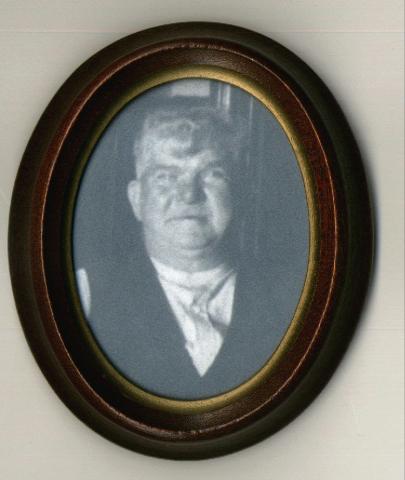
We
have been contacted by Stephen's relatives in New
Zealand and they have kindly given us permission to
include Stephen's photograph on site.
Report of Inspectors of Mines into the Explosion
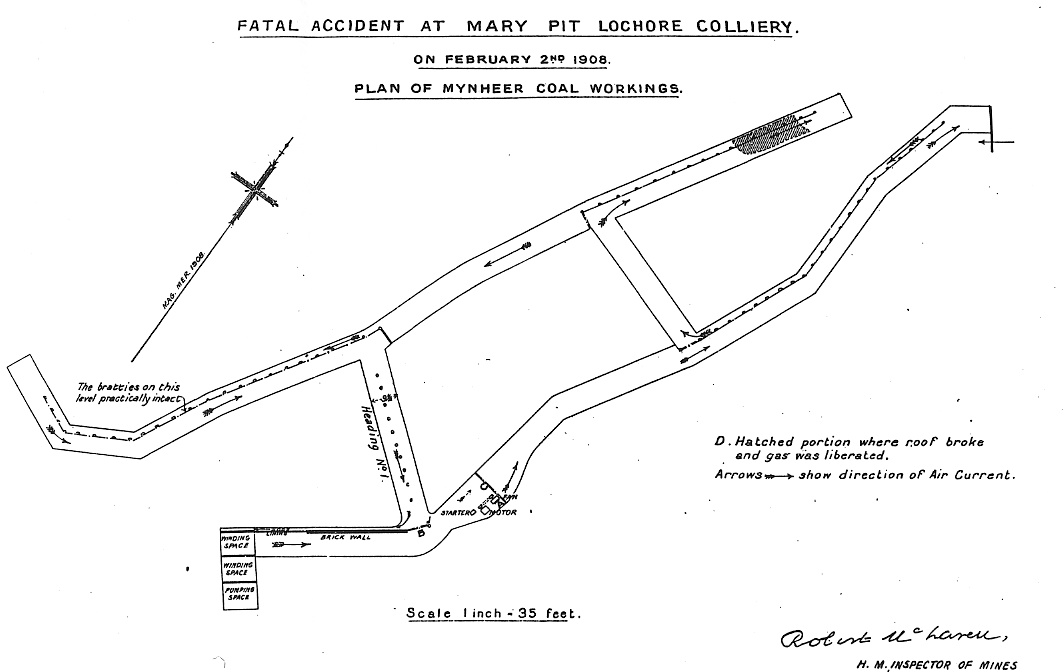
This is a plan of the site of the explosion at the Mary Pit
on February 2 1908
"Cowdenbeath &
Lochgelly Times & Advertiser"
Wednesday 14 July 1909
THE MARY PIT EXPLOSION
HEAVY DAMAGES AGAINST THE COMPANY
The actions arose out of an explosion of
inflammable gas in the Mynheer seam of the defenders' Mary Pit,
Lochore, on 2 February, 1908, which resulted in the death of three
miners and injuries to a number of others. The Mynheer seam is 180
feet above the five foot seam to which the shaft is sunk.
Inflammable gas was met with in the course of operations, and
safety lamps only were in use.
As the workings were developed, the air current
was found to be insufficient, and the defenders introduced into the
Mynheer seam a fan driven by an electric motor in connection with
the ventilation. On the evening of Sunday, 2 February, 1908,
several miners, prior to commencing work, were waiting at the
mid-working station until the fireman completed his inspection of
the workings. The fireman went to the motor and switched on the
current. Immediately thereafter a terrific explosion took place.
The pursuers said that the accident was caused by the defective
system of working the pit, and by the defenders' failure to
observe and carry into effect the general and special rules in
force at the pit. The defenders maintained that the accident was
not attributable to their fault or to the fault of those for whom
they were responsible or to any defect in their system of working
the mine.
Robert Gibson, sen., Crosshill, Lochgelly, sued
for £750 for the death of his son, William; William Stein,
miner, Strathearn Road, Kirkcaldy, sued for £750 for the
death of his son, John; Thomas Bell, miner, Lower Milton, Lochore,
sued for £500 in respect of personal injuries; Robert
Thomson, miner, 22 Montrose Street, Lochore, sued for £500 in
respect of personal injuries.
The jury, after an absence of three quarters of
an hour, returned a unanimous verdict for the pursuers. They found
Gibson entitled to £300; Stein, £300; Bell, £350;
and Thomson, £500.
"Cowdenbeath & Lochgelly Times &
Advertiser"
Wednesday 27 October 1909
SEQUEL TO AN EXPLOSION
