"West Fife Echo"
Wednesday, February 5, 1908
DISASTER AT THE MARY PIT
THREE MEN KILLED & FIVE INJURED.
A NEW MINING DANGER.
A melancholy accident, involving the death of three men and serious injury to five others occurred at the Fife Coal Company's new Mary pit at Lochore at a late hour on Sunday evening. About an hour after the ten o'clock shift had been lowered, an explosion, or rather a series of explosions, occurred in the Mynheer Seam. That seam goes off the shaft at what is known as the second bottom, the lower or Fivefeet bottom being fully twenty fathoms further down. As it is only about a year since coal began to be drawn from the pit, the seams have not yet been penetrated any great distance, the Mynheer extending barely 100 yards in from the shaft. At the time of the accident only the eight men killed or injured in the disaster were engaged in that seam, but 72 men were working in the Five feet section below. The real cause of the disaster is still a matter of conjecture. As the Mynheer seam was known to be fiery, safety lamps were in use, and there were a dynamo and fan in the seam for the purpose of clearing the air. The accident happened just at the time the dynamo was started to drive the fan. This operation was considered expedient before allowing the work to proceed, and John McGinn, the inspector, residing at the Hynds, Lochore, set the dynamo a-going. No sooner had he done so than an explosion occurred, that being followed by three others. At that time three men - John Stein (18), drawer, Caravan Rows, Lochore; William Gibson (17), drawer, Crosshill; and James Law (18), miner, New Colliery Houses, Lochore - were standing at the pit bottom; and becoming alarmed after the first explosion, they, so far as can be ascertained, had signalled for the cage to descend and take them to the surface. But by the force of one or other of the later explosions the whole three were blown down the shaft to the Fivefeet bottom, Gibson was killed outright, his injuries being painfully disfiguring; Stein passed away while being conveyed in the ambulance van to the Dunfermline and West Fife Hospital; and Law lies in that institution in an extremely critical condition. The other men injured were McGinn, Stephen Peggie (26), miner, New Colliery Houses, Lochore; Thomas Bell (33), miner, Lower Milton; John Thomson, miner, New Colliery Houses; and William Abel (19), drawer, New Colliery Houses.
The force of the explosion must have been very great, not only for the reason that it blew the men down the shaft from such a distance, but that it partially wrecked the shaft between the Mynheer and Fivefeet seams. The only theory which can be advanced to account for the explosion was that of an electric spark from the dynamo, creating an ignition with the firedamp; and if that be the explanation a new danger is added to the many which are connected with the mining industry. At the pithead a distinct rumbling noise was heard by the pitheadman on duty.
Immediately the alarm was given at the surface that a calamity had occurred, doctors and ambulance wagons were telephoned for, and Drs Todd, Glencraig, A. Dickson and D. E. Dickson, Lochgelly, were early on the scene, along with ambulance vans from the neighbouring districts of Lochgelly, Kelty, and Cowdenbeath. Before this, however, the manager of the colliery, Mr John Allan, was apprised of the disaster, and he, along with the under-manager, Mr Andrew Ramsay, an overman, Mr Peter Watson, and a shaftsman, Mr Thomas Whyte, formed themselves into a rescue party, and descended to the scene of the occurrence. Their first efforts were directed to the removal of the men who were lying badly burned in the Mynheer seam, and these men were all successfully conveyed to the surface. After having had their injuries temporarily dressed, Peggie, Abel, and McGinn were conveyed to the Dunfermline Hospital, Thomson and Bell being taken to their respective homes in order not to overtax the ambulance accommodation. Thereafter the rescue party descended to the lower bottom to find the other three men. Owing to the damage which had been caused to the shaft, this was necessarily a slower operation, as the rescuers had to make things right before they could reach the men.
It was about 4 o'clock in the morning before the last of the men had been brought up.
With commendable presence of mind George McAndrew, the overman in the Fivefeet section, gave instructions for the 72 men working in that section not to attempt to proceed to the surface by means of the shaft, else some of them might have fallen victims to the deadly afterdamp which follows an explosion. The men accordingly took the road, about 1½ miles long, which connects the Mary, with her sister pit, the Aitken, at Kelty, and ascended the Aitken shaft.
As may be expected, the news of the explosion caused great excitement in the neighbourhood, and a large crowd of people, including many women, congregated at the pithead, while the rescue operations were proceeding. In rendering first aid, the doctors had many willing assistants, including the local police officers and others. Later yesterday it was deemed advisable to have the two men who were conveyed home at the time of the accident, taken to Hospital.
The body of Gibson, which had been lying in an engine house at the pithead, was chested and removed. Mr Henry Rowan, the general manager for the Company was present during the earlier part of the operations yesterday. Mr Robert McLaren, H. M. Inspector of Mines, his assistant, the manager of the colliery, and the other officials descended the shaft for the purpose of investigating the cause of the explosion.
Law, whose condition was regarded as hopeless from the beginning, died in the Hospital on Monday afternoon. The condition of the other men is critical.
DISTRESSING SCENE
One of our representatives, asking for information re the deceased men, was taken by a friend of James Law to the home of his mother. On being invited in by the mother, he found a number of sympathetic neighbours seated round the fire. Mrs Law, who did not know the worst, said that she was glad the reports about her son's condition were of a hopeful nature, and that she was looking forward to having him back with her again. She told me, writes the correspondent, that the family had come from Denbeath nine months ago and that her son was of a very quiet disposition. On leaving, I beckoned to a neighbour to come outside so that he could break the sad news gently to the devoted mother. This action was, however, noticed by Mrs Law, and with "He's deid; I see it in his face," she fell into violent hysterics screaming for her son and mentioning his name repeatedly in her cries. The family gathered round her knees - mostly little children - became alarmed and commenced crying too. To the words of comfort by the consoling neighbours she could not then listen, but kept on crying and wringing her uplifted hands. The scene was indeed heart-rending. It was some time before the afflicted woman became somewhat composed, and I left with a vivid picture of that scene of great distress in a sorrowing household.
AN INSPECTOR'S STATEMENT
I also paid a visit (our correspondent continues) to the home of George McAndrew, an inspector, who was in the five feet seam and who warned the men in that seam of the danger, and then sent them up by the Aitken Pit more than a mile away. A request for a short outline of what happened was readily answered in the affirmative, and Mr McAndrew gave the following statement:
"As I was at the bottom of the mine in the five feet seam when, at 11.18 p.m., I heard a loud explosion, followed soon after by another. I then heard a cry for help and I found a man on the cage. I, along with some others who were near, took him off and laid him in the corner. He was James Law. Soon after we heard other two explosions, not so loud, and two men came falling down the shaft, one falling on a hutch and an other between the hutch and the cage. The man who fell between the hutch and the cage was Gibson, and we saw at once that he was dead, having been killed instantaneously. The other, Stein, was alive, and we put him in a corner beside Law, and made them as comfortable as possible, though we were unable to render much assistance to them. Law was very quiet, but Stein was moaning a good deal. These men lay for more than two hours before the rescue party succeeded in reaching us - Mr Allan, general manager and several other officials at the pit. There were four separate reports and, immediately after, the seam where I was became clouded with smoke. I sent word to all the men in the different places to proceed at once to the Aitken shaft, a little over a mile distant. It is a good road, and all got up safely. I was in the Glencraig explosion nearly six years ago, but it was not as bad as this one. The men who are now deceased, Gibson, Law, and Stein, were very severely injured and also very badly scorched."
A PIT LAD'S STORY
A lad, George Fenwick, who was working in the five feet seam, told the following story to our representative:
"I was working down the dook when my neighbour came rushing and shouted 'Get your clothes quick and come on.' I asked what was wrong and he just answered the one word 'explosion.' We left the place at once and proceeded by instruction from the bottom to the Aitken shaft. It is a good road, but great difficulty was experienced in getting to our destination. Several times we went into old workings and had to retrace our steps. It would only, I think, be about a mile, but nearly two hours elapsed before we got to the Aitken shaft."
MINERS' V. C.
OBVERSE AND REVERSE VIEWS
A few months ago the King, who, as everyone knows, is always deeply interested in deeds of heroism performed by his humble subjects,
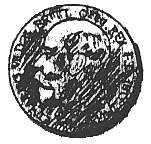 |
noticed that there was no medal existing which could be conferred on heroes of mines who at the risk of their own lives go to the rescue of their comrades entombed by the pit disasters which unhappily occur from time to time.
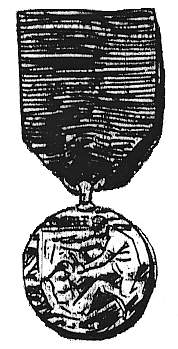
His Majesty gave instructions that this defect was to be remedied by the striking of a special medal at the Royal Mint. This medal, of which we are able to give obverse and reverse pictures, is now ready. It is in silver, beautiful in design, and is attached to a dark blue ribbon with a yellow edge.
