Owners: Fifeshire Main Collieries Company
Oakley Collieries Ltd., Edinburgh
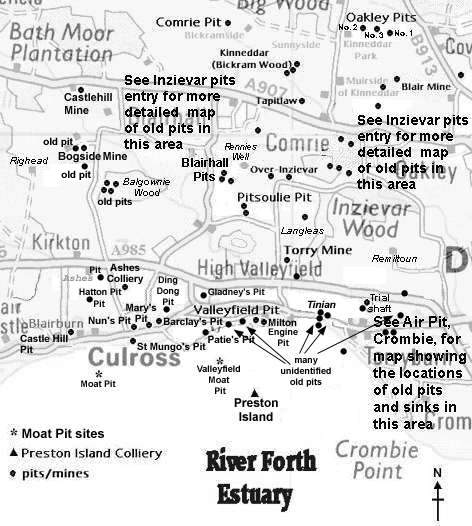
The Kinneddar or Oakley Nos. 1, 2, 3 Pits located to the
west of Dunfermline and north of the village of Oakley, were
originally owned by Fifeshire Main Collieries. Sinking around the
middle of the 19th century, the colliery was taken over by Oakley
Collieries in 1896. The Oakley pits appear to have ceased coaling by
1925 and were closed completely by 1932.
Sadly, there was a disaster at this colliery on 31 May, 1895
(see report later).
[Earlier pits are known to have worked ironstone and
coal in the Kinneddar/Comrie region immediately to the west,
and south-west, of this Oakley/Kinneddar Colliery and where
information is available, it appears in this index entry.]
M. Martin & Webmasters
 |
 |
 |
| Colliery opened: 1840s(?) | Colliery
closed: ceased coaling 1925;
completely closed 1932 |
|---|---|
| Source Date of Information Supplied | |
| Manager / Under-Manager / Men underground / Men above ground / Coal seams worked | |
| 1857 (Forth
Iron Co.)
Upper Kinneddar and Oakley Collieries From Hunts "Mining Records" |
|
| 1860 (Bowman & Co.) | |
| 1873 | |
| Mr William Brown, manager (See History item) | |
| 1880 (W. C.
C. Erskine)
Kinneddar Colliery |
|
| 1895 (Oakley Collieries Ltd.) | |
| Mr Robert
Calderwood, manager : Mr John Campbell, under-manager
. Mr Calderwood would leave his post the following year. |
|
| 1896 (Oakley Collieries Ltd.) | |
| William J. Love / John Campbell / 144 / 28 / Household, manufacturing and steam coals. | |
| 1900 (Oakley Collieries Ltd.) | |
| John Campbell, under-manager. | |
| 1902 (Oakley Collieries Ltd.) | |
| J. F. Lloyd / J. Campbell / 206 / 40 / Household, manufacturing and steam coals. | |
| 1904 (Oakley Collieries Ltd.) | |
| Archibald Barrie / ------------ / 183 / 42 / Household, manufacturing and steam coals. | |
| 1905 (Oakley Collieries Ltd.) | |
| A. Barrie / ------------ / 172 / 33 | |
| 1908 (Oakley Collieries Ltd.) | |
| A. Barrie / A. McNeil / 178 / 43 | |
| 1911 (Oakley Collieries Ltd.) | |
| A. Barrie / A. McNeil / 138 / 42 | |
| 1912 (Oakley Collieries Ltd.) | |
| A. Barrie, manager;
A. McNeil, under-manager. Nov: Mr Archibald Barrie leaves to take up an appointment in a Welsh colliery near Swansea. |
|
| 1917 (Oakley Collieries Ltd.) | |
| Feb: Mr William McGarrity, manager | |
| 1918 (Oakley Collieries Ltd.) | |
| Wm. Shepherd / A. McNeil / 153 / 45 | |
| 1920 (Oakley Collieries Ltd.) | |
| ------------ / ------------ / 245 / 77 | |
-------------------------------------
Information on the geology of the coalfield
at Oakley
(based on a report from 1900)
"The portion of the Fife coalfield lying on
the extreme western borders of the county has its strata dipping
westwards under the higher portions of the Carboniferous system,
which form the coalfield of Clackmannan. In a geological sense,
therefore, the Saline, Oakley, and Torryburn ground belongs to that
coalfield, rather than to that of Fife. But this tract lies well
within the limits of the county, displays so fully the coal series
between the lower and upper limestones, and contains, moreover,
points of such special interest, that a place must be found for it
in any account of the geology of Fife.
Examination of any Fife map will show that the tract we have now to
consider forms a strip of ground which begins on the north at the Outh
Hill, one of the western eminences of the Cleish Hills, and stretches
in a south-westerly direction to the sea at Torryburn. If the dip and
strike continued regular, this strip would be about a mile broad. Owing
partly to the thick cover of superficial deposits obscuring the strata,
partly to the want of evidence from borings and pit shafts, there are
parts of the strip about which little can be said. Only over three
sections of its course is information tolerably full. These are the
Saline, Oakley, and Torry mineral fields details of which will be
entered in individual colliery entries (see Main Menu - West Fife link - for Index).
The various mineral seams found in the
Saline coalfield have not been continuously worked into the Oakley
district but there can be no doubt that they extend across the
intervening space. About 530 yards to the east of Blairsgreen, a
pit has been sunk to the Dunfermline Splint seam which has been
found at a depth of 70 fathoms. In recent years, a number of bores
put down between Saline and Oakley have passed through all the
measures down to what is probably the Hosie Limestone.
The lower Dunfermline seams appear to thin out
in that part of the district, although their position can be fairly
well identified. South-east from the farm-steading at Sunnyside, a
mile and a half S.S.W. from the village of Saline, this limestone
was reached at a depth of 252 fathoms from the surface. What was
believed to be the position of the Dunfermline Splint Coal lay at a
depth of 207½ fathoms, but the seam was only 16 inches thick.
A seam of coal, 2 ft. 7 in. thick, with two partings of shale, and
supposed to be the Mynheer seam, was met with at a depth of 179
fathoms.
What was thought to be the Glassee seam occurred
at 157 fathoms, but this was only 16 inches thick. A splint coal, 2
ft. 7 in. thick, possibly the Kinglassie Splint or Duddie Davie
seam, lay at a depth of 116 fathoms. What was regarded as the
Jersey Coal was pierced at 103 fathoms but was only 3 ft. 5 in.
thick, including two partings.
Some thin coals, interstratified with shales and
ironstones, which were reached at 64 fathoms, may perhaps represent
the Lochgelly Black-band ironstone.
The seams which occur at Oakley and Comrie are:-
Janet Peat Coal, Overton or Oakley Parrot Coal, Cadell's Parrot
Coal, Upper and Lower Black-band Ironstone, Ontake Coal, Three-Foot
Coal, Six-Foot Coal (Jersey Coal), Four-Foot Coal (Duddy Davie
Coal), Dunfermline Splint Coal and Stinking Coal.
The various seams in the Oakley coalfield crop
out to the north-west of the Forth Iron Works. The Upper Ironstone
crosses the streamlet in the Bickram Wood, south of Sunnyside. The
Lower Ironstone crops out 200 yards lower down and crosses into
Perthshire [old boundaries] under the farm of Tapitlaw. The Ontake
Coal comes out on the bank of the burn at the Muirside sandstone
quarry, while the Three-Foot seam appears in the stream immediately
above Comrie Bridge.
These seams are powerfully affected by several
large faults which traverse the Oakley field. The most northerly
dislocation may possibly be a continuation of the great Loch Fitty
fault which makes the northern boundary of the Dunfermline
coalfield. It appears to enter the Oakley field in an east-west
line somewhere to the north of Blair House, and it passes into
Perthshire among the ironstone pits to the north-west of Tapitlaw
where it has a downthrow of 10 fathoms to the south.
A much more effective fault, a little further
south, runs in an east-west direction from the ironworks for half a
mile west of the county boundary, when it bends towards the
north-west and, passing under the Mains of Comrie, appears to unite
with the fault just referred to. The throw of this dislocation is
about 70 or 80 fathoms to the south, and it shifts the outcrops of
the strata for about two-thirds of a mile to the east.
The ironstone is at the surface immediately to
the west of the ironworks. To the south of Oakley Station another
fault brings up the Ontake Coal which crops out at the west end of
the South Oakley Cottages. At the road on the south side of these
cottages, another east-west fault throws down the strata 27 fathoms
to the south. The ironstones have been found in bores and pits all
over the ground to the west, and southwards to the coast at Torry.
The Upper Ironstone has been reached at a depth of 90 fathoms in a
pit on the Perthshire side of the county boundary, 700 yards due
south of Rennie's Walls.
An important boring (Blairhall Diamond Bore) has
been made by the Coltness Iron Company about a mile west of Oakley
Station and close to Rennie's Walls.
[The journal of this bore was courteously
communicated to the Geological Survey by the Manager of the Company
and is given, in full, at the end of the Appendix to the 1900
Geological Memoir. Due to its great length, it is not listed on the
website at the present time.]
-----------------------------------------
Oakley Colliery (19th century report)
| Name of coal | Thickness | Quality | Class |
|---|---|---|---|
| Five Foot Coal | 3 ft. | Very good | Steam |
| Kinneddar Splint Coal | 3 ft. 6 in. | Fair | Household |
| Plans of Abandoned Seams for Oakley | Pits or Mines designated in Plans |
|---|---|
| COAL; Success; Sourmilk; Jewel (1867); Jersey (1895) | Oakley Nos. 1, 2, 3 |
| COAL; Comrie Four Feet; Comrie Six Feet; Five Feet (1907) | Oakley |
| COAL; Four Feet; Six Feet | Oakley Nos. 2, 3 |
| COAL; Five Feet (September, 1921) | OAKLEY; Blair |
| COAL; Sourmilk (April, 1908); Splint (September, 1919); Upper Five Feet (September, 1923); Two Feet; Three Feet; Lower Five Feet (March, 1925) |
Oakley or Kinneddar
Nos. 1, 2, 3 |
---------------------------------------------
Information on coals worked at, or near, Oakley/Kinneddar Pits
(Based on a report from 1930)
The structure of the Oakley-Kinneddar coalfield is comparatively simple. The rocks dip fairly uniformly to the north-west, but at Blair and Oakley, in the south-east of the district, are flatter and undulating. Numerous faults intersect the field but, apart from the two large boundary faults on the north and south, these do not appear to persist for any distance. The base of the Limestone Coal Group crops out along the western side of the Luscar ridge which extends from Carnock north-eastwards to Craigluscar. The structure of the ground north of Carnock is very obscure and bores are few and unsatisfactory. Traces of old crop workings can be seen 700 yards north of Luscar House. These may be in the Stink Coal or in one of the still lower and thinner seams. The Carnock anthracite workings are limited towards the dip by converging faults. Outcrops of coals, to the north of the Kinneddar pits, are seen in the stream - the Bluther Burn - east of Langfauld Bridge where three sections were measured:-
(1)
| Flaggy sandstone | 3 ft. |
| Fakes, blaes and ribs | 4 ft. |
| COAL | 1 ft. 10 in. |
| Fireclay | 2 ft. |
| Fakes | 1 ft. |
(2)
| Faky blaes and ribs | 5 ft. |
| COAL | 1 ft. 8 in. |
| Fireclay | 1 ft. |
| Sandstone | 2 ft. |
These two are probably the same seam, repeated by faulting.
(3)
| COAL | 1 ft. 6 in. |
| Sandstone, clay top | 3 ft. 6 in. |
| Coaly rib | 1 in. |
| Sandstone | 2 ft. |
| Faky blaes | 4 ft. |
| Sandstone | 1 ft. |
| Faky blaes | 4 ft. |
| Sandstone | 7 ft. |
These sections are not sufficient to allow of definite correlations being made. The coal in sections (1) and (2), however, probably belong to the Dunfermline Group and may perhaps be an attenuated representative of the Five Foot Coal. The coal in section (3) again is perhaps the Mynheer seam.
Eight significant coals were present within a depth of 236 fathoms in the Oakley-Kinneddar district, namely:- Oakley Main Coal, Ontake or Sour Milk Coal, Comrie Three Foot Coal, Kinneddar Splint Coal, Fife Foot Coal, Two Foot Coal, Dunfermline Splint Coal and Stink or Sulphur Coal.
There has always been difficulty with the Main and Blairhall groups
of coals in this field and in many cases it is very difficult to be
certain of correlations from one part of the field to another. This is
not due to any complication caused by whinstone intrusions but simply
to the extraordinary variation of the strata themselves.
The Kinneddar Splint or Comrie Lower Four Foot Coal
is the most constant horizon of the Main Group and is readily
recognizable throughout the district. The seam is wrought as a steam
coal at Kinneddar Colliery where it occurs 64 fathoms from the surface.
The following is a section in the workings:-
| Blaes | - |
| Falling | 6 in. |
| COAL | 1 ft. 3 in. |
| Stone | 2 in. |
| COAL | 1 ft. 6 in. |
| Stone | 3 in. |
| COAL | 6 in. |
| Sandstone | - |
This seam has also been wrought in the vicinity of Comrie, Oakley, and Blair as the Comrie Lower Four Foot. Also known as the Comrie Splint, Oakley Splint, and Comrie Main, this coal can be identified with the Lochgelly Splint and Parrot seam.
A thin coal, locally reaching 20 in., occurs at levels varying from 3 to 7 fathoms above the Kinneddar Splint. The horizon is recognisable throughout the district, but the intervening strata may be nearly all sandstone in some places, and mostly blaes in others. This seam is perhaps the equivalent of the Ell Coal of Central Fife.
The next coal is an important seam known as the Comrie Six Foot or Kinneddar Five Foot and occasionally as the Oakley Five Foot. It lies 9 to 15 fathoms above the Kinneddar Splint and probably represents the Lower Jersey. In the west of the district it is usually a thick seam, up to 6½ ft. with one or more partings, but in the Kinneddar area occurs in two leaves separated by a fathom or more of sandstone. Below are the sections from the workings at Kinneddar:-
KINNEDDAR UPPER FIVE FOOT SEAM
| Sandstone | - |
| COAL | 8 in. |
| Stone | 4 in. |
| COAL | 1 ft. 4 in. |
| Fireclay | 7 in. |
| Faky sandstone | - |
KINNEDDAR LOWER FIVE FOOT SEAM
| Blaes | 8 in. |
| Sandstone | 9 in. |
| Stone | 1 in. |
| COAL | 1 ft. 9 in. |
| Fireclay | 1 ft. 6 in. |
| Fakes | - |
It is a good steam coal and at one time was wrought as the Comrie Six Foot at Comrie, Oakley, and Blair. Another good coal occurs close above the last seam at distances varying from 2 fathoms or less to 13 fathoms. This is the Kinneddar or Comrie or Oakley Three Foot. It is wrought as a steam coal at the Kinneddar Pits where the following is the section of the seam:-
| Blaes | - |
| COAL | 1 ft. 6 in. |
| Stone | 4 in. |
| COAL | 1 ft. |
| Blaes | - |
Occasionally a 2 in. stone rib is found six inches from the top of the upper leaf. In the west of the district bores show this seam to be 6 ft. thick in places, but at markedly differing levels above the Six Foot.
Several inconstant and thin seams of coal and ironstone occur in this field. One of note, approximately 7 fathoms below the Ontake Coal, was once known as No. 3 Comrie Blackband. A bore to the north of Oakley, near Blairsgreen, gives the following section of the seam:-
| Blaes | - |
| COAL | 2 in. |
| BLACKBAND IRONSTONE | 8 in. |
| COAL | 5 in. |
| Sandstone | - |
Several thin coals also occur in the strata overlying the Inzievar Ironstone seam, and one of these, the Oakley Upper Coal, attains workable dimensions in the neighbourhood of South Oakley - an old mining village that lay less than quarter of a mile south of Oakley Station. It is said to have reached the surprising thickness of 7 ft. but no records of workings are known. Elsewhere within the district it is difficult to identify and indeed is often absent.
This poster is one of several displayed by Fife Regional Council by the side of the former mineral railway (now part of the Kingdom cycle ways) which ran westwards from Dunfermline to Saline. It is sited close to the old mining areas of Oakley, Carnock and Pitdinnie, and the villages of Crossford and Cairneyhill.
 |
Quotes on this poster pertaining to the coal mining which formerly went on in this area are:
"FAIR THEE WELL YE MINING MEN, YOU GAVE YOUR LIFE TO THE PIT"
(from 'The Life o' the Collier' by Dave Spittal)
"Hear the echo of pick and shovel deep down as miners dig for black gold."
---------------------------------------------
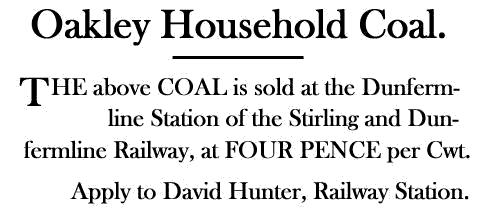
"Dunfermline Journal"
Friday, 27 April,
1855

"Dunfermline Journal"
Monday, 4 February, 1856
EXPLOSION IN A COAL PIT AT OAKLEY
FOUR LIVES LOST
On the forenoon of Monday week, an explosion of
foul air took place in a coal-pit at the Forth Iron Works, by
which, we regret to state, four lives have been lost. It appears
that an ironstone seam had been opened in the pit, about
thirty-three fathoms from the surface, where, to enable the men to
form the ironstone bottom, a scaffolding was placed, the coal seam
being seven and a half fathoms under that.
Three men were engaged in the pit when the
explosion took place. The noise produced, as heard in the
neighbourhood, resembled the sharp report of a cannon. A girl, 15
years of age, who was at the mouth of the pit, was instantly
deprived of life.
The cause of the melancholy accident cannot be
exactly explained, although there is a probability that it has
arisen from some sort of carelessness on the part of one or other
of the three unfortunate sufferers in the pit. They were the only
persons in the pit at the time, and were provided with suitable
Davy lamps. One of the oversmen, William Jamieson, and another man
named G. Drysdale, were in the pit shortly before, and there was no
symptoms of foul air. They, however, warned the men to be
cautious.
Some suppose that in trimming the lamp or lamps,
the old wicks, not properly extinguished, had been thrown
carelessly down the scaffolding, and that as no current of air was
there, that foul air might have been collected. Immediately after
the occurrence, every effort was made by the men in the works and
neighbourhood to recover the bodies of the men in the pit. This was
a work of considerable difficulty, but it was accomplished in about
two hours after the melancholy occurrence.
The names of the unfortunate sufferers are James
Erskine, who has left a wife and six children; Andrew Mitchell, who
has left a wife and four children; Robert Martin, unmarried. The
name of the female was Marion Drysdale.
----------------
The Coal Mines Inspection Act
Year ending 31stDecember, 1856
by Robert Williams.
The accident, No. 3 in Schedule, at Oakley, near Dunfermline, Fifeshire, occurred in a pit, newly sunk to the main coal , which produced a considerable quantity of fire-damp. In this pit, which is 85 yards deep, there is a band of ironstone 15 yards above the coal. In commencing the working of this ironstone, a scaffold was fixed in the pit; but being put there to serve a temporary purpose, no care had been taken to make the joinings of the planks air-tight which composed it. There was also an opening made in the partition (or midwall) where this scaffold was fixed, which would allow the downcast current of air to pass through it, into the upcast division of the pit, leaving that part of the pit under the scaffold, and the opening in the partition unventilated, which showed a great want of consideration or judgment on the part of those under whose management these operations were conducted, in not either having the joinings of the scaffold made air-tight or the space under it ventilated, particularly when it was known that the coal at the bottom of the pit generated a quantity of fire-damp. By what means the carburetted hydrogen gas was ignited is unknown. The three men that were on the scaffold were found dead at the bottom of the pit, and a young woman who was on the pithead at the time was killed by a piece of wood falling upon her, which was thrown out of the pit by the force of the explosion.
[The victims were identified as James Erskine, Robert Martin, Andrew Mitchell and Marion Drysdale.]
-----------------------------------------------------
"Dunfermline Press"
14 May, 1859
MINERS' DELEGATES MEETING
On Saturday last, a meeting of delegates from the mining districts of Fifeshire was held in Crombie's Hotel, Bruce Street. On the roll being called, there appeared delegates from the following collieries - namely, Oakley, Elgin, Wellwood, Halbeath, Cuttlehill, Little Raith, Donibristle, Muttonhole, Overton, Burnside, Cowdenbeath, Lumphinnans, Inzievar, South Steelend and Lochgelly, the whole representing a body of 758 men, members of the Union. Wm. Anderson was called to the chair. The principal subject of discussion was the funds of the Union, whether they should be massed in a general fund, or left separately in connection with the individual works. It was ultimately agreed that these should be paid one penny for local expenses, one penny for a victim fund and twopence for general expenses.
The draft of a petition to the House of Commons was then read. The petition was in favour of eight hours daily labour, the extension of the factory system regarding education to the children of miners, the adoption of improved machinery for the prevention of accidents, the levying a tax of one farthing per ton on minerals for the support of the widows and orphans of miners killed by accident or for miners disabled by working in the mines, the weighing of minerals sent up by miners, and the removal of females from banks and pit-heads. ...
.. It was stated, on the part of the Oakley miners, that all they sought for was the sympathy of their fellow-workmen in the county, though they would gladly receive assistance for the old and infirm. The men at Oakley had come to the resolution to leave the colliery and seek employment elsewhere. It was further stated that wages had been very low for the last 12 months. The highest daily earnings of the ironstone miners was 3s., and the coal-miners 2s. 8¼d.
After the various expenses were deducted, the weekly wages amounted to about 12s. If the reduction of sixpence a-day was submitted to, the ironstone workers would not be able to earn more than 1s. 6d. and the coal-miners 1s. 2½d. daily. ...
-----------------------------------------------------
"The Scotsman"
23 May, 1859
STRIKE AT OAKLEY
During the week a reduction of the wages of the miners belonging to, and the workmen at, Oakley Iron Works, took place, to the extent of sixpence per day, in consequence, as was alleged, of a fall in the price of iron. On intimation being given of this reduction, the miners held several meetings, at which it was at length resolved not to submit to the reduction. Mr Ferrie, the manager, in consequence of the reduction in the price of iron, would not consent to give the former wages until a rise took place in the price of the company's manufacture. The miners accordingly resolved to leave the various pits, and go in search of work elsewhere, which they did, and the Oakley Company are obtaining a supply of coal to combine with their own from the Clackmannan Coal Company. As for the operatives at the Oakley Works, we may state that, after being on strike for a few days, and the furnaces damped, the men had the good sense in the circumstances to submit to the temporary reduction in their wages made by Mr Ferrie, and on Saturday they resumed work.
-----------------------------------------------------
"Dunfermline Press"
28 May, 1859
MEETING OF MINERS' DELEGATES
..The strike at Oakley was the chief subject under discussion. It was stated that 300 of the men had either removed or were removing, and to assist them there was voted from the "victim fund", 10s. to married men and 6s. to those who are unmarried. ...
... We are glad to learn that the Oakley miners have returned to their work, a proceeding which in the circumstances is highly commendable.
-----------------------------------------------------
"The Scotsman"
28 June, 1870
DUNFERMLINE. - Pit Accident. - A miner, named Michael Dollan, aged fifty years, was on Saturday severely injured at Oakley by the falling down of a ton of stones from the roof of a pit in which he was working. His right thigh and three of his ribs were broken, and the back of his head and right arm were also severely cut.
-----------------------------------------------------
"Dunfermline Saturday Press"
28 December, 1889
FATAL ACCIDENT IN A WEST OF FIFE COAL PIT
An accident, by which one man was killed and another
injured, occurred on Thursday afternoon in a pit which is
being sunk by the Kinneddar and Blair Coal Company at
Cowstrandburn, near Saline. It appears that Robert Ramage,
Carnock, and Thomas Donaldson, Dunfermline, had lighted the
fuse of a shot, and given the signal to be hoisted in the
"kettle" to the surface. While the men were
ascending, the cage struck the sides of the shaft, and
breaking part of the tackling the poor men were precipitated
to the bottom, a distance of six fathoms. The shot went off
immediately thereafter, and on another cage and other men
being lowered, it was found that Ramage was dead, while
Donaldson had sustained a severe shock to the system and was
much bruised about the head and body.
Ramage was 45 years of age. The accident occurred through
the bow of the kettle snapping and how Donaldson escaped with
his life is a mystery.
------------------------------------------------
"The Scotsman"
23 April, 1891
EXTRACTS FROM THE PROSPECTUS OF
THE FIFESHIRE MAIN COLLIERIES, LIMITED
INCORPORATED UNDER THE COMPANIES ACT, 1862 to 1890.
SHARE CAPITAL, £150,000, Divided into -
15,000 EIGHT PER CENT. CUMULATIVE PREFERENCE SHARE of £5 each ...
£75,000
15,000 ORDINARY SHARES of £5 each ... £75,000.
This Company is formed to purchase the right to work for minerals in three leasehold properties known respectively as Upper Kinneddar, Blair, and Nether Kinneddar, situate in Fifeshire, Scotland, to work, the underlying coal field, and further develop the several seams of coal, iron ore, limestone, fireclay, and other minerals on the said property.
This coalfield, the area of which is about 2000 acres, is situate in Fifeshire, Scotland, four miles west of Dunfermline, and six miles from the newly-opened Forth Bridge. The leases are to run for thirty-one years from May 1890.
Mr Cheesewright says - "In addition to the borings made in the property, a rectangular shaft 12 ft. by 5 ft. has been sunk to a depth of 24 fathoms on Upper Kinneddar, and fitted with pumping and hauling machinery. In this shaft four workable seams of coal run through the property. I also saw some bands of splendid fireclay, which will be a source of great revenue to the Company. The property is of very great value, being undoubtedly a very rich coalfield, with an unlimited supply of fireclay of first-rate quality, with proper appliances, and when the pit is in full working order, an output of from 350 to 450 tons of coal and from 150 to 200 tons of fireclay per day can easily be maintained. The fireclay alone will show a handsome profit on the cost of its production."
Mr Gregory says:- "The Kirkcaldy and District Railway Company are applying to Parliament for powers to build a line across Upper Kinneddar, and as the course of it will be only about half-a-mile north of the present pit, a short branch might be made to connect the Stirling, Dunfermline, and Edinburgh part of the North British Railway. The new Forth Bridge passes the south edge of Blair, and is connected with the estate by sidings. The fixed rents are moderate, merging into exceptionally low royalties for coal, being 5d. per ton on common coal from Upper and Nether Kinneddar, and 5d. per ton for large, and 2d. per ton for small, from Blair. There are miners' cottages on the Blair property which can accommodate about 200 colliers. There is also 'Blair House', which could be used as a dwelling-house for the managers and for offices, and also other buildings. The present price of good household coal at the pithead is about 10s. per ton. The cost (including royalties, winning, raising, and loading) is about 4s. per ton. I estimate the amount of common coal in the leaseholds at over 25,000,000 tons; but say only 12,000,000 tons, this will give an output of 400,000 tons a year for thirty years. On this modified calculation, and taking into consideration the lowness of the royalties, and that the cannel coal, ironstone, and fireclay have not been included, I value the property at £200,000.
In every respect I consider this is a most valuable mineral field, and one which ought to pay well under prudent management, and which may be worked up into a most successful affair by energy and skill."
Mr Cheesewright says:- "I cannot too forcibly urge upon those connected with this valuable property the importance of commencing work at once. There was never a time when the coal found in Fifeshire realised such high prices as at present. The lowest estimate I can put as the value of the property is £220,000. This I do after careful consideration of the bores, my knowledge of the field, and easy access by road or rail to the property."
During the past fifteen years the output of coal from the Fife collieries has shown a marked and steady increase, as proved by the returns published by the Board of Trade - thus:-
In 1874, annual output of Fife coal amounted to 1,390,678 tons.
In 1880, annual output of Fife coal amounted to 1,93,511 tons. (38 per cent. increase over 1874.)
In 1889, annual output of Fife coal amounted to 2,761,616 tons. (Nearly 100 per cent. increase
over 1874.)
The purchase price of the several mineral leases enumerated above, together with the machinery
and plant, including all mineral and other rights and the obligations of the Vendor, hereinafter mentioned,
has been fixed by the Vendor (who is the promoter of the Company) at £25,000 in fully-paid up Preference
Shares, £25,000 in fully-paid up Ordinary shares, and the balance (£25,000) in cash. £75,000 of the Shares
will thus be available to provide working capital. The Directors are advised that £20,000 will be ample to
sink the new pit No. 1, supply all machinery for it, and open up the seams of coal for an output of 500
tons a day, but they will reserve £25,000 for these purposes. The subscription of the Shares now offered
will, as the Directors are advised, provide for an increased output up to 2000 tons per day.
Judging by Mr Gregory's report, the cost of winning and raising coal to the pithead at Kinneddar,
including royalty and way-leave, will not exceed 4s. 6d. per ton. The selling price of the "splint"
and other good household coal in waggons at the pithead at the present time averages fully 10s. per ton
according to current prices in Fifeshire, showing a gross profit of 5s. 6d. per ton. To be on the safe side,
however, the profit is estimated at 4s. 6d. per ton only.
Taking the daily output of coal at only 500 tons, and allowing for 260 working days, the total annual
output would be 130,000 tons; and assuming a gross profit of 4s. 6d. per ton as above, this would
amount to a gross annual income of £29,250.
Less, as under -
Management expenses, say £5000
Sinking fund to redeem capital within the term of the leases, say on a 3 per cent. table ... £3300
Eight per cent. on £75,000 Preference Shares ... £6,000
Eight per cent. on £75,000 Ordinary Shares ..... £6000
Leaving a surplus of ... £8,950 for division - one-third to the Preference Shares and two-thirds to the
Ordinary Shares.
The above Estimate, it will be noticed, is calculated on a daily output of only 500 tons, but
should the output be increased to 2000 tons a day Dividends would, of course, be proportionately increased.
In the above estimates no credit is taken for the profit to be obtained from the fireclay and ironstone, which
the Directors are advised is considerable.
Full reports on the coal, fireclay, and other minerals lying in and under the properties have been
prepared by Mr F. H. Cheesewright, A.M.I.C.E., M.S.E., 60 Haymarket, S.W., and by Mr T. Currie
Gregory, G.S., M.E., C.E., London, on the instructions of Messrs Andrew Mellor & Smith, Solicitors
for the Company, acting under the authority of the Chairman of the Company, and all the above
statements and estimates are made by the Directors on the basis of such reports, and have
been duly certified by those experts to be correct. These reports and estimates, together with
plans and surveys of the properties, can be seen at the Offices of the Company. ...
------------------------------------------------
"Dunfermline Saturday Press"
3 October, 1891
The Fifeshire Main Collieries Company are now supplying household coals which are giving the greatest satisfaction to all purchasers.
------------------------------------------------
"Dunfermline Saturday Press"
28 November, 1891
THE OAKLEY COALFIELDS
The Fifeshire Main Collieries (Limited) are making great progress in developing their property. The Company took possession seven months ago, and are now raising coal from their No. 1 pit, and a second shaft is rapidly being sunk. The buildings and plant are in course of erection, and will shortly be completed. We hear also that the North British Railway Company are actively constructing a branch line to connect the pits with their main line near Oakley Station.
------------------------------------------------
"Dunfermline Saturday Press"
2 January, 1892
STRIKE AT KINNEDDAR COLLIERY
The miners employed at the Fifeshire Main Coal Company's works at Kinneddar came out on strike on Wednesday in consequence of it being proposed to introduce new conditions of employment. The rules at which the men particularly feel aggrieved are those which provide for warnings being lodged on certain dates, giving the employers power to determine at what hours work shall be begun and stopped, and for making no allowance for hutches which may contain what is known as foreign material. The case was submitted to a meeting of the Wages Committee of the Fife and Kinross Miners' Association on Wednesday night, when approval was expressed of the men's action in refusing to comply with the new conditions.
------------------------------------------------
"Dunfermline Saturday Press"
29 October, 1892
ACTION AGAINST THE FIFESHIRE MAIN COLLIERIES SEQUEL TO THE FLOODING OF A PIT
In the Dunfermline Sheriff Court on Monday the record was
closed in an action for payment of £110 raised by James
Addie, pit sinking contractor, Dunfermline, against the
Fifeshire Main Collieries (Ltd.).
The defenders carry on the business of coalmasters at
Oakley, and in September 1891 they accepted an offer by the
pursuer to sink a shaft on the lands of Upper Kinneddar,
Oakley. The pursuer offered to perform the work within six
months after he received instructions to commence, at the
rate of £21 per fathom. It was agreed that eight months
should be allowed for the sinking of 80 fathoms, but the
directors were to give a bonus of £100 for every month
saved by the contractors.
Work was begun on the 26th October, but only one
shift of men instead of three could be employed owing to the
want of pumping and winding engines. This machinery was not
on the ground on 3rd December, and operations were
stopped until 26th February, when three shifts of
men were started, but after five days' work they had to
stop in consequence of the shaft being drowned out with
water.
On the 2nd April operations were resumed, and
were continued until 2nd June, but had to be
suspended through the tumbling crane seat of the engine
breaking down.
The pursuer was prevented recommencing the sinking until
20th July, and three days afterwards he was forced
to stop owing to the shaft being flooded with water. About
ten days later another start was made, but work had shortly
to be ceased.
A dispute then arose as to putting in larger pipes and rods,
and the pursuer removed his tools.
The defenders admit generally the delays which occurred, and
explain that they provided ample and efficient machinery so
far as could be foreseen after making all reasonable
inquiries and taking all due precautions, but the growth of
water was much beyond what was anticipated, and led to them,
in the course of the sinking, procuring stronger pipes.
Such contingencies, they say, are always contemplated in
pit-sinking contracts, and the pursuer must be held to have
had them in view in making his offer. They deny that the
pursuer was subjected to delays for which they were
responsible. They plead that the pursuer, having
unjustifiably terminated the contract, and having thereby
caused them loss and damage to an amount exceeding the sum
sued for, they ought to be assoilzied [absolved]. Sheriff
Gillespie suggested that a plan should be lodged or he should
visit the place. The agent for the defenders said that the
Sheriff could not go down the pit without being drowned.
Proof was fixed for Friday, 18th November.
Agents:- For pursuer, Mr J. C. Macbeth; for defenders, Mr
John Ross.
------------------------------------------------
"Dunfermline Saturday Press"
1 June, 1895
APPALLING PIT DISASTER NEAR DUNFERMLINE
NINE LIVES LOST : SEVERAL MEN INJURED
An appalling pit disaster occurred yesterday
afternoon, at one of the pits of the Fifeshire Main Collieries,
between four and five miles west from Dunfermline.
Fire broke out at No. 3 pit, while several men
were working and the results were calamitous - two miners being
killed and seven injured, four of whom afterwards succumbed. The
pit itself was almost totally wrecked.
The shaft is sunk to the Jersey seam 55½
fathoms down, and to the Lochgelly seam at a depth of 67½
fathoms. There is another shaft to the seams for ventilating
purposes, known as the "upcast". The men started work as
usual at seven o'clock yesterday morning. At a quarter to
three, after a number of men had finished work for the day, and had
been raised to the surface, Mr Robert Calderwood, the manager,
noticed that there was more smoke coming up the upcast than should
have proceeded under ordinary circumstances from the furnace at the
bottom of the Jersey seam.
Mr Calderwood at once descended the shaft, and
found that the furnace had ignited the woodwork surrounding it. He
speedily set about stopping the air current, and ordered a number
of men to do the same at another point. A squad of men was also
sent to the bottom of the Lochgelly seam, in order that the
communication might be cut off entirely. He afterwards descended
the Lochgelly seam himself to see how the men were getting on
there; but had not been many seconds down when he heard shouts
proceeding from the "Jersey". Mr Calderwood states that
the signal was given for the cage to be raised to that seam; but,
instead of stopping there, the cage, probably through some
misunderstanding, was drawn right into the pithead.
In passing the Jersey seam, Mr Calderwood
observed a tremendous volume of smoke proceeding from it, and the
heat was intense. No time was therefore lost in lowering the cage
again. Four or five men were rescued from their perilous position
and brought to the surface - some of them in a terribly injured
condition. The cage was sent down a second time, and on this
occasion six or seven men were drawn to the pit bank - several of
them, as in the former case, suffering from fearful injuries. After
the ten or twelve men had reached the pithead in safety, it was
discovered that two miners were still missing. Mr Calderwood asked
for volunteers to accompany him down the shaft; and John Cooper,
underground manager; and John Hynd, night foreman, readily offered
to make the descent. The cage was accordingly lowered once more,
but no trace of the two men could be found. A pony was, however,
brought to the surface. It was thought by some that there was no
one down the shaft, but others insisted that two men - Frank Sharp
and Thomas Sharp - were still underground.
The rescue party made another descent; but, on
coming up again, they had to report for the second time that, so
far as finding the two missing men was concerned, their journey had
been fruitless. Still undaunted, and regardless of the danger they
incurred, the rescue party ordered the cage to be lowered a third
time, and on this occasion they went right down to the bottom of
the shaft, at the Lochgelly seam.
There they found the lifeless bodies of the two
men whom they had so heroically searched for. The two Sharps had a
terrible death. While endeavouring to escape from the Jersey seam,
in the blinding smoke, the darkness, and the intense heat, they had
rushed headlong into the lower shaft, and were dashed to the
bottom, a distance of twelve fathoms.
Within half-an-hour from the time the outbreak
of fire was noticed, the "upcast" shaft and the pithead
were practically wrecked. The shaft was lined from top to bottom
with wood, and the flame rose twenty feet above the winding drum,
which is forty feet in height.
The pit-mouth was covered over last night, and
orders were given to stop the pumping engines. The water, which
flows at the rate of between 300 and 400 gallons a minute, will,
therefore be allowed to rise in the shaft.
As already stated, the names of the two men who
were killed were Frank Sharp and Thomas Sharp. The former was about
61 years of age, and the latter about 30. Both men resided in
Comrie village.
The list of the injured is as follows: William
McKenna, Torryburn; Alexander Thomson, Blackhouse; John Hunter and
Thomas Hunter, Comrie; George Ramage, George Bell, and Alexander
Sharp, Oakley.
Drs Dow, Lee, and Tuke drove out to the scene of
the disaster, and did what they could to alleviate the suffering of
the injured men, and to prepare them for removal to the Dunfermline
Cottage Hospital. Those who had sustained the severest injuries
were conveyed to the Hospital in the ambulance waggon, and the
others upon a light lorry, and one in a wagonette.
The whole seven men were brought to the Hospital
- one of the large wards having been put in readiness for their
reception. The medical gentlemen in attendance were Messrs Dow,
Sturrock, Lee, Fraser, and Tuke. In order to cope with the work,
the services of the two district nurses were called into
requisition. Provost Walker and Mrs George Mathewson were present
at the Hospital all evening, and rendered much valuable
assistance.
Some of the injured men were in a fearful
condition. In one or two cases their faces were almost beyond
recognition, and their hands terribly blistered and swollen, while
their bodies were scorched all over. The sufferings of the poor men
must have been terrible in the extreme.
FOUR DEATHS AT THE HOSPITAL
Four of the unfortunate men admitted to the
Hospital succumbed to their injuries last night and this morning -
their names being John Hunter and Thomas Hunter, Comrie; George
Ramage, Oakley; and Alexander Thomson, Blackhouse. Much sympathy
will be felt for the relatives of the poor men who have had such a
terrible death.
At four o'clock this morning, one of the
three survivors was believed to be just dying; while, in the case
of another, little hope was entertained of recovery.
Kinneddar Pit Disaster Report
31 May, 1895
REFERENCES: The Mines Inspectors Report 1895. Mr.
Ronaldson.
Report to the Right Honourable The Secretary of State for
The Home Department by Sheriff John Comrie Thomson and J. B.
Atkinson, Esq., H.M. Inspector of Mines on the Accident at
Kinneddar Colliery, Fifeshire. Cmd. 1955.
The Colliery Guardian, 17 January, 1896, p. 119.
The colliery was the property of Fifeshire Main Collieries, Limited. There was a large furnace at the bottom of the Jersey upcast shaft which was always kept burning and, for a few days before the disaster, it was necessary to light more fires to clear large amounts of gas that had accumulated in the mine. The fires set fire to the wooden lining on the upcast shaft, the No. 3 Pit, which fell down the shaft.
At the time of the disaster, the workmen were out of the
mine and underground operations were confined to repair work.
Two coal seams were worked at the colliery, the Jersey and
the Splint and three shafts were in use. No. 1 Pit was 12
feet x 5 feet and 22 fathoms deep and lay 500 yards to the
rise of the Nos. 2 and 3 Pits.
No. 1 was used only as a downcast shaft and the air taken to
the Jersey workings of the No. 2 Pit. The strata rose one in
five and a half to the north-west..
The No. 2 shaft was the main shaft (downcast) and was 21
feet x 7 feet and was used for drawing coal from both seams,
the transport of men, pumping water.
The Splint coal lay at 65 fathoms and the Jersey coal 11
fathoms above this.
There was only one cage used from both the Jersey and the
Splint seams at the time of the accident and the other cage
ran in the shaft to balance the engine.
The No. 3 shaft was sunk to the Splint coal and was used as
the upcast shaft for the colliery. It was also the escape
shaft and second outlet and it was in this shaft that the
accident occurred.
The air that went down the No. 2 Pit entered the Jersey seam
and passed round the working faces in one current. The
remainder of the air passing down the shaft divided into two
currents at the bottom of the shaft; one to the east, and one
to the west of the Splint coal workings entered the No .3 Pit
and met the air for the Jersey where it all went to the
surface.
The total quantity of air passing through the pit was 20,000
cubic feet of air per minute.
The miners used naked lights, and safety lamps were used only on necessary occasions. The ventilation was good but the weather was becoming warmer and this impeded the ventilation and more ventilation was required to clear away some blackdamp that was found at the extremity of the west level in the Jersey seam.
The No. 3 Pit was 12 feet x 6 feet with a wooden lining
which was three inches thick and extended from the surface to
the Splint coal with a break of 13 feet just below the Jersey
coal where the crosscut entered the shaft.
On the east level, between Nos. 2 and 3 shafts in the Jersey
seam, there was a wooden door separating the intake and
return currents.
The sinking of the No. 3 Pit had been completed only at the
end of 1893. Up to November, 1894, a fire lamp and an open
fire produced the ventilation and then a furnace, known as a
cube in Scotland, was constructed and built to the
manager‘s instructions. This was 6 feet x 2½ feet
with sides constructed of 9-inch brickwork and the bed of
iron plates which were open at both ends.
The furnace burned 10 to 14 cwt. of coal in 24 hours. The
flame was used after the furnace was finished but the fire
was discarded. In order to deal with any fire that might be
caused, a sinkers kettle, which held 120 gallons of water,
was kept nearby. It was the practice of the bottomers at the
No. 2 shaft to carry two pails of water to the No. 3 Pit. The
content of one pail was thrown over the slides and a plank
fence in the shaft and the other was emptied into the pail to
keep up the water level. The timber exposed to these fires
was never ignited but it was realised that it could do so. It
was stated, by the people who put the water on the planking,
that it steamed when they did so.
On the day-shift, the cube was visited by the day-shift
fireman, Alexander Thompson, and by the bottomers in the
Jersey seam. During the afternoon, and up to 11 p.m., the
night-shift fireman attended them and afterwards left a man
in charge until the day-shift fireman descended.
The blackdamp issuing into the pit needed increased
ventilation and Cooper, the under-manager, with the help of
Thompson, but on his own initiative, erected an open
fireplace in the bottom of the No. 3 Pit. It consisted of
three feet iron rails on bricks and crossed by other rails. A
fire of about 3 cwt. of coal was kindled at about 7.30 a.m.
and no precautions were taken to prevent the fire igniting
the woodwork.
When Cooper went to the surface for his breakfast, he saw
Mr. Calderwood, the manager, and reported to him what had
been done. Mr. Calderwood gave instructions to have the place
watched.
On the day of the accident 118 people descended the mine
at 7 a.m. and all went well until the shift was nearly over.
The bottomer at the No. 2 Pit was not at work and his place
had been taken by another.
At 2.30 p.m., three small flames were seen in the packing
just above the bars and attempts were made to put these out
by using buckets of water. This was not successful and an
effort was made to take down the timber but this was also not
successful. The flame was carried forward in the shaft and
the timber was soon blazing. It reached the surface and the
framework and pulleys were set alight as well as the wooden
building on which the winding-engine was placed.
Shortly after the men had stopped work, the manager
noticed great volumes of smoke coming from the Jersey seam
upcast shaft. He went down at once and found that the furnace
was a mass of flames. Within half an hour the upcast shaft
and the pithead were totally wrecked and flames rose sixty
feet into the air, twenty feet above the winding-drum.
The manager quickly set about trying to stop the air
reaching the fire and ordered men to go to the bottom of the
pit to cut off all communications. He followed a little later
to see how they were getting on with the work. He had not
been down in the lower seam for long when he heard cries
coming from the Jersey seam.
He returned in the cage but there was a misunderstanding and
he was not taken to the Jersey seam but to the surface. He
had passed the Jersey seam and felt an intense heat. He lost
no time in lowering the cage again to the mine. When it came
up it contained four men who were terribly burned and in
agony.
The cage was sent down for a second time and returned with
three miners in a similar condition as the first party.
One eyewitness said, " I hope I‘ll never live to see such another scene. The cage came up, the men fell out of it anyhow, screaming and roaring with the pain. We could do nothing to help them, for the flesh came off where we touched them. It was an awful sight. The rest of the men were crying like bairns."
Doctors were sent for and the men were tended at the
pithead for the blisters on their hands, faces and bodies
which were badly scorched. It was not thought that their
condition was serious but it was realised the following
morning that seven men had died.
All the dead men were working at the stoppings that were
being erected to try to put out the fire. They did not
realise the danger they faced as burning material fell down
the shaft and filled the workings with smoke and fumes.
Lockhart Bellock was the only man to get out alive and he
gave a first-hand description of the conditions in the mine:
"I went down the pit at half-past six in the morning and
worked as usual until a quarter-past two o'clock. I had
occasion to come to the bottom of one of the shafts at that
hour, and on passing the upcast shaft, Alexander Thompson,
the pit inspector, said to me, 'Come here, the woodwork
of the upcast shaft has caught fire.'
There is a big tank of water at the bottom of the mine and
we at once got pails and commenced to pour water on the
flames. We very soon found the work was no use and I really
began to think we had got into a bad job. Seeing that we
could do no good, I stopped pouring water and rushed to the
workings and told the men to run because the upcast shaft was
on fire. All the men in that section put on their clothes and
we rushed to the bottom in the hope of getting to the
surface.
When we reached the level leading on the Jersey seam
bottom of the upcast shaft, we met the manager and he asked
Thomas Sharp and me to go and build an airtight-stopping to
cut off the draught. We worked for about half-an-hour and
gradually the air became so bad that it was with difficulty
the lamps could be kept in. At this stage, the manager came
along and asked us how we were getting on. We replied that we
should require assistance and he sent old Frank Sharp to give
us a hand. I had my side of the stopping built and old Frank
had almost finished his when a terrible crash took place in
the upcast shaft and the flames burst upon us. The air for
this point turned and our lights went out. We saw it was no
use in doing any more and began to rush for the downcast
shaft. We found it a difficult matter to pilot out in the
darkness down the incline, and we got hold of the signal wire
and by this means got into the roadway leading to the bottom
of the shaft.
As we went along we found the heat near the roof so intense
that we were compelled to crawl on our hands and knees.
Before we had gone far, I heard Tom Sharp cry out, "I am
choking! I replied, "Come away, we are nearing the
bottom and we may get up!
Tom Sharp seemed to make a determined effort after this for
I found them both striking up against my heels. Here, I
became faint and confused that I have only a faint
recollection of what happened. I remember, however, that, on
nearing the bottom, I struck against my clothes and pick
where I had laid them down when I was called away to the
stoppings. I then knew that I was going right into the mouth
of the pit, and ran a danger of falling from the Jersey to
the Splint seam. I made a turn and went round the back of the
pit, and on groping about, I could not find the Sharps. I
suppose the poor men had gone straight on, and had fallen to
the bottom of the shaft where they were found. On getting a
faint glimmer of light, I found Thompson signalling for the
cage to come down.
When it came, we got in and were carted to the surface. I
then realised for the first time the struggle I had had for
life. I soon recovered my strength and I am now suffering
more from a strike with a stone, which fell on me from the
roof, than from the burns!
It was thought that all the men were out of the pit when
it was discovered that two were missing. The manager called
for volunteers to descend the pit and two men came forward.
They searched for some time but found nothing and returned to
the surface thinking that a mistake had been made but those
on the pit bank were positive that Frank and Thomas Sharp
were still underground. Eventually the rescuers found the
bodies of the two Sharps at the bottom seam. They had tried
to escape from the Jersey seam and had fallen down the shaft
in the smoke and fumes.
| The men who were burned: | ||
| Name | Age | Job |
| Alexander Thompson | 31 | Fireman |
| Alexander Sharp | 42 | Miner |
| William McKenna | 42 | Miner |
| Thomas Hunter | 41 | Miner |
| George Ramage | 31 | Miner |
| John Hunter | 28 | Miner |
| George Bell | 28 | Miner |
| The men who fell down the shaft: | ||
| Frank Sharp | 52 | Miner |
| Thomas Sharp | 23 | Miner |
The disaster left eight women widows and forty fatherless
children. An inquiry was held at the Court House in
Dunfermline on 15 July and all interested parties were
represented.
The inquiry found that the actions of Cooper and Calderwood
made an error of judgement in making the fire but found that
no one was to blame for the seven who were burned to death.
As for the men who fell down the shaft, it was found that the
rules had been breached.
The inquiry finished with the following comments: "The
evidence was led to the superiority of a fan over
furnace-ventilation but as regards safety and efficiency, and
it was admitted by the manager that the furnaces were only a
temporary expedient and that the erection of a fan was
contemplated. There is nothing +in the Coal Mines Regulation
Act 1887 forbidding the use of furnaces for ventilating
purposes and their use at the present time is not uncommon,
nor are they dangerous if the proper precautions are taken.
We do not, therefore, think it necessary to make any
recommendations on this head beyond the obvious suggestion
that where furnaces are employed, they should be placed in
such a situation and under such conditions that adjacent
inflammable material can not be set on fire by them.
-----------------------------------------------------
"Dunfermline Saturday Press"
8 June, 1895
THE KINNEDDAR PIT DISASTER
Hearts are sad, and homes are
lonely -
A little while ago so glad;
Faces that were bright and cheerful,
Now have got a look so sad.
If we knew what memories linger
Round each dear departed friend -
Memories deep and true and tender,
Thoughts of which can never end -
We would have a deeper pity,
We would have a truer love,
For the orphans, and the widows,
Whose dear ones God has led above.
But to God each heart is open,
He alone can see their grief;
He alone can shield and guide them;
He alone can send relief.
Yet each good, true-hearted servant,
Still may lend a helping hand,
And may make bereaved hearts glad
With glimpses of a better land.
Sow the seeds of love and pity;
Then, when harvest-time has come,
Each will be well rewarded
When the Master says, "Well done".
Carnock, 6th June 1895 B. H.
More info on the Oakley/Kinneddar Disaster.
May 1895

---------------------------------------------------
"The Scotsman"
26 June, 1895
THE FIFESHIRE MAIN COLLIERIES. - Within less time than was expected the water has been pumped from the workings at the Fifeshire Main Collieries, and mining operations have already been resumed in the upper seam in which the fire broke out on the 31st ult. A free passage has been established between the downcast shaft and the old pit, which will in the meantime serve the purpose of an upcast shaft. Preparations are being made for repairing the damaged upcast shaft, and until this work is completed, the Lochgelly splint coal cannot be wrought. Already, however, the majority of the men who remained in the district have been re-engaged, and it is expected that the normal output will soon be produced.
---------------------------------------------------
"Dunfermline Saturday Press"
10 August, 1895
ACCIDENT AT THE FIFESHIRE MAIN COLLIERIES
Edward Flint (28), labourer, Baldridgeburn,
Dunfermline, met with an accident at the Fifeshire Main Collieries
on Wednesday. He was engaged, along with others, in erecting a
pithead frame at No. 3 Pit, where the recent disaster occurred. He
had climbed to the top of the frame, at a height of about 35 feet,
for the purpose of attaching a rope. While he was so engaged, the
woodwork came away unexpectedly.
Flint managed to keep on the frame until he was
near the ground, when he leapt off. Two of his ribs were broken,
and he was cut about the head. The injured man was removed to the
Dunfermline Cottage Hospital, where he was attended by Dr
Tuke.
---------------------------------------------------
"Dunfermline Saturday Press"
23 November, 1895
While John Anderson, miner, Whitemyre, was working on Saturday at No. 2 Pit, Kinneddar Colliery, he was knocked down with such violence by a fall of coal that his nose was actually split in three. He was also injured about the back and legs. Anderson was removed to the Cottage Hospital.
---------------------------------------------------
"Dunfermline Saturday Press"
16 May, 1896
In Dowell's Rooms, Edinburgh, on Thursday, the Fifeshire Main Collieries were sold as a going concern for £13000 - £600 above the upset price. It is not known who the purchaser is.
---------------------------------------------------
"Dunfermline Saturday Press"
23 May, 1896
The fact that Kinneddar Colliery has been purchased and is to be worked by a new Company has given much satisfaction in the district, as the miners here will continue to have employment. The new Company, it is reported, are likely very soon to develop the Kinneddar coalfield by sinking down to the seams of better quality. Should they do this, the colliery will likely take a better hold of the market, so that better and brighter days may be in store for the district.
---------------------------------------------------
"Dunfermline Saturday Press"
27 June, 1896
PRESENTATION TO A COLLIERY MANAGER
On Saturday afternoon, the workmen at Oakley Colliery - previously the Fifeshire Main Collieries - showed their respect for Mr Robert Calderwood, their late manager. The workmen met in the school-house, and, headed by a piper, marched to Mr Calderwood's residence, Blair House, where they drew up on the lawn. Mr John Campbell, undermanager, asked Mr Calderwood to accept a massive gold albert and appendage and a field-glass for himself, and a carriage time-piece for Mrs Calderwood. Mr Campbell, in making the presentation, referred to their late manager's ability, and to the cordial relations between him and those placed under his charge. Mr Calderwood feelingly replied. The company afterwards spent an enjoyable time in singing, dancing, and engaging in various sports. The presentation articles were selected from the stock of Mr P. Henderson, jeweller, High Street.
---------------------------------------------------
"Dunfermline Saturday Press"
26 September, 1896
An accident of a peculiar nature, which terminated fatally, occurred at the Oakley Collieries, Fifeshire, on Wednesday. Philip Coyne, a labourer, was engaged in removing waggons from a coal screen as they were filled. One of the waggons stuck at the points of a crossing, and a horse was employed to restart it. Coyne was in the act of removing the tail chain from the centre hook after the waggon was again underway, when his left foot was caught in the points. He was knocked down, and the wheels of the waggon passed over the entire length of his leg. On his removal to the Dunfermline Cottage Hospital, Drs Drysdale, Tuke, and Lee found it necessary to amputate the limb at the thigh. Death occurred within a few hours of the operation. Coyne was twenty-four years of age, and unmarried.
[A Report of the Fatal Accident Inquiry into
the death of Philip Coyne is given in the issue of 24 October,
1896. Among those giving evidence were:- William John Love,
colliery manager, Blair House, Oakley; George Bower, engine-keeper;
and, John Docherty, carter, Blair Cottages. Coyne, a pit-sinker to
trade, had been working at the shunting for about a
month.
The Jury found as follows:- "That the
accident took place on the 23 September 1896, in the siding near
No. 2 Kinneddar pit, Oakley Colliery Company, and was caused by
deceased getting his heel caught in the angle of converging rails
when engaged in shunting operations, and he was in consequence run
over by the waggons; that the death took place on the same day in
the Cottage Hospital, Dunfermline.]
--------------------------------------------------
"Dunfermline Press"
16 September, 1899
NEW CONDITIONS OF EMPLOYMENT
The men employed at Oakley Collieries have got a new code of conditions of employment posted at the pithead. The conditions include a special scale regulating deductions for foreign material. The men are determined not to submit to the new rules, and a mining correspondent says that if the employers insist upon them being put in force, a strike will be inevitable.
--------------------------------------------------
"Dunfermline Press"
23 September, 1899
OAKLEY - NEW RULES AT THE COLLIERY
The contract rules posted at the Oakley Collieries last week have been amended. ... Mr Lloyd, the courteous manager, showed that he in no way desired to take any undue advantage of the men. ... These conditions have all been withdrawn, and there is not the slightest likelihood of any further trouble in connection with the new contract rules.
--------------------------------------------------
"Dunfermline Press"
15 September, 1900
Andrew Cunningham, pit bottomer, Saline, met with his death on Saturday at No. 2 Kinneddar Pit, Oakley Collieries Company, Limited. The deceased was employed in the five feet seam, and was in the act of pushing a loaded hutch into the cage with a view to its being drawn up the shaft, while an assistant at the opposite side of the shaft was taking an empty hutch off the cage. The full hutch derailed the empty one, and deceased was endeavouring to set right the empty hutch, and was standing with one foot on the cage and the other foot on the bench at the side of the shaft when the winding engine at the pithead was set in motion and the cage began its ascent. The deceased and the hutch were precipitated to the pit bottom - a distance of 11 fathoms. One of the unfortunate man's legs was severed from his body, and death was instantaneous. The deceased, who was 29 years of age, leaves a widow and four children.
-------------
"Dunfermline Press"
20 October, 1900
This issue carried the report of the Fatal
Accident Inquiry held at Dunfermline Sheriff Court with Sheriff
Gillespie presiding, into the death of Andrew Cunningham, pit
bottomer, Saline, who was killed while at work in No. 2 Kinneddar
Pit by falling down the shaft.
Among those giving evidence were: John
Campbell, under-manager, Oakley Collieries Limited; William Sharp,
assistant pit-bottomer; William McPherson, pit-bottomer; Robert
Bissett, assistant pit-bottomer; and David Brown,
engine-keeper. The Jury returned a formal verdict.
------------------------------------------------
"Dunfermline Press"
30 March, 1901
OAKLEY COLLIERIES (LIMITED)
The statutory meeting of this company was held in the registered offices, 39 Albany Street, Edinburgh, on Tuesday - Mr W. Bruce Lindsay, the Chairman of the Company, presiding. After referring to the allotment and issue of shares, &c., particulars of which had been previously sent to the shareholders, the Chairman reported that another seam of coal had been found in the fifth borehole, as also a seam of good blackband ironstone. The seam of coal is 3½ feet thick, and of superior quality. The ironstone is of good quality and average thickness. The Chairman also reported that estimates for air compressors and a coal-cutter had been accepted, so that they expected to have this machinery in operation at the colliery before the end of May.
-----------------------------------------------
"Dunfermline Press"
19 October, 1901
Alexander Bowie, a roadsman, residing at Oakley, was struck by a race of empty hutches in No. 2 Pit, Kinneddar Colliery, on Saturday, and sustained bruises about the head and neck. He was removed to the Dunfermline Cottage Hospital.
-----------------------------------------------
"Dunfermline Press"
1 February, 1902
FATAL RESULT OF AN ACCIDENT
David Suttie, forty years of age, railway surfaceman, 139 New Row, Dunfermline, died in the Dunfermline Cottage Hospital, at midnight on Thursday from the effect of injuries sustained at Oakley Collieries a week ago. Suttie was loading a waggon from a bing of hot ashes when a quantity of the ashes slipped forward upon him, burning his legs, arms, and face severely.
----------
"Dunfermline Press"
22 February, 1902
This issue carries the Report of the Fatal Accident Inquiry into the death of David Suttie, railway surfaceman, Dunfermline, who died as a result of injuries received in a serious burning accident at Oakley Colliery on 23 January. Among those giving evidence were:- Dr Tuke, Dunfermline; Agnes Angus, nurse, Dunfermline Cottage Hospital; James Macdonald, surfaceman, 29 James Place, Dunfermline; and Alexander Bain, surfaceman, 76 Golfdrum Street, Dunfermline. The jury returned a formal verdict.
-----------------------------------------------------
"The Scotsman"
26 September, 1902
FATALITY IN A FIFE PIT. - Thomas Reekie (20), miner, Oakley Rows, Carnock, Fife, was fatally injured in the Oakley Colliery Company's No. 2 pit, Kinneddar, on Wednesday night. While he was filling a hutch with coal at the face a large stone fell from the roof, and crushed him. The stone was so large that it had to be broken up and levered off before he could be extricated, and when he was found life was extinct.
---------------------------------
"Dunfermline Press"
27 September, 1902
On Wednesday afternoon, while Thomas Reekie, son
of John Reekie, and residing with his parents in Store Row, Oakley,
met with an accident in Kinneddar Pit, belonging to the Oakley
Colliery Co., Ltd., which proved fatal. Reekie was employed with
other men driving a dook, and while throwing out some coal to the
drawer, a stone weighing several tons fell on him, killing him
instantaneously.
While Reekie's body was being brought to the
surface his father was at the pithead about to descend the shaft to
begin work.
A sister of the young man was also employed on
the pithead. Deceased was a member of the Carnock United Free
Church. He was a regular attender at worship, and occupied his
usual seat in the church on Sabbath last. Reekie, previous to the
accident, was drawing the coal, and had only left the pit bottom
with a hutch about two o'clock, and on arriving at the bottom
of the dook, exchanged places with one of the workmen, and had only
thrown out a few pieces of coal when the accident
occurred.
--------------
"Dunfermline Press"
25 October, 1902
This issue carried a Report of the Fatal Accident Inquiry held before Sheriff Gillespie and a Jury in Dunfermline Sheriff Court on Monday, into the death of Thomas Reekie, on 24th September, at No. 2 Pit, Kinneddar Colliery. Those giving evidence included:- John Frederick Lloyd, Blair House, Oakley, manager of Oakley Collieries Ltd. ; John Hynd, miner, Saline; Henry Baxter, miner, Saline; Robert Sharp, miner, Oakley Rows; and David Morgan, pit inspector, Comrie. The Jury returned a formal verdict.
-----------------------------------------------------
"Dunfermline Press"
22 November, 1902
An accident occurred in No. 2 Kinneddar Pit,
Oakley Collieries, on Saturday, by which John Lindsay, miner,
Saline, lost his life. Lindsay was at work in the five-feet seam
when a large stone fell from the roof upon him, causing almost
instantaneous death. Deceased was twenty-nine years of
age.
A Saline correspondent writes:- The deceased,
who was married to a daughter of Mrs James Dick, Rose Villa,
Saline, was extremely popular, chiefly through his quiet,
unassuming manner and kindly disposition, and the utmost sympathy
of all sections in the village and surrounding district is felt for
his young widow and his other relatives. Deceased was a member of
the Saline Parish Church and choir, and also a Sunday School
teacher, and was one of the mainstays in the Band of Hope in
connection with the Church. Fitting reference to his death was made
from the pulpit by the Rev. Mr McLaren, Established Church on
Sunday last. A large gathering of all classes followed the remains
to Saline New Cemetery on Tuesday.
----------
"Dunfermline Press"
29 November, 1902
This issue carried the Report of the Fatal Accident Inquiry, held in Dunfermline Sheriff Court, on Thursday, before Sheriff Gillespie and a Jury, into the death of John Lindsay, at No. 2 Kinneddar Pit, Oakley Collieries. Those giving evidence included:- John Frederick Lloyd, manager; William Moultrie, miner, Saline; Thomas Meiklejohn, miner, Comrie Village; and Andrew Martin, pit inspector. The Jury returned a formal verdict.
-----------------------------------------------------
"Dunfermline Press"
Saturday, 5 December, 1903
Alexander McDonald, brusher, residing at Carnock, was fatally injured in the five-feet seam of Kinneddar Pit, Oakley Collieries, on Monday afternoon. A large stone fell from the roof upon his head and shoulders, killing him instantaneously. Deceased was 53 years of age. He only came to reside at Carnock on Saturday, and had not been more than an hour in the pit when the accident happened.
----------
"Dunfermline Press"
12 December, 1903
Under the Fatal Accidents Inquiry Act, an inquiry was held in the Sheriff Court, Dunfermline, on Thursday - before Sheriff Gillespie and a jury - into the circumstances attending the death of a miner named Alex. McDonald, brusher, Carnock, at the Kinneddar Pit on 30th November. Those giving evidence included:- Archibald Barrie, manager, Blair House, Oakley; Campbell McDonald, brusher, (son of deceased); William Scott, miner, Kinneddar Cottages, Saline; and David Allan, inspector, Store Row, Oakley. A verdict in accordance with the evidence was given.
---------------------------------------------------
"Dunfermline Press"
22 October, 1904
COLLIERY BREAKDOWN
Owing to a breakdown of the pumps at Oakley Colliery, about 150 men were idle last week. Barring this accident, the men have not lost a day's work since the beginning of June.
---------------------------------------------------
H. M. Inspector of Mines Report 1907
Mr. Robert McLaren's Report
Fatal Accident at Oakley, Fife
Owner: Oakley Collieries Ltd.
22 August, 1907
John Reekie, 15, Assistant Bottomer. Deceased's work was to take the empty tubs from the cages and couple them up into rakes, while engaged in this work he slipped on the iron plates at the pit bottom, and fell into the cage seat, and just then the cage descended on him.
---------------------------------------------
"Dunfermline Press"
24 August, 1907
John Reekie (15), son of John Reekie, pit inspector, Oakley, met with a serious accident on Thursday afternoon at Kinneddar Colliery, whereby he received a severe wound on the head and was internally injured. He was conveyed home and attended to by the local waggon to Dunfermline and West Fife Hospital. Reekie had been engaged in the bottom, and on going round to take off the empties he slipped his foot and fell into the cage seat, and before he could get up, the cage descended and struck him. Only for the promptitude of the engineman, Mr William McGruther, in applying the brake when he felt the cage stopping, the poor lad would have been crushed to death.
---------------------------------------------
"Dunfermline Press"
31 August, 1907
John Reekie, who was so seriously injured on Thursday last week at the Oakley Collieries, No. 1 Pit, Kinneddar, died on Saturday morning at the Dunfermline and West Fife Hospital. As stated in last week's Press, deceased, who was fifteen years of age, was engaged at the pit bottom, and was in the act of removing some empty hutches when he slipped on the plates and fell into the cage seat, just as the cage was being let down the shaft. The engineman, Mr McGruther, acted with commendable promptitude when he felt the obstruction, and was able to apply the brake to his engine, before it reached the bottom. By that time, however, the lad had been terribly injured about the head, as well as internally. After being examined by Dr Gemmell, assistant to Dr Zuill, Carnock, the lad was conveyed to the hospital. Deceased was a son of John Reekie, pit inspector, Oakley Rows.
---------------------------------------------
"Dunfermline Press"
14 September, 1907
Under the Fatal Accidents Inquiry Act, an inquiry was held in the Sheriff Court, Dunfermline, on Thursday - before Sheriff Shennan and a Jury - into the circumstances attending the death of John Reekie, Jun., pit worker, lately residing at Oakley Rows, Carnock, who was injured on 22 August at the bottom of No. 1 Pit, Kinneddar Colliery, by being struck by a descending cage, and died on 24th August in the Dunfermline and West Fife Hospital, from the effects of the injuries. Those giving evidence included:- Ina Angus, nurse, Dunfermline and West Fife Hospital; Archibald Barrie, colliery manager; James McGrouther, engineman; and William McPherson, pit bottomer. A formal verdict was returned by the Jury.
---------------------------------------------
"Dunfermline Press"
16 November, 1907
OAKLEY - MINERAL DEVELOPMENTS
Operations have begun with a view to the re-opening of one of the old pits belonging to the Oakley Collieries, Ltd. The intention is to sink the shaft in order to reach the lower seams of coal, which it is now regarded as practicable to work.
---------------------------------------------
"Dunfermline Press"
1 May, 1909
While Alexander Hogg, son of David Hogg, Comrie Village, was engaged taking down some coals in Kinneddar Pit, belonging to the Oakley Collieries Company, he met with an accident whereby one of his legs was very badly bruised and cut, which necessitated it being stitched. Dr Zuill was in attendance and declared that none of the bones were broken. It is estimated that about twelve cwts of coal fell upon Hogg, and it is miraculous how he escaped with so little injury. We are pleased to learn he is progressing favourably.
---------------------------------------------
"Dunfermline Press"
23 April, 1910
An alarming accident took place at Oakley Colliery on Monday morning, whereby two girls ran a very narrow escape of being seriously injured. About 8 o'clock, while work was going on as usual, part of the framework covering the pithead suddenly gave way burying the two girls who were standing ready to push the empty hutches on the cage. Fortunately, one of the large beams landed on the top of the empty hutches which kept the weight of the other material off the girls. Mr Barrie, the colliery manager, who was on the pithead at the time, lost no time in having the debris removed, and the girls were rescued from their perilous position.
---------------------------------------------
"Dunfermline Press"
7 May, 1910
MINERS' GRIEVANCE
A good deal of feeling exists amongst the men at Oakley colliery at present owing to the management allowing miners to go down the pit and make ready coals when the pit is not working, as it is alleged that those going down in this way have a great advantage over others the following day. At a largely attended meeting of the miners employed at the colliery, held about a fortnight ago, it was almost unanimously decided that the practice complained of should be put a stop to and a deputation including Mr Lee, one of the miners' agents, who was present at the meeting, waited on Mr Barrie, the manager, and informed him what the men desired. However, on Tuesday last there was a repetition of the grievance, and to make matters worse coals were drawn out of the pit and emptied for the purpose, it appears, of keeping those men in work, when the majority of the miners had to go idle. The matter is now in the hands of the general secretary of the Miners' Association, who has been furnished with all particulars. It is but right to state that very little friction has taken place at this colliery for many years, and there is little doubt that when the manager and agent meet the present complaint of the men will be put right.
---------------------------------------------
"Dunfermline Press"
4 February, 1911
OAKLEY COLLIERY DEVELOPMENT
It is stated on good authority that developments on an extensive scale are contemplated in
the neighbourhood of Oakley. There at present the Oakley Collieries Company, Ltd., have one pit.
A second shaft is to be sunk for the purposes of developing the minerals on Comrie Estate.
The intention is to reach the Dunfermline Splint coal, which lies at a depth of two hundred fathoms,
and also to tap some of the seams which lie at a lower depth than the existing shaft reaches.
Boring tests have proved the existence of a rich field, the working of which may be expected
to give a new lease of life to Oakley neighbourhood.
---------------------------------------------
"Dunfermline Press"
13 January, 1912
The circumstances attending the death of Mary Hogg, pithead worker, Comrie Village, Oakley, are somewhat peculiar. On Saturday morning deceased, who was about thirty years of age, was engaged at Kinneddar Colliery. She had placed an empty hutch on the cage and had failed to get in a position of safety before it was sent away, with the result that the upper part of the cage struck her about the head. Complaining of a pain in her back, the woman was escorted to her home, where she was seen by Dr Zuill, Carnock. Death occurred shortly afterward, the result, it is supposed, of shock.
---------------------------------------------
"Dunfermline Press"
27 January, 1912
Under the Fatal Accidents Inquiry Act, an inquiry was held in the Sheriff Court, Dunfermline, on Thursday - before Sheriff Umpherston and a Jury - into the circumstances attending the death Mary Auld Hogg, pithead worker, who was injured by a descending cage at No. 2 Pit, Oakley Collieries, and died later in the same day. Those giving evidence at the inquiry included:- Margaret Hogg, wife of James Hogg, merchant, Glenburn, Comrie; Archibald Barry, colliery manager; John McNeill, winding engineman; Christine Whyte, pithead worker, Hermitage Cottage, Oakley; James Macbeth (14), pithead worker; Alexander Love, jun., (15), pithead worker; and Andrew Philp, pitheadman. The jury returned a formal verdict.
---------------------------------------------
"Dunfermline Press"
1 June, 1912
COAL DEVELOPMENT AT EAST GRANGE
It has now been established from borings which have been conducted during the last eighteen months or two years that a rich mineral field lies under the lands at East Grange, a lease of which has been obtained from Mr Dalgleish, Brankstone Grange, by the Carron Company. Indeed, the result of the borings is stated to have exceeded expectations, and although nothing has been divulged as to the immediate intentions of the Company, it is regarded as probable that developments of great magnitude will be entered upon, possibly in the very near future.
---------------------------------------------
"Cowdenbeath & Lochgelly Times"
12 June, 1912
NEW MINING CENTRE IN WEST FIFE
IMPORTANT COAL FINDS
A new mining centre is likely to spring up within a few years in West Fife. To the west of Dunfermline, in the vicinity of Blairhall, where the Coltness Iron Company's pit is situated, extensive boring operations have been going on for nearly two years, and it is understood that the result of the borings have greatly exceeded expectations. A rich mineral field has been discovered beneath the lands at East Grange, a lease of which has been obtained from Mr J. T. Dalgleish, Brankstone Grange, by the Carron Company.
---------------------------------------------
"Cowdenbeath & Lochgelly Times"
26 June, 1912
DEVELOPMENT OF FIFE COLLIERIES
NEW SEAMS WEST OF DUNFERMLINE
The boring operations prosecuted to the west of Comrie village have been concluded, and the results are
considered to be in every way satisfactory. All the seams of coal common to the West of Fife have been
passed through, and the lowest, the Dunfermline splint, was pierced at a depth of about 200 fathoms.
The boring was undertaken at the instance of the Oakley Collieries, Limited, of which Sir James Sivewright of
Tulliallan is the head. The coal is of excellent quality, and of the anthracite nature, which is specially adapted
for navigation purposes. The Oakley Collieries, Limited, have acquired a lease of the minerals on the estates
of Nether and Upper Kinneddar, in the Saline district.
Their enormous field will now extend roughly to about 3000 acres. When the different collieries are developed
it is likely that the coalowners will make a strong effort to compete with the Welsh coalfield in the supplying of
war vessels, particularly those which are to be stationed at the Rosyth Naval Base.
Colliery activity in the future promises to be more extensive to the west of Dunfermline than it has even been
in the district to the east.
---------------------------------------------
"West Fife Echo"
Wednesday, 24 July, 1912
FATHER AND SON KILLED AT OAKLEY
RUN DOWN BY WAGONS
Kinneddar Colliery, which forms part of the properties of the Oakley Collieries, Limited, was on Monday the scene of a double fatality. The victims were James Page (44), and his son, Laurence Page (16). They had only been in the district since Friday. During that time the Page family had been in joint occupation of a tent along with the family of William Alexander. It is said that their reason for occupying so primitive accommodation was that they could not secure a house in the district. Page was a labourer out of employment, and Alexander is a pit drawer, who is in work. It occurred to Page that he might obtain a job at Kinneddar pit, of the Oakley Collieries, Ltd., at the close of the holidays, and he decided to make an effort. Accompanied by his eldest son, Laurence Page, he early in the day proceeded to the pithead along with Alexander, who knew the district better than the Pages. The three were on the railway beneath the pithead screens, when a train of seventeen empty wagons, was being shunted, the wagons forming the first part of the train. Page and his son were walking in the four-foot way, but Alexander was out of the rails. It is supposed that owing to the noise of the pithead machinery the men failed to hear the approach of the vehicles. Before the Pages got out of the way, they were knocked down and several wagons passed over their bodies, one of which was decapitated and the other disembowelled. Alexander, who was on the outside of the line, was struck by a vehicle, but fortunately he was knocked clear, and he escaped with a bruised arm. The driver of the engine, Henry Hogg, could not possibly observe the presence of the men, and neither could the guard, Robert Wallace, from the position which he occupied. The accident was first observed by pithead workers. After the engineman had been apprised of the double fatality, he drew the train forward, in order to remove the wagons which had passed over the bodies. Help having been obtained the bodied were chested and conveyed to Saline, in which parish the colliery lies. In view of the sad predicament of the family, the colliery officials gave instructions to their factor to open an empty house in the rows for the purpose of accommodating both the families. Page, who was a native of Belfast, is survived by a wife and three children. He had come from Broxburn to Oakley district and he had also wrought at one time in Grangemouth. His wife is a native of Wolverhampton, but she has been in Scotland since she was five years of age.
---------------------------------------------
"Cowdenbeath & Lochgelly Times"
11 September, 1912
FIFE COAL EXPANSION
The Oakley Collieries, Limited, are conducting boring operations near to Oakley village, and the Dunfermline splint seam has been pierced at a depth of only 30 fathoms. The Dunfermline splint is the lowest seam in Fife. At collieries in the district it is being worked at depths of 200 and 300 fathoms. The coal is of good quality and is likely to be suitable for household purposes. ...
---------------------------------------------
"Dunfermline Press"
9 November, 1912
Mr Archibald Barrie, manager of the Kinneddar Pit, belonging to the Oakley Collieries, Ltd., has received an important situation as manager of a large Welsh colliery near Swansea. The output per day is said to average twelve hundred tons. Mr Barrie, who has been ten years in the district, takes up his new duties next week.
---------------------------------------------
"The Scotsman"
24 March, 1913
FATAL ACCIDENT AT A FIFE COLLIERY. - An accident occurred late on Friday at Kinneddar Colliery, by which James Shepherd, miner, Polmont, was fatally injured. A large stone, weighing about five cwts., fell from the roof and pinned him to the pavement. He was conscious when other workmen went to his assistance, but he died before he could be removed to the surface. The stone had fallen upon his chest and left arm. Shepherd was forty-five years of age and married.
--------------------------
"Dunfermline Press"
29 March, 1913
James Shepherd, a miner residing at Brightons, Polmont, met with his death on
Friday night last week at Kinneddar Pit, wrought by the Oakley Collieries, Ltd. Shepherd
was at work as a brusher in the heading of the 3 ft. seam when a large stone, weighing
about 5 cwt., fell from the roof without warning and pinned him to the ground. His shouts
for help attracted the attention of several companions, who at once went to his assistance.
The heavy stone was lying across his chest, and the injuries inflicted were so severe that the
unfortunate man expired before he could be taken to the surface. He was forty-three years
of age and was unmarried.
--------------------------
"Dunfermline Press"
3 May, 1913
Little was revealed in the inquiry regarding the death of James Shepherd, miner, who was killed in the Oakley Colliery Company's Kinneddar Pit on 21 March by a stone falling on him from the roof. Neill McNeill, the under manager, said that deceased had brushed and wooded his place quite safely so far as could be judged. There was nothing that could have suggested itself to witness whereby the accident could have been prevented. A formal verdict was returned.
---------------------------------------------
"Dunfermline Press"
10 May, 1913
PROSPECTIVE MINING DEVELOPMENTS.
There is every reason to believe that the Oakley Collieries Company will shortly sink one or more shafts to the north-west of the Kinneddar Pit, where boring operations were recently conducted. Boring operations are being prosecuted on Inzievar estate, Oakley at the instance of the Coltness Iron and Coal Company, Ltd.
---------------------------------------------
"Dunfermline Press"
31 January, 1914
On Wednesday afternoon a fatality took place in the Five Feet seam of the Kinneddar Pit, belonging to the Oakley Collieries, Ltd., the victim being William Reid (17), a pony driver, residing at Langfaulds Cottage, Saline. It was the deceased's duty to drive races of loaded hutches from the top of a dook to the pit bottom, and to return with the empty tubs. Reid left the top of the dook with a loaded race. Being longer than usual in returning, a young lad named Wallace set out to investigate the cause of his delay. Wallace had not proceeded thirty yards when he discovered that a heavy fall had taken place, the race of hutches being practically covered with debris. Assistance having been obtained, a search was made for the missing pony driver, whose body was not recovered until the expiry of about a couple of hours. Suffocation was the cause of death. Curiously enough, the pony which was drawing the hutches escaped uninjured.
-----------------------------
"Dunfermline Press"
7 February, 1914
Under the Fatal Accidents Inquiry Act, an inquiry was held in the Sheriff Court, Dunfermline, on Thursday - before Sheriff Umpherston and a Jury - into the circumstances attending the death of William Reid, pony driver, lately residing at Langfaulds Cottages, Saline, who died on 27 January in Kinneddar Pit, Oakley Collieries, Limited, from injuries received by a fall of material from the roof. Those giving evidence included:- George Wallace, hanger-on; Neil McNeill, under-manager; William Stobie, roadsman, Drumcappie Place, Saline; and John Burnett, pony driver. A verdict in accordance with the evidence was returned by the jury.
---------------------------------------------
"Dunfermline Press"
29 August, 1914
On Sunday, John Ramage, pithead worker, Longfaulds Cottages, Saline, met with a serious accident at Kinneddar Colliery. He was engaged executing some repairs at a coal scraper, when the machinery was accidentally set in motion. Part of the mechanism caught Ramage by the legs. Dr Zuill, Carnock, who was called, found that both legs were fractured between the knee and the ankle. Ramage was first conveyed home, and afterwards he was taken to the Dunfermline and West Fife Hospital.
---------------------------------------------
"Dunfermline Press"
26 September, 1914
William Brown (15), drawer, son of John Brown, miner, Oakley Rows, Carnock, met with an accident in the five feet seam of Kinneddar Pit on Tuesday. He was caught by the tail chain of an empty hutch, which caused him to fall and fracture his left ankle. Dr Zuill, who attended the injured lad, ordered his removal to Dunfermline and West Fife Hospital.
---------------------------------------------
"The Scotsman"
31 March, 1915
SALE OF COLLIERY PLANT, COUPLED WINDING and HAULAGE ENGINES,
LANCASHIRE BOILERS, AIR COMPRESSORS, PUMPS, SCRAP IRON, &c.,
OAKLEY COLLIERIES, OAKLEY, by DUNFERMLINE, on THURSDAY, 8th April 1915,
at 11.30.
SHIRLAW, ALLAN, & CO., Auctioneers, Hamilton, have received instructions from
Messrs OAKLEY COLLIERIES, LTD., in consequence of the installation of Electric Plant,
to SELL BY AUCTION as follows:-
3 Double-Flued Lancashire Steam Boilers, 28´ x by 7½´ and 7´, by Penman & Co.,
Glasgow, and Inglis, Hossack, & Co., Airdrie, with Galloway Tubes and Mountings, insured
at 80 lb. Pressure; Pair Coupled Winding Engines, 18´´ Cylinders, 3´ Stroke, with 10´ Drum; Pair
Coupled Air Compressors, 20´ Steam Cylinders, 20´ Air Cylinders, 3´ Stroke, by John Slee & Co.,
Earlestown; Main and Tail Haulage; Pair Horz. Coupled Engines, 14´ Cylinders, 24´´ Stroke, 2 Drums,
4´ dia. x 2´, and Gear; 4 Horz. Driving Engines, 12´´, 10´´, and 8´´ Cylinders, and Connections; Double
Acting Worthington Steam Pump, 22´´ Cylinders, Four 10´ Rams, 18´´ Stroke, 16 Receive and 16
Discharge Valves; 2 Tangye Special Steam Pumps, 12´´ x 7´´ x 24´´ and 12´´ x 6´´ x 12´´; 3 Tangye
Duplex Steam Pumps, 18´´ x 8´´ x 12´´ and 6´´ x 4´´ x 10´´; Double-Acting Worthington Steam Pump, 5¼´´
x 4¾´´ x 5´´; 3 Coal Cutters, for Air, 8´´ Cylinders, 10´´ Stroke; Dross Washer, capacity about
150 Tons per day of eight hours, and Connections; Electric Dynamo, 100 Volts, 50 Amps; Air Receiver,
about 19½´ x 5´, with Mountings; 2 E. E. Boiler Tanks, 27´ x 5´ and 15´ x 4½´; 9´´, 8´´,
and 6´´ C. I. Flanged Steam Pipes; Plate Coal-Picking Table, about 30´ between Centres, 2´ Broad,
and Gear; 2 Scraper Conveyors, 33´ and 22½´ - between Centres; 1-Ton Hutch Weighing Machine,
by Avery; 2 Pit Cages; Heavy M. I. Pump Rod Plates; 2 Centrifugal Pumps, 5´´ and 3´´; Large Number
Railway Rails and Chairs; Waggon Springs; Large Quantity C. I., M. I., and Steel Scrap; Scrap Brass;
Old Wire Ropes; Empty Barrels, &c.
Catalogues from Auctioneers.
Hamilton, March 1915.
---------------------------------------------
"Dunfermline Press"
20 January, 1917
FATAL ACCIDENT AT OAKLEY COLLIERY
Last week, William Chapman (42), brusher, residing at Oakley Rows, Carnock, was admitted to the Dunfermline and West Fife Hospital suffering from a fractured collar bone and internal injuries received while at work in the three feet seam at Oakley Colliery. He was in the act of brushing the roof, in which he had just fired a shot, when a stone, weighing about a ton, fell upon him and pinned him to the pavement. He was removed home, but afterwards, on the advice of Dr Zuill, Carnock, he was conveyed to Hospital, where he died on Tuesday evening.
-------------------------
"Dunfermline Press"
24 February, 1917
Under the Fatal Accidents Inquiry Act, an inquiry was held in the Sheriff Court, Dunfermline, on
Thursday - before Sheriff Umpherston and a Jury - into the circumstances attending the death of William
Chapman, brusher, lately residing at 53 Oakley Rows, Carnock, who died in the Dunfermline and West
Fife Hospital on 16 January following an accident in Oakley Colliery, by a stone falling from the roof.
Those giving evidence included:- William McGarrity, colliery manager; James Lawler, brusher; James
Pratt, leading brusher; and Charles Hutton, pit fireman.
The jury returned a formal verdict, to which a rider was added to the effect that they were of the
opinion that if a temporary prop had been set under the stone when the break was observed, the
accident might not have occurred.
---------------------------------------------
"Dunfermline Press"
12 October, 1918
Mr Robert Pearson, engineer, who has been for the last seven years employed at Bowhill Colliery, and who has left the district to fill a more important position at Oakley Colliery, was met in the Bowhill Hotel on Saturday evening and presented with a travelling case. ...
---------------------------------------------
"Dunfermline Press"
22 January, 1921
ACCIDENT AT KINNEDDAR PIT.
SIX MEN INJURED BY GAS IGNITION.
Kinneddar Pit, owned by the Oakley Collieries, Limited, was the scene of an alarming
accident on Thursday. Six men were involved, the names being -
William Stobie (married), miner, residing at Milesmark, Dunfermline.
James McNeil (married), underground manager, residing at Comrie Village.
Alexander Love (married), miner, residing at Oakley Rows.
George Love (unmarried), miner, son of Alexander Love, miner, residing at Oakley Rows.
Robert Mitchell, miner, residing at Milesmark, Dunfermline.
Adam Pollock, miner, residing at Oakley Rows.
The men were engaged in the five-feet seam, in which the use of naked lamps is
permissible. Shortly before eleven o'clock, there was an unexpected ignition of
gas, which extinguished the men's lights. All the men received serious burning
injuries. Assistance was soon forthcoming, and the men were conveyed to the pithead,
where they were medically attended to.
Stobie and McNeil were in a serious condition. These two, along with George Love
and Mitchell, were taken by ambulance to the Dunfermline and West Fife Hospital.
Alexander Love and Pollock were able to be removed to their homes. The four men in
hospital are suffering from serious burning injuries about their faces and hands. Stobie,
who must have fallen in the excitement following the ignition, is suffering from a serious
scalp wound.
It was ascertained at the Hospital late last night that Stobie was still in a critical
condition. The condition of the other three men was stated to be satisfactory.
---------------------------------------------
"Dunfermline Press"
29 January, 1921
MINER SUCCUMBS TO INJURIES.
One of the victims of the gas ignition at Kinneddar Colliery on Thursday of last week
died in the Dunfermline and West Fife Hospital on Sunday. This was William Stobie,
miner, residing at Milesmark. In addition to having been burned about the face and
hands, deceased had his skull fractured, as a result of falling during the excitement
which followed the extinguishing of the men's lights. He was unconscious on being
removed to hospital, and he had never regained consciousness.
Deceased was married, and is survived by his widow and four children. James McNeill,
the undermanager; George Love, miner, and Robert Mitchell, other victims of the
accident, are still in hospital. They are making satisfactory progress towards recovery.
--------------------
"Dunfermline Press"
19 February, 1921
Under the Fatal Accidents Inquiry Act, an inquiry was held in the Sheriff Court, Dunfermline, on Thursday - before Sheriff Umpherston and a Jury - into the circumstances attending the death of a miner named William Stobie, lately residing at Carnock Road, Milesmark. Those giving evidence included:- William Shepherd, colliery manager; Thomas Duncan, fireman; Robert Hunter, fireman; William Beveridge, miner; John Graham, miner; Thomas Pollock; Alexander Love; George Love; Robert Mitchell, jun., and James McNeil, undermanager. The jury added a rider to their formal verdict as directed by the Sheriff.
---------------------------------------------
"The Scotsman"
8 April, 1921
INTIMIDATING DEMONSTRATION AT
OAKLEY COLLIERY.
Yesterday morning, between eight and nine o'clock, a crowd of strikers, numbering between four and five hundred men, marched from Valleyfield to the Kinneddar pit of Oakley Collieries (Limited). There several men, including colliery officials, had been engaged attending to the pumps. A deputation of the strikers sought to interview the manager. They encountered a strong force of police, however. To the officers the deputation peremptorily demanded an instant withdrawal of all labour from the colliery. On the manager being communicated with, he observed, in effect, that it would be hopeless to continue operations, and he intimated that the colliery would be closed down within twenty-four hours. The demonstrators thereupon withdrew after indicating that they would return with reinforcements within twenty-four hours in order to ascertain if the manager had fulfilled his promise.
---------------------------------------------
"Dunfermline Press"
25 September, 1926
The breakaway in the mining area of West Fife is gaining strength. ... Twenty-five men are working underground at the Fife Coal Company's Kinneddar Pit. ...
---------------------------------------------
"Dunfermline Press"
2 October, 1954
Death of Former Pit Manager
Mr William Shepherd, 5 Muircockhall Road, Townhill, whose death has
occurred at the age of 82, was one of the village's best-known residents.
A native of the village, he began work with Townhill Colliery Company, studied
mining, and became manager of the colliery.
He was in charge there when coal-cutting machines were introduced to the pit
for the first time in this area. Leaving Townhill, Mr Shepherd was appointed
manager of Kinneddar Pit, Oakley, which was latterly taken over by the Fife Coal
Company, and he held that position until he retired in 1932. ... He is survived by
his widow and a family of three sons.
---------------------------------------------
