Owners: Fife Coal Co. Ltd.
NCB
------------
The 2017 Lindsay Colliery Memorial Service.
Kelty Community Council held a moving memorial service for the 60th anniversary of the Lindsay Colliery Disaster, when, on the 14th December 1957, nine men lost their lives and thirty men were injured in an underground explosion. The service, which was very well attended, commenced at 7pm on 15th December 2017, at Kelty Community Centre.
Further information about the Lindsay Colliery Disaster can be found later on this page.
------------
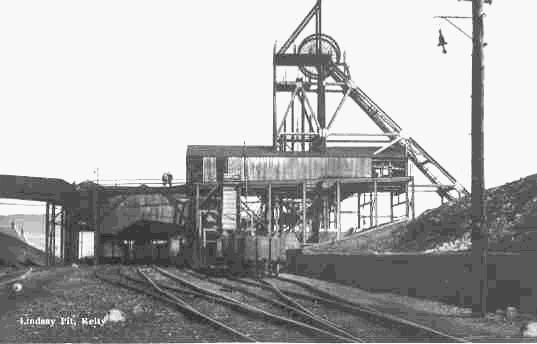
The Lindsay Pit, shafts originally Kelty Nos. 4 and 5, got its name from the Fife Coal Company's first chairman. The pit, which began sinking in 1873, was situated in the south-east corner of Kelty, and about two miles north of Cowdenbeath.
In an article, written in December 1898, we find a brief reference to the Lindsay: "... The Lindsay Pit continues to vomit out a large output; but the old Kelty pits which fell into the hands of the Fife Coal Company upwards of a quarter of a century ago, have been abandoned, and a good deal of dismantling work has been carried through. ..."
No. 4 Pit was eventually to become the deeper of the two
shafts (132 fathoms) sunk on the site, No. 5 Pit becoming
known locally as the "Wee Pit" because it only went
to around 71 fathoms. The pithead was re-organised after a
fire in 1919 and, in its later working years, coal was raised
through the main shaft and the No. 1 Surface Mine (ca 1924),
to the west of the shafts, with a later No. 2 Surface Mine
(ca 1939), being used for ventilation and man-riding.
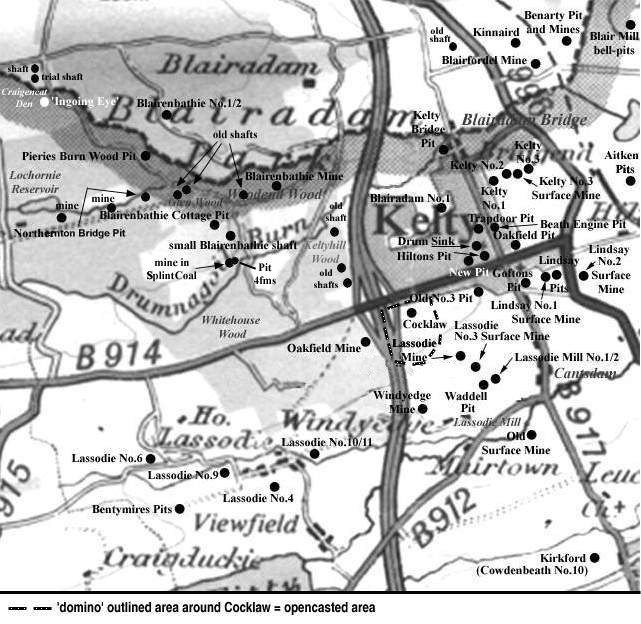
By 1945, the Lindsay No. 2 Surface Mine, close to the site
of the old Nos. 1, 2 Pits of Blairenbathie, was being
developed by the Fife Coal Company and employed 11 men
underground and 12 surface workers to produce household and
steam coals from the Five Feet Coal seam.
Following nationalisation, the Blairenbathie Mine* now had
manager Mr. G. Marshall supervising the work of 60 men
underground and 23 surface workers to provide household coal
from the same seam.
 |
 |
 |
After 1856, into the later decades of the nineteenth century, the number of pits in and around Kelty mushroomed at an amazing rate.
 |
 |
 |
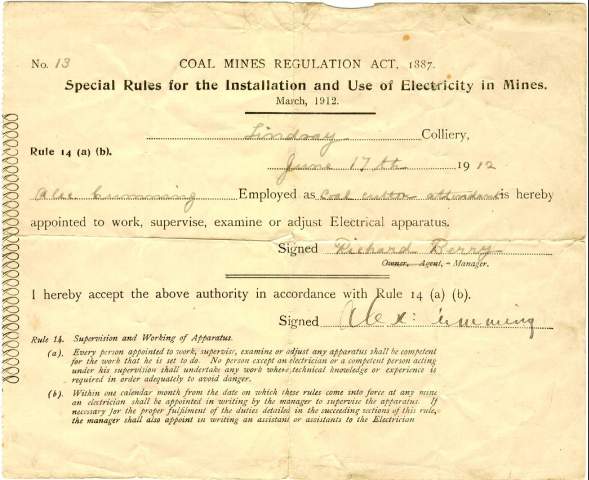 |
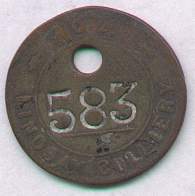
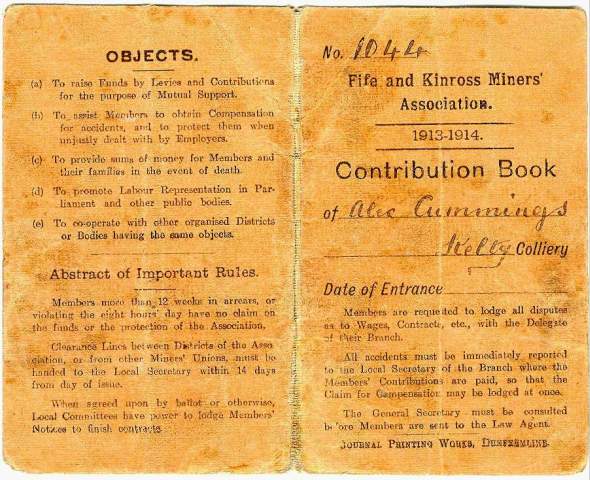
[The Union Book was kindly sent to
us by one of our readers, Bill Cumming. It belonged to his
grandfather, Alex Cumming, who worked at this pit. I would
love to hear from any of our readers who know anything at all
about Alex, or his family members, who resided at 2 Cantsdam,
Kelty. Alex also served in the Black Watch in India and South
Africa.]
M. Martin (Author).
--------------------------------------------------------
| Pit opened: sinking 1873 | Pit closed: January, 1965 |
|---|
| Source Date of Information Supplied |
|---|
| Manager / Under-Manager / Men underground / Men above ground / Coal seams worked / Shaft Details |
| 1873 (Fife Coal Co. Ltd.) |
| C. Carlow, Jnr. - No. 4 sinking - 1 shaft fatality recorded. |
| 1874 |
| John Beveridge / ---------- / 25 / 14 / Main Coal / D'cast (9½ x 8¾) 252 ft. / U'cast (7 x 8¾) 252 ft. [Lindsay] |
| 1875 |
| John Beveridge / ---------- / 22 / 10 / Main Coal / D'cast (16 x 8½) 270 ft. / U'cast ----- . Fan ventilation. [Lindsay] |
| 1876 |
| John Beveridge / ---------- / 52 / 24 / Main Coal / D'cast (16 x 8½) 270 ft. / U'cast -----. Fan ventilation. [Lindsay] |
| 1877 |
| John Beveridge /
---------- / ---- / ---- / Main Coal / D'cast (16 x
8½) 270 ft. / U'cast ----- [Lindsay]
John Beveridge / ---------- / 76 / 26 / Main, Jersey and Bank Splint / D'cast ----- / U'cast ----- [No. 4] |
| 1878 |
| John Beveridge / ---------- / 130 / 30 / Main, Jersey and Bank Splint / D'cast (16 x 8½) 270 ft / U'cast ----- [No. 4] |
| 1879 |
| John Beveridge / ---------- / 124 / 31 / Main, Jersey and Bank Splint / D'cast (16 x 8½) 270 ft / U'cast ----- [No. 4] |
| 1880 |
| John Beveridge / ---------- / 151 / 37 / Main, Jersey and Bank Splint / D'cast (16 x 8½) 270 ft / U'cast ----- [No. 4] |
| 1881 |
| John Beveridge / ---------- / 168 / 38 / Main and Bank / D'cast (16 x 8½) 270 ft / U'cast ----- [No. 4] |
| 1882 |
| John Beveridge /
---------- / 147 / 58 / Bank, Main, Jersey / D'cast
(16 x 8½) 420 ft / U'cast (14 x 5½)
150 ft. [No. 4]
Fan 18' x 5'. |
| 1890 |
| John Beveridge / ---------- / 195 / 28 / Five foot; Splint / D'cast (16 x 5) 372 ft./ (9 x 5) 432 ft. / U'cast (16 x 9) 660 ft./ ------ 780 ft. [No. 4] |
| John Beveridge / ---------- / 72 / 14 / Bank and Main / D'cast (9 x 5) 248 ft./ (9 x 5) 432 ft. / U'cast (16 x 9) 432 ft./ ------ 540 ft. [No. 5] |
| 1896 |
| John Beveridge / ---------- / 505* / 180* / Household, manufacturing and steam coals. [* Kelty Colliery] |
| 1902 |
| John Beveridge / G. S. Christie / 1,070* / 228* / Household, manufacturing and steam coals. [* Kelty Colliery] |
| 1904 |
| Mr Richard Berry / ---------- / 318 / 95 / Household, manufacturing and steam coals. [Lindsay] |
| 1905 |
| R. Berry / ---------- / 353 / 76 [Lindsay] |
| 1908 |
| R. Berry / ---------- / 339 / 94 [Lindsay] |
| 1911 |
| R. Berry / ---------- / 458 / 86 [Lindsay] |
| 1913 |
| Richard Berry, manager Feb: James Sharp, under-manager, No. 4 Pit Mar: Departure of Mr Robert Hughes, oversman, Lindsay Colliery. |
| 1916 |
| Jun: Mr Richard Berry, manager,
moves to Lassodie Mill Colliery. Mr William Bridgewood, former manager at Blairadam, moves to Lindsay Colliery. Aug: Mr David Forbes, oversman at Lassodie Mill, appointed to Lindsay Colliery. |
| 1917 |
| Jul: Mr William Bridgewood,
manager, moves to Leven agency. Mr John Spence, former manager at Mossbeath, now appointed to Lindsay and Lassodie Mill Collieries. |
| 1918 |
| John Spence / David Forbes (No. 4 Pit) / James Penman (No. 5 Pit) / 267 / 71 |
| 1920 |
| John Spence / David Forbes
/ 220 / 99 June: Mr John Spence appointed manager at Glencraig Colliery. |
| 1922 |
| January: Mr George
Buchan, manager, departs to take up the same position at
Lassodie Mill Colliery.
Mr Thomas Bauld appointed new manager of the colliery. Death is announced of Mr Richard Berry, former manager of the Colliery. |
| 1923 |
| Mr William Lawrie / David Forbes / ---- / ---- |
| 1924 |
| April: Mr David Forbes,
under-manager, is promoted to post of colliery manager.
Mr Lawrie taking up a post in India. |
| 1927 |
| Mr Smith / -------------- / ---- / ---- |
| 1928 |
| Mr Charles Hynd / -------------- / 366 / 85 |
| Household, steam and blaes. Five Feet, Dunfermline Splint, Little Splint, Bank and Main. |
| 1930 |
| Aitken No. 3 Surface Mine discontinued? |
| 1931 |
| Mr C. Hynd, manager. May: Mr Andrew B. Sanderson appointed undermanager (formerly undermanager at Lumphinnans No. 1). |
| 1932 |
| Jul: Mr John Archibald appointed manager (formerly undermanager at Bowhill Colliery). |
| 1933 |
| Jul: Mr Andrew Sanderson, undermanager,
appointed manager of United Coal Company's colliery at Southrigg. |
| 1934 |
| Oct: Mr W. E. S Peach, manager. Mr James McWhinnie/Mr George Buchan, undermanagers. Mr G. McDonald, oversman. |
| 1935 |
| Feb: re-opening of No. 3 Surface Mine announced. |
| 1936 |
| Jun: Mr James McWhinnie, undermanager, appointmented colliery manager with Messrs Wm. Baird & Co. |
| 1938 |
| H. R. King / Alex. Thomson (Pit) / George Buchan (Surface Mine) / 580 / 149 |
| 1939 |
| Apr: Mr H. R. King, manager.
appointed agent of Dysart group of collieries. Mr T. Thyne, planning agent, appointed colliery manager. |
| 1940/41/42 |
| Jun: Mr T. Thyne, manager; Mr Alex. Thomson, under-manager. |
| 1943 |
| July: Mr Alex. Thomson
promoted to manager of Lumphinnans No. 1 Pit. Mr J. Keddie succeeds Mr Thomson. |
| 1945 |
| William Reid / J. Keddie (Pit) / D. Sneddon (Surface Mine) / 554 / 158 |
| Household and steam coals. Top Bank, Wee, Main, Jersey and Seven Feet. |
| 1947 (NCB) |
| William Reid / J. Keddie (Pit) / D. Sneddon (Surface Mine) / 618 / 160 |
| Gas, household, industrial and steam coals. Approx. annual output = 243,800 tons |
| 1948 (NCB) |
| William Reid / J. Keddie (Pit) / D. Sneddon (Surface Mine) / 618 / 173 |
| Household coal. Seven Feet, Main, Jersey, Top Bank and Wee Coals. |
| 1949 (NCB) |
| William Reid / J. Keddie (Pit) / D. Sneddon (Surface Mine) / 595 / 153 |
| Household coal. Seven Feet, Main, Jersey and Wee Coals. |
| 1950 (NCB) |
| William Reid / J. Keddie
(Pit) / D. Sneddon (Surface Mine) / 608 / 154 Jul: Mr W. Reid appointed manager at Comrie Colliery. |
| Household coal. Glassee,
Main, Jersey and Seven Feet.
System of ventilation in common with Cowdenbeath Nos. 7, 10 and Mossbeath. |
| 1951 (NCB) |
| J. B. Fotheringham / J. Keddie (Pit)/ A. Bennett (Surface Mine) / 636 / 158 |
| Household coal. Glassee,
Main, Jersey and Seven Feet.
System of ventilation in common with Cowdenbeath Nos. 7, 10 and Mossbeath. |
| 1952/53 (NCB) |
| J. B. Fotheringham / J. Keddie (Pit) / A. Bennett (Surface Mine) / 711 / 168 |
| Household coal. Glassee,
Main, Jersey and Seven Feet.
System of ventilation in common with Cowdenbeath Nos. 7, 10 and Mossbeath. |
| 1954 (NCB) |
| Mr J. B. Fotheringham, B.Sc.,
manager, to planning engineer in charge, Seafield project. Mr William Reid, manager, Comrie Colliery, to manager at Lindsay Colliery. William Reid / J. Keddie (Pit) / A. Bennett (Surface Mine) / 711 / 168 |
| Household coal. Glassee,
Main, Jersey and Seven Feet.
System of ventilation in common with Cowdenbeath Nos. 7, 10 and Mossbeath. |
| 1955/56 (NCB) |
| William Reid / Andrew Bell (Pit) / A. Bennett (Surface Mine) / 711 / 168 |
| Household coal. Glassee,
Main, Jersey and Seven Feet.
System of ventilation in common with Cowdenbeath Nos. 7, 10 and Mossbeath. |
| 1957 (NCB) |
| William Reid / Andrew Bell (Pit) / A. Bennett (Surface Mine) / 791 / 171 |
| Household coal. Glassee,
Jersey, Little Splint and Seven Feet.
System of ventilation in common with Cowdenbeath Nos. 7, 10 and Mossbeath. |
| 1958 (NCB) |
| William Reid / Andrew Bell (Pit) / W. Orr (Surface Mine) / 800 / 170 |
| Gas, household,
industrial and steam coals. Blaes.
Glassee, Mynheer, Jersey, Little Splint and Seven Foot. |
| 1959 (NCB) |
| William Reid / A. Bennett (Pit) / W. Orr (Surface Mine) / 765 / 163 |
| Gas, household,
industrial and steam coals. Blaes.
Glassee, Mynheer, Jersey, Little Splint and Seven Foot. |
| 1961 (NCB) |
| William Reid / W. Orr /
670 / 150 Jun: Mr William Reid, manager, retires. Mr Hugh Thomson, assistant planning engineer (West Fife Area) appointed manager. |
| Gas, household, industrial, steam coals and blaes. Glassee, Mynheer, Little Splint, Seven Foot. |
| 1962/63 (NCB) |
| Mr Hugh Thomson, manager. |
| 1964 (NCB) |
| P. Sinclair / W. Orr / 562 / 134 |
| Gas, household, industrial, steam coals and blaes. Mynheer, Little Splint. |
--------------------------------------------------------
Kelty Colliery (19th century report)
| Name of Coal | Thickness | Quality | Class | |||
|---|---|---|---|---|---|---|
| Main Coal | Roof Coal | > | 1 ft. 10 in. | > | Good | Bunker Coal |
| Good Coal | > | 4 ft. 8 in. | > | |||
| Jersey Coal | Coal | > | 2 ft. 6 in. | > | Good | Steam |
| Stone | > | 2 ft. 4 in. | > | |||
| Coal | > | 3 ft. 8 in. | > | |||
| Bank Coal (Lochgelly Splint) | 4 ft. 5 in. | Good | Steam and 2nd class
Household |
|||
| Dunfermline Splint Coal | 4 ft 7 in. | Good | Best Household | |||
--------------------------------------------------------
| Plans of Abandoned Seams for Lindsay Pits, Kelty | Pits or Mines designated in Plans |
|---|---|
| COAL; Main (September, 1915); Two Feet; Upper Jersey (June, 1919); Lower Splint (August, 1921); Lower Jersey (November, 1921) |
Lindsay Nos. 4, 5
Aitken |
| COAL;
Glassee; Jewel; Five Feet (July, 1928)
Later workings have been added to the plan of the Five Feet seam. The amended abandonment date in respect of this seam is September, 1935. Later workings have been added to the plan of the Glassee seam. The amended abandonment date in respect of this seam is March, 1937. |
Lindsay Nos. 4, 5 |
| COAL; Little Splint (December, 1930) | Lindsay |
| COAL; Main (November, 1934) | Lindsay |
--------------------------------------------------------
Information on coals worked at, or near, the Lindsay Pits
(based on reports from 1930-34)
The No. 5 Pit was never deepened beyond the Lochgelly
Splint seam. An attempt to work the Sulphur Coal seam between
the Lindsay Pit and Viewfield was not successful as the coal
was so impregnated with iron pyrites or 'Fools Gold'
that the machines could not cut it.
The sandstone which split the Dunfermline Splint Coal at
Oakfield died out towards the Lindsay where Splint Coal, 4
ft. 4 in. to 4 ft. 9 in. thick, was wrought below the main
Cowdenbeath road.
There was no Two Foot Coal here as the strata between the
Dunfermline Splint and Five Feet Coal seams consisted
entirely of hard sandstone. The Five Feet Coal, a fair
household and good steam coal, lay about 20 fathoms above the
Dunfermline Splint and was worked along the east side of the
Oakfield fault as far south as Leuchatsbeath. It was a coal 5
ft. to 6 ft. thick resting on sandstone and overlain by
blaes. It was found to be foul and broken near the fault and
was slightly burnt in the region of the main road north of
Leuchatsbeath.
To the east of the Oakfield fault, 3 ft. to 3 ft. 6 in. of
Glassee Coal was worked from the No. 4 Pit. A cross-cut mine,
which tapped the seam 400 yds. south-east from Netherton
Bridge, at a depth of 189 fathoms, found 4 ft. 1 in. coal, on
1 ft. coaly blaes, on 1 ft. 5 in. coal.
Between the Oakfield fault and the old Perth railway line,
where the Bank or Lochgelly Parrot Coal has been exhausted
from the pit, a typical seam had blaes with coal strains (2
ft. 6 in.), coaly blaes (10 in.), COAL (1 ft. 5 in.), stony,
irony coal (3 in.), COAL (6 in.), stony, irony coal (3 in.)
and COAL (2 ft. 8 in.) resting on 3 ft. of faky fireclay.
In a mine from the bottom of the No. 4 Pit, the Kinglassie
Splint Coal and Bank Coal were separated by 15 fathoms of
sandstone.
On the east side of the Oakfield fault, a small section of
the Lower Jersey Coal, 3 ft. thick and only of average
quality and containing a few dirt bands, was wrought. The
Upper Jersey Coal was drawn from the surface-mine west of the
pit (opened around 1924) and was about 3 ft. 8 in. including
a 1 in. yellow stone parting near its base.
Kelty Main Coal, generally exceeding 5 ft., was raised from
this surface-mine as was Gorman's or Rough Coal, a poor
quality coal with several partings. A second surface-mine
serving the Lindsay Pit was opened about fifteen years after
the first.
Additional information on the Lindsay Colliery
Kelty No. 4 shaft ('Big Pit') was sunk 131 fathoms to the Dunfermline Splint and Kelty No. 5 pit ('Wee Pit') was worked to the depth of 70 fathoms. Coal was raised from the Wee Pit (Lochgelly Splint) while the other shaft continued to be sunk to the Dunfermline Splint. The first connection to the Lindsay from other pits was in the Main Coal to No. 3 East Pit and to the Oakfield Pit, which was located on the site of the present Bowling Green, Kelty.
While shafts were being sunk, heavy feeders of water were encountered and pumps were brought from the Neb Pit at Loch Fitty. Pit ponies were made redundant when the first electric haulage was introduced.
1919: Fire broke out and destroyed the pithead. Men underground had to find their way to the surface through other pits.
1920: New screening, plant, fan, steel head and winder were erected around No. 4 shaft, which was the only shaft retained.
1924: The driving of No. 1 surface haulage mine commenced.
1939: No. 2 surface mine was driven for man-riding.
Lindsay pit workings were connected to other neighbouring collieries by Harley's Brae, Drum Brae and by Coal Mine to the Aitken.
1950: The new pithead baths, canteen and Medical Centre at the Lindsay Colliery, was opened by Mr. Abe Moffat, President of the Scottish Miners' Union, on 25 March.
Custody of the baths at that time was accepted by Mr.
James Hodge, BEM, Beechbank House, Kelty, the oldest employee
of the pit, who was 76 years of age and had a record of 65
years service in the mining industry, starting in the Lindsay
in 1885, aged 12 years.
In charge of the Medical Centre was Nurse May Buist,
followed by Nurse May Ness (both local women)
---------------------------------------

"Dunfermline Saturday Press"
22 November, 1873
On Tuesday evening, about half past five o'clock, an accident, which had a fatal result, happened at the new pit - to be designated the Lindsay pit - which has been opened at Kelty Colliery, by the Fife Coal Company. It appears that two men, named Thomas Dislington and John Sinclair, were engaged in sinking operations and had just laid a train for blasting a piece of rock, and were being drawn up the shaft in the "kettle", when in some way Dislington came into violent contact with a battery of wood, and was precipitated to the bottom. In consequence of this, Sinclair lost his balance, and would have fallen out of the "kettle" also, were it not that he managed to seize hold of the water-pipe, and uttered a loud cry, which caught the ear of the engine keeper, who at once stopped the ascent of the "kettle". Dislington was found to be alive when reached, but he expired on being brought to the pit-head. He was about fifty years of age, and has left a widow and five children. Sinclair states that when they were approaching the bottom he called out to Dislington to mind his head, but immediately afterwards the poor fellow fell down the shaft.
--------------------
"The Scotsman"
21 November, 1873
DUNFERMLINE - FATAL PIT ACCIDENT. - An accident, which had a fatal result, has happened at a new pit which is to be worked by the Fife Coal Company at Kelty. Two men, named Thomas Dishington and John Sinclair, who were employed in sinking operations, had just laid the train for blasting a piece of rock, and were being drawn up the shaft in the "kettle", when Dishington came into violent contact with a batten of wood, and was precipitated to the bottom. Sinclair lost his balance, and would have fallen out also, were it not that he seized hold of the water pipe, and gave a loud cry, which caught the ears of the engine-keeper, who instantly stopped the ascent of the "kettle". Dishington was alive when reached, but he expired on being brought to the top of the shaft. The deceased was about 50 years of age.
---------------------------------------
A Few Notes on the Early Days
by
CHARLES AUGUSTUS CARLOW
1876: About this time, the sinking of the Lindsay Pit, named after the Chairman, was started. It was a big job at the time. Much water was encountered, and, when the sinking neared completion, considerable anxiety was caused by the non-appearance of the Dunfermline Splint Seam. The thickness of strata between the Five Feet Seam and the Dunfermline Splint at Lindsay Pit is unusually great, but in the course of time a flag was hoisted, indicating that the Dunfermline Splint Seam had been reached.
Some of the "Old Timers" may remember Ebby Hunter. He was foreman junior at the sinking, and for many years afterwards was a respected foreman at Leven Pits.
One of the interesting occurrences at Lindsay Pit was the
introduction of the first electric haulage, about 1898. This
was designed to haul two hutches up a dook between the
Lindsay and the Aitken Pit, which was then being sunk.
Everybody was so sceptical about this enterprise that the
motor haulage was not taken down the pit until it had been
proved able for its work by hauling two loaded hutches up a
slope on the pithead.
The pithead was burned to the ground in 1919. The whole
colliery has been re-equipped above and below ground, and
will last for many years.
------------------------------------
"Dunfermline Saturday Press"
19 February, 1876
KELTY - NEW SEAM OF COAL
We are glad to learn that the Fife Coal Co. have been successful in reaching in their Lindsay Pit a new seam of coal nearly six feet thick, and equal in quality to the Dunfermline Splint. This seam was worked at Kelty Colliery upwards of forty years ago, but was cut off by a "want", on the other side of which it has been found. It was in those days called the "bank" coal, because the quality was so fine that when it would not pay to work any of the other seams, the lessee was always sure of success by laying out some money for a fresh hold of that seam.
------------------------------------
"Dunfermline Saturday Press"
23 December, 1876
On Wednesday, a man named Alexander Mill sustained injuries of a somewhat serious nature, owing to a lump of blae having fallen upon him while he was at work in the Lindsay Pit, Kelty Colliery. He was attended by Dr. Lane, Crossgates.
------------------------------------
"Dunfermline Saturday Press"
1 November, 1879
Allan M. Hay, a brusher, Kelty, while working in the Lindsay Pit on Monday, was severely injured by some coals falling on him. He was conveyed home and attended by Dr. Nasmyth, Cowdenbeath, and is progressing very favourably.
------------------------------------
"Dunfermline Saturday Press"
7 February, 1880
On the 29th inst. a man named John Gilfillan got his left leg broken by falling on the rails in the Lindsay Pit, Kelty Colliery.
------------------------------------
"Dunfermline Saturday Press"
10 July, 1880
On Thursday, W. Logan, residing at Viewfield, when at his usual employment, in the Lindsay Pit, had his collar-bone dislocated.
------------------------------------
"Dunfermline Saturday Press"
17 March, 1883
FATAL FALL DOWN A COAL PIT AT KELTY
Between three and four o'clock on Friday afternoon last week, John Phillips, a pit sinker, Kelty, met with a fatal accident. He was employed sinking at the Lindsay Pit, Kelty, and was being lowered with other workmen in a "kettle", which was brought to a standstill ten feet below the surface to allow plumbing for further sinking. While engaged working he happened to step too near the edge, and losing his footing he fell to the bottom of the pit, a distance of 78 feet. Death was instantaneous - the body being frightfully mangled. Phillips met with an accident three weeks ago, and Friday was the first day he had been at work since then. He was 50 years of age, and has left a wife and one child.
------------------------------------
"Dunfermline Saturday Press"
27 December, 1884
COAL OPERATIONS IN WEST OF FIFE
The Fife Coal Company, Limited, have struck the
Dunfermline Splint at a depth of 130 fathoms in the Lindsay
Pit, Kelty. The seam is five feet thick, and of good quality.
The field that is under lease from the Earl of Moray is 1000
acres in extent, and contains an aggregate thickness of 38
feet of workable seams of coal. Although the seam just struck
will yield a comparatively small quantity of water, ample
provision has been made for the opposite contingency by the
erection near the bottom of a large compound pumping engine,
the largest of its kind in Scotland capable of forcing to the
surface 1500 gallons per minute - thus doing more than four
engines of the old type, and effecting a great saving of
fuel. The new engine has been made and erected by Messrs.
Henry Balfour and Co., Leven.
The Fife Coal Company, we understand, are preparing for the
introduction of coal cutting machines, which have proved so
successful elsewhere, and which will tend to increase the
output of the field.
------------------------------------
"Dunfermline Saturday Press"
30 May, 1885
On Wednesday, while a miner named Thomas Stenhouse was engaged in the Lindsay Pit, Kelty Colliery, a large piece of coal fell, and being unable to escape he was struck on the head and shoulders, and had his collar bone broken. He was attended by Dr. Nasmyth, the colliery surgeon.
------------------------------------
"Dunfermline Saturday Press"
12 September, 1885
While a young man named James Spence, a pit-bottomer in the Lindsay Pit, Kelty Colliery, was engaged on Friday last week, in extricating a chain which had got fixed in a pulley on the wheel brae, the chain broke. The result was that one of the hutches dashed down the brae, and, striking Spence on the left haunch, jammed him against the roadside, whereby he sustained serious internal injuries.
------------------------------------
"Dunfermline Saturday Press"
9 October, 1886
An accident occurred at the Lindsay Pit here on Thursday. Henry Wright, a miner, had been working at the face, when a piece of coal came away knocking him down and inflicting severe bruises. The unfortunate man was conveyed to his house at Blairenbathie, where he was attended to by Dr. Nasmyth, Cowdenbeath. No bones were broken, and the man is expected to recover in a day or so.
------------------------------------
"Dunfermline Saturday Press"
4 December, 1886
While engaged in the Lindsay Pit, on Tuesday, Thomas and Andrew Cowan, father and son, were struck by a piece of coal which fell from the face. Both sustained severe bruises, and were attended by Dr. Nasmyth, Cowdenbeath.
------------------------------------
"Dunfermline Saturday Press"
5 February, 1887
On Saturday, a man named John Mackay was very seriously injured in the Lindsay Pit, Kelty Colliery, by a mass of coal falling on him from the roof.
------------------------------------
"Dunfermline Saturday Press"
28 January, 1888
SERIOUS FIRE AT A FIFE COLLIERY
NARROW ESCAPE OF MINERS
200 MEN THROWN IDLE
On Wednesday night about half-past seven o'clock, fire
broke out in the Lindsay Pit, Kelty Colliery, belonging to
the Fife Coal Company. The pit is one of the most extensive,
and consequently one of the most expensively fitted works in
the county of Fife. The winding engines are of the most
approved type, and near to the "gig" house a
ponderous pumping engine, and all the other appliances of a
first-class colliery.
There are 200 men usually employed about the pit, and,
according to custom, the men engaged underground were drawn
between 2 and 3 o'clock - labour, so far as coal-getting
was concerned, being suspended at the latter hour. In the
course of the afternoon, however, about a dozen men were
lowered to the workings to do oncost work, and immediately
thereafter three men, named Alex. Foster, David Campbell, and
Wm. Petrie, descended to a point near mid-shaft for the
purpose of carrying out some repairing in the pumping-gear.
At about the time already indicated the engineman observed
smoke issuing from underneath the floor of the
"gig-house" on the pit bank, and immediately the
drum by which the cages were raised and lowered soon became
enveloped in flames. This state of matters at once aroused
doubts in the mind of the engineman and others as to the
safety of the men engaged in the underground workings in
brushing operations, and particularly the three others
employed in mid-shaft repairing some piping.
The engineman, however, took in the situation, and he at
once raised the cage a little as a signal to the men that all
was not right above the ground. The signal given, the
engineman lowered the cage, and stopped it at a platform some
90 fathoms down the shaft, and at which point an engine is
erected and an engineman was employed.
The engineman at the pit bank made this move to give the
three men an opportunity of escaping with their lives, and a
halt at the platform had not been made for more than a minute
when the ropes became so heated on the drum that they
snapped, and the two cages were precipitated to the bottom,
carrying with them a great many of the wooden fittings of the
shaft. The report, in the words of the men themselves,
resembled that of the rapid firing of a double-barrelled gun.
Meantime, a large number of people arrived on the pit bank,
and a hose-pipe was directed upon the burning, while all the
pails and other vessels available were brought into
requisition. The fire continued to spread, however, and a
message was sent to Dunfermline, fully eight miles distant,
asking the assistance of the city fire brigade. In the
interval, the men connected with the colliery succeeded in
confining the flames to the gig-house, and by the time the
brigade arrived the fire had almost spent itself, and the
building was wrecked. For several hours the ruins continued
to smoulder, and it was found necessary to maintain a
continual stream of water upon them and their surroundings.
Comparatively little damage was done to the winding engines.
The damage on the pit bank, which is covered by insurance,
was therefore confined chiefly to house property and drum,
while in the shaft the steel ropes, cages, and other fittings
were destroyed.
The damage has not yet been fully ascertained, but it is
believed it cannot be far short of £1000. While so much
was done to extinguish the flames on the pit bank, no effort
was spared to ascertain the fate of the poor men engaged in
mid-shaft. A search party was despatched by another mine, and
they reached the Lindsay Pit, to find the three men were
alive, Campbell was the only man on the cage when it was
lowered to the platform, and he leapt off as soon as the halt
was made, while Foster and Petrie were engaged among the
pumps and escaped the falling debris. The two latter,
however, lost their lights, and had to sit in the dark in a
position of imminent danger until they were rescued by men
who reached them by a cross-cut which leads into the mouth of
the shaft at a point near to where they were imprisoned.
The men employed at the pit will necessarily be thrown idle
until the damage is repaired - a work which is expected will
occupy at least a week. The affair created a great sensation
in the village of Kelty, and crowds of people surrounded the
pit mouth for hours.
------------------------------------
"Dunfermline Saturday Press"
25 August, 1888
While a miner, named Robert Erskine, was working in a blind pit, which is being sunk in connection with the Lindsay Pit at Kelty Colliery on Thursday, a stone hammer of 14 lbs. weight was allowed by some mishap to fall down the shaft and struck Erskine on the head, fracturing his skull. He was attended by Dr. Nasmyth.
------------------------------------
"Dunfermline Saturday Press"
8 March, 1890
A serious accident occurred on Tuesday in the Lindsay Pit, Kelty Colliery. A large mass of coal fell from the roof and struck two miners - Thomas Stenhouse and Robert Penman, who were working at the face. Stenhouse was killed almost instantaneously, and Penman sustained very severe injuries.
------------------------------------
"Dunfermline Saturday Press"
19 December, 1891
John Wallace (52), a brusher, residing at Oakfield, met with an accident on Monday while engaged in No. 5 pit, Kelty Colliery, belonging to the Fife Coal Company. A large piece of stone fell from the roof and struck Wallace on the left foot. Dr. Nasmyth, Crossgates, attended the injured man, and ordered his removal to the Edinburgh Royal Infirmary.
------------------------------------
"Dunfermline Saturday Press"
3 December, 1892
While working at the coal face in the Lindsay Pit, Kelty Colliery, on Friday last, William Pratt (23), Kelty, got his collar bone fractured, and was otherwise injured by a large mass of coal falling upon him.
------------------------------------
"Dunfermline Saturday Press"
10 December, 1892
KELTY - FATAL ACCIDENT ON THE RAILWAY
A distressing accident, resulting in the death of one man and the serious injury of another, occurred on the railway at Kelty on Saturday afternoon. About two o'clock two miners of middle age, named Allan Penman and David Wyse, were proceeding along the railway line near the Lindsay Pit, Kelty. They stepped from one line to the other in order to allow a pug engine to pass, but failed to observe the approach of the West of Fife mineral train from the opposite direction, and before they were able to get out of its way both were knocked down and run over. Penman was instantaneously killed, while Wyse has his right arm taken off, besides sustaining severe internal injuries.
------------------------------------
"Dunfermline Saturday Press"
25 February, 1893
On Thursday morning, John Syme, miner, in the Lindsay Pit, belonging to the Fife Coal Company, at Kelty, was killed by a fall of coal from the roof. The deceased leaves a widow and six young children.
------------------------------------
"Dunfermline Saturday Press"
18 March, 1893
George Barclay (40), miner, Cantsdam, met with an accident while working in the Lindsay Pit, Kelty Colliery, on Tuesday. A mass of coal fell from the face upon his left leg and foot, and several bones of the latter were broken.
------------------------------------
"Dunfermline Saturday Press"
15 July, 1893
Angus Stewart, employed as a fireman at the Lindsay Pit, Kelty Colliery, met with a fatal accident on the West Fife Mineral Railway, on Tuesday. Stewart had been crossing the railway for the purpose of getting some drinking water, when the colliery pug-engine came up and run him down. A loaded waggon went over Stewart's body, and death ensued immediately after the accident. Stewart leaves a wife and a grown-up family.
------------------------------------
"Dunfermline Saturday Press"
23 December, 1893
John Penman (22), son of Robert Penman, miner, Kelty, was killed in the underground workings of the Lindsay Pit, Kelty Colliery, on Tuesday afternoon. A large stone had fallen from the roof, on Penman, crushing him terribly, and causing almost instantaneous death.
------------------------------------
"Dunfermline Saturday Press"
2 February, 1895
Lawrence Carrol (44), miner, Viewfield, Kelty, suddenly expired in his own house on Tuesday night, after returning from work at the Lindsay Pit. Heart disease was the cause of death. Deceased was married, and leaves a widow and family.
------------------------------------
"Dunfermline Saturday Press"
2 March, 1895
Helen Izatt (16), pithead worker, Kelty, while employed at the Lindsay Pit, Kelty Colliery, on Tuesday, received such a serious accident to her right hand that it had to be amputated a little above the wrist by the Drs Nasmyth, Kelty and Crossgates. The girl had stepped on to the travelling-table while it was in motion. She fell, and her hand caught between two pinion wheels.
------------------------------------
"Dunfermline Saturday Press"
25 May, 1895
John Gordon (53), miner, Oakfield, sustained a fracture of the skull while working at the face in No. 4 Pit, Kelty Colliery, on Monday. A piece of coal came suddenly away and striking him on the head knocked him up against a prop. He was attended by Drs. W. Nasmyth, Crossgates, and Alexander Nasmyth, Kelty.
------------------------------------
"Dunfermline Saturday Press"
1 June, 1895
On Saturday, David Scobie (30), miner, Kelty, while in the act of filling a hutch with coals in Lindsay Pit, Kelty Colliery, a large piece of coal fell from the "face", knocking him against the wall, and fracturing his jaw.
------------------------------------
"Dunfermline Saturday Press"
29 June, 1895
SEQUEL TO A KELTY PIT ACCIDENT
A PITHEAD GIRL SUES FOR £500
In the Dunfermline Sheriff Court on Tuesday, the record was closed in an action at the instance of Helen Izatt, with the consent of her father, George Izatt, miner, Dewar's Row, Kelty, against the Fife Coal Company, in which £500 is claimed at common law in name of solatium and damages, or alternatively £50, 14s. under the statute. The pursuer, who is sixteen years of age, was employed by the defenders as a pithead worker at the Lindsay Pit, Kelty Colliery, and she avers that on the 26th February last she was instructed by John Mitchell, the general manager, through John Elder, who has charge of the girls on the pithead, to climb over the side of an enclosure and clean out a nut screen. After getting over, she bent down, and in doing so fell forward, and her right hand was caught in one of the pinion wheels of the screening apparatus, with the result that her hand had to be amputated. She attributes the accident to the defective construction of the plank, she having to stand on narrow beams ten or twelve feet from the ground. The defenders deny liability, and state that the pursuer went to the place without orders, and that the accident was caused by her own unwarrantable conduct. If she did require to be inside the enclosure, she should have stood upon the nuts, and not upon the beams. Proof was fixed to be heard on Thursday 25th July, beginning at 9.30 A.M.
Agents - For pursuer, Mr Macbeth; for defenders, Messrs Ross & Connell.
12 October, 1895
This issue announced that proof was led in the action raised by Helen Izatt's father against the Fife Coal Company, and that Sheriff Gillespie would read the evidence before pronouncing judgement in the case.
Supplement: 26 October, 1895
The above issue quoted the findings in the Helen Izatt v. Fife Coal Company case: "At all events, there is so much doubt as in the Sheriff-Substitute's opinion to disentitle the pursuer to a verdict." The Sheriff had found in law that the defenders - the Fife Coal Company - were not liable in damages.
30 November, 1895
Helen Izatt's team had immediately appealed against the decision of 26 October and the above issue announced that she had successfully appealed against the decision, and was to be awarded £200 as damages for the loss of her right hand.
------------------------------------
"Dunfermline Saturday Press"
7 December, 1895
While engaged in the Lindsay Pit on Saturday, John McAllum (28), met with an accident whereby his right leg was broken between the knee and ankle. McAllum was about to run two hutches down the wheel brae, when he noticed them uncoupled, and to avert an accident he pulled the first waggon off the rails, which unfortunately fell on his leg, causing injuries as above stated.
------------------------------------
"Dunfermline Saturday Press"
11 January, 1896
Andrew Cowan (33), miner, Kelty, was killed yesterday, in the Lindsay Pit, Kelty, by a fall from the roof. Other three men were slightly injured.
-------------------------
"The Scotsman"
11 January, 1896
PIT ACCIDENT IN FIFE. - Another serious accident occurred yesterday afternoon at the Fife Coal Company's Lindsay Pit, Kelty Colliery, by which one man was killed and two were injured. Three miners - Andrew Cowan, John Cowan, and William Hodge - had finished work for the day, and were resting at the face previous to going to the pit bottom to be raised to the surface, when a large quantity of blaes fell from the roof. All the men seem to have been struck, and Andrew Cowan was buried among the rubbish. Some time elapsed before he could be extricated, and it was then found that he was dead. The deceased, who was 33 years of age, was married, and leaves a widow and five children. His brother John sustained a severe shock to the system, and William Hodge was injured about the head and one of his arms.
-------------------------
"Dunfermline Saturday Press"
25 January, 1896
FATAL ACCIDENT INQUIRY AT DUNFERMLINE
A MINER WHO WAS KILLED AT THE CLOSE
OF HIS DAYS' WORK
Sheriff Gillespie held a public inquiry in Dunfermline Sheriff Court yesterday, relative to the death of Andrew Cowan, miner, Cantsdam, which occurred on Friday 10th inst., by an accident in the underground workings of the Lindsay Pit, Kelty Colliery, Fife Coal Company, Ltd. ..... The Jury found that the accident took place on 10th January 1896, in a connection which was being formed between the Lindsay and the Aitken pits of the Fife Coal Company, Limited, by a fall of materials from the roof upon the deceased, who was killed on the spot.
------------------------------------
"Cowdenbeath & Lochgelly Times & Advertiser"
25 March 1896
MINING DISPUTE AT KELTY
A meeting of the miners employed at the Lindsay Pit, Kelty Colliery, was held on Saturday afternoon in connection with a dispute that has arisen over a change in the screening arrangements. It was stated that a deputation had waited upon Mr Carlow, the general manager of the Fife Coal Company, and it appeared that as no satisfaction had been obtained a section of the men were threatened to strike. Mr Weir advised the men not to lodge their warnings, and he promised to write to Mr Carlow asking him to receive another deputation, along with himself, with a view to having the dispute amicably settled. He was authorised to say that in the event of no settlement being effected the men would be quite willing to submit the question to an independent party for his decision.
------------------------------------
"Dunfermline Saturday Press"
7 November, 1896
PIT EXPLOSION
An explosion of an alarming nature occurred on Friday last week, in the Fife Coal Company's Lindsay Pit, Kelty. Michael Brown, a miner, residing in Croal Place, Kelty, was in the act of preparing a cartridge for blasting purposes, when, it is supposed, a spark dropped from a lamp into his flask, which had been left without a stopper. A loud report was heard, and on the smoke clearing it was found that Brown had been knocked down and badly injured. He was much burnt about the face. He was assisted home by his brother John, and attended to by Dr Rose.
"Dunfermline Saturday Press"
14 November, 1896
FATAL RESULT OF A PIT EXPLOSION
Michael Brown, miner, Kelty, has died from the injuries which he received in the Fife Coal Company's Lindsay Pit, Kelty, a fortnight ago. He was engaged in blasting work, and was in the act of preparing a cartridge, when it is supposed a spark from a lamp dropped into his powder flask, and he was knocked down by the force of the explosion which occurred. It was at first expected that he would recover, but inflammation of the lungs supervened.
[The Fatal Accident Inquiry into the death of Michael Brown was held in the Dunfermline Sheriff Court on the 11th December. The Jury found that the cause of the explosion was a spark being blown off the wick of deceased's lamp, and being carried into the open aperture of his powder flask.]
------------------------------------
"Dunfermline Saturday Press"
10 July, 1897
In the underground workings of the Lindsay Pit, Kelty Colliery, on Tuesday, James Lindsay, brusher, Croall Place, had his right arm severely lacerated by a fall of freestone from the roof.
------------------------------------
"Dunfermline Press"
20 November, 1897
While William Wise, miner, Earl's Row, Kelty, was working in the Lindsay Pit on Saturday, a piece of coal, weighing about 3 cwts., fell from the face upon his left leg, breaking it a little above the ankle. He was attended to by Dr Carmen, Kelty.
-------------
Alexander Ross, miner, Bridgend, had his right thigh broken while working at the Lindsay Pit on Wednesday. He had been turning a loaded hutch of coal on the metal plate at the top of the wheel brae, when omitting to attach the hutch to the wheel brae chain, the hutch moved forward and crushed Ross's right leg against one of the roof supports.
--------------------------------------------
"Dunfermline Press"
8 October, 1898
While Andrew W. Cowan was at work in the Lindsay Pit, on Monday, a stone fell from the roof and struck him on the thigh, cutting him severely.
--------------------------------------------
"Dunfermline Press"
27 May, 1899
Peter McCarron, pony driver, Croall Place, Kelty, met with a serious accident in the Lindsay Pit, Kelty, Fife Coal Company, on Tuesday. On arriving at a trap-door, the pony which he was driving stumbled and caused the door to become unfastened. McCarron jumped off the hutch to fasten the door. The pony started, and the unfortunate man was severely crushed between the trap-door and one of the hutches. He was injured internally, and Dr Carment ordered his removal to the Dunfermline Cottage Hospital.
------------
"Dunfermline Press"
3 June, 1899
Peter McCarron, 54 years of age, died in the Dunfermline Cottage Hospital on Tuesday as the result of injuries sustained in the Lindsay Pit, on Tuesday last week.
-------------------------------------------------
"Dunfermline Press"
3 June, 1899
Alexander Miller, forty-nine years of age, tramp labourer, was run over by two empty waggons at the Lindsay Pit, Kelty Colliery, Fife Coal Co., on Saturday. Miller was working at the coal screening machine at the pithead between one and two o'clock. Shunting operations were going on at the railway siding, and through some cause or other the unfortunate man got on to the rails while two waggons were approaching. The wheels of the vehicles passed over his legs, about severing them from the trunk. Miller was removed to the Dunfermline Cottage Hospital, where he died within half-an-hour afterwards.
-------------------------------------------------
"Dunfermline Press"
19 January, 1901
While David Sibbales or Scott, a labourer, residing in High Street, Kinross, was endeavouring to stop a runaway waggon at the siding at the Lindsay Pit, Kelty Colliery, on Tuesday, he met with a serious accident. Before he got the runaway stopped it collided with another waggon, and his left arm was jammed between the buffers of the two waggons. The arm was so severely crushed that it had to be amputated at the Dunfermline Cottage Hospital.
-------------------------------------------------
"Dunfermline Press"
22 June, 1901
While David Rennie, miner, Nasmyth Place, Kelty, was engaged at his working face in the Lindsay Pit, Kelty Colliery, on Wednesday, a piece of coal suddenly came away, and, striking him on the breast and left side, fractured one of his ribs. The broken rib penetrated the left lung. The injured man was attended to by Dr Carment.
-------------------------------------------------
"Dunfermline Press"
15 March, 1902
James Keddie, twenty-five years of age, brusher, Kelty, died in the Dunfermline Cottage Hospital on Tuesday from the effect of injuries sustained in the five-feet seam of the Lindsay Pit, on 21st October last. He had been knocked down and severely bruised by a fall of stones from the roof, and it was afterwards found that his spinal cord was injured.
---------------
"Dunfermline Press"
Saturday, 12 April, 1902
This issue carried the Report of the Fatal Accident Inquiry held in Dunfermline Sheriff Court on Wednesday into the death of James Keddie, brusher, Kelty, who was fatally injured in the Lindsay Pit, in October last, and died on 11th March. Those giving evidence included:- Nurse McCrone, Dunfermline Cottage Hospital; Charles Carlow Reid, surveyor, Kelty Colliery; Robert Robertson, pit inspector, Dewar's Row, Kelty; Donald Ross, brusher, Russell Row, Kelty; and Simon Cargill, miner, Cantsdam. A formal verdict was returned by the Jury.
------------------------------------
"Dunfermline Press"
26 July, 1902
Alexander Hodge, miner, Cantsdam, Kelty, died in Dunfermline Cottage Hospital on Sunday from the effects of injuries sustained in the Lindsay Pit, Kelty Colliery, on Saturday. A stone had fallen from the roof against a prop. The prop was dislodged and struck Hodge on the head, fracturing his skull. He was taken home and afterwards conveyed to the Hospital, where he died without regaining consciousness.
------------------
"Dunfermline Press"
2 August, 1902
This issue carried the Report of the Fatal Accident Inquiry before Sheriff Gillespie and a Jury in Dunfermline Sheriff Court on Monday into the death of Alexander Hodge at the Lindsay Pit on 19th July. Those giving evidence included:- George Shearer Christie, manager; Archibald Hodge, miner, Viewfield, Cantsdam (son of deceased); Robert Hardie, miner, Oakfield; and John Honeyman, pit inspector, Croall Place, Kelty. A formal verdict was returned by the jury.
------------------------------------
"Dunfermline Press"
9 April, 1904
William Kennedy, electric engineman, employed at the Lindsay Pit, Kelty Colliery, and residing at Nasmyth Place, Kelty, met with a terrible death on Saturday. At about four o'clock his body was found in the engine-room at the pithead between the seat of the electric engine and the fly-wheel. The back of his head was badly injured, and part of his right leg between the knee and ankle was almost torn off. It is supposed that he had been oiling the machinery when he was caught by the fly-wheel. Deceased was forty years of age. He was married and leaves a widow and five children.
---------------
"Dunfermline Press"
30 April, 1904
Under the Fatal Accidents Inquiry Act, an inquiry was held in the Sheriff Court, Dunfermline, yesterday - before Sheriff Gillespie and a jury - into the circumstances attending the death of William Kennedy, electrical engineer, 90 Nasmyth Place, Kelty, found dead on 2 April in the electrical engine-house at the Lindsay Pit, Kelty. Those giving evidence included:- David Stevenson, colliery oversman, Oakfield; Patrick Payne, winding engineman, 30 Main Street, Lochgelly; William Cook, oversman; and Richard Berry, colliery manager. A formal verdict was returned by the jury.
-------------------------------------------------
"Dunfermline Press"
2 July, 1904
While shoeing a horse in front of the smithy at the Lindsay Pit, Kelty, on Monday, Andrew Stronach, blacksmith, residing at the Old Rows, Lassodie, had his left leg fractured between the knee and ankle. A motor car which passed frightened the horse. The man was conveyed to the Dunfermline Cottage Hospital.
-------------------------------------------------
"Dunfermline Press"
29 October, 1904
On Tuesday, Bella McDonald, Lower Oakfield, who is engaged as a pithead worker at the Lindsay Pit, had one of her legs severely crushed by being jammed between the hutch she was pushing and two that accidentally broke away.
-------------------------------------------------
"Dunfermline Press"
29 October, 1904
Early on Wednesday morning Mr John Beveridge,
Moraybank, retired colliery manager, passed peacefully away at the
advanced age of eighty years.
Mr Beveridge had been in the service of the Fife
Coal Company for a very lengthened period. He was at one time
manager of the Lindsay Pit, and took over the management of the
Aitken when that pit was started. Much of the success of the Kelty
pits was due to his activity.
-------------------------------------------------
"Dunfermline Press"
10 December, 1904
Henry Anderson, pit inspector, Cantsdam, met with an accident in the splint seam of the Lindsay Pit, Kelty Colliery, on Thursday. While examining the coal face, a quantity of coal came down upon him, fracturing his right leg and bruising his ribs.
-------------------------------------------------
"Dunfermline Press"
14 April, 1906
Henry Campbell, miner, Union Buildings, Kelty, was severely injured in the Lindsay Pit on Tuesday morning. Campbell had been about to start work when a fall of coal came away and pinned him against a tree, severely crushing him about the chest.
-------------------------------------------------
"Dunfermline Press"
2 May, 1908
John Izatt, pit repairer, 33 Dewar's Row, Kelty, was badly injured on Thursday in No. 4 of the Lindsay Pits, Kelty. He was working in No. 2 motor dook of the Dunfermline Splint seam when a quantity of stone fell upon him from the roof. His back was bruised and he sustained serious internal injuries. Izatt was examined at the pithead by Dr Carment and was then removed home in an ambulance waggon.
-------------------------------------------------
"Dunfermline Press"
15 August, 1908
While at work in the Lindsay Pit, Kelty, on Saturday, a miner, named Fred Hunter, residing at Oakfield, was knocked down by a runaway hutch, and had one of his ribs fractured and was considerably bruised on the leg and arm. He was conveyed home in the ambulance waggon.
-------------------------------------------------
"Dunfermline Press"
19 September, 1908
On Wednesday morning a brusher named John McDonald, Croall Place, Kelty, was seriously hurt in the Lindsay Pit. McDonald was engaged filling a hutch, when a stone weighing between three and four cwts came away from the roof and falling upon him injured his back. After being examined by Dr Moir, he was conveyed to Dunfermline and West Fife Hospital.
-------------------------------------------------
"Dunfermline Press"
24 April, 1909
At a large meeting of miners held in the Co-operative Hall on Monday evening, it was reported that Dr Carment had resigned the post of colliery doctor.
--------------------------------------------
"Dunfermline Press"
22 May, 1909
EXPLOSION AT KELTY
TWO MEN SEVERELY BURNED
On Tuesday night two brushers, named Henry Cargill, jun. (24), 7 Ashfield Street, Kelty, and Andrew Guthrie (27), 7 Cantsdam Road, were severely burned by an explosion of blasting powder while proceeding to their working place in the Lindsay Pit. Cargill, who had charge of the powder box, was in the act of examining the contents when from some cause unknown the powder exploded. The two men were burned about the arms, neck, and face. They were conveyed to the surgery of Dr Moir, and were attended to by that gentleman and by Dr Keay. On Wednesday it was found advisable to remove the men to Dunfermline and West Fife Hospital.
-------------------------------------------------
"Dunfermline Press"
2 October, 1909
KELTY MINERS AND DOCTOR QUESTION
The colliery dispute at Kelty entered upon another important phase on Thursday, when notices on behalf of about 800 miners in the pits in the Kelty district were lodged with the Fife Coal Company, intimating their objections, after a fortnight, to the deduction of 6d fortnightly from their wages in respect of medicine and medical attendance.
--------------------------------------------
"Dunfermline Press"
1 January, 1910
FATAL RESULT OF A PIT ACCIDENT
William Wright, Fernie's Buildings, Kelty, has succumbed in the Dunfermline and West Fife Hospital to injuries received in the Lindsay Pit about ten weeks ago. While Wright and two or three others were proceeding down an incline on their way to their working places they were overtaken by a race of runaway hutches, and Wright was seriously injured about the head. Deceased was well known in junior football circles, and was secretary of Kelty Rangers Football Club for five or six years.
--------------------------
"Dunfermline Press"
12 February, 1910
Under the Fatal Accidents Inquiry Act, an inquiry was held in the Sheriff Court, Dunfermline, on Thursday - before Sheriff Shennan and a Jury - into the circumstances attending the death of a miner named William Wright, lately residing at Lower Oakfield, who died in Dunfermline and West Fife Hospital on 23 December, from injuries received on 8 October in No. 4 Lindsay Pit, Kelty, by being struck by a race of runaway hutches. Those giving evidence at the inquiry included:- Alexander Cook, oversman; John Guthrie, drawer; David Lindsay, fireman; and David Beveridge, an agent of Fife Coal Company. The jury adopted the Sheriff's suggestion, that there should be added to the verdict a rider to the effect that the evidence did not prove the cause of the rope breaking.
--------------------------------------------
"Dunfermline Press"
23 April, 1910
William Mullin, pithead labourer, had his arm dislocated at the shoulder, and was otherwise bruised while at work at the Lindsay Pit, Kelty, on Wednesday. He was in the act of stepping on to a ladder coming down from a waggon, when the ladder skidded from beneath him, and he was thrown heavily on to the buffer end, receiving the injuries above stated. Mullin, who resided in one of the Lochgelly lodging-houses, was conveyed to Dunfermline and West Fife Hospital.
--------------------------------------------
"Dunfermline Press"
21 January, 1911
William Livingstone (26), residing at Morayfield, Cowdenbeath, and employed at the Lindsay Pit as an engineman, was, on Tuesday, conveyed to the Royal Infirmary, Edinburgh, suffering from a severe injury to his face. He had found a fog signal in the engine-room, and while handling it it exploded. His eyes were affected and his face was cut.
--------------------------------------------
"Dunfermline Press"
23 September, 1911
Peter Burt (71), repairer, Hotel Buildings, took ill while at work in the Lindsay Pit on Monday, and died almost immediately. Seized with a faintness, he fell down, and his working companion immediately ran for assistance. Dr Keay, who attended, certified death to be due to heart failure. Mr Burt was a well-known and highly respected resident. He served on the Management and Educational Committee of Kelty Co-operative Society for a number of years, and filled the position of chairman for several terms. He was one of the veteran miners to whom Mr Carlow recently referred, and of whom he said he felt proud. Deceased is survived by a widow and grown-up family.
---------------------------
"Dunfermline Press"
21 October, 1911
Under the Fatal Accidents Inquiry Act, an inquiry was held in the Sheriff Court, Dunfermline, on Tuesday - before Sheriff Umpherston and a Jury - into the circumstances attending the death of Peter Burt, pit repairer, which occurred suddenly in No. 4 Lindsay Pit, Kelty, on 18 September. Those giving evidence included:- Robert Thomson, repairer, 43 Campbell Street, Dunfermline; and David Newton, roadsman, Mossgreen Place. A formal verdict was returned by the jury.
--------------------------------------------
"Dunfermline Press"
24 February, 1912
David Cowie, Hodge's Buildings, Perth Road, met with a severe accident while following his employment in the Lindsay Pit, Kelty, on Wednesday. He was working at the face when some falling coal crushed him against one of the roof supports, fracturing his left arm and a number of his ribs, besides bruising his left side. He was removed to the Dunfermline and West Fife Hospital.
--------------------------------------------
"Cowdenbeath & Lochgelly Times"
28 August, 1912
An alarming accident took place at the Lindsay Colliery, Kelty, belonging to the Fife
Coal Company, on Saturday, when several workmen had a narrow escape of being killed.
The scene of the accident was No. 5 pit. Three men were in the cage going up the pit - brushers
who were proceeding home - while in the down cage were Mr Hughes, manager, and Mr Sneddon, inspector.
When at the pithead the cage did not stop, but went right up to the pulley wheels, where it stuck.
Owing to the new gates on the cage, in order to comply with the Mines Act, the men in the up
cage could not jump when they came to the surface, and were compelled to remain in the cage
as it went crashing through the gates or shuts of the pit.
Assistance was sent up, and the men succeeded in getting on to the roof of the pithead, and
proceeded home, suffering only from fright. The men in the down cage when it came to the bottom
with a crash got a severe shaking, and suffered so much that they had to proceed home. The
dangers of overwinding have been attracting the attention of colliery managers within recent years,
and two patents have been invented to prevent it.
-------------------------------------------------
"Dunfermline Press"
14 September, 1912
Joseph Neilson (47), miner, Dalgety Place, Lower Valleyfield, was admitted to the Dunfermline and West Fife Hospital on Tuesday suffering from serious injuries. He was engaged at one of the coal faces in No. 4 Lindsay Pit, when he was struck by a fall of coal, which jammed him against a pillar. On his admission to hospital it was found that his back had been broken, and that he was suffering from other injuries.
-------------------------------------------------
"Dunfermline Press"
5 October, 1912
A labourer named Thos. Barnett, residing at Lumphinnans, was badly bruised by being crushed between waggons at the Lindsay Pit, Kelty Colliery, on Monday. He was taken to the Dunfermline and West Fife Hospital, where he is progressing favourably.
-------------------------------------------------
"Dunfermline Press"
18 January, 1913
FATAL RESULT OF ACCIDENT.
Joseph Neilson, miner (46), residing at Dalgety Cottages, died in the Dunfermline and West Fife Hospital on Sunday morning from injuries received to his spine while he was at work in Lindsay Pit fully four months ago. He leaves a widow and large family of young children.
-------------------------------------------------
"Dunfermline Press"
1 February, 1913
Under the Fatal Accidents Inquiry Act, an inquiry was held in the Sheriff Court, Dunfermline, on Thursday - before Sheriff Umpherston and a Jury - into the circumstances attending the death of a miner named Joseph Neilson, lately residing at Lower Oakfield, Kelty, who died in Dunfermline and West Fife Hospital on 12 January from injuries received in No. 4 Lindsay Pit, Kelty, on 10 September last, by being struck by a fall of coal from the face. Those giving evidence included:- Nurse Jeanie Moffat; Charles Nelson (16), drawer to his father; Robert Williams, miner, Manse Buildings, Kelty; James Smith, pit fireman; and James Sharp, under-manager. A formal verdict was returned.
-------------------------------------------------
"Dunfermline Press"
1 March, 1913
In the Gothenburg on Saturday, Mr Robert Hughes, oversman at the Lindsay Colliery, was met by the workmen and honoured on the occasion of his leaving to take up other duties.
-------------------------------------------------
"Cowdenbeath & Lochgelly Times"
2 April, 1913
TWO MINERS KILLED AT KELTY
Two men lost their lives, and a third had a narrow escape on Friday in No. 4 Lindsay Pit, Kelty, of the
Fife Coal Company. The victims were John Duff, junior, Mossgreen Place, Kelty, and John Gilbert, Athol Place,
Perth Road, Cowdenbeath. Those two men were engaged, along with John Jackart, Kelty, in the bank seam,
at what is technically known as back brushing. Some supports had been put up to the roof, and the men were
engaged in placing others when a fall of about twenty tons of material took place. Duff and Gilbert were completely
buried, but Jackart escaped, as he had gone out into the roadway at the moment to refill his lamp, and the falling
material no more than reached him. Under the direction of Mr Berry, the manager of the colliery, a rescue party set
to work, and in two hours they found the two men, life in each case being quite extinct, death having been caused
by suffocation.
Duff, who was 30 years of age, leaves a widow, but no family. Gilbert, who was 56 years of age, leaves a widow
and large grown-up family. The Gilbert family have been very unfortunate recently, two sons having died, while a
third was severely injured in a motor accident.
Mr John Jackart, the miner who had such a marvellous escape, said, in an interview that the three men were
working in the bank seam of the Lindsay Pit, brushing the road, widening it, and also making it higher, so that it
would conform to the new Mines Acts. They had just finished their "piece" and had started work again
about a quarter past two. Duff taking away the stones from the foot of the "bar", which they had erected
in the centre of the road. Gilbert was standing with his hand on the hutch, when Jackart discovered that his lamp
wanted filling, and he went out into the road to fill it. When he had it only half-filled with patent tallow, he heard a fearful
crash. The wood, which was about 9 inches to the foot in thickness, snapped through the middle. Jackart got a fright,
as the stuff fell right at his feet. He went back a bit, and immediately returned, shouting to the other two men, but he
received no reply. Realising that a terrible accident had taken place, he then ran "ben" the pony road, where
he met a miner, Henry Hodge, and some other men, who all made their way to the scene of the accident. Mr Sharp,
oversman, was soon on the spot, and very quickly over a dozen men were working from both sides of the fall. Mr Berry,
the manager, arrived soon afterwards, and the rescue party worked till the bodies were found, Duff at 5 o'clock,
and Gilbert half an hour later. The fall, according to Jackart's opinion, was about 20 tons.
Gilbert's body was badly crushed, but Duff's had scarcely a mark. Further questioned, Jackart said that if
the men had received any warning at all they could have escaped, as there was plenty of room but there was not a
single warning sound. The fall just came down with a crash. It must have been a surge, as it came from a "laigh" side.
Commenting on his miraculous escape, he said that if his lamp had not required refilling, or had he stayed a minute longer
he would have been killed too.
"This is my first such experience," he said, shaking his head, "and I hope it will be my last."
Duff was a member of Davidson's billiard team, which won the West Fife League Championship, and was to have
been presented with one of the championship badges. "We were arranging for a social and dance last night for the
occasion of the presentation of the badges," said Jackart, who is also a billiard player, "and the two of us were
chums there. We had arranged for a month tonight, and we were to meet again tonight to finish the arrangements."
The Billiard League has had a sad experience this year, as three of the players have been killed in mining accidents:- Simpson
of Bowhill; McLeallan of Pollock's; and now Duff of Davidson's. Gilbert was a well-known quoiter.
-------------------------------------------------
"Dunfermline Press"
3 May, 1913
Under the Fatal Accidents Inquiry Act, an inquiry was held in the Sheriff Court, Dunfermline, on Thursday - before Sheriff Umpherston and a Jury - into the circumstances attending the death of John Gilbert and John Duff, brushers, who were instantaneously killed in the No. 4 Lindsay Pit, Kelty, by a fall of material, estimated to weigh about fifteen tons. A formal verdict was returned.
-------------------------------------------------
"Dunfermline Press"
24 May, 1913
A young married man named Thomas Fenton, who resided in Laurie's Buildings, Kinross, and who was employed at the Lindsay Pit, Kelty, lost his life on Wednesday night. Fenton was employed as a coal-cutting machineman, and previous to finishing off work for the shift had occasion to be working at the machine, when, it is stated, a stone falling set the machine in motion, with the result that Fenton was caught and had one of his legs torn off from the thigh. Dr Keay lost no time in going down the pit and proceeding to the place where the accident happened. The injured man died while he was being conveyed to the Dunfermline and West Fife Hospital. Deceased, who was thirty years of age, leaves a widow, and an infant, little more than a week old.
-------------------------------------------------
"Dunfermline Press"
14 June, 1913
Under the Fatal Accidents Inquiry Act, an inquiry was held in the Sheriff Court, Dunfermline, on Thursday - before Sheriff Umpherston and a Jury - into the circumstances attending the death of Thomas Fenton, coal-cutter driver, lately residing at Lowrie's Buildings, Kinross, who died on 21 May 1913 in an ambulance waggon on the public road at Crossgates, in consequence of injuries received in No. 4 Lindsay Pit, Kelty, from an electrical coal-cutting machine in motion. Those giving evidence at the inquiry included:- Richard Berry, colliery manager; Jasper Anderson Paterson, assisting deceased at the coal-cutter; Thomas Kelly, fireman; and John Millar, oversman. The jury returned a formal verdict.
-------------------------------------------------
"Dunfermline Press"
4 July, 1914
William King, jun., 15 years of age, had one of his feet severely jammed by a hutch while he was engaged as a pony driver in the Lindsay Pit on Thursday.
-------------------------------------------------
"Dunfermline Press"
6 February, 1915
William Simpson, miner, Nasmyth Place, one of Kelty's most prominent Freemasons, and an office-bearer in the Provincial Grand Lodge of Fife, met with an accident at his work in the Lindsay Pit. His head was severely cut and one of his legs badly bruised by a fall.
-------------------------------------------------
"Dunfermline Press"
27 March, 1915
Orr Mill, jun., Clarion Cottages, Kelty, met with a serious accident while at work as an underground fireman in the Lindsay Pit on Friday last week. In the course of his rounds a fall of stone from the roof took place. Mill's legs were very badly injured.
-------------------------------------------------
"Dunfermline Press"
17 April, 1915
A young man named Robert Russell, residing at Upper Oakfield, met with a bad accident in the Lindsay Pit on Monday. He had finished work for the day and was proceeding to the pit bottom when he was jammed by some hutches. After being removed home and attended to by Dr Keay, it was found that he had received a fracture of the collar bone, and that his body was badly bruised.
-------------------------------------------------
"Dunfermline Press"
24 June, 1916
Mr William Bridgewood, colliery manager, who has been transferred from Blairadam to the Lindsay Colliery, has been presented by the Blairadam workmen with a wardrobe as a token of respect. Mr James Wilkie made the presentation at a social gathering in No. 1 Gothenburg on Saturday.
-------------------------------------------------
"Dunfermline Press"
24 June, 1916
While at work in the Lindsay Pit on Thursday, John Clark, miner, Erskine Place, and John Redmond, Croall Place, were caught by a large stone which dropped out between two lipes. Clark had some ribs broken and was somewhat severely bruised about the chest. Redmond received cuts on the head, some of which required stitching.
-------------------------------------------------
"Dunfermline Press"
1 July, 1916
Mr Richard Berry, colliery manager, lately transferred from the Lindsay Pit to
Lassodie Mill Colliery, was waited upon on Saturday and presented with a gold
watch from the Lindsay Pit workers.
Mr W. Newlands, electrician, was honoured in the Gothenburg on Monday. Mr Bridgewood,
manager, Lindsay Pit, presided over a good gathering of friends. Mr John Duncan, manager,
Blairenbathie Pit, presented Mr Newlands with a marble clock and side ornaments,
along with a set of three oxidised silver vases, as tokens of respect in the occasion of his
approaching marriage.
-------------------------------------------------
"Dunfermline Press"
22 July, 1916
George Muir (33), colliery fireman, residing at Nasmyth Place, Kelty, died in the Edinburgh Royal Infirmary on Monday morning from the effects of an accident in No. 4 Pit, Lindsay Colliery, Kelty, on the 14th inst. A number of hutches had gone off the rails in Hodge's dook in the five feet section. Muir and other men were in the act of replacing the tubs when they heard a race of empty hutches coming down the dook. The men ran into the manholes for safety. After the hutches had passed the men came out for the purpose of continuing the re-railing operation. Unexpectedly another race of loaded hutches came forward. Muir was knocked down and dragged along the roadway for some distance. On being conveyed to the surface he was examined by Dr Moir, who found him to be suffering from severe shock and internal injuries. He was conveyed home and was afterwards removed to the Edinburgh Royal Infirmary.
-------------------------------------------------
"Dunfermline Press"
26 August, 1916
Mr David Forbes, who has been oversman at Lassodie Mill for some time, has been transferred to Lindsay No. 4 Pit, and took up duties on Wednesday.
-------------------------------------------------
"Dunfermline Press"
9 September, 1916
Under the Fatal Accidents Inquiry Act, an inquiry was held in the Sheriff Court, Dunfermline, on Thursday - before Sheriff Umpherston and a Jury - into the circumstances attending the death of George Muir, pit fireman, lately residing at Nasmyth Place, Kelty, who died in the Royal Infirmary, Edinburgh, on 17th July in No. 4, Lindsay Pit, Kelty, by being struck by a train of loaded hutches. Those giving evidence included:- William Bridgewood, colliery manager; John Philp, mining contractor; John Gallacher, roadsman; John Mackay, colliery fireman; and Jane Rodger or Muir, widow of deceased. A formal verdict was returned.
-------------------------------------------------
"Dunfermline Press"
25 November, 1916
Andrew Blair (31), miner, William Terrace, Lower Oakfield, died in the Dunfermline and West Fife Hospital on Tuesday from the effects of an accident which he received in No. 2 [4?] Pit, Lindsay Colliery, early on the morning of that day. He was at work in the Jersey section when an unexpected fall of stone from the roof took place. He was seriously injured internally. Blair was married, and is survived by a widow and four young children.
---------------------------------
"Dunfermline Press"
16 December, 1916
Under the Fatal Accidents Inquiry Act, an inquiry was held in the Sheriff Court, Dunfermline, on Thursday - before Sheriff Umpherston and a Jury - into the circumstances attending the death of a miner named Andrew Philp Blair, lately residing at William Terrace, Lower Oakfield, who died on 21 November in the Dunfermline and West Fife Hospital from injuries received on 20 November in No. 4 Lindsay Pit by a stone falling upon him from the roof. Those giving evidence included:- Alexander Blair, miner, Black Road, Kelty, a brother of deceased; Andrew Paton; James Ramsay, fireman, Upper Oakfield; John Millar, colliery oversman; and William Bridgewood, colliery manager. The jury returned a formal verdict.
-------------------------------------------------
"Dunfermline Press"
10 February, 1917
KELTY - MINERS' FIRE COAL
The contract for the driving of the workmen's fire coal has been let as follows. From Blairadam Pit to northern district - Messrs McNally Bros., at 1s 1d per load; from Lindsay Pit to the other portion of the village - Messrs H. & A. Inglis, at 1s 6d per load.
-------------------------------------------------
"Dunfermline Press"
23 June, 1917
William Innes (31) and Thomas Sharp (42), stone miners, the former residing at Church Street, Kingseat, and the latter at West Park Street, Cowdenbeath, were the victims of a serious accident in the stone mine of No. 4 Pit, Lindsay Colliery, Kelty, on Saturday morning. Shortly after midnight three shots were fired in the working place by a shot firer. A loud explosion followed. Innes and Sharp, having partaken of their "pieces", returned to their working place. There then occurred another explosion, the result of which was that both men were seriously injured. Innes received a compound fracture of the left leg, below the knee, and right forearm. Sharp's injuries consisted of flesh wounds about the breast, arms, and hands. Dr Moir, who was immediately in attendance, ordered the removal of the men to the Dunfermline and West Fife Hospital.
-------------------------------------------------
"Dunfermline Press"
20 April, 1918
While examining a fall in the Lindsay Pit on Wednesday night, William Hall, night-shift fireman, was seriously injured by a large stone falling from the side. The unfortunate man was buried, the stone having to be broken up before he was released. Hall, after being examined by Dr Sanjana, was removed home suffering from serious injuries to his back and other parts of the body.
-----------------------------
"Dunfermline Press"
18 May, 1918
KELTY PIT ACCIDENT ENDS FATALLY
William Hall, pit fireman, Williamson's Terrace, Lower Oakfield, died in the Dunfermline and West Fife Hospital on Wednesday from the effects of an accident which he received in No. 4 Lindsay Pit, Kelty, on 17 April. He was engaged on inspection duties when a heavy fall came away from the brushing. His spine was fractured. He was forty-nine years of age, and married.
-----------------------------
"Dunfermline Press"
15 June, 1918
Under the Fatal Accidents Inquiry Act, an inquiry was held in the Sheriff Court, Dunfermline, on Thursday - before Sheriff Umpherston and a Jury - into the circumstances attending the death of William Hall, fireman, lately residing at William Terrace, Lower Oakfield, Kelty, who died on 15 May in the Dunfermline and West Fife Hospital from injuries received on 17 April in No. 4 pit, Lindsay Colliery, by a stone falling on him from a roadside. Those giving evidence at the inquiry included:- John Spence, colliery manager; John Lawson, brusher; and Robert Penman, brusher. A formal verdict was returned by the Jury.
-------------------------------------------------
"Dunfermline Press"
25 January, 1919
With a view to providing work for returning soldiers, a portion of the Lindsay Pit started on the double shift system on Thursday. The management expect to be able to accommodate fully eighty men meantime.
-------------------------------------------------
"Dunfermline Press"
12 April, 1919
While at work in the Lindsay Pit on Friday last week, Robert Brown, jun., Ross Buildings, Kelty, was badly injured by a large stone falling from the roof. After being medically attended to, he was removed to his home, where he is making satisfactory progress. He is well-known as a former Kelty Rangers and Lochgelly United footballer.
-------------------------------------------------
"The Scotsman"
Saturday, 7 June, 1919
DISASTROUS FIFE COLLIERY FIRE.
£40,000 DAMAGES - 500 MINERS IDLE.
Damage estimated at £40,000 was caused by fire at the Lindsay Collieries,
Kelty, belonging to the Fife Coal Company, last night. The fire originated in the
engine-house of the screening plant, and spread quickly over the whole woodwork
of the two shafts comprising the colliery, destroying all the surface structures and
winding apparatus. There was a shift of men to the number of 150 employed
underground. Those in the lower seam had, fortunately, an outlet at Aitken Pit,
half-a-mile away, and they were brought out safely by six o'clock.
Great anxiety was, however, felt for the safety of four men who were engaged in
opening the upper seam. There was no outlet for them unless by way of the shaft,
which passage had been closed by the destruction of the winding apparatus.
When the fire began to subside a number of workmen started to improvise
machinery for getting them up. A winch was fitted up, and a kettle was lowered, by
which the men were drawn to the surface. There was great cheering from thousands
of persons who had gathered at the colliery as the men appeared. The four men
who had such a trying experience were Robert Moodie and his two sons, John
and David, residing at Lord Street, Kirkcaldy, and Edward Skelding, Foulford Road,
Kirkcaldy.
Mr Augustus Carlow, managing director, Fife Coal Company, and Messrs H. Rowan
and Charles C. Reid, agents of the company, superintended the rescue operations.
Cowdenbeath and Dunfermline Fire Brigades were on the scene, and lent effective
assistance. Between 400 and 500 are thrown out of work.
-------------------------------------------------
"Dunfermline Press"
7 June, 1919
DESTRUCTIVE FIRE AT KELTY COLLIERY.
MINERS' ALARMING EXPERIENCE.
EXCITING RESCUE SCENES.
Pithead Destroyed - Damage £40,000.
The Lindsay Colliery of the Fife Coal Company, at Kelty, was the scene of a disastrous fire yesterday afternoon. Between three and four o'clock it was observed that the woodwork of the screening engine-house was ablaze. Efforts to subdue the burning proved futile, and the fire spread with alarming rapidity. Within a comparatively short time the entire pithead buildings of the two shafts of the colliery were enveloped. ... Approximately, the fire caused damage estimated at about £40,000. The Lindsay colliery employs between 400 and 600 men, all of whom, it is expected, will be accommodated in other pits of the Fife Coal Company in the neighbourhood, pending the reconstruction of the pithead apparatus and machinery at the Lindsay Colliery.
-------------------------------------------------
"Dunfermline Press"
16 August, 1919
Contractors have already begun to erect the pithead frame and screening plant of the most modern design, to replace that destroyed by fire at the Lindsay Colliery some weeks ago.
-------------------------------------------------
"Dunfermline Press"
24 April, 1920
At the Lindsay Pit, which was destroyed by fire nearly a year ago, a large squad of workers have started this week to put the roads underground into a state of repair. Some time will elapse before the coal faces are reached.
-------------------------------------------------
"Cowdenbeath & Lochgelly Times & Advertiser"
16 June, 1920
MINING APPOINTMENT
Mr John Spence, who is presently manager at Lindsay Colliery, Kelty, has been appointed manager of Glencraig Colliery.
-------------------------------------------------
"Dunfermline Press"
11 June, 1921
The burning bing at the Lindsay Pit is spreading with alarming rapidity, and the task of extinguishing the fire is likely to cause much concern to the Fife Coal Company's officials in the near future.
-------------------------------------------------
"Dunfermline Press"
30 July, 1921
Mr James Hunter has been placed in charge of the ambulance station at the Lindsay Colliery. ...
-------------------------------------------------
"Dunfermline Press"
6 August, 1921
KELTY BING FATALITY
While engaged cutting a trench at the burning bing at the Lindsay Pit with a view to safe-guarding the electrical plant, James Campbell, miner, Railway Row, Kelty, met with an accident which terminated fatally in the Dunfermline and West Fife Hospital on Wednesday morning. He was engaged with others in demolishing a brick house which stood in the way of the trench, when he was caught by the falling material, and so severely crushed that all hopes of recovery were abandoned from the first. Deceased was about thirty-two years of age and leaves a widow and three young children.
-------------------------------------------------
"Dunfermline Press"
27 August, 1921
Work was resumed at Benarty Colliery on Monday, the first start since the coal trade dispute, and a few extra men are being engaged daily. The men employed at Blairadam and Blairenbathie are being hard hit, only working about two or three days per week. The Aitken and Lindsay Pits are working steadily, and the output is already far in excess of that secured for some years. Work is likely to be suspended for a day or two at the Lindsay Colliery, where the management have been forced to install heavier electrically-driven winding gear with a view to coping with the increased output.
-------------------------------------------------
"Dunfermline Press"
24 September, 1921
Under the Fatal Accidents Inquiry Act, an inquiry was held in the Sheriff Court, Dunfermline, on Thursday - before Sheriff Umpherston and a Jury. A formal verdict was returned in the case of James Campbell, brushing contractor, Railway Row, Kelty, who died from injuries received at the Lindsay Pit, Kelty, by part of a brick wall falling on him from a building which was being taken down near the pit bing.
-------------------------------------------------
"Dunfermline Press"
15 October, 1921
KELTY. - MINERS' LOW EARNINGS. - Much hardship is being experienced in the district, and the Parish Council are being kept busy, men working every day being forced to make application for relief. In some cases, they are only earning 2s 6d per day on the pithead.
-------------------------------------------------
"Dunfermline Press"
15 October, 1921
Peter Syme, Millar's Buildings, Kelty, was severely injured while at work in the Lindsay Pit on Monday, by being caught by a fall of stone from the roof. He was removed home, where he is making satisfactory progress.
-------------------------------------------------
"Cowdenbeath & Lochgelly
Times"
25 January, 1922
COLLIERY MANAGER'S DEATH
Mr Berry, colliery manager, Kelty, died last week. He was troubled with asthma and his death was due to this affection combined with influenza. The deceased was for a long time manager of the Lindsay Colliery.
-------------------------------------------------
"Dunfermline Press"
20 January, 1923
While at work in the Lindsay Pit on Wednesday, James Moir, residing at Stewart's Buildings, Kelty, met with a serious accident through a sudden burst of coal and fall from the roof. After being medically attended to the unfortunate man was conveyed to Edinburgh Royal Infirmary suffering from serious injuries to the head and one of his eyes has been totally destroyed. He has long resided in the village, and is well-known throughout the district.
-------------------------------------------------
"The Scotsman"
29 January, 1923
ELECTRICAL ENGINEERS' VISIT OF INSPECTION TO FIFE PITS. - Members
of the Association of Mining Electrical Engineers to the number of 80 paid a visit on Saturday
to collieries belonging to the Fife Coal Company (Ltd.) in the Kelty and Lochore districts. They
examined the electrically-driven plant at the Lindsay Pit, Kelty, and the large electric generating
station at the Aitken Pit, Kelty, which includes two 3000 K.W. turbines and one 1500 K.W. turbine.
The present load is 4800 K.W.
The company then proceeded to the Mary Pit, Lochore, which has now reached its full depth of
290 fathoms. Here the electric winding machinery was examined as well as the re-inforced concrete
pulley frame. The company were afterwards entertained to tea. Mr J. R. Copping, chief electrical
engineer, Fife Coal Co., welcomed the visitors, and Mr Muirhead, president of the Association,
replied.
-------------------------------------------------
"Dunfermline Press"
7 April, 1923
On Tuesday, the ambulance waggon was called out on three occasions to remove home injured persons who had met with accidents at the various pits. Fortunately, none of the accidents was of a serious nature. Probably the worst case was that of a young man named Simpson, residing in Kinross, who was crushed while at work in the Lindsay Colliery.
-------------------------------------------------
"Dunfermline Press"
30 June, 1923
A young lad named Callander, residing at Millar's Buildings, had one of his legs fractured while he was at work in the Lindsay pit on Saturday forenoon. ...
-------------------------------------------------
"Dunfermline Press"
1 September, 1923
COLLIERY BREAKDOWN. - Owing to the bursting of an electric cable, the men employed in the Lindsay Colliery had the not too pleasant experience of travelling underground to Blairadam Pit on Saturday. Fortunately, they had a good road, a thing not often existing in communication roadways.
-------------------------------------------------
"Dunfermline Press"
17 November, 1923
A sad death took place in the Lindsay Pit, Kelty, on Saturday.
James Tulloch, 29 years of age, unmarried, and residing in Kingseat,
had occasion to go out the road to assist in replacing a derailed hutch,
after which he returned to the coal face, remarking to his companions, "I
think I have done for myself this time."
The unfortunate man thereupon dropped down dead. The body was
removed to the surface where Dr Alex. Moir, after examination, expressed
the opinion that death was due to heart failure.
-------------------------
"Dunfermline Press"
1 December, 1923
Under the Fatal Accidents Inquiry Act, an inquiry was held in the Sheriff Court, Dunfermline, on Thursday - before Sheriff Umpherston and a Jury - into the circumstances attending the death of James Haldane Tulloch, miner, lately residing at Main Street, Kingseat, who died on 10 November in the Lindsay Pit, Kelty, from injuries which he was stated to have received when assisting to replace a derailed loaded hutch. Dr Fairley, Dunfermline, gave evidence at the inquiry.
-------------------------------------------------
-------------------------------------------------
"Cowdenbeath & Lochgelly
Times"
16 January, 1924
On Saturday two Cowdenbeath miners were involved in mining
accidents, which took place in No. 9 Pit, Kelty [sic].
While engaged at work in the Glassee Section of No. 9 Pit,
John Boyle, an underground fireman, residing at 176 Broad
Street, Cowdenbeath, was struck by two runaway hutches,
having one of his ribs fractured, and at the same time being
injured about the face and head.
The Lindsay Pit accident arose out of a shot firing
incident. Andrew Gray, Chapel Street, Cowdenbeath, was shot
firing at the coal face, along with Arthur Simpson, Curate
Wynd, Kinross. Gray ignited one shot, leaving Simpson to fire
the other two. Somehow one of Simpson's shots failed to
light, and before he could get it relighted, the first shot
went off, inflicting serious injuries to his head and face.
Gray at once went to the assistance of the injured man, who
was with all speed taken to the Dunfermline and West Fife
Hospital, where on examination it was found that he was badly
injured and had lost the sight of his left eye.
-------------------------------------------------
"Cowdenbeath & Lochgelly
Times"
2 April, 1924
Mr David Forbes, who has been undermanager of the Fife Coal Company's colliery at the Lindsay, Kelty, for some years, has been promoted to the position of manager of the colliery, in succession to Mr Lawrie, who has gone to India to fill an important position.
-------------------------------------------------
"Cowdenbeath & Lochgelly
Times"
16 July, 1924
Nearly 160 workers at the Lindsay Colliery, Kelty, have been served with their notice, it having been found advisable to dispense with the afternoon shift there.
-------------------------------------------------
"Cowdenbeath & Lochgelly
Times"
18 March, 1925
This issue carried the Fatal Accident Inquiry Report into the death of Robert Russell, lately residing at Mossgreen Street, Kelty, who died on 3 March in No. 4 Lindsay Pit, Kelty, from injuries received by a stone falling on him from the roof. Among those giving evidence included was John Campbell, oversman, Shiels Road, Kelty. After further evidence had been led, the jury returned a formal verdict.
------------------------------------
"Dunfermline Press"
21 November, 1925
While at work in the Splint Seam, Lindsay Pit, on Wednesday afternoon, M. McMorrow, Cowdenbeath, had one of his legs fractured as the result of a burst of coal from the face.
------------------------------------
"Dunfermline Press"
17 April, 1926
ABSENTEEISM AT LINDSAY PIT. - The Lindsay Pit Company are appealing to the men to attend work, more especially so on the Friday afternoons and night shifts, and on Saturday mornings, so as to avoid absenteeism and the threatened withdrawal of Friday pays.
------------------------------------
"Dunfermline Press"
13 November, 1926
INCREASED OUTPUT OF COAL. - Work is steadily progressing at the surface mine, Lindsay Colliery. On Wednesday the amount of coal raised was the largest since the stoppage, totalling 60 tons, which is a fair proportion from seventeen men employed underground.
------------------------------------
"Dunfermline Press"
11 December, 1926
A start was made with the producing of coal in the Lindsay Pit, Kelty, on Tuesday, when operations were resumed in the Dunfermline splint seam. The number of men employed will be augmented at short periods, although many will not find work this year. The folly of not allowing safety men to work (writes our correspondent) is cutting deep now, and many have altered their opinions during the last few days. ...
------------------------------------
"Cowdenbeath Advertiser"
22 July, 1927
NARROW ESCAPE
Arch. McArthur, along with another eight men, had a very narrow escape while engaged at work in the Lindsay Pit, Kelty. The fans were cut off, and the party were in danger of their lives through the presence of black damp. A rescue party had to be summoned, and the men were got out. Archie is making good progress.
------------------------------------
"Lochgelly Times"
24 August, 1927
George Hamilton, 16 years of age, son of Mr Barney Hamilton, Nasmyth Place, Kelty, met with his death in the Lindsay Colliery Surface Mine on Thursday afternoon. He had finished his work for the day and was proceeding up the mine when he was struck by some hutches which had broken away from the haulage race. He was badly smashed about the head and body, death being instantaneous.
-------------------------------------------------
"Lochgelly Times"
21 December, 1927
Pit Winding Accident at Kelty
CAGE DROPS TO BOTTOM
FOURTEEN MEN INJURED
It is fortunately not often that winding
accidents occur. When they do happen there is always the
possibility of a serious outcome. The one which happened on Friday
morning at the Lindsay Pit on the North Road, near Kelty (Fife Coal
Coy.) gave rise at first to alarming reports. Fortunately, bad as
it proved to be, it was not so serious as had been rumoured. There
was no loss of life entailed, but fourteen men were injured more or
less seriously. The cage in use is of the double decked type. It
was being lowered with a full complement of men for the day shift,
when some defect suddenly manifested itself in the winding
apparatus. The result was that the cage, apparently out of control,
developed an abnormal speed as it neared its journey's end,
about 140 fathoms from the surface, and crashed with terrific
violence through the staging covering the sump.
The impact at the pit bottom was such that the
occupants, sixteen in number, were violently dashed about the cage,
their heads and bodies coming into contact with the roof and sides.
The crash was heard a considerable distance away in the underground
workings, and several pit workers, skilled in "first aid"
treatment, were soon on the scene. Among those who performed
meritorious service in this direction were Archibald Duncan, the
pit bottomer; John Gibb, fireman; George MacDonald, fireman; Frank
Campbell, and David Hood.
Meanwhile, news of the accident had been
telephoned to the pithead, where preparations, including the
summoning of medical practitioners and ambulances, were hastily
made for giving the necessary attention to the men, several of the
more seriously injured of whom were placed in the upgoing cage on
stretchers. Dr Keay and Dr Moir, who promptly responded to the
summons, attended to the injured as they were brought
up.
THE VICTIMS.
Three of the men were found to be so seriously
injured that, as already indicated, the medical men ordered their
removal to the Dunfermline and West of Fife Hospital. These
were:-
Albert Coutts, 9 Ness's Buildings, Kelty,
whose right leg was fractured at the knee.
Andrew Wilson, Normand Place, Cocklaw Street,
Kelty, whose right foot, involving the great toe, was injured, and
William Gray, 203 Stenhouse Street, Cowdenbeath,
who suffered from bodily bruises and severe shock.
The other men, all of whom suffered from shock,
and had sustained bodily injuries, were:-
John Clarkson, Oakfield Street, Kelty;
Joe Arnott, 46 Nasmyth Place, Kelty;
George Dunn, Roman Catholic Institute, Cowdenbeath;
Ignatius Moore, Kirkford, Cowdenbeath;
William Gray, 11 Adams Terrace, Kelty;
James Cargill, 3 Scotland's Place, Kelty;
Robert Watson, Kirkford, Cowdenbeath;
Andrew Paterson, East Park Street, Cowdenbeath;
David Sinclair, Doune Terrace, Kelty;
Andrew Philp, Keltyhill, Kelty;
Alexander Richardson, Brown's Buildings, Kelty.
These men were taken to their respective homes in the Kelty ambulance waggon. When the news of the accident reached Kelty and Cowdenbeath, there was naturally great consternation, which was accentuated when the ambulance waggons bearing the victims to their respective homes began to make their appearance on the streets.
A TERRIFYING EXPERIENCE.
It was in connection with the first cage which
was being lowered with the day shift men that the mishap occurred.
One of the injured, interviewed in his home, stated that the men on
the ill-fated cage, which left the surface at about half past five
o'clock in the morning, experienced nothing unusual in the
downward journey until within a few feet of the bottom when the
speed seemed to accelerate. It was curious, he said, that the most
seriously injured were the men on the top deck of the cage, and
that those who fared worst were the men who were in a kneeling
position on the cage. "It was a terrifying experience for us
all," he added, "and might easily have been more dire in
its consequences."
William Gray, one of the men in hospital,
is a member of the Executive Board of the Fife, Kinross, and
Clackmannan Mineworkers' Association.
The Lindsay Pit is one of the oldest belonging
to the Fife Coal Company. Some years ago, following a disastrous
pithead fire, electric power was installed for winding purposes.
The winding engineman in charge at the time of the mishap was
Alexander Millar, who is thoroughly experienced and careful in the
discharge of his duties.
-------------------------------------------------
"Dunfermline Press"
11 May, 1929
PIT FIREMAN'S DEATH
George Dunn, who resided in the town for nearly thirty years and worked as a pit fireman, died in the Dunfermline and West Fife Hospital on Sunday night from blood poisoning. Mr Dunn was one of the men involved in a cage accident about two years ago. ... He is survived by a widow and grown-up family.
-------------------------------------------------
"Dunfermline Press"
22 June, 1929
Wm. Brown, miner, Lindsay Row, Kelty, met with an accident in the splint section of Lindsay Colliery on Saturday through the displacing of a wheel tree. It came out with great force, hitting Brown on the head. After being medically attended to, he was taken home, where he is making good progress toward recovery.
-------------------------------------------------
"Dunfermline Press"
28 September,
1929
COLLIERY APPOINTMENT. - Mr Frank Ord, who has been oversman in the surface mine, Lindsay Colliery, for some time, has been promoted to the position of under-manager in No. 11 Pit, and has taken up duties there.
-------------------------------------------------
"Dunfermline Press"
9 November, 1929
While at work in the Lindsay Colliery, Kelty, on Friday night last week, Harry King, brusher, residing at Cocklaw Street, had his left hand severely injured besides receiving cuts on the head and back. King was in the act of removing a prop when he slipped and fell. His hand was caught between a stone and the face of the axe he was using at the time. After attention from Dr Keay, he was removed to Dunfermline and West Fife Hospital.
-------------------------------------------------
"Dunfermline Press"
21 December, 1929
COLLIERY WORKERS' SOCIAL. - The workers in the Bank seam section of the Lindsay Colliery met in a social capacity in the Gothenburg Supper Room on Saturday. Mr William McCarron presided over a large gathering, Mr Molvie was presented with a clock as a marriage gift.
-------------------------------------------------
"Dunfermline Press"
4 January, 1930
David Sinclair, underground fireman, William Terrace, Lower Oakfield, Kelty, received severe body and face injuries as a result of gas ignition in the Lindsay Colliery, Kelty, on Thursday night between eleven and twelve o'clock. The driving of a new "dook" had been commenced, and it was following a fall from the roof that the accident occurred. The injured man was treated by Dr Keay and afterwards removed to the Dunfermline and West Fife Hospital.
-------------------------------------------------
"Lochgelly Times"
8 January, 1930
David Sinclair, a well-known inhabitant of
Kelty, has died in the West Fife Hospital, Dunfermline, as the
result of an accident in the Lindsay Pit. Sinclair, who was a mine
fireman, was injured on Friday by an explosion of gas which had
collected behind a fall. At the time of the accident he was in the
company of another man, who fell flat when the explosion occurred,
and thus escaped with little injuries.
The two men were alone in that section of the
pit, and it was with great difficulty that Sinclair was brought to
the bottom of the shaft.
Sinclair, who leaves a wife and family,
was for a few years a member of Beath Parish Council. He was an
energetic member of the Children's Treat Committee and the Old
Folks' Treat Committee.
-------------------------------------------------
"Dunfermline Press"
11 January, 1930
KELTY FIREMAN'S FATAL INJURIES.
By the death of Mr David Sinclair, William Terrace, Lower Oakfield, Kelty has lost one of its best-known and most respected citizens. His death followed an accident in the Lindsay Pit early on Friday morning last week. ...
-------------------------------------------------
-------------------------------------------------
"Lochgelly Times"
15 January, 1930
At a fairly representative meeting of Kelty miners, held in Co-operative Hall, Kelty, on Sunday, the advisability of pithead baths being installed at the Aitken and Lindsay Collieries was discussed.
-------------------------------------------------
"Lochgelly Times"
5 February, 1930
At a mass meeting of Kelty miners, held in the Co-operative Hall on Sunday, a further step was made towards having pithead baths installed at the Aitken and Lindsay Collieries.
-------------------------------------------------
"Dunfermline Press"
8 February, 1930
Under the Fatal Accidents Inquiry Act, an inquiry was held in the Sheriff
Court, Dunfermline, on Thursday - before Sheriff Umpherston and a Jury - into
the circumstances attending the death of David Sinclair, colliery fireman,
who died on 5th January at the Dunfermline and West Fife Hospital from the
effects of burning injuries, caused by an explosion of inflammable gas on 3rd
January in the Lindsay Pit, of the Fife Coal Company, Limited, in course of his
employment as underground fireman. Those giving evidence included:- Andrew
Bernard, oncost man, 65 Naysmith Place, Kelty; David Hodge, colliery fireman,
Upper Oakfield, Kelty, and Charles Hynd, manager.
On the suggestion of the Sheriff, the jury added to their formal verdict an
expression of opinion that, in the circumstances, the dook where the ignition
occurred ought to have been inspected with only a safety lamp up to the coal
face, and a naked light ought not to have been used before that had been done.
-------------------------------------------------
"Dunfermline Press"
15 February, 1930
The ballot of the Kelty miners at the Aitken and Lindsay Collieries
on the question of pithead baths was taken on Tuesday and the result,
which was declared on Thursday, was as follows:- Aitken Colliery, in
favour, 808; against, 168.
Lindsay Colliery, in favour, 387; against, 100.
-------------------------------------------------
"Dunfermline Press"
15 February, 1930
PITS IDLE. - The workers at the Aitken Pits and Peewit Pits had an idle day on Wednesday. Work was carried on at the Lindsay.
-------------------------------------------------
"Dunfermline Press"
8 March, 1930
IDLE PITS. - The Lindsay Pit workers are enjoying an advantage over their comrades at the Aitken and Peewit Collieries. The latter pits are on short time, while, to use the expression of a worker at the Lindsay - "We have nae lost a shift yet."
-------------------------------------------------
"Dunfermline Press"
12 April, 1930
George Hynd (63), a pithead worker, residing at 9 Blackhall Terrace, Cocklaw Street, Kelty, met with a serious accident on Wednesday morning while working on the redd bing at the Lindsay Colliery. Hynd became jammed between two loaded hutches and the "tippler". Two of his ribs were fractured, and he also suffered from bruises to the body.
-------------------------------------------------
"Dunfermline Press"
26 April, 1930
The surface-men of the Lindsay Colliery met in a social capacity in the Supper Room of the Public House Society, Ltd., on Saturday evening. The occasion was a presentation to Mr Wm. Pratt, foreman, on his leaving the colliery to take up a position as coal inspector at the Peewit Pit. ...
-------------------------------------------------
"Dunfermline Press"
30 August, 1930
KELTY PIT ACCIDENT.
YOUNG LAD KILLED.
A gloom was cast over Kelty and district by a fatal accident which
befell a Kelty youth while working in the Lindsay Colliery on Monday
morning. Deceased was William Boyd, the fourteen-year-old son of
David Boyd, Boyd's Buildings, Kelty. He was employed
loading and unloading the cage with hutches, and while it is not
known exactly what happened, it is surmised that he slipped and
fell beneath a descending cage. Terrible injuries were inflicted,
and death was instantaneous.
A pathetic story is told about the unfortunate lad, who a week
prior had been engaged at work on the pithead. When the
vacancy occurred underground, the names of several lads along
with his own name were put into a hat and his was the name that
was drawn. He was only working his fourth shift when the accident
happened.
--------------------------
"Dunfermline Press"
25 October, 1930
Under the Fatal Accidents Inquiry Act, an inquiry was held in the
Sheriff Court, Dunfermline, on Thursday - before Sheriff Umpherston and
a Jury - into the circumstances attending the death of William Boyd,
oncost worker, Boyd's Buildings, Oakfield Street, Kelty, who died
on 25th August, at the pit bottom of the Lindsay Colliery, Fife Coal
Company, Limited, having been crushed by the pit cage.
Those giving evidence included Mr Charles Hynd, colliery manager,
Main Street, Kelty, and Robert Gilmour, onsetter, 125 Foulford Road,
Cowdenbeath. The jury returned a formal verdict.
-------------------------------------------------
"Dunfermline Press"
29 November, 1930
An accident occurred in the Lindsay Colliery on Wednesday evening whereby James Adams, Forrest Buildings, Kelty, and Neil Johnstone, Glen Cottages, Foulford Road, Cowdenbeath, were injured. They had just completed their shift and were going up the surface mine when two hutches broke away from the top of the incline and crashed into them. Johnstone received internal injuries and Adams had one of his legs fractured. The men were attended to by Dr Keay, who ordered their removal to Dunfermline and West Fife Hospital.
-------------------------------------------------
"Dunfermline Press"
4 April, 1931
Mr J. Drysdale, who has been foreman mechanical engineer at Leven Colliery, has been appointed at the Lindsay Colliery, Kelty.
-------------------------------------------------
"Dunfermline Press"
11 April, 1931
Hugh Grossett (34), miner, residing at 38 Nasmyth Place, Kelty, received a fracture of the left leg when a stone fell on him from the roof while he was at work in the Lindsay Colliery, Kelty, on Wednesday morning.
-------------------------------------------------
"Dunfermline Press"
25 April, 1931
James Kirk (23), acetylene burner, 4 Watson Street,
Cowdenbeath, met with a serious accident on Thursday
morning while he was engaged in dismantling a redd chute
at the Lindsay Colliery, Kelty.
Kirk was sitting astride a metal cross-beam punching out rivets
when he overbalanced and fell a distance of fifteen feet. His
head struck the edge of the chute and he received a fracture
of the lower jaw, a compound fracture of the nose, and severe
bruises about the head and chest.
After being attended to by Dr Moir, he was removed to the
Dunfermline and West Fife Hospital.
-------------------------------------------------
"Dunfermline Press"
2 May, 1931
Mr Sanderson, who has been undermanager at No. 1 Colliery, Lumphinnans, belonging to the Fife Coal Company, Ltd., has been appointed to a similar position at the Company's Lindsay Colliery.
-------------------------------------------------
"Dunfermline Press"
27 June, 1931
FIFE COAL COMPANY'S DEVELOPMENTS.
ELECTRICAL LOCOMOTIVE UNDERGROUND.
IMPORTANT
INNOVATIONS AT LINDSAY COLLIERY.
The Fife Coal Company, Ltd., one of the largest colliery concerns in the country, has been always credited with a far-sighted policy. Several years ago one of the most important enterprises undertaken was the improvement of the housing and general social conditions of the miners. Then came the development of electric power for speeding up the work of coal getting. In 1922 the super power station at the Aitken Colliery, Kelty, which is regarded as the largest electrical power station in Scotland, came into being. Since that time many improvements have been effected, and within the last few weeks there has been installed in the Lindsay Colliery the latest method of haulage - a storage battery locomotive, which displaces the use of horses in the pit bottom. The first of its kind to be introduced in Fife, it is also one of the first installed at any Scottish colliery, although several locomotives of this type are in use in connection with the Grampian electricity scheme in the Highlands. ... Everywhere at the colliery the most up-to-date mining methods are in evidence. The pit is under the able guidance of Mr Hynd, manager, and his assistants, who have made the Lindsay Pit one of the most efficient collieries in Scotland.
-------------------------------------------------
"Dunfermline Press"
3 October, 1931
William Rae (30), miner, 19 Russell Crescent, Cowdenbeath, received a fracture of the pelvis as a result of a stone falling on him in his working place in the Lindsay Colliery, Kelty, on Friday night last week. After being medically attended to at the colliery, he was removed to the Dunfermline and West Fife Hospital.
-------------------------------------------------
"Dunfermline Press"
20 February, 1932
Robert Bain (23), 46 Union Street, Kelty, a motorman employed in the Fernie Splint Seam in the Lindsay Colliery, Kelty, met with a serious accident while engaged at his employment on Monday. He was knocked down by a race of hutches and his right leg was fractured in two places. After attention by Dr Keay, Kelty, he was removed to the Dunfermline and West Fife Hospital.
-------------------------------------------------
"The Scotsman"
6 May, 1932
The Fife coal strike again extended yesterday, to Lindsay Pit, Kelty,
where over 500 men struck work. It is now claimed that about 5000 men
are on strike. They belong to six pits belonging to the Fife Coal Co.
The men are waiting for a reply to a letter sent to the general manager
asking for the complete withdrawal of notices giving wage reductions. ..
-------------------------------------------------
"Dunfermline Press"
2 July, 1932
PRESENTATION TO COLLIERY MANAGER. - A happy company of officials and employees of the Fife Coal Company, Ltd., Bowhill, met in the Gothenburg Supper Room on Saturday evening, under the chairmanship of Mr Robt. Ross. Occasion was taken to mark the transfer of Mr John Archibald, undermanager, to the managership of the Lindsay Pit, Kelty. ...
-------------------------------------------------
"Dunfermline Press"
9 July, 1932
James McQuire, colliery fireman, 4 Union Street, Kelty, received a fracture to his left shoulder while at work in the Lindsay Pit on Saturday forenoon by being crushed between a moving and a stationary hutch. Dr Moir, who was called to the pithead, attended to the injured man, who was afterwards conveyed to his home in the colliery ambulance waggon.
-------------------------------------------------
"Dunfermline Press"
20 August, 1932
James Inglis, sixteen years of age, employed at the Lindsay Colliery, Kelty, met with an accident while at work there on Monday. His left forearm became jammed between a race of hutches and a derailed tub, and severe bruises were inflicted. He was attended to by Dr Moir, Kelty, who found on examination that no bones were broken.
-------------------------------------------------
"Dunfermline Press"
24 December, 1932
William Thomson (68), electrical engineer, who resided at 3 Shiels, Kelty, was killed almost instantaneously as the result of an accident in the Lindsay Pit, Kelty, on Tuesday. Thomson had been assisting in placing a coal-cutting machine on a bogey by means of a crane. While the machine was in midair, it suddenly swung round and struck him on the temple, causing a fracture of the skull, from which he died a few minutes later. Deceased leaves a widow and grown-up family.
-------------------------------------------------
"Dunfermline Press"
14 January, 1933
The Lochgelly splint seam of the Lindsay Colliery, Kelty, was the scene of an outbreak of fire during last weekend. The fire was detected by the presence of gas fumes, and the management immediately withdrew the men on all the shifts. To extinguish the outbreak the seam was built up, and this work was attended with great risk on account of the presence of white damp. Several men were affected, and one of the most serious cases was that of Mr Wm. McCarron, Station Road. As a result of building in the fire, much machinery and miners "graith" were sacrificed, and probably it will not be retrieved for a considerable time.
-------------------------------------------------
"Dunfermline Press"
4 February, 1933
On Monday evening, Thomas Milne (37), miner, Ramsay's Buildings, Kelty, met with his death while at work in the Lindsay Pit, Kelty Colliery. He was in the act of placing a roof support in position when a stone, weighing almost a ton, fell from the roof. When the stone was removed, it was found that in addition to internal injuries Milne's right leg had been fractured. Dr Keay, Kelty, was at the pithead when the injured man was brought to the surface. By that time life was extinct, the doctor expressing the opinion that death had been practically instantaneous.
---------------------------
"Dunfermline Press"
25 February, 1933
A formal verdict was also returned in the case of Thomas Milne, miner, Cocklaw Street, Kelty, who was killed on 30th January in the underground workings of the Lindsay Colliery, of the Fife Coal Company, Limited, as the result of a fall of material from the roof. Those giving evidence included William Milne, miner, 119 Nasmyth Place, Kelty, a brother of the deceased.
-------------------------------------------------
"Dunfermline Press"
25 February, 1933
Under the Fatal Accidents Inquiry Act, an inquiry was held in the Sheriff Court, Dunfermline, on Thursday - before Sheriff Umpherston and a Jury - into the circumstances attending the death of William Thomson, electrical engineer, 3 Shiels, Kelty, who died in the ambulance room at the Lindsay Colliery, of the Fife Coal Company, Limited, from injuries received by him being struck on the head by a coal-cutter then being lowered by a block and chain. Those giving evidence included James Chalmers, engineer, 257 Perth Road, Cowdenbeath. A formal verdict was returned by the jury.
-------------------------------------------------
"Dunfermline Press"
22 July, 1933
APPOINTMENT. - Mr Andrew Sanderson, who has been under-manager at the Lindsay Colliery for a number of years, has been appointed manager of the United Coal Company's colliery at Southrigg.
-------------------------------------------------
"Dunfermline Press"
7 October, 1933
John Stirton (38), machineman, Moorfield Place, Cocklaw Street, Kelty, received serious injuries as the result of an accident in the Lindsay Colliery, Kelty, on Tuesday. A coal-cutting machine was being moved from one part of the run to another and Stirton was caught between the jib of the machine and a steel prop. His right leg and foot were severely lacerated. After being attended to by Dr Keay, he was removed to the Dunfermline and West Fife Hospital.
-------------------------------------------------
"Dunfermline Press"
20 January, 1934
Mr John Ford, Safety Inspector of the Fife Coal Company, Ltd., addressed a meeting of the firemen of the Lindsay Colliery, Kelty, yesterday morning. He dealt with matters relating to keps, gates, shot firing, manholes, cables, timbering, lamps, etc. An interesting discussion followed, and various points were satisfactorily answered by the speaker.
-------------------------------------------------
"Dunfermline Press"
10 February, 1934
ENGINEERING FEAT AT LINDSAY COLLIERY.
The Lindsay Colliery, belonging to the Fife Coal Company, Ltd., was the
scene during last weekend of a remarkable engineering feat by which a haulage
cable, nearly two and a half miles long, measuring one and a quarter inches in
diameter, and weighing nearly 20 tons, was lowered down the shaft and placed
on a motor haulage which commences 50 yards from the pit bottom and is over
a mile in length.
On former occasions when a similar work was tackled the rope had to be cut in
three sections, but on this occasion a scheme to obviate this was conceived by
Mr W. E. S. Peach, manager of the colliery, under whose supervision the work
was carried through.
The cable, on a drum provided with a strong hand brake, was lowered down
the shaft by means of a specially erected pulley, pulled along the roadway,
connected with the motor of the haulage, and assisted by a staff of men
down the haulage, placed round the terminal wheel and brought back to
the haulage motor. The speed of the drum at the pithead had to coincide
with the speed of the motor of the haulage.
Communication by telephone was installed at four points so that either
the drum or the motor could be stopped at a second's notice.
-------------------------------------------------
"Cowdenbeath Advertiser"
27 July, 1934
Owen Whitelaw, a prop drawer, who resides at Station Road, Kelty, was badly crushed by a fall which took place in the main coal seam of the Lindsay Colliery on Wednesday. After medical attention, he was removed to Dunfermline and West Fife Hospital.
-------------------------------------------------
"Cowdenbeath Advertiser"
14 September, 1934
COLLIERY ACCIDENT
A Dunfermline miner, Andrew Jarvie, who resides in High Street, met with a serious accident in the Wallsend section of the Lindsay Colliery on Friday morning. He was following his usual employment when he was caught by a heavy fall from the roof. He sustained a fracture to the leg, a dislocated shoulder, and injuries to the head and back.
After attention at the colliery he was removed to Dunfermline and West Fife Hospital.
-------------------------------------------------
"Dunfermline Press"
15 September, 1934
KELTY COLLIERY WORKMEN'S INSPECTORS
A ballot has been taken at the Lindsay Colliery, Kelty, this week on the question of the appointment of two workmen's inspectors. There were only two nominations, Messrs A. Moffat and James Stewart, representing the United Mineworkers of Scotland. The vote resulted as follows:- For, 380; against, 128.
-------------------------------------------------
"Dunfermline Press"
29 September, 1934
AN UNUSUAL ACCIDENT.
Robert Smith, miner, who resides at Kirkford, Cowdenbeath, was involved in an unusual accident in the Lindsay Colliery, Kelty, on Tuesday. He had completed his shift, and was on his way to the pit bottom when his head came into contact with a steel girder on one of the main roadways. He was removed to hospital suffering from concussion.
-------------------------------------------------
"Dunfermline Press"
20 October, 1934
A MINING FEAT.
A feat calling for great care and skill has been accomplished at the
Lindsay Colliery, Kelty, belonging to the Fife Coal Company, Limited, in
raising to the surface a piece of coal weighing one and a half tons.
The coal was taken from the Wallsend Seam, which is a considerable
distance from the pit bottom. First of all it was cut from under with a coal
cutting machine, and considerable care had to be taken in getting it down
to the pavement, away from the roof, without breaking it. Its dimensions
were 6 feet by 3 feet 4 inches by 2 feet 4 inches, and it was used for
exhibition at Arbroath.
Mr W. E. S. Peach supervised the operations, and the work was carried
through by Mr G. McDonald, oversman; Mr James McWhinnie, undermanager;
and Mr W. Anderson, pitheadman.
-------------------------------------------------
"Cowdenbeath Advertiser"
2 November, 1934
MINING ACCIDENT
John Douglas, Ness's Buildings, Kelty, met with an accident in the Lindsay Colliery this week. He was struck by a fall of stone and sustained a fracture to the left leg necessitating his removal to Dunfermline and West Fife Hospital.
-------------------------------------------------
"The Scotsman"
7 December, 1934
FIFE MINER FATALLY INJURED
David Buchanan, a widower, 34 years of age, who resided at Sunnyside Cottages, Blairadam, lost his life in the Lindsay Pit, Kelty, yesterday. He was the driver of a battery locomotive underground, and his death was caused through being crushed at the main ventilation door.
--------------------------
"Dunfermline Press"
8 December, 1934
KELTY PIT FATALITY.
David Buchanan (34), a widower, who resided at Sunnyside Cottages, Blairadam, was found dead in the Lindsay Colliery, Kelty, on Thursday morning. Deceased, who was a pit bottomer, was employed as a driver of the underground electric locomotive, and, as there were no witnesses of the accident, the cause of death can only be surmised. As a party of miners were returning to the pit bottom early in the morning, they found the body lying beside a wooden trap-door. It is thought that Buchanan had underestimated the distance between the locomotive and the trap-door, and that before he could get out of the way, the locomotive crashed through the door. He received terrible injuries to his head, and death was instantaneous. Deceased went from Dunfermline to reside at Blairadam a short time ago.
----------------------------
"Dunfermline Press"
15 December, 1934
Under the Fatal Accidents Inquiry Act, an inquiry was held in the Sheriff Court, Dunfermline, on Thursday - before Sheriff Umpherston and a Jury - into the circumstances attending the death of David Buchanan, pit bottomer, Sunnyside Cottages, Cleish, who died on 6th December in the underground workings of the Lindsay Colliery, Kelty, of the Fife Coal Company, Limited, from injuries caused by his being crushed between a ventilation trap-door and an electric locomotive which he was driving. Those giving evidence included James Hodge, repairer, Beechbank House, Oakfield Street, Kelty. A formal verdict was returned by the jury.
----------------------------
"Cowdenbeath Advertiser"
15 February, 1935
No. 3 MINE TO BE RE-OPENED
Kelty is also to share the brighter prospects which seem to be facing the mining industry in the Cowdenbeath district. On top of the decision to re-open the Gordon Pit at Cowdenbeath comes the news that the No. 3 Surface Mine in Kelty, belonging to the Fife Coal Company, Ltd., is also likely to be resumed.
This mine was in operation in 1920 for a short period but has been standing idle since.
Preparatory experiments are at present being carried out, and upon the success of three "trials" will depend the magnitude of the undertaking.
At all events the mine is certain to give employment to a goodly number of miners in the district.
Situated as it is in the vicinity of the old East Pit, which closed down over thirty years ago, the re-opening of the mine will no doubt revive memories of that old colliery amongst the veteran Kelty miners. The East Pit was regarded as one of the best pits in the district in these days, and it was in this colliery that the first coal-cutting machine was introduced to Fife.
-------------------------------------------------
"Dunfermline Press"
16 February, 1935
MINE TO BE RE-OPENED AT KELTY.
Following the intimation last week of the re-opening of the Gordon Colliery at Cowdenbeath, belonging to the Fife Coal Company, Limited, comes the announcement that the Company have decided to re-open the No. 3 Surface Mine at Kelty. Preparation work for the re-opening of the mine, which was closed in 1920, is at present going ahead, and it is confidently expected that a large number of men will find employment in a few months time.
-------------------------------------------------
"Dunfermline Press"
8 February, 1936
KELTY PIT FATALITY.
William Turnbull Robertson (18), oncost worker, Main's Buildings, Oakfield Street, Kelty, died in the Dunfermline and West Fife Hospital yesterday morning as the result of injuries received in an accident in the Lindsay Colliery, Kelty, on Thursday. He was struck by a race of empty hutches and suffered a fracture of the skull, and other injuries.
---------------
"Dunfermline Press"
21 March, 1936
Under the Fatal Accidents Inquiry Act, an inquiry was held in the Sheriff Court, Dunfermline, on Thursday - before Sheriff Umpherston and a Jury - into the circumstances attending the death of a miner named William Turnbull Robertson, Oakfield Street, Kelty, who died on 7th February at the Dunfermline and West Fife Hospital from injuries received by him on 6th February in the surface mine, Lindsay Colliery, of the Fife Coal Company, Limited, caused by his being struck by a race of hutches. Those giving evidence included George Buchan, underground manager at the colliery. A formal verdict was returned by the jury.
-------------------------------------------------
"Dunfermline Press"
6 June, 1936
MINING. - Mr Jas. McWhinnie, undermanager at the Fife Coal Company's Lindsay Colliery, has received an appointment as colliery manager with Messrs Wm. Baird & Co.
-------------------------------------------------
"Dunfermline Press"
11 July, 1936
COWDENBEATH MINER INJURED.
Yesterday afternoon, Alexander Haldane, Union Street, Cowdenbeath, was removed to the Dunfermline and West Fife Hospital, suffering from injuries to his back as the result of an accident in the Lindsay Colliery, Kelty.
-------------------------------------------------
"Dunfermline Press"
17 July, 1937
David Burt, 53 Main Street, Lumphinnans, had a narrow escape from serious injury in an accident in the Fife Coal Company's Lindsay Colliery, Kelty, on Monday. He was employed in the Lochgelly Splint section when he was buried by a fall. He was quickly extricated and was found to be only slightly injured, several ribs being bruised.
-------------------------------------------------
"Dunfermline Press"
14 August, 1937
CONSTRUCTION OF AERIAL ROADWAY AT KELTY.
As a result of the growth of the Lindsay Colliery, and due to the necessity of finding new ground for the depositing of "redd", the Fife Coal Company are having erected at the Lindsay Colliery, Kelty, an aerial roadway, or, as it is technically known, a double rope system, for transporting debris from the workings of the colliery over the main road and into the fields, a distance of half a mile. A covered overhead bridge will be erected across the main Cowdenbeath-Perth roadway, and at various points in the scheme steel towers, each 120 feet in height, are being provided.
-------------------------------------------------
"Dunfermline Press"
2 October, 1937
KELTY MINE ACCIDENT.
Yesterday afternoon, as the day shift at the Lindsay Colliery Surface Mine, Kelty, was nearing completion, a surface labourer, William McDonald, 38 years of age, Croall Place, Kelty, was involved in an accident as a result of which he was immediately removed to the Dunfermline and West Fife Hospital. He was engaged in uncoupling tubs, when he had the misfortune to be caught between two. He received severe injuries to the head and in addition suffered shock.
-------------------------------------------------
"Dunfermline Press"
20 November, 1937
FIFE COAL COMPANY APPOINTMENTS.
The Fife Coal Company, Ltd., yesterday announced the following staff appointments: Mr W. S. Peach, manager of the Lindsay Colliery, Kelty, to be agent of the Cowdenbeath and Lumphinnans Group of Collieries; and Mr H. King, assistant planning engineer at the Central Offices, to be manager of the Lindsay Colliery, Kelty.
-------------------------------------------------
"Dunfermline Press"
25 December, 1937
Under the Fatal Accidents Inquiry Act, an inquiry was held in the Sheriff Court, Dunfermline, on Thursday - before Sheriff Umpherston and a Jury - into the circumstances attending the death of William Black McDonald, colliery surface worker, 4 North Croall Place, Kelty, who died in the Dunfermline and West Fife Hospital on21st October in a service haulage road at the Lindsay Colliery, Kelty, by being crushed between two hutches. Those giving evidence included: Thomas Pearson (19), pithead worker, 15 Main Street, Hill of Beath; Robert Dewar (17), pithead worker, 90 Nasmyth Place, Kelty; Andrew Couper (38), pithead foreman, 105 Nasmyth Place, Kelty; and Elizabeth Henderson (24), a nurse in the Dunfermline and West Fife Hospital. A formal verdict was returned by the jury.
-------------------------------------------------
"Dunfermline Press"
2 July, 1938
Harry Salmond (37), 80 Centre Street, Kelty, was removed to the Dunfermline and West Fife Hospital on Thursday afternoon following an accident in the Lindsay Colliery, Kelty. He was employed as a fireman and was carrying out his duties in the Jersey Dip when he was struck on the back by a fall from the roof.
-------------------------------------------------
"Dunfermline Press"
29 April, 1939
FIFE COAL CO. PROMOTIONS.
The Fife Coal Company announce the following promotions:- Mr William Lindsay, agent of Dysart group of collieries, to be planning engineer of the eastern group; Mr H. R. King, manager of the Lindsay Colliery, Kelty, to succeed Mr Lindsay, and Mr T. T. Thyne, assistant planning engineer, to succeed Mr King.
-------------------------------------------------
"Cowdenbeath Advertiser"
26 May, 1939
COWDENBEATH MINER INJURED AT KELTY
Robert Campbell, 40 Stenhouse Street, Cowdenbeath, a miner employed in the Lindsay Colliery, Kelty, met with an accident on Tuesday. While dressing the side of a roadway in the Jersey development of McNeill's Mine he disturbed the setting of a girder under which he was working. The girder swung out and struck him, causing two ribs to be fractured.
After attention, he was removed to Dunfermline and West Fife Hospital, where he is stated to be progressing favourably.
-------------------------------------------------
"Dunfermline Press"
15 July, 1939
TWO PIT DEATHS.
... Formal verdicts were also returned in the inquiries regarding the deaths of Robert Eadie Campbell, coal miner, 40 Stenhouse Street, Cowdenbeath, who died on 13th June in the Dunfermline and West Fife Hospital from injuries received by him on 24th May in the underground workings of the Lindsay Colliery of the Fife Coal Company, Ltd., caused by a fall of material from the roof of his working-place; and Joseph McCullough, coal miner, 7a Melville Street, Lochgelly, who was killed on 8th June in the underground workings of No. 1 Pit, Minto Colliery, of the Lochgelly Iron and Coal Company, Ltd., by a fall of material from the roof of his working-place.
-------------------------------------------------
"Cowdenbeath Advertiser"
29 September, 1939
COWDENBEATH MINER INJURED AT KELTY
Edward Fairley (31), 87 Blamey Crescent, Cowdenbeath, met with an accident in the Lindsay Colliery, Kelty, on Tuesday.
Fairley, who was employed as a packer, was struck by a stone. He sustained a fracture to the right thigh, and, after attention, was removed to Dunfermline and West Fife Hospital.
-------------------------------------------------
"Dunfermline Press"
17 February, 1940
SECTION DISPUTE AT KELTY COLLIERY.
A dispute over the question of stripping has led to a stoppage of work in the Jersey
Section of the Lindsay Colliery, Kelty, and has thrown 100 men idle since the backshift
on Monday.
Yesterday it was stated that an arrangement had been arrived at which would permit
of a resumption of work on Monday.
-------------------------------------------------
"Dunfermline Press"
1 February, 1941
KELTY COLLIERY BRIDGE COLLAPSES.
On Tuesday morning, the Lindsay Colliery, Kelty, overhead bridge, which
passes over the Great North Road, collapsed and blocked the road for some time.
The bridge protects the aerial ropeway which carries debris from the colliery to bings
in a field across the road.
A repair squad hurried to the scene from the Cowdenbeath Central Workshops, and
using oxy-acetylene burning plant, they cut away the suspended parts of the structure
and so cleared the roadway for traffic.
William Alexander, Wilson Street, Townhill, an engineer's assistant, who was
on the bridge when it collapsed, was flung a considerable distance to the ground
and was fortunate to escape serious injury. After he had been given first-aid treatment
at the colliery, he was removed to Dunfermline and West Fife Hospital, where his
condition is now stated to be very satisfactory.
-------------------------------------------------
"Dunfermline Press"
22 February, 1941
WELL-KNOWN TOWNHILL MAN'S DEATH.
VICTIM OF AYR COLLIERY EXPLOSION.
The funeral took place on Wednesday afternoon in Dunfermline of Mr Charles Hynd,
colliery manager, one of the victims of a colliery explosion at Ayr.
Mr Hynd was well-known in West Fife. A native of Townhill, he was for several years
manager of Mossbeath Colliery, Cowdenbeath, and later manager at Lindsay Colliery, Kelty,
before he was appointed manager at Newcuthbert, Ayrshire. ...
-------------------------------------------------
"The Scotsman"
6 June, 1941
FIFE PIT ACCIDENT
Three Men Dead; Two Injured
EXTENSIVE ROOF FALL
Three pit workers lost their lives and two were injured when they were buried under an extensive fall yesterday morning in the underground workings of the Lindsay Colliery, Kelty, belonging to the Fife Coal Company, Ltd. The three men killed were:-
   Bernard Lynch (65), conveyor engine attendant, Woodend Park, Kelty;

   Peter Wilson (29), stripper, Main Street, Lumphinnans; and

   Robert Nicol (29), stripper, Nasmyth Place, Kelty.
The injured are:- Edward Drummond (23), stripper, Nasmyth Place, and John
Pryde (45), shot-firer, Lower Oakfield, Kelty.
The men had just begun work in the Lochgelly splint section of the colliery, when
there was an extensive fall of material from the roof, and they were trapped. Rescue
parties under the direction of Dr J. N. Williamson, the company's safety engineer;
Mr W. E. S. Peach, colliery agent; Mr T. Thyne, manager; and Mr A. Thomson,
under-manager, made heroic efforts to extricate the men. The body of Lynch was
recovered shortly before midday.
Drummond and Pryde were extricated at about the same time, and it was found that,
although injured, their condition was not serious. Several hours elapsed before the
bodies of Wilson and Nicol were brought to the surface. Drummond and Pryde, who
were removed to Dunfermline and West Fife Hospital are suffering from shock and
general bruising.
----------------------
"Dunfermline Press"
7 June, 1941
THREE DEAD IN KELTY PIT ACCIDENT.
Five Men Buried Under Fall.
Buried under an extensive fall of coal, three men were killed and two injured in the
underground workings of the Lindsay Colliery, Kelty, on Thursday.
The dead men are Bernard Lynch (67), conveyor engine attendant, 11 Woodend Park,
Kelty; Peter Wilson (29), stripper, 45 Main Street, Lumphinnans; and Robert Nicol (29),
stripper, Nasmyth Place, Kelty.
Those injured were Edward Drummond (23), stripper, Nasmyth Place, Kelty; and John
Pryde (45), shot firer, Lilybank, Lower Oakfield, Kelty.
Soon after the men began work on the dayshift in the Lochgelly Splint section of the
colliery, there was an extensive fall of roof coal, and they were trapped. Rescue parties,
under the leadership of Dr J. N. Williamson, the Company's safety engineer; Mr W.
E. S. Peach, colliery agent; Mr T. Thyne, colliery manager; and Mr Alex. Thomson,
under-manager, made heroic efforts to extricate the entombed men.
Shortly before mid-day, they succeeded in rescuing Pryde and Drummond, and it was
found that, although injured, their condition was not serious. The body of Lynch was
recovered at about the same time.
Throughout the afternoon the rescuers continued their strenuous and hazardous
efforts to reach the other two men who were known to be under the fall.
Several hours elapsed before Nicol and Wilson were extricated, and both were
found to be dead.
Drummond and Pryde were removed to Dunfermline and West Fife Hospital suffering
from shock and general bruising.
Lynch, a married man, was a native of Cowdenbeath. Nicol was well-known as a
junior football player, and was capped as an international outside-right during the
season that his team, Kirkford Juniors, won the Fife Cup and the Fife and Lothians
Cup.
----------------------
"Dunfermline Press"
21 June, 1941
Under the Fatal Accidents Inquiry Act, an inquiry was held in the Sheriff Court, Dunfermline, on Thursday before Sheriff MacLean into the circumstances attending the deaths of Bernard Lynch (66), conveyor attendant, 11 Woodend Park, Kelty; Robert Nicol (29), miner, 36 Nasmyth Place, Kelty; and Peter Wilson (27), miner, 45 Main Street, Lumphinnans, who were killed on 5th June by a roof fall in the underground workings of the Lindsay Colliery, Kelty. Those giving evidence included: Thomas T. Thyne, colliery manager, New Middleton, Hazel Road, Kelty; Alexander Thomson, under-manager, 21 Lindsay Cottages, Kelty; Thomas Lilburn, underground colliery fireman, Hazel Cottages, Kelty; Thomas Bunyon, underground colliery fireman, 10 Ness's Buildings, Oakfield Street, Kelty. A formal verdict was recorded by the Sheriff.
-------------------------------------------------
"Dunfermline Press"
21 June, 1941
FOURTH DEATH IN KELTY ACCIDENT.
Sheriff Court Inquiry.
John Pryde (45), shot firer, Lilybank, Lower Oakfield, Kelty, died in Dunfermline
and West Fife Hospital shortly before midnight on Saturday as the result of injuries
received on 5th June in an accident in the Lindsay Colliery, Kelty. Pryde was one of
five men who were buried under an extensive fall of roof coal. Three of them were
killed and Pryde and another man were injured.
Pryde leaves a widow and a young family. A detachment of the Home Guard, of
which deceased was a member, paraded at the funeral which took place on Tuesday.
HOUSE OF COMMONS STATEMENT.
Mr Grenfell, Secretary for Mines, in reply to Mr Gallacher (West Fife), in the House of
Commons on Tuesday, made the following statement regarding the fatal accident at the
Lindsay Pit, Kelty:-
"I regret to say that five men - four of whom lost their lives - were buried by a large
fall of top coal in a 10 ft. seam known as the Lochgelly splint seam. The face, which
was started only about a fortnight before the accident occurred, was supported by props,
bars, and wooden pillars - a system which had worked satisfactorily in two neighbouring
faces in the same seam - but that system having proved inadequate in certain special
conditions which arose on the new face, it must be strengthened, and that is being done.
The House will join with me to express our sympathy with the families and friends of the
men who were killed.
-------------------------------------------------
"Dunfermline Press"
21 February, 1942
KELTY PITHEAD FIRE.
Fire broke out on Monday night at the pithead of the Lindsay Colliery, Kelty, belonging to the Fife Coal Company, Ltd. The outbreak originated in an outhouse and flames speedily spread. Kelty, Cowdenbeath, and Dunfermline brigades, however, soon had the fire under control. The damage did not cause the pit to be thrown idle. On the way to the outbreak, one of the Cowdenbeath fire motors overturned at a bend in the road. One of the firemen sustained slight injuries to one of his hands.
-------------------------------------------------
"Dunfermline Press"
28 March, 1942
KELTY PITWORKER'S FATAL INJURIES.
Duncan McDougall Ormiston (40), colliery worker, 2 Blackwell Terrace, Kelty, died in Dunfermline and West Fife Hospital on Saturday as the result of injuries received in a pithead accident about ten days previously.
-------------------------
"Dunfermline Press"
18 April, 1942
Under the Fatal Accidents Inquiry Act, an inquiry was held in the Sheriff Court, Dunfermline, on Monday before Sheriff MacLean into the circumstances attending the death of Duncan McDougall Ormiston, colliery oncost worker, 2 Blackhall Terrace, Kelty, who died on 21st March in Dunfermline and West Fife Hospital from the effects of injuries received on 10th March in a surface mine of the Lindsay Colliery, caused by his being crushed between a hutch and a wall. A formal verdict was recorded by the Sheriff.
-------------------------------------------------
"Dunfermline Press"
6 June, 1942
KELTY PITWORKER'S FATAL INJURIES
James Thomson (69), oncost worker, Leslie Place, Station Road, Kelty, died in Dunfermline and West Fife Hospital on Thursday as the result of injuries received on 22nd May in the Lindsay Colliery, Kelty. Crushed between two races of hutches in the Jersey haulage road, he had his left hip dislocated and received a fracture of the left leg.
----------------------
"Dunfermline Press"
27 June, 1942
PIT ACCIDENTS.
... Fatal accidents in collieries were the subject of the remaining four inquiries, in
each of which the Sheriff [MacLean] entered a formal verdict.
The inquiries concerned the deaths of John McClelland, colliery shaftsman, 111
Dundonald Park, Cardenden, who died on11th May in Dunfermline and West Fife
Hospital from the effects of injuries received that day in the winding shaft of No. 2 Pit,
Jenny Gray Colliery, Lochgelly, caused by his being struck by a piece of coal which
had fallen down the shaft; James Thomson, miner, Leslie Place, Station
Road, Kelty, who died on 4th June in Dunfermline and West Fife Hospital from injuries
received on 22nd May in the underground workings of the Lindsay Colliery, Kelty, in
course of his occupation as an oiler and greaser, caused by his being crushed
between two races of hutches; John Kelly, miner, 10 Melville Street, Lochgelly,
who died on 11th June in Dunfermline and West Fife Hospital from injuries received
on 10th June as the result of a roof fall in his working-place in course of his employment
as a prop shifter in the Jenny Gray Pit, Lochgelly; and John Brown, miner, 11 Twelfth
Street, Bowhill, who was fatally injured on 13th June in the underground workings of
No. 1 Pit, Bowhill Colliery, by being struck by a hutch, which in turn had been
struck by a runaway race of hutches.
-------------------------------------------------
"Dunfermline Press"
16 January, 1943
William Fowler (41), miner, 54 Main Street, Lumphinnans, was fatally injured on Monday while at work in the Jersey section surface mine, Lindsay Colliery, Kelty. A quantity of material burst from the coal face and he was crushed between a piece of stone and a wooden prop. Fowler received severe head injuries, to which he succumbed while being conveyed by ambulance to Dunfermline and West Fife Hospital.
------------------------
"Dunfermline Press"
27 March, 1943
Under the Fatal Accidents Inquiry Act, an inquiry was held in the Sheriff Court, Dunfermline, on Monday - before Sheriff MacLean and a Jury - into the circumstances attending the death of William Hardie Fowler, colliery oncost worker, 54 Main Street, Lumphinnans, who died on 11 January in an ambulance, in which he was being conveyed to Dunfermline and West Fife Hospital, from the effects of injuries received that day in the surface mine of the Lindsay Colliery. Those giving evidence at the inquiry included:- James Lawson, under-manager of the mine; and David Page, shot-firer. Sheriff MacLean recorded a formal verdict.
-------------------------------------------------
"Dunfermline Press"
3 July, 1943
Mr Alex. Thomson, recently under-manager, Lindsay Colliery, and now manager at No. 1 Lumphinnans Colliery, was met by officials and workmen in No. 1 Gothenburg supper room on Saturday evening and presented with a wallet and notes. Mr Keddie, who succeeded Mr Thomson, presided, and Mr Robert Penman made the presentation. Songs and recitations were contributed by members of the company.
-------------------------------------------------
"Dunfermline Press"
8 July, 1944
KELTY - PRESENTATION
Mr George Thomson, foreman engineer, Lindsay Colliery of the Fife Coal Company, Ltd., has been appointed chargehand at the Company's No. 1 Lumphinnans Colliery. He was met by a representative gathering of the management and employees in No. 2 Gothenburg supper room on Saturday and presented with a wristlet watch. Mr Alex. Drysdale, chief engineer, presided, and Mr Reid, colliery manager, made the presentation. Songs and recitations were contributed by members of the company. The arrangements were made and tea served by Messrs Miller, Smillie and T. Boyd.
-------------------------------------------------
"Dunfermline Press"
13 October, 1945
Two colliery oncost workers were injured, one of them fatally, in an accident in the Lindsay Colliery, Kelty, on Tuesday. William Ford (37), Lawrence Street, Kelty, and James Robertson (59), 10 Croall Place, Kelty, were at work in the Jersey Section of the colliery setting a wood prop when a large stone fell on them from the roof, pinning them to the "pavement". Both men were removed to Dunfermline and West Fife Hospital, where Ford succumbed to his injuries on Thursday morning. He leaves a widow and two of a family.
---------------------------
"Dunfermline Press"
8 December, 1945
This issue reported briefly that a Fatal Accident Inquiry was held in Dunfermline Sheriff Court, on Thursday, before Sheriff Hamilton and a jury, into the death of William Ford, miner, Laurence Street, Kelty, on 11 October in Dunfermline and West Fife Hospital from injuries received on 9 October in the underground workings of Lindsay Colliery, Kelty. A formal verdict was returned.
-------------------------------------------------
"Dunfermline Press"
22 December, 1945
John Erskine Ferguson (40), stripper, 13 Alexander Street, Cowdenbeath, died in Dunfermline and West Fife Hospital on Saturday as the result of injuries received the previous day in an accident in the Lindsay Colliery, Kelty. Ferguson was at work in No. 4 Pit, when there was a burst-out of coal and stone in his working place, dislodging a steel prop which struck him on the head. Suffering from a fracture of the skull and other injuries, he was conveyed to the pithead, and attended to by a doctor, who ordered his removal to Dunfermline and West Fife Hospital. Ferguson never regained consciousness and died in hospital early the next morning.
----------------------
"Dunfermline Press"
9 February, 1946
COLLIERY ROOF FALLS.
Formal verdicts were also returned after inquiries regarding the deaths of James Erskine Ferguson, miner, 13 Alexander Street, Cowdenbeath, who died on 15th December in Dunfermline and West Fife Hospital from injuries received the previous day as the result of a fall of coal and stone in the Jersey No. 3 Section, No. 4 Pit, Lindsay Colliery; and James Wright, miner, 9 Hall Street, Lochgelly, who died on 22nd January in the underground workings of No. 1 Pit, Minto Colliery, his death having been caused by a roof fall.
-------------------------------------------------
"Dunfermline Press"
Saturday, 11 January, 1947
Mr William Gray hoisted the N.C.B. flag at the Lindsay Colliery, where the speakers were Councillor J. Sneddon, Mr D. Lyall, president, Kelty Cooperative Society; Mr Wm. Reid, colliery manager; and Mr Colin Terris.
-------------------------------------------------
"Dunfermline Press"
20 March, 1948
TREES PLANTED ON COLLIERY BING
An important development in a scheme to beautify the district took
place on Wednesday when 1000 young trees were planted on the Lindsay
Colliery bing between Cowdenbeath and Kelty.
Mr D. C. Ferguson, of the Forestry Department of Edinburgh University,
supervised the operation, which was carried through in conjunction with the
National Coal Board. A variety of trees, including European and Japanese
larch, Scotch pine, and Sitka spruce, were planted. If successful, the
scheme is to be extended throughout the county.
-------------------------------------------------
"Dunfermline Press"
11 June, 1949
COAL OPERATIONS
May Wreck Road
A move by the National Coal Board to work a seam of the Lindsay Colliery at a
depth of 366 feet may result in the "total wrecking" of a mile section of the
main trunk road through Kelty to Perth.
On hearing this at Cupar on Friday of last week, Fife Road Board decided to make
strong representations immediately to the Ministry of Transport, who are the
highway authority for trunk roads.
Pointing out that a 28-day notice of the intention had already been given the
Lochgelly Town Council, Provost J. Drummond declared that the Ministry
would have to move at once if serious damage was to be prevented.
Police Judge D. Fraser, St Andrews, said the situation was one of the utmost
importance and urgency.
-------------------------------------------------
"Dunfermline Press"
25 March, 1950
KELTY PIT BATHS
To-day's Opening Ceremony
The new pithead baths, canteen, and medical centre at the Lindsay Colliery, Kelty,
are to be opened this afternoon by Mr Abe Moffat, president of the National Union of
Mineworkers (Scottish Area) and Chairman of the Scottish Miners' Welfare Committee.
The installation, which was built at an approximate cost of £81,000, is equipped with a
new type of clothes' lockers. These lockers are designed to enable clothing to be
stored on a coat hanger, and are sufficiently deep to take an overcoat. Each locker is
provided with a coat hanger with trouser rail, and contains an insulated box for boots or
shoes, which will prevent the warm air from affecting the leather. There is accommodation
for 933 men. The canteen at the Lindsay Colliery is adjacent to the clean entrance of the
baths, and the medical centre provides a high standard of facility, and consists of a
treatment room, doctor's room, nurse's room, bathroom, and waiting-room.
A full-time nurse will be employed at this centre.
-------------------------------------------------
June, 1950
Coal from Lindsay Colliery was used in the boilers at Guardbridge Paper Mill, near St Andrews. William MacLeod, former chief engineer at the mill, has kindly sent analysis details on the incoming coal which was evaluated on its arrival.
| COAL
REPORT
Fuel: Lindsay Supplier: N.C.B. |
Laboratory Reference: 36/50
Sampled ex: Wagons |
Date
received: 19.6.1950
Date Tested: 20.6.1950 |
THERMAL
VALUES
Calorific Value: 10,700 B.T.U's/lb. Evaporative Power: 11.1 lbs |
|---|---|---|---|
| Moisture: 15.5 % | Volatile Matter (less Moisture): 25.2 % | Fixed Carbon: 46.6 % | Ash: 12.7 % |
--------------------------------------------------
"Dunfermline Press"
22 July, 1950
COAL BOARD APPOINTMENTS
The Scottish Division of the National Coal Board announce the following appointments:- Mr W. Reid, formerly manager of the Lindsay Colliery, Kelty, appointed manager of Comrie Colliery; Mr J. N. Adamson, formerly manager, Comrie, appointed sub-area planning engineer, Bathgate/Forth Sub-Area, Central East Area.
--------------------------------------------------
"Dunfermline Press"
19 August, 1950
PRESENTATION TO COLLIERY MANAGER
Mr William Reid has been the recipient of a wallet of Treasury notes from the
officials and workmen of the Lindsay Colliery, Kelty, on his departure to take up a
similar appointment as manager of Comrie Colliery. The event was attended by
over 100 officials, workmen, and guests.
Mr J. Fotheringham, the new manager of the Lindsay Colliery, presided, and the
presentation was made by Mr George Hutchison, agent for the Kelty group of
collieries. ... Votes of thanks were proposed by Mr J. Proudfoot, manager of
Lumphinnans No. XI Colliery.
--------------------------------------------------
"Cowdenbeath Advertiser & Kelty News"
16 March, 1951
YOUNG LAD KILLED
A sixteen-year-old Kelty youth, Robert Hutchison, son of Mr and Mrs David Hutchison, 110 Blair Street, lost his life as the result of an accident which occurred in the surface mine of the Lindsay Colliery on Wednesday morning.
There was no eye witness to the accident. Hutchison was employed as a coupler in the 7 feet section of the mine. His body was found by workmen lying between two sets of rails near the loading bank. From the nature of the injuries it is presumed that he was jammed between two hutches.
--------------------------------------------------
"Dunfermline Press"
13 September, 1952
DEATHS OF KELTY PITWORKERS
Within hours of one miner being found injured and unconscious at Lindsay Colliery,
Kelty, another employee at the pit collapsed and died last weekend. The injured man
died later in hospital.
John Veitch, aged 71, a belt attendant who resided c/o Ross, Woodend Cottages,
Cowdenbeath, was found by a workmate at 9 o'clock on Friday night lying
unconscious at his working place underground.
Veitch, who was injured about the head, was taken to the surface and removed to
Dunfermline and West Fife Hospital, where he died early on Tuesday morning.
On Saturday morning, Alexander Colliar (66), a blacksmith employed at the Lindsay pit,
who resided at 32 Bath Street, Kelty, arrived for work at 6 o'clock and complained
to workmates of feeling sick. About two hours later he collapsed in the blacksmith's
shop and was taken to the pit medical centre. On the arrival of a doctor he was found
to be dead.
Colliar, who was a widower, was to have competed this afternoon the Loch Leven
angling championship. He was a member of the Kelty Artisan Angling Club and was
runner-up this season for the championship.
--------------------------------------------------
"Dunfermline Press"
4 April, 1953
PITHEAD WORKER'S FATAL INJURIES
Killed at Colliery Where Son Lost His Life
David M. Boyd, colliery surface worker, 209 Oakfield Street, Kelty,
was fatally injured in an accident on the pithead at the Lindsay Colliery, Kelty,
on Wednesday. He was caught between two hutches of redd and received
injuries to which he succumbed almost immediately.
Boyd, who was 57 years of age, is survived by his wife and a married daughter.
His only son was the victim of a fatal accident in the underground workings
of the Lindsay Colliery about twenty years ago.
--------------------------------------------------
"Dunfermline Press"
11 September, 1954
65 Years' Service in the Mines
Mr Alexander Skene, 69 Foulford Street, Cowdenbeath, retired on Saturday after 65 years' work underground at various collieries in Cowdenbeath district. The eldest son of the late Mr Alexander Skene, for many years a colliery manager in West Fife, he began work in the Mary Pit. For several years he acted as a section oversman and colliery fireman. An expert in rope-splicing, he was invited by Dr Parker, the then Principal of the Fife Mining School, to teach rope-splicing at the school. ... Mr Skene has also been prominently identified with mine rescue work. For over 20 years he rendered valuable service as a member of the Cowdenbeath rescue team. During the last 18 years he has been employed in the Lindsay Colliery, Kelty.
--------------------------------------------------
"Cowdenbeath & Lochgelly
Times"
21 January, 1955
Miners of the Lindsay Colliery, Kelty, and Blairenbathie Mine, West Fife, winners of the NCB Output Competition, are donating their prize money of £100 and £50 respectively to retired miners and charitable institutions. This was announced on Friday when the cheques were handed over to Mr George Mullin, Area General Manager. He congratulated the collieries on their success and on the wise use they were making of the money.
--------------------------------------------------
"Dunfermline Press"
22 January, 1955
COAL OUTPUT AWARDS AT KELTY
Handed Over to Charities
The unselfishness of the miners of the Lindsay Colliery and Blairenbathie Mine, Kelty, in allocating the prize-money which they had won in the National Coal Board output competition to "assist those less fortunate in life than themselves" was warmly commended last Friday afternoon when (as briefly reported in The Dunfermline Press last Saturday) the prize monies were distributed at a meeting held in the Lindsay Colliery canteen. ...
--------------------------------------------------
"Dunfermline Press"
7 May, 1955
FOUR MEN INJURED IN KELTY PIT EXPLOSION
Two Detained in Hospital
Four miners were injured, two of them seriously, in an early morning underground
explosion at Lindsay Colliery, Kelty, on Thursday.
The injured are:- Adam Park (26), 28 Inchgall Avenue, Crosshill, and David Scott (51),
220 Perth Road, Cowdenbeath, who were removed to Dunfermline and West Fife Hospital;
and Peter Duff (24), 86 Adams Terrace, Kelty, and William Robertson (21), 10 Kinnaird Street,
Lochgelly, who sustained slight injuries.
The four men were in a party at work in a development section, known as the Mynheer Mine,
when the explosion occurred. Park and Scott, who were nearest the point of explosion, were
hurled from their feet, sustaining severe burns on the chest and neck. The other two, some
distance away, felt the blast sweep past them, and, though slightly injured, went to the aid
of their workmates.
The alarm was flashed to the pithead and the men were taken to the surface to be treated
at the first-aid centre. Duff and Robertson were allowed home after treatment, and the other
two were conveyed to hospital and detained. Park's condition was stated to be "fair"
and Scott was said to be "comfortable."
Officials from the Coal Board area headquarters at Cowdenbeath later visited the colliery to
investigate the cause of the explosion.
--------------------------------------------------
"Dunfermline Press"
18 June, 1955
Lindsay Pit Accident
William Duff, a 17-year-old miner, 11 Drum Road, Kelty, was involved in an accident in the Lindsay Colliery last Friday when he was struck by a hutch. After an X-ray examination at Dunfermline and West Fife Hospital, it was ascertained that he was suffering from a fractured skull, and he was removed to the Royal Infirmary, Edinburgh.
--------------------------------------------------
"Cowdenbeath Advertiser"
24 June, 1955
One man had both legs broken and five others were injured as the result of an accident which occurred in the Lindsay Colliery, Kelty, on Friday. The accident took place in No. 9 Glassee Section of the pit. The haulage rope on the haulage broke and three hutches broke away on a gradient of 1 in 3. The most seriously injured was Robert Traynor (54), miner, 10 West Row, Hill of Beath. He appeared to get the full impact of the runaway hutches. Both his legs were fractured and he also sustained back injuries. He was removed to Dunfermline and West Fife Hospital, and afterwards transferred to the Eastern Hospital, Edinburgh. The others escaped with bruises and were treated in the Medical Centre at the Colliery before being allowed home.
--------------------------------------------------
"Dunfermline Press"
25 June, 1955
HAULAGE ACCIDENT IN KELTY PIT
Miner Seriously Injured
One man had both legs broken and five other men received slight injuries
as the result of an accident in the Lindsay Colliery, Kelty, last Friday. The accident
took place in No. 9 Glassee Section of the pit, where three hutches broke
away on a gradient.
The most seriously injured was Robert Traynor (54), miner, 10 West Row, Hill of Beath.
He appeared to get the full impact of the runaway hutches. Both his legs were fractured
and he also sustained back injuries. He was removed to Dunfermline and West Fife
Hospital and later to the Eastern General Hospital, Edinburgh. The others who escaped
with bruises and were treated at the medical centre of the colliery before being allowed
home were:- James McKay (34), miner, 55 Blackburn Drive, Cowdenbeath; George McIntyre,
miner, 3 Beveridge Place, Lumphinnans; John Fraill (42), miner, 10 Green Street, Townhill;
Robert White (38), oncost worker, 63 Keltyhill Avenue, Kelty; John McEwan (23), oncost
worker, 135 Keltyhill Road, Kelty.
--------------------------------------------------
"Dunfermline Press"
29 October, 1955
Peter Hunter, colliery surface worker, 47 West Park Street, Cowdenbeath, died in Bridge of Earn Hospital on Saturday shortly after being admitted suffering from injuries received when he was knocked down by a motor car on the main north road opposite the Lindsay Pit, Kelty, where he was employed. Hunter had completed his work for the day and was in the act of crossing the road to board a bus to take him home. Deceased, who was 66 years of age, is survived by his widow.
--------------------------------------------------
"Dunfermline Press"
7 July, 1956
Miner Killed by Roof Fall
A Kelty miner, Robert Brown (39), 18 Union Street, was killed on Tuesday when there was a partial collapse of the roof in the section of the Lindsay Colliery in which he was working as a stripper. The roof collapsed at 8 am and all the miners in the section escaped except Brown, who was nearest the coal face. Rescue parties were formed at one o'clock. The colliery was closed for the afternoon shift. Brown was a married man with three children.
-------------------------
"Dunfermline Press"
11 August, 1956
Pinned Down By Girder
A similar verdict [formal] was returned after an inquiry into the death of Robert Malcolm Brown, coal miner, 18 Union Street, Kelty, who died on 3rd July in the Lindsay Colliery, Kelty, from a depressed fracture of the skull and other injuries received when he was crushed by stones which fell from the roof. Those giving evidence included: Dr David L. McKinnon, West Fife area medical officer to the N.C.B.; Robert Sneddon (44), colliery shot-firer, 33 Croftangry Road, Kelty; Adam Hamilton (34), colliery oncost worker, 54 Lochleven Terrace, Kelty; and Alexander Martin Sneddon (49), colliery deputy, 69 Lochleven Terrace, Kelty.
--------------------------------------------------
"Dunfermline Press"
7 September, 1957
Colliery Accident
On Monday, at the Lindsay Colliery, an engineer, James Mitchell, Blamey Crescent, Cowdenbeath, was seriously injured when his clothing was caught in a machine he was repairing. So severely crushed was an arm that it had to be amputated at the elbow. He is in Bridge of Earn Hospital.
--------------------------------------------------
"Dunfermline Press"
21 December, 1957
NINE DEATHS IN KELTY PIT DISASTER
Lindsay Colliery Explosion As Night Shift Ends
In Fife's worst pit disaster for 18 years nine men were killed and eleven injured as the
result of an explosion which took place in the Lindsay Colliery, Kelty, early on Saturday morning.
The accident occurred at 3.50 am, about 1½ miles from the pit bottom in No. 3 Glassee Section.
At the time of the explosion there were about 200 men working on the night-shift which was due to end
at 6 am.
One of the men who died was 53-year-old David Scott, developer, 220 Perth Road, Cowdenbeath,
who was overcome by fumes while attempting to rescue his workmates.
The other victims were:- William Masterton (55), oversman, 46 Beechbank Crescent, Kelty; Robert Cook (64),
deputy, 22 Centre Street, Kelty; Bernard Pietrik (32), beltman, 10 Clentry Crescent, Kelty; Dan Anderson (42),
machineman, 9 Flower Street, Kelty; Hugh McPherson (43), machineman, 30 Blamey Crescent, Cowdenbeath;
William J. McCulloch (55), packer, 3 Erskine Street, Lochgelly; Thomas Johnston (39), packer, 24 Primmer
Place, Cowdenbeath; and John Hughes (37), machineman, 75 Ballingry Road, Ballingry.
George Rowley (49), 4 Nivingston Place, Lumphinnans, was detained in Dunfermline and West Fife Hospital
suffering from shock and facial injuries.
Those who received treatment at the hospital, but who were later allowed home, were:- Robert Smith (53),
161 Perth Road, Cowdenbeath; Sam Fitzsimmons (46), 49 Greenbank Drive, Cowdenbeath; William McAughay (58),
13 Dalbeath Crescent, Cowdenbeath; Robert Condie (42), 23 Blamey Crescent, Cowdenbeath; and James
Hutchison (40), 30 High Street, Cowdenbeath.
Five who were treated at the medical centre at Lindsay Colliery were:- William Monaghan (20), 123 Blair Street,
Kelty; Robert McGuiness (21), 51 Kirkland Avenue, Ballingry; W. Fleetham (36), 3 Benarty Crescent, Lumphinnans;
D. Smith (35), 117 Mossbeath-side Road, Cowdenbeath; and John Nitsch (35), 223 High Street, Kinross.
WORKERS EVACUATED
As soon the alarm was raised by men working near the affected section, the 200 workers in the underground
workings were evacuated, while messages were flashed to rescue units. All emergency organisations in West Fife
were brought into action as rescue teams dashed to the colliery.
As the news spread round Kelty, wives and relatives of the men working in the colliery gathered anxiously at the pithead.
Rescue teams prepared to go into the workings wearing breathing apparatus. Although there was no fall to hinder their
progress, they had to build an air screen round the affected area which was a scene of twisted props and girders.
The first body to be recovered was that of William Masterton, the oversman, and, by noon, six bodies had been brought
up soon afterwards.
Officials of the National Coal Board Fife Area headquarters at Cowdenbeath directed the rescue operations. Among
those who went to the pit were Mr R. W. Parker, chairman of the Scottish Division, N.C.B.; Mr A. R. Moore, production
director, Scottish Division; Mr L. R. Milligan, industrial relations director and former manager of the West Fife area; Mr
Abe Moffat, chairman of the Scottish Area of the National Union of Mineworkers; Mr John Wood, Scottish secretary
of the Union; and Mr Alex Moffat, vice-president of the Scottish Area of the Union.
Mr George Mullin, West Fife Area manager, was in charge of the rescue work, assisted by Mr R. F. Young, Area safety officer.
Heroic Rescue Attempt
The heroic effort of 53-year-old David Scott to rescue his workmates was told by two of the survivors.
Alexander Moyes (24), said that he and his mates were working in the Mynheer Section when men in No. 4 Section told
them of the explosion.
"I went to the section with Dave O'Donnell, Bob Muirhead, and Dave Scott. We tried to get by the main
gate, but the twisted girders and machinery blocked us. We then tried another way lower down and managed to get in.
We managed to get through the dust and saw five bodies. Dave Scott shouted directions to us as we tried to get further
in, but it was just too much for us. Dave Scott went on further and I saw him collapse. I was done myself, but another
workmate dragged me out."
Mr James Hutchison said that Mr Scott told him to get the rescue squads organised and then turned back into the
section shouting that he must see what he could do.
BLOWN OFF FEET
Another survivor, William Fleetham said: "I was about 400 yards away from the explosion. We were putting
up a girder in my section. I was blown off my feet and could not see for coal dust. With two workmates I got to a
loading point, where I phoned the pithead to report the accident. Then I got an official from another section. I met
Dave Scott going into the affected section."
One of the men Scott had been trying to reach was William McCulloch, whose son was married to Scott's daughter.
William McAughay said that his mate, Sam Fitzsimmons, called him down from the section only seconds before the blast
and that probably saved his life.
Oliver McPherson, Mungall Street, Lumphinnans, whose brother was killed in the explosion, said that men in his section
ran to help. They got some stretchers at the pit bottom and some of the men went up to the pithead for more. They
wanted to go right in, but a fireman prevented them, saying there were four men in already. McPherson said that
several men tried to go into the section but could not get far because of the fumes.
Lindsay Colliery is one of the oldest in Fife. It employs about 800 men and produces about 300,000 tons of coal annually.
Since 1951 it has been opened as a safety mine.
Public Inquiry to be Held
Mr Maudling, the Paymaster-General, announced in the House of Commons on Monday that Lord Mills, the Minister
of Power, has directed the Chief Inspector of Mines to hold a public inquiry into the explosion.
Replying to a private notice question by Mr W. Hamilton (Laboratory., West Fife), Mr Maudling said: "In this tragic
explosion nine men lost their lives and 11 more were injured. I am sure the whole House will wish to join with me and
my colleagues in expressing the deepest sympathy with the families of those who lost their lives and those injured.
Her Majesty's Inspectors of Mines are investigating the circumstances of the explosion, and Lord Mills has directed
the Chief Inspector of Mines to hold a public inquiry."
Mr Hamilton said everyone on his side of the House would wish to be associated with the expression of sympathy the
Minister had given to the relatives of those killed or injured.
PRAISE FOR RESCUERS
"May I also add a word of praise for the valiant rescue work," Mr Hamilton added, "performed by those
whose work is too often taken for granted, and in this case may I particularly refer to the efforts of Mr David Scott, who
sacrificed his own life in an attempt to save others. Further, may I ask whether any complaints have been received in the
last 12 months concerning the ventilation of this pit and what remedial action has been taken by the management."
Mr Maudling said he was grateful to Mr Hamilton for his remarks about the rescue work. He was sure the whole House would
agree with what had been said. On the second point he thought it would be wrong for him to say anything in the House as
a public inquiry was going to take place.
Mr Williams (Lab., Don Valley) - Can the Minister say - I will understand if he cannot - whether there were in this mine gas
detectors available?
Mr Maudling - I think it would be wise for me to see that the public inquiry takes note of both these points.
--------------------------------------------------
The Explosion of 14 December, 1957

--------------------------------------------------
"Dunfermline Press"
21 December, 1957
PIT DISASTER FUND IS LAUNCHED
Widespread Response to Appeal by Lord Lieutenant
The Disaster Appeal Fund launched in aid of the dependants of the nine miners who lost their lives in Saturday's explosion at Lindsay Colliery, Kelty, had reached a total of over £250 on Thursday. ...
Investigations
Investigations into the cause of the explosion began immediately at the colliery. Mine inspectors and safety
engineers worked till late on Saturday night and continued their inspections in the next few days. Normal ventilation
was restored about twelve hours after the disaster and air samples were taken at regular intervals for analysis.
The colliery resumed working on Monday, although two sections, the affected section and the one adjoining, were
not brought into operation. There was a turnout of almost 74 per cent of the manpower at the colliery and many of
the other men were attending a trade union inquiry at Dunfermline.
Funeral Services
Five of the victims were buried at Kirk o' Beath Cemetery on Tuesday afternoon. The funerals were those
of Bernard Pietrik, Daniel Anderson, William Masterton, Hugh McPherson, and David Scott.
Over 2000 miners travelled from all parts of Fife to pay tribute and many wreaths and flowers were laid at each
graveside. Among those who attended were Mr R. W. Parker, chairman of the Scottish Division, N.C.B.; Mr H. R.
King, Scottish reconstruction director; Mr G. Mullin, West Fife area manager; and many other Scottish Divisional
and area officials. Mr Abe Moffat, chairman, led a delegation from the Scottish area of the National Union of Mineworkers.
Representatives of the N.C.B. and of the N.U.M. also attended the funerals at Ballingry of John Hughes and at
Lochgelly of John McCulloch. The funeral of Thomas Johnston took place to Kirk o' Beath Cemetery on
Wednesday and the funeral service for Robert Cook was held at Wariston Crematorium, Edinburgh, on Wednesday
afternoon.
--------------------------------------------------
"Dunfermline Press"
28 December, 1957
PIT DISASTER FUND NEARS £2000 MARK
Contributions Pour in from All Parts of Scotland
By Thursday the total of contributions to the Appeal Fund launched by the Earl of Elgin, Lord Lieutenant of Fife, and Mr John Sneddon, county convener, for the dependants of the nine men who died in the Lindsay Colliery Disaster, had passed the £1900 mark. ...
--------------------------------------------------
"Dunfermline Press"
28 December, 1957
Rosyth Miner's Special Effort
A young Rosyth miner, who is shortly to go into hospital for an operation, following injuries sustained in
a pit accident, has raised £15 for the Lindsay Colliery Disaster Appeal Fund. The youth is 19-year-old
David Booth, 46 Selvage Street, and between Tuesday and Thursday of this week he raised the money from
friends and neighbours and by means of a collection taken at Rosyth Dockyard Recreation Club.
In March 1956 David, a trainee miner, was working his eighth day underground at Aitken Colliery, Kelty,
when he was hit on the head by the handle of a prop drawer. He was taken to Dunfermline and West Fife
Hospital where he lay unconscious for fifteen days. After an emergency operation and a lengthy period in
hospital, David was allowed home, but was unable to go back to work until September this year. He was
not allowed to go underground, and took up duties as a colliery dispatch clerk at Lumphinnans No. XI Colliery.
Then, at the beginning of December, David had to stop working again and was informed that he would have
to go to Bangour Hospital where, for protection, a silver plate will be inserted in his head.
David has been told by an N.C.B doctor that he will never be able to work underground again. However,
David says: "If I get the chance I will certainly start work down the pit."
--------------------------------------------------
"Dunfermline Press"
11 January, 1958
Lindsay Colliery Disaster Fund
By yesterday morning, the total contributions to the Lindsay Colliery Disaster Appeal Fund launched by the Earl of Elgin, Lord Lieutenant of Fife, and Mr John Sneddon, county convener, for the dependents of the nine victims of the disaster had reached £4633 12s 4d. ...
18 January, 1958 £5562 1s 10d.
25 January, 1958 £6494 9s 1d.
1 February, 1958 £7502 8s 6d.
8 February, 1958 £8629 17s 4d.
15 February 1958 £11,295 13s 2d.
22 February 1958 £11,842 11s 5d.
1 March, 1958 £13,115 13s 5d.
8 March, 1958 £14,456 18s 8d.
15 March, 1958 £15,161 3s 5d.
22 March, 1958 £15,448 8s 6d.
--------------------------------------------------
"Dunfermline Press"
22 February, 1958
Lindsay Pit Disaster Inquiry Date
The public inquiry by Sir Harold Roberts, H. M. Chief Inspector of Mines, into the explosion at Lindsay Colliery, Kelty, on 14th December, will be opened at St Margaret's Hall, Dunfermline, on Tuesday, 4th March. Nine men were killed in the accident and 11 were injured.
--------------------------------------------------
"Dunfermline Press"
15 March, 1958
STRIPPER INJURED
A 32-year-old Cowdenbeath stripper, George Kinnell, 7 Seco Place, was injured in an accident in Lindsay Colliery on Monday. He was working in the mid-Jersey surface mine when he was jammed between the coal cutter and a prop. He was conveyed to Bridge of Earn Hospital where it was found necessary to amputate his left arm above the elbow.
--------------------------------------------------
"Dunfermline Press"
28 June, 1958
KELTY PIT HEROES ARE RECOGNISED
Carnegie Trust Awards for Men Who Tried to Save Comrades
The heroism of six miners, one of whom lost his life attempting to rescue his comrades, in the disaster at
Lindsay Colliery, Kelty, on 14th December last year, was recognised by the Carnegie Hero Fund Trust at their
meeting in Dunfermline on Thursday.
Nine men, including one of the heroes, David Scott (53), miner, 220 Perth Road, Cowdenbeath, died in the
disaster, and eleven were injured. The explosion took place at 3.50 am, one-and-a-half miles from the pit bottom,
in No. 3 Glassee Section.
Scott's widow was awarded a memorial certificate and a supplementary allowance at the rate of £1 weekly.
Honorary certificates were awarded to:- Edward Stanley Tungate, developer, 33 Lochleven Terrace, Kelty; Robert
Muirhead, developer, 5 Green Road, Kinross; Alexander Kinninmonth Moyes, colliery developer, 78 Lochleven
Terrace, Kelty; David O'Donnell, developer, 4 Zetland Place, Lumphinnans; and Robert McCartney,
colliery brusher, 99 Keltyhill Avenue, Kelty.
Muirhead, Moyes, and O'Donnell, who suffered physically as a result of their efforts to rescue their
comrades, were given grants of £12, £28, and £10 respectively, to cover financial loss. ...
--------------------------------------------------
"Dunfermline Press"
19 July, 1958
For Heroism at Lindsay Pit
Queen's Commendation for Six Miners
The Queen's Commendation for brave conduct has been awarded to six miners, one of them posthumously,
for their heroism in the rescue operations at the Lindsay Colliery, Kelty, on 14th December last year, when nine men lost
their lives and eleven were injured.
The posthumous award was in the case of David Scott (53), miner, 220 Perth Road, Cowdenbeath, who died in the disaster.
The other men who have received the Queen's Commendation are:- Robert Bell McCartney, brusher, 99 Keltyhill Avenue,
Kelty; Alexander Kinninmonth Moyes, developer, 78 Lochleven Terrace, Kelty; Edward Stanley Tungate, developer, 33
Lochleven Terrace, Kelty; Robert Muirhead, developer, 5 Green Road, Kinross; and David O'Donnell, developer,
4 Zetland Place, Lumphinnans.
In June, the Carnegie Hero Fund Trustees awarded a memorial certificate and a supplementary allowance to Scott's
widow, and also made awards to the other five rescuers who have now received the Queen's Commendation.
--------------------------------------------------
"Dunfermline Press"
26 September, 1959
Pit Shot Firers Commended by H.M. Inspectors
Mr John Smith, Lindsay Colliery, Kelty, won the West Fife Area Shot-firing competition for the fourth year in
succession on Wednesday afternoon. He earned high praise from H.M. Inspectors of Mines who acted as
adjudicators. Mr Smith, who resides at 9 Clentry Crescent, Kelty, is employed as a shot-firer and relief deputy at the Lindsay.
The competition was staged under realistic conditions at Mossbeath Training Centre, Cowdenbeath. Five competitors
from the various groups in the Area took part and the results were:- 1, J. Smith, 168 points; 2, Harold Rolland, Glencraig, 146
points; 3, George Bell, Comrie, 134 points; 4, Charles Lamming, Lumphinnans No. XI; 5, James Bowhill, Minto, 126 points. ...
--------------------------------------------------
"Dunfermline Press"
27 February, 1960
Field For Redd Bing
Application for the use of a field for a redd bing for the Lindsay Colliery to the east of the present bing
was made by the N.C.B. at a meeting with a deputation from Fife County Council. The field extends to
about 11½ acres.
Mr McCallum, of the N.C.B., indicated that it was intended to form the tip in two layers each of 20 ft.,
giving an overall height of 40 ft.
It was agreed that the top soil would be stripped and used on completion of tipping for re-soiling the finished
surface. The Board also agreed that they would be prepared to use the ground in two stages each of
approximately half the area so as to leave as much land as possible in agricultural use. The edges of the
finished tip would be graded to a gradient of not more than 1 in 12.
--------------------------------------------------
"Dunfermline Press"
15 April, 1961
Cowdenbeath Miner's Fatal Injuries
A 34-year-old miner, John Gilruth, 28 Woodside, Cowdenbeath, died in Bridge of Earn Hospital on Wednesday night as the result of an accident which occurred in the Lindsay Colliery, Kelty, on Monday. Gilruth, who was employed as a prop drawer in No. 2 Mynheer Section, was crushed by a conveyor. He suffered severe bodily injuries and both of his legs were fractured. He was unmarried and lived with his parents, Mr and Mrs Thomas Gilruth.
--------------------------------------------------
"Dunfermline Press"
3 June, 1961
Manager Retires
Mr William Reid, manager of the Lindsay Colliery, Kelty, retired on Wednesday after 51 years'
service in the mining industry. A native of Fordell, he gained his early mining experience in the Alice,
William and Lady Anne collieries which formed the original Fordell Group.
He became a junior official at Donibristle and his promotion was progressive. At 21 years of age he
became manager of Cowdenbeath No. 7 Pit after service in various capacities at Mossbeath, Frances,
and Bowhill pits. During the subsequent period he twice held the managerial position at Lindsay Colliery,
with an intervening spell at Comrie Colliery. ...
--------------------------------------------------
"Dunfermline Press"
10 June, 1961
Lindsay Colliery's New Manager
Mr Hugh Thomson, "Langley," Station Road, Lochgelly, has been appointed manager
of the Lindsay Colliery, Kelty, in succession to Mr William Reid who retired last week after 51 years'
service in the mining industry.
Mr Thomson, who is assistant planning engineer for the West Fife Area of the N.C.B., has had a
comprehensive training in the industry dating back to the Fife Coal Company days. He came to the
Aitken Colliery, Kelty, as a mine surveyor in 1935 from the Shotts Iron Company. Later he was appointed
under-manager at Wellsgreen Colliery in the East Fife Area and was then promoted to the position of
manager at Randolph Colliery. He returned to Wellsgreen as manager before his appointment as
assistant Area planning engineer at Cowdenbeath.
--------------------------------------------------
"Dunfermline Press"
24 June, 1961
Lindsay Colliery Fatality
The jury also returned a formal verdict [at Dunfermline Sheriff Court on Wednesday] in
the case of John C. Gilruth (34), miner, 28 Woodside, Cowdenbeath, who was found to
have died on 12th April, in Bridge of Earn Hospital, from renal failure supervening on
multiple injuries sustained at his work in the Lindsay Colliery, Kelty, when he was crushed
between a prop and a prop-removing apparatus which became caught in a moving conveyor.
Those giving evidence included: David Dick (39), colliery deputy, 342 Perth Road,
Cowdenbeath, and Alexander Bauld (47), 118 Small Street, Lochgelly.
--------------------------------------------------
"Dunfermline Press"
30 December, 1961
Colliery Fatality
A Glencraig man died on Thursday afternoon following an accident at the Lindsay Colliery, Kelty, when he was employed as an electrician. He was George Munro (25), Glenfoot, Glencraig. The accident occurred at 11.10 am in the Air-Dooks Compressor House, underground, where his workmates discovered Munro lying unconscious. They applied artificial respiration, and Dr D. L. MacKinnon, N.C.B. area doctor at the colliery, went underground with a nursing sister, taking oxygen apparatus with them. They failed to revive Munro, however, and he died at 1.45 pm. Munro was unmarried, and lived with his parents. It is thought he touched a high-tension starter switch on the compressor.
-----------------------------
"Dunfermline Press"
24 March, 1962
Electrician Died At Colliery
When a 26-year-old electrician examined a contactor starter motor in the Lindsay
Colliery while the power was still switched on he received an electrical shock and
was found to be dead when taken to the surface, a fatal accident inquiry was told
at Dunfermline Sheriff Court on Wednesday.
The inquiry was into the death of George Munro, Glenfoot, Main Street, Glencraig,
who died following an accident in a compressor house at the Lindsay Colliery, Kelty,
on 28th December 1961. Munro was unmarried.
Those giving evidence included: Peter Johnson (36), chief electrician, 4 Murray Villas,
Kelty, and Ronald William Dewar, chargehand electrician.
The jury returned a formal verdict.
--------------------------------------------------
"Dunfermline Press"
3 August, 1963
Surface Mine To Close
The surface mine at the Lindsay Colliery, Kelty, is to close, leaving 120 men
redundant. Detailed arrangements will be made in discussion between the colliery
management officials and the unions, Mr J. S. Brown, Fife Area Secretary of the
National Coal Board, said in a statement to the Press yesterday.
"At a special consultative meeting held on Thursday at the Lindsay Colliery,"
he said, "the proposal was discussed to stop work in the surface mine and to
concentrate output in the pit. The committee accepted that the reserves lying to the
surface mine were exhausted, and accepted closure.
"At the same time, the committee expressed appreciation of the Board's
decision to develop the Cardenden Smithy seam, which was not the original scheme
of development, and would, if successful, have the effect of extending the life of the
colliery beyond the time originally anticipated.
"In the present concentration, 120 men will be redundant and discussions on
the detailed arrangements will be held between the colliery management officials
and the unions."
--------------------------------------------------
"Dunfermline Press"
18 January, 1964
Effect Of Pit Closures In Fife Area
... In line with the decrease in the number of pits, the decline in numbers of non-industrial
staff continued. The reduction in 1963 amounted to approximately 7 per cent.
In a report on individual collieries, the Board state that results had, on the whole,
been satisfactory, and some good performances had been achieved.
Exceptions were Kinglassie and Lindsay, Kelty, both of which had been faced either
with dwindling reserves or heavily faulted strata, and Bowhill. ...
--------------------------------------------------
"Dunfermline Press"
13 June, 1964
MINE WORKER DIED AFTER WALL FELL
A 27-year-old Kelty man died from injuries sustained at Lindsay Colliery,
Kelty, when a wall, on which a warning that it was "dangerous" had
been chalked almost three weeks previously, collapsed on him.
The circumstances of the accident were related at a fatal accident inquiry at
Dunfermline Sheriff Court on Tuesday, when a jury of six men and one woman,
after retiring for several minutes, returned a formal verdict.
They found that Alexander Leishman Lynch, jun., oncost worker, 89 Cocklaw
Street, Kelty, died on 22nd February at Dunfermline and West Fife Hospital as
a result of multiple skeletal and internal injuries sustained by him on 20th
February in the underground workings of Lindsay Colliery in the course of his
industrial occupation as an oncost worker in the employment of the National
Coal Board, when a wall collapsed on to him.
Those giving evidence included: James Affleck (37), 230 High Street, Kinross;
Robert B. Brown (39), colliery deputy, 6 Brackmount, Cowdenbeath; Norman J.
Smith (45), colliery deputy, 38 Bath Street, Kelty; Douglas Dewar (47), colliery
deputy, 181 Keltyhill Avenue, Kelty; and, James T. Douglas (24), colliery
electrician, 16 Chapel Street, Cowdenbeath.
--------------------------------------------------
"Dunfermline Press"
31 October, 1964
Kelty Pit To Be Closed
The Lindsay Colliery, Kelty, is to close. After consultations between the
National Coal Board and the Miners' Unions, the Board issued the following
statement on Thursday - "The economically workable reserves have dwindled
and recent developments in the Cardenden Smithy Seam have proved unsatisfactory
and have had to be stopped. As a result of consultation between Board officials
and representatives of the trade unions involved, it has been agreed that the pit will
run down in stages. The total number of men employed is around 580 and it is
estimated that there will be an immediate redundancy of some 160 men, many
of whom will be offered vacancies in the Fife and Alloa Areas. It is hoped that the
majority of the men will be absorbed in the next few months."
The Lindsay Colliery was sunk in 1884 and has thus been in production for 80
years. Just over a year ago the surface mine at the Lindsay was closed and at
that time it was decided to develop the Cardenden Smithy Seam, which, if it had
been successful, would have extended the life of the colliery.
In 1962 the Lindsay was placed under "C" class, pits which were to be
closed in from three to five years. There were 27 such pits in Scotland employing
8000 men.
--------------------------------------------------
"Dunfermline Press"
7 November, 1964
Two Miners Trapped
Falls of coal trapped two miners in the Wellesley [sic] Colliery, Kelty, on Thursday
night. The men, who escaped after two hours spent between the falls, were William
Merchant (30), 3 McDonald Avenue, Kinross, and William Hynd (44), 17 Clentry
Crescent, Kelty.
Francis Conway, Lochgelly, and Harry Butler, Dunfermline, made their way over
the top of one of the falls and brought the two men to safety.
Conway sustained slight concussion and was kept in hospital overnight for
observation, but was allowed home yesterday.
--------------------------------------------------
"Dunfermline Press"
16 January, 1965
Kelty Colliery Closure
The Lindsay Colliery, opened 90 years ago, and the first pit to be sunk by the Fife
Coal Company, went out of production yesterday, the last of nine in the Kelty area to be
closed. There were 580 men employed at the colliery when it was disclosed in October
that the Lindsay would be run down in sections.
For the past two years the threat of closure has been hanging over the colliery, for in
1962 it was named, along with 26 other mines in the country, to be closed by the Coal
Board. Among other pits affected in the West Fife area was the Aitken, which closed in
1963.
Kelty, once a miners' village surrounded by mines, no longer has a mine in the vicinity.
Most of the miners in the Lindsay have found alternative jobs in other collieries.
--------------------------------------------------
"Dunfermline Press"
23 January, 1965
… After 90 years of active life the Lindsay has closed down as a coal producing pit and only maintenance and salvage men are left. The Lindsay was the first pit sunk by the Fife Coal Company. Salvage men will continue work at the pit for some time.
--------------------------------------------------
"Dunfermline Press"
25 February, 1967
Smell From Lindsay Bing Poses Problem
Whenever the wind is out of the east, Kelty people suffer from the fumes which blow over the village from the Lindsay bing. The Lindsay pit closed in January 1965, after 90 years, during which time many miners in Kelty worked there. Since the closure, the bing has gone on burning and at times is wreathed in smoke. Complaints have been made to Councillors and to political bodies to take action to have the nuisance terminated, and an approach has been made to the National Coal Board.
--------------------------------------------------
"Dunfermline Press"
17 June, 1967
Crash Goes Kelty Landmark
A famous Kelty landmark of long standing crashed in a cloud of dust at 2.45 pm on
Thursday. Thus vanished yet another symbol of the great days of the Central Fife Coalfield.
It took an National Coal Board demolition team only six hours to raze to the ground the 84 feet
tall steel rig, which formed, with its pulley wheels, the headgear of the Lindsay Colliery, the
most prolific pit of the old Fife Coal Company. ...
--------------------------------------------------
"Central Fife Times"
4 January, 1996
Fund's New Year boost
The Lindsay Memorial Disaster Fund, in Kelty, is £500 better off thanks to the generosity of two local firms.
At an annual Christmas dance held in Wee Jimmies, Cowdenbeath, organised by Hunter Repairs and Dunfermline Carriers, the sum of £400 plus was realised.
Both firms made the total up to £500 and our photograph shows memorial fund treasurer Eddie Richardson receiving cheques from James and George Hunter representing the companies.
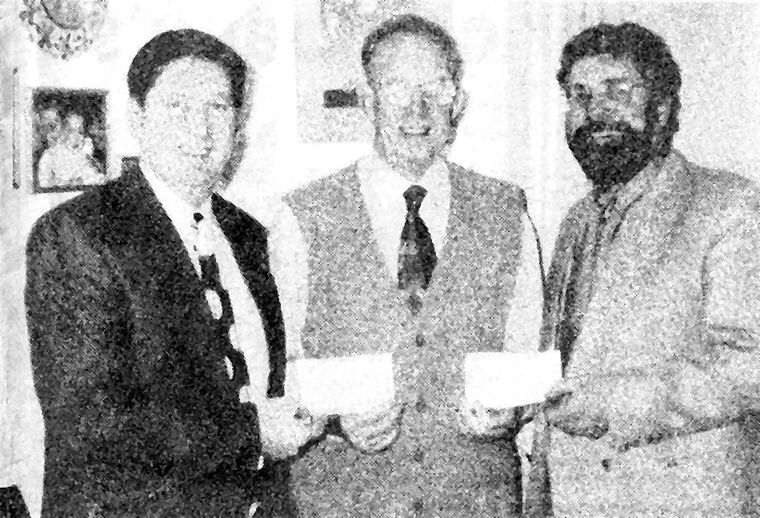 |
James was deputising for Mr Livingston who lost his father in a mining accident as did both James and George, Blairhall and Fordell Collieries being the scene of the fatalities.
In accepting the donation on behalf of the fund, Mr Richardson said that the management and employees had been very generous and he wished them a very prosperous 1996.
The fund, which will see a memorial erected in Kelty to mark the Lindsay Disaster of 1957, has made remarkable progress in 1995 and is bang on target.
--------------------------------------------------
"Dunfermline Press"
9 February, 1996
Miners' monument
Sculptor David Annand has been commissioned to produce a bronze statue of a miner to commemorate the Lindsay Colliery disaster.
The 5 ft 4 in statue will be erected on a site at Kelty library along with a second memorial depicting a winding wheel and hutch on rails, at Lindsay Bridge. The bronze statue alone is expected to cost around £10,000, with Scottish Coal likely to meet the cost of the Lindsay Bridge memorial.
The Lindsay Memorial Fund has received £5000 from Fife Regional Council and £2500 from Dunfermline District Council and is on the way to meeting its target, according to secretary Archie Campbell. Nine miners died in the disaster, which took place on 14th December 1957.
Artist David Annand, of Kilmany by Cupar, was recently commissioned to sculpt the late racing driver Jim Clark.
Meanwhile, the £325 proceeds of the last meeting of the Kelty Reunion Club in Canada have been contributed to the fund. The last reunion in Hamilton was attended by 110 people aged from 12 to 89 years old. It was decided to end the reunion because of declining numbers and the age of many of the expatriates.
--------------------------------------------------
"The Courier"
December, 1996
Lindsay Pit disaster remembered
OBELISK DEDICATION CEREMONY
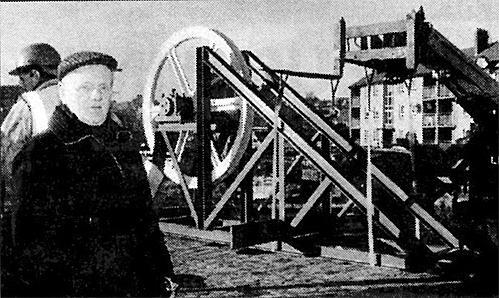 |
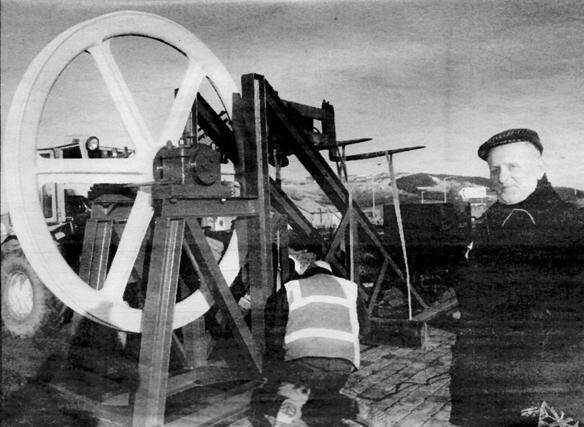 |
The nine men who were killed in a violent explosion at the Lindsay Pit, Kelty, will be remembered on Saturday at the dedication of an obelisk to mark the 39th anniversary of the disaster.
The ceremony will be the culmination of nearly two years work by the Lindsay Disaster Memorial Fund to honour the men who died and to mark the mining heritage of the village - some 2000 men were employed between the Lindsay and Aitken Collieries.
The dedication ceremony at the former Lindsay Pit site will start at 10.30 am when Rev Dr H C Ormiston, industrial chaplain of the mining industry, will give the welcome and introduction. Kelty Church minister, Rev Robin Allison will then talk about mining and the community, and the work of the Disaster Fund Committee will be outlined by chairman, Pat Rattray.
Michael McGahey, retired president of the Scottish National Union of Mine Workers will perform the unveiling of the obelisk - winding gear and a hutch full of coal - and the reading and prayer will be given by Father Michael Purcell, Parish Priest, Kelty. The dedication of the obelsik and one minute's silence will follow.
Pictured [see image link above] is Mr Archie Campbell of the Memorial Committee watching the installation of the memorial by contractors Gilmartin, who secured a RECHAR environmental improvement contract for Kelty.
The design for the obelisk, which was selected by the committee, was formulated by former Kelty man, Jim Douglas, now of Glenfarg. The wheel and hutch were made at the Longannet complex courtesy of Scottish Coal and the finishing works were completed by trainees at Rosyth Dockyard, courtesy of Babcock Thorn.
On the memorial is a plaque which features the inscription, "On this site stood the Lindsay Colliery where on 14th December 1957 nine men lost their lives in an underground explosion." The Lindsay Disaster, in the week before Christmas, plunged the whole community into mourning.
The colliery, which opened in 1873, was owned by Fife Coal Company prior to the nationalisation of the pits and closed in 1965.
The obelisk site, with seating and landscape works, will be a place for former miners to reminisce and provide an opportunity for young people to learn about mining heritage.
Today, looking around Kelty, there is no physical evidence that, for over 100 years, coal had been extracted from the area and that mining was the main source of employment in the area. The legacy of mining in the village includes Kelty and Blairadam Brass and Pipe Bands, as well as the Moray Institute - all originally subsidised by the miners contributions and still going strong today.
Work on a life size bronze miner statue to mark the 40th anniversary of the disaster is currently being worked on by David Annand of Kilmany, North East Fife. The miner will be sited outside Kelty Library.
The committee would like to thank everyone who donated to the disaster fund.
--------------------------------------------------
"The Courier"
December, 1997
The day a village held its breath
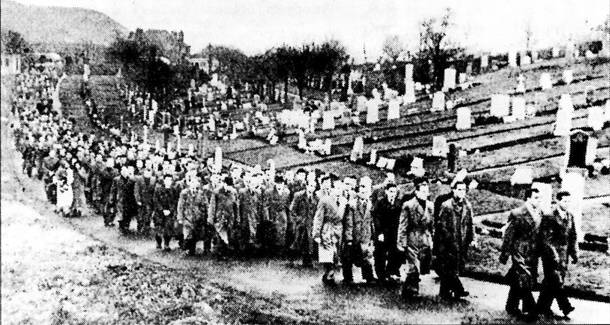 |
Kelty is preparing to remember the nine men who died in the Lindsay Colliery disaster four decades ago. With a week of community events planned leading up to the unveiling of a new memorial, Graeme Esson, of the Courier, spoke to one ex-miner with vivid memories of the tragedy.
Forty years on from the tragic death of nine miners at Kelty's Lindsay Colliery, Archie Campbell knows that memories live longer than dreams.
The retired miner was one of the volunteers who helped bring the blackened bodies from the pit after the tragic explosion.
Eight men working in the Glassee section lost their lives in the 1957 disaster and a ninth died in a brave attempt to rescue his colleagues.
Now the Kelty community is preparing to remember them with a week of events culminating in the unveiling of a new sculpture in their memory and a remembrance service.
Lindsay Disaster Memorial Fund secretary Archie, of Centre Street, Kelty, was one of the driving forces behind making the memorial a reality.
He was 33 at the time of the tragedy and worked in the Glassee section where the explosion took place in the early hours of 14th December 1957.
"I have a lot of vivid memories of the disaster, and memories live longer than dreams," he said.
He recalled how he arrived for his day shift shortly before 5am to be told that the disaster had happened a couple of hours before.
"The rescue boys had to go down first with their breathing apparatus. They had been down a couple of hours when the word came back up that there was no hope of anyone living in the disaster area. There were eight men working there, and the other man who lost his life went in to rescue them."
After inspecting the scene the rescue team established a fresh-air base where breathing apparatus was not needed.
"Their job was to go in with stretchers, mark out the positions of the bodies, wrap them in hessian, strap them onto stretchers and carry them to the fresh-air base.
Me and many volunteers were sitting and waiting to take the bodies right up to the mortuary. That was our job on that day. I did see one of the bodies and instead of being white he was pure black," he recalled.
Hundreds of people had volunteered to help, but he had been chosen because he knew the area.
"There wasn't a boy that would have refused to go down that pit. I'm no hero, I was feart along with the rest of them."
He was at the pit bottom for more than 12 hours before the operation was completed - then had to take his children to a Christmas party.
Afterwards, however, he went to a subdued Kelty Club, where he received the unwelcome news that he would have to go down the pit the following day.
As workman inspector for that area he had to accompany the safety inspector to take gas samples in the section.
"I was terrified, but I wouldn't admit it," he confessed. "The samples were all found to be clear, but when the cage came up in daylight … I'm not a religious man, but I thanked God when I saw that daylight."
There had been hardly any damage to the mine - the victims had all died of asphyxiation.
Archie said the explosion had been caused by smoking, but said ventilation problems in that section had been "atrocious" and that officials as well as miners had smoked in the mines.
In press reports from the time, survivors working elsewhere in the section told how the explosion had been "like a bomb."
Miners spoke of being blown over, then having to crawl to safety while blinded by the coal dust.
The memorial to be unveiled next Saturday is a sculpture of a miner by renowned Fife artist David Annand, possibly best known for his sculpture of racing driver John [sic] Clark.
"It is very lifelike," said Archie. "I am quite happy with it and I am proud of it too."
The appeal was launched in 1995 to raise £10,000 for the memorial, which will be sited outside Kelty Library, and an obelisk on the site of the colliery itself.
Support was received from many people and organisations, with the obelisk being erected last year on the anniversary of the disaster.
Chancellor Gordon Brown and retired Scottish National Union of Mineworkers president Mick McGahey will be among 250 people expected to gather next Saturday to pay their tribute at the unveiling of the memorial.
The following day will see a remembrance service in Kelty Parish Church for all those who lost their lives in Kelty mines.
And these tributes will follow a week of community activities to mark the event's importance to the community.
An exhibition, "Mining the Archives," is already open in Kelty Library, featuring a series of photographs and articles dealing with the history of mining in the area and the disaster itself.
The library will also host a demonstration of mine rescue equipment on Thursday, with some dramatic tales of life underground.
Kelty and St Joseph's Primary Schools are holding competitions on a mining theme for silver quaichs donated by former miner Mick Conway at Inverkeithing Trophy Centre.
Performances will be given at the refurbished site outside the library by Kelty Blairadam Pipe Band on Monday and Kelty and Blairadam Brass Band on Wednesday.
Local artist Jim Douglas, from Glenfarg, will be giving a talk on mining and photographs on Tuesday in the Moray Institute.
It will also house silent documentary films from the Scottish Screen Archive on Wednesday, with live piano accompaniment.
--------------------------------------------------
"To commemorate the 50th Anniversary of the Lindsay Disaster, several events took place in Kelty. We are grateful to George Hunter, Crossgates, for permission to scan and display copies of the Memorial Service and Carol Service booklets from 14th December 2007."
M. Martin & Webmasters.
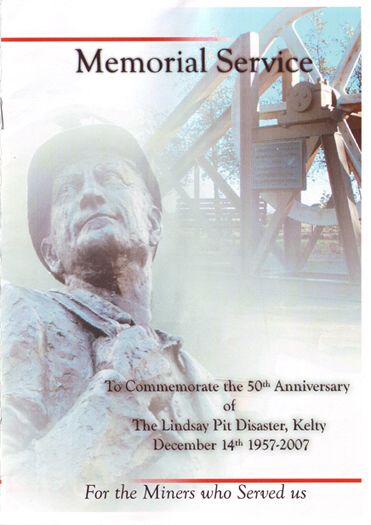 |
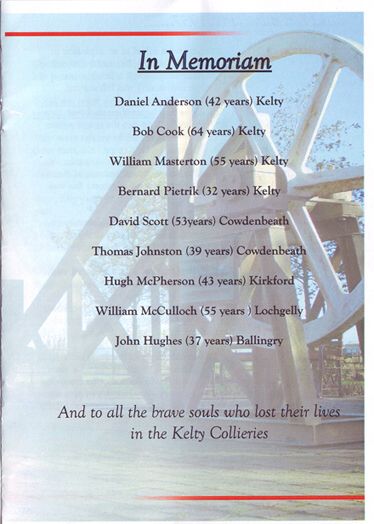 |
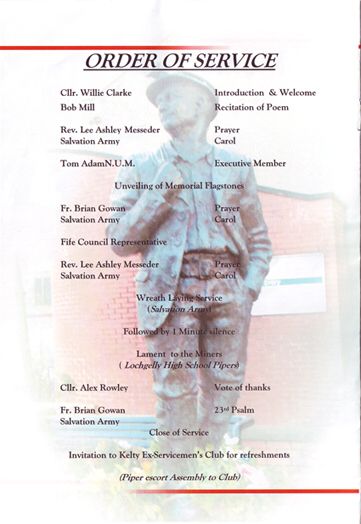 |
 |
 |
 |
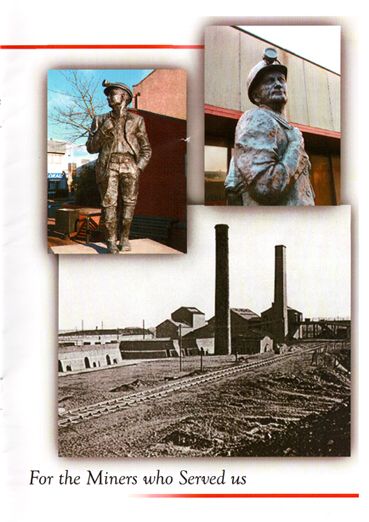 |
 |
--------------------------------------------------
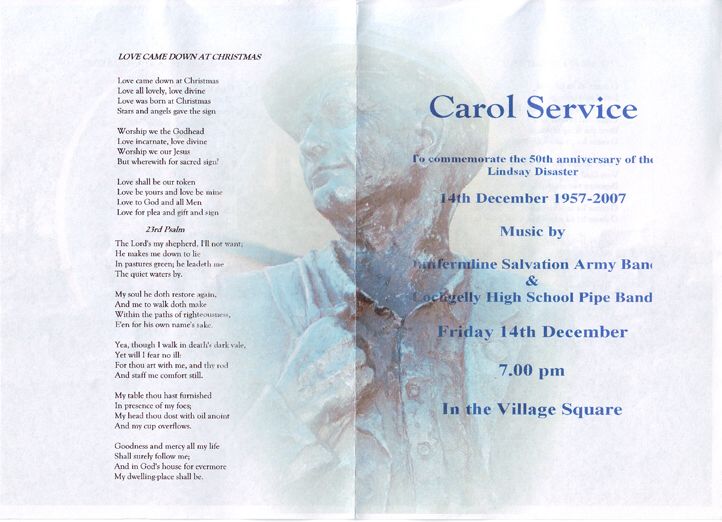 |
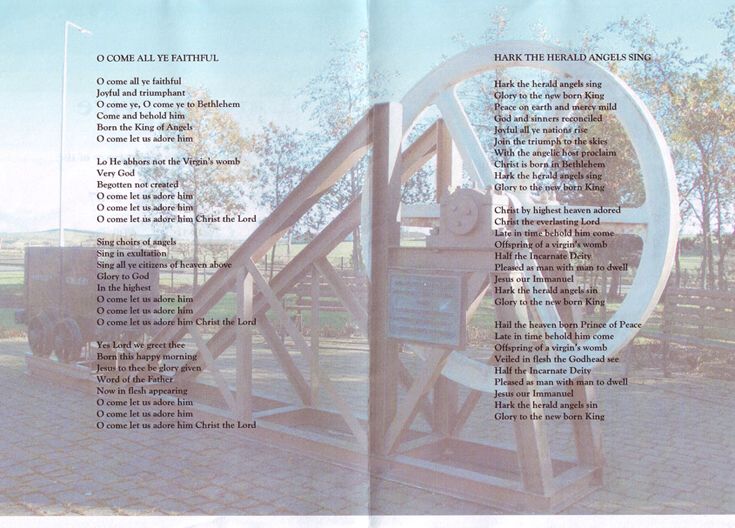 |
--------------------------------------------------
