Owners: Fife Coal Co. Ltd.
NCB
There had been a couple of incidents at the Lindsay
Colliery prior to this date; one man was fatally injured in
an explosion in 1930, and ignition of firedamp on 4 May,
1955, had injured two men. Sadly, nine miners lost their
lives and eleven miners were injured on that fateful day in
December, 1957, while working the Glassee Coal seam.
The mine was worked in three shifts. In the Glassee seam,
coal was filled on the day and afternoon shifts during
alternate weeks, the deputies changing with their men. The
night shift deputies, however, remained permanently with that
shift and so, for one week, had the first preparatory shift
and the following week the second preparatory shift.
At the time of the explosion, the output of the pit was
approximately 1,100 tons a day, of which around 400 tons came
from the Glassee Seam.
Management at the Lindsay Pit at the time of the explosion
The colliery was in the West Fife Area of the Scottish Division National Coal Board. The principal officials were:
Area General Manager:       Mr. G. Mullin
Area Production Manager:    Mr. J. Hutchison
Deputy Area Production:     Mr. R. B. Dunn

Manager (Operations)
Group Manager:              Mr. J. C. B. Haynes
Manager:                    Mr. W. Reid
There were two under-managers: Mr. W. Orr, who was in charge of the workings of No. 1 Surface Mine; and Mr. A. Bell, who was in charge of the remaining underground workings.
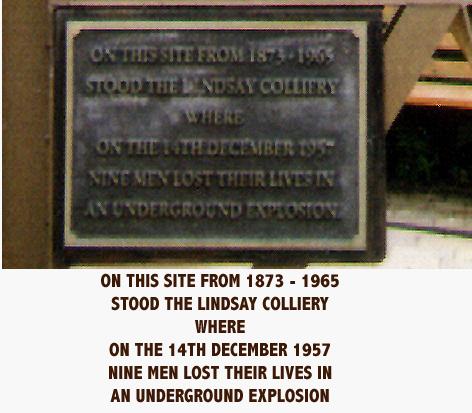
Lindsay Disaster
The Explosion of 14
December, 1957
 |
 |
The No. 3 Unit
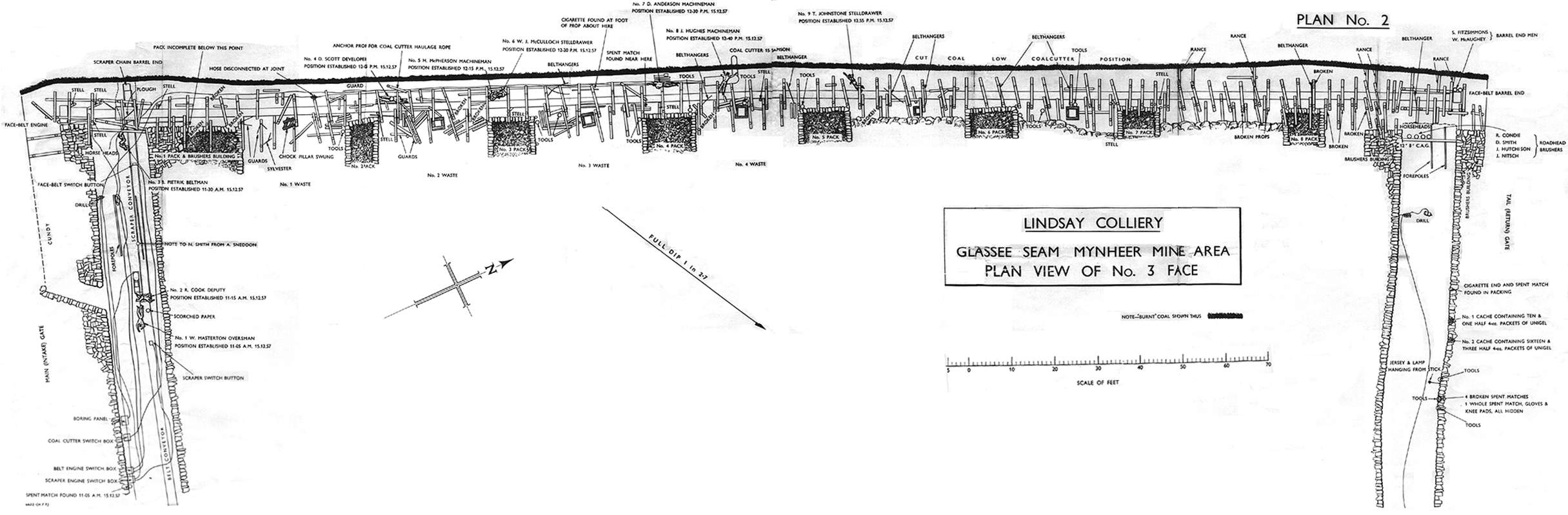
17. Plan No. 2 show the face of No. 3 Unit in which the explosion occurred; The face was 120 yards long and was advancing across the line of true dip. The gradient of the face was 1 in 3-3, dipping from the main (intake) gate towards the tail (return) gate, and the gates rose towards the face at a gradient varying from 1 in 4 to 1 in 5. The seam was about 3 feet 6 inches thick and was overlain by a blaes roof. The Unit was bounded on the rise side by the abandoned No. 2 Unit, the waste of which was contacted from time to time, and on the dip side by a fault from which ran igneous intrusions. There was "burnt" coal from these intrusions in the lower part of the face.
18. The face was supported by a mixture of wood and rigid steel props set to corrugated steel bars. Intermediate packs were built and chocks were set along the edge of the waste to facilitate caving. Wet cutting was practised, and coal being undercut by machine to a depth of 4 feet 6 inches and hand loaded on to a bottom loading belt conveyor which conveyed it uphill to main gate. In the main gate a short scraper conveyor carried the coal to the main belt conveyor.
Ventilation
19. Air entered No. 3 Unit through the main gate and, after passing down the face and through the tail gate, left by a return common to Nos. 3 and 4 Units, Air sampling had been regularly carried out: the highest firedamp content recorded before the separation of ventilation referred to paragraph 15 was 0-39 per cent, in the tail gate on 4th October, 1957; after the change the highest was 0-26 per cent. at the bottom corner of the face. No samples were taken in the wastes, but a few tests where made at the waste edge by holding a flame a flame lamp at arm's length onto the waste.
Electricity
20. Electricity was lawfully in use. The electrical included gate and face conveyor drives coal cutters, drills and pumps
 |
THE EXPLOSION AND SUBSEQUENT EVENTS
21. One hundred and seventy-four men were employed underground on the night of 13th / 14th December, 1957, when the explosion took place. Of those in the Glassee Seam 13 men were employed in No. 3 Unit, under the charge of Robert Cook, deputy, and William Masterton, overman, both of whom were subsequently killed. In No. 4 Unit there were 16 men under the charge of Robert Smith, deputy. The work in No. 3 Unit was to cut the face, brush the bottom gate and withdraw supports from the waste. In No. 4 Unit the work ways that of the first preparatory shift.
22. When the men arrived at No. 3 Unit there seems to have been some difficulty in starting the brushing of the bottom road because of loose coal and inability to get the face belt to run. The coal cutting machine was also held up, apparently for the same reason. By 2 a.m. however the coal cutting machine had cut out of the bottom corner and had passed the gate, and soon afterwards Cook, the deputy, is said to have fired three brushing shots. The brushers then cleaned up, erected a girder and began packing dirt on the high side of the road. By 3 a.m. waste drawing had been completed, and at about 3.30 the deputy asked one of the workmen, S. Fitzsimmons, to help tighten the face belt and get it running for the day shift. He had proceeded to do this when in his own words "the next thing I know was a man lying on top of me."
23.This was at 4 a.m. W. McAughey and R. Condie, who were in No. 3 Unit, said that they were blown over by hot air and dirt, and that the air was very thick and black W. Fleetham and W. Monaghan were blown over but saw no flame. Another man said "there was no terrific heat just warm air."
24. The men working in the Mynheer Development did not hear anything which indicated clearly to them that there had been an explosion. Shortly after 4 a.m., however, they were told by Fleetham that something had happened in No. 3 Unit. Five of them, accompanied by another man from No. 4 Unit, immediately set off to see if they could rescue any of the men affected. They were unable, because of dust and fumes, to approach the Unit by the intake. D. O'Donnell and A. Moyes, however, managed to enter through the return airway and reached the face. They saw the bodies of T. Johnstone, J. Hughes and D. Anderson, who it seems clear were dead, but were then obliged to retreat. On the way down the face, however, they met D. Scott and R. Muirhead and returned up the face with them; they were followed later by R. McCartney and E. Tungate. O'Donnell and Moyes were soon overcome by the atmosphere, however, and had to be helped out by McCartney and Tungate. Scott was then overcome: Muirhead did his best to help him out but found it physically impossible to do so and had to make his own escape.
25. These six men followed the best traditions of the mining industry when they made this gallant attempt to rescue their fellow workmen. It is with great regret that I report that when eventually David Scott was recovered he was dead.
26. On his way to the Mynheer Development, Fleetham had telephoned the surface to report the explosion. A. M. Sneddon, the deputy in the Mynheer Development, also telephoned the surface and asked them to inform the manager and to summon rescue brigades. These messages were passed on immediately to the manager, W. Reid, at home. His attempt to telephone the Cowdenbeath rescue station by way of the Area office was unsuccessful. He accordingly telephoned J. C. B. Haynes, the group manager, at about 4.10 a.m. and asked him to get the rescue brigades; the latter telephoned the safety officer and asked him to do it. This the safety officer did, passing the message at 4.25 a.m. and was soon joined by other National Coal Board officials. All men not needed for rescue operations were withdrawn from the mine and it was ascertained that nine men could not be accounted for.
27. The rescue superintendent and two assistants arrived at the colliery with equipment at 4.40 a.m. Cowdenbeath is a Scheme B station without permanent brigades, and it was therefore necessary to assemble a rescue brigade from the local trained rescue workers. At 5.30 am. one had assembled and was ready to go underground; ten minutes were then spent waiting for instructions from the National Coal Board officials who had by this time also assembled at the mine. The first team went underground at 5.40 am. and established a fresh air base just beyond the loading point Pat a place known as the Old No.1, about 1¼ miles inbye. They were followed by the group manager, who took charge of operations underground; the manager remained on the surface in charge of events there.
28. The rescue team left the fresh air base at 6.40 am. and then made a complete circuit of the affected district, starting on the return side. They had no particular difficulty in getting along the road or face, though it was rather warm and visibility was only about 12 yards. During this circuit they located at various points the bodies of the nine missing men, all of whom were dead. About ten yards beyond the coal cutter, going towards the intake gate, the team discovered a whole, unsmoked cigarette lying on the ground at the foot of a prop. The cigarette was dirty but, according to the captain of the team, no dirtier than was to be expected after an explosion. The team found no other contraband during this first inspection. They arrived back at the fresh air base at 7.20 a.m.
THE INVESTIGATION
29. Meanwhile efforts were being made to restart the ventilation. Temporary repairs were made to the overcast, which had been damaged slightly by the explosion, and sheets were erected to divert as much air as possible into No. 3 Main Gate. By 9.20 am. the district was clear enough to be entered without breathing apparatus.
30. The district was then inspected by Mr. F. S. Pollard, H. M. Senior District Inspector of Mines and Quarries, accompanied by Mr. W. Hislop, H. M. District Inspector of Mines and Quarries, officials of the National Coal Board and representatives of the National Union of Mineworkers. The only trace of firedamp was in a roof cavity in the extreme left-hand corner of the face. Only a few signs of violence were seen at the outbye end of No. 3 main gate: the gearhead of the gate conveyor had been moved about 2 feet out of line; a little further inbye the belt was thrown off line: and further inbye still the conveyor structure had been moved. The air crossing in No. 4 intake gate was also damaged.
31. The waste drawing seemed to have been completed, and the sylvester was lying in No. 1 waste. On reaching the coal cutting machine Mr. Pollard saw that the haulage rope had been newly extended and that the control handle was in the position normally used for inching, which suggests that the machineman was tightening the rope at the time of the explosion. Mr. Pollard thought he saw traces of coking but preferred to leave the point to experts from the Safety in Mines Research Establishment. In the tail gate, where there were no signs of explosive violence, the amount of brushing still unremoved was not enough to have blocked the ventilation, nor to have hindered men getting out into the gate.
32. A drilling cable was seen to be hanging on hooks in the tail gate some 15 yards back from the face; there was also a deputy's relighter lamp hanging up in that gate. Shot firing exploders and shot firing cables were found hanging up in both gates. In various places, Mr. Pollard found a total of 15 four-ounce cartridges of explosives, some cut in half. Some of this explosive was concealed under stones.
33. A further inspection of No. 3 Unit was made on the following morning, 15th December, by Mr. C Sharpe, H. M. District Inspector of Mines and Quarries, who was accompanied by Mr. W. Linton, overman. This inspection was directed particularly to discovering anything that might have acted as an igniting agent. Mr. Sharpe made a systematic search of the whole Unit, starting on the intake road of No. 3 Unit at the third refuge hole in from the entrance to the main gate. he found a spent matches generally along the intake road inbye, and cigarette butts towards the roadhead. Amongst this contraband was a cigarette butt and a spent match, which were found behind some conveyor trays piled up at the side of the intake road just before reaching the face. On the face itself he found a spent match at the foot of No. 4 pack (that is, near the point at which the rescue brigade had found a whole cigarette). He found cigarette butts " in abundance" and also an empty cigarette packet in the return road.
34. When the bodies of the men killed in the explosion were brought to the surface, police officers examined their clothing. In three cases they found contraband:
| (1) | an empty cigarette packet; another packet containing a partly smoked cigarette; another partly smoked cigarette; and three spent and four live matches: | |
| (2) | a cigarette packet containing one cigarette; one loose cigarette; and three matches; and | |
| (3) | a small tin containing a partly smoked cigarette. |
35. Mr. Sharpe also found "at least 40 cartridges" of loose explosives hidden in various places under stones, or buried. Most of this was at the side of the return road, but one or two cartridges were found in the intake to the Unit.
36. On 16th December, Mr, L. Cheesbrough, H. M. District Inspector of Mines and Quarries, accompanied by officials of the National Coal Board and representatives of the National Union of Mineworker, visited the affected area to take dust samples. Samples were taken systematically (as prescribed by the Coal Mines (Precautions against Inflammable Dust) Regulations, 1956), in the No. 3 Unit tail gate, the common return for Nos. 3 and 4 Units, the intake road and the belt level. In the No. 3 Unit tail gate, the roof and side samples varied from about 86 to about 93 per cent. incombustible matter, and the floor samples from about 56 to about 68 per cent. In the common return, the corresponding figures were 79 to 99 per cent. (except for one figure of 38 per cent.) and 58 to 75 per cent.; in No. 3 Unit intake 55 to 74 per cent. and 34 to 49 per cent.; and in the belt level 64 to 86 per cent. and 48 to 62 per cent.
37. On 15th and 16th December, Mr. S. Jones and Dr. H. titman of the Safety in Mines Research Establishment accompanied by Mr. Hislop and a party which included representatives of National Coal Board and the National Union of Mineworkers, visited No. 3 Unit to collect samples of deposited and impacted dust and coke and specimens of material likely to indicate exposure to flame. These specimens and samples were subsequently examined microscopically and chemically at the Establishment. Coking was found in the samples of dust taken at about the middle of the face, in those taken at the roadhead of the main gate and for 720 feet down the gate itself, and in those taken in the cundy. Splinters of wood and a sample of fabric, collected at the roadhead of the main gate, in the cundy and 720 feet along the main gate, were definitely burned.
38. Mr. Jones thought, on the basis of these results, that the definite indications of blast on the face were limited to impacted dust and small coal on the faces of supports facing the main gate and extending from a point about 60 feet from the intake to a point about 60 feet from the return. He described as "a quiet zone" a length of about 60 feet of the face, beginning at the main gate, which showed signs of burning, but not of coking or violence. He thought that his examination showed that the direction of blast was away from this? zone along the intake and down the face towards the return, and inferred that the point of origin was within or near this zone, He did make the reservation that the direction of blast is not necessarily the same as the direction of travel of the flame. For example, a mild explosion travelling up the face might have developed much greater violence in the intake, and blast travelling back from this point of violence might give on the face signs of blast opposed in direction to that of the travel of flame. He thought, however, that this was unlikely to have occurred here, for there were no signs of sufficient violence either in the face or in the main gate. He also concluded, from the absence of signs of coking near his assumed point of ignition, that the initial ignition had been of firedamp; but that it was extended in the main gate as an explosion of coal dust.
39. Lamps and electrical apparatus were removed from the Unit to the Safety in Mines Research Establishment for test.
40. Four of the cap lamps showed no signs of damage beyond that to be expected from normal wear. Two others were slightly damaged, the damage consisting respectively of a dent and a small hole in the battery case. Another lamp had its headpiece broken and its cable severed, the insulated cable covers also being exposed near the cable gland. Another lamp was in a similar condition, but with the headpiece more badly broken and with about half the thinner part of the moulding missing.
41. The electric coal cutter when examined showed no signs of an internal explosion. The machine was, however, subjected to the standard flameproof tests. Two tests were made, but in neither did the explosion inside the machine ignite the gaseous mixture outside. Similar examinations and tests were made of the other electrical machinery removed from No. 3 Unit. It was all found to be in good order, and in no case did an internal explosion ignite the external firedamp mixture.
42. An investigation was also made into the possibility of ignition having been caused by frictional sparking during undercutting. All the picks visible on the low side of the chain seemed to be in good condition; two of them (one from each row) were taken from the chain, together with two new picks from the bag, for scientific examination. The machine seemed to have been cutting in dirty coal or shale; a sample of this, covering the full depth of the cutting horizon, was taken for petrological examination.
43. Examination at the Safety in Mines Research Establishment confirmed that the picks were in good condition Those taken from the machine showed very little wear. There was a bright surface on the stock of one of these picks, but there was no sign of "blueing' , nor was there any sign of plastic flow. The mineral specimens were found to vary in hardness. A petrological examination of the specimens showed that they gave the X-ray pattern of kaolin only and contained less than 1 per cent. of quartz, if any.
44. The firedamp content of the air in the waste was investigated. Samples were taken after the explosion on a regular basis in the two top wastes, that is the wastes below Nos. 1 and 2 Packs. Out of 262 samples the highest concentration found was about 8-67 per cent. in a sample taken in No. 3 waste (the waste below No. 3 Pack), but on a further 11 occasions 1 per cent, was found. Boreholes were also made through the top corner of the face into the abandoned No. 2 Unit. While a hole was in coal, air samples taken from it were found to contain a high proportion of firedamp fell off rapidly and eventually became negligible. After the Unit had been re-started a flame lamp test at the waste edge between No. 2 and No. 3 packs showed between 3 and 4 per cent of methane.
THE NATURE, CAUSE AND DEVELOPMENT OF THE EXPLOSION
45. One of the most significant features of this explosion was the presence at the face of a virtually unaffected area, aptly described by Mr. Jones as a "quiet zone", which extended from near the gate to the vicinity of No. 3 waste. After hearing his evidence and his remarkably clear account of his investigation I am in complete agreement with his conclusions, I think that the presence of flame, but not coking, in this zone established beyond doubt that it was the site of a mild ignition of firedamp, the blast of which at this point was insufficiently strong to raise coal dust. I think it is also clearly established that the explosion did not travel far down the face towards the return: the signs of blast disappeared within about 260 feet; and men working at the return roadhead 60feet father on were uninjured. On the intake side, however, the signs of burning and coking described by Mr. Jones convinced me that flame had travelled about 720 feet outbye along the main gate. Other effects, such as the displacement of the delivery end of the conveyor 750 feet outbye, the injury to J. Rowley, the haulage attendant, and the damage to the air crossing in No. 4 intake gate showed that blast travelled still father. The spread of the explosion is shown on Plan No. 4.
46. Mr Jones also explained very clearly why blast does not necessarily indicate the direction of flame travel. I agree entirely, however, with his conclusion that in this case it did. The existence of the "quiet zone", from which all signs of blast clearly radiated, showed conclusively that there had been no blast reversal effect.
47. My conclusion, therefore, is that this explosion originated in or near the "quiet zone" as a comparatively mild explosion of firedamp and was propagated down the main gate by coal dust. No other conclusion is, I think, possible. That the original explosion was mild and that fuel was firedamp is clear from the absence alike of signs of violence or signs of coking within the zone. Coal dust could not, at this point, have been raised into the flame. The effects of this mild original explosion could not, however, have spread so far down the main intake road unless the explosion had found new fuel there. I do not think that this fresh fuel could have been methane. There was no evidence to suggest that methane was given off in the intake gate and it certainly could not have migrated from the face against both the gradient and the ventilation. The intake was, however, also a conveyor road; I have no doubt that the coal dust on it provided the necessary fuel.
48. I have little hesitation in dismissing electricity, shot firing and frictional sparking at the coal cutter as possible igniting agents. The electrical machinery was found to be in good condition and still flameproof. The exploders were found hanging up and were clearly not in use at the time. The material damage to the cap lamps had plainly occurred during the explosion. The state of the coal cutter picks and the nature of the strata make it unlikely that there was frictional sparking even if, which is by no means sure, the machine was cutting at the time of the explosion. I conclude that the igniting agent was a match.
49. Besides all this negative evidence there are several positive facts to support these conclusions. A spent match and an unlit cigarette were found at the face near No. 3 Waste and contraband was found in the clothing of some of the victims nearby; the only place in the unit whew firedamp has been found in appreciable concentrations is in the vicinity of this waste and drawing-off operations had been completed there only a short time before the explosion. When all these facts we considered I regard the sequence of events as established beyond reasonable doubt.
50. The picture as I see it is that following drawing-off operations a comparatively small volume of firedamp was emitted. from the vicinity of No. 3 waste, possibly due to a heavy fall but more likely, I think, as the result of the closure of bed separation cavities acting as a kind of bellows. Because of the inclination of the face the firedamp travelled along the roof against the air current towards the main gate roadhead, thus forming a layer of gas over an area corresponding with the "quiet zone". Somebody then struck a match and ignited the gas. Because of the release of pressure afforded by the wastes, the explosion was not sufficiently violent to raise an inflammable dust cloud along the face on the return side, particularly in view of the blanketing effect of the small coal, but was powerful enough to raise such a cloud at the loading point at the main gate roadhead whence it was propagated along the gate as a coal dust explosion by dust raised mainly from the conveyor.
51. The representatives of all the interested parties agreed with these views about the initial cause and place of origin of the explosion and also I believe, except for Mr. Hunter, about its subsequent development. Mr. Hunter submitted that the microscopical examination of coke and splinters, to use his own words, was "flimsy evidence" on which to decide the part played by coal dust in the propagation of the explosion along the main gate. I cannot accept this view. To the experienced observer, the evidence provided by the microscopical examination of dust specimens and splinters is remarkably revealing.
52. In this particular case the evidence so provided was corroborated by the analysis of dust samples. Evidence given by Mr. Jones of the examination of explosion dust, the. dust which had been raised in the course of the explosion, and by Mr. Cheesbrough of samples taken in the usual manner from the roof, floor and sides after the explosion, showed that there was more than sufficient combustible dust present in the main gate to propagate an explosion. Moreover, the samples taken by Mr. Cheesbrough from the roof and sides contained 55 to 74 per cent. of incombustible matter; while in the explosion dust specimens referred to by Mr. Jones, the incombustible content increased regularly from 20 per cent. near the face to 40 per cent. approaching No. 2 Transfer Point The difference in incombustible content between these two types of samples confirms me in thinking that the explosion was propagated along the intake gate mainly by coal-rich dust from the transfer point at the roadhead, from the structure of the conveyor and from the belt.
53. For all these reasons I could not accept Mr. Hunter's submission. Moreover, he offered no alternative explanation of the damage to the air crossing or the movement of the delivery end of the conveyor, and put no questions about dust to his expert (Mr. Mullin) which I regarded as giving me added justification for rejecting his submission on the point.
OBSERVATIONS ON THE CAUSES AND CIRCUMSTANCES
OF THE EXPLOSION
Searching and Smoking
54. Despite the system of searching described in paragraph 11, the amount of contraband found after the explosion and the evidence given by workmen and other witnesses showed conclusively that smoking was widely practised not only in the Glassee district but in other parts of the mine. This was, I think, common knowledge to workmen and officials alike. Mr. Moffat sought to show that the failure to stamp out smoking was in the main due to the cursory nature of the searching and the laxity of officials. It is certainly true that contraband was very rarely found in any of the searches carried out on the approved system, the surface searchers (whose experience covered about two years) said they had never found any at all, and the last entry in the book recording the finding of contraband was dated 27th March, 1956, on the other hand, I was much impressed by the evidence of Mr. Campbell, a stripper, and Mr. Bell, the under-manager.
55. Mr. Campbell gave his evidence in a most forthright and straightforward manner and as he in no way gave me the impression of wishing to shield the officials, I think the following extract of his cross-examination by Mr. Moffat worth quoting:--
| "Q. | Were you ever search at this colliery, Mr. Campbell?--Yes. | |
| "Q. | Were you searched very often?---Every day on the surface and every second or every third day in the fireman's station. | |
| "Q. | Could you give me some idea of the kind of search that took place?--Fairly thorough, but I could have had cigarettes if I cared to take them through with me. | |
| "Q. | How could you have taken them through with you if you wanted to with that search? Did the searcher go into all your pockets?--Yes. | |
| "Q. | Did he examine all the articles you carried?--Yes. | |
| "Q. | How could you go through then if he had done that? If he searched all your pockets and examined all your articles how could you go through?--I do not know the answer to that, Mr. Moffat, but if I were going to take cigarettes past the fireman I could have taken them. | |
| "Q. | It is quite obvious that some miners have taken them in more that I would expect, but the point I want to put is that if a thorough search is made along the lines I have suggested, how could you then take cigarettes through that search? If all your pockets were searched, all your articles were searched, how then would it be possible for you to go through with cigarettes? Would it be possible for you to get through if that search was carried out?--The search that the colliery did at the station I could have had them, Sir. | |
| "Q. | What kind of search was carried on at the station?--They searched my pockets, my haversack, and looked in my hat and my knee-pads. | |
| "Q. | I am going to pass now to the question of contraband. I think it would be helpful if you gave us some details of the results of your surprise searches. I think you carried out such a search on 5th September, 1957 do you remember that?--Yes |
List of the Dead Men
| Name | Age | Occupation |
| Daniel Anderson | 42 | Machineman |
| Robert Cook | 64 | Deputy |
| John Hughes | 37 | Machineman |
| Thomas Johnstone | 39 | Packer |
| William Masterton | 55 | Oversman |
| William McCulloch | 55 | packer |
| Hugh McPherson | 43 | Machineman |
| Bernard Pietrik | 32 | Beltman |
| David Scott | 53 | Developer |
List of the Injured Men
| Name | Age | Occupation |
| Robert Condie | 42 | Brusher |
| Samuel Fitzsimmons | 49 | Prop Drawer |
| William Fleetham | 35 | Back Brusher |
| James Hutchison | 49 | Brusher |
| William McAughey | 58 | Repairer |
| Robert McGuinness | 21 | Brusher |
| William Monaghan | 20 | Back Brusher |
| Jan Nitsch | 35 | Brusher |
| John Rowley | 49 | Haulage Operator |
| David Smith | 35 | Brusher |
| Robert Smith | 53 | Deputy |
