Owners: Henry Ness & Co.
Lochside Coal Co.
Lochside Coal & Fireclay Co., Ltd., Townhill
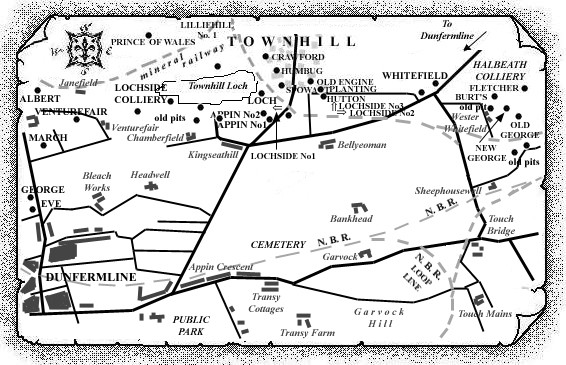
The Lochside Pit and the related Fireclay Works lay to the
south of the Town Loch at Townhill. We believe that, approaching
1930, this works closed and three new mines were developed
just to the east of this location.
Please refer to the Lochside Nos. 1, 2, 3 Mines entry for
information post-1930 on the fireclay mines which we believe
were still operating around 1959.
 |
| Pit opened: 1890s ? | Pit closed: by 1930? |
|---|
| Source Date of Information Supplied |
|---|
| Manager / Under-Manager / Men underground / Men above ground / Coal seams worked |
| 1896 (Henry Ness & Co.) |
| Henry Ness / ------------ / --- / --- / Standing / Household, manufacturing and steam coals. |
| 1902 (Lochside Coal Co.) |
| A. Paterson / ------------ / 18 / 2 / Household, manufacturing and steam coals. Blaes. |
| 1904 (Lochside Coal Co.) |
| A. Johnstone / ------------ / 22 / 3 / Household, manufacturing and steam coals. |
| 1905 (Lochside Coal Co.) |
| ---------- / ------------ / 16 / 3 |
| 1906 (Lochside Coal Co.) |
| Dec: William Johnstone, under-manager |
| 1908 (Lochside Coal & Fireclay Co.) |
| William Johnstone / ------------ / 22 / 3 |
| 1909 (Lochside Coal & Fireclay Co.) |
| William Johnstone, manager |
| 1911 (Lochside Coal Coy.) |
| ---------- / ------------ / 23 / 3 |
| 1918 (Lochside Coal & Fireclay Co.) |
| William Wilson / ------------ / 32 / 3 |
| 1920 (Lochside Coal & Fireclay Co.) |
| William Wilson / ------------ / 44 / 6 |
| 1928 (Lochside Coal & Fireclay Co. Ltd.) |
| William Wilson / ------------ / 48 / 5 |
| Steam coal, blaes and fireclay. Five Feet, Clay, Dunfermline Splint and Two Feet. |
| Now refer to the Lochside Nos. 1, 2, 3 Mines entry |
Information on coals worked at the Lochside Pit & Fireclay Works, Townhill
(based on a report from 1930)
By 1930, at Lochside, to the south of Town Loch, the Dunfermline Splint Coal seam had almost been exhausted by "stoop and room" workings.
A section recorded at the pit had the following composition:
| Description | Thickness |
| Fakes | - |
| Faky blaes | 1 ft. |
| Blaes | 1 ft. |
| COAL | 3 ft. 11 in. |
| Sandstone | - |
The fireclay underlying the Five Feet Coal was wrought from the Lochside Fireclay Works around this time, the coal itself being mostly worked out by "stoop and room", the stoops being 6 ft. square. The seam was 3 ft. thick and it had a roof of blaes and a fireclay pavement.
-----------------------------------------------
"Dunfermline Press"
2 April, 1904
On Thursday, Alexander Williamson, miner, Main Street, Townhill, met with serious injuries in the Dunfermline Splint Seam of the coal mine at Lochside Coal and Fireclay works, belonging to Messrs H. & D. Ness. He was pushing a hutch of blae when a stone burst from the side of the road. The stone knocked him against the hutch and fell upon his left leg, causing a compound fracture. The injured man was conveyed home and examined by Dr Bell, who ordered his removal to the Dunfermline Cottage Hospital, where the leg was amputated at the knee.
-----------------------------------------------

"Dunfermline Press"
3 November, 1906
Between ten and eleven o'clock yesterday forenoon a fatality occurred in the coal mine connected with the Lochside Coal and Fireclay Works at Townhill, belonging to Messrs H. & D. Ness. The victim was George Ritchie, a miner, thirty years of age, residing at Mid Beveridgewell, Dunfermline. The unfortunate man was engaged driving a road through some old workings for the purpose of getting out blae and fireclay, when a stone weighing half a ton fell upon him from the roof, which, at the place, was about seven feet high. James Hastie, a fellow-workman, had left Ritchie for a few seconds, and on his return he found his companion sitting on the roadway in a doubled-up position and apparently dead, a supposition which was proved to have been well-founded. Dr Bell, who had been summoned, was waiting at the pithead when the body was brought to the surface, and on making an examination he gave it as his opinion that death had been almost instantaneous, Ritchie's spine having been fractured as the result of a blow on the back of the head by the stone. The remains were conveyed to Mid Beveridgewell in the ambulance wagon. Deceased was a married man, and is survived by a widow and four children, of whom the eldest is nine years, and the youngest, an infant of four months. In the Beveridgewell district, where the deceased was well-known, the accident created a painful sensation.
-----------------------------------------------
"Dunfermline Press"
1 December, 1906
Under the Fatal Accidents Inquiry Act, an inquiry was held in the Sheriff Court, Dunfermline, on Friday - before Sheriff Shennan and a Jury - into the circumstances attending the death of George Ritchie, miner, lately residing at Mid-Beveridgewell, Dunfermline, who was killed on 2nd November in the Lochside Pit, Townhill, by a fall of stone from the roof. Those giving evidence included:- John Hastie, pit drawer, Elgin Street, Dunfermline; Andrew Peacock, miner, Main Street, Townhill; Andrew Todd, miner, 1 Union Street, Townhill; and William Johnston, under-manager. A formal verdict was returned by the jury.
-----------------------------------------------
"Dunfermline Press"
26 June, 1909
On Wednesday forenoon a fatality occurred in the mine which is wrought in conjunction with the works of the Lochside Coal and Fireclay Company, Townhill. The victim was George Burt, thirty-nine years of age, a miner, residing at Muir Road., Townhill. Burt was engaged getting blae in the old workings of the Dunfermline splint seam, when, without any warning, a band of the stone, weighing about 18 cwts., fell from the roof upon him. Great difficulty was experienced in removing the stone, which had to be levered by means of stout pit props. Dr A. L. Bell, who examined the body, expressed the opinion that death must have been almost instantaneous, the unfortunate man's neck having been broken. Deceased leaves a widow and three children, for whom the deepest sorrow is felt.
------------------------
"Dunfermline Press"
17 July, 1909
Under the Fatal Accidents Inquiry Act, an inquiry was held in the Sheriff Court, Dunfermline, on Thursday - before Sheriff Shennan and a Jury - into the circumstances attending the death of George Burt, miner, lately residing at Muir Road, Townhill, who, on 23rd June, was killed in the old workings in Dunfermline splint seam in the coal mine at Townhill of the Lochside Coal and Fireclay Company, by a stone falling upon him from the roof. Those giving evidence included:- William Johnston, colliery manager; Campbell Fyfe, miner, Main Street, Townhill; and William Penman, pit fireman, Kingseathill. A verdict was returned in accordance with the evidence.
-----------------------------------------------
"Dunfermline Press"
27 November, 1909
Lochside Coal and Fireclay Company, Limited, was registered on 18 November, with a
capital of £40,000 in £1 shares (20,000 ordinary shares, 20,000 preference shares), to acquire
the business of coal masters, brick, and fireclay goods manufacturers carried on by Mr David Wilson
Ness and Mr Henry Ness, jun. The Company is a private one. The first directors are Messrs David
Wilson Ness and Henry Ness, jun. - managing director, Mr David Wilson Ness, Lilybank, Dunfermline.
The registered office is situated at Lochside Works, Townhill, Dunfermline; and the secretary is Mr Wm.
Ditchburn, Burnbank, Headwell Road, Dunfermline.
-----------------------------------------------
"Dunfermline Press"
16 July, 1910
While at work in the 5-ft. seam of the Lochside Coal and Fireclay Coy, on Monday, a miner, named David Jack, had his left foot severely bruised by a large stone falling from the side of a road.
-----------------------------------------------
"Dunfermline Press"
22 March, 1913
While at work in Ness' mine, worked in connection with Lochside Brickwork, David Cowan, miner, residing in Viewfield Place, was somewhat severely injured on Saturday. Cowan was in the act of holing when the coal burst over the "gibs" and, falling on him, crushed him severely on the lower part of the body. He was taken home on a stretcher, where he was attended to by Dr Bell.
-----------------------------------------------
"Dunfermline Press"
27 November, 1915
Andrew Peacock (49), miner, Main Street, Townhill, was the victim of a serious accident in the coal mine at Lochside Coal and Fire Clay Works on Tuesday morning. He was engaged taking down blae, when a piece, weighing about 8 cwts., unexpectedly came away. He was struck by the falling mineral. His right thigh was fractured, and his left hip joint and three fingers of the left hand were dislocated. The man was conveyed home and attended to by Dr A. L. Bell, who ordered his removal to the Dunfermline and West Fife Hospital.
-----------------------------------------------
"Dunfermline Press"
5 February, 1916
TOWNHILL ACCIDENT ENDS FATALLY.
The death took place in Dunfermline and West Fife Hospital on Wednesday of Andrew Peacock, miner, Main Street, Townhill, who met with an accident in the coal mine at Townhill of Lochside Coal and Fireclay Company on 23 November last. He was working at the face when a heavy fall of blae occurred, breaking his right leg at the thigh, fracturing three fingers of the left hand, and causing serious bodily bruises. Peacock was forty-nine years of age, and is survived by his wife and family.
-----------------------------------------------
"Dunfermline Press"
4 March, 1916
Under the Fatal Accidents Inquiry Act, an inquiry was held in the Sheriff Court, Dunfermline, on Thursday - before Sheriff Umpherston and a Jury - into the circumstances attending the death of a miner named Andrew Peacock, lately residing at Main Street, Townhill, who died in the Dunfermline and West Fife Hospital on 3 February 1916, from injuries received on 23 November 1915, in Lochside Mine, Townhill, of the Lochside Coal and Fireclay Company, Ltd., by a piece of blae falling on him from the face. Those giving evidence included:- Police Sergeant Hugh Macdonald Black, Townhill; George Brown, miner, Kirkgate, Dunfermline; William Wilson, manager; and Christopher Muir, pit fireman.
-----------------------------------------------
"Dunfermline Press"
20 May, 1916
MINERS' MEETING. - At the usual monthly meeting of the miners of the Townhill district on Thursday - Mr James Russell presiding - it was stated that the contributions to the special drawing on behalf of the Edinburgh Royal Infirmary were as follows:- Townhill Colliery, £11 ; Muircockhall Colliery, £13 3s 6d ; Lochside Mine, £1 6s ; total - £25 9s 6d.
-----------------------------------------------
"Dunfermline Press"
19 January, 1918
FIRE AT LOCHSIDE BRICKWORKS
A destructive fire took place on Tuesday evening at the works of the Lochside Coal and Fireclay Company, Townhill. ... The pit at the works, from which supplies of coal and clay are obtained, is also at a standstill.
-----------------------------------------------
"Dunfermline Press"
7 February, 1920
David Jack, miner, Main Street, Townhill, was severely injured about the legs, while at work at Lochside Coal and Fireclay Works on Tuesday. He was caught by a fall of stone from the roof, and one of his legs was fractured above the ankle, while the other was severely crushed. He was conveyed home, and promptly attended to by Dr Bell. This is the third accident the unfortunate miner has had in the same mine.
-----------------------------------------------
"Dunfermline Press"
29 October, 1923
FATAL PIT ACCIDENT. - Christopher Muir (65), residing at Townhill Road, was fatally injured in the pit of Messrs The Lochside Coal and Fireclay Company, Limited, at Townhill, on Saturday. Employed as an inspector, he had just finished his work for the day when, proceeding along a roadway, he slipped, and fell in front of a rake of loaded hutches, one of which was overturned and fell upon him.
--------------------------
"Dunfermline Press"
3 November, 1923
PIT INSPECTOR'S SUDDEN DEATH
Christopher Muir (65), who had been employed as an inspector in the coal mine attached to the works of the Lochside Coal and Fire-Clay Company, Ltd., at Townhill, died with tragic suddenness on Saturday forenoon. He had finished his work for the week, and was proceeding along a haulage road en route for the pit bottom when he suddenly collapsed, death occurring almost instantaneously. It was at first thought that he had been overtaken and struck by a race of hutches, but a post-mortem examination disclosed the fact that death was the result of natural causes. Deceased, who resided at Grieve Street, Dunfermline, was for a number of years church officer at St Andrew's United Free Church, St Margaret's Street.
--------------------------
"Dunfermline Press"
1 December, 1923
Under the Fatal Accidents Inquiry Act, an inquiry was held in the Sheriff Court, Dunfermline, on Thursday - before Sheriff Umpherston and a Jury - into the circumstances attending the death of Christopher Greig Muir, fireman, lately residing at 35 Grieve Street, Dunfermline, who died on 27 October in the Lochside Coal & Fireclay Company's mine at Townhill. Dr J. Finlayson Fleming gave evidence at the inquiry.
-----------------------------------------------
"The Scotsman"
19 August, 1926
DUNFERMLINE BREAKAWAY
Last week about a dozen miners resumed work in the mine of the Lochside Coal and
Fireclay Company, Townhill, Dunfermline. Gradually, the number of men who have
returned to the pit has increased, and yesterday it was reported that forty men were at work.
Between five and six o'clock yesterday morning, a picket of at least one hundred men
and women assembled in the vicinity of the works. They subjected the men to some jeering,
which possibly would have developed into something more serious but for the presence of a
large body of police. Fearing molestation, several men who had already resumed work, failed
to put in an appearance at the pit yesterday morning.
-----------------------------------------------
"Dunfermline Press"
21 August, 1926
Last weekend about a dozen miners resumed work in the mine of the Lochside Coal and Fireclay Company, Townhill, Dunfermline. Gradually, the number of men who have returned to the pit has increased, and on Wednesday it was reported that at least forty men were at work. ...
-----------------------------------------------
"Dunfermline Press"
11 September, 1926
... Thirty men are engaged at the Derby mine, Wellwood, and forty-five miners have resumed at the mine of the Lochside Coal and Fireclay Company, Townhill. None of the men is being interfered with by those who are still on strike, although the police are keeping a vigilant observation on the situation.
-----------------------------------------------
"Dunfermline Press"
Saturday,
25 September, 1926
INTIMIDATION AT
TOWNHILL
__________________
"Miners Sent To
Prison"
The sequel to a picketing incident at Townhill
on 19th August was seen in the Dunfermline Sheriff Court
on Thursday. James Robertson Sutherland, Checkweighman, 6, Wilson
Street, Townhill, and Gabriel Alexander Carr, machineman, 50 Dundas
Street, Townhill, were charged under the Conspiracy and Protection
of Property Act with having, in Green Street, Townhill, with a view
to compelling John Bower, pit fireman, and Adam Bower, miner, Main
Street, Townhill, to abstain from working in the Lochside coal and
fireclay mine, which they had a legal right to do, followed with a
large number of other persons in a disorderly manner, and thus
intimidated them.
Mr John S. Soutar, Procurator Fiscal, conducted
the prosecution, and Mr R. W. Currie, solicitor, attended on behalf
of the accused, who denied the charge.
"Insulting and terrifying tactics"
John Bower, pit fireman, one of the men alleged
to have been intimidated, said he was employed in Lochside mine,
and in consequence of the coal stoppage he was off work from
1st May until 12th August, when the mine was
re-opened. Every day after that he stopped work about 2 o'clock
and was annoyed by people following him home. At about 2
o'clock on 19th August, he left the mine with his
son Adam and when they were walking along Green Street they were
met by a band of twenty or thirty children and then by the accused.
Witness warned the accused at that stage that these mobs and
demonstrations had been going on long enough and that he was
determined they should cease. He asked them to go their own road.
About twenty yards further on they met the main mob, consisting of
upwards of a hundred people. They followed the witness and his son
"booed" and hissed and sang "show me the way to go
home". They were marched up in this way to Main Street, a
distance of a hundred or a hundred and fifty yards. At the corner
of Main Street witness saw Sergeant Campbell and gave the accused
in charge. As a result of these insulting and terrifying tactics,
witness added, his son did not return to work until 30th
August.
Mr Currie - So far as Sutherland and Carr were
concerned, there was nothing terrifying or insulting to you?
Witness -
It depends on what you
mean.
In answer to further questions, witness agreed
that when he addressed the accused they made no reply. Asked if the
accused had ever opened their mouths at all, the witness replied
that when they were in the crowd they said "come on now,
boys". He had not heard accused telling the crowd not to speak
and not to make a noise. He agreed that some of his fellow workmen
in the district disapproved of him working an eight hours day, but
as a mine fireman he thought he was entitled to work.
"Had been doing it all week"
Asked in what way the two accused
"insulted" him, witness replied :- They were 25 yards or
thereby in front of the main crowd. They were there for the special
purpose of doing what the crowd had been doing all week - trying to
terrify or stop or insult any workman who had worked.
Did they tell you that that was why they were
there ? - No, but I was aware.
Their form of terrifying you and insulting you
was not to answer when you spoke to them? - They seemed to think,
if they did not speak, that they were doing alright, but I
differed.
Adam Bower, son of the previous witness,
corroborated generally the evidence in chief of his father, along
with whom he was at work in the Lochside mine. The crowd, he said,
was singing and booing.
The Procurator Fiscal - Did you, from their
behaviour, form any opinion as to what they were driving at?
Witness -
I expect it was to try to stop us from working.
Procurator Fiscal - Had
that any effect on you?
Witness - Yes. It had an effect. My wife turned
ill through it. She was in bed for two days. I was off my work from
the day it happened until 30th August.
Cross examined, the witness did not think that
the object of the crowd was to show that his father and he were
working eight hours in the Lochside mine, That might have been
their object. Neither of the accused replied when his father spoke
to them. It was not the case that what Sutherland cried to the
crowd was "walk on boys". He admitted that there was no
jostling of any kind, and nothing said about working.
Replying to the Procurator Fiscal, witness said
the crowd followed him and his father for about 250
yards.
"Police evidence"
Police Sergeant James Campbell, Townhill, stated
that he was on duty in Main Street, Townhill, along with Constable
Hutton, when he learned that there was a crowd in Green Street who
might be interfering with workers. When he got to Green Street he
observed the two Bowers coming toward the end of the street. A
crowd of 150 persons was following them. The two accused were
immediately behind the Bowers. There was booing, hissing and
singing in the crowd. The Bowers, who gave the two men in charge,
informed him that they had been subjected to this annoyance for a
certain distance. Both men were taken into custody. They both
resisted being apprehended. At the Police Station, Townhill, on
being warned and charged, Sutherland replied - "I am quite
prepared to deny that": and Carr's reply was - "I am
the same as him".
Questioned by Mr Currie as to what the crowd was
doing, witness replied - Singing, shouting, bawling and hissing.
There were about twenty or thirty children in the crowd and a few
women. He did not hear the crowd using any threats towards the
Bowers. All he saw was the two accused walking behind the two
Bowers.
Police Constable J. A. Hutton, replying to Mr
Currie, said the crowd was not behaving in any outrageous fashion.
What he heard was just a general noise.
"Accused's version"
Sutherland, giving evidence on his own behalf,
said he was present at the foot of Green Street when the two Bowers
came forward as if returning from their work. There were some women
and children about and further up the street he saw some more men
and women. When the Bowers came forward, the father addressed some
words to his son. They made no reply to what was said. What the
elder Bower said was - "Here they are again; take note, and he
said he would make him (Sutherland) sorry for it.
"What", asked Mr Currie, " was
your object in being there at all? The reply was - "to show
our disapproval of the breakaway".
Mr Currie - To show your disapproval and
displeasure at what they had done in working eight hours?
Witness - Yes. Carr and the witness proceeded,
took care to avoid committing any breach of the law. He warned
people in the vicinity to pass no remark. He did not ask the Bowers
to desist from working or threaten them in any way. Carr and he
walked silently behind them as they walked up the street. There was
no jostling or anything of that kind. He denied telling the crowd
to "Come on boys". What he asked the crowd to do was to
"Walk on boys". The only noise consisted of some singing
by children.
"Fighting an industrial crisis"
Interrogated by the Procurator-Fiscal,
Sutherland said he heard no booing or jeering.
"What business is it of yours, asked the
Procurator-Fiscal, if the Bowers choose to do an honest day's
work? - We are fighting an industrial crisis at the present time,
and we disapproved, and tried to show that, in a quiet manner,
according to the law, to any man breaking away from the ranks of
the workers.
And you choose to go about idle, living on
charity? - Not if I get a living wage.
That is what you are doing in the meantime? - I
deny that. I am living on no charity.
You are not working? - I am willing to work.
Because these men, Bowers, have a proposal made
to them which suits them, both as regards time and money, and
because you disapprove of that, and think they should neither use
that time in that way to earn money, you proposed to take steps to
stop it if you can? - I took no steps to stop it.
What were you doing there: were you just taking
a walk there for curiosity? - As a citizen, I have a right to be
on the street as long as I conduct myself in an orderly
manner.
What were you doing in this mob of 150 meeting
the Bowers on their way home from work? - I never organised the
mob.
What were you doing there, if you want to
conduct yourself like an ordinary citizen? -
Curiosity; the same as the rest.
Carr was held as concurring in the evidence
given by Sutherland.
"A regrettable case"
The Procurator-Fiscal, at the close of the evidence, remarked that this was a regrettable case, because it came from Townhill, which, as a general rule, was a model village in which there was no trouble. It was not a very serious outbreak, had it not been connected with the present industrial stoppage. What undoubtedly was intended, or was done, by these two malcontents was to take part in a demonstration intended to influence the Bowers in connection with their perfectly legitimate work. Of course, one must make allowances for the ignorance of that class of person. The accused thought that what they could do in this way could be done with impunity but, fortunately, there were provisions which enabled one to reach such conduct as this. Whatever view his Lordship might take with regard to the penalty applicable to such a case, he thought there was no doubt that what had been proved had established a case in accordance with the complaint.
"Influencing" or "Compelling"
Mr Currie, on behalf of the accused, said that the Procurator-Fiscal had apparently based his case on the allegation that the accused were taking part in a demonstration which had for its object the influencing of the Bowers in connection with their work. If that was all the Procurator-Fiscal alleged, then he submitted that the case was not proved. He had got to do something a great deal more than establish a demonstration for the purpose of influencing people. He had got to prove that the accused were there for the purpose, not of influencing but, compelling the two Bowers to do or refrain from doing something which they were entitled to do. That, he submitted, had not been proved. Before it could be held that a thing had been done for the purpose of compelling a person to abstain from doing something, the situation must be very much stronger than a mere demonstration for the purpose of influencing. It had not been proved that the presence of the two accused on the occasion in question was an offence against the Statute in respect, he submitted, that it had not been proved that their purpose was to compel the two men to abstain from working. What they were there for was a legitimate purpose, namely, to show their disapproval of what the men had done. Mr Currie added that, since the disturbance, there had been no trouble at Townhill.
The Sheriff found the charge proved and passed sentence upon each of twenty one days imprisonment.
Court Case No. 527 - Offence: Conspiracy &
Protection of Property Act 1875
Date of first calling: 20.08.1926
Plea: Not Guilty
Date assigned for hearing: 30.08.1926
Date of Sentence: 23.09.1926
Sentence: 21 days imprisonment
--------------
Extract: "Dunfermline Press"
16 October, 1926
____________________
"TOWNHILL PRISONERS RELEASED"
"A Cordial Welcome Home"
The Townhill miners who were recently sentenced
to twenty-one days imprisonment under the Conspiracy &
Protection of Property Act 1875, as a sequel to a picketing
incident, received a cordial welcome from the villagers on their
liberation on Thursday.
The men were met at Kingseathill by the Townhill
Silver Band and a large concourse of people, and were played home
amid enthusiastic scenes.
In the evening, the "heroes" and their
wives and families were entertained in the Co-operative Hall at an
"at home" on the invitation of the Co-operative
Society's Committee of Management, Womens' Guild, Strike
Committee and band.
Mr George Izatt, Chairman of the Industrial
Co-operative Society, occupied the chair. After he had offered a
few remarks the company, numbering over 70, sat down to
tea.
In the course of the proceedings, Mrs Robert
Smart, Mrs G. Izatt, Mr James Stevens, Mrs Peter Sharp, Mr G. Carr
and Mr Robert Paterson contributed songs.
A number of dances were engaged in by the
company, to music supplied by members of Townhill Silver Band.
Votes of thanks were given to the Womens' Guild and
'Store' Committee. Mr William Yule, the Labour candidate
for the Third Ward, made a few remarks which were highly appreciated
by the company.
-----------------------------------------------
