Owners: Thomas Spowart & Co. Ltd.
NCB
There was a pit sunk to around 42 fathoms, the Leadside No. 1
(the Lead is a small burn flowing eastwards from here towards Town
Loch) just to the west of Wellwood, north of Dunfermline, around
1847. Later, a more modern pit, Leadside No. 2, was sunk further
east and it is thought to have been Wellwood's - and
Dunfermline's - last working pit.
The colliery, which also
had a mine, was closed following a serious fire at the pithead of
Leadside No. 2 Pit in 1950.
 |
| Pit opened: No. 1 sunk ca 1847 : No. 2 sunk 1908 | Pit closed: No. 1 1930 ? ; No. 2 and Mine (June, 1950) |
|---|
| Source Date of Information Supplied |
|---|
| Manager / Under-Manager / Men underground / Men above ground / Coal seams worked |
| 1910 |
| William Wilkinson, manager. |
| 1918 |
| William Wilkinson / Alexander Shepherd / 126 / 38 |
| 1920 |
| ------------ /
Alexander Shepherd / 130 / 38 Leadside Mine: 37 / 10 |
| 1926 |
| Nov: Alexander Shepherd, under-manager. |
| 1928 |
| George Livingstone / Alexander Hynd / 51 / 21 |
| Steam coals. Mynheer. |
| 1945 |
| Leadside No. 2 Pit: Alex. Tripney / William McNeilly / 140 / 41 |
| Manufacturing and steam coals. Five Feet and Dunfermline Splint. |
| 1947 (NCB) |
| Leadside No. 2 Pit: Alex. Tripney / 180 / 50 |
| Industrial and steam coals. Approx. annual output = 55,200 tons. |
| 1948 (NCB) |
| Alex. Tripney / 180 / 55 |
| Household, manufacturing and steam coals. Five Feet, Two Feet and Dunfermline Splint. |
| 1949 (NCB) |
| Alex. Tripney / 168 / 46 |
| Household, manufacturing and steam coals. Five Feet, Two Feet and Dunfermline Splint. |
| 1950 (NCB) |
| Alex. Tripney / 171 / 44 |
| Household, manufacturing
and steam coals. Five Feet and Dunfermline
Splint. [March 1951: Mr A. M. Tripney, formerly manager, Wellwood, appointed manager at Lady Helen.] |
---------------------------------------
Information on coals worked at Leadside Pits, Wellwood
A late 19th century observer commenting on the Wellwood
coalfield stated: "There was another pit called the
Leadside, which may be taken notice of here. It reached the
splint coal about the year 1847, and was sunk to a depth of
42 fathoms. This pit passed through a dislocation of the
strata that runs through the old Venturefair Bridge. Not far
away from the pit bottom, the coal was found to be
deteriorated in quality, as if at some period of the
world’s existence it had suffered by fire. This
deterioration always commenced next to the roof, and came
gradually downwards until the whole seam became affected. The
coal lost its beautiful brilliant colour and assumed a
bluish-black tint, and lost its brilliancy until it passed
almost into a hard cinder. Some close mines were prosecuted
through this, but in many places were not successful in
obtaining the coal in its original form.
There are many places in the Fife coalfield where this same
thing takes place - where the coal gets black and sooty,
worthless for any purpose; and, as a general rule, where this
predominates it is accompanied with a soft, dangerous roof,
and sometimes the line of fracture in the coal is reversed.
There are many more pits on these lands that may be referred
to, such as the Albert, the Engine, John, Prince, and the
Victoria Pit, out of which a great deal of coal was produced
of very fine quality, and contributed very much in making
Hawkiesfauld [Wellwood] the thriving little mining
village it is now."
... and based on a report from 1900 ...
In the workings of the Leadside No. 1 Pit, as they
progressed north and west, it was found that the Dunfermline
Splint Coal had been converted into a kind of "blind
coal", or coarse anthracite, and to have become useless.
At this stage, the working "faces" were stopped,
and a trial mine, about six feet in width, was driven for
several hundred yards to near the north march of Mr.
Wellwood's coal-field, where it adjoins Lord Elgin's
coal, lying under the lands of Colton, but without coming to
anything better - the seam being still at the
"face" of the mine in the state of a soft and
comparatively worthless anthracite. The Splint Coal seam, for
nearly the whole of the north part of Leadside Farm, is in
this state, and also to the west, with the exception of a
portion adjoining the Elgin field."
No intrusive rock (whinstone) was visible either in the workings or at the surface of any part of the Wellwood Colliery, nor were the seams above the Splint Coal altered. The cause of the deterioration of the coal must, therefore, have acted from below upwards. To the east of Leadside, the seam resumed its usual excellent character in the pits of Townhill Colliery.
... and from a 1930 report ...
Workings at the Leadside pits in the Dunfermline Splint
recorded blaes ( 4 ft.), stone (2 ft.) and coal (4 ft. 6 in.)
on a sandstone pavement. Another name occasionally used in
the district for this seam was the "Four Foot
Coal".
The Two Foot Coal lay 3 to 6 fathoms above the Dunfermline
Splint and was typically a 2 ft. seam on a faky fireclay or
fake pavement and with a roof of blaes associated with
ironstone ribs and balls.
A section in these pits had a blaes roof, coal (1 ft. 6
in.), stone (3 in.) and coal (5 in.) lying on fakes.
The important Five Foot Coal seam lay about 6 fathoms above
the Dunfermline Splint at Leadside where a section of the
seam had a blaes roof, coal (3 ft.), stone (2 in.) and coal
(2 ft.) on a hard fakes pavement.
The Mynheer Coal was a variable seam wrought here as a steam
coal. In the west and south-west of the district it never
exceeded 1 ft. 6 in. and in some places the horizon was
unrecognisable. The Mynheer Coal occurred roughly 16 fathoms
above the Five Foot Coal, and the overlying blaes were often
irony. The seam had the name 'Crow'or 'Craw
Coal' applied to it occasionally.
The Glassee Coal was even more variable within the district
than the Mynheer Coal. It was wrought at one time in the
Leadside area but was unrecognisable in many parts of the
district, particularly in the south-west. The seam, like the
Mynheer, sometimes had an irony roof.
The Main Group of coals (lower Eight Foot to Six Foot)
never exceeded 20 fathoms in total in this district and the
more usual distance was about 16 fathoms. It included six
coals, most of which contained partings, while the
intervening strata varied considerably in thickness.
The Eight Foot Coal was the lowest seam of the group and it
occurred in two leaves separated by 3 ft. to 48 ft. of barren
strata. Both leaves were wrought in most parts of the
district, often as separate seams.
Many faults were encountered in the workings at Leadside and
their general direction was north-westerly, appearing to
converge on the greater east-and-west Lochhead fault. Any
borings put down within this troubled belt were extremely
difficult to read.
| Plans of Abandoned Seams for Leadside Pits, Dunfermline | Pits or Mines designated in Plans |
|---|---|
| COAL; Five Feet; Splint (1852) | John,
Leadside, Tom, Victoria, Waterloo
[Wellwood] |
| COAL; Dunfermline Splint; Five Feet (1870) | Leadside |
| COAL; Splint (1892); Fourteen Feet (1893); Five Feet (1896); Ell (1899); Cairncubie (1903); Upper Eight Feet (1904); Lower Eight Feet (1906); Swallowdrum (1907); Mynheer; Three Feet; Six Feet or Upper Four Feet; Little Splint. |
Broomhead; Colton Nos. 1, 2; Crawford; Derby No. 2;
Donald; Humbug; Jessie; Killibone; Leadside;
Lindsay's; Loch; Lochend; Prince; Prince of Wales;
Spowart; Townhill; Wallsend Nos. 5, 6, 7, 8.
[Elgin & Wellwood] |
| COAL; Swallowdrum; Cairncubie; Mynheer; Splint or Four Feet; Five Feet; Six Feet; Eight Feet. IRONSTONE (1925) | Albert,
Arthur, Baldridge, Balmule, Bank, Beveridge, Bruce, Bye,
Colton, Derby, Drumtuthil, George, Hunter, James,
Leadside, March, Prince of Wales, Rosebank, Tom,
Union, Venture Fair, Victoria
[Elgin & Wellwood] |
| COAL; Mynheer (1906); Dunfermline Splint (1922); Upper Ell; Lower Ell (1924); Swallowdrum (1925); Five Feet (1926); Glassee (August, 1927); Two Feet (November, 1927) | Arthur,
John, Leadside Nos. 1, 2; Lochend
[Elgin & Wellwood] |
-------------------------------------------

"Dunfermline Journal"
April, 1852
On Saturday, the 17th current, Grace Russell, a young woman about 15 years of age, was employed at the Leadside Pit of the Wellwood Colliery, assisting the banksman at the pit head - the part of the work which she had to perform being to shove the empty tubs into the cage when the full ones were drawn away by the banksman. The pit is divided into two compartments, and the coals raised by means of two cages moving transversely, so that when the full one arrives at the top of the pit, the empty one reaches the bottom. About two o'clock in the afternoon, the young woman, by an unfortunate mistake, instead of running the tub into the cage, which was then even with the surface in the west division of the pit, she pushed it into the eastern division, which was then open, and fell along with it to the bottom, a depth of 42 fathoms, and of course was killed. The father of the unfortunate young woman, who is a smith at the work, was in the pit when the accident took place, having gone down shortly before to shoe some of the ponies that are employed under ground.
-------------------------------------------
"Dunfermline Journal"
September, 1853
A fatal accident occurred at Leadside Pit, Wellwood Colliery, on the afternoon of Thursday the 22d instant. William Beveridge, miner, in attempting to get into the cage without giving the proper signal to the engine driver, it being the regulation of the pit that no person should go into the cage without giving warning, and when no warning is given the engine driver stops no longer than the full tub is removed from the cage at the pit mouth and the empty one replaced, which allows ample time for the man at the bottom of the pit to do the same, the consequence was that Beveridge having given no warning, he being only half-way into the cage when the engine started, and before any signal could be given he was raised a few feet up and crushed between the cage and the side of the pit, causing instant death. The deceased was married, and has left a widow and six children.
-------------------------------------------
"Dunfermline Monthly Advertiser"
November, 1858
On Monday last, 8th inst. at noon, a young boy, named James Sinclair, was killed by the fall of a stone from the roof of the working at Leadside Pit, Wellwood Colliery. This stone, which weighed two tons, had been observed to be loose, and a man had gone for a prop to keep it up, but before he returned the fatal accident had occurred. His brother, also a boy, who wrought at the same wall, had his feet both severely crushed by the fall.
----------------------
"The Scotsman"
Wednesday, 10 November, 1858
A melancholy accident occurred on Monday forenoon at Wellwood Colliery - two boys, brothers, named Sinclair, of the respective ages of ten and twelve years, were employed in filling a tub of coals at the bottom of a pit, when a large stone, supposed to be about four tons weight, fell from the roof. The eldest boy was killed on the spot, the stone falling right on his head and crushing him flat. The younger was struck by the edge of the stone and his leg fractured; his recovery is extremely doubtful.
-------------------------------------------
"Dunfermline Press" - 15 May, 1909
-------------------------------------------
"Dunfermline Press"
2 April, 1910
On Wednesday afternoon an accident occurred in Messrs Thomas Spowart & Company's Leadside Pit, Wellwood Colliery, whereby John Drysdale, a lad of fifteen years of age, residing with his mother at 8 William Street, lost his life. It was the boy's first day in the pit. He was engaged as a chain-runner between Lochside Mine and Leadside Pit. Shortly before two o'clock he was in the act of running the final race of tubs for the day. What actually happened nobody knew. Attracted by an unusual noise, several men at the pithead proceeded to the mine. There they found Drysdale lying in an unconscious condition, six of his race of ten full hutches having apparently passed over his body. With all speed he was conveyed to the Dunfermline and West Fife Hospital. There it was found that both the arms and the legs were fractured. Death ensued within an hour after his admission to the hospital.
-------------------------------------------
"Dunfermline Press"
16 April, 1910
Under the Fatal Accidents Inquiry Act, an inquiry was held in the Sheriff Court, Dunfermline,
on Thursday - before Sheriff Shennan and a Jury - into the circumstances attending the death of
John Drysdale (16), a labourer, lately residing at 8 William Street, who was injured on 30 March
on a gangway at Leadside Pit, Wellwood, by being run over by several loaded hutches, and
who died in the Dunfermline and West Fife Hospital later on the same day.
Those giving evidence included:- William Torrance, jun., (15), Wellwood, pithead worker; William
Torrance, miner, father of previous witness; William Paterson, chain runner, Victoria Terrace,
Dunfermline; Thomas Kay, pitheadman, Nethertown Broad Street, Dunfermline; William Cook,
winding engineman, 117 Baldridgeburn; and William Wilkinson, colliery manager.
The jury returned an open verdict, stating that the exact cause of the accident had not been
proved, and adding an expression of opinion to the effect that, as it was deceased's first
day in the pit, he should not have been left so soon to do this dangerous work alone.
-------------------------------------------
"Dunfermline Press"
13 January, 1912
At about eleven o'clock on Sunday evening, the body of a man was found in a mine at Leadside Pit, Wellwood, wrought by Messrs Thomas Spowart & Company, Ltd. It was evident that death had been due to exposure, and that the body had lain in an icy atmosphere for at least twenty-four hours. The body was identified as that of William Lindsay, retired colliery under-manager, Kingseat Colliery. Deceased, who was seventy-two years of age, had been residing with a son at Lassodie. He visited Dunfermline on Friday, and had stayed overnight with another son in the city. He was last seen in Dunfermline on Saturday afternoon at which time, it is supposed, he set out for Lassodie. His whereabouts were not thereafter ascertained until the body was found as stated. For many years deceased lived at Halbeath.
-------------------------------------------
"Dunfermline Press"
31 May, 1919
A deputation of the workers of Wellwood Colliery waited on Mr James Greig, oversman, last week, and presented him with a clock, along with a gold pendant for his wife, on the occasion of his leaving the colliery to act as manager of the Dunfermline Co-operative Society's coal depot. ...
-------------------------------------------
"Dunfermline Press"
27 November, 1920
Mr Alex. Malcolm, jun., Co-operative Buildings, Townhill, was presented with a handsome pocket wallet and fountain pen by his fellow-workers at Leadside Colliery on the occasion of his leaving for Australia. In thanking the workers for the gifts, Mr Malcolm said he would always remember the kindness and consideration shown to him by his fellow-workers at Leadside.
-------------------------------------------
"Dunfermline Press"
12 February, 1921
Yesterday, about a hundred miners at Leadside Pit, belonging to Messrs Thomas Spowart & Company, were idle owing to the depression in the coal trade.
-------------------------------------------
"Dunfermline Press"
2 July, 1921
... At Wellwood, Muircockhall, and Townhill, pumping is unnecessary, so that, as soon as the ventilation has been restarted, and the falls cleared away, work will be proceeded with on normal lines. ...
-------------------------------------------
"Dunfermline Press"
16 October, 1926
The first pit fatality in Fife since the beginning of the miners' strike occurred on Thursday in Leadside Pit, Wellwood, belonging to Messrs Thomas Spowart & Company, Limited. The victim was James Salmon McDade Burnett (16), a drawer, who resided at Lochhead Cottages. Burnett had started work underground for the first time that morning and he was in the act of drawing a hutch from the coal face when a stone suddenly burst from the roof. The unfortunate lad was pinned to the "pavement" by the stone and killed instantaneously.
-------------------------
"Dunfermline Press"
6 November, 1926
Under the Fatal Accidents Inquiry Act, an inquiry was held in the Sheriff Court, Dunfermline, on Thursday - before Sheriff Umpherston and a Jury - into the circumstances attending the death of James Salmon McDade Burnett, drawer, lately residing at Lochhead Cottages, Wellwood, who died on 14 October in No. 2 Leadside Pit of Wellwood Colliery, from injuries received by a stone falling on him from the roof. Those giving evidence at the inquiry included:- Alexander Shepherd, under-manager, Water Row, Wellwood; and James Bathgate, colliery fireman, Grieve Street, Dunfermline. The jury returned a formal verdict.
-------------------------------------------
"Dunfermline Press"
9 July, 1932
COLLIERY MANAGER'S DEATH. - After a protracted illness, Mr George Livingstone, colliery manager, passed away at his residence, Venturefair Avenue, on Wednesday. He had been manager of the Elgin and Wellwood Collieries of Messrs Thomas Spowart & Co., Ltd., for some years. ...
-------------------------------------------
"Dunfermline Press"
19 March, 1938
FATAL ACCIDENT AT WELLWOOD COLLIERY.
Late on Friday evening last week, John Downie, pithead worker, residing
at 60 Robertson Road, Dunfermline, died in Dunfermline and West Fife Hospital
as a result of injuries which he received at Leadside Pit, Wellwood Colliery, on
Thursday. Nobody actually witnessed the accident. Deceased, it is presumed,
was engaged adjusting the drum of a waggon haulage on the surface when
he was accidentally drawn into the mechanism, from which he was extricated
by workmates.
On being conveyed by ambulance to the hospital in an unconscious condition, it
was found that he was suffering from, among other injuries, a fracture of the
spine. Downie was 34 years of age.
----------------------
"Dunfermline Press"
21 May, 1938
Under the Fatal Accidents Inquiry Act, an inquiry was held in the Sheriff Court, Dunfermline, on Thursday - before Sheriff Umpherston and a Jury - into the circumstances attending the death of John Young Downie, colliery labourer, 60 Robertson Road, Dunfermline, who died on 11th March in Dunfermline and West Fife Hospital from injuries received on the previous day at the surface sidings at Leadside Pit, Wellwood, belonging to Thomas Spowart & Company, Ltd., caused by his being caught between a rope and drum of a mechanical haulage. Those giving evidence included: William Aitken, 12 Water Row, Wellwood, pitheadman; and William J. Ross, engineer, 25 Victoria Street, Dunfermline. A formal verdict was returned by the jury.
-------------------------------------------
"Dunfermline Press"
16 December, 1939
ACCIDENT AT LEADSIDE PIT.
Francis Sykes (19), 2 Bandrum Terrace, Steelend, a labourer in the employment of a firm erecting a colliery washing plant at Leadside Pit, Wellwood, was injured as the result of a fall while at work on Monday afternoon. Sykes was engaged on a gangway of the washing plant when he overbalanced and fell to the ground, a distance of twenty-five feet. Suffering from a head injury and slight concussion, he was removed to Dunfermline and West Fife Hospital.
-------------------------------------------
"Dunfermline Press"
7 September, 1940
DUNFERMLINE MINER INJURED.
John Campbell (45), brusher, 117 Baldridgeburn, Dunfermline, received a fracture of the right ankle as the result of an accident on Sunday in the Leadside Mine, Wellwood Colliery. Campbell was setting a prop in position when a stone came away from the roof and fell on him. He was removed to Dunfermline and West Fife Hospital.
-------------------------------------------
"Dunfermline Press"
2 November, 1940
DUNFERMLINE MINER INJURED.
Charles Kelso (47), miner, 84 Robertson Road, Dunfermline, was injured in an accident while on his way to work at Wellwood Colliery on Wednesday morning. He was walking down the mine when he tripped and fell, receiving a fracture of the left leg below the knee. He was conveyed to Dunfermline and West Fife Hospital.
-------------------------------------------
"Dunfermline Press"
27 April, 1946
ELGIN AND WELLWOOD COLLIERY.
PROPOSED DEVELOPMENT.
It was announced this week that Messrs Thomas Spowart & Co., Ltd., are
preparing plans for the development of the Lochhead coalfield to the north of Wellwood.
The area of the coalfield which the development concerns is 120 acres, with an aggregate
thickness of coal of 25 feet. The Leadside Pit, which is close on one hundred years old, is
incorporated in the scheme, which aims at an output of 400 tons of coal per day for
twenty-five years, and the employment of approximately 200 men.
-------------------------------------------
"Dunfermline Press"
13 September, 1947
WELLWOOD COLLIERY ACHIEVEMENT.
EMERGENCY WATER SUPPLY FROM TOWN LOCH.
At a time when public attention is focussed on the mining industry by reason of unofficial
stoppages and crises, it is pleasing to record a notable achievement accomplished by officials
and men of the Elgin and Wellwood Colliery which prevented the loss in output of several
hundred tons of coal.
The water supply was suddenly cut off, due to a burst water main, and the seriousness of
the situation was immediately apparent as there was no reserve water supply available at the
colliery. It was a case of the surface plant being at a standstill with the prospect of a subsequent
loss of output for the next forty-eight hours. An urgent call to senior officials of the National Coal
Board brought an immediate response, a petrol pump, together with one thousand yards of hose
pipes, along with a team of willing workers being quickly on the scene. By midnight the same
day, water was being pumped from the nearby Town Loch. Steam was again raised and the
pit was able to work to full capacity as a result of this emergency water supply for the next two
days, when the normal county supply was restored. The achievement was a tribute to the
initiative and resourcefulness of officials and men.
-------------------------------------------
"Dunfermline Press"
29 January, 1949
FIFE PITS TO CLOSE
Six pits in Fife and Clackmannan area will be closed in the next two years. These employ 950 men.
This was announced by Lord Balfour, chairman, Scottish Division of the Coal Board, at a conference in
Edinburgh on Thursday. The pits are being closed because they are uneconomic or nearing exhaustion, he said.
The six pits are:- Leadside (237 men); Lumphinnans No. 1 (154 men); Craigrie (146 men);
Melloch (11 men); Meta (98 men), and Rosie (305 men).
It is not expected the closure of these pits would present a problem of displaced manpower.
It was considered the men could be readily absorbed within the area.
-------------------------------------------
"Dunfermline Press"
1 October, 1949
WELLWOOD COLLIERY DEVELOPMENT
A new mine, which has been driven through a fault from the existing seams of Wellwood
Colliery, near Dunfermline, has now reached a fresh seam of Dunfermline Splint coal.
Although it belongs theoretically to the seams of coal already being worked, the fault having
occurred by a fracture in the strata and a subsequent slipping of rock and coal downwards
along the plane of the fracture, there is a possibility that further seams will be discovered
within the new development area, which, if they prove to be of normal dimensions, will greatly
increase the life of the colliery.
-------------------------------------------
"Dunfermline Press"
29 October, 1949
RUSSIAN MINING DELEGATES
Visits to Wellwood and Comrie
The Russian mining delegation, which, on the invitation of the Scottish Area of the National Union of Mineworkers, is at present making a tour of Scottish mining districts, met a company of fully twenty miners and their women folk, at an informal meeting held in Wellwood Institute on Tuesday evening. ...
-------------------------------------------
"The Scotsman"
13 June, 1950
COLLIERY FIRE. - The National Coal Board were endeavouring yesterday to find suitable temporary alternative employment for 80 employees of Wellwood Colliery, Dunfermline, who were thrown idle as a result of a fire which occurred at the pithead in the early hours of the morning. When the outbreak occurred in the pithead weigh box, 12 nightshift workers were underground. They were warned to leave the workings by a safety engineer, who had entered by means of a nearby mine, which provided the means of escape for the men underground. Units of Fife Fire Brigade tackled the blaze with the assistance of a 100-foot turntable ladder, and were on duty for nearly six hours. Loss of output is estimated at nearly 200 tons daily.
-------------------------------------------
"Dunfermline Press"
17 June, 1950
Pithead Blaze at Wellwood
Cage Crashes to Pit Bottom
With the pithead weigh-box and the above-ground woodwork of the shaft ablaze, twelve
night shift underground workers at Leadside Pit, Wellwood Colliery, safely reached the surface
after making their escape from the pit by means of a nearby mine, in the early hours of Monday
morning.
The fire broke out at about 1 am. One of the first to observe the flames was Mr John Ferguson,
4 South Square, Wellwood. He ran to the home of Mr W. Wood, safety officer, who immediately
went to the pit and, entering by the mine entrance, told the night-shift workers to leave immediately.
When they reached the surface the flames were at their height. When a 1½ inch thick haulage
rope was burned through the south cage crashed down the shaft, a distance of 80 fathoms, to the
pit bottom.
Dunfermline units of Fife Fire Brigade were on duty for almost six hours, and, in order to tackle the
outbreak, they brought into use a one-hundred foot turn-table ladder.
The National Coal Board immediately took steps to find temporary alternative employment for the
eighty employees of the pit who were thrown idle as a result of the fire, while equipment was
provided to enable eighty men, who normally work in the mine, to resume employment.
Loss of output at the pit and mine was estimated at nearly 200 tons per day.
Wellwood Colliery is one of the oldest installations in West Fife, and was sunk in 1847.
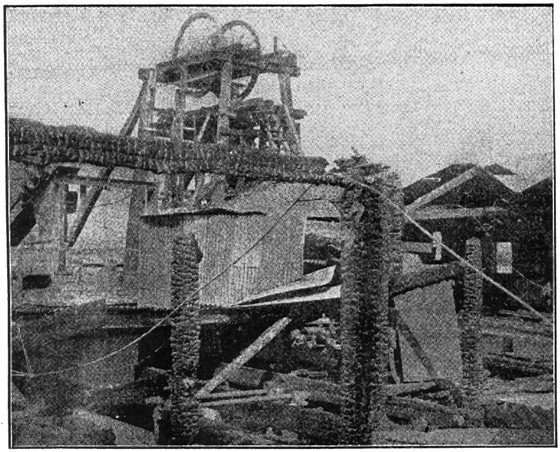 |
Charred timbers and damaged pithead super-structure at the Leadside Pit, Wellwood,
gave an indication of the alarming nature of the early morning fire at Wellwood Colliery on Monday.
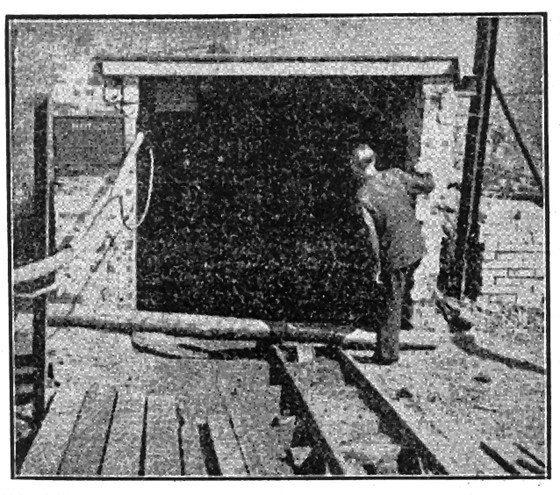 |
The entrance to the mine through which underground workers made their
escape from the workings of Leadside Pit when the fire was at its height.
-------------------------------------------
"Dunfermline Press"
24 June, 1950
WELLWOOD PIT TO BE CLOSED
Following last week's fire at Wellwood Pit, it is understood that the century-old
colliery and the adjoining mine are to close down.
Of the 160 men involved, a number will be retained at Wellwood for dismantling work.
A considerable number have already found employment at other collieries in the district, and
particularly at the Aitken Colliery, while the remainder will be absorbed in other local pits.
-------------------------------------------
"Dunfermline Press"
23 August, 1952
How Wellwood is Being Given a "New Look"
Passing of the Miners' Rows
The time is not far distant when the mining village of Wellwood situated within half
a mile to the north of the centre of Dunfermline will have undergone a complete transformation. ...
The village of Wellwood, named after Andrew Wellwood of Garvock, Dunfermline, the
owner of the lands and minerals underneath, was built by James Spowart of Venturefair
and Bellfield, who is described by Dr Henderson in his "Annals of Dunfermline" as "
a very enterprising and successful coalmaster."
A subsequent lessee was Thomas Spowart and for many years the colliery owners were
Thomas Spowart & Company., Ltd.
Another name for Wellwood, now little used, was Hawkiesfauld, so-called, it is believed,
because of the existence at one time of a coal fauld adjacent to the village, belonging
to a merchant of the name of Hawkie. ...
THE OLD PITS
Less than a century ago, the miners of Wellwood were employed at pits embraced in the
Wellwood Colliery group. These pits were Leadside, situated a few hundred yards to the
north of the village; the Arthur, on the Drumtuthil Road; the Derby, beyond Colton; the
Monkey, at Bowershall; Killiebone adjacent to Loch Fitty; and the Colton. All these pits
have long been closed. In most cases the coal had been worked out. It is many years
since the Killiebone Pit ceased to operate, a sudden inrush of water, which completely
flooded the workings and involved the total loss of the miners' graith, leading to the
abandonment of the colliery.
The last of the Wellwood Colliery group to be closed was the Leadside Pit, which
because of a serious outbreak of fire in one of the coal seams was deemed by the
National Coal Board to be no longer workable. In the days of these pits, the miners
had long distances to tramp to and from their work. ...
-------------------------------------------
| See also Wellwood Colliery entry as in later years "Leadside" became synonymous with "Wellwood" |
|---|
