| A few years after
the closure of the Kingseat No. 1 Pit (closed in 1902), the colliery was to
be taken over and redeveloped by a group known as the Kingseat
Colliery Company, later Kingseat Company Limited, working
successfully until the end of 1945 as Dean Colliery. Management personnel
of the Company included Thomson Smith (managing director); William Smith
(agent); and David Nicholson (colliery manager). Four mines were developed by the operators, Nos. 1, 2, 3 close to the site of the original Kingseat No. 1 Pit, with surface mine No. 4, known locally, we have been informed, as 'Henderson mine', located to the east of the village, by the Cowdenbeath road, and close to the location of an earlier pit about which little is known at this stage. Resinking of the Kingseat No. 1 took place in 1925 but it was the old Kingseat No. 3 which was re-opened to become the Dean No. 3 Pit. It is believed that this was the shaft which was flooded leading to the closure of the Dean Colliery in 1945. |
|---|
 |
 |
-------------------------------------------------
Kingseat (Dean) Colliery
| Colliery opened: ca 1902 | Colliery closed: 1945 |
|---|---|
| Source Date of Information Supplied | |
| Manager / Under- Manager / Men underground / Men above ground / Coal seams worked / Shaft Details | |
| 1905 (Kingseat Colliery Co.) | |
| ------------ / ------------ / 14 / 35 | |
| 1908 (Kingseat Colliery Co.) | |
| David Nicholson / ------------ / 78 / 15 | |
| 1911 (Kingseat Co. Ltd.) | |
| David Nicholson / ------------ / 135 / 19 | |
| 1916 (Kingseat Co. Ltd.) | |
| Jun: Departure of Mr David Nicholson. | |
| 1918 (Kingseat Co. Ltd.) | |
| Alexander Walker / ------------ / 149 / 33 | |
| 1920 (Kingseat Co. Ltd.) | |
| Alexander Walker / ------------ / 228 / 64 | |
| 1923 (Kingseat Co. Ltd.) | |
| Mr Alexander Walker, manager. | |
| 1925
(Kingseat Co. Ltd.) No. 1 Pit resunk to the Dunfermline Splint |
|
| 1928 (Kingseat Co. Ltd.) | |
| Alexander Walker / David Nicholson / 213 / 64 | |
| Household and steam coals. Five Feet, Six Feet, Four Feet, Eight Feet and Cairncubie. | |
| 1938
(Kingseat Co. Ltd.) Kingseat Dean workings largely closed |
|
| Dean: Alexander Gray / David Nicholson / 95 / 67 | |
| No. 4 Surface Mine: Alexander Gray / Alex. McDowall / 178 / 13 | |
| 1945
(Kingseat Co. Ltd.)
Water invades the colliery in November; colliery abandoned by December. |
|
| Dean No. 3 Pit: Alexander Gray / David Nicholson / 225 / 83 | |
| No. 4 Surface Mine: Alexander Gray / W. McNeilly (manpower included in figure for No. 3 Pit) | |
| Plans of Abandoned Seams for Kingseat (Dean) Colliery
(with dates where available) |
Pits or Mines designated in Abandonment Plans |
|---|---|
| COAL; Upper Five Feet; Dean; Upper Dean;
Swallowdrum; Dunfermline Splint (September, 1902);
Lower Five Feet; Lower Eight Feet (December, 1927) Upper Eight Feet (February, 1929) |
Kingseat or Dean Nos. 1, 2, 3 |
| COAL; Six Feet; Dean; Swallowdrum (October, 1910) | Kingseat or Dean Nos. 2, 3 |
| COAL; Fourteen Feet (February, 1914) | Dean No. 2 |
| COAL; Six Feet; Swallowdrum (May, 1928) | Kingseat or Dean Nos. 1, 2, 3 |
| COAL; Four Feet or Upper Five Feet (November, 1930) | Kingseat or Dean Nos. 1, 2, 3 |
| COAL; Mynheer (August, 1935) | Dean No. 3 |
-------------------------------------------------
"Dunfermline Press"
14 March, 1908
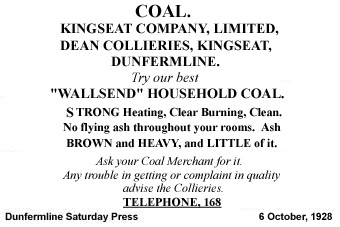
This issue carried an advertisement for the DEAN PIT, Kingseat Company, Limited, Coalmasters, Dunfermline - household coals sales.
-------------------------------------------------

"Dunfermline Press"
21 November, 1908
Under the Fatal Accidents Inquiry Act, an inquiry was held in the Sheriff Court, Dunfermline, on Thursday - before Sheriff Shennan and a Jury - into the circumstances attending the death of William Harper, coal filler, lately residing at 29 Turbayne Row, Townhill, who was injured on 23rd September in the Dean Pit, Kingseat Company, Limited, by getting his hand abraded by coming into contact with the haulage rope or the road roof, in consequence whereof blood-poisoning supervened, and he died on 12 October 1908 in the Dunfermline and West Fife Hospital. Those giving evidence at the inquiry included:- David Nicholson, colliery manager; Elizabeth K. Stein, nurse, Dunfermline and West Fife Hospital; William Paton, miner, 10 Store Row, Townhill; James Walls, miner, 3 Duncan's Buildings, Townhill; Roseanne Connelly or Hynd; and Dr Tuke, Dunfermline and West Fife Hospital. The jury, by the direction of the Sheriff, returned a verdict in which they found that the deceased died from blood-poisoning, the exact cause of which had not been proved.
-------------------------------------------------
"Dunfermline Press"
26 December, 1908
MINER'S SUDDEN DEATH
While at work in the Dean Pit, Kingseat, on Wednesday morning, Robert Hardie, a miner, of middle age, was seized with a sudden illness. To a man who was engaged alongside of him, Hardie remarked that he was feeling dizzy. The man paid little attention at the time, and was surprised a few minutes afterwards to find that Hardie had collapsed, and that he was seriously ill. On the manager being summoned to the scene, Hardie was removed to the pit bottom, and thereafter to the surface, when he expired before there was time to requisition medical assistance. A post-mortem examination showed that death was due to rupture of the heart. The deceased was caretaker of the Dunfermline Socialist Society rooms in Kirkgate, where he resided.
-------------------------------------------------
"Dunfermline Press"
8 June, 1912
On Friday of last week, a miner named John Kay, residing at Townhill, and working in the Dean Pit, Kingseat Colliery, had his back severely injured through a portion of the roof falling on him.
-------------------------------------------------
"Dunfermline Press"
17 August, 1912
While operations were in progress for "chesting" the water out of the lower workings of the Dean Pit, Kingseat Colliery, on Saturday, which had become flooded through the recent heavy rains, a "rake" of water boxes became derailed. The person in charge, Wm. Hunter, son of Adam Hunter, Townhill, was in the act of lifting the "rake" on to the rails again when it was inadvertently moved away, causing him somewhat severe injuries. The injured man was medically attended to in his own home.
-------------------------------------------------
"Cowdenbeath & Lochgelly Times"
28 August, 1912
James Wilson (28), an oversman engaged at Kingseat Colliery, and residing at Main Street, Kingseat, has had a miraculous escape from death. He was about to take a pike down the shaft from the lower scaffolding, and, under the impression that the cage was waiting, he stepped off the landing. At that moment the cage was a considerable distance down the shaft, but, in stumbling forward into space, Wilson had the presence of mind to clutch at the cage slides. Suspended in mid-air, he endeavoured to attract the attention of those at the head of the shaft, but there was no answer to his repeated calls. Overcome by the strain, Wilson was at last compelled to release his hold, and he fell down the shaft on to the top of the cage, between thirty and forty feet below. His right ankle was dislocated and his head and body bruised, but, having regard to the height from which he dropped, his escape from a violent death was remarkable.
-------------------------------------------------
"Dunfermline Press"
25 October, 1913
Aitken Black, miner, Halbeath, was admitted to the Dunfermline and West Fife Hospital on Tuesday evening suffering from serious injuries which he received while at Dean Colliery, Kingseat. He was squeezed between a moving hutch and the roof. Black is a member of the Executive of the Fife and Kinross Miners' Board.
-------------------------------------------------
"Dunfermline Press"
6 June, 1914
In the Dean Pit yesterday a serious accident befell a miner named Thomas Barclay, residing at the Gates, Highholm. He was engaged in shot-firing. A charge failed to go off, and he returned to his working place to ascertain the cause. On approaching the shot-hole the powder exploded and his face and eyes were badly injured. Dr Bell, who was summoned, ordered the man's removal to the Dunfermline and West Fife Hospital. It is understood that, although the injuries were of a serious nature, there is some hope of saving Barclay's eyesight.
-------------------------------------------------
"Dunfermline Press"
18 July, 1914
At the Dean Pit, Kingseat Colliery, on Monday, a miner's drawer, named Peter Sharp, residing at Townhill, was overtaken by a runaway hutch and severely crushed about the lower part of the body. Sharp was conveyed home.
-------------------------------------------------
"Dunfermline Press"
15 August, 1914
KINGSEAT PIT CLOSED.
The Dean Pit, Kingseat Colliery, was closed on Tuesday this week till further notice. Muircockhall and Townhill collieries are still working full time.
-------------------------------------------------
"Dunfermline Press"
21 November, 1914
The men employed at the Dean Pit, Kingseat Colliery, were notified on Thursday that the pit would be closed till further notice. It is not expected that the stoppage will be of long duration.
-------------------------------------------------
"Dunfermline Press"
12 February, 1916
Alexander Clunie, brusher, residing at Reid Street, Dunfermline, was the victim of a fatal accident at the Dean Colliery, Kingseat, on Saturday morning. He was in the act of leaving the cage at one of the bottoms when he missed his footing, and fell between the moving cage and the side of the shaft. He was severely crushed, death being practically instantaneous. Deceased was about thirty-six years of age and was only recently married.
-----------------------------
"Dunfermline Press"
4 March, 1916
Under the Fatal Accidents Inquiry Act, an inquiry was held in the Sheriff Court, Dunfermline, on Thursday - before Sheriff Umpherston and a Jury - into the circumstances attending the death of a miner named Alexander Clunie, lately residing at 23 Reid Street, Dunfermline, who died on 5 February in the shaft of Dean Colliery, Kingseat Company, Ltd., by his head being crushed between the roof of a descending cage and the plates at a mid-working. Those giving evidence included:- John Wardlaw, winding-engineman, Railway-Side Place, Townhill; Thomas Pollock, miner, Main Street, Kingseat; Alexander Morrison, miner, Edgar Street, Dunfermline; John Hempseed, pithead foreman, 42 Dundas Street, Dunfermline; David Nicholson, colliery manager, Lilliehill Cottage, Townhill; James Scott, pithead labourer, Viewfield Place, Townhill; and William Russell, mid-bottomer, Main Street, Kingseat. The Sheriff, addressing the jury, said he thought this was a case where the facts were so perfectly obvious that it was their clear duty to add to their formal verdict that the accident was due to neglect to use gates upon the cage. The jury concurred in adding the suggested rider.
-------------------------------------------------
"Dunfermline Press"
8 July, 1916
Mr David Nicholson, late manager, Dean Colliery, Kingseat, was on Friday last presented with an umbrella and purse of money, subscribed for by the workers, as a mark of the respect in which he is held. Mr Charles Finlay and Mr Walter Dolan were delegated by the subscribers to make the presentation, which was gratefully acknowledged. Mr Nicholson leaves Kingseat to fill an important position in a neighbouring colliery.
-------------------------------------------------
"Dunfermline Press"
15 May, 1920
While at work at the Dean Colliery on Thursday, Thomas Young, Main Street, Townhill, was caught by the coal-cutting machine and rather badly injured. He was at once conveyed to the Dunfermline and West Fife Hospital.
-------------------------------------------------
"Dunfermline Press"
24 September, 1921
Ralph Malpas, blacksmith, had the misfortune to receive severe injuries at the Dean Colliery on Tuesday. Malpas, who resides at Green Street, Townhill, was conveying a heavy piece of metal to the pithead when he slipped and the metal fell on him. His right leg was fractured at the thigh and his head severely bruised. He was conveyed to Dunfermline and West Fife Hospital.
-------------------------
Walter Leighton (14), son of Mr Walter Leighton, Engine Place, Townhill, was caught by a runaway hutch at the Dean Colliery on Thursday last week. Both his legs were severely bruised and sprained. He was conveyed to the Hospital, but was not detained. Mr Leighton, senior, is just recovering from a serious accident which befell him at Townhill Colliery some time ago.
-------------------------------------------------
"Dunfermline Press"
3 February, 1923
While James Alexander Wishart, 38 years of age, a miner, was proceeding to his work at the Wallace Pit, Kingseat Colliery, on Sunday evening, he suddenly became ill and collapsed in a field near the pit. On assistance being forthcoming, it was found that life was extinct. Deceased leaves a widow and young family. It is stated that deceased enjoyed good health until about a month ago, when he complained of pains in his stomach.
-------------------------------------------------
"Dunfermline Press"
21 April, 1923
ACCIDENT. - James Dacre, a young lad, residing at Loch Street, Townhill, was seriously injured at the Dean Colliery on Tuesday, through being jammed between some hutches which had broken away. On examination, it was discovered that he had received two double fractures, one of the leg and another of the arm. He was conveyed to Dunfermline and West Fife Hospital, where he is now progressing favourably.
-------------------------------------------------
"The Scotsman"
5 September, 1923
DUNFERMLINE MINER KILLED AT PITHEAD. - A fatal accident occurred yesterday forenoon at the pithead of the Wallace Pit, Dean Colliery, Kingseat, near Dunfermline. The victim was Alexander Drummond, who was in the act of repairing a cage. The cage was about to descend, when he was accidentally caught by the safety apparatus on the side, which fell upon his neck, causing instantaneous death. Drummond was between 50 and 60 years of age, was married, and resided at 127 Pittencrieff Street, Dunfermline.
-------------------------
"Dunfermline Press"
8 September, 1923
The pithead of the Wallace Pit, Kingseat Colliery, was the scene of a fatal accident on Tuesday forenoon, the victim being Alexander Drummond, residing at 127 Pittencrieff Street, Dunfermline. Employed at the colliery as a repairer, he had been engaged during "piece time" doing some repairs to a cage at the pithead. He had just completed these operations and was in the act of sending the cage away, when one of the safety gates, or "policemen", as these appliances are described by the miners, unexpectedly descended striking him on the upper part of the body. An examination disclosed that the neck was fractured, and that death had taken place almost instantaneously. Drummond was between fifty and sixty years of age, and leaves a widow and family of seven. An iron-moulder to trade, he had taken up pit work only about twelve months ago.
-------------------------
"Dunfermline Press"
29 September, 1923
Under the Fatal Accidents Inquiry Act, an inquiry was held in the Sheriff Court, Dunfermline, on Thursday - before Sheriff Umpherston and a Jury - into the circumstances attending the death of Alexander Drummond, pitheadman, lately residing at 127 Pittencrieff Street, Dunfermline, who died on 4th September at No. 3 Pit, Dean Colliery, Kingseat, from injuries received by being crushed between the pithead scaffolding and the sliding safety doors, when a cage was descending. Those giving evidence included:- William Webster, pit bottomer, Whitening Row, Townhill; James Keir, assistant pitheadman, Pittencrieff Street, Dunfermline; Alexander Walker, colliery manager; and James Masterton, winding engineman, Parkneuk, Dunfermline. The jury added to their formal verdict a rider in the terms outlined by the Sheriff.
-------------------------------------------------
"Dunfermline Press"
27 October, 1923
On the occasion of his marriage, Mr Wm. Smith, agent at Dean Colliery, Kingseat, was entertained at dinner by a representative company of the colliery employees and friends in the D.C.I. Rooms, on Thursday evening. During the evening, Mr Smith, who is associated with his father, Mr Thomas Smith, in the management of the colliery, was made the recipient of a silver tea service, a grandfather clock (in oak), and a cutlery service. Mr Alexander Walker, colliery manager, presided and the presentations were made by Mr S. Cottrell. ...
-------------------------------------------------
"The Scotsman"
15 January, 1924
DUNFERMLINE'S MINING ROYALTIES. - It was reported at Dunfermline Town Council meeting last night that the coal mining royalties payable to the burgh for the year 1923 in respect of their collieries at Townhill and Kingseat amounted to £2515, an increase of £501 compared with the previous year.
-------------------------------------------------
"Dunfermline Press"
2 January, 1926
A fatal accident occurred on the closing day of the year at the Dean Colliery, Kingseat. The victim was Edward Tully, a boy of sixteen, residing at Anderson's Buildings, Kingseat. Just before the end of the shift, Tully was engaged along with several men replacing a hutch which had left the rails. The operation had been completed when a large stone came away unexpectedly from the roof. Tully was caught by the stone and received injuries from which he died almost immediately thereafter.
---------------------------
"Dunfermline Press"
16 January, 1926
Under the Fatal Accidents Inquiry Act, an inquiry was held in the Sheriff
Court, Dunfermline, on Thursday - before Sheriff Umpherston and a Jury - into
the circumstances attending the death of a miner named Edward Miller Tulloch,
lately residing at Main Street, Kingseat, who died on 31 December, in No. 1 Pit,
Dean Colliery, Kingseat, from injuries received by a fall of material upon him from
the roof.
Those giving evidence included:- Robert Beveridge, contractor brusher, Kingseat;
and Alexander Walker, colliery manager, Halbeath. A formal verdict was returned
by the jury.
-------------------------------------------------
"Dunfermline Press"
11 September, 1926
RE-OPENING OF KINGSEAT COLLIERY.
The Dean Colliery, Kingseat, Dunfermline, was re-opened this week, and thirty miners have resumed work. This brings the total number of men now working in the Dunfermline pits to over one hundred. ... None of the men is being interfered with by those who are still on strike, although the police are keeping a vigilant observation on the situation.
-------------------------------------------------
-------------------------------------------------
"Dunfermline Press"
2 February, 1929
While engaged at his work in Kingseat Colliery on Tuesday, Thomas Dolan, 9 Dundas Street, Townhill, was severely crushed by a stone falling from the roof upon him. He was conveyed to Dunfermline and West Fife Hospital, and was afterwards removed to his home.
-------------------------------------------------
"Dunfermline Press" - 12 October, 1929
-------------------------------------------------
"Lochgelly Times"
15 January, 1930
The coal royalties payable to the Dunfermline Corporation in respect of the operations by their lessees for the year to Martinmas, 1929, amount to £665 (including wayleaves) for Muircockhall Colliery, and £502 for Kingseat Colliery, a total revenue of £1167. ...
---------------------------------------------------
"Dunfermline Press"
9 January, 1932
BURGH MINERALS
INCREASED ROYALTIES
The lordships in respect of the Dunfermline Corporation coalfields for the year 1931 amounted to, in the case of Muircockhall, £539 5s 4d, and in the case of Kingseat, to £342 12s 0d - a total of £881 17s 4d. Wayleaves in respect of Muircockhall amounted to £26 6s 8d, making the total revenue £908 4s 0d. The revenue from Muircockhall is more by £100 2s 8d than in the previous year, and in the case of Kingseat there is a decrease of £95 13s 5d.
---------------------------------------------------
"The Scotsman"
18 June, 1932
FATAL PIT ACCIDENT
Fife Man Killed and Another Seriously Injured
One man was killed and another seriously injured in a shot-firing accident
yesterday in No. 3 Pit, Dean Colliery, Kingseat, near Dunfermline. The men,
William Pearson (29), stone miner, 1 Henderson Street, Kingseat; and Sinclair
Sutherland (20), drawer, 25 Mayflower Street, Townhill, were engaged in driving
a stone mine through a "hitch" in order to get to the coal eight shots
had been set, and it is presumed that the men had been caught by the explosion.
Pearson was killed instantaneously, having received a fracture of the base of the
skull. Sutherland was removed to the Dunfermline and West Fife Hospital suffering
from a wound on the right thigh, severe bruises, and haemorrhage. His condition is
regarded as critical.
-----------------------
"Dunfermline Press"
18 June, 1932
KINGSEAT COLLIERY FATALITY.
MINER KILLED IN SHOT-FIRING ACCIDENT.
TOWNHILL MAN SERIOUSLY INJURED.
The men, William Fisher Pearson (29), stone miner, 1 Henderson Street, Kingseat, and Sinclair Sutherland (20), drawer, 25 Mayflower Street, Townhill, were engaged in driving a stone mine through a "hitch" in order to get to the coal. In course of the operations yesterday morning eight shots were set at about half-past nine o'clock, and about an hour later the men were found lying in the mine, Pearson having been killed almost instantaneously, while Sutherland was so severely injured as to be unable to go for help. The men had evidently been caught by the blast of the shots, Pearson receiving a fracture of the base of the skull. Sutherland had received a severe wound on the right thigh, and was in a weak condition as a result of haemorrhage. was also suffering from shock and extensive bruising. Sutherland, was removed to the Dunfermline and West Fife Hospital, where he lies in a critical condition. Pearson leaves a widow and two children.
-----------------------
"Dunfermline Press"
30 July, 1932
Under the Fatal Accidents Inquiry Act, an inquiry was held in the Sheriff Court, Dunfermline, on Thursday - before Sheriff Umpherston and a Jury - into the circumstances attending the death of William Fisher Pearson, coal miner, 1 Henderson Street, Kingseat, Dunfermline, who was killed on 17th June in the underground workings of No. 3 Pit of the Dean Colliery, belonging to the Kingseat Company, Limited, by an explosion of gelignite. Those giving evidence included: Hugh Malcolm, miner, 41 Main Street, Kingseat; Duncan Condie, colliery fireman, 64 Main Street, Kingseat; Alexander Gray, manager of Dean Collieries, Gowanlea, Halbeath; and Sergeant Findlay, Kelty. The jury returned a formal verdict adding to this an expression of opinion that the management should consider the advisability of using electrical in place of fuse ignition where a number of shots were being fired together.
---------------------------------------------------
"Dunfermline Press"
20 January, 1934
While at work in the Swallowdrum section of No. 3 Pit, Dean Colliery, Kingseat, on Tuesday morning, John Toshack (42), miner, 77 Main Street, Kingseat, received injuries to his back as the result of being struck by a large piece of coal. After being attended to by Dr Weir, he was removed to the Dunfermline and West Fife Hospital.
---------------------------------------------------
"Dunfermline Press"
27 January, 1934
In an advertisement for coal sales, the colliery ownership was described as:
KINGSEAT COMPANY, LIMITED,
KINGSEAT AND LASSODIE, & c., COAL OWNERS,
DEAN COLLIERIES, KINGSEAT, DUNFERMLINE.
---------------------------------------------------
"Dunfermline Press"
9 June, 1934
KINGSEAT COLLIERY.
DUNFERMLINE SPLINT SEAM LOCATED.
IMPORTANT DEVELOPMENT.
As a result of the closing of the Halbeath and Kingseat Collieries thirty years ago, the
famous Halbeath-Dunfermline splint coal was speedily submerged by water.
On the re-opening of the collieries by Kingseat Company, Ltd., the upper seams were worked.
While the process of unwatering the lower seams was being steadily proceeded with, various
seams, including the Ruby and Wallsend, were uncovered. Within the last few days the original
Dunfermline-Halbeath splint has been opened out, and is being worked by the Company, thus
foreshadowing extended life of the colliery.
As is well-known, the seam, which is on average of four feet in thickness, and is the deepest
in the West of Fife coalfield, is of excellent quality, having an ash percentage of 1.25.
Kingseat Company, Ltd., have acquired a lease of the Lassodie minerals. These have been
tapped, and are being worked by means of a mine driven below Loch Fitty.
---------------------------------------------------
"Dunfermline Press"
8 September, 1934
KINGSEAT COLLIERY.
700 YARDS TUNNEL UNDER LOCH FITTY.
FIVE SEAMS OF COAL STRUCK.
It is approximately thirty years since the Kingseat Coal Company, headed by Mr Thomson
Smith, commenced operations at Kingseat Colliery, where work had for some time been
suspended. Mr Smith and the colleagues who are associated with him now, trade under the
name of "Kingseat Colliery, Limited", and their official papers bear that they are
owners of the Dean, Kingseat, and Lassodie Collieries.
Hitherto, the Company have practically confined their operations to the upper coal seams of
the Kingseat-Dunfermline coalfields, and they have a considerable output of household and
steam coal.
Now, however, as already stated in the Dunfermline Press, they have extended their
underground ramifications to the southern section of the Lassodie coalfield lying to the
north of Kingseat.
FIVE YEARS' UNWATERING WORK.
Most of the Company's work has been carried on in the western section of the Kingseat
field, but some years ago the management turned their attention to the eastern part with a view
to underground developments. Part of the scheme was to re-open the north-east pit, which is
situated on the southern fringes of Loch Fitty.
A glance at the workings showed that if developments northwards were to be attempted, the
drainage of a wide stretch of workings, which were completely flooded with water, would have
to be undertaken. Ultimately pumping plant was set in motion, and at a comparatively early
stage as much as 1000 gallons of water per minute were passing through the "delivery box"
at the surface. The extent of the flooded area and the normal growth will be apparent when it is
stated that nearly five years expired before the submarine "reservoir" had been
completely drained.
RUNNING MINES UNDER THE LOCH.
The old workings dried, the management decided to run mines under Loch Fitty, catch up all the coal left in the upper seams in the Kingseat field, and to make a connection with the Lassodie field on the north side of the lake. This meant that the tunnel would have to be run a distance of at least 700 yards from the inner section of the old workings. A feature which made the tunnelling more difficult was the fact that there obtrudes between the Kingseat and Lassodie fields what is known as the "Great Loch Fitty, Seventy Fathoms Fault".
THE SEAMS TAPPED.
The mines were driven through the "fault" and other parts of the strata in ordinary course, and as many as five of the well-known Fife seams have been tapped in the Lassodie field, namely:- "The Dunfermline Splint", 4½ feet in thickness; the "Five Feet", 6 feet thick; the "Two Feet", the "Mynheer", and the "Eight Feet". The latter three seams are all of the thickness commonly met with in the Dunfermline and West Fife fields.
HOUSEHOLD AND STEAM COAL.
The tapping of the Lassodie area thus gives the Company a selection of excellent household and steam coal, and as developments proceed will add considerably to the output and the life of Kingseat Collieries. The "Dunfermline Splint" is the lowest seam worked in the "Kingdom", and from time immemorial has been known throughout Scotland as one of the best household coals in the country.
NINETY FATHOMS UNDER THE LOCH.
It may be interesting to state that, so far as the loch is concerned, nothing is likely to arise which
will complicate operations. The sheet of water is comparatively shallow, and from the water to the
tunnel there is a covering of 90 fathoms - 540 feet.
Electricity is a feature of the motive power of a colliery nowadays, and the transport work which will
fall to be carried on between the shaft and the Lassodie field tapped will doubtless be done with the
aid of electrical plant.
KINGSEAT IN 1860.
In 1860, Kingseat, with its stretch of moorland, had a somewhat bleak appearance in winter.
Halbeath and Cuttlehill Collieries were then owned by Messrs Henderson, Wallace & Company,
and the general manager was Mr C. A. Carlow, the father of the later Mr Charles Carlow, who, for half
a century, was at the head of the management of the Fife Coal Company. Mr C. A. Carlow cut the
first turf of No. 1 Pit, Kingseat, in 1863, and then followed Nos. 2 and 3 shafts. As the colliery
developments proceeded, the village of Kingseat sprang up and brought life and movement to the place.
As time wore on Mr Andrew Wallace, who was a partner of the original firm - Henderson, Wallace &
Co. - became sole partner, and on his death he was succeeded by his two sons, Mr R. W. Wallace and
Mr George Wallace.
The latter, who died at a comparatively early age, was one of the most genial of men, and gave
promise of being an active and useful member of the Fife and Clackmannan Coalowners' Association.
Although he gave up colliery work in 1902, Mr R. W. Wallace continues his connection with the coalowners,
and, for many years has been Chairman of the Coalowners' Association. He conducts the business
with great tact, as the fact that he has been chairman without a single break since 1895 shows, and at
the joint meetings of representatives of the coalowners and miners his rulings on questions on which
differences of opinion arise are accepted with the same readiness by one side as the other. ...
---------------------------------------------------
"Dunfermline Press"
26 January, 1935
DEATH OF MR. R. W. WALLACE OF HALBEATH.
Mr Robert Walker Wallace of Halbeath, died at his Edinburgh residence, 7 Inverleith Row, on Monday. ... He was a son of the late Mr Andrew Wallace, who owned what were then known as Halbeath and Kingseat Collieries. ... On the death of his father, he became associated for a time, with a younger brother, the late Mr George Wallace, in the management of the collieries. ...
-------------------------------------------------
"Dunfermline Press"
18 May, 1935
COALS
DIRECT FROM THE PITHEAD.
KINGSEAT COMPANY., LTD.
KINGSEAT and LASSODIE, Etc.,
COALOWNERS,
DEAN COLLIERIES, KINGSEAT,
DUNFERMLINE.
Telephone 168.
____
FOR HOUSEHOLD COAL, giving Heat, Cheer, Clean, Bright, Clear Fire, with
Economy in burning:-
DUNFERMLINE SPLINT, 40/- per Ton; 2/- cwt bag.
"MIDE" SPLINT, 32/- per Ton; 1/8 cwt bag.
"WALLSEND" SPLINT, 30/- per Ton; 1/6 cwt bag.
"RUBY" SPLINT, 26/6 per Ton; 1/4 cwt bag.
"HOUSEHOLD" SPLINT, 23/2 per Ton; 1/2 cwt bag.
NUTS COAL for "Triplex" and all Kitchenette Ranges:-
SUPER SIZE TREBLES, our Best Quality Coals, 30/- per Ton; 1/6 per cwt bag.
WASHED TREBLES and DOUBLES, mixed, 25/- per Ton; 1/3 per cwt bag.
All above rates include delivery (in bags) and
emptied into your coal cellar.
Courteous and Prompt Attention.
Orders, address as above, and/or to JOHN
PITCAIRN, Coal Merchant, DUNFERMLINE.
_____
-------------------------------------------------
"Dunfermline Press"
28 September, 1935
THREATENED STRIKE AT KINGSEAT COLLIERY.
A mass meeting of miners was held in the Welfare Hall, Kingseat, on Sunday evening. The Rt.
Hon. William Adamson, who addressed the meeting, stated that the Kingseat Colliery Company
refused to accede to the men's demand for a flat rate of 9s 6d for heavy grade workers, and
an increase for other workers.
It was agreed that a ballot be taken and strike notices given to the Company if the men approved of
this. The result of the ballot was disclosed on Wednesday. It showed 194 in favour of a strike and 27
against. ...
-------------------------------------------------
"Dunfermline Press"
11 January, 1936
MINING ROYALTIES.
The royalties payable to Dunfermline Town Council in respect of the burgh minerals for the year to Martinmas 1935 were as follows:- Muircockhall, £836 6s; Kingseat, £128 15s 6d; Derby mine, £252 9s 2d; Lochside (blae and fireclay), £47 13s 2d; - a total of £1282 3s 10d.
-------------------------------------------------
"Dunfermline Press"
17 July, 1937
A young miner, David Russell, Main Street, Kingseat, received injuries to his back when he was struck by a fall of material from the roof of his working place in the Dean Colliery, Kingseat, early yesterday morning. He was removed to the Dunfermline and West Fife Hospital.
-------------------------------------------------
"Dunfermline Press"
9 April, 1938
FIRE AT KINGSEAT PITHEAD.
Damage estimated at about £300 was caused by an outbreak of fire on Sunday afternoon at the pithead at No. 1 Dean Pit, Kingseat Colliery. The old engine house at the pithead was being dismantled, acetylene burners being used in the operations. ... The engine house and engine were completely destroyed.
-------------------------------------------------
"Dunfermline Press"
13 August, 1938
PITHEAD FIRE AT KINGSEAT.
Dunfermline City Fire Brigade was summoned by telephone to an outbreak of fire at the Dean Colliery, Kingseat, on Thursday afternoon. .. The total damage was comparatively trifling.
-------------------------------------------------
"The Scotsman"
Monday, 12 June, 1939
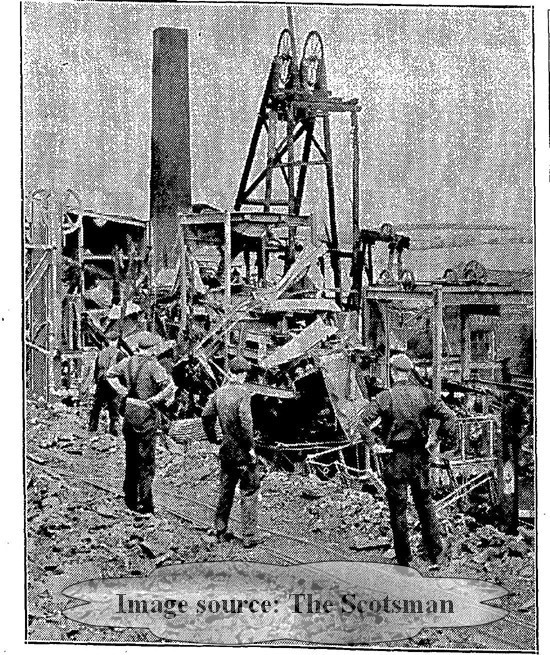
FIFE PITHEAD BLAZE. - Miners view the burnt-out pithead at Dean Colliery, Kingseat, near Dunfermline, after the fire on Saturday.
 |
-------------------------------------------------
"Dunfermline Press"
17 June, 1939
KINGSEAT PITHEAD FIRE.
DISASTROUS BLAZE.
350 MEN THROWN IDLE.
About 350 miners were thrown idle and damage was done to the extent of £10,000
when a disastrous fire on Saturday afternoon completely wrecked the pithead at the Wallace Pit,
Dean Colliery, belonging to the Kingseat Company, Limited.
Fortunately there were few men below ground at the time, the outbreak occurring shortly after the
dayshift men had finished work for the day and ascended to the surface. It was soon after this
that it was seen that the scaffolding above the upcast shaft of the Wallace Pit had caught fire.
Men who were still at work on the pithead gave the alarm, and their first thought was for the safety
of several men who were still down below. The men underground were James Steedman, an
inspector; Robert Innes and William Thomson, shaftsmen; and David Nellies, pumpman.
Owing to the damage done by the fire, it was impossible to communicate with them in the ordinary
way and Mr Alex Gray, the manager, accompanied by the under-manager and several workmen,
travelled down by the Mustard Pit to warn them, and by this alternative outlet they made their
way to the surface.
Urgent summonses were sent to Dunfermline Fife Brigade and the Mine Rescue Station at
Cowdenbeath. When the Fire Brigade arrived on the scene shortly before 1.30 pm, the whole
pithead structure was ablaze. Fanned by a high wind, the flames had spread quickly,
enveloping a mass of highly inflammable material.
A coal bing became ignited, and bags of coal ready for sale were burning fiercely. As the
pithead scaffolding blazed, the cage crashed to the pit bottom.
The firemen, under the direction of Firemaster W. B. Muir, first concentrated upon saving
the winding structure from collapsing. The timbers were ablaze, and if the structure had
crashed allowing the large winding wheels to fall down the shaft, serious damage might
have been done to the electrical apparatus operating the pumps. A plentiful supply
of water was obtained by pumping from Loch Fitty, which immediately adjoins the colliery.
In tackling the blaze, the firemen had an exceedingly difficult and hazardous task. Using
rope lines and hook ladders, Firemaster Muir and two firemen climbed to the top of the 60-foot
high winding structure, carrying up a line of hose with which they extinguished the blaze at this
point. The strong wind which was blowing accentuated the difficulties of the firemen in
accurately directing jets of water at the highest parts of the buildings.
The screening plant and other structures were also involved in the blaze, as well as the
scaffolding of a haulage way from No. 4 Mine.
Owing to the magnitude of the outbreak, reinforcements had to be sent, and altogether
there were on duty 15 regular firemen and 20 members of the Auxiliary Fire Service.
About a mile of hose was in use. In spite of the strenuous efforts of the firemen and
workmen, the pithead was reduced to a mass of twisted wreckage. The firemen were
on duty until nearly ten o'clock on Saturday night.
The disaster to the pit is a serious blow to the villagers of Kingseat, many of whom
assembled at the pithead to watch the efforts that were being made to prevent the
calamity of enforced idleness for their menfolk.
At the monthly meeting of Dunfermline Town Council on Monday evening, a resolution
was passed on the motion of Police Judge Miss Frew expressing sympathy with the
miners who had been thrown out of employment as a result of the fire.
-------------------------------------------------
Jim White, South California, reported in January 2008:- " ..Yes, I remember the fire as all my relatives worked there,
but from my recollections nobody lost any work as the mine was also open, and usually most of the miners
entered their job site from there, as most of the coal seams were in that direction.
If I remember correctly they binged the coal at the mine location, until the new pithead was erected again,
but in 1939 I was 10 years old and it was another four years before I entered into the electrical apprenticeship
at Dean colliery. By that time the new pithead was functioning and so was the mine.
From my recollection the air was pumped down the mine and came up the Dean shaft. The main fan for air distributions
was at the mine head, not the Dean pit, so you can imagine that when it went on fire, the updraft from the Dean
shaft would certainly help to cause a complete burn out of the pithead.
I was working at the Dean in 1945 when it closed. When that happened, I, and some others, was down the Dean
working at pump levels as the water was rising. I recollect we tried to beat the incoming water to no avail even
with all the pumps working. I also seem to recollect we had to walk via the Dean to the Mine underground to
get out of there. Some of these recollections are getting hazy, however, but the electrical staff was one of the
last to leave the job as they tried to save what they could of the equipment and that meant electrical supply
had to be maintained, so they kept us on the staff."
---------------------------------------------------
"Dunfermline Press"
16 December, 1939
MINER'S DEATH IN HOSPITAL.
SEQUEL TO KINGSEAT PIT ACCIDENT.
The death took place in Dunfermline and West Fife Hospital on Saturday of John Gibbons, miner, residing at 2 Gladstone Place, Headwell, Dunfermline. About six weeks ago, while engaged in the underground workings of the Dean Colliery, he was caught in a heavy fall of material from the roof. He sustained serious internal injuries about the lower part of the body. Gibbons, who was 55 years of age, is survived by his wife and a family.
---------------------------------------------------
"Dunfermline Press"
1 February, 1941
Under the Fatal Accidents Inquiry Act, an inquiry was held in the Sheriff Court, Dunfermline, on Thursday before Sheriff MacLean into the circumstances attending the death of a miner named John Collins, 46 Lauder Street, Dunfermline, who died on 1st January in Dunfermline and West Fife Hospital from the effects of injuries received by him on 17th June 1940, in No. 4 Mine, Kingseat Colliery, by a fall from the roof of his working-place. Those giving evidence included: Robert Allan, miner, 6 Crawford Place, Townhill, and Robert Mitchell, miner, 8 Quarry Street, Kingseat. A nurse in Dunfermline and West Fife Hospital gave evidence that the cause of Collins' death was a fracture and dislocation of the spine. A formal verdict was recorded by the Sheriff.
---------------------------------------------------
"Dunfermline Press"
26 June, 1943
KINGSEAT COLLIERY
Threatened Closure
It was ascertained this week that Kingseat Colliery is one of the three collieries in the Dunfermline
area which the Ministry of Fuel and Power propose to close under the scheme of the Ministry for the
concentration of coal output. The other collieries in regard to which negotiations are proceeding
with a view to similar action being taken are Muircockhall, leased by Henry Ness & Co. Ltd.,
and Elgin and Wellwood, wrought by Thomas Spowart & Co. Ltd.
The prospect of being directed to work at other and more modern collieries in West Fife is not
being regarded favourably, by the 230 underground and surface men employed by the Kingseat Co.
Ltd. Representatives of the workmen had a meeting on Thursday evening with the officials of the
Fife, Clackmannan, and Kinross Miners' Union, at which the situation was discussed at some
length.
Today, fuller consideration will be given to the matter by the Executive Board of the
Association. There is a likelihood, too, that the situation will engage the attention of the Executive
of the National Union of Scottish Mineworkers, who are to meet in Glasgow on Monday.
-------------------------------------------------
"Dunfermline Press"
24 November, 1945
This issue reported on the flooding of the underground workings of the Kingseat Colliery on Thursday which brought about the abandonment of mining operations and made 300 men idle. The flooding started in a recently opened section of the Dean Colliery, Kingseat, which is owned by Kingseat Company, Ltd. On Friday, with water still rising, the officials of the Company decided there was no option but to close the colliery. It was suggested by some that the water may be coming from the nearby Loch Fitty.
-------------------------------------------------
As a 'thank you' for site information passed to the Kingseat Community Council in August 2010,
we were delighted to receive a copy of the following memorandum from Malcolm Hall, who was
undertaking research for the Community Council.
M. Martin & Webmasters.
Inrush of Water - Kingseat Colliery.
MEMORANDUM
by P.W. Brown.
On Thursday 15th November 1945 an inrush of water from a drivage in the Seven Feet or Steam Coal Seam occurred at Kingseat No. 3 Pit belonging to Kingseat Company. To examine the potential dangers of this occurrence, Dr. Wm. Reid, General Works Manager, The Fife Coal Company, Limited, convened a meeting of all interested parties. This meeting was held in the Central Offices of the Fife Coal Company Ltd. at 11am on Thursday 22nd November 1945. The following were present:-
The Fife Coal Coy. Ltd.. Dr. Wm. Reid (who presided), Mr. G. R.
Buchanan and Mr. P. W. Brown.
H.M. Mines Inspectorate. Mr. A. H. Steele, H. M. Divisional Inspector of Mines, and
Mr. J. P. Hall, H. M. Inspector of Mines.
Ministry of Fuel and Power. Mr. R. Crawford.
Fordell Coal Coy. Mr. N. S. Landale.
Kingseat Coal Coy. Mr. W. Smith.
H. Ness and Coy. Mr. T. J. Macoustra.
T. Spowart and Coy. Mr. W. Gemmell.
Mr. Currie, Mining Engineer, who had knowledge of the coal field, was also present.
At the outset, Dr. Reid described the history of the inrush. As a possible consequence of the occurrence, he tentatively referred to the potential dangers to adjacent collieries. So that this problem could be thoroughly examined he had had plans prepared on a scale of six inches per mile showing the workings in each seam embracing an area bounded by Fordell Day Level, Kirkford No. 10 Shaft, Cowdenbeath, Lassodie Colliery, Kingseat and westwards covering Highholm, Muircockhall, & c. to Pitfirrane Day Level.
These plans were exhibited and explained by Mr. P. W. Brown.
Mr. W. Smith who had a working knowledge of Kingseat Company's operations
from their inception, informed the meeting that Irvine, the former tenant, abandoned No.
3 Pit in 1910 and that he had partly filled in the shaft to above the Glassee level. In 1915,
Mr. Smith took over No. 3 Shaft. He found that during the time this shaft had been
abandoned, the water had reached a level of 250 feet from the surface and had
remained at this level. The surface level at No. 3 Pit is 1460 and the level of Loch Fitty, 1413.
(Datum 1000' below O. D.) After the Kingseat Company had unwatered the shaft to the
Glassee bottom at a level of 980 they estimated that the normal growth was 1000 gallons
per minute; after some remedial work had been carried out on the margin of Loch Fitty, this
was reduced to 850 gallons per minute. From this, the following questions arise:-
(1) During the time No. 3 Pit was standing, i.e. 1910/1915, did the growth of 1000
gallons per minute find its way to any other Colliery or did the rise of water to the
250 or 1210 level cut off all feeders?
(2) Was this 1210 level the normal outflow level of surrounding surface?
During the 1910/1915 period there is no direct evidence that the Kingseat growth of 1000 gallons per minute found its way to No. 10 Kirkford Colliery or to Dalbeath Colliery; both these pits were fitted with steam shaft pumps. Both pumps may have had ample capacity to deal with an extra growth of water, but as no records of delivery were kept there is no evidence that they did so. Again, no evidence can be got that any additional water was carried by Fordell Day Level, Halbeath Day Level or any other source to the south via old workings in Keirsbeath, Cuttlehill or Wallace's old pits. The mouth of the Halbeath Day Level is approximately 1311. The water level in the Eliza Pit is 1239, in the Engine Pit 1314, and the Fordell Day Level (west junction) 1210.
Between Dalbeath Colliery and No. 3 Pit Kingseat Dunfermline Splint workings, there is supposed to be a barrier of 70 yards as indicated on plan attached. According to available records, the workings on either side of this barrier were operated on the Kingseat side in 1897 and on the Dalbeath side in 1896. It is possible that coal filling by means of the "Harp" was in existence in these workings, and if so, then the small coal, which would be retained in the waste, would tend to reduce subsidence and the magnitude of induced breaks.
In 1904 the working of the Five Feet Seam in Dalbeath Colliery overlapped the barrier left in the Dunfermline Splint. Presumably this overlap was not to such an extent as to contact breaks from Dunfermline Splint workings in the Kingseat Colliery.
The workings from Kingseat in the Five Feet Seam are a considerable distance away.
Again in 1909, working from Dalbeath Colliery in Lochgelly Parrot overlapped completely the barrier between Dalbeath and Kingseat, in the Dunfermline Splint.
It may be argued that though there may be sufficient coal barriers in the three seams mentioned, the intervening strata may be so shattered as to be pervious to water; against this there is no evidence that water did pass during the 1910/1915 period and in any case it is most probably that any breaks which did exist are now sealed.
The next question which arises is this:-
Should the water rise to a higher level now, say to 1413, i.e. the level of Loch Fitty, than
it did in the 1910/1915 period, and thereby create a greater pressure, will it find its way
to Cowdenbeath workings?
The general consensus of opinion is that it would not. Nevertheless, as a safeguard, the Fife Coal Company would make provision for a possible additional growth, by installing an additional pump in the Lochgelly Bottom, No. 10 Kirkford Colliery.
During the discussion and after the examination of Plans it was established that Kingseat "wastes" and water accumulations at any time during its known history were remote from all surrounding areas, with the exception of the Kingseat-Dalbeath barrier previously mentioned.
Filling up No. 3.
It was agreed unanimously that Kingseat No. 3 would be filled up with debris and clay seal at intervals, especially below the Seven opening and further that a column of pipes would be sealed in the shaft so that level of water could be ascertained as and when required and that this column of pipes would be led a short distance into the Cairncubbie mines so that the water would have free access.
In this regard, Mr. Steele and Mr. Crawford, as representatives of the Ministry are to interview the Coal Commission.
The following shafts are still open and the water levels therein can be, and should be, measured regularly at stated intervals:- the "Eliza" Pit and "Engine" Pit: (at the north side of Halbeath Playground), the "North" Pit, to north of Railway above mineral cottage and "Cobden" Pit to south of Railway. The old workings associated with these pits are probably jointly drained to a certain level by the west branch of Fordell Day Level, via Roadside and Humbug Pits, &c. commanded by Fordell; by Muircockhall, (Ness and Co.) and by Wallsend Pit and Baldridge in the area covered by Spowart & Co.
Wallace's Keirsbeath and Cuttlehill Area.
In these estates, there is sufficient barrier left by Kingseat against the old workings to the south. This area contains much "waste" and many old shafts, the most important of which are:- Eliza Pit, Engine Pit, Queen Pit, Cobden and North Pit. (Cuttlehill).
FORDELL BARRIERS.
Since the period 1910/1915 Fordell Colliery has worked Dunfermline Splint, Five Feet Coal, and Glassee Coal in the area next to North Pit old waste. A barrier of 300' was observed in the plans of Dunfermline Splint and Five Feet Coal. The southerly workings in these seams from Fordell were stated to be dry, whereas those in the north-west corner were wet.
The water from this area travels to the Alice Pit; thence it is pumped to the William Pit and from there to the Fordell Day Level.
The Glassee working has all been on the south side of the "McFend" Fault which, from observations made, has been proved to run out to zero approximately 1700 feet east of the old North Pit. These Glassee stoop-and-room workings were extended over the old wastes of the Dunfermline Splint and Five Feet workings in the North Pit.
This working in Glassee has been and still is practically dry but where it is over the old waste, the level of the Glassee seam is 1296 which is above the presumed water level to the west (1000 Datum).
Mr. Landale reported that water from the west enters the Fordell Day Level about (?) Pit where the level of the Day Level is 1210 (Datum 1000). The level of the Day Level at Lady Ann is 1220.
Muirbeath. Highholm
From an examination of plans and a statement made by Mr. Currie it would appear that this area is completely isolated from Kingseat waste by a large fault on north (?). In Muircockhall workings there is protection by a fault and a barrier.
It was revealed that a surface mine from the Railway cottage at the level crossing, Highholm Farm, had been driven at approximately 1-3 in a northerly direction through fault and whin and that Dunfermline Splint, to rise of Kingseat had been worked therefrom. Further, that during the period when Messrs. Wallace Bros, operated Kingseat, a connection to this mine was made by the extraction of a barrier and the mine subsequently used as an unrecognised outlet.
Muircockhall (Ness and Co.)
It was stated that Muircockhall has workings in the vicinity of the Eliza shaft in the Cairncubbie; Six Feet (main coal) and Three Feet Seam (Swallowdrum) above the water level Datum 1239. (See Manager re pumping here.)
See Mr. Landale's Report attached.
Cuttlehill, Keirsbeath, Wallace's and Dunfermline Burgh Lands Coalfields appear to be connected in one seam or another.
The average growth of water pumped at Muircockhall is approximately 300/350 gallons per minute from the shaft bottom which is in the Eight Feet Coal i.e. Lochgelly Parrot, at a level of 1242 (1,000' Datum). During 1944 with exceptional heavy rains the amount of water pumped for three days was 1000 gallons per minute, and for about six weeks 800 gallons. When the water rises in Muircockhall it is alleged it goes to Eliza Pit but when there is a sudden rise in Eliza the water comes to Muircockhall. During the 1926 strike the water rose four feet on the plates and no further. It was thought then that at this level it found its way to Eliza.
-------------------------------------------------
"Dunfermline Press"
1 December, 1945
KINGSEAT COLLIERY - DOUBLE FATALITY
Two Men Killed on Last Shift
Two pitworkers were killed while working their last shift yesterday in Dean Colliery, Kingseat, which is
closing down owing to the flooding of the underground workings.
The two men, James Nellies, 58 Buffie's Brae, and James Main, Transy Feus, Dunfermline,
were engaged dismantling some of the colliery plant when they were struck by runaway hutches.
Nellies was killed instantly, and Main was removed to Dunfermline and West Fife Hospital suffering
from injuries to which he succumbed later in the day. Nellies and Main, who were brothers-in-law,
were to have started work in another colliery next week.
--------------------------
"Dunfermline Press"
9 February, 1946
Under the Fatal Accidents Inquiry Act, an inquiry was held in the Sheriff Court, Dunfermline, on
Thursday before Sheriff Hamilton into the circumstances attending the death of miners James Nellies,
58 Buffie's Brae, Dunfermline, and James Main, Transy Feus, Dunfermline, who were injured by
a runaway race of hutches on 30th November in the main haulage road of No. 4 Mine, Kingseat
Colliery. Nellies was killed instantly, and Main died in Dunfermline and West Fife Hospital later the
same day.
Those giving evidence included: Duncan Condie, underground fireman, 64 Main Street, Kingseat;
James Wilson, miner, 7 Beatty Place, Dunfermline; Adam Bower (21), clipper, 15 Clunievar Street,
Parkneuk; and William McNeilly, under-manager, 88 Main Street, Kingseat. A formal verdict was
recorded by the Sheriff.
-------------------------------------------------
"Dunfermline Press"
6 April, 1946
KINGSEAT COLLIERY.
SALE OF PLANT.
Buyers from various Scottish and English coalfields were among the bidders at a three days'
sale of colliery plant which began on Tuesday at the Dean Colliery, Dunfermline, belonging to the Kingseat
Company, Ltd.
The colliery, which had been in operation for about forty years, was abandoned last December after
flooding of the underground workings. The main shaft, which is ninety fathoms deep, has now been filled
up with 5000 tons of debris and waste material.
The highest prices obtained at the first day of the sale were £480 for an electrically-driven main
rope haulage, £155 for a tail rope haulage, and £165 for an electric motor.
-------------------------------------------------
"Dunfermline Press"
19 January, 1963
Former Colliery Manager
The death occurred on Monday of Mr William Smith, 206 Perth Road, Cowdenbeath, who gave long service to the coal mining industry. A native of Dunfermline, Mr Smith was the son of a Kingseat coalmaster, Mr Thomson Smith, who took over Kingseat Colliery to operate as a brickwork. When this venture failed, Mr Smith helped his father in coal mining, and eventually he took over Kingseat Colliery from his father. … Mr Smith, who was 74, is survived by his wife, two sons and a daughter.
-------------------------------------------------
Memories of working at the Dean Colliery, Kingseat.
Our friend Jim White, a former Kingseat electrician, now in Southern California, reminisces in
January 2008:-
"... Talking about the Henderson mine, the coal from the Henderson mine came over a rail track,
with hutches drawn by a haulage engine installed at the Dean Pit, which crossed the Kingseat-Kelty
road, which means the Henderson mine was much closer to Hill of Beath hill than the Dean Colliery.
Some called the Dean, the Wallace Pit - both names were used - most confusing! This pit was very close
to the Piggery which was on the left side of the road going down to Loch Fitty. A few hundred pigs were
killed and buried in that field when foot-and-mouth broke out during the war years. We were obliged to
run our bike wheels and our pit boots though a water disinfectant bath every time we went to work and
came from work down that road during that period of time.
The Henderson mine was a walk-down mine and to drive to it you took the other road in Kingseat. I think
they call it the Cuddy Road. ... The Kingseat-Kelty road was how you travelled to get to the Dean/Wallace Pit.
The Henderson mine was one of the two mining projects which were at least 1mile apart but there was an
underground connection because I have walked underground between the two mining projects.
The Henderson mine was the younger of the two coal projects and they worked under Hill of Beath hill area
as well as some of the seams the Keirsbeath opencast worked recently. The Henderson had a new mine canteen built.
Good fish and chips! I can vouch for that!
So, that must have been back in 1944.
The mine was rather steep
and, when entering it, we were walking in the direction of Hill of Beath hill underground. During the war they used
part of the Henderson mine as an emergency air-raid shelter. I don't know how often it was used for that
purpose, but they had an air-shaft with an entrance-door a couple of hundred yards down the mine where some
folks did venture during the air-raids.
All the coal cleaning and tub repairs, etc., was carried out at the Dean Pit;
as well as the workshops, both mechanical and electrical.
Not far from Loch Fitty, the coal bings were right down to the edge of the Loch in those days. There also was a
coal bing at the Henderson mine. It pointed straight at Hill of Beath hill running parallel with the tub rails which
went between the pit and the mine.
The full-size railway line which brought wagons with pit props and wood used for roof supports, etc., was running
parallel to the south side of the Loch Fitty, and about two hundred yards from the Loch side, so it was running
parallel with the Kelty-Kingseat Road.
During the war the army placed a light beacon on Hill of Beath hill. The German planes dropped bombs trying to
hit it. One of the bombs was a direct hit on a old-timer resident of Kingseat in his air-raid shelter. Poor soul! - he had
no chance to survive. The miners were furious and toppled that beacon right off the hill and it tumbled
down the side of the hill. I still remember the uproar about that. Some of the bombs landed in the Loch as well as
on that Kingseat shelter and killed many fish which floated
to the surface; so there was fish for all for a couple of days!
I did read recently about Loch Fitty having stopped the fishing. I do believe that it is a direct result of the opencast on
the north side of the Loch. Most of it is gone now but the blasting vibrations and leakage into the Loch of contaminated
water from the opencast is what I believe has done the damage to the trout. The fish in that loch, before they stocked it,
were pike and perch, and I think that is probably what it has converted back to since they had to stop stocking it. However,
I am sure the opencast guys will dispute that.
My grandfather, my dad and my uncle, and yours truly, all worked in the two coal projects at Kingseat. I was an electrician
but the rest of the family were all coal miners. We all worked there till both the pit and the mine closed. Then grandfather retired;
dad and my uncle went to Comrie; and I moved to No. 7 Pit Cowdenbeath and Kirkford pumping station where I was employed
as an electrician. I saw the pit baths erected at Kirkford and the lamp station at which I helped to install the battery-charging
equipment for maintaining the electric headlamps for the underground workers. ..."
-------------------------------------------------
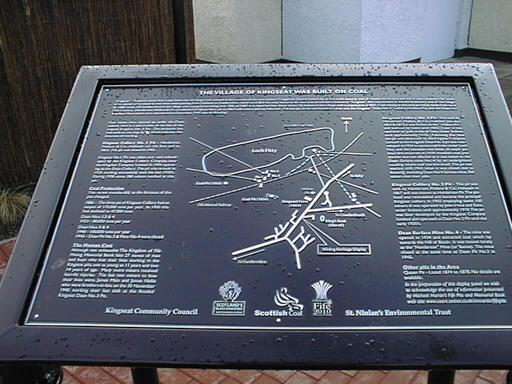
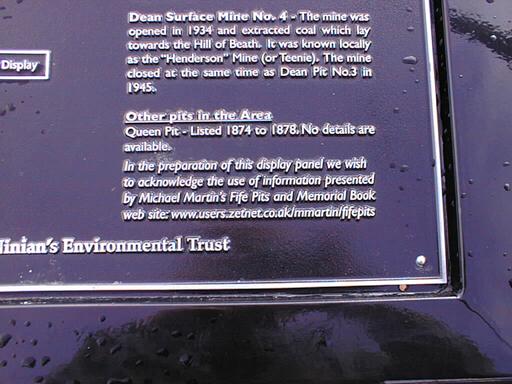
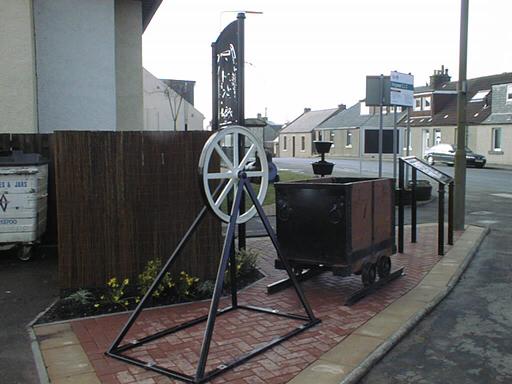
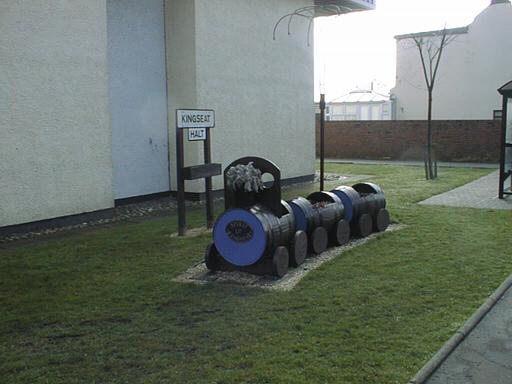
Kingseat's Mining Heritage Display
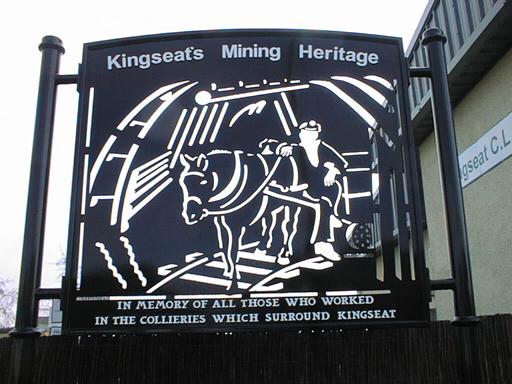
The villagers have produced a fantastic display of information boards, designs and model artefacts commemorating Kingseat's historic coal mining industry. Several pits and mines worked the coals in the lands immediately to the south of Loch Fitty during the 19th and 20th centuries.
 |
 |
 |
 |
 |
-------------------------------------------------
