Owners (various): Forth Iron Co. [1854-61]
Merry and Cunningham
W. C. C. Erskine (see also Lady Louisa Pit entry)
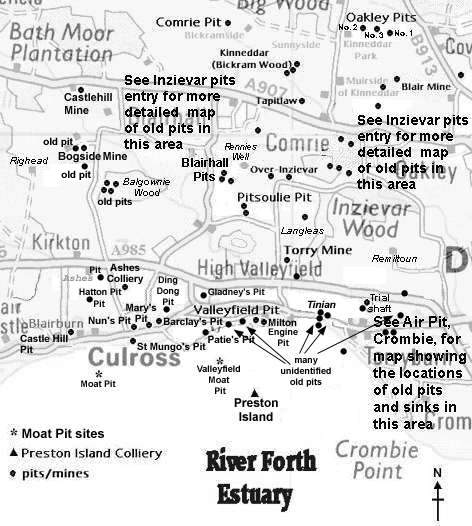
Throughout 19th century Kinneddar and Comrie - just west, and north-west, of Oakley - a great many small ironstone and coal pits worked the minerals (see map). Many were solely ironstone pits but a great number worked thin coal seams in addition to ironstone.
[The numbering system, however, involving the many
early Comrie, Kinneddar and Tapitlaw coal and
ironstone pits within abandonment plans, makes it difficult
even for the 'experienced researcher' to establish
accurate locations and descriptions of minerals worked for
each and every pit.
Pits which have been clearly located will, of course, appear
on our map and, where some additional information has been
gleaned, these will appear as individual entries in the main
index.]
M. Martin & Webmasters
 |
 |
Kinneddar Colliery (19th century report)
| Name of coal | Thickness | Quality | Class |
|---|---|---|---|
| Five Foot Coal | 3 ft. | Very good | Steam |
| Kinneddar Splint Coal | 3 ft. 6 in. | Fair | Household |
A 19th century observer had this to say about some Comrie,
Kinneddar and Tapitlaw coal pits and seams:
"The coal pits here were put down a considerable
distance to the south-east or rise, where the main ironstone
cropped out, which gave them the advantage to go down to the
thick coals at considerable less depth than if they had
thought of deepening any of the ironstone pits.
The first pit sunk was on the farm at Tapitlaw. It was sunk
to a depth of 50 fathoms. In this pit three seams of coal
were found - the first at a depth of 20 fathoms from the
surface, and it was 3½ feet thick. This coal was of a
very middling quality, was worked principally by the
long-wall system, had a very good roof, and was a very
comfortable working, and the coal in the long-wall working
was very easily got.
A considerable area of this coal was worked. One
characteristic of the coal was, it gave off a considerable
amount of gas. In the face of headings, or any place that was
a little in advance, it was always very troublesome to get
the coal cut or blasted. Ventilation, I may say, in those
days was not so strictly paid attention to as it is now,
which to a certain extent may explain away this; but I
believe that the Oakley workings in their day were perhaps
the best ventilated workings in Fife.
The next seam of coal struck in this shaft was the six-feet
coal, at a distance below the three-feet of 16 fathoms. This
coal was opened up in this pit, and a very large area of it
worked out - I believe near to one square mile has been
exhausted. It was all worked by the stoop-and-room system,
and in many places its thickness was seven feet. It had a
remarkably good sandstone roof, was of a friable nature, was
easy to dig. One miner could, out of a 12 feet wide place,
produce four tons of coal.
The next coal was found underneath this six-feet coal 14
fathoms. It was a coal four feet thick, with about two inches
of stone at its centre. It had a strong fake for roof and was
a very strong splint coal. This coal was chiefly used at the
furnaces for smelting purposes, it being the strongest and
best coal in every respect; and, I may say, I believe, the
best coal that was ever found about Oakley. A square mile and
more of this coal has been worked also by the stoop-and-room
system.
Four pits in all were sunk to these three coals, two pits on
the lands of Kinneddar, No. 5 and No. 6 pits, which worked a
considerable area to the rise, or to the east of the road
which leads to Saline, but a considerable portion yet remains
to be worked, although it is possible it may be deluged with
water."
| Plans of Abandoned Seams for Comrie, Kinneddar and Tapitlaw | Pits or Mines designated in Plans |
|---|---|
| COAL; IRONSTONE (1851). | COMRIE
Nos. 1, 2 |
| COAL; Comrie; Ontake. IRONSTONE. | COMRIE |
| COAL; Three Feet; Four Feet; Six Feet; Overton Gas | COMRIE
No. 1 |
| COAL; Comrie. IRONSTONE (1854) |
KINNEDDAR
Nos. 1, 2, 3, 11, 15 |
| COAL; Twenty Inch (1854); Three Feet; Six Feet. IRONSTONE; Under (1854) |
KINNEDDAR
Nos. 1, 2, 3, 11, 15 Tapitlaw Nos. 1, 3, 4, 5, 6 |
| COAL; Comrie Three Feet; Comrie Four Feet or Splint; Comrie Six Feet; Ontake (1861). IRONSTONE; Lower; Upper. | COMRIE |
| COAL; Three Feet; Four Feet; Six Feet; Ontake; Splint (1866). Seam unnamed, ten fathoms below Under Ironstone (1876). IRONSTONE. | KINNEDDAR AND COMRIE |
| COAL; Gas (1867) | COMRIE |
| COAL; Four Feet; Six Feet. IRONSTONE; Blackband (14 May, 1874) | COMRIE
Nos. 1, 3, 4, 17 |
| COAL;
Three Feet; Six Feet; Comrie Splint or Four Feet; Ontake;
Seam unnamed, ten fathoms below Ironstone.
IRONSTONE; Blackband. |
COMRIE AND KINNEDDAR |
| COAL;
Three Feet; Four Feet; Six Feet; Ontake; Sourmilk.
IRONSTONE; Upper and Under Blackband (1849 1874) |
COMRIE AND KINNEDDAR |
----------------------------------------------
"The Scotsman"
4 January, 1837
COALFIELD IN THE SOUTH OF PERTHSHIRE,
PARISH OF CULROSS
TO be LET, for such a number of years as may be
agreed on, the COAL under the LANDS of EASTER COMRIE,
consisting of four different seams, varying from four to seven feet in
thickness, of excellent quality for household purposes, besides a
good Smithy Coal about two feet thick.
It is also understood that there is a good
Parrot or Gas Coal in these lands, and the Proprietor has no doubt
if a diligent search was made but it would be
successful.
There is also Ironstone in Comrie Den.
The locality of these coals is good; the
turnpike road from Dunfermline to Alloa runs through the grounds,
which are also situated within three miles of Torry Harbour on the
Forth.
For farther particulars apply to ROBT. CLARKE,
Esq. of Comrie, by Culross, the proprietor; or MR GRIER, Mills
Mark; Dunfermline - either of whom will receive offers for a lease,
stating a fixed yearly rent or a lordship, in the Proprietor's
option.
Comrie, January 1837.
-----------------------------------------------
"The Scotsman"
25 May, 1844
ESTATE IN FIFESHIRE FOR SALE
BY PRIVATE BARGAIN;
THE ESTATE OF NETHER KINNEDER, lying in the parish of Saline
and county of Fife, situated about six miles west from Dunfermline. ...
The minerals on the estate have not been wrought, but from the indications
afforded by the strata of the adjoining lands, in which Coal and Blackband
Ironstone have been found, there is no doubt, in the opinion of an eminent
engineer, that both these minerals exist in the property, and could be turned
to good account in the event of a rise in the price of iron.
The public burdens are very moderate, and the property will be sold at a
price which will yield a purchaser a good return from the land rental alone,
independent of the woods and minerals. ...
Edinburgh, 10th May 1844.
-----------------------------------------------
"Fifeshire Journal"
Thursday, 20 November, 1851
DUNFERMLINE - NEW IRON WORKS
We are happy to learn that Messrs Merry and Cunningham, Carron Brae Iron Works, near Glasgow, have taken the valuable minerals on the Inzievar estate, in this neighbourhood, and have begun to work them. The iron fields in Airdrie and in the west being nearly exhausted, iron-masters everywhere are searching for a further supply. The digging for the ore, roasting it, &c., will give employment to a great number; and as these gentlemen do not intend to build a village, houses and lodgings are in great demand at Torryburn and Newmills, this parish being almost the only district in Fife that, during the last ten years, has decreased in its population, and decreased in business. However, in this respect there will be a great increase, as the company intend to have a store of their own. The ore, when calcined, is shipped or conveyed away to the Glasgow furnaces. We regard this as another source of prosperity in the western districts of Fife.
-------------------------------------------------
"Dunfermline Journal"
9 November, 1855
SERIOUS ACCIDENT
On Wednesday, the 24th ultimo, as Michael Dollan, miner, residing at Oakley, was employed at No. 5 coal-pit at Kinneddar, belonging to the Forth Iron Company, repairing an old road which leads to part of the workings in said pit, a great mass of stones and coals fell from the roof and one of the sides of the road upon him. When extricated from his perilous position, it was found that his left leg was broken, and his right leg fractured, besides having received several severe cuts on the head and other parts of his body.
-------------------------------------------------
"Dunfermline Monthly Advertiser"
February, 1860
OAKLEY
We are happy to state that the miners in the ironstone pits of the Forth Iron Works, have got a rise of wages equivalent to 6d. a-day, and this without asking. Mr Ferrie deserves great credit for giving this unforced advance, as the iron-masters of the West of Scotland have rather blown out their furnaces than give any advance at all.
------------------------------------
"The Scotsman"
3 January, 1861
DUNFERMLINE - FATAL OCCURRENCE
On Tuesday, while a number of women and children were engaged in digging coal from a heap of rubbish at the top of an exhausted pit belonging to the Forth Iron Company, near Dunfermline, the upper part of the heap gave way, and two of the children were buried beneath the rubbish. Before a clearance could be effected, one of the children died from suffocation, and when the other was extricated, it was found that one of its legs had been fractured, besides sustaining other severe injuries.
-----------------------------------------------------------
"Dunfermline Journal"
April, 1861
OAKLEY - FATAL ACCIDENT
On Monday forenoon, a young man named Condie
Chalmers Leitch, met his death near No. 18 Comrie Pit, the property
of the Forth Iron Company. It appears that, shortly after
breakfast, Condie had gone upon a locomotive in charge of a
brother, and that, while nearing the pit in question, it is
supposed that he had gone down to uncouple the waggons, when he
fell, and the waggons passed over his body before there was time to
stop them. The unfortunate man was brought up as an engine-driver,
but during the last ten years he has been a sailor, only returning
from sea a few months ago. After escaping the perils of the deep in
India, Australia, and China, he has thus suddenly perished almost
within hail of his father's house.
Condie was about 30 years of age, and unmarried.
His father and mother both survive to mourn his sad and untimely
fate.
------------------------------------
"Supplement: Dunfermline Saturday
Press"
6 February, 1864
SEVERE ACCIDENT AT KINNEDDAR
On Sunday afternoon, Robert Duncan, a miner, residing at the village of Bickeram, while repairing the pumps of the Ironstone Pit, on Kinneddar, lost his right leg. He was lying on a scaffolding mid-way in the pit, when a heavy iron-chain, 30 hundred weight, broke, or became disentangled from its fastenings, the ends of the chain descended the pit, and the doubled part struck his leg at the knee joint, sweeping it clean away. The leg dropped with the chain to the bottom of the pit. The bleeding from the wound was very great, but a messenger was sent on horseback for Dr. Dow, surgeon to the Forth Iron Works, who very promptly arrested the bleeding. A few hours later, Dr. Dow, assisted by Dr. Morris, Dunfermline, amputated the limb at the thigh, and notwithstanding the great loss of blood, the sufferer is doing well.
------------------------------------
"The Scotsman"
7 February, 1866
MINERALS. - TO BE LET, the MINERALS in the ESTATE of
NETHER KINNEDDAR, which lies within a Mile and a-Half of the
Oakley Station of the Stirling and Dunfermline Railway. The Lands
contain the Comrie Blackband Ironstone, the Dunfermline Coals, and, it is
expected, the Overton Gas Coal, which is now extensively used for oil
producing purposes. It is proposed to divide the Field into Two Lots -
Two for Gas Coal, and the others for Blackband Ironstone and Coals.
Particulars may be learned by applying to WILLIAM TRAQUAIR, W. S., 17
Young Street, Edinburgh; or WILLIAM MOORE, Mining Engineer, 43 West
George Street, Glasgow.
------------------------------------
"The Scotsman"
25 April, 1867
AT THE FORTH IRON WORKS, OAKLEY,
DUNFERMLINE,
ON TUESDAY, 30TH APRIL, 1867.
FIRST PORTION
EXTENSIVE SALE OF VALUABLE MACHINERY,
COAL-PIT PLANT AND UTENSILS:-
Two BLOWING ENGINES (coupled), Steam Cylinders 50 inches and Blowing Cylinders 100 inches diameter, 9 feet stroke, wrought expansively, and 8-Flued Boilers, 33 feet long, 6 diameter, mounted complete, with Floats and Furnace Mountings, Engine House and Foundations, made by Murdoch, Aitken, & Co. at present working - little the worse of wear:
THE MATERIAL OF FOUR BLAST FURNACES:
HORIZONTAL and BEAM ENGINES, with Pumping and
Winding Gear.
EGG-END BOILERS,
Large Quantity MALLEABLE and CAST-IRON RAILS,
CAST-IRON PLATES, PUMP PIPES and RODS.
HEMP AND WIRE ROPES, CHAINS, HUTCHES,
PIPE PROVING MACHINE, STRONG CRANES, WINCHES,
CAST IRON PIPES, Various.
Large Quantity CAST-IRON MOULDERS' BOXES,
BRASS TUBES Large Quantity STORES, OILS,
TOOLS, SCRAP IRON, CASTINGS, CAST IRON, and
COLLIERY PLANT for CARRYING on an EXTENSIVE
WORK.
BY AUCTION.
To be SOLD at the FORTH IRON WORKS, OAKLEY,
DUNFERMLINE, ON TUESDAY, 30th April, 1867.
------------------------------------
Information on minerals worked in the Kinneddar, Comrie and Tapitlaw pits
(based on a report from 1930)
The Ontake, Sour Milk, or Comrie Upper Four Foot lies about 56 fathoms above the Kinneddar Splint. It is generally a compound seam, often showing four or five leaves with a total thickness up to 9 ft. Ironstone ribs are usually present both in the seam itself and in the overlying blaes. The following section is recorded in a boring near Tapitlaw, west of Comrie village:-
| Blaes | - |
| COAL | 9 in. |
| Blaes and ironstone ribs | 6 in. |
| Blaes | 8 in. |
| COAL | 3 in. |
| Coaly blaes | 1 in. |
| COAL | 8 in. |
| Blaes | 2 in. |
| COAL | 2 ft. 3 in. |
| Blaes | 9 in. |
| Sandstone | - |
The Ontake has been wrought in the past in parts of the district, but few records of the workings exist. The seam is the equivalent of the Milton Main of Valleyfield and of the Rough Coal of Central Fife. A thin coal occurring 3 fathoms below the Ontake Coal locally reaches a thickness of 4 ft. near Oakley village where it was named the ‘Jewel’.
Comrie Lower or No. 2 Blackband Ironstone,
correlated with the Lochgelly Blackband of Central Fife, lies
8 to 12 fathoms above the Ontake Coal. It is an inconstant
seam, often very thin or even absent, but occurs in workable
thickness to the west and south-west of Oakley village, and
again at Inzievar. In the Kinneddar field it is absent or
represented only by thin irony ribs. About 20 acres were
wrought between Tapitlaw and Comrie Mains, the thickness
being recorded as 10 in.
A section in a boring at Tapitlaw shows:-
| Ironstone | 3 in. |
| Parroty blaes | 4 in. |
| COAL | 11 in. |
The seam was named the Success Blackband by the Coltness Iron Co., and has also been known as the Comrie Mid Stone.
The succeeding 12 to 20 fathoms consist of various strata with a thick post of sandstone in the upper part. Above this come about 10 fathoms of blaes and fakes with several very variable coals; one of these coals has been locally worked under the names Blairhall Main, Oakley Main, or Wee Splint of Comrie. Old boring records and sections give thicknesses up to 6 ft. and sometimes two workable seams, 6 ft, apart, are present. In other parts of the district, however, the coal is less than 1 ft. thick and cannot be distinguished from other thin seams near it.
The Inzievar or Blairhall Blackband Ironstone lies above the Blairhall Main Coal at a distance that varies from 1 to 7 fathoms. It has been somewhat extensively wrought around Oakley, Comrie, and Inzievar, and was also known as the Oakley, Upper Comrie, or No. 1 Comrie, Ironstone.
The following paragraphs are quoted from the account of the Inzievar or Blairhall Blackband Ironstone in 'The Iron Ores of Scotland' (1920):
"… The Oakley Ironstone field was the most important in Fife. The Inzievar seam alone was worked to a larger extent than the better known Lochgelly Blackband, and what is left of it, added to the potentialities of the lower seams already referred to, make the district still the principal ironstone area of the county. The Inzievar Blackband was doubtless known in the early 19th century, but intensive mining began in the 1870s, when the Carron Company, the Shotts Iron Company, and Messrs. Merry & Cunninghame sank pits on the grounds of Blairhall, Inzievar and Comrie. In 1883 the mining of the ironstone passed into the hands of the Coltness Iron Company, who worked it until 1907, and for most of the details obtained we are indebted to Messrs. Russell of that Company.
The wrought-out area is compact, and is divided into two
nearly equal portions separated by the Comrie Burn, and the
Comrie volcanic neck. The southern area extends from the crop
near Oakley westwards beyond Bridgetown, south of which place
it reaches Pitsoulie. It covers about 200 acres.
The outcrop of the northern wrought-out area is more
westerly, owing to the fault which traverses the field. This
area extends from Tapitlaw westwards to north of Overton, and
its northern limit lies some 200 yds. north of Shepherdlands.
It covers about 400 acres. The total worked-out area of the
Oakley Ironstone field is thus about 600 acres. To this must
be added an area, not ascertained, which was worked by a deep
pit half a mile due north of Overton Cottage, north-east of
Muirside, on the extreme western edge of Fife 33 S.W. The
field was worked from a number of pit shafts, the more
westerly ones being of considerable depth, as there is a
steady north-west dip of 10o. …
At Blairhall the Inzievar seam had the following section:-
| Sandstone roof | - |
| PARROT COAL | 4 in. |
| IRONSTONE (BLACKBAND) | 1 ft. 3 in. |
| Blaes | 3 in. |
| IRONSTONE (BLACKBAND) | 1 in. |
| Parroty blaes | 3 in. |
In the Over Inzievar workings the thickness was 14 in., the same as in Messrs. Merry & Cunninghame's No. 4 South Comrie Mine, and according to the Forth Iron Company's general section it reached 20 in.
At the northern end of the field, the following section obtained, according to an old report of D. Landale, who states that it thinned out to the north:-
| Shale roof | - |
| BLACKBAND | ¾ in. |
| PARROT COAL, irregular | 2½ in. |
| Blackband balls | 2½ in. |
| Coaly matter | 3 in. |
| Good BLACKBAND | 8 in. |
| Wild PARROT | 1 in. |
| CHERRY COAL | 5 in. |
The above remarks all apply to the best parts of the wrought-out field. When the Coltness Company discontinued working the ironstone, the western working face, from west of Bridgetown to Pitsoulie, ran through much faulted ground, and the seam was only 9 in. thick. Similarly the old plans of the northern wrought-out area show evidence of thinning out along its north-western and northern margins.
Borings to the south of the Blairhall workings, that is, in the Valleyfield area, and borings to the north of the old Comrie workings, at and near Sunnyside, show a marked attenuation of the seam. This corresponds with the indications furnished by the working faces, and shows that there is little hope of any extension of a workable field along the direction of the strike.
On the other hand there are reasons to believe that a fairly large area lies to the dip of the central portion of the old field. That central portion practically coincides with the volcanic neck of Comrie, so that the more immediately available reserves would lie to the west of it, in the Mains of Grange area, that is, between Overton Cottage, to the north, and Grange Burn, to the south. There would also be further possibilities to the dip, towards West Grange, at a depth approaching 200 fathoms.
Three sections of this seam, taken from borings west and north-west of Comrie village, are given below:-
COMRIE MAINS
| Blaes and bands | - |
| BLACKBAND IRONSTONE | 1 ft. 7 in. |
| Soft COAL | 4 in. |
| Sandstone | 2 in. |
| Blaes | - |
KINNEDDAR (BICKRAM WOOD)
| Blaes | - |
| IRONSTONE and PARROT COAL | 8 in. |
| IRONSTONE | 9 in. |
| COAL | 3 in. |
| Fireclay | - |
TAPITLAW
| Fakes | - |
| PARROT COAL | 3 in. |
| BLACKBAND IRONSTONE | 1 ft. 5 in. |
| Blaes | 4 in. |
| Foul COAL | 2 in. |
| Dalk | 2 in. |
| Fireclay | - |
Several thin coals occur in the strata overlying the Inzievar Ironstone, and one of these, the Oakley Upper Coal, attains workable dimensions in the neighbourhood of South Oakley - an old mining village that lay less than quarter of a mile south of Oakley Station. It is said to have reached the surprising thickness of 7 ft., but no records of workings are known. Elsewhere within the district it is difficult to identify and indeed is often absent.
-----------------------------------------------------------
