| Serious coal
mining in the Kingseat area to the north-east of Dunfermline
probably dates from the early 19th century. By mid-century there
were at least two coal pits operating to the north-west of the
village, one not far from the southern shore of Loch Fitty; the
other close to the track which would eventually lead down to the
Kingseat No. 1 Pit of the 1860s, established by Henderson and
Wallace. No ownership or technical details are known for these
early pits but over the next decades Henderson, Wallace & Co.,
quickly established their No. 2 and No. 3 Pits to the east, and the
north-east, respectively, of their No. 1 Pit. No. 2 was also known as the
'Henderson Pit' and No. 3, we have been informed, was sometimes
referred to as the 'Wallace Pit'. We have used this information to
collate newspaper entries mentioning 'Henderson' and 'Wallace'
into the Kingseat No. 2 and No. 3 Pit entries in the index. The emergence of the Kingseat Colliery Company in 1905 to operate the Kingseat (Dean) Colliery - formerly on the site of the No. 1 Pit - whilst John Irvine's company continued to work pits of the original Kingseat Colliery, means that readers (and researchers) have to be careful in their identification of pits as belonging to either Kingseat Colliery or Kingseat (Dean) Colliery. A number of mines were struck at the Dean Colliery (Nos. 1, 2, 3 close to the old Kingseat No. 1 Pit location; and No. 4 Mine to the east of the village by the north side of the road leading to Cowdenbeath where there may have been an earlier shallow pit of the 'old' Kingseat Colliery, called No. 4 Pit or 'Mary' (yet to be confirmed). M. Martin & Webmasters |
|---|
Owners: Henderson, Wallace & Co.,
Halbeath (1866? - 1876)
Andrew Wallace (1877 - 1889)
Wallace Bros., Halbeath (1890s)
Dec 1891: Death of Mr. George J. Wallace.
John Irvine & Sons, Dunfermline (1902? - 1911?)
Kingseat Dean Colliery:-
Kingseat Colliery Company
later Kingseat Co. Ltd. (1902? - 1945)
 |
 |
Kingseat Colliery
| Colliery opened: 1866? with Kingseat No. 1 | Colliery closed: 1912? |
|---|---|
| Source Date of Information Supplied | |
| Manager / Under- Manager / Men underground / Men above ground / Coal seams worked / Shaft Details | |
| 1867 -
Kingseat No. 1 Pit mentioned in an abandonment plan
Kingseat No. 2, originally the 'Henderson Pit', sinking around this time |
|
| 1874 (Henderson, Wallace, & Co.) | |
| Kingseat
No. 1
C. A. Carlow / ------------ / 61 / 11 / 5 Feet and Splint D'cast 456 ft. : U'cast 339 ft. |
|
| 1875 (Henderson, Wallace, & Co.) | |
| Kingseat
No. 1
C. A. Carlow / ------------ / 100 / 16 / 5 Feet and Splint D'cast 456 ft. : U'cast ----- |
|
| Queen Pit - listed - no details | |
| No. 3 Pit - listed - no details | |
| 1876 (Henderson, Wallace, & Co.) | |
| Kingseat
No. 1
C. A. Carlow / ------------ / 119 / 19 / 5 Feet and Splint D'cast 456 ft. : U'cast ----- |
|
| Queen Pit - listed - no details | |
| No. 3 Pit - listed - no details | |
| 1877 (A. Wallace) | |
| Kingseat
No. 1
C. A. Carlow / ------------ / 110 / 19 / 5 Feet and Splint D'cast 456 ft. : U'cast ----- |
|
| Queen Pit - listed - no details | |
| No. 3 Pit - listed - no details | |
| 1878 (A. Wallace) | |
| Kingseat
No. 1
A. Crookston / ------------ / 154 / 23 / 5 Feet and Splint D'cast 456 ft. : U'cast ----- |
|
| Queen Pit - no longer listed | |
| Kingseat
No. 3
A. Crookston / ------------ / 109 / 17 / Splint, 5 feet D'cast 660 ft. : U'cast 537 ft. |
|
| 1879 (A. Wallace) | |
| Kingseat
No. 1
A. Crookston / ------------ / 146 / 21 / 5 Feet and Splint D'cast 456 ft. : U'cast ----- |
|
| No. 2
Henderson
A. Crookston / ------------ / 142 / 22 / Splint, 4', 8 Feet, 3' 8"; Upper, 5-feet. D'cast ----- : U'cast 339 ft. |
|
| Kingseat
No. 3
A. Crookston / ------------ / 160 / 21 / Splint, 5 feet D'cast 660 ft. : U'cast 537 ft. |
|
| 1880 (A. Wallace) | |
| Kingseat
No. 1
A. Crookston / ------------ / 133 / 21 / 5 Feet and Splint D'cast 456 ft. : U'cast ----- |
|
| No. 2
Henderson
A. Crookston / ------------ / 159 / 22 / Splint, 4', 8 Feet, 3' 8"; Upper and Lower 5-feet. D'cast ----- : U'cast 339 ft. |
|
| Kingseat
No. 3
A. Crookston / ------------ / 173 / 23 / D'cast 660 ft. : U'cast 537 ft. / Splint, 5 feet Mr. A. Crookston departed February, 1881, to a new appointment as manager of Wemyss Colliery. |
|
| 1881 (A. Wallace) | |
| Kingseat
No. 1
Charles A. Carlow / ------------ / 102 / 19 / 5 feet and Splint D'cast 456 ft. : U'cast ----- |
|
| Kingseat
No. 2
Charles A. Carlow / ------------ / 155 / 24 / Splint, 8 Feet, Upper and Lower 5 feet. D'cast ----- : U'cast 339 ft. |
|
| Kingseat
No. 3
Charles A. Carlow / ------------ / 177 / 26 / Splint, 5 feet D'cast 660 ft. : U'cast 537 ft. |
|
| 1882 (A. Wallace) | |
| Kingseat
No. 1
Charles A. Carlow / ------------ / 101 / 19 / Splint & 5 feet D'cast 456 ft. : U'cast ----- |
|
| Kingseat
No. 2
Charles A. Carlow / ------------ / 126 / 20 / 8 feet. D'cast ----- : U'cast 339 ft. |
|
| Kingseat
No. 3
Charles A. Carlow / ------------ / 191 / 28 / D'cast 660 ft. : U'cast ----- |
|
| Mr. Robert Cook, some time underground manager at the colliery, leaving the district to fill manager's position in the Drumpellier Colliery, Coatbridge. | |
| 1888 Death of Mr. A. Wallace, coalmaster. |
|
| 1889 ( Wallace Bros.) | |
| Kingseat
No. 1
W. W. Muir / ------------ / 62 / 15 / Upper eight foot; Lower eight foot; Dean D'cast (13 x 5½) 132 ft. : U'cast (9 x 8½) 153 ft. Fan ventilation - fan (Guibal) 24' x 8'. |
|
| Kingseat
No. 2
W. W. Muir / ------------ / 89 / 20 / Five foot; Splint D'cast ------- : U'cast (9 x 8½) 537 ft. |
|
| Kingseat
No. 3
W. W. Muir / ------------ / 159 / 35 / Upper five foot; Five foot; Splint D'cast (8½ x 8) ---- : U'cast ---- 537 ft. |
|
| 1891 (Wallace Bros.) Dec: Death of Mr. George J. Wallace, coalmaster. |
|
| 1896 (Wallace
Bros., Halbeath)
Departure of Mr William W. Muir, manager of Halbeath and Kingseat - September. |
|
| Kingseat
Colliery
John Irvine / ------------ / 351 / 78 Gas, household, manufacturing and steam coals. Fireclay and ironstone. |
|
| 1902 (John Irvine, Dunfermline) | |
| Kingseat
Colliery
John Irvine / ---------- / 161 / 41 Gas, household, manufacturing and steam coals. Fireclay and ironstone. |
|
| 1904 (John Irvine, Dunfermline) | |
| Kingseat
Colliery
A. Morris / ---------- / 30 / 5 Gas, household, manufacturing and steam coals. |
|
| 1905 (John Irvine, Dunfermline) | |
| Kingseat
Colliery
---------- / ---------- / 26 / 9 |
|
| 1906 (John Irvine & Son, Dunfermline) | |
| Kingseat
Colliery
Dec: Mr William Strain, manager |
|
| 1908 (John Irvine & Sons, Dunfermline) | |
| Kingseat
Colliery
Duncan Ferguson / ---------- / 82 / 20 |
|
| 1911 (John Irvine & Son, Dunfermline) | |
| Kingseat
Colliery
---------- / ---------- / 11 / 1 |
|
| 1918 - no
record - only Dean Kingseat Colliery
See separate table following this information. |
|
Kingseat (Dean) Colliery
| Colliery opened: 1905 | Colliery closed: 1945 |
|---|---|
| Source Date of Information Supplied | |
| Manager / Under- Manager / Men underground / Men above ground / Coal seams worked / Shaft Details | |
| 1905 (Kingseat Colliery Co.) | |
| ------------ / ------------ / 14 / 35 | |
| 1908 (Kingseat Colliery Co.) | |
| David Nicholson / ------------ / 78 / 15 | |
| 1911 (Kingseat Co. Ltd.) | |
| ------------ / ------------ / 135 / 19 | |
| 1918 (Kingseat Co. Ltd.) | |
| Alexander Walker / ------------ / 149 / 33 | |
| 1925
(Kingseat Co. Ltd.) No. 1 Pit resunk to the Dunfermline Splint |
|
| 1928 (Kingseat Co. Ltd.) | |
| Alexander Walker / David Nicholson / 213 / 64 | |
| Household and steam coals. Five Feet, Six Feet, Four Feet, Eight Feet and Cairncubie. | |
| 1938
(Kingseat Co. Ltd.) Kingseat Dean workings largely closed |
|
| Dean: Alexander Gray / David Nicholson / 95 / 67 | |
| No. 4 Surface Mine: Alexander Gray / Alex. McDowall / 178 / 13 | |
| 1945
(Kingseat Co. Ltd.)
Water invades the colliery in November; colliery abandoned by December. |
|
| Dean No. 3 Pit: Alexander Gray / David Nicholson / 225 / 83 | |
| No. 4 Surface Mine: Alexander Gray / W. McNeilly (manpower included in figure for No. 3 Pit) | |
| Plans of Abandoned Seams for Kingseat Colliery
(with dates where available) |
Pits or Mines designated in Abandonment Plans |
|---|---|
| COAL; Two and a Half Feet (1867) | Kingseat No. 1 |
| COAL; Three and a Half Feet; Five Feet; Upper Five Feet; Splint (1882) | Kingseat Nos. 1, 2, 3 |
| COAL; Upper Five Feet; Lower Five Feet (1902) | Kingseat Nos. 1, 2, 3 |
| COAL; Five Feet (1883); Three Feet; Upper Eight Feet; Lower Eight Feet; Splint. | Kingseat Nos. 1, 3, 4 |
| Plans of Abandoned Seams for Kingseat (Dean) Colliery
(with dates where available) |
Pits or Mines designated in Abandonment Plans |
|---|---|
| COAL; Upper Five Feet; Dean; Upper Dean;
Swallowdrum; Dunfermline Splint (September, 1902);
Lower Five Feet; Lower Eight Feet (December, 1927) Upper Eight Feet (February, 1929) |
Kingseat or Dean Nos. 1, 2, 3 |
| COAL; Six Feet; Dean; Swallowdrum (October, 1910) | Kingseat or Dean Nos. 2, 3 |
| COAL; Fourteen Feet (February, 1914) | Dean No. 2 |
| COAL; Six Feet; Swallowdrum (May, 1928) | Kingseat or Dean Nos. 1, 2, 3 |
| COAL; Four Feet or Upper Five Feet (November, 1930) | Kingseat or Dean Nos. 1, 2, 3 |
| COAL; Mynheer (August, 1935) | Dean No. 3 |
| This entry will
hold all information pertaining to the Kingseat No. 1 Pit and also any general information or newspaper items on pits of the Kingseat Colliery which cannot readily be assigned to
named or numbered pit entries. See individual site entries for
Kingseat No. 2 Pit; Kingseat No. 3 Pit; Kingseat No. 4 Pit;
and Kingseat (Dean) Colliery. We would be very grateful for any information
or background relating to the pits and/or mines of the Kingseat
coalworks. |
|---|
-------------------------------------------------
"Dunfermline Journal"
30 April, 1858
DUNFERMLINE - MINERAL RAILWAY
... They hope to open the railway on or about the 9th of May with one engine. The King's Seat branch has been abandoned for the present, as the minerals in that district, for the transport of which the railway was intended, have not been wrought.
-------------------------------------------------

"Dunfermline Press"
24 February, 1866
A fatal accident occurred in Kingseat Coal Pit, Halbeath Colliery, belonging to Henderson, Wallace & Company, on Tuesday, to a brusher named John Paterson, residing in Crossgates. It appears that Paterson had gone into the waste to procure stones for building purposes, and sometime afterwards he was found dead, with a stone about the weight of a ton lying upon him. It is the practice for brushers in pits working in pairs, but on this occasion, it is supposed deceased and his companion had separated, that they might more speedily accomplish their work. We understand that Paterson belongs to Clackmannan, and has left a wife and family.
-------------------------------------------------
"Dunfermline Press"
11 June, 1870
On Tuesday afternoon, a very serious accident occurred in the Kingseat Pit, belonging to the Halbeath Coal Company, whereby a boy of about thirteen years of age, named William McLure, got himself severely hurt. McLure was a pony driver, and had brought a race of hutches to the top of an incline near the bottom of the pit. Here he was unyoking the pony before putting on the drag, when his foot slipped on the iron rails, and he fell to the ground. The hutch, weighing about six cwt., went over him, breaking his right thigh bone, and cutting and otherwise injuring him about the head. The poor fellow was at once conveyed home, where he was shortly afterwards attended to by Dr. Bartholomew, of Inverkeithing, but his injuries were so serious that he was removed to the Royal Infirmary, Edinburgh, next day.
------------------------------------
"Dunfermline Press"
6 September, 1873
FATAL PIT ACCIDENTS
ACCIDENT AT KINGSEAT
Two fatal accidents have taken place this week in the district. On Saturday night, a sinker named William Patterson, met his death in the old Kingseat pit wrought by the Halbeath Coal Company. It seems that at present the pit is being deepened, and while Patterson, along with another workman, was engaged in sorting the pumping apparatus used in connection with the sinking operations, he suddenly missed his footing and fell off the planking to the bottom of the shaft - a depth of about 26 fathoms. After the lapse of several hours, the body was recovered and brought to the bank, when it was found that, to all appearances, death had been caused instantaneously. Deceased has left a widow and two children. He was much respected in the district, having acted as beadle of St. Margaret's U. P. Church, Dunfermline, for some time. His funeral, which took place on Tuesday, was largely attended.
------------------------------------
"Dunfermline Press"
25 October, 1873
On Monday, a man named Charles Roger Graham, sustained some severe injuries while being drawn up the shaft of the old Kingseat pit, owing to the "kettle" having come into contact with a baton. Graham was employed in sinking operations, which are being carried out in the pit at present.
------------------------------------
"Dunfermline Press"
9 January, 1875
On Thursday, while a man named Andrew Murray was employed in a pit at Kingseat Colliery in shunting a hutch, he got his left leg broken. He was speedily attended by Dr. Bell.
------------------------------------
"Dunfermline Press"
11 November, 1876
On Saturday last, a lad named Peter Rumgay, met with an accident while employed in No. 1 Pit, Kingseat Colliery, by which he got his left leg and right arm broken. He was attended by Dr. Bell, Dunfermline.
------------------------------------
"Dunfermline Press"
13 January, 1877
On Saturday morning, a man named James Brown, while employed in No. 1 Pit, Kingseat Colliery, met with rather serious injuries. Somehow the "gib" gave way at the point where he was working, and the result was, that a large lump of coal was brought down upon him. He was attended by Dr. Bell.
------------------------------------
"Dunfermline Press"
26 March, 1881
On Thursday, a miner, named James Anderson, residing at Appin Crescent, Dunfermline, met with a rather serious accident when engaged in No. 1 Pit, Kingseat. Anderson was employed taking off a quantity of coal from the seam, when it suddenly gave way and fell upon him. After having been extricated, it was found that he had sustained a compound fracture to one of his legs, while the other was seriously bruised. He also received other injuries about the body. Dr. Bell attended and dressed the wounds. The injuries are not expected to prove fatal.
------------------------------------
"Dunfermline Press"
13 May, 1882
On Friday afternoon last week, while Robert Penman, residing at Crossgates, was employed in the old pit of Kingseat Colliery, a large stone fell from the roof and crushed him to the ground, whereby he was severely bruised on the head, face and back. On being conveyed home he was attended to by Dr. Bell, and is now recovering.
------------------------------------
"Dunfermline Press"
3 June, 1882
On Saturday, the workmen of Kingseat and Halbeath Collieries met in the Foresters' Arms Hall, Kingseat, for the purpose of making a presentation to Mr. Robert Cook (who for some time has acted as underground manager at the collieries), on the occasion of his leaving the district to fill an important manager's position in the West of Scotland (Drumpellier Colliery, Coatbridge).
------------------------------------
"Dunfermline Press"
26 January, 1884
Two accidents occurred at Kingseat on Tuesday. John Duncan, 15 years of age, while working in one of the pits, had his left leg broken at the thigh by a heavy piece of coal falling upon it. A miner named White had one of his ankles and feet severely bruised, by the fall of some rubbish in the same pit. Both were attended by Dr. Bell, Dunfermline, and are now progressing favourably.
------------------------------------
"Dunfermline Press"
23 January, 1886
John Nisbet, a road repairer at Kingseat Colliery, met with a serious accident on Thursday. He had been working on a wheel brae, when he was run over by a hutch, and had his right leg fractured, besides being otherwise injured. Medical aid was promptly obtained, and the unfortunate man's sufferings attended to.
------------------------------------
"Dunfermline Press"
11 August, 1888
BOY CRUSHED TO DEATH IN A KINGSEAT MINE
Charles Ferguson (15), a pony driver, residing with his parents at Kingseat, near Dunfermline, met with a fatal accident while employed in one of the pits of the Kingseat Colliery on Saturday. Ferguson had been driving a pony with a race of loaded hutches along one of the main roads, when he fell from his seat, and was crushed to death between the vehicles and the side walls.
"Dunfermline Press"
19 January, 1889
Charles Ferguson, a pony driver, aged 15, was killed on Saturday at Kingseat Colliery, near Dunfermline. He had been driving a race of hutches when he fell from his seat, and was crushed against the side of the road, causing rupture of the heart and other internal injuries. Death was almost instantaneous.
| Strangely, these two reports, apparently on the same fatality, appeared in the newspapers at the times stated. |
|---|
-------------------------------------------
"The Scotsman"
3 December, 1891
SUDDEN DEATH OF A FIFE COALMASTER. - Mr George J. Wallace, coalowner, died suddenly at Dunfermline late on Tuesday night. For a few days he had been suffering from influenza, but the immediate cause of death was the bursting of a blood vessel on the brain. On the death of his father, about three years ago, Mr Wallace succeeded, along with his elder brother, to the extensive colliery business at Halbeath and Kingseat, and took the principal share of the management. ... Mr Wallace was thirty-five years of age. He was married about two years ago, but his wife died shortly after the marriage.
-------------------------------------------
"Dunfermline Press"
26 December, 1891
On Wednesday evening, a number of the workmen presented Mrs. Wm. Allan with a handsome present for her kindness to the workmen during sickness or accidents. Mrs. Allan suitably replied, and a very pleasant evening was spent.
-------------------------------------------
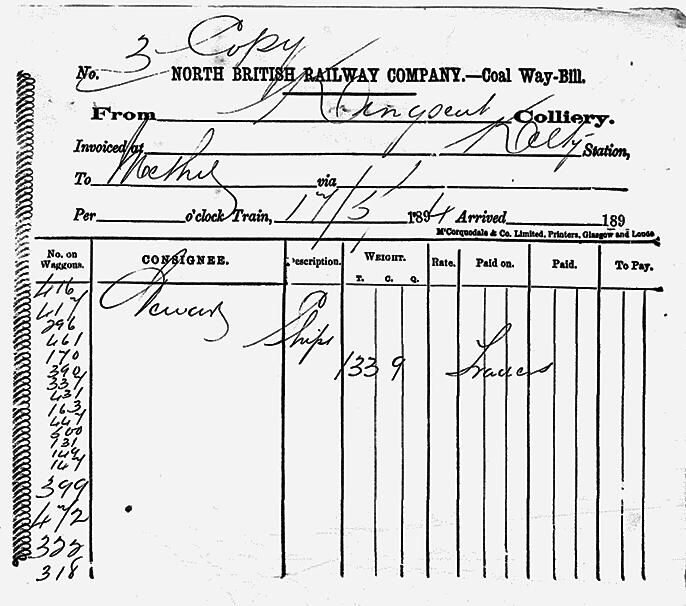
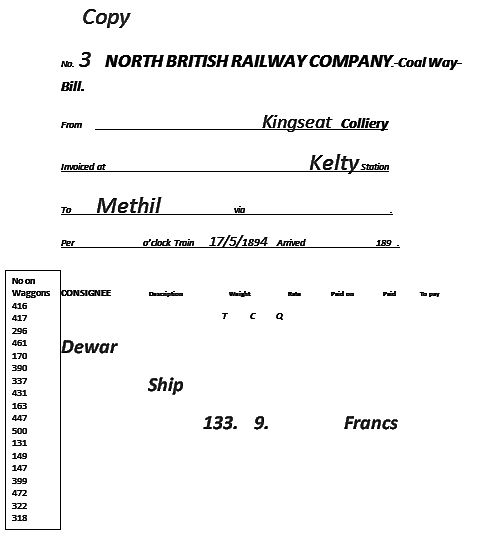
Website visitor, Jim Brydie, Kelty, kindly sent a copy of a North British Railway Company. - Coal Way-Bill dated 17th May, 1894, which dealt with the shipping of eighteen waggons of coal from Kingseat Colliery to Methil.
 |
 |
-------------------------------------------
"Dunfermline Saturday Press"
11 August, 1894
THE SUDDEN DEATH AT KINGSEAT
As the result of a post mortem examination, Dr Bell is able to state that the death of Thomas Smith, miner, Kingseat, on Thursday last, was due to perforation of the stomach, and acute peritonitis.
-------------------------------------------
"Dunfermline Press"
8 February, 1896
Michael Berry, miner, 76 Appin Crescent, received an injury to one of his eyes while working at Kingseat Colliery on Tuesday. He was removed to the Cottage Hospital, and attended by Dr A. L. Bell, who found it necessary to remove the injured eye.
-------------------------------------------
"Dunfermline Press"
9 May, 1896
KINGSEAT - BOY KILLED
A boy named John Lindsay, pithead worker, son of James Lindsay, storekeeper, Hill of Beath, was killed at No. 1 Pit, Kingseat Colliery, on Thursday. He had been watching some shunting operations at the railway siding, and, while looking at the engine, failed to notice several waggons coming from an opposite direction down the incline on the main line. He was run over by the waggons, and only lived a quarter-of-an-hour.
John Sneddon, pony-driver, son of Robert Sneddon, miner, Kingseat, had his left leg broken in the same pit on the same day. Dr Bell was speedily in attendance in both cases.
[A full report on the fatal accident inquiry into the death of John Lindsay, which was held in Dunfermline, was given in the issue of 30 May, 1896.]
-------------------------------------------------
"Dunfermline Press"
13 June, 1896
EMPLOYING A BOY UNDER AGE
At the Sheriff Court on Thursday, William Wilkinson Muir, certificated manager of No. 1 Pit, Kingseat Colliery, and John Morris, pitheadman, were charged with a contravention of the Coal mines Regulation Act, and the Special Rules in force that, on various dates between 20th March and 7th May, the accused employed above ground, in connection with the mine, or failed to prevent from being employed, the now deceased John Lindsay, son of James Lindsay, colliery storekeeper - a boy then under 12 years of age. The accused pleaded guilty. It was explained that the boy's age had been entered in the pithead book by another official, and that what the accused had failed to do was check the entry. Muir was found £2, or five days. Morris was dismissed with an admonition.
------------------------------------
"Dunfermline Press"
26 September, 1896
HALBEATH - PRESENTATION
Mr William W. Muir, manager of Halbeath and Kingseat Collieries, was waited upon by a deputation of the Games Committee at his residence on Saturday evening, and presented with a handsome marble timepiece, on the occasion of his leaving Halbeath. Mr Robert Nisbet made the presentation, and Mr Muir feelingly replied. A most pleasant and enjoyable evening was spent.
--------------------------------------------------
"Dunfermline Press"
2 June, 1900
On Monday, Agnes Davidson, fourteen years of age, coal-picker, Fairfield of Lassodie, met with an accident at No. 1 Pit, Kingseat. The girl was engaged at the picking table, and while the jiggers were in motion her left foot was caught by a wheel. The toes of the girl's foot were so severely crushed that, on her removal to the Dunfermline Cottage Hospital, Dr Bell found it necessary to amputate them.
-------------------------------------------------
"Dunfermline Press"
29 September, 1900
James McEwan, forty years of age, a tramp labourer, supposed to belong to Coatbridge, was found dead in the fire holes at No. 1 Pit, Kingseat Colliery, on Saturday morning. The discovery was made by the engineman, James McDonald. McEwan had been working at the pit as a coal filler, and is supposed to have been sleeping overnight at the fireholes. After a post-mortem examination, death was certified to have been due to suffocation.
-------------------------------------------------
"Dunfermline Press"
19 January, 1901
The Town-Clerk stated that the annual report by
Mr Millar, mining engineer, on the Burgh minerals had been
received. It appeared from the report that the royalties amounted
to £9807 15s 6d - an increase of £3497 2s 4d on the
preceding year.
The various collieries contributed to the
increase as follows:
Townhill £1605 16 1
Muircockhall £200 7 11
Muirbeath £1588 0 0
Kingseat £57 11 7
Street Brothers £45 6 9
... The rate of increase was 2.65d per ton. The increase was mainly due to the higher price of coal, the output having only increased to the extent of 13 per cent. ...
---------------------------------------------------
"Dunfermline Press"
20 April, 1901
KINGSEAT COAL
At a meeting of the Property Committee on the 4th inst., there was read a letter from Messrs Wallace Brothers, coalmasters, to the Chamberlain, dated 15th ult., intimating that they had now been obliged to cease working the coal belonging to the Burgh at Highholm - the splint coal having all been wrought and the 5-foot coal as far as practicable, and that they had requested Mr Miller, M. E., to have the last survey as early as convenient.
---------------------------------------------------
"Dunfermline Press"
23 August, 1902
STOPPAGE OF KINGSEAT COLLIERIES
The following notice has been posted at Halbeath and Kingseat Collieries:-
"NOTICE TO WORKMEN. - Notice is hereby
given that, fifteen days after this date, all contracts with
workers above and below ground will terminate owing to the
practical exhaustion of the coalfield.
"All workers wishing to remain in occupancy
of our houses are requested to apply to the Manager.
"WALLACE BROS."
"Halbeath and Kingseat Collieries"
"15th August, 1902."
Mining operations have proceeded at Kingseat for
about fifty years. At the Cuttlehill and Halbeath Collieries labour
was suspended twenty-five years ago in consequence of water rising
in the workings owing to the stoppage of the pumping engine at the
Queen Pit. Some months ago No. 1 Pit at Kingseat, which was in
operation for forty-eight years, was brought to a standstill, so
that for the last few months only two pits have been at work. At
one time the collieries gave employment to between 600 and 700 men,
but of late the number has not exceeded 300. One of the Kingseat
pits is sunk on the lands of the Marquis of Tweeddale, and an
effort is being made to find another lessee "for the large
areas of upper seams which (according to advertisement) are still
to work." In the event of no lessee being found the Kingseat
miners will require to secure employment at the pits in the
neighbourhood.
A mining correspondent writes:- "Unless
some drainage scheme were adopted so that some valuable coal which
is now under water could be reached, it will not be possible to run
the collieries as paying concerns. The closing of the works will
cause considerable inconvenience to a number of old residents, who
view the situation with a feeling of sadness. They are attached to
the place, and it is not too much to say, have warm regard for
their employer, Mr Wallace."
---------------------------------------------------
"Dunfermline Press"
30 August, 1902
THE STOPPAGE OF KINGSEAT COLLIERIES
Mr R. W. Wallace of Halbeath, in formally opening the Halbeath and Kingseat Flower Show, on Saturday, made reference to the notice recently posted at the Kingseat Collieries intimating the stoppage of the pits. ...
---------------------------------------------------
"Dunfermline Press"
6 September, 1902
THE STOPPAGE OF KINGSEAT COLLIERIES
The notices posted at Halbeath and Kingseat Collieries, intimating a stoppage of the collieries owing to the practical exhaustion of the coalfield, expired on Saturday. Nearly 300 workers are affected by the change. The bulk of the miners took home their graith on Saturday, and it was evident that they did so with regret - many of the men having worked at the collieries practically all their days. Fifty of the men have been retained on one day's notice in order to remove a small piece of coal near the bottom of No. 2 Pit, and to do work following upon the stoppage of the pits. The miners resident in Halbeath and Kingseat are to continue as tenants of the colliery houses, although working at neighbouring pits.
---------------------------------------------------
"Dunfermline Press"
20 February, 1904
Since Mr R. W. Wallace stopped operations at Kingseat Colliery, work has been carried on by Mr John Irvine in the Dean Seam in No. 2 Pit. In all the lower workings the water is rising, and it is possible that operations may require to be suspended. To provide against a stoppage, Mr Irvine has begun to sink a shaft near Kingseat Farm to a small stretch of the eight feet seam.
---------------------------------------------------
"Dunfermline Press"
17 November, 1906
A ROOF "FALL" AT KINGSEAT COLLIERY
A fatality occurred at Kingseat Colliery (Messrs John Irvine & Son) between nine and ten o'clock on Wednesday morning. The victim was James Johnstone, miner, residing at Turbayne's Row, Townhill. Johnstone was engaged holing, when the roof gave indications of coming away. He made to get into a place of safety, but was too late, and a large stone, weighing upwards of a ton, fell upon him, inflicting injuries which must have been instantaneously fatal. When the body was extricated, it was found that the man's back was broken. Deceased was about thirty years of age, and is survived by a widow and three of a family.
--------------------------
"Dunfermline Press"
1 December, 1906
Under the Fatal Accidents Inquiry Act, an inquiry was held in the Sheriff Court, Dunfermline, on Friday - before Sheriff Shennan and a Jury - into the circumstances attending the death of James Johnstone, miner, lately residing at 62 Turbayne's Row, Townhill, who was killed by a fall of stone from the roof at Kingseat Colliery on 14th November. Those giving evidence included:- William Strain, manager; James Russell, Campbell Place, Townhill; Thomas Wilson, miner, Viewfield Place, Townhill; and James Wilson, pit fireman, Main Street, Kingseat. The jury returned a formal verdict.
-------------------------------------------------
"Dunfermline Press"
20 April, 1907
By cable, information has just been received in Dunfermline of the death at Alberta, Canada, of Charles Hutton, eldest son of Mr David Hutton, merchant, Baldridgeburn. Hutton lost his life in a heroic attempt to rescue a young lad who was caught by after-damp in the Bass Mine, Coleman, Alberta. Before emigrating to Canada, the deceased was manager at Kingseat Colliery. ... Deceased, who was thirty-two years of age, was a widower.
-------------------------------------------------
"Dunfermline Press"
5 December, 1908
Under the Fatal Accidents Inquiry Act, an inquiry was held in the Sheriff Court, Dunfermline,
on Thursday - before Sheriff Shennan and a Jury - into the circumstances attending the death of a
miner named Martin McKenna, Halbeath, Dunfermline, who, on 20 November, was killed at
Kingseat Colliery while engaged at a coal-cutting machine. Those giving evidence included:-
Duncan Ferguson, colliery manager; James Laird, miner, Kingseat; Peter Sneddon; and Andrew Murray.
The jury, by the direction of the Sheriff, found that "the accident occurred through the deceased's
clothing catching the starting handle of the machine and setting it in motion while the deceased was
stretching over it in the course of oiling it."
-------------------------------------------------
"Dunfermline Press"
11 April, 1914
KINGSEAT COLLIERY
It may be of some interest to point out that since 1907 Kingseat has been a small
contributor to the burgh coal revenue. In 1879 Kingseat Colliery contributed as much
as £1822 6s to the revenue; in 1880, the total was £1808 0s 7d; and in 1882 it was
£1112 3s 5d.
From this date, however, it began to fall because of the working of the colliery being
developed in coal seams stretching into the lands belonging to other superiors; and in
1902 the Kingseat contribution fell to £61. For four years there was a complete blank,
and in 1907 the contribution amounted to £44 8s 7d. Last year it was £349 17s 5d.
At Kingseat colliery operations are, as at Townhill and Muirbeath, confined to the
upper seams. The Dunfermline splint and the five feet seams are flooded with water,
an abandonment having taken place more than a decade ago because of the seams
being exhausted. ...
-------------------------------------------------
"Dunfermline Press"
9 February, 1918
MINING ROYALTIES
The report by the City's Mining Engineer on the burgh's collieries to Martinmas 1917 shows that the royalties received were as follows:- Townhill, £1767 9s 11d; Muircockhall, £416 0s 8½d; Kingseat, £251 12s 3d; wayleaves, £96 16s 8½d. This represents a decrease in lordships, including wayleaves, of £1684 18s 1d as compared with the preceding year.
-------------------------------------------------
"Dunfermline Press"
9 January, 1926
REDUCED MINING ROYALTIES
The total revenue derived by the Town Council of Dunfermline in respect of the burgh
collieries for the year to Martinmas 1925 amounted to £1948 17s 2d, made up as
follows: - Townhill, £800 (fixed rent); Muircockhall (royalties), £1099 4s 2d;
Muircockhall (way leaves), £24 13s; and Kingseat (fixed rent), £25.
The decrease in revenue as compared with the previous year was £157 7s 5d.
There was a decrease of coal output amounting to 23,632 tons compared with the year
1924. These decreases, according to the Burgh Mining Engineers, were due to the
state of the coal trade and to the stoppage of operations at Townhill Colliery.
-------------------------------------------------
"Dunfermline Press"
26 January, 1935
DEATH OF MR. R. W. WALLACE OF HALBEATH.
Mr Robert Walker Wallace of Halbeath, died at his Edinburgh residence, 7 Inverleith Row, on Monday. ... He was a son of the late Mr Andrew Wallace, who owned what were then known as Halbeath and Kingseat Collieries. ... On the death of his father, he became associated for a time, with a younger brother, the late Mr George Wallace, in the management of the collieries. ...
-------------------------------------------------
"Dunfermline Press"
28 September, 1935
THREATENED STRIKE AT KINGSEAT COLLIERY.
A mass meeting of miners was held in the Welfare Hall, Kingseat, on Sunday evening. The Rt.
Hon. William Adamson, who addressed the meeting, stated that the Kingseat Colliery Company
refused to accede to the men's demand for a flat rate of 9s 6d for heavy grade workers, and
an increase for other workers.
It was agreed that a ballot be taken and strike notices given to the Company if the men approved of
this. The result of the ballot was disclosed on Wednesday. It showed 194 in favour of a strike and 27
against. ...
-------------------------------------------------
"Dunfermline Press"
11 January, 1936
MINING ROYALTIES.
The royalties payable to Dunfermline Town Council in respect of the burgh minerals for the year to Martinmas 1935 were as follows:- Muircockhall, £836 6s; Kingseat, £128 15s 6d; Derby mine, £252 9s 2d; Lochside (blae and fireclay), £47 13s 2d; - a total of £1282 3s 10d.
-------------------------------------------------
