 |
|
We are always very
appreciative when site visitors express their thanks for the
work we are doing on the Fife pits and it was a great
pleasure to hear from Lorraine Parkinson that, through her
research into her family tree, she had encountered the site
and had informed her father, Andrew Marshall, a former mine
surveyor in Fife, of the site content. This has triggered
Andrew Marshall into 'a trip down memory lane' and he
has begun to recall and describe some events from his working
life as a mine surveyor to his daughter, Lorraine, who has
kindly sent some of these memories to be shared.
|
| See 'Memorabilia' Link for Letter of Appointment |
|---|
Down Auchterderran Road in Lochgelly, past the cemetery, then turn left, at a bridge over the railway, there was a track that led to Lochgelly Station. Somewhere on that track (from Brigghills or Minto Pit) he went down to the underground passages of a disused pit [the Eliza] to take air samples. He used an anemometer and did a cross-section of the tunnel.
In 1947, when the pits became nationalised and the mining companies lost their individual titles, he thinks that the Lochgelly Iron and Coal Co. could have become just Lochgelly Coal Co. at that time, but not sure.
His best friend, Marshall Duncan's father, was pay-master for the Wilson and Clyde Coal Co. Marshall checked the wagons for the distribution of coal. His other best friend, Roddie McKechnie, was also an apprentice surveyor with the Lochgelly Iron & Coal Co. His father worked for Wilson & Clyde Coal Co.
Peter Henderson was the manager of Lochgelly Iron & Coal Co. and a Mr. Storrie was also in management. His son, Jimmy Storrie, was in management too. He accidentally killed a young boy in Lochgelly, while driving from his home in Dunfermline to work. There was a brother who was a pilot in the RAF. One day he flew his plane to the pit and flew loops around the chimney stacks!
That's what came out of today's conversation. I'm sure once I get him onto your website, he'll start talking more!"
"I don't think my father has talked so much in years!
I'm definitely going to tape him and all his stories when he
comes to visit! You are right, it was the Eliza Pit - or
'Liza' as he calls it. The Arthur Pit he now thinks was on
a road that ran parallel to the Lochgelly-Cowdenbeath road, south
of Lumphinnans. He said it was one of the Lochgelly Iron & Coal
Co. pits.
Some other memories that came out yesterday -
... landowners who owned the land above the pits, also owned the
mineral rights below ground. They were paid royalties. Every month
the 'laird's surveyor' would come out to check on the
progress and make sure everything was as stated.
... little doors in the big doors at the bottom of the shaft, to open and equalise the pressure so you could open the big door.
... "Chappin'" to let the engine-room know to bring you up; 'hutches' to bring the coal up.
Outside Lochgelly, on the Auchterderran Road, on the right side - 'the Avenue' - a horse and cart went down when the ground caved in because of mine workings. Coal seams would outcrop along that area and folk would collect coal.
He had to survey and pay farm damages. Seams had to be at least 60' or 10 times the thickness of the seam, whichever was the greater, below the surface.
... pit ponies turned loose on the Clune Hill [west of North Glencraig].
He used to keep an envelope at the back of his surveying journal and in that he would keep horse hairs taken from the ponies' tails. He used them as sights in his instruments - black for above ground and white for below!
A wee girl, curious as to what he was doing, once asked if he was taking photographs with the surveying instrument. "Whit are ye daen, mister?" He asked her if she would like to have a look. Of course, everything was upside down - the cows, the trees, etc. She quickly ran off, holding her skirt down!!!
If he wanted to make a copy of a plan, it took as long as 2 hours. Depending on the amount of sunlight. He went to the yard, to the pattern maker, a fellow called 'Auld'. There was a big barrel with a table top. Inside this there was a felt-pad. The plan was placed inside the barrel, yellow side down and the barrel was turned 360 degrees. The sun would shine on the glass and affect the special 'ozalid' paper. The plan was then rolled up and placed in a box to cure it. The yellow print turned black. The liquid used had a terrible smell and just about choked you! But the whole process took so long - it was a good skive!
He used the cogs that went in the horses' shoes to wedge his plumb-bob in to the ceiling of the shaft if there were no overhead girders.
Outside the offices of the Lochgelly Iron & Coal Company there were 2 marks in the kerb to check the lengths of their chains. They had a 66 ft. long steel chain made up of 100 links for measuring. He could count links in the dark to get measurements! He remembers taking readings between the Brigghills or Minto Pit and the Eliza Pit. The fans would be shut down so there were no breezes and a 50 lb. weight plumb-bob would be lowered down each shaft and immersed into a barrel of oil to stop it oscillating. Then he could take his readings. He talked about how you took readings above ground then transferred them to below ground.
Gosh, he remembers a lot, so I'd better get it all down before he starts forgetting!
I bought him a plate at Kirkcaldy Art Gallery that had all the Fife Pits on it. He talked a bit about the mines when I got him that, but nothing like what he's done since I found your site. Glad I found it! Thanks ... you've given me some special time with my dad! "
|
We were also delighted to
hear from John (Jock) Hayhoe who lives in Australia.
|
Congratulations on your great website which I have enjoyed
looking at many times over the past couple of years and hope you
keep up the good work.
My name is John Hayhoe and I live in Scoresby, Melbourne,
Australia, but I was brought up in Crossgates, Fife, where I lived
until I was married in 1967 and migrated to Australia.
I served my apprenticeship as an electrician with the NCB in Fife,
starting at the Central Workshops, Cowdenbeath, in March 1961, and,
after 12 months, I transferred to Lumphinnans No XI ( the Peewit),
where I 'finished my time' in June 1966 - just in time for
the pit to close - and in November 1966, I transferred to Seafield
until we emigrated to Melbourne.
I was employed in the Railways here for twenty-five years before
taking a redundancy package, and since then have worked for various
employers and for the past six years at the former Naval Dockyard
in Williamstown (a western suburb of Melbourne) where we are
building 10 Anzac Class frigates for the Australian and New Zealand
navies.
We have had many employees there who originally come from Fife and
quite a few who worked at Rosyth Dockyard, and I have a lot of
friends who worked in the pits before coming out to Australia.
My other reason for writing, apart from congratulating you on your
site, is to ask if you have any more information or photos, etc.
which you could include about the Central Workshops, Cowdenbeath,
as I also had an uncle who worked in the Stores there for many
years, and who then went on to work as the Planned Maintenance
Clerk at Fordell Pit (the Alice) and then the Michael Colliery.
If I remember correctly, there were smaller workshops in the east
(may have been at Dysart), where I went on an 'advanced
apprentices course' just before finishing my apprenticeship,
and somewhere in the west (may have been Comrie). I'm sure
there were apprentices from both these workshops in my class at
Cowdenbeath Tech. and any information, etc. about either of these
would also be appreciated.
Congratulations again on all the work you've put in to the
site, and more power to you in the future.
Lang may yer lum reek.
Best Wishes from Down Under,
John (Jock) Hayhoe
|
In July, 2002, we heard from
Richard (Dickie) Maxwell, now based in Toronto, Canada.
|
I think the site is great - brings back a lot of memories. I
worked in the Wellesley in 1945-52 - worked as a stripper in most
seams - finished up in the basin - manager, G. Wilson; undermanager
Jock Hume.
I ran at all the Highland Games under R. Maxwell, Leven. Won the
Fife running championships - five races in one day 220 yds. to 2
miles at Beveridge Park, Kirkcaldy. All prizes were on show at
Wellesley Pit, 1949 - also won the Alva Hill Climb same year.
Big families at the Wellesley were the Macdonalds, Buists,
Hamiltons, Cunninghams, Feachens, Morelands, Frasers - all
hand-strippers - Big Andy Hamilton - Union top man.
I visited the mine last year, drastic changes, I was there in the
golden days - East Fife soccer - Niven, Philp, Finley, Aitken, Alan
Brown, wee Tammy - legs Charlie - Duncan - Henry Morris - beat them
all - Celtic, Rangers, Hearts, Hibs - those were the days!
Well, I've enjoyed my visit - will do it again sometime.
Good luck!
Dickie Maxwell
"Hi Chris, I gladly give you permission to print anything I send you! I wish now that I had added a few more pieces. Like in the beginning, I had to go to Townhill, Dunfermline, live in a bunkhouse, and do 6 weeks training in an non-producing mine, certainly got me used to being underground. I've still remembered how to use the phone, by scraping the wires up near the roof with an Elastoplast box. Yesterday, I enjoyed a good 4 hours reading through your website. Looks like it will take me months to get through it all. Great reading.
I think the site, is terrific! I started mining as a Bevin boy. I lived in Ayrshire and got called for the Army in Aug 1944. After being examined by 4 doctors and passed A1, the next step was into the signing on officer's office - he is the guy who gives you your army number then gets you to sign. He then says, Oh! you're off to the coalmines! When I asked what he meant, he replied, "the next number in your line ended with a 4 so that sends you into coal mining." I said no way I'll go there! He said you'll get a letter in a few days, with the mine address, you either show up, or the police will pick you up and escort you there. Charlaw & Sacriston Colliery, County Durham.
After 2 years, I transferred to the Wellesley for 4 years, Wellsgreen for 2 years, then to re-opening the Cameron mine, which closed again a few months later. Still not demobbed. I met and married a Leven girl. No regrets."
|
Also in July, 2002, Ian
(John) Sloan, Coaltown of Balgonie, Fife, wrote to Chris
Neale, Information Services Librarian, Dunfermline Carnegie
Library re the Memorial Book and the death of his grandfather
(see the East Fife Index entry for Valleyfield Pits)
and, with John's permission, we wish to pay tribute to a
very brave man.
|
Dear Chris
Mining Memorial Book
Some time ago I was in the Methil Heritage Centre and looked through the Mining Memorial Book for the entry on my Grandfather, whom I am named after.
The entry was incomplete, so I took the enclosed form to update the information in the Memorial Book. I have finally got round to going into the attic and found the enclosed papers.
I thought it would be of interest to you to not only give you the Report of the Fatal Accident in 1939 in Valleyfield pit that killed my Grandfather, but also to include the newspaper report of how he was commended in 1929 for his heroism during an accident in the Cadzow Colliery in the Lanarkshire Coalfields. He was one of the "Brave Colliers" who went into the coal seam filled with black damp in an attempt to rescue their colleagues.
The fatal accident in October 1939 left my father, his five brothers and sisters and his mother (my Grandmother) in pretty dire straits - the Coal Company concluded that as my Grandfather had "acted of his own volition", in checking out the shot fire, his dependants were not eligible for any compensation for his death. No Health and Safety at Work Act in those days!
Also, as Under Manager of the Colliery, the family lived in relative comfort in a house provided by the Coal Company. They even had the pit's gardener look after their garden! After a brief period, the Coal Company required the house for the new Under Manager, so my Grandmother and her family were moved to the miners' rows in High Valleyfield. When I was born, in 1946, my father and mother were still living in the family home due to the shortage of any post-war housing.
If you wish any further details, please do not hesitate to contact me. I trust that you will find this information useful and that the next edition of the Mining Memorial Book will contain more information on the Grandfather that I never had the privilege of meeting.
Yours sincerely,
Ian (John) Sloan.
Note: the brave part played by John Sloan in the Cadzow
Colliery incident, in the early hours of the 10th October, 1929,
when three men lost their lives, is indicated in the extracts
below. The three miners who lost their lives were: John Whitton,
underground fireman; Robert Andrew Mathie, coalpit brusher; and
Robinson Foster, coalpit brusher.
Anyone requiring a full account of the newspaper report should
make a request to M. Martin, Author.
... John Sloan, colliery undermanager, 241 Low Waters, Hamilton, said that when he arrived at the scene of the accident Foster had been got out. He seemed to be still breathing. It was impossible to get into the other men. He sent for a smoke helmet and ultimately managed to reach first Mathie and then within six feet of the coal face, Whitton. Whitton was lying on his back and Mathie was lying face downward. They were dead. He found them two hours after the accident. ...
... On the following day he got up to the end of the air
tubes and found a brattice cloth lying across the air tubes. This
was about the place where Foster was overcome and in falling he may
have knocked the cloth over the tube and blocked the ventilation.
When witness got to the face there was only three feet of coal
between the scene of the accident and the abandoned mine. He put a
pick through and managed to get his hand through. As soon as the
hole was made there was a strong current of air from the abandoned
road which ventilated the scene of the accident.
He found a heavy blower of gas close to where the shot had been
fired by Whitton. The shot holes were close together. ...
... After the accident when witness first tried to get to
Mathie and Whitton he could only climb up the terraces to within
sixty feet of the coal face. He lay down to get air in his lungs in
order to make another attempt, when the smoke helmet, which he had
previously sent for arrived. It was dangerous to climb in such a
place with a smoke helmet, admitted the witness in reply to
questions. He recovered both men one by one with the help of wire
ropes.
"They were bigger and heavier than yourself," said Mr.
Masterton, mines inspector, "and it was a magnificent
job."
... At the conclusion of the case the Fiscal said that so far as fault was concerned he did not wish to say anything. He desired to pay tribute to the heroic action of Dr. Nora Steele and the heroic efforts of Sloan, Rodgers, and the other men in the mine who had tried to save their comrades. ...
... Sloan, the undermanager, Rodgers the fireman, a repairer named Whyte (who did not give evidence) were marvellous. ...
... He [Mr. D. C. Orr] added that he had never known of any man going into such a place with a smoke helmet as Sloan had done. Sloan knew full well that the tubes were short and the air he got pumped to him must be vitrated. It was heroic.
|
We were also delighted to
hear from Lisa Marie Thomson who lives in United States.
|
Dear Sirs,
I am so grateful for the team effort put forth in the Fife Mining
Website, as I verified some information about my own coalmining
families.
David Thomson was my great-grandfather and was the manager at Bowhill Pit in 1896. He married Eliza Herd, who I believe was the daughter of Walter Herd (Walter Herd & Sons, Kirkcaldy-owned Begg and Dunnikier Pits). Their son was Frederick Thomson, who was also a miner. Frederick married Margaret Campbell, the daughter of David Campbell (coalminer in Fife) and Christina Penman Campbell.
Frederick Thomson and his family emigrated to the United States in 1923, which I believe was due to the pit strikes in 1921. However, Frederick Thomson and his family are not listed on the immigration passenger lists in the United States and it is believed he travelled by ocean liner. Frederick and his family first settled in Indiana, but the family was uprooted once again and moved to Oak Hill, W.VA. where he found coalmining work. His daughter Elizabeth "Betty" Thomson married my American grandfather, Robert Batten, who was also a coalminer.
Due to the money it would have taken for them to emigrate, in addition to the moves, we could not figure out how he afforded this on a coalminer's wage. If Walter Herd was indeed Frederick's maternal grandfather, it would explain how he managed to afford these moves. We believe that it was either inherited to his mother, himself, or the money was simply given to him to uproot and move to the United States. How so very hard this must have been for their families as they seem to have lived in a very close-knit community. This seems to be the case with most coalmining families for some odd reason.
I wrote to Tam Shaw, as well, in hopes that he may be able to assist me with further information. I am aware that all relatives were coalminers in Fife but due to Frederick's move to the United States, I have lost a connection with an entire set of four Scottish families in Fife. A fact which, I admit, has bothered me for some reason. Therefore, I was hoping that you may have additional information on the Herds, Thomsons, Penmans, and Campbells mentioned or, perhaps, photographs of my family members. If not, I would appreciate any information you could share with me or contacts that may be able to point me in the right direction.
Today, I am happily married to a Glaswegian Thomson who is the son of a doctor, by the way. I suppose I broke the coalmining cycle but continue to be attracted to my roots. However, it seems to be very important to me and I am searching for answers these days. My Scottish gram is still alive in her eighties but her memory is so. She was only eight when she came to the United States.
In closing, I believe in what you are doing is a good thing. You have helped me with information I was not aware of and I am sure you have helped so many others due to your team work of research, time, and effort. I owe you so much gratitude for your contributions of keeping what I feel is the memories of my ancestors alive. Their hard work, the horrible conditions in which they worked, and the blood and sweat they stained the ground with. That is how I see it. I am wanting to join the Peak Mining Society to also contribute to their memories personally. Something I can give back for all that they gave me and what I have today. It does not seem like enough but it is a start.
Thank you for your time and interest.
Kind regards to everyone involved.
Lisa Marie Thomson
United States
|
Some time ago, Andrew Simpson Jr.,
Blackpool, Lancashire, sent us notes from his Dad's
biography. His father, Andrew Burns Simpson, lived in Formby,
Merseyside, and we were delighted to display that part which
deals with life in the 1920s as a miner in some of the pits of East
Fife. Andrew has been in touch again [October 2007] with a few
letters and documents relating to his Dad's early career. Sadly,
we record the passing of Andrew Burns Simpson, in March 2006,
at the age of 97 years.
|
"In those days in the pits in the twenties, one had to be multi-skilled. There was no point in sending a man two thousand feet into the bowels of the earth and three miles out under the sea to do a repair job, and then have him return to the surface to tell the manager it's a fitter or an electrician or a joiner or a rope splicer that's required. One had to be not "jack" but "master" of all trades. If you couldn't repair the machinery instantly, the miners got sent home without pay. If you established a reputation for getting miners sent home, you got a lump of coal through your kitchen window on pay-day.
Then there was Mary, I think she fancied me! I sometimes shared a tuppeny bar of Cadburys Dairy Milk with her and she would slobber all over me as I ran my fingers through her yellow mane. You see she was a pit pony! I found her one day down the pit with her minder hitting her on the backside with a stick. I stopped him and asked him why. His reply was that he'd hitched her up to six empty tubs and she had refused to budge! "The little bitch has learned to count, five is all she will take to the waiting miners." At that moment there was a loud crack, and the whole roof fell in front of us, fifty tons of it! When the dust cleared, Mary was missing, but she wasn't trapped, we could hear her shoes clattering on the metal sleepers behind us as she often did when she got the chance. She'd gone to the stables, but not before she had unhooked his lunch box from the nail it was hanging from and kicked it about until it had spilled open and she had eaten his sandwiches. He swore he would swing for her when he caught up with the little sod, but he never hit Mary again. We both knew that Mary had saved our lives. She had sensed that the roof fall was imminent, that is why she refused to budge.
After spending five years underground in the East Fife pits the great depression came along. All the five pits I had worked in closed down. The coal seams had got further and further away from the winding shaft, and the coal too expensive to extract. I signed on the dole but I never got paid the fourteen shillings per week because my chum and I had dug up the beach for lugworms and gone fishing. We earned more than the 3/4d. per day we were allowed, and the manager at the dole office told us we must choose between fishing and signing on. So we went chasing worms and rowing our boat all over Largo Bay with a 500 yard line, with a hook every yard, just as Alexander Selkirk (Robinson Crusoe) had done about 300 years ago."
| See 'Memorabilia' Link for letters of reference and documents pertaining to Andrew Burns Simpson's career in the National Steel Foundry, Kirkland Works, Leven, and at Leven and Wellesley Collieries, East Fife. |
|---|
|
In May, 2003, we were pleased
to hear from Nancy Smith Kemper, Ohio, USA, formerly of
Kinglassie, Fife.
|
"Hi Mick,
I just stumbled on your website and although I haven't had time
to read all of it, I found it very interesting. I will go to it
again when I have the time.
I was born and raised in Kinglassie and worked for the NCB for 12
years. I was a payroll clerk for the Central Region. I started in
the Kinglassie office and was there for about 2 years. I then
worked at Bowhill for another year or two, then spent the rest of
my time at the Lochgelly office.
Every Friday (of the 12 years) I made up the payroll and paid the
Kinglassie miners. Did I ever pay you?
I got married in August, 1957, and came to Ohio in December, 1957.
I worked with the NCB until that time.
I have kept in touch with four girls from the old days and one of
them - Betty (Young) Merrilees - lives in Los Angeles. She used to
go to Lochore pit on Fridays to pay the miners.
In the Lochgelly office there were about 24 girls making up the
payroll for the Central, West and East regions. It was a happy
office and never a dull moment.
It is difficult for US people to realise how well-paid our miners
were and that they made enough money to live a good life. In the
1950s, miners on this side of the ocean were considered to be
'backwoodsy hillbilly folk' with little education and the
miners were not as safe as our men were.
I had an NCB friend who came from Scotland to advise the mining
industry here in the US. He was a mining engineer and was in great
demand. He made big money and travelled to many US states in the
course of his work. Nowadays, the coal industry is dead.
Say 'Hi' to Fife for me."
Sincerely,
Nancy Smith Kemper
|
In December, 2003, we were pleased
to hear from Harry Jack, of
Edinburgh.
|
Hello again Michael,
I've spent several hours dipping into your site. Great stuff!
Interesting that you moved from Fife to Yorks. -
my folks made a similar move in 1930.
My Dad (1902-1981) was a mechanic in a factory in Dunfermline, went
away to sea as an engineer with the British India line in 1927, but
was courting at the time so returned to Fife. No work to be had in
the mills so he had a year in Lumphinnans No. XI. (I once saw a bus
with 'Pewit Mine' on the destination blind, but he always
called it 'The Peeweep').
I remember him saying that the
management thought more about the ponies than they did about the men;
after all, replacing a dead pony cost money. He moved down to a weaving
factory in Lancashire and married my mother in 1930.
Her father (Lindsay Gillespie) had been a miner at Hill of Beath, but after being in the Royal Scots in France in WWI decided he wasn't going back. "They'll hae to sell coal in wee pokes in chemist's shops afore I gang doon there again". His last job was as a labourer in the Burntisland shipyard.
My parents lived in Lancs. until 1952 when they moved 'back
home' to Fife. I was born down there and when I was 15 years
old, Dad arranged a visit to a local pit - Cleworth Hall Colliery,
near Tyldesley. I shall never forget it. From all I could gather,
this pit was a pretty primitive example even then (1949?). The top
of the cage was just a bit of bent and battered sheet-iron, and of
course I was (innocently) expecting a gentle descent like a lift in
Lewis's. After about a mile (it seemed like it) walking bent
down, then crawling up a long slope about 3 feet or less from floor
to roof, beside the 'pans', it was amazing to see all these
cheery men just laughing at us, at the coal face.
They gave us a rough idea of the work, starting
up a coal-cutter, the pans shaking the coal away downhill to the
tubs (Dad called them 'hutches' of course) somewhere down
in the dark. 'Impressed'? The word is inadequate.
Years later (1959?) I went down Comrie Pit in Fife; my cousin had married a pit-surveyor and he took me down. It was impressive too, but a lot cleaner and tidier and very modern, compared with that Lancashire pit, only ten or so years before.
Sorry, I'm rambling on. But I was so interested in your website and thought I ought to say 'thanks'.
More power to your elbow. Keep up the good work!
Harry Jack
(Edinburgh)
| In January and February, 2004, we were very
pleased to hear from William H. Macleod, Guardbridge, who shared
with us his recollections of some of the old shafts in the Dunnikier
area of Kirkcaldy and who revealed his interest in the history of the
early colliery and, in particular, the Engine Pits of the
Dunnikier coalworks.
M. Martin & Webmasters |
|---|
Hello Mick,
"Your maps of the Dunnikier and other Kirkcaldy
pits are wonderful. Over a period of years I have been trying to
identify the various shafts and was delighted to have confirmation
in your maps. Some of the abandoned shafts were features of the
scenery in my early days in Kirkcaldy, such as the round Townsend
Pit shaft and the square shaft half-way up Whyteman's Brae
beside Keeper Whyteman's cottage with its great hedge all
round.
The Stair Pit beside the railway alongside the
footbridge over the line from Borelands New Row; Balgreggie Pit
just outside Dysart, etc.
The Lady Blanche was still a ventilating unit
and I used to peer over the wall at the Lancy Boilers
(Lancashire-type boilers - in the trade Lancashire was commonly
shortened to "Lancy") and listen to the throb of the
engine that drove the fan.
One shaft with rusting engine was immediately
beside the roadway and the other was hidden on the opposite side of
the road at Fitzroy Street (converted very briefly for
electric-wind, I think. There were many others.
The Engine Pit in Den Road was marked by a
square, steel structure that marked the shaft and may still be
there. I believe that the pumping engine there lifted the water
that came down through the old abandoned roads from the Muttonhole
and Lina Pits and lifted it into an adit that discharged into the
harbour or thereabouts.
The Begg pits discharged their water via the
same route I suspect.
The engine was recommisioned around 1852, I
believe, and this is recorded in one of the newspapers of the
time.
About then, a new lessee was being sought for
Dunnikier Colliery, and a man with mining knowledge was sought also
and advertised for. I am interested as my great-grandfather came
from West Wemyss to work at Dunnikier around that time and was for
years a winding-engineman latterly at the Lina Pit. He died in 1909
but had to give up work some years before that.
I am curious about the recommisioning of the
pit. My grandfather, who worked as a collier in the Isabella Pit
until its closure ca 1877, pointed out to me, as a small child, a
point above "Fraser's Den" where there had been a
shaft which apparently the locals had called "Macleod's
Pit". I have since wondered if this was an air access pit for
the Engine Pit and might have been used temporarily during the
recommisioning work, but this is pure conjecture.
I have so far tried in vain to locate data on
the Engine Pit but without success.
In early Wemyss parish records, my
great-grandfather is described as an enginewright but all
subsequent references are to an engineman. His father-in-law,
William Henderson, born ca 1788, was described in early records as
an enginewright and latterly as an enginefitter. I wondered if my
great-grandfather James Macleod was perhaps one of the squad
involved in the Engine Pit refurbishing and stayed on as an
engineman? He and his family stayed in Smeaton Row. His eldest son,
John, after a spell in the army, was also an engineman. He died in
1919 and had been a winding-engineman at the "Dubbie"
(Francis Pit).
I would be extremely grateful to learn whether
you have any information about the Engine Pit and its relation, if
any, to the Engine that was located earlier behind the Fife
Station.
Smeaton (Colliers) Row
I have again been studying your most excellent and comprehensive
data on Dunnikier Colliery under your section on Fife Pits. The
final item is reported as taken from the "Fife Free
Press" of January, 2003. It shows a picture which, it states,
shows the collier's cottages at Dunnikier Colliery on a
location close to the Fire Station.
As you will no doubt know, this is an error. I
believe that the row of cottages shown is Smeaton Row, abandoned
shortly after the Fever Hospital - now part of Victoria Hospital -
was built . The trees in the background are those of Dunnikier Den
behind Octavia Lodge. My great-grandfather, who was an engineman at
Dunnikier Colliery, stayed in one of these cottages with his large
family . The colliers had a quoiting ground close behind the
cottages and I imagine, though I can not prove it, that its site is
within the grounds of the present-day Victoria Hospital.
Perhaps this may interest you.
I was also interested in your report regarding
the opening of the Miner's library at Dunnikier. The man quoted
as making the reply and thanks to Major Oswald was a John Leitch.
As a child, I knew a lady who was the son of a John Leitch and I
was always told that her father - John Leitch - had sunk the Pannie
Pit which I took to mean that he had been the pit-sinker who had
sunk the shafts!
If it is the same man, he and his family had
lived originally in Dunnikier Pit Row. He had a large family but I
don't think that any of them followed him into the mining
industry.
His son, James, was a boyhood friend of my
grandfather and he emigrated to the USA and had a responsible
position with American GEC, I seem to recall.
The family grave is in Bennochy Cemetery.
You will probably know, but the "Fifeshire
Journal" of 4 February, 1858, reported the opening of a free
school for the "instruction of the cottagers".
It states, "The skeleton walls of a disused engine-house stand
prominently forth on a large piece of waste ground skirted by an
infinity of little cottages inhabited by families employed in coal
pits adjacent."
Part of the school cost came from considerable
sums contributed by influential people. The target sum was
£1200. Mr. Oswald gave £50 plus ¼ acre ground valued
at £100. Messrs. Swan, Flax Spinners, gave
£100.
This area included Dunnikier Row to which the
"Fife Free Press" referred.
On 16 August, 1855, the "Fifeshire
Journal" gives a report of "An Examination at the collier
school."
Many thanks for your reply to my notes on
Dunnikier. I am very interested in finding out something about the
period prior to the Goodalls, when a number of licencees worked the
early pits for the Oswalds.
I am particularly interested in finding out the
dates of the original Engine Pit beside Dunnikier Row and the later
Engine Pit in Den Road but have had little luck so far.
If I locate anything of significant interest, I
will let you know.
I am amazed that no photograph of the Pannie Pit
survived because there were a lot of early photographers working in
the area. For example, they photographed Smeaton Row. However, none
seem to have been found of the pit.
I can just recall it, ca 1929, when it was
awaiting demolition and I walked around the site with my
grandfather when much of it had gone. The bing was quite massive
and, as kids, we used to climb to the top. It was still in being
long after the pit had gone.
I will let you know if I find anything
worthwhile.
Wishing your impressive site every success. I
find your website absolutely fascinating and a wonderful job!
... I do not know how well you would know
Kirkcaldy. St. Mary's Road ran in the form of a flattened
semi-circle from the junction of Coal Wynd / Mitchell Street /
Dunnikier Road and returned into Dunnikier Road further to the
north.
In that semi-circle lay the remains of the
Dunnikier Row and the site of the original engine pit. This area is
now largely occupied by the Fire Station.
... Incidentally, Dunnikier Miners'
Institute stood on the corner of St. Mary's Road. It was much
poorer than any other that I have come across - of corrugated iron
and timber construction.
After the 'Pannie' closed in 1927 there
would be few miners to use it - as any remaining in the industry
would have moved possibly to the Randolph Pit or to the Francis
(Dubby) at the Dysart end of the town.
I have vivid childhood memories of a group of
men - all sitting on their hunkers at the bank corner at
Loughborough Road, and, looking back, I reckon that they were
probably displaced 'Pannie miners.
... I never cease to be astounded by the extent of the Pannie
[underground workings] from Pathhead Beach up to Pathhead Muir Farm.
I really wish that I fully understood the [abandonment] plans .
One thing is certain, they confirm exactly my childhood memory of the
winding gear location - as I recalled viewing it from Den Road just below
Smeaton Road . The date must have been 1931 as my brother was in his
pram and I was with my great aunt Janet who died in 1932.
I can see that scene in my minds eye with clarity. Ultimate demolition
must have taken place not long after - as my grandfather and I walked over
the site after demolition had progressed. I remember a brick-building that I think
had been the power station. There were steps up to an arched-doorway and
I think that I recall round-topped windows from which the glazing had been
stripped."
Best Regards,
William Macleod
|
In February, 2006, we were pleased
to hear from Stewart McIntosh, Kinghorn. He has sent us a tale (in dialect) which
is based on a true experience of him going down the Michael Pit in 1953. It is
part of a collection of poems and stories that Stewart does on a year to year basis.
This tale was written in November, 2000.
|
"The Mary, Frances, Michael, Rosie, Seafield, Lumphinnans No. 11, Isle of Canty, Balgonie, what sights,
smells and sounds do they conjure up in your mind, dear reader?
Eh wis eighteen when I first went doon the pit in nineteen an' fifty-three, ald by ony standard. It was eleven in
the mornin'. A raw an' as black day as ever they were in the East Neuk, wi' the rain blatterin'
on the tin sheds and findin' its way into the crooks and crannies of the windin' shed and, behind the yairds
fu' o' trucks with honest black coal for fires and furnaces, bilers and locomotives a' roond Britain, and
the river Forth a tortured mass o' spume and spindrift at the back o' it.
And here Eh wis, in dungarees that were a size o'er big and buits burnished and the steel toe caps glintin' in
the cald unwelcoming fluorescent light of the green unpleasant lockers, gaen doon the pit.. Meh lamp an' battery
an' helmet a' seemed wrang. The battery box on meh belt nudged me self-consciously in the back, the cable
seemed tae twitch meh ear the way meh uncle hid as a boy an' the lamp on meh helmet seemed to hae a life
o' its ain disconnected frae meh heid like some big black stag beetle waitin' tae pounce.
The cage ropes were runnin' o'er the large spidery wheels and whinin' quietly. One cage doon and the
other up. Bells rang, gates rattled, cars shot aff an' on the flair below, and Eh wis jostled intil the cage. Hid there been a tally?
Eh nivver kent, but Eh suppose there must hae been. Three hunner fathoms tae the pit bottom, echteen hunner feet, an'
it was as if yer stomach wis sclimin ooten yer mooth! Then the brakin' and the cage stopped as suddenly as it hid stairted
and bounced up and doon, up and doon, 'til it was lockit in.
It wis warm in the bottom, a welcome change frae the wild and windy pitheid. The fans howled in the updraft shaft an' then
Eh sa' him. He wis on an ald iron stretcher, black as soot, save for a red and white bundle roond his left fit. Wee Shuggie,
the shotfirer at number four face on the sooth road, had gotten it wrang that morn. They hid been in a hurry tae bla' the face
fir the next shift, oor shift. The holes were drilled, the sticks in an' tamped, the wires led back, battery connected an' the
plunger pressed, ken, but nothin' hid happened. Shuggie was an afie impatient soul, an' he hid run forrard into the drift
tae check when the lot went aff. The blast ripped away part o' his fit, and there was his boot lyin' at his side noo as
they a' waited fir the cage. It looked afie sorry fir itsel'.
But there wisna time tae feel sorry for Shug or a faimily robbed o' its livelihood for the cars were waitin' tae tak us tae the
pitface a mile away under that foaming Forth. The pointsman flung the clutch on the cable that snakit like an angry viper between
the rails and the cars jerked aff jarring meh shudders against their rough edges as I hunkered doon, fearin' to lose the heid in
the uncertain hecht o' the road. The walls ran past behind us a' coated in black dirt and dust and streakit in white stane
dust for fear of explosions. Mony a fire hid stairtit wi' gas or the dust, and there was aye plenty o' baith.
The men guffawed as Eh wis soakit by a stream o' water frae the roof as we neared the switch. "A' Baptists doon here" a
mannie cried! And Eh wondered how lang the pit could keep its feet dry as the pressure o' a' that water above it nivver let
up, day or nicht, day or nicht. Eh minded on the auld balled - Half ower, half ower tae Aberdour, 'tis fify fathom deep an' there
lies bold Sir Patrick Spens, wi the Scot's Lords at his feet! Were they a' keekin' at me the now, through these cracks
in the roof?!
And then we wis at the face, an' doon on yer hauns and knees, pick and shovel, to clear and shore to the next blast. The belt
loader sterted up ahint us an' the belts an' clips went tack-attack-tack-attack o'er the pulleys an' the motors
howled and roared. At least on this face the seam was four feet thick, they'd nae hackin' oot on yer back or side here.
Mind you, time didna bide doon there. Time was for lassies, wifies and the wains in the long miner's rows at the back o' the pit.
Hack and back, hack and back, dust an' the can' the slivers o' coal that got under the skin an' made ye a miner.
Lungs tae wid hack soon no' wi' a pick but wi' the coughin' o' black sputum an' dust. An' so the
shift went on.
Lousin' time cam' at last. Back the same road, feet on the couplings between the cars and hang on like grim death for the
cars were fu' o' coal noo. Then maybe a crack wi' yer pal as ye waited on the cage at the pit bottom. At last, up and
up into the dark o' a dirty wet and windy night. Lamps and tools in, helmet and clothes on the hook, a dook in the shower that
was aye bilin' or freezin', change and awa' hame wi' a fag an' a fish supper on the way an' nivver
tae see the light o' day for a six-month.
As I gang past the coaltowns o' Fife noo in the train and in the car, Eh can barely see the sites where these great pits and their
bings wance stood. Wha wis ashamed o' them to hide them so? And sittin' beh meh imitation coal fire Eh look at the coal
sculpture on the mantel that wee Shuggie made as a livelihood efter his accident. It's o' a miner, a Fifer, an' in the
sculpture his twa wee bit bairns huggin' him as he comes aff his shift.
Aye, true grit, better than onythin' that John Wayne ever did!"
| In May, 2008, James Guthrie, now living in Ancaster, Ontario, Canada, contacted the website with a memory
of an old miner, Andrew Daw, who worked at the Dora Pit, Little Raith Colliery, where James, at the age of 15 years, started work
as an apprentice electrician in 1944. James has kindly offered more memories of his time at the Dora Pit and some family background
which he has agreed to share with us. The following notes have been compiled using several of James' emailed messages to Chris.
M. Martin & Webmasters |
|---|
"Hi Chris,
Our family lived at 2 Birnie Ridge, Cowdenbeath, at the end of Bridge Street, next door to Mr. Cunningham and afterwards
Mr. Scott. Our parents were John and Amelia and I have two brothers and two sisters. I am the oldest, then Maybelle, John, Elizabeth and
Robert.
My father and brother, John, also worked at the Dora. Dad was an electrician but when we moved to Cowdenbeath on January 2, 1942, from
East Wemyss, he took up the job of Fireman/Oversman. He had to study and get his certificate for the fireman's job. He had been
working at the Michael Colliery as an electrician.
John, my brother, who is 3 years younger than me, started an apprenticeship as an engineer 1947-8. I attended Buckhaven High School
for a few months and transferred to Beath High School in January,1942.
Elizabeth had scarlet fever in East Wemyss and was sickly afterwards with rheumatic fever; so the doctor advised we seek a drier climate
which was the main reason we all moved to Canada in 1951.
Another reason was that my parents had met and married in Canada and their first three children were born in Calgary, Alberta. They then moved
to Scotland where Elizabeth was born in Stoneyburn, West Lothian; and Robert, in Ayr.
The great depression in the 1930s brought my parents and their three kids back to Scotland. Dad went back to mining in Stoneyburn, then a mine
called Kingshill No. 2 in the moors near Forth, Lanarkshire; then to Dalmellington, Ayrshire; then to East Wemyss, and finally to Cowdenbeath for
almost 10 years.
I worked at the Dora Pit, Little Raith Colliery, in Cowdenbeath, starting in 1944. At that time there was an old miner Mr. Andrew Daw who I am
certain qualifies to be on your list of veteran employees. He told me once he started work at a very young age, I believe now he said 8 years old, and his job was to
open doors when the coal tubs were to pass through. He did not wear a helmet but he wore a cap with a tallow lamp with a naked flame to see by.
At that time we all wore carbide lamps, but soon after we were using battery lamps. Andrew Daw was well over 65 at this time.
I now live in Ancaster, Ontario, Canada. Ancaster is a relatively old town (incorporated in 1796) but recently amalgamated into the city of Hamilton
and is about 50 miles from Toronto.
I have no problem with you putting my memory of Andrew Daw in your memories page. I am very much in awe of the website ever since I
accidentally discovered it several years ago.
I started work at the Dora, when I was 15 years old, under the tutelage of Mathie Christie and Bob Frew. My uncle,
Erskine Moffat Guthrie (known as Eric) was the mine manager. Bob Frew, I note, is mentioned in a story of a fatal accident at the Dora in 1955.
I left the Dora Pit in 1951 to come to Ontario, Canada. My memories of working at the Dora are very good, all because of the people I came in
contact with. My job as an electrician could be hard at times but compared to the guys working at the coal face, etc., working conditions
were not as bad, as we were in and out and when we finished an assignment we could go back to the shop on the surface.
My favourite times were when everybody stopped at piece time and the chatter was full of stories told in good humour, jokes, and the banter
between friends. Jock Gilliard was one of the best at story telling.
Piece time on the surface generally was spent in the engineer's shop when we might have a football game; the ball was a coupling used
as a seal in a pipe joint!
I had a great admiration for the average miner and their courage, working as they did under bad conditions but with complete professionalism.
With the advent of the NCB, the training of electricians and engineers had a high priority. I was given the opportunity to start on a 3-year program
at the Fife Mining School getting 1 day off to attend, as well as going three 2-hour periods at night studying Electrical & Mechanical Engineering
leading to a National Certificate examination.
During one summer break, I went with three other apprentices from other pits in the area to a training school in Sheffield. The course covered
servicing coal cutters, motors and controllers. We were assigned to lodgings with a lady who was nice enough but her main topic of conversation
was that it was her birthday in a few days. This somehow got under our skin as we felt that it was a broad hint to buy her a birthday present! Our
decision was unanimous, we left and got another place; there was no way we were going to be coerced into buying a gift! True Scots!
One time a brand new Sutcliffe Conveyer Belt machine was delivered to our pit. It looked pretty powerful and impressive and was duly installed.
About one week later, John Hall was watching it as it loaded coal. Somehow he stuck an arm in, or a sleeve caught in the rollers, and he came up
the pit in great pain. I saw him as the ambulance took him to the hospital. He had to get the arm amputated. Fortunately, I am not aware of any
other really serious accidents while I was there. After I left I heard of a fatal accident to a shaftsman who was struck on the head by a piece of
falling timber while working in the shaft.
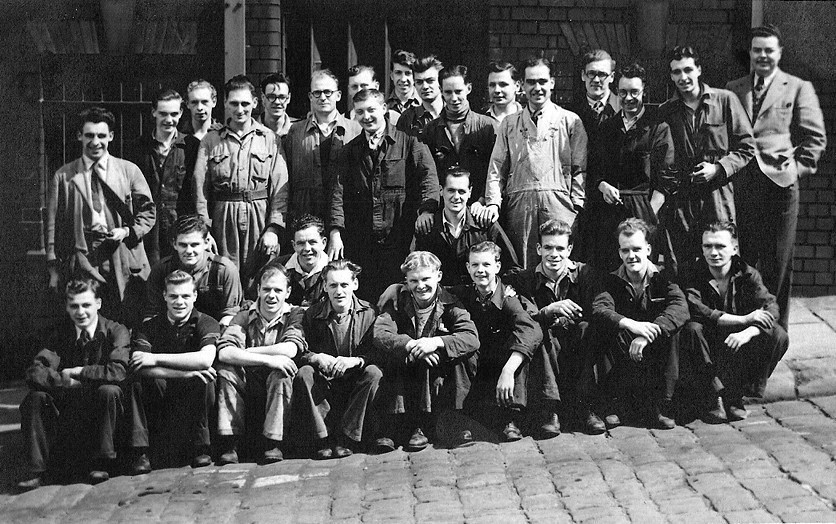
I thought I would send a copy of a photo taken at the Sheffield Training Centre, August 1949."
|
|
"The group came from England, Wales and Scotland. Every two weeks another group arrived. I am sitting on the curb, first one at the
bottom left side. Back row, 3rd and 4th are from the Cowdenbeath area. I am not sure of the fourth person from our area. You have my permission to
use the group photo on the website.
My full name is James Erskine Guthrie; same as my grandfather. My father's name was John Moffat Guthrie; he also worked at the Dora
and left at the same time as I did to come to Canada."
Thanking you for your interest,
James Guthrie
|
In March, 2009, Joe Gibson, originally from Kelty but
now living in the West of Scotland, contacted us to say a 'thank you' for our efforts in
recording the social history of the Fife miners within the website content. Joe has kindly donated
some of his personal memories with a promise to add more at a later date.
|
"I was born in 1945 and started work at the Lindsay Colliery 'tables' in 1960. I left the pit in 1963 after doing my 16 weeks underground training and working underground on the pit bottom and the materials. I left before completing my face training but I did return to work at both Comrie Colliery and Castlehill Mine, in both cases underground on 'the materials'."
"I am fascinated with your interest in and study of mining especially in Fife. My father, uncles, and both
my grandfathers, all worked in the Aitken. My uncle Robert 'Basher' (as it says on his headstone) Brown
was killed in the Lindsay in 1956. His name is included in your roll call. I wonder if you could tell me if there is a
permanent memorial, with the names of all miners accidentally killed in the Fife pits, or if such a memorial is envisaged?
I am now retired and living on West coast of Scotland but I would love to help or contribute in any way to
achieving such a memorial, as I am very proud to be a descendant of Fife mining stock."
"I am so very grateful that the social history of the Fife miners is not being forgotten. Being asked to contribute
any mining memories I have is indeed an honour. My memories are I fear insignificant but all memories are 'grist
to the mill' so here's hoping there might be something of value.
My uncle 'Basher' (I never called him anything else) was killed in the Lindsay in 1956 when I was
eleven years old. 'Basher' was my favourite uncle and a hero to his own son, myself, and my brother. He
was aptly named 'Basher' for he had hands like shovels and would let us touch the blue scars he bore
on his shoulders from previous pit injuries.
I can remember him playing football with us on the 'green' in
front of Dewars Row (one of the last of the miners rows in Kelty). I still have the memory of the day he was killed
as clear as a bell. A small tragedy in the large scheme of things, maybe, but nobody could explain to three little boys
why such a large part of their world was taken away and so suddenly.
It was a bright morning in July and I think the last week before the 'miners' fortnight'. We were
gathered in the assembly hall of St. Joseph's Primary school in Kelty for morning prayers. We may have been
breaking up for the holidays that day - I'm not sure - but I remember either the headteacher or the priest saying
we had to say a special prayer for a man who was trapped down the Lindsay. I remember being vaguely worried
thinking 'my Uncle Basher works down the Lindsay'.
Later on, at 'leaf time', my cousin
(Basher's son) appeared to say we had to go to his house for school dinner. I immediately knew there was
something wrong because my cousin was Protestant and he came into the Catholic school playground. Crazy,
but that's what made the act significant.
In my aunt's house at dinner-time I remember her leaning over the deep sink, scrubbing away at the old-fashioned
scrubbing board and I can still remember she just kept repeating 'wull somebody no gi'e mi word aboot
my man?'
Later, after school, I didn't go straight home; I was too scared of what I might hear. I walked along Main Street,
where my mother met me on her way to telegram her sister in Barnsley. Mother called me over and said, 'Joseph,
yer uncle Basher's deid.' I simply went back to my aunt's house, laid my head on her scullery table,
and cried and cried - my first real tears - for a beloved uncle buried in the Lindsay pit.
The papers said 'Another mining accident.' There were so many broken hearts, what can anybody say?
Please let me know if I can contribute anything else; like working in the Lindsay perhaps?"
Joe Gibson.
[Joe has kindly forwarded a couple of tales from the Aitken, although as he says, the same stories - maybe with a change here and there - were probably being told in pits across the length and breadth of Fife.]
"Talking of Poles working in the pit, I am reminded of an Aitken Pit story told to me by my father. It concerned
a Polish miner and a Scotsman who was well-known for his attempts at 'swinging the lead'.
The Pole
and the Scot had between them been pushing a heavy tub up a 'dook' (steep incline). On arriving at the top,
the Scot paused to catch his breath, saying, "Some push, eh?"
"Aye," said the Pole,
" ... an'
some no push! "
"Another story - this one from my aunt - was of the 'pit bottomers' playing the game 'I Spy' during
their 'piece time'.
One man stumped everyone with the initials ' I K '. After everyone gave in, back came the answer ' ile
kan '. After loud protests, a colleague was heard to say, Get yir spellin' right, it's ' O K ' -
oil kan!
Perhaps these stories were told in other pits as well but I still find them amusing!"
-----------------------------------------
