
|
Following a brief conversation at the mining conference held in the Adam Smith Centre, Kirkcaldy, in November, 2019, 'webmaster' Chris Sparling corresponded with Bob McDonald, Glasgow. Bob is also a graduate of Heriot-Watt, Edinburgh, but Bob had studied Mining Engineering a few years before Chris studied Applied Chemistry. Bob kindly agreed to supply information for the website on his brief mining career.
|
"I left Kirkcaldy High School to study Mining Engineering at the Mining Department of Edinburgh University and Heriot Watt College. There was no family connection with coal mining and I was the first, on both sides of the family, to stay at school beyond the statutory leaving age. Having no elder or younger siblings, and no professional relatives, my career choice was based on a two-week work experience project at Comrie Colliery during my last year at school.
I was awarded two travelling scholarships, in 1952 and 1954, to study copper mining in Northern Rhodesia (now Zambia) at Roan Antelope Copper Mines, Luanshya, and gold mining in the Gold Coast (now Ghana) at ABA Mines, Tarkwa, during the academic summer holidays.
I failed re-sits on returning from the Copperbelt in 1952 so decided to take a year out and undergo coal–face training for a year at the Lindsay Colliery, Kelty. This training was essential to qualify for entry to Coal Mines Acts examinations.
James B. Fotheringham was the manager then and was manager at Rothes Colliery during the Queen's visit in 1958. I believe he ended his career at Doncaster HQ.
There were 10 students in my final year, none having any family connection with coal mining. "
Back Row: Archie Spence, Randit Chowdry, Vincent Halpen, Mustak Chatterjee, Alan Lindsay
Front Row: Bob McDonald, Jim Irvine, John Wilson, Lawrence Opokwu.
Photo taken by Jim Johnstone.

Back Row: Mustak Chatterjee, Bob McDonald, Jim Irvine
Front Row: Vincent Halpen, Randit Chowdry

Back Row: Alan Lindsay, Archie Spence
Front Row: Jim Irvine, John Wilson, Bob McDonald.
"I must have perked up my studies that year, because I won the ICI NOBEL prize for the best AH-WC student or else the standard of mining student that year was poor!"
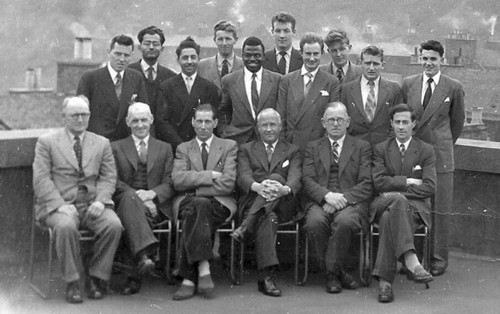
Standing (L to R): Jim Johnstone, Mustak Chatterjee, Randit Chowdry, Alan Lindsay,
Lawrence Opokwu, Vincent Halpin, Jim Irvine, Archie Spence, John Wilson, Bob McDonald
Seated (L to R): Mr Jim Shields, Mr R. McIntosh, Depute Mine Rescue Station Manager, Mr J. ('Jock') Webster,
Professor Robert McAdam, Mr Davidson, Mine Rescue Station Manager, Mr W. ('Willie') Watt
"After graduation, I became a Directed Practical Trainee (DPT) with the National Coal Board East Fife Area in August 1955 until August 1957 in which time I gained my 1st Class Colliery Manager Certificate.
After a brief spell as a Grade 2 Deputy (£16.11.6d a week) at Frances Colliery, I was appointed Area Ventilation Engineer for the East Fife collieries.
Lochhead Colliery and Frances Colliery were notorious for spontaneous combustion underground fires. Willie Forbes was manager at the former and a real character. I spent a few night-shifts as senior official when tackling such fires at Lochhead. Both collieries were on "forced ventilation" i.e. the main fans blew the air through the underground workings.
Frances Colliery only had one shaft and had used one of the neighbouring old shafts, Lady Victoria, for ventilation purposes. This meant the one and only Frances shaft was the return shaft for the ventilation system.
Being the coal and man winding shaft, this became contaminated by the noxious gases from the underground fires and caused the colliery to cease production.
Long before I took up my appointment, a steep mine had been driven from the Frances shaft pillar, coming to the surface at the bend of the road leaving the colliery to the main road. The fan evasee was a land mark for a while but disappeared some time ago.
I discovered the main fan, a Thermotank two-stage axial flow, was running in reverse. On contacting Dr Third, Thermotank's Technical Director, I was told it had been installed that way to maintain the "forced ventilation" even although the housing and evasee were designed for a reversed flow.
I approached the Area Production Manager, Mr A M Stewart, with the proposal to reinstall the fan in its design position and reverse the ventilation system thus making the Frances shaft an intake rather than a return airway. This meant the coal and man winding would not be affected by the underground heatings which were so common after the two week holiday periods. The proposal was agreed and the work was undertaken during the colliery's 1960 two week holiday period.
A redundant axial flow booster fan was installed at the top of the ventilation mine to maintain an adequate air flow through the underground workings while the main fan shaft was being reversed.
On starting the main fan as an exhaust ventilator, the underground air flow measurements were very encouraging until a telephone call was received from a very irate manager of Lochhead Colliery, Willie Forbes, complaining his "air was being stolen by the Frances".
The reason for this was found to be an unmarked "blind pit" which had connected Lochhead and Frances at the start of World War II in case a bombing raid had destroyed either winding gear. Both collieries had been on forced ventilation and the blind pit had been at a point of neutral pressure until the Frances reversal had created a negative pressure. This incident was never officially reported but the lesson learned remained with me throughout my career.
"In October 1961, I started as Area Ventilation Engineer in an area of 20+ collieries, two of which had a history of large disasters viz. Creswell and Markham.
The East Fife collieries were not "gassy pits" and I had never read a gas cap underground on a flame safety lamp. This was not the case in Derbyshire. I soon learned this when I became involved in researching dangerous emissions of large quantities of methane gas from the floor of coal seams being worked at Ireland and Renishaw collieries.
Norman Siddall was the Area General Manager (later becoming Sir Norman Siddall, Chairman of the NCB) and he summoned me to a meeting one morning at Ireland Colliery in the Manager's office where I was told two face-workers had been overcome in an irrespirable atmosphere but fortunately rescued. The senior HM Inspector of Mines was present and he recommended action be taken or else closure of the colliery could result because of the increasing risk of loss of life as had happened at Cortonwood Colliery on the 19th June 1961. 4 miners were killed by asphyxiation following an emission from the floor.
My suggestion to research the phenomenon at Ireland Colliery was agreed by Mr Siddall and accepted by the HM Inspector who then agreed to allow production at the colliery to continue.
Following the Cortonwood incident, a Working Party had been set up by the Coal Industry National Consultative Council, Safety and Health Committee, under the Chairmanship of Dr H. L. Willett, to consider the subject of floor emissions and the published report in 1964 showed that 10% of emissions studied had occurred at Ireland Colliery.
My practical work at Ireland and Renishaw collieries became part of the national study, being undertaken on behalf of the Working Party by Professor Fred Hinsley at Nottingham University, and led to my MSc research thesis. There was no M Phil degree in those times!"
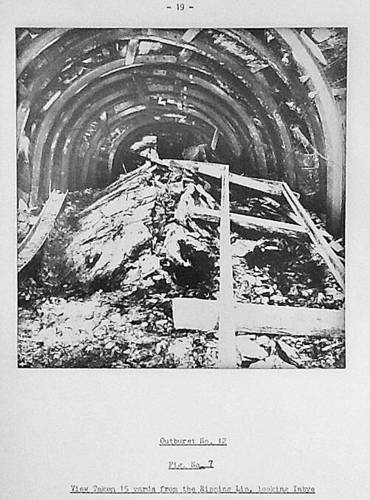
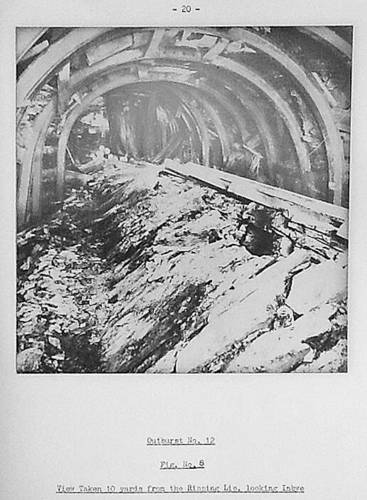
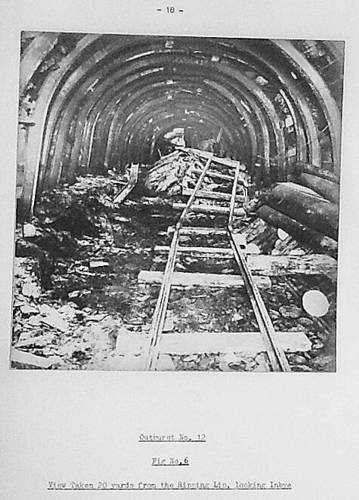
"These photos were taken to record the extreme pressure which must have been generated by the methane gas and roof force to fracture the mine roadway so violently."
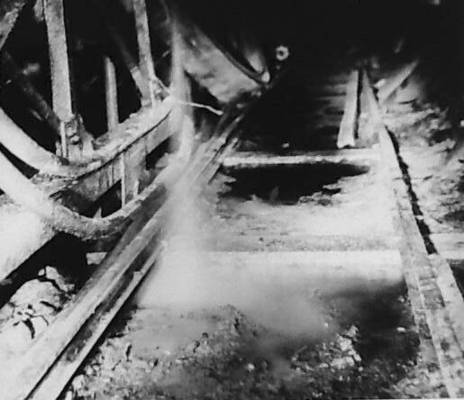
"Here we see high pressure methane ejecting water from a borehole."
"I was also responsible for introducing methane drainage at Markham No. 1 Colliery which had experienced a major disaster on the 10th May 1938 when 79 miners were killed and 40 injured by a methane/coal dust explosion. This work was undertaken with the cooperation of the Mines Research Establishment, Isleworth.
The colliery had operated from 1938 with compressed air as the underground power source and the objective was to show that methane drainage could sustain a level of safety to allow electric power being used on the coal face. I left the industry in August 1967 but believe this was achieved.
No. 1 Area, East Midlands Division, amalgamated with Nos. 4 and 5 to become the NCB North Derbyshire Area in 1966 and I was promoted to the senior post.
Mr R. B. Dunn had been promoted from Assistant General Manager, Central Area, Scottish Division, to General Manager of the North Derbyshire Area. Another well-known name, but not in 1967, was Bert Wheeler, who was Manager at Westthorpe Colliery. I knew Bert before he moved to Derbyshire having been a student in the year behind me at 'the Watt'.
Following a visit of Sir Alf Robens, the NCB Chairman, to the NCB Area Office in 1966, it was evident from his speech that he had lost the political argument with Harold Wilson, the Prime Minister, and the industry would have to close "uneconomic" collieries. This became evident with the increase of transferred senior staff from Durham, Scotland, Lancashire, etc., and I could see no future for myself in the coal mining industry so decided to change career in August 1967."
_______________________________
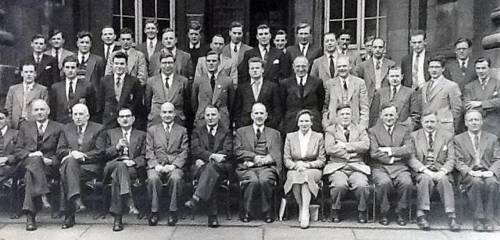
BACK ROW (in-between faces): C. Bexon, J. Darragh, A. Lindsay, J. P. Wild, D. G. King, D. Glover, W. D. Thomas, W. McNally.
THIRD ROW: T. L. J. Chiverton, G. L. Beard, J. E. Short, S. R. Bateman, W. Young, D. Jagger, J. K. Dixon, J. W. McAuslin, J. Souter, R.N. Thomson, A. J. Stanley.
SECOND ROW: A. McLelland, W. J. Griffith, R. McDonald, H. Woods, I. Tucker, L. N. Darby, G. Oxer, R. Thorneycroft, H. R. Henshaw, J. Lawrence, J. Eadie.
FRONT ROW: P. D. Anthony, W. E. Blunt, G. Keith Allen, A. Grierson, C. McCaw. J. H. Mitchell, Prof J. C. Mitcheson, Miss D. M. Haines, G. Williams, A. J. Cook, E. M. Howells, J. Pettit.
"Four East Fife Area candidates were there. Me - 3rd from the left, 2nd row; John Souter -3rd from the right, 3rd row; Alex. McLelland (Electrical Engineer) - 1st on left, 2nd row; and Jim Eadie- 1st from right, 2nd row."
______________________________
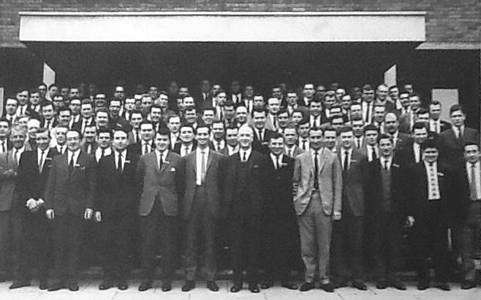
"On this photo I'm 5th from the left in the front row. The front row were the "tutors", all NCB senior officials from different departments and areas. Being the youngest, I was lumbered by becoming the "Entertainment Organiser" and that was some experience, I can tell you!! I can't remember any names but I'm sure a number would end up with senior posts throughout all the NCB areas, probably in the 1970s."
______________________________
