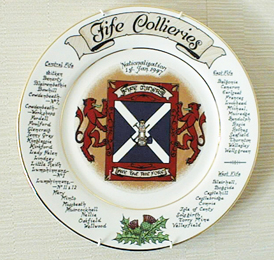
In January 2009, we were delighted to hear from Iain Chalmers, Cowdenbeath, who wrote, " I think the site is very interesting and informative and I am also very pleased to see you used the 'Aye Tae the Fore' and the centre piece from the 84/85 strike badge on the front page. The 'Aye Tae the Fore' was coined by myself and used in the design of the Fife Miners' badge which I produced to raise funds for the sacked miners after the dispute. Keep up the good work."
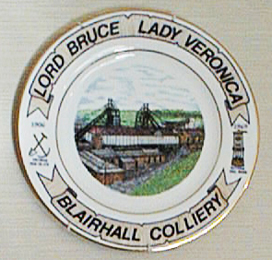
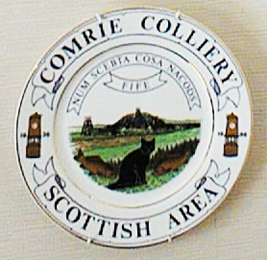
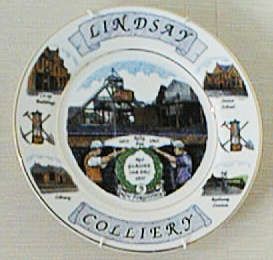
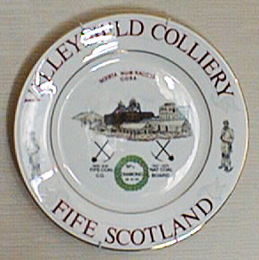
We invited Iain to tell us more about his fund raising activities and he responded, "Thanks for the reply. I will be more than happy to provide you with details regarding both the badges and also the colliery plates that I also designed. Some of the plates were sold to raise funds to erect monuments to commemorate colliery disasters such as Valleyfield, Lindsay and the Michael. So when I get time I will put something together for you. Many thanks."
We are pleased to present the first part of that information now, and Iain has
promised to add more at a later date.
M. Martin & Webmasters.
----------------------------------------------
Hi Chris,
As promised, here is my involvement in mining collectables. ... I will follow up with the
history of the plates.
During the strike of 84/85, or the long weekend as I call it, I was one of the first Scottish
pickets to enter the Nottingham coalfield. After attending the funeral of David Jones, the
young lad who was killed on picket duty, the Scottish contingent had arranged to stay
overnight at a miners' welfare in Yorkshire, outside of Doncaster. I can't recall
which one. The local miners were sending Flying Pickets into Nott's and said there
were three spare seats in a car and the Scots miners duly picked three names out of a
hat, one of which was mine. Anyway, off we went driving miles through back roads to
avoid police road blocks, a journey of approximately 30 minutes took about an hour and
a half to reach Bevercotes Colliery.
We managed to survive and to get back in
one piece to the Yorkshire Miners' Welfare. I was impressed by some of the
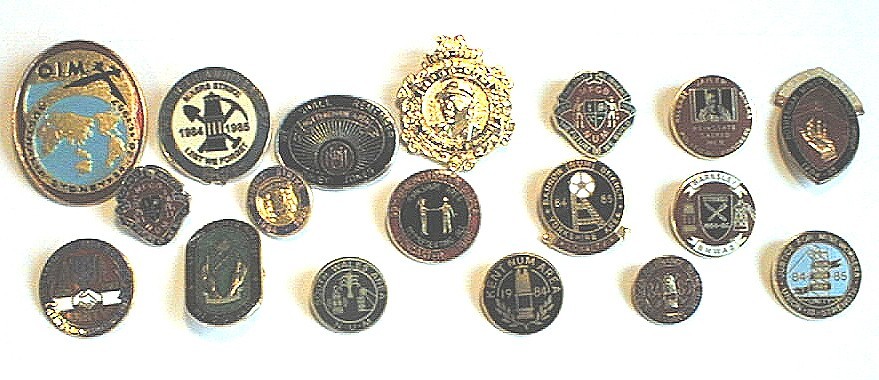
badges the Yorkshire lads were wearing, designating both their colliery and branch.
The local miners said they sold them to raise money to help support the strike and
their families so I started to collect them. There were a few Scottish badges available,
pre-strike Area badges, etc., although I believe that the Polmaise miners had a
badge struck for their pit.
The badge collecting amongst striking miners and supporters really started to take off
with some miners wearing their collected badges on their jackets, like medals (confirmed
by photos of picketing miners), and whenever I went South, which I did often as I
was a member of Dysart Central Strike Committee and also on Cowdenbeath Strike
Committee as I worked in Seafield colliery and lived in Cowdenbeath, I was known
as the Foreign Secretary as I was always being sent all over the place.
I always looked out for badges I didn't have and took some to trade. In
the early months of the strike, some of the badges produced were in a limited
number and I am pleased to say I have a few of those rare ones in my collection.
After a while, I had too many for my strike jacket, which I still have to this day, so
I started mounting them in frames. By this time there was a large circle of serious
badge collectors throughout the UK, and beyond, very interested in miners badges.
Anyway, the dispute came to a close and the collieries started to shut and
the miners then started to issue closure badges to commemorate not just the strike
but their collieries.
A sad business but they made sure their pits would never be
forgotten, with the monies raised going to help the victimised miners in their various
Areas.
I was back at Seafield by now and collecting mining material for the
Lady Victoria Mining Museum - mainly documents - and also for Kirkcaldy District
Museum, such as strike banners and mining artefacts. My personal strike diaries
are there as well as the Dysart daily strike books, so for future generations
there are two sources of the strike on a daily basis in Fife.
I knew that the
landscape would change and I was committed to making sure what I could
preserve was collected, documented and safeguarded. I fought for my
communities and lost. I wasn't going to sit back and let the men and
women who made these communities be forgotten.
I am pleased to say
I played a major part in saving the Frances Colliery headgear and the
winding engine which is now preserved at the Lady Victoria.
I recognised that there was a market for Scottish badges and started
designing badges for the various strike centres, etc., and selling them
by mail order. Remember, no internet back then!
I also went with my
good lady wife to the Yorkshire and Durham Galas with my stall and
raised a fair amount at those venues, all profits going to the Scottish
Sacked Miners, the (mainly) English miners were issuing special editions
of only 200 badges and were deemed to be very collectable but still
there was a lack of Scottish badges.
By this time I had limited the
Scottish badges to 100 per issue and those badges were indeed
very collectable. I have to say with sadness that most of the badges
I designed went South of the Border with very few sold in Scotland.
If a colliery had been closed I could design and issue a badge without
permission. However, if it was an active pit I had to ask the local NUM
branch for permission but as, I said, the profit went to help our victimised
colleagues, there never was a problem.
One of the rarest badges issued in any of the British coalfields, and also
one of my last, was the Seafield colliery closure badge. When the pit shut,
33 men (all grades) transferred into the mothballed Frances Colliery at Dysart,
and I designed and issued 33 badges only at cost of production for the
transferred men, of which I was one. With my badge-collecting friends
on first refusal, I am pleased to say very few of these badges went South.
Two badges I am very pleased with - and indeed proud of - are the
Fife Miners 'Aye Tae the Fore' badge and the Scottish Area
Strike badge which I see are combined on the Fife Pits website.
Whenever
I went on picket duty outside of the Kingdom, the Fife miners were always
in the front, even our women folk, and I designed this badge using the
outline of Fife, with a Davy lamp off-centre left, and around the sides
the legend Fife Miners (top) 'Aye TaeThe Fore' (bottom).
The strike was strongest in Fife and I did this one was to honour them.
I was sitting at home on Christmas Day, 1986, watching my young daughter
play with her toys when I had an idea for a badge using the Saltire held
on either side by two Rampant Lions with a crossed Pick and Shovel
behind a Davy lamp, using a shield shape. So, to the annoyance of my
good lady, I went to my desk and worked on a design. I submitted my
idea to the Scottish Area and the outcome was the Official Scottish Area
Strike Badge.
Every badge I designed has a story behind it,
commemorating, in my opinion, the finest men and women of a
generation now sadly passing into the mists of history. Their struggle
was my struggle, their joy was my joy, their tears were my tears. For over a
year we stood together - we shall not be forgotten.
Yours aye,
Iain Chalmers
-----------------------------------------------------
-----------------------------------------------------
|
----------------------------------------------
|
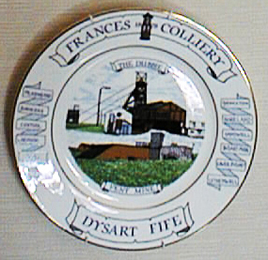
NUM official-cum-artist Iain Chalmers has a lot on his plate. … For Iain, 147 Moss-side Road, Cowdenbeath, is preparing to complement his popular range of commemorative crockery; a series of eight mining plates and a plate to commemorate the Forth Rail Bridge centennial.
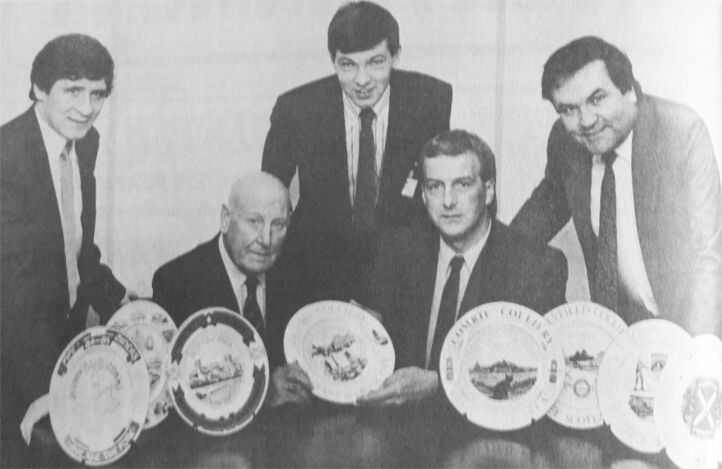
Last week Iain - the NUM branch chairman of Frances Colliery - and fellow officials presented a presentation set of eight plates to Fife Regional Council.
Frances delegate, Pat Egan, and branch secretary/treasurer, Sandy Clark, were also present at the Fife House presentation.
Iain explained the plates were being presented to the council as a token of the NUM's appreciation of their role in the struggle to maintain the coal industry in Fife.
Said Iain, "I think it is important that Fife's proud mining heritage should be preserved. We are presenting the plates to the region in recognition of the council's support to the union and their ongoing campaign to develop the Frances Colliery."
The plates were accepted on the council's behalf by Mr Gough, himself a former miner, and by Councillor John MacDougall, leader of Fife's Labour administration.
Mr Gough said the gesture exemplified the bond which existed between the miners and Fife Regional Council.
"The miners are an integral and most important part of the heritage of Fife and we can assure them that these mementoes will be preserved and respected and looked at with fond affection," he said.
Four of the presentation plates portray individual collieries - Valleyfield, Comrie, Michael and Seafield - while two focus on composite themes, detailing Fife and Cowdenbeath mines. A seventh in the mining series commemorates Fife's role in the miners' strike.
The Seafield plate - Iain's final design - was available in 1987.
Iain explained that he sent a design outline to plate manufacturers Edwards & Locketts, of Staffordshire, who gave the sketch for development, to a professional artist and sent a proof plate for correction.
Iain has donated the proceeds of the various plates to different charitable causes.
For example, some £350 went from the sale of the Valleyfield plate to the Valleyfield Disaster Memorial Fund for a commemorative sculpture that was erected last autumn.
Iain explained he was now working on a joint design for the Glencraig and Mary Pits in Central Fife, and he was also on the look-out for old photographs of the former Wellesley Pit.
A Blairhall pit plate was also in the pipeline.
Explaining that each design took him about three months to research and draw, Iain stated there was often a story behind each plate.
Iain said, "I am planning another four or five designs to add to the Fife mining plate series. These plates have really taken off in Fife communities."
----------------------------------------------
