 |
At the gathering of Colliery Managers from all parts of Scotland recently held in the Fife Mining School, Cowdenbeath, Mr Robert Crawford gave an interesting account of the Equipment and Work of the Fife and Clackmannan Joint Colliery Rescue Station. Subjoined are the chief portions of the address:-
The opening of the Fife and Clackmannan Joint
Colliery Rescue Station, which is the first of its kind in
Scotland, suggests a short review of the circumstances which
resulted in the adoption of the scheme. Following upon a mining
disaster, which occurred about seven years ago at a colliery in the
West of Fife, and the possibility of disasters increasing in number
in consequence of the extensive developments of the mineral
operations in the combined counties, an interview took place
between Mr Charles Carlow, Chairman of the Fife Coal Company, and
Mr Robert McLaren, Chief Inspector of Mines for the East of
Scotland district, to discuss the following pints:- (1) What could
be done to prevent colliery disasters such as happen by underground
fires or explosions of firedamp; and (2) the most reliable means to
adopt to rescue life and relieve the suffering of the injured in
the event of a disaster taking place.
After this interview, Mr Carlow called the
attention of the coalowners to the matter, and they subsequently
appointed a committee to make inquiries, in order to ascertain
whether any benefit was likely to accrue from a rescue station,
equipped with life-saving apparatus. In accordance with the remit
by the coalowners, the committee - consisting of Mr James Bain,
Alloa Collieries; the late Mr R. M. Morton, Fordell Collieries; Mr
Henry Rowan, of the Fife Coal Company; and Mr R. A. Muir, of
Bowhill Coal Company; along with Mr R. McLaren, H. M. Inspector of
Mines - visited different parts of England, where such stations
were in operation, and made exhaustive and searching inquiries into
the work done. They also visited the mining exhibition at London,
and examined the different life-saving apparatus exhibited there,
and attended a meeting of the Federated Institute of Mining
Engineers to hear papers read on the subject. After careful
consideration, the committee framed a report, which was submitted
to the coalowners, and in which the following recommendations were
set forth:-
1 A central station equipped with a certain number of sets (say twenty) of apparatus ready for use in case of emergency is necessary for Fife.
2 A certain number of sets of apparatus (say not less than five) should be kept ready at every colliery.
3 At least twenty men in every colliery, including all the officials who know the mine, should be instructed in the construction and use of the apparatus.
4 An intelligent man should have the care of the central station, and be capable of instructing the men in the use of the apparatus, and keeping the apparatus in order.
5 The apparatus designed by Mr Garforth is the best suited for our mines, being lighter, smaller, and more flexible than any others inspected by the committee.
After discussion and deliberation, the
coalowners proceeded to give practical effect to these
recommendations, and on 4th November, 1910, a rescue
station was formally opened, and demonstrations carried out, in the
smoke gallery, before a representative company of Scottish
coalowners and managers and Government Inspectors, by men wearing
the Drarger, Meg, Merco, and Fleuss portable breathing
apparatus.
Since then the training of men has been
practically continuous, and, presently, there are in the combined
counties 165 men who have been passed as fit and capable to
undertake rescue and recovery work. The station staff consists of
an instructor and an assistant, and the governing powers are vested
in a general committee of general managers.
|
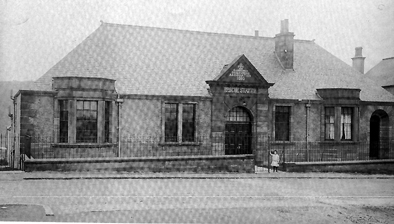
The station has been erected at Cowdenbeath as
the most convenient centre for the combined counties. It serves an
area of approximately 390 square miles, with 91 collieries, and
26,000 men, and is linked up by telephone with all the collieries
for which it serves.
The building has been built at a cost of
£1500, an additional £800 being expended upon apparatus
and equipment. This expenditure has been met by the Coalowners'
Association, and the cost of maintenance, which amounts to nearly
£2000 per annum, is being subscribed by the various
collieries, the proportion in each case being based upon the
particular output.
The main entrance to the building communicates
with a drill hall measuring 24 feet wide by 55 feet long. The hall
has an experimental gallery around three sides on the same floor
level, which is 134 feet long by 8 feet wide, with a capacity of
9880 cubic feet. The partition dividing the hall from the gallery
is glazed all round, so that the movements of the men under
training may be observed by the instructor. Doors are conveniently
placed in the partition, which can be immediately opened, so as to
permit of the prompt exit to fresh air of any man who might happen
to be overcome. One part of the gallery, termed the
"nursery", has been made free from obstructions, having a
level floor and high roof, so that the men can walk about without
any trouble for some time after entering the gallery, and thus get
accustomed to the artificial atmosphere before commencing to exert
themselves. The other part of the gallery is so arranged that as
nearly as possible it will present the difficulties and obstacles
likely to be met with in the damaged roadways of a pit after an
explosion. Smoke is led by means of flues from a furnace chamber
into the gallery, and caused to circulate through it by a small
electrically-driven exhaust fan. By means of a draught board the
atmosphere can be made so dense that the lamps of the men
practising in the gallery can only be observed with difficulty
through the inspection windows. Eventually a boiler will be
erected, and pipes fitted around the gallery, so as to heat it, and
thereby accustom the men to work in high temperature, as there is
not only the danger and immediate risks to life consequent upon the
presence of irrespirable gases, but also those attendant upon
extremely high temperatures, which might cause death by "heat
stroke".
On the right of the main office is the
instructor's office and house, and on the left the board room,
men's dressing room, bathroom, repairing room, and apparatus
room. A motor garage is situated at the rear of the main building.
The building is heated with hot water pipes, and fitted with the
latest sanitary appliances. Current for lighting the building, as
also for operating the fan and charging pump, is taken from the
mains of the Fife Electric Power Company.
The equipment of the station at the present time is as follows:-
1 Twenty complete sets of the "Weg" portable breathing apparatus with spare parts.
2 Two Pulmoter automatic oxygen reviving apparatus.
3 Six smoke helmets, with bellows and hose attachments.
4 Twenty electric hand lamps.
5 Twenty storage cylinders of a capacity of 120 c ft respectively.
6 Canaries.
7 Ambulance stretchers, also bandages, dressings, etc, packed ready for immediate transport.
8 An electrically-operated recharging pump for refilling the cylinders of the apparatus Pulmoter.
9 A motor car to convey the apparatus to and from the collieries.
A reserve of 1560 cubic feet of oxygen is
maintained, and all the small cylinders connected with the portable
apparatus kept fully charged. Also a minimum stock of 800 lbs. of
caustic potash kept. This reserve oxygen and caustic potash are
sufficient to supply twenty sets of apparatus for 24 hours'
continuous rescue operations, and by that time it would be possible
to have a fresh supply forward.
Up to the present time no apparatus
have been
stored at the pits. A great difference of opinion exists regarding
the keeping of apparatus there, it having been pointed out that it
is risky on account of the liability of such apparatus to get out
of order. It appears to the writer that where collieries are
situated within a radius of, say, ten miles from the central
station, and there are facilities for conveying the apparatus
quickly to the spot, the apparatus should be retained at the
central station, as it would probably be at the colliery as quickly
as the men to wear it could be summoned and arrive there. On the
other hand, when the distance from the central station is greater,
such an arrangement might be found to be unworkable without the
risk of serious delay in bringing the apparatus to the scene of the
accident, and in such cases the better plan is to arrange for each
outlying colliery to make provision for the storage and maintenance
of sets of apparatus, fully charged and ready for use. The sets at
the collieries should not remain longer than two weeks before being
replaced by an equal number from the station, this being conceded
to be the only practical way of ensuring that the apparatus at the
collieries are always in perfect adjustment. A small air-tight
house will be erected at each colliery, so that by filling it with
sulphur or other noxious fumes each explorer could enter it, and so
test his apparatus before descending the pit.
The "Weg" portable breathing apparatus
has been designed by Mr W. E. Garforth, and the name
"Weg" derived from his initials. It is of the
regeneration type, wherein the same volume of air is breathed
repeatedly having the products of respiration abstracted, and the
oxygen replenished from two cylinders of compressed oxygen. In
figures 4 to 7 A.A. represents two oxygen cylinders, made of steel
and curved to fit the contour of the body, and containing oxygen at
a pressure of 120 atmospheres, or 180 lbs per square inch, their
capacity under the pressure being 18,000 cubic inches. They are
fitted with cocks, B.B. which can be operated at will; the usual
practice being to utilize the contents of the left hand cylinder
first, the exhaustion of this cylinder, when exploring, being a
warning to retire to the shaft or other place of safety; the
contents of the right hand cylinder being utilized for the return
journey. A pressure gauge S. is fitted, the hinged cover being
provided with a mirror which reflects, to the wearer, the pressure
and quantity of oxygen remaining in the cylinders. The oxygen
passes from the cylinders through a reducing and lung governing
valve E. to the mouthpiece H. This lung governing valve forms one
of the principal features of the apparatus. Figure 8 is a plan of
the valve partly in section, figure 9 is a cross section. Through
the base, and figure 10 a longitudinal section. The base A. is made
of gun-metal, and is secured by a pipe and union to the oxygen
cylinders. On the stop valve of the oxygen cylinder being opened
the high pressure oxygen passes through the port C. to the centre
of the base. At this point the port C. divides; to the right the
port D. leads through a stop valve E. which is normally left open
to the seat F. of the lung governed valve. To the left the point C.
communicates with the port I. which is normally closed by the
"bye pass" or "emergency" valve H. When the bye
pass valve is open oxygen passes direct to the mouth and lungs
without going through the lung governed valve. The stop valve E. is
provided to cut out the lung governed valve in case of an injury
to, or break down of the mechanism of the latter, and the wearer
then supplies himself with oxygen at his discretion through the bye
pass. In order to prevent the wearer of the apparatus from making
any mistake in the event of it being necessary to operate any of
these valves in the dark the emergency valve H. and the stop valve
E. are provided with differently shaped heads the former being
circular with a milled edge, and the latter octagonal. As the high
pressure oxygen does not extend beyond the base, the case of the
lung-governed valve is made of aluminium for the sake of lightness.
The valve case is closed on one side by the rubber diaphragm (K).
which is provided with a protecting cover (L); one side of the
diaphragm is in communication with outside atmosphere by means of
the hole (M) in the protecting cover, and is acted on by the
pressure of the atmosphere. The other side of the diaphragm is in
communication with the lungs by means of a flexible pipe connected
with the mouthpiece, and is acted on by the lung pressure. To the
diaphragm (K) a bell crank lever (N) is attached by means of an
eyebolt (O) and a nut (P). The hole in the diaphragm, through which
the eye-bolt passes is made gas tight by means of the washers (Q),
the inside washer being large enough to prevent the rubber
diaphragm from being drawn in too far by encountering a stop piece
which limits the travel of the diaphragm. The bell crank lever (N)
is suspended from the fulcrum pen (R) and by means of a pin (S)
moves the compound lever (T), which is fastened by the adjusting
screw (U) and the nut (V) to the plunger (W) holding the main valve
(X), which is held against its seat (F) by the spring (Y), which
works around the plunger, and is contained in the cylinder (Z). The
valves work as follows:- Exception during inspiration the diaphragm
(K) occupies the position shown in Fig. 9, and the valve is then
held tight against its seat. When, owing to the action of
inspiration of the wearer, the pressure in the interior of the
valve chamber falls, the diaphragm is pressed inwards by the
pressure of the outside atmosphere. This movement of the diaphragm
is transmitted by the bell crank lever and the compound lever to
the valve. The excess of pressure on the large area of the outer
side of the diaphragm, due to the disturbance of the equilibrium by
the action of inspiration, multiplied by the leverage obtained by
the bell crank and compound levers, and assisted in some degree by
the pressure of the oxygen on the underside of the valve, is
sufficient to compress the spring and lift the valve from its seat.
At the moment that inspiration ceases the spring closes the valve
until the next inspiration begins. As the movement of the diaphragm
is caused by the inspiration of the wearer, and as the duration or
depth of the inspiration s a direct measure of the demand of the
lungs for oxygen it follows that the deeper the inspiration the
greater the quantity of oxygen which will pass through the valve to
the mouth and lungs. The lungs themselves may, therefore, be said
to control automatically the supply of oxygen to the wearer, and
there is, firstly, always the requisite quantity of oxygen
available for each breath, and secondly, there is no waste of
oxygen.
The oxygen then passes through the flexible
metallic tube, Figs. 4 to 7, which is carried round to the back,
and over the head of the wearer to the mouthpiece. The mouthpiece
is made of special metal, and is of limited capacity, so that the
force of the lungs may expel all the vitiated air contained in it.
It is also of small area, so as to enclose only part of the nose
and chin, allowing the wearers to talk to one another and also
speak through a telephone, which may be attached to the mouthpiece
of the leader of each exploring party.
The mouthpiece is connected to the face by means
of a pneumatic joint, which renders it air tight, and it is held in
position by the inhalation, exhalation, and oxygen tubes (P, K, and
G), which take the form of a 3-way metal tube and is carried over
the head and fastened to an ordinary miner's leather cap. The
3-way tube, besides securing the mouthpiece, acts as a protection
to the head, something like a fireman's helmet and is provided
in front with a flexible metallic hinge, which allows the helmet to
be worn within certain limits of size by any person. As an
additional safeguard, leather straps with pieces of elastic
inserted are attached to a leather flap at the back of the cap and
buckled to two straps attached to each side of the mouthpiece,
which, thereby, holds the mouthpiece firmly in position and takes
away all fear from the mind of the wearer of its being displaced,
whilst it allows of free movement to the head. The expired breath
is carried through an exhale valve (J) fitted in the mouthpiece,
and which opens downwards, or away from the mouth. This valve is of
simple construction and made from mica to avoid sticking, which
might be caused by the saliva, and it prevents the impure air from
returning to the lungs during the next inhalation of oxidised and
purified air. The expired breath then passes by means of the
flexible corrugated pipe (K) into the regenerator (L), which is in
the form of a rectangular tin box, fitted with baffle plates, and
containing caustic potash, which absorbs the carbon dioxide exhaled
by the lungs. The nitrogen thus freed from the carbon dioxide
passes on to a pure rubber reservoir bag (N), which, being
flexible, enlarges and diminishes in volume in direct
correspondence with the requirements of the lungs; thence it
travels by the inhalation pipe (P), and through the inhalation
valve (R) to the mouthpiece, where it unites with afresh supply of
oxygen. The modus operandi of the apparatus may be explained as
follows:- When exhalation takes place the valve R closes and J
opens. The exhaled air passes up over the head and down through the
regenerator into the breaking bag (N). The bag (N), therefore,
contains only purified air. When inhalation takes place the valve
(J) closes, R opens, and purified air is drawn through the pipe P
into the mouthpiece. But as soon as inhalation commences, the lung
governed valve admits the necessary quantity of oxygen through the
tube G into the mouthpiece, where it mingles with the inflowing
current of purified air, and is then inspired into the lungs. The
path traversed by the currents of gas through the apparatus can be
traced by means of the arrow heads. The apparatus when fully
charged will allow of 2 to 3 hours arduous work, but when engaged
in very light work it will last for a period of 5 to 6
hours.
The weight of the apparatus is 32 lbs., and is
attached to a belt and shoulder straps which distribute the weight
over the shoulder and other parts of the body. Goggles are used to
protect the eyes when exploring among smoke.
Re 2.- The Pulmoter automatic oxygen reviving
apparatus is used for performing artificial respiration in case of
a man gassed or otherwise asphyxiated. It consists of a pair of
concertina bellows, "B." figs. 11 and 12, alternately
inflated and collapsed by the pressure of the flow of oxygen and
air, and thereby operating a reversing valve. The oxygen is
supplied from the oxygen cylinder, C, by turning the valve, and
through the reducing valve D to the suction nozzle S, which at the
same time draws in a suitably large volume of air. This nozzle
supplies the power for inflating and deflating the lungs (R).
B.-When applied to a man the lungs are first filled with air until
the normal pressure of 8 inches of water column is reached. This
pressure acts on the bellows and inflates them, thereby drawing the
reversing valve in the chamber from the position shown in fig. 11
to that of fig. 12. In the position of the valve the current
produced by the nozzle S draws the air out of the lungs under a
negative pressure of 4½ inches water column, and discharges it
into the open air. As soon as the lungs are emptied the bellows
collapse and return the reversing valve into position for
re-inflation, and this cycle of operations is repeated
automatically as long as required. The natural respiration rhythm
is exactly imitated - the rhythm depending on the capacity of the
lungs. Moreover, the same rhythm is maintained regularly
throughout, which is very important in connection with the
resuscitating of unconscious men. (R) The nose mask N, fig. 13, is
held in position by the bow M, the button K being pressed down
until the mask fits tightly against the nose, where it is retained
automatically. The mask is connected to the Pulmoter by two
flexible pipes, of which E serves for inflating the lungs with
fresh air, whilst the other A conveys the vitiated air for
discharge through the apparatus. (B) Artificial respiration, as
usually performed, is very exhausting to the operator, who in
consequence becomes slow and irregular in his movements, and may be
tempted to abandon his efforts too early through sheer physical
exhaustion. The Pulmoter, however, never grows tired, and it
possesses still another feature of the greatest importance, in that
it mixes a proportion of oxygen with the air introduced into the
lungs. Ordinary air contains oxygen in the proportion of 1 to 5,
sufficient for the needs of a healthy subject by whom it is
absorbed, by the haematin of the blood which conveys it to the
tissues where it is again yielded up. In cases of gassing, however,
we have to deal with an abnormal condition, in which the haematin
has formed wholly or partially a stable compound, and incapable of
absorbing oxygen. When the change has only partially occurred the
introduction of fresh air alone may bring about the desired result,
but in more advanced cases fresh air alone would be useless. In
these cases the plasma of the blood must be saturated with oxygen,
and thus conveyed to the tissue until new haematin is formed, when
the normal course is resumed. Now the tension of oxygen in air is
not sufficient for this purpose, and in order to bring about the
desired result an extra supply of this gas must be introduced as in
the Pulmoter. The administration of oxygen, combined with
artificial respiration, forms an ideal method, and there can be no
doubt that in the future many lives will be saved, which under the
olden methods would have been sacrificed. Where fractures of the
arm, bones, or ribs, or abdominal injuries exist, it may be
dangerous, if not impossible to perform artificial respiration by
ordinary means. Here such an apparatus as the Pulmoter may not only
save life, but also be the means of preventing serious injury and
suffering. After the injured person has recovered consciousness, or
in cases of persons only partially overcome, a supply of oxygen can
be given to them by means of an inhalation apparatus, fig. 13,
which is mounted on the inside of the lid of the wooden box, in
which the Pulmoter is fitted. The apparatus delivers oxygen at the
rate of about 170 cubic inches per minute.
Re. 3.- In Fife there have been several serious
underground fires, due to spontaneous combustion, and on several
occasions it has been found necessary to isolate large areas of
workings, involving a prolonged loss of output. It has been thought
that more than one of these fires might have been extinguished or
lesser areas cut off, had there been any possibility of penetrating
the surrounding smoke and fumes, and attacking the fire at close
range. The advisory committee, therefore, recognised that
underground fires would probably require more serious attention
than would the results of explosion, and in order to enable
operations to proceed with greater rapidity, safety and efficiency
in dense smoke and fumes, such as extinguishing, digging out or
damming off the fire with stoppings, within a comparatively short
distance (say 60 yards) of good air. The station has been equipped
with six sets of smoke bellows helmets, which is to be preferred to
compressed oxygen apparatus, besides which it is more economical
and requires no special training in its use. Fig. 15 shows the
apparatus in use supplying one man, but by utilising a forked
coupling two or three men may be served. The helmet completely
covers the head; it is blocked out of raw hide, and fitted with
aluminium frames, and windows of clear mica, and an exhale valve on
top. A continuous current of fresh air is furnished by double
acting bellows, arranged for working by hand or by foot, through
non-collapsible hose. For convenience in dragging the hose a belt
and buckle arrangement is provided. Such apparatus is useful
occasionally during the normal working of a pit, as for example in
penetrating accumulations of black damp in dip workings, or shafts,
etc.
Re 4. - It is essential in connection with
recovery work the explorer be provided with a good light, and in
view of this, the station has been equipped with 20 lamps of the
Float type. This lamp, Fig 16, consists of an aluminium casting,
measuring 5¼ by 4½ by 2½ inches, and containing a
battery composed of two cells, connected in series, which give
3½ volts across the terminals. The electrolyte used is a
patented mixture, somewhat similar to the ordinary bichromate
solution, and the quantity used per charge, is such that it does
not reach the carbon and zinc elements, which only extend half way
down the cell. To put the battery into action the lamp is simply
turned upside down, so as to bring the electrolyte in contact with
the active elements. Two strap handles are provided so that the
lamps can be carried in the lighted or out position and the handle
for carrying the lamp in the lighted position is fitted with a
swivel eye, in the middle of which a hook is attached so that the
lamp can be hung from an explorer's belt should he require to
have both his hands free.
The weight of the lamp charged is 3½
lbs, and burns from 7 to 8 hours. The power of the light in the
reflectories being about 30 to 40 candle power. The lamp being
small and light is very suitable for rescue and recovery work, and
another point of enormous advantage is that no electrical plant is
required for recharging, and after having been charged and
hermetically sealed the lamp can be kept for a considerable period
without attention and without any action or deterioration, and
consequently always ready for instant use in case of
emergency.
Re. 5 - D. J. S. Haldane's admirable
conclusions to the use of mice and birds in testing for carbon
monoxide or white damp after explosions and at underground fires
have been greatly homologated by the Committee and canaries are
kept at the station for this special purpose.
Organisation and Drilling of Rescue Teams - The
success of a Rescue Station depends as much on the personnel of
each rescue party as on the efficiency of apparatus, because one
member by becoming inefficient may neutralise the work and endanger
the safety of his companions. Therefore in organising the
respective teams only industrious temperate and healthy men are
selected, and as such as are always to be relied on to be at hand
when required. Physical fitness is the first consideration and
every applicant before being enrolled as a member must be certified
by a doctor to be healthy, vigorous, and of sound constitution,
with perfect hearing and of an unexcitable disposition. Men having
an ambulance training are preferred, and each must possess a good
knowledge of the workings and ventilation of the pit at which they
are employed. Roadsmen, firemen and repairers, are usually
selected, because these men are more used to general pit work,
other than coal getting and possess a better knowledge of the
different parts of the pit than the colliers. To agree to become a
member of a rescue team involves a great amount self sacrifice on
the part of any man, for he has to undergo in addition to his own
employment a considerable amount of additional work in training of
by no means a pleasant kind, and not only is there a sacrifice of
their time and leisure in qualifying themselves to become
efficient, but they know that whenever a disaster occurs in which
rescue work with its attendant dangers is required they will be
called upon to render immediate assistance. Numerous men, however,
have responded to the call for recruits and have taken up the work
with real enthusiasm. Each team consists of five men (fig. 17) one
of the members being the leader to whom the management and the
supervision of the rescue party and operations are specially
confided. His main duty is to carefully watch the pressure gauges
of the apparatus and the general condition of his men and observe
that the limits of the apparatus and safety are not overstepped.
Two of the other men are superior workmen as a considerable portion
of the duties to be performed in recovery work consists in forming
passages through heavy falls and bratticing fro ventilation; one of
the two being competent to replace the leader in case anything
should happen to him; whilst the other two may be merely strong
labourers, but intelligent, to carry tools, etc. The training of
the prospective teams takes place at the station, under the
personal supervision of the instructor, who thoroughly understands
what is required of the apparatus and is trained not only in the
wearing and handling of it, but also in cleaning and repairing of
it, and testing the various parts fro imperfections, and leakage.
The instructor also possesses a capacity for organisation and
enforcement of discipline without which any rescue party, for the
purpose in view would be useless. Panic is the direct enemy of
relief parties and thorough training in the use of the appliances
under a strict disciplinarian is the only way to eradicate the
tendency to it. A complete training comprises 13 practices, the
first test to be gone through being as follows:- Each member first
undergoes a course of instruction in the construction and handling
of the various appliances forming the equipment of the station and
learns how to take the breathing apparatus to pieces and put it
together again, also fit it on his companions, after which
practices commence with the breathing apparatus in the drill hall.
Later on practices are undertaken among irreparable passages in the
smoke gallery. Each practice is of fully two hours duration and
work performed such as raising repeatedly, a weight of 56 lbs. to a
height of 6 feet by means of a rope passing over a pulley, with
intervals during which some form of underground labour is performed
such as building brick stoppings, redding passage through heaps of
stones, raising low bars by means of screws and securing them in
position by props, setting timber and fixing up screens, creeping
over obstructions and through contracted passages and during each
drill the transport of an injured man is performed with the use of
a lay figure. Practices are given in reviving an unconscious man
with the Pulmoter, also instruction in first aid to the injured.
The building of brick stoppings in the smoke gallery is undertaken
with the smoke bellows helmet. The names and addresses of the
members of each team, medical officer's reports, number of
attendances by the instructor, results of every practice, etc., are
recorded by registers kept at the station. The following examples
of what is considered useful work have been carried out:
Five men equipped with the apparatus entered the
drill hall at 2 p.m. and examined each others apparatus. At 2.06
p.m. they entered the smoke gallery and each lifted the weight 25
times, then commenced to redd a passage through a heap of stones,
lifted three boxes each weighing 12 cwt. By means of screws and
secured them in position with props, afterwards built a brick
stopping 6 feet by 4 feet by 14 inches, and passed through a sheet
iron pipe 2 feet wide in diameter, climbed a ladder and crept
across a scaffold 6 feet high, passed through another air tube 2
feet wide, brought through the aforementioned passages on a
stretcher a lay figure weighing 15 stone, reconstructed the gallery
and came out at 3.55 p.m.
The best duration test match made at the station
was as follows:- John Burt, of No. 7 Cowdenbeath Colliery equipped
with the apparatus remained in the smoke chamber for 6 hours 10
minutes during which time he alternately walked and rested, the
total distance walked being fully 6¼ miles.
As regards weight lifting tests, David Miller of
Rosie Colliery, Wemyss, on one occasion raised the 56 lb. weight to
a height of 6 feet, 900 times equal to 302,400 foot pounds in 1
hour and 26 minutes, and on another occasion Andrew Redpath of
Glencraig Colliery lifted it 860 times in 1 hour 29 minutes, being
equal to 288,960 foot lbs. of work.
If at the expiry of the 13th practice
any member is not considered efficient, he is called upon to
perform additional practices. Each member when fully qualified
receives a certificate and medallion. The efficiency of the trained
men is tested every six weeks by undergoing one practice
underground, also every opportunity of using the appliances in
connection with small underground fires, accumulations of
blackdamp, etc., will be taken as such incidents are of the
greatest possible value for ascertaining the suitability of men for
work of a more serious nature, and at the same time give the men
greater confidence in the efficiency of the apparatus on which
their life depends, than they could ever attain so long as their
experience is confined to a practice gallery from which they know
they can escape if necessary at a moment's notice. While the
main inducements to join a rescue team will generally be a noble
desire to be able to save life, the Committee recognised that men
willing to take the risks should be liberally paid while undergoing
training, also travelling expenses refunded. Members are,
therefore, paid at the rate of half a shift for practice, and it
has also been decided that when men are called upon for dangerous
work underground, where it is necessary to wear the breathing
apparatus, a higher rate of remuneration will be
granted.
Eventually at each of the affiliated collieries
there will be rescue troops consisting of two or more teams,
according to the number proposed by the Mine and Rescue Bill, to
comply with the above proposals the aim of the Committee is to
train 2 per cent. Of the 26,000 men employed underground in the
combined counties and so arrange the shifts of the trained men that
at all times, both day and night, there will be at least one or
more teams above ground. With such arrangements each colliery would
have a sufficient number of men within call, to form the first and
second rescue teams to carry on the work until the arrival of the
main body of trained men forming the surrounding collieries and of
the Instructor from the central station with further supplies of
oxygen, chemicals, etc.
Special instruction is given to officials
and trained men regarding recommendations to be observed when engaged
at actual rescue work operations, so that every detail of the
exploration work may be carried out with firmness.
At colliery disasters volunteers were never yet
lacking to save their entombed fellowmen, but the advent of rescue
apparatus combined with efficient training and with a method of
procedure carefully considered and decided upon beforehand marks
out certain men as specially fitted to undertake this dangerous
work. While the use of rescue apparatus might not always allow of a
rescue party reaching the entombed men and saving them, it might
enable the party to penetrate, with confidence, some distance into
the mine in order to form passages through falls, build stoppings,
hang screens, and thereby restore the ventilation sufficiently to
enable the work of reclamation to be carried out with dispatch and
anything which facilitates the rapidity and safety with which the
roadways and ventilation can be restored must contribute towards
the saving of life and at the same time take away that feeling of
helplessness which has often been experienced in the past by those
standing by the side of a pit where an explosion or fire has
occurred and where relations and friends of the entombed men are
waiting in dreadful suspense for those in authority to take some
action for their recovery, such action being generally delayed by
uncertainty as to the conditions existing below ground and the
consequent fear of incurring further loss of life. On the other
hand should satisfactory results not be realised as early as
desired there will in any case be the consciousness and
satisfaction in knowing that efforts have been made to provide both
the men and means to cope with the hour of emergency.
The writer hopes that the object of the
foregoing, notes, viz.:- To evoke discussion on the whole subject
of rescue and aid work may be amply fulfilled, more particularly as
the compulsory installation of rescue apparatus at collieries is
receiving at the present time such marked attention from the
legislature as a means of dealing promptly and effectively with
accident.
Mr Henry Rowan, Mr John Paul (Lochgelly Coal
Co.), Mr C. Reid, and others, took part in the discussion. Mr Ford,
manager of Nos. 7 and 10, Cowdenbeath Colliery (Fife Coal Co.),
gave a practical demonstration, and his lecture was illustrated by
lime-light views.
