 |
 |
Sunday, 2 November, 2003
Dear Mick,
I came across your site whilst browsing last night and I found it to be very informative and nostalgic. My uncles - Jim ('Snecky'), John, Pete,and Neil Ritchie - were all miners from Dundonald as were the majority of men in the area.
There was also my schooldays pal's father, Chick Cunningham, who was winding engineman at 'Bowhill'. I mention them because it is not beyond the possibility that you may know them or of them.
I cannot claim the honourable title of Miner although I was employed by Bowhill Colliery for three years from 1953 to 1956 when it was under-going extensive renovation and modernisation involving an hydraulic system of hutch loading and unloading in the pit bottom and a larger motor-house with more powerful motors at the top of the dook, as well as the widening of main roads, and so on.
I did, however, get a little insight into the working conditions of minersfrom my initial underground training at Muircockhall. My Father, like myself, was not exactly a miner but he worked in Kinglassie Pit (c.1927). About 1931(?) he worked at a pit not far from Steelend, Saline - do you know which one that would be? - and in 1932 (?) he worked in the Michael, East Wemyss.
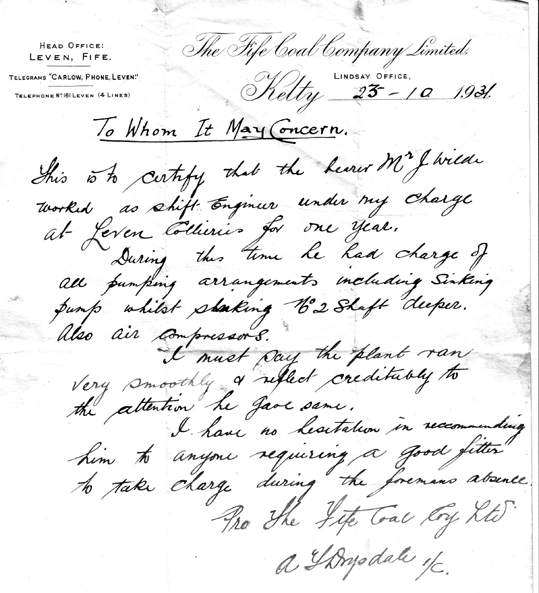
He was a Pumping Engineer who was involved in the installation and maintenance of pumping systems. Attached is a copy of one of his references.
|
|
|
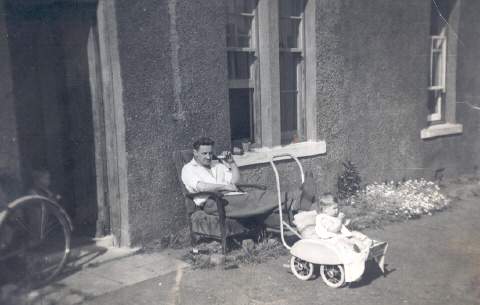
The other attachment is a photograph of me and our first born son, John, relaxing in the sunshine outside No. 14, Capledrae, in 1956. This was the first home of our own since we were married in 1950, so your picture of Capledrae brought back many happy memories.
Later on, we moved to 5th Street in Bowhill as Beatrice, my wife, being a 'Townie' from Dundee, was not very happy about the surroundings. Sadly for me one other thing. Do you have any information about the Bowhill Pit disaster in 1935 or thereabouts?
Thank you,
John Wilde
(but commonly called Jack)
-----------------------------------------------------
September, 2006
"Hello Chris,
Please feel free to use any of this tale for the website. I have
just recently found some members of my family tree through Scotland's people website. There
were five generations of James Baxter going back to around 1863 although I'm not too
sure of the exact date. Unfortunately, I am not related to Jim Baxter, the famous Fife football player, but I thought he
was a great player.
My father, James Baxter, was a coal miner, but he also worked later in Rosyth
dockyard. He married Alice Mitchell, who was a weaver and who worked in the jute mills of Dundee.
My grandfather (di), James Baxter, a coal miner, was born in 1883 and lived in Arthur Street, Cowdenbeath.
He married Catherine Duff, a pithead worker from Cowdenbeath. My other grandfather (di), Alexander Mitchell, a
check weighman, was born in 1886 and died in 1953. He was from Auchtertool and married Elizabeth Paterson
Sneddon who was born in 1886 and died in 1956 at Thistle Street. She worked as a domestic servant.
Now, there is an event which happened at Moss Morran which I hope you and your readers might be interested in.
On the 12th January, 1903, at the spot where the Donibristle mining disaster happened, there were two young men
trying to skate on the partially frozen pond, when one of them fell through the ice. To his good fortune he was saved
by the other brave lad. The brave heroic act was commemorated by the presentation of a medal to the saver. You
may be wondering where that medal is now, well I can tell you as my brother, Jim Baxter, Dinnington, nr Sheffield, has
it. The inscription on the medal is as follows "Presented to James Baxter on rescuing Alexander Mitchell on
12 January 1903 at Moss Morran Loch. The local community collected money together to purchase the medal and it
was sent to H. G. Greaves of Sheffield to be inscribed.
Isn't it a strange coincidence that the two lads involved in this Moss Morran incident were my di Baxter (then aged 20)
who saved my di Mitchell
(then aged 17)?"
Rena Cameron
 |
 |
-----------------------------------------------------
December, 2008
Dear Mick,
I have been visiting your site on and off for a number of years now and
thought it was about time I wrote to extend my gratitude. The site is a
veritable mine (no pun intended) of historical information. I have
direct links to a number of the pits in Fife. I was brought up in
Coaltown of Balgonie, my grandfather worked in Lochhead Colliery, I
worked in the Frances Colliery ('79 - '84). I studied at Lauder Technical
College under the guidance of the late Harry Adamson and others such as
Mr Buist, Mr Campbell and Mr Williamson. I worked in the Lothians at
Bilston Glen and in North Yorkshire at Ricall, Whitemoor and Allerton By
Water.
I emigrated to Australia in 1990 and have worked in underground coal
mines in Queensland where I have worked through the ranks from Deputy to
Undermanager to Mine Manger, to the position that I currently hold. My
success in large part is due to the education and training received
during my time with the NCB.
I was wondering if you have given any thought to an expat area in your
web site. The amount of people that I have come in to contact in
Australia with links to Fife pits is phenomenal. Just a thought!!!!
Anyway, thanks for a great site and keeping Fife's mining history alive.
All the best for the festive season.
Regards,
Douglas H.K. White-------------------------------
[While we presently do not have an official 'expat' area on the website, please
feel free to contact Douglas at: doug.white@dme.qld.gov.au
Douglas was
happy for us to post his story and has kindly sent a list of his former acquaintances
which includes: Robert Brown, Mick Murphy, Ally McLeod, Grant Skinner, Scot Skinner.
(All Frances Colliery)
Brian Allison, Allen Glen, Colin Hay, Mick Hynd, Allen Aird, Jimmy Canning. (All ex Lauder Techical College). Jimmy Canning now lives and works in Queensland (ex Bogside).
See some of Doug's certificates on Memorabilia - Menu 4].
Michael Martin & Webmasters.
-----------------------------------------------------
February, 2009
Hi Mick,
What an amazing site. So much research has gone into it. It has jogged a
few of my memories from my time in the Scottish coal field.
I was, however, very much saddened to read about the death of Willie Kerr.
I've lost touch with all my old colleagues from those days and expect
that many of them our now dead.
A potted history -
1970 - did my basic underground training at Woolmet Colliery, the
underground bit at Bilston Glen in their underground training gallery.
1970 - worked at the Dubby (Frances) for a couple of weeks during the main
summer break as the rope splicer's laddie and received my first injury
and I still have the scar!
1971 - worked during the summer holidays at Seafield as a tracker's laddie
checking the fishplate bolts.
1972 - worked during my holidays at Seafield moving up to be a transport
worker.
1973 - graduated onto heavy transport doing development and face
installation work.
1974 - started my face training at Seafield, graduated from Heriot-Watt
University with an honours degree in Mining and started an accelerated
management training course. When I completed my face training, I was then
sent to Bogside Mine as a Management Engineering Trainee (MET).
1976 - Moved to Castlehill Mine where my training was more focused (under
the direction of George Caldow, Deputy Manager).
1978 - Promoted to Undermanager at Kinneil Colliery.
1981 - Moved to Polkemmet Colliery as Colliery Safety Engineer.
1986 - Promoted to Deputy Area Safety Engineer (I was a member of the Area
Incident Team and was involved in a number of call-outs).
Around 1987-88 I had some involvement in the closure of Seafield. It broke
Willie Kerr's heart to find himself as the manager there at that time.
1988 - Moved to Ayrshire as a Colliery Safety Engineer.
1989 - Transferred to Nottinghamshire working at another half dozen odd
collieries down there before I was made redundant in 1994.
I will try and fill a bit more detail in for you when I have more time.
I originally come from St Andrews and WAS surprised to find so many
old pits nearby. Was there a pit up on the hill still operating in the
1950s? My father was the local doctor. He often told us that he had to
go underground to attend to someone who had been hurt.
That's enough for now.
All the best,
Bob Howden
-----------------------------------------------------
[A few days later, Bob was back in touch with 'Webmaster' Chris Sparling, recalling a few events and some names of former colleagues. If any of you read this, and would like to get in touch with Bob again, please email Mick via the website postbox.]
Hi Chris,
... For instance, some of the work I did on heavy transport was on transporting the 'chocks'
(powered supports) for D:22 down the dook from the 170 level. Even though I wasn't face-trained,
the oversman let me on the face to see what it was like. After the holidays, I went back to university to
continue my studies. When the news came through about the [Seafield] disaster I was stunned and I spent
a long time wondering if I had made the correct career choice and did think of doing something else. However,
I stuck with it and if I could only remember things properly had a pretty interesting career!
I wouldn't say I had been one of Willie Kerr's close friends but we struck up a relationship one
day when he discovered that I was going to university. He desparately wanted to get into management
and said that he wished he had my university learning. I, on the other hand, said that I wished I had his experience.
From then on we met up from time to time to exchange bits and pieces of information. I was pleased to see him
progress up through management.
It was really interesting seeing a lot of the names of the management team again. D.T Paterson, Jimmy Glancy,
Frankie Rolland, Davy ('dumperheed') Wilson, John Soutar. I really admired Colin Fox; he was always
so smart, immaculately turned out both above and below ground. He always seemed to have time to stop
and speak to everyone as he went round the district.
I was especially moved by Max Meharry's description of the rescue work. It was Max who agreed that I
could do short stints at the colliery during my university holidays, comparing it to students working for the Post
Office over Christmas. After I signed up with the Coal Board proper, it was Max who got me my first (and last)
Coal Board house in Fishcross.
In the early days I can remember Max playing one of the classic tricks on me. This was when I was working
with the trackers in the main loco roads. The intake roadway was cold and damp so I went to see Max to see
if I could get a donkey jacket. He wrote a line out for me there and then and I rushed to the store, only to be
given a shovel. When I went back to see him I got the classic reply, "Use the shovel, laddie, and it'll keep
you warm!".
All the best,
Bob Howden
-----------------------------------------------------