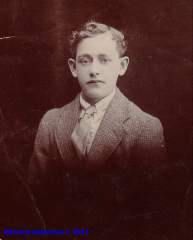
Eddie, aged 15, a miner
| The following story is taken from an oral
history, recorded on tape, by my father, Edward Johnston, about
1985, when he was 83 years old. It tells the story of his early
life and is transcribed exactly as he tells it on his tapes.
The odd word may be missing, but the message is as accurate as
possible. Any errors in spelling etc., are mine. These tapes
were transcribed in September, 2002.
John Johnston, Sydney, Australia |
My name is Edward Johnston. I was born on the third day of
January, 1902, at 18 Scott Street, Aston, subdivision of
Duddingston in the county of Birmingham. My mother was Annie Daly
(Johnston). My father was John Johnston, railway detective.
I was the youngest of six children. My eldest brother being John,
the next one James, then Peter Thomas, then my sister Helen Mary
(Sissy) and Charles Kitchener Johnston. Charles Kitchener and
myself were the only two born in England. The rest of the family
were all born I think in Broxburn in Scotland. My father and mother
were married in that area, I couldn't tell you exactly the
place, but they were married somewhere about the Lothians. My
father was born in Ireland. It seems that his mother, when
expecting, had gone to visit some relatives in Ireland where he was
born, 1902-3.
My father and his mate had taken some goods from a van in one of the sidings. It was some props belonging to a theatrical company. I don't know what it was, but they had gone and pawned them, just for a few drinks. They were found out, of course, and the police were after them. However, before he would stand up to it, he cleared off, and we never heard of him to this day. After a while, my mother took us all back to Scotland, and I think she stayed with some relatives for a while, but it did not work out. So, as a result, we came to Fifeshire and there were some relatives in Kelty. We stayed there for a little while, I don't know whether it was a grandfather or what it was. However, that didn't work out either, so as a result, we had to go into the Poor House in Dunfermline. After being in Dunfermline for a period, I couldn't tell you how long, the County got us fixed up with a little house in Cowdenbeath in a street called the Diamond Row. There were about four or five cottages all together. I don't know if they were called after the Queen Victoria Diamond Jubilee or not. I don't think so, because they were old and dilapidated and were nearly ready to be demolished when we went into them. However, the house consisted of two rooms - what we call in Scotland a "But and Ben." You ate your food and slept in one end. We had the other end with bunk beds. I think there were four bunk beds in all. The kitchen and living room floor was all laid with stone flags, and the back-bedroom had an earthen floor, which we had to put lino on top of it. When the damp weather came, snails and worms and everything came up out of the floor. It was some place I could tell you! My memories of it were very vague, but I could remember all that.
My mother got a job cleaning out the schools. She used to go in the morning about seven o'clock. I don't know what sort of work she would be cleaning at the school, but she came home about nine, and then she would go out for washing. She didn't take washing in, she went to people's homes and did washing all day. She was there nearly all day, and she would get about half a crown, which was two shillings and sixpence, and maybe a bowl of soup or something like that, to keep her going. In the evening she had to go back to the school again and do more cleaning, with the result that the rest of the children were all at school, and I had to be left in the house by myself. I can remember quite well, my mother used to lock the door and put the key back under the door for me. I was no more than about three or four years of age. She used to go about half past two, and the school didn't come out until about four, with the result that I was left in the house 'till the elder ones came home. One thing sticks out in my memory. I was about four at the time and just up from where we lived, there was a wall, and I used to go up and put tins on it, and throw stones at tins until I could knock them all off. My mother came to the door and shouted on me and I wouldn't leave until I could knock every tin off the top of the wall, and I got a clout when I got down to the house of course!
My mother had a hard life and I don't think we ever fully
appreciated what she did for us. I forgot to say that when we were
in the home in Dunfermline, two people - a man and wife - offered
to adopt John and Jim. These people were saying they wouldn't
have to change their name or anything, however, my mother said she
was going to keep them all together. We were still being looked
after by the Parish. I think it was twice a year we got some
clothes. I think maybe a pair of pants, like what the scouts used
to wear, a jersey and a pair of boots, and that was all we got. She
had to pay for the rest, unless she knew some people who had
cast-offs just to help us keep going. I remember I got a kilt, I
would be about ten years of age. I got a kilt from a woman that my
mother used to do the washing for, and her boy used to wear this
kilt, and it was a full kilt, and I used to wear this at the time,
and they used to sing after me "kiltie kiltie cauld bum".
I remember when I was about three or four, I went out of the house
one day and ran across the road, and there was a bloke coming down
the road on his bike who hit me, and I think I broke all the spokes
in his bike. I think he got the worst of it. I wasn't too bad,
losing a few bits of skin here and there, but he was the worst. So
I got a smacking for that, for running across the road, not paying
any attention.
Next door to where we lived was a two-storey block, and they had a chip shop in this place, and in order to get some chips, we used to go around gathering all the papers. In those days, if you took in a bundle of papers, they gave you a bag of chips, so that wasn't too bad. Kitch used to chum with the lad that had the chip shop. Bird they called him. It was a funny thing they called him Harry (Hairy) Bird. He had these big gobstoppers. He gave Kitch one, and he had been sucking it, and it went back his throat.
He was choking, and he ran into the house, and I didn't know what was wrong with him. He turned blue in the face, and mother found out what had happened and she tried everything. She put him on his belly and thumped his back, and tried everything and she thought he was going to die. However, she had been cleaning the fireside, and her fingers were all black lead, and she eventually put her fingers down his throat and managed to get this marble, just like a marble lolly out. At the time she tore all his throat, but if she hadn't got it out he would certainly have died. That is one of the things that happen when you suck one of these lollies, don't let it go back your throat!
We had a soccer team at that time, at the North End Park in Cowdenbeath, and they were a fairly good team. There was a big fruit shop there and John and Jim and Tom, on a Saturday, used to take baskets of fruit to the ground, and sell them. They got a penny a shilling for selling the fruit, and they always came home with some fruit after the games. I was there at a game one day, I would be about five years old. I don't know who was playing Cowdenbeath but I was shouting like mad, "Come on Cowden" and there was a bloke sitting next to me, and he gave me a threepenny piece for supporting Cowdenbeath. I said "I'll go and support Cowdenbeath every week for a threepenny bit!"
I remember my first day at school, when I went to school, and boy I didn't like it! I remember, I can still see the classroom yet. There were four big pictures in the classroom, showing all the seasons of the year. We also had a clock which you could learn to tell the time by turning the hands. That's things that stick in my memory of this classroom. That was the first one I was in, but I did not care much for the school. Not at that stage anyway. Later on I wasn't too bad.
However, the house we were living in was going to be demolished to build a lot of shops and one thing and another, and so we got told to move out, we had to get another place. They were going to demolish all of the building about four or five houses The other people had cleared out and we were the only ones left. We hadn't got a place and we were very lucky. The day before they came to demolish the house, my mother got on to a place in Bridge Street. It was only a little better than the one we left, but it was some place to go. However, in the morning, and before we got our furniture away, they were taking the bloody tiles off and everything, so we had to move! They were going to make us move. That's one way of evicting you, however, we got our stuff. I don't think we needed a cart to move our furniture, a barrow would have been enough, because all we had were two or three rickety chairs and an old table and an old dresser. That was, I think, the total complement that we had. You wouldn't give tuppence for the lot!
The house we moved to was on the Aberdour Road, and we were near a place called Moss Morran. At 1902, I think, it was there was a mine disaster. There had been a mine there at one time, and the old bog, where they had been extracting the coal underneath with peat and everything, and there had been a lot of heavy rain, and the roof had given way. Peat and bog and everything had come in, and suffocated the men that were in it. What they call the Moss Morran Disaster. Nine or ten men were killed. There were a lot got out, but nine or ten men lost their lives. They never got their bodies yet, because they were all covered up with moss and peat and everything . I remember at that time the ground was always subsiding, and there had been a baker's van coming from DCI, that was Dick's Cooperative Institution, coming along the road with his horse, and the road gave way, and the van went right down into a hole! They had to get the horse unbuckled from the van to get the van out, but they had to cover up the horse. They had to shoot it, as the ground was all boggy. It had fallen right down in a hole and there was nothing they could do about it. The road was always cracking and giving way, and one thing and another. There were two or three houses there, at the side of the road, and they sunk right down until the window sills were right down level with the road, but there was nobody living in them at that time. It was just the nature of the ground. It was just all bog!
I can remember seeing Halley's Comet The year was 1909, I'm not quite sure about it, I think it was about that period. Everyone went to see the comet and they tried to tell us, if the tail came down and touched the earth, that would be the end of us. There were a lot of people going off their bloody head about this thing and it was thousands of miles away, bloody millions of miles away! Another thing that sticks out in my mind, at that time in 1909, Jack Johnson, the black boxer, beat Tommy Burns for the Championship of the World at Rushcutters Bay, in Sydney, and that sticks out in my mind also because I got a newspaper and written on the ground was "Johnson knocks out Tommy Burns for the Championship of the World." These things stick in my memory for later years.
In these days there was very little traffic on the road, and we used to go to the blacksmith and get him to make a gird for us. It was a hoop made with iron, and you put a cleet in it, and we used to go from Cowdenbeath to Aberdour, which was maybe about four miles, and we would run all the way to Aberdour with this gird. There was no traffic to do you any damage. We used to go there, and we were so hungry when we were coming back, we used to eat the orange peel, that was lying at the side of the road, where people had been eating an orange and just threw it down. We were so bloody hungry, we were glad to eat the peel! The year I went to school, my brother John left, he was nine years older than me, and he got a job at the Aitken Pit. It was about two and a half miles away and they had to walk this every day, backwards and forwards, because there was no transport then. Sometimes they ran trains but it was very seldom, and of course you couldn't afford a train anyway. One evening, they were walking back from work, I think there were four of them altogether, and there was a train or an engine came along. The wind was against it, and they wouldn't hear it coming. It was close on them before they knew it was there, and three jumped clear, but this other fellow, he was hit by the engine and got killed.
I don't know what happened but we had to move again. We got another house at what they called the Borough Road in the Borough buildings, but it was a case of out of the frying pan into the fire because this little house that we got, was right next to a place where they made lathes to put the plaster on them, when they were making ceilings for the roofs and one thing and another. The gas-works was right at the back of us and the place was hotching with rats! They had all the skirting board and everything eaten up. We had to go to the Council and tell them about it, and they put traps down. They put everything down, but when you went to bed at night, you could hear them running across the lino, and hear them squeaking, and one thing and another. It was a terrible place, but we had to stick that because there was nowhere else to go.
In the house where we lived, Cowdenbeath football ground was just over the back of it, and we used to go there on a Wednesday, that's when they did all their training, and I got to know all the players. We used to get the ball when they kicked it over the post or bar, and we used to field it for them, and we got to know them. There were two lads there that used to play for Rangers at one time - Bell and McKenzie had been the Rangers full-backs for years and years There was another little lad that came from the west of Scotland, he played centre. Willie Carol they called him, and to look at him you wouldn't think he was a footballer at all. He was bandy-legged, and everything. Dicks Cooperative in Cowdenbeath had a lot to do with the team, and the one that scored the most goals of a Saturday, used to get a pound of sausages for every goal that they scored! There was one week that Carol scored seven goals, so seven pounds of sausages he would take home with him!
My brother Tom had started to work in the mine by this time and Jim also. Tom had been in the mine a few weeks, when they took him out, and brought him back to school, because they passed an Act that you could only leave the school at certain times of the year, and they had to take him out of the pit, and go back to school for a while before he could go back to his job, which was bloody ridiculous!
John and Jim worked to a contractor in the mine, Peter Penman they called him. He used to come down and visit us in Cowdenbeath and he said, "Why should you travel all this distance to work? Why don't you come up to Kelty and get a house up there?"So, my mother decided she would do that, as the boys were all working up in Kelty at the Aitken Pit, and it was a long way to travel to work. My mother went up to Kelty and made enquiries and we got a little house, well, it was a bigger one than the one we were situated in at present. It was situated better, it was a cleaner place. I think there were two rooms, a scullery, kitchen, inside toilet. There was no bathroom of course. Very few bathrooms in these days. My mother decided to take the house, so we moved up there between 1910 and 1911.
Sis got a job at the Lindsay Colliery at the Tables, that's where all the coal was checked for redd or stones. It was a great long table, and the women used to sit there and pick all the stones out. That was four of them working, so there were just Kitch and I left. We were doing a little bit better than previously.
The miners came out on strike about this period, it was called the Billy Fairplay strike. It lasted for about three weeks. It seems the owners wanted to not pay them for small coal, only for the big coal. They had what was a thing that filled the skip with big coal, and then they had to fill another skip with small coal, using a shovel, and they were paid very little for it, and they went on strike for three weeks. The miners eventually won their case and went back and had to fill the coal with a shovel, and got mixed up and that was what they called the Billy Fairplay Strike. These days the coal all comes small and you wonder what they were doing then. That was about 1912, and it comes to my memory that at that time the "Titanic" was sunk. We were out for a walk and we got this word that the "Titanic" had been sunk. There was an old fellow, near Kirkford, called McLeod - called the 'Miners Poet' - he has been injured at one time in the mine, and he was crippled, and he used to go to all the football matches and made up poetry. He wrote one about the sinking of the "Titanic", and he was highly commended for it. The words read:
"On the fourteenth of April at early break of day,
The gallant ship "Titanic" sailed merrily on her way.
It was her maiden voyage and all supposed that she,
Would reach her destination but it was not to be.
The Captain did his best to save the vessels human load,
But found it was beyond his power it was the will of God.
That many there should perish beneath the surging waves.
Unconscious just two hours, before that God had planned their
graves."
We used to play a lot around the Lindsay Pit, at their wood yard, and we used to build things where all the timber was there for the use of the miners. We built little huts and had some fun there, and maybe boil potatoes. However, this Sunday morning, we took a shortcut and went through the fence and down through the railway, across the mineral railway and up the other side. There, as we went through, there was a lot of money lying just through the fence. About fifteen shillings we got for four of us, and we had a grand old time. It must have been an old bloke that we knew, Penman they called him, who lived with his aged mother, and he used to get drunk on a Friday or a Saturday night; he must have been taking a shortcut. He had fallen down the banking, and lost all his money. It was fifteen bob, and we bought a football, and spent the whole lot of it. We never even let mother know about it!
John and Jim joined the 'Territorials'. Quite a lot of Kelty lads joined. They joined the Argyll and Sutherland Highlanders, and their depot was at Kinross They used to go up there for rifle practice, and once a year they went away for a camp. I remember they were going away to camp - I think it was Carnoustie or Barry, at the side of the River Tay, and they were there for a week or two camping, and the bloke that used to work with them, Jimmy Penman they called him, he was the father of Willie Penman who played for Raith Rovers later, and he was supposed to be all dressed to go away to camp, and John and Jim took a look at him. His kilt was on wrongly, his sporran was in the wrong place, and they had to dress him before they went away. He was an awful bloody site!
I don't think I've anything to talk about up to the '14 War, nothing of importance took place. However, my brothers John and Jim were away at a place called Macrahanish, that's in Argyllshire, at the camp, and the War was just declared there in 1914. When they came home, they were shipped right off. All the Territorials in Kelty - there were quite a lot of them - and they all went away in a brake, and there was a photograph taken of them at Kelty Cross. Of the whole lot that went, there was only about three or four returned, and my two brothers were amongst them.
At the outbreak of War, John and Jim and all the other Kelty lads, were posted right down to Bedford, and that's where my brother John met his future wife. They were only in Bedford for a few weeks, eight or ten weeks, and then they were shipped right off to France. They were in France before the end of 1914. All the soldiers that went to France before the end of 1914, got what they called the 1914 Star. John and Jim both got them. At the end of the War, Jim finished up a Sergeant, and John finished up a Sergeant Major. Through the whole lot of the War, I think they were only home twice, or three times, for the four years that they were there, and one time I remember John came home and still had the clay of Flanders on his boots, and he had a sealskin-coat on. Mother went and had a look at it, and it was moving with lice, and she had to burn it. His kilt was moving with lice, and she had to go over it with a candle, for she couldn't destroy it for he had to go back with it again to France, and they must have been in a filthy condition. Most of the soldiers that came home, they hadn't time to get themselves cleaned before coming home, and they were lousy. All their clothes were lousy. My brother Tom joined up, I think it was the Royal Field Artillery, and they were stationed near Edinburgh, near Piercehill Barracks in Edinburgh. However, he had only been in a few months, when they discharged him. He had what they called flat feet. They didn't need to worry about his feet, he was on a bloody carriage with horses and that, so they put him out. Later on he joined up again, and they accepted him, this time he joined the Royal Garrison Artillery. He went to France in that capacity. He met John and Jim when he was in France. The three of them were in the battle area, and they all came through all of it.
My teacher asked one day if any of us had brothers in the front line, and of course I put my hand up. I gave her John's number in the Territorials, and she communicated with him, and she knitted socks and sent them to him The first time when he came home on leave, he went and visited her. Her father was the manager of the Aitken Colliery, Beveridge they called him - her name was Greta, Greta Beveridge. John went and visited her a few times when he came home, but she was a little bit older than him. She would be about thirty at that time.
When I was fourteen, I left school and started looking for work,
and there was a man just lived a few doors from us, Mr Hynds you
called him. He said he could do with a young lad to work with him
in the mine, and it was in Benarty Pit, which was a fair way from
Kelty. A good mile and a half to walk, and Peter Penman said,
"It's pretty far for you to walk, even if you got the job,
and if it was raining when you were coming home, you would be
soaked through before you got home". Because in those days
there was no transport to these places. He said, "Wait, and
you may get a job somewhere else." I heard about a lad that
lived up the road a bit, he had a contract in the Aitken Colliery.
I went up to his door and knocked, and asked if he was employing
anybody, and he said, "Yes, I could do with a boy, you can
start on Monday". So I got all the required equipment, pit
boots and moleskin trousers, and piece box and tea flask, and I
went down to the Aitken.
At that time Kitch was working in the Lindsay Colliery, and he was
driving a pony, and he seemed to like it there. Him and his mates,
in the morning, used to go over the gardens and steal all the
vegetables, and take them down and give them to their ponies!
I started in the Aitken, and this seam they called it the Bank
seam, it was in Ramsay's Mine, and it was very wet. The seam
there was on an incline, and the air was very bad and in these days
you just used the tallow lamp. If you moved your head too quickly
the flame used to shoot away it was the bad air that was in the
section. The seam would be about two feet six inches high, and the
job I had was to go underneath the low part, what they call the
brushing, and throw the coal out, and then fill it into a skip. A
wheeler then came and took the skip away, and brought an empty one
and that's the job I had to do. There were about fourteen skips
a day to fill, and it was very wet, and I wasn't very big but I
didn't have room to kneel. Sometimes you had to sit on your
bottom and throw the coal under the low bit, then fill the skip,
and you were soaking wet because there was always water on the
pavement. However, I stuck this for about nine months, when I
worked with Jock Kirk, and he was a 'tight bugger'! He
wouldn't even give you proper tools to work with! His shovels
and that were no handles on them, and I worked away for a while. I
think I was getting two and sixpence a day, that's like 25
cents in present time, what could you do with two and sixpence!
However, Peter Penman said, "I think you're better coming away from there! I'll go along to Lassodie Mine, and see if I can get a job for you. So he went to Lassodie, that's about two miles away, walking along the railway. However, he got a job and we got started there and I was doing pretty well for a while there, doing the same sort of work. Peter prepared all the wall and undercut it, and shored it up, and then when you wanted some coal you just removed one of the shores, or gives, and he threw it out to me, and I put it in the skip. Then the wheeler came, just the same principle as the other mine, and took the coal from you. We worked for a few weeks then Peter Penman wasn't feeling too well this morning and said, "You go along to the pit," and his uncle was the fireman, or deputy as they call them, and he said, "You see him, and he will probably let you work the place on your own," and I was only about fifteen at the time. I went and saw Tom Penman you called him, I said, "Peter's not coming in, would it be alright for me to go to work on my own?" He said, "You should be safe enough, you go in and I'll call round later". So it was a long time before he came, but I had four skips filled. Then in came another man, Lyle you called him, and he came from Kelty. At his place, the roof had caved in, and it was unsafe for him to work in, so the deputy had sent him to work with me. However, at the end of the day I didn't get any more skips. I filled four for myself before he came, and after that he cleaned all the coal out that Peter Penman had prepared, and he didn't give me another skip When I went home I told Peter Penman and he said, "Oh that's not going to do! I'll see the Union when I go back!" He saw the Union and explained it all, and I got another seven skips, which was a very good wage at that time. I was only fifteen, on my own down the pit.
Peter Penman and I got on very well there for a while, and he
got to know the under-manager and he said, "Look, I need a man
to go with old Tom Blair, who was a stone mine driver. I'm
going to drive a stone mine into an old section, and he needs
another experienced man to go with him. You go, Peter, with Old
Tom, and I'll get another job for Ted. I have a job in the pit
bottom that will do him lovely."
When the cage came down, I pulled a catch and knocked the empty
skip off, and pushed it away to the haulage road. It was a very
good job but the wages weren't so good as when I was working
with Peter. You could sing up, shout up, the shaft to the girls
that worked on the pit top, and one day, the onset, the bloke who
put the skips on the cage, he had forgot to put the sneck down, and
the cage was half-way up and we heard a bang, bang, bang! The skip
was bouncing from one side of the shaft to the other, and
eventually when it came to what they call the low doors, it got
clear of the cage and came right down the shaft and by the time it
reached the pit bottom, the only thing you could see were the
wheels, the rest was smashed to pulp! There were none of us injured
and no damage to the shaft. In these days there were only wooden
slides in the shaft. It could have done a great lot of damage,
however, it didn't!
After a while the mine we were in, there was another lower section below us. Peter Penman was working with Old Tom, and they bored their holes this day, and they charged them all up and they got down the mine a bit, and went and fired the shots. When it broke through, it broke into an old section that had been lying there for years, and it was full of water, and the water rushed down the incline right out the haulage road, down to where we worked and down the shaft to the pit below us. There was a terrific lot of water carried all the rails and sleepers and everything in front of it! It was about a week before we could get working properly. Had we been in a mine where there wasn't another section below us, we could have been all drowned, because there was a hell of a lot of water in this mine, in this old mine!
The War in Germany was coming to an end, and Peter Penman said when the War finishes we're getting out of the mine for good. On the eleventh of the eleventh at the eleventh hour, the Armistice was signed, and the manager had warned them at the pit top, that when the War was finished, they weren't to send any word down the mine about it being finished. However, there was no communication, no phones, you had just to shout up the shaft, and they could shout down. It was a very shallow pit, and when the War was finished, of course some of the girls shouted down the War was finished, and everybody dropped tools and went right home. Peter Penman was as good as his word. In a couple of weeks time we left the mine, and he says now we'll have a holiday!
However, we stayed there 'till the job was finished, and
then, by this time, my brother Jim was back from the Army. Peter
Penman and him went down to the Aitken Pit, to see about a job, and
there was a contract that needed a lot of men for this new section,
and Jim and Peter - they signed the contract, and about thirty or
forty men working. So Kitch and I, we went there and got a job too.
We were what you call drawers. You pushed the skip from one place
to another, down an incline then down the haulage road, and then to
the pit bottom. So that's the job we had and we were called
drawers - they call them wheelers here in Australia. We did very
well there for a long time.
The wages hadn't been very good, but the Sankey Commission were
deciding whether the miners should get a rise or not, and we got a
fairly good rise and it was backdated for a few months. Peter
Penman and Jim had been employing a lot of blokes, from different
sections, and when the money came through for the blokes who had
been working, they couldn't trace them all, with the result
that there was a lot of money left. Peter Penman and Jim got it all
and said, "We'll split it up" and they couldn't
find some blokes, some had left the colliery, and one thing and
another, so there was quite a lot of money, so Kitch and I got our
share. Another time Peter Penman went and drew the pay line one day
and when he looked at it he said, "Oh there's something
wrong here!" There was about three hundred and fifty pounds
too much on the line. So Peter said to Jim, "What will we do?
If we report this, the clerk who put this through will get the sack
for good, so we'll put it on top of the wardrobe, and keep it
there for a couple of months to see what happens." At the end
of that time nothing had been said about it through the books, so
Jim and Peter divided it up and Kitch and I got a little bit share,
which was pretty good for us!
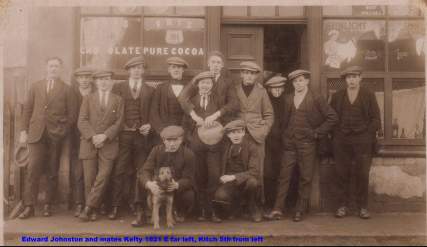
In Lower Oakfield, at that time, there were quite a lot of lads,
and they were always talking about starting a football team. So we
had a meeting and decided that before they started, we would have
to put money together, to get football jerseys and boots and one
thing and another, and we would have to see about a field for
playing. This went on for weeks, and they were always supposed to
be putting money in, but it never eventuated. So, Jim Scott and I,
we decided, I think we were about the only two putting in money,
the rest were always smoking or gamblers. So Scott and I put five
pounds each, and a couple of the lads went across to Edinburgh to
Lumleys, that was the sports people in Edinburgh, and they bought
these jerseys, maroon jerseys and a ball, and we decided to call
the name the Kelty Hearts after Hearts of Midlothian in Edinburgh.
Then the lads started putting money in every week, quite a lot of
blokes about twenty or thirty of us in that area, and we started
putting money in every week, and got quite a few quid together.
There was a fairly level piece of ground up at the top end of the
public park, and we got permission to put up some goal posts. We
levelled it out a bit, and we had a fairly good ground. We bought a
clubhouse - we had a clubhouse built. It cost us over a hundred
pounds.
We joined the Fife League, a Juvenile League, and we were doing
very well having beaten quite a lot of teams. We had occasion to go
to Bowhill to play a game and at the finish of the game we were
beaten, I think it was 1 - 0. We were looking over the lines at all
the players names, and discovered that all the players names had
been filled in with pen except one, which was filled in with
pencil, and thought this was a little bit strange. We made
enquiries, and discovered this fellow came from way up in Dunkeld.
Peter Carere at that time had the Ice Cream shop, and had a car - a
taxi hire service. It was a Daimler car, he had a beautiful car,
and he and a couple of the lads went up to Dunkeld to find out
about this bloke, and they discovered that he was a senior! We
lodged a protest against the result, and we won the protest. But
instead of getting the points, we had to go and replay, and we got
beat at Bowhill 4 - 0. It cost us a good lot of money to send this
car up to Dunkeld, the lads lost their wages, and one thing and
another, however, we had a good laugh about it later!
We went down one day to Aberdour to play a game in the Fife League. Towards the end of the game we were being beaten 2 - 1 and Bill Linton, that's a lad that eventually went to Australia, we got a penalty kick. It was the last two minutes of the game, and he scored, of course, and that made it 2 - 2 and we had two busloads there. We had quite a lot of followers at the time, an awful lot of girls used to go with us, and we created such a pandemonium down in Aberdour after this game, that when the lads from Aberdour were supposed to replay up in Kelty, they failed to turn up, and we got the points!
Another time, we were in the fourth round of the Scottish Juvenile Cup, and we had to go and play another team that came from Douglas Water - Rangers they called them. We had to go to a place near Falkirk to play this game, and we had a couple of busloads there. When the game started, there had been a jumble sale, and all these buggers from the Glasgow area, they had bayonets and revolvers, old revolvers, of course, you couldn't use them. They were running up and down the line with these bayonets, and a lot of the lads playing for the Hearts, they got the shits I think, and we were beaten 2 - 1! That was the end of that game!
In 1921 we had a miners' strike. The owners wanted to
reduce wages, we had fairly good wages for a while, and they wanted
to reduce our wages, so the miners all came out on strike. The
railwaymen, we had a general strike as a matter of fact, but the
railwaymen all went back, and we were left to fight it on our own
for twenty-one weeks. It had been great weather, and at nighttime
we used to go out and forage for vegetables and anything we could
get our hand on - coal!
There was a mine not far from where we lived, and we used to go and
get coal, fill bags of coal down the road a bit from Cantsdam. A
crowd of them had went into a field, to steal some turnips. The
farmer's son came out and fired a shotgun at them, and one of
the lads, Tom Gibb, was injured. There was a case about it, but he
couldn't get any compensation or anything, because he had no
right to be there, and they were thieving, and the case went
against the miners, of course. He didn't get anything, with the
result that he lost the power of one of his arms for the rest of
his life, Tom Gibb!
Bill King, a chum of mine, had gone out to Australia. The
Lintons and the Kings and the Balmains, they were all there. During
the War one of the Balmain girls had fallen in love with one of the
Australian sailors. She married him, and went out after the War to
Australia, and she sent for her father and mother and family, and
they all went out to Australia.
The Lintons then followed, they were relatives of the Balmains, and
then the Kings went out. So Bill King, my chum, was there and I had
been communicating with him. So eventually he said, "Would you
like to come out to Australia?" so I said, "Yes, of
course," and I was nominated. I was getting everything all
fixed to come out, and my mother said to Peter Penman, "We
can't let him go out on his own." So Peter decided to come
out along with me, and went into Dunfermline and passed all his
examinations, and he eventually got accepted and we came out
together.
My father, Eddie Johnston, migrated to Australia in 1924-25 and
worked in the coal mines in New South Wales in the Lithgow Region.
His mother came out in 1926 and his brother Tom and his family
arrived a little later and they all worked in the mines.
Dad married Nellie Stewart, from Lochgelly, the sister of Tom
Johnston's wife in Lithgow in 1932. As the Depression began to
take effect in Australia, they returned to Scotland in 1933 to life
on the Dole.
We arrived back in Scotland - I think it was March, 1933, and we
had sold all our furniture, of course. A chap that worked in the
mine, Les Derrick, and his brother, bought all of it.
When we came back out to Australia later on in 1965, we went and
visited this lad and he still had some of the furniture he bought
from us, so he said it had lasted very well! When we got back to
Scotland, to Lochgelly, we were staying with Nellie's mum and
dad.
Aggie, Tom and Johnny were staying in the room and we were living
in the attic. Well, we were unemployed; we couldn't get a job
and couldn't get the Dole, because we had been so long out of
the country, and with the result we had to go to the Town House and
claim relief. I still had a few pounds, but I wasn't going to
tell them that. Tom decided to go back to the mines and he went
down to the Mary Pit at Lochore, and he got a job there.
A funny thing, the manager there was an under-manager in the Aitken
Pit when I was working there, and left there in 1926. Tom had been
telling him he had been out to Australia, and he said to Tom,
" Do you know Ed Johnston?" and he said, "I'm
his brother, he's back home too!" and he said, "You
bring him down, and I'll give him a job!" The funny thing
about that was this bloke, the under-manager, we were nearly always
fighting, when I worked under him in the Aitken.
One Saturday, there was a big match on at Cowdenbeath, and we all
came down the mine, down to the haulage road, and we were down
before knock-off time, and he was there to stop us. I had a few
unkind words to say to him, with the result that when he went up he
reported it to the manager. When I went back to the pit on the
Monday morning, there was a note on my check saying I had to go to
see the manager after my shift was finished. However, I went into
the office and him and I were going to have a fight, and the
manager said, "I don't want any of that! If you're
going to fight, you'd better get outside!"
However, all the blokes I worked with were all outside the office,
so I said, "Look! I'm sorry what I said just because of
the heat of the moment. I wanted to see the football match,"
and he said, "I understand that," and we parted the best
of friends. When Tom got this job he said, "Send for Ted and
I'll give him a job too." However, I couldn't think of
going back to the mines in Scotland, after the conditions that we
were working under in Australia.
The mines in Australia, the coal was all about seven or eight feet
high in the mines, and it was nearly all on level ground, a bit
undulating, but mostly level, and in Scotland the seams were all on
the slope, very low and I said, "I'm not going back to the
mines!" So I was idle for a while.
They sold eggs for a while and after my sister and myself were born in 1936, in Lochgelly, he finally got permanent employment, as a builder's labourer, with Robert Terras, the builder from East Wemyss.
We were given a new house by Terras, in East Wemyss, in 1939, in June of that year, and then, in 1940, Eddie was called up for War Service. He was too old for the military so he joined the Police Force and was stationed at Cupar, Oakley, Saline and finally Leuchars, during the War Period.
The last year of the War, there was a circular came round the Police Stations, asking for volunteers for ex-miners to go back to the mines. I was so sick fed up with this job, I took my chance and put in an application. I had to go up to Dundee and pass the doctor up there, and I was eventually accepted for the mines. So I was back in East Wemyss and I got a job in the Michael as a pan shifter, conveyer pans, and the wages were a lot better than in the Police, and we were doing pretty well. Just after the War finished, the mines were nationalised, and we got a big rise in wages.
We went to live in Leven at Gladstone Cottage, and I was travelling from there to the mine and I finished up. I hurt my back in the pit, lifting a heavy prop, and I slipped, and I did something to my discs with the result my right leg, I could hardly move it! I had an X-ray in Edinburgh, and the bloke that was examining me took a needle and stuck it in my foot, and I couldn't feel it. He said, "Treatment's no good for this you! I'll have to have an operation." So I had to go into Edinburgh Infirmary(Western General), for the operation on my discs.
So they sent me home, and the ambulance called for me every so often, and I had to go into Kirkcaldy for treatment, with the result that they put me before a Board, and they found I was able for light work. I had to go back to the mine. When I was working on the coal face there I was making good money, but after my accident, I was put on a conveyer belt pressing a button, and the wages was only just about half what I should have been getting at the face! At the finish up, all I got for the accident was one hundred and fifty pounds!
However, I made up my mind to retire. I went to the Michael before a Board, and I was examined and everything. At that time, I had been suffering from angina, and I had a note from my own doctor stating this, and I got word back from the Coal Board that they had accepted my resignation. I was awarded one hundred and fifty pounds or something for my accident. I also got the Miner's Pension, which at that time was only a pound a week, however, it was a great help!
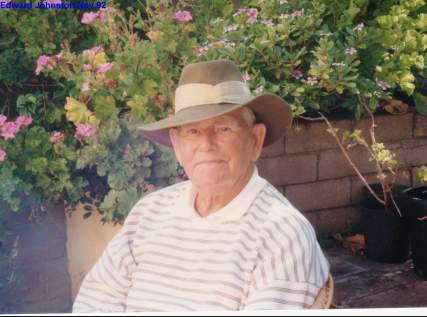
Eddie and family migrated to Australia again in January, 1965, and he retired to Wollongong, near Sydney, where he enjoyed a happy retirement with his wife and family and grandchildren.They moved to Sydney in 1987 to be nearer their family.
He and Nellie enjoyed good health until both were in their nineties. Nellie died in 1990, aged 92,and Eddie died in 1995, aged 93.