Owners: R. G. E. Wemyss
Wemyss Collieries
Wemyss Coal Co. Ltd.
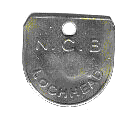
NCB
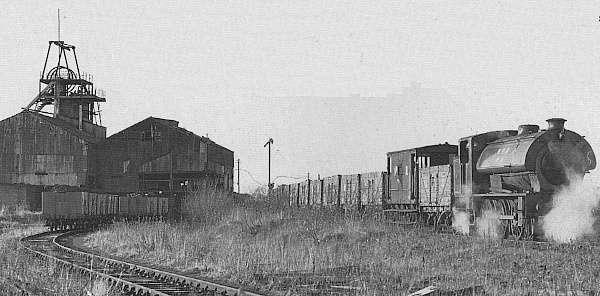
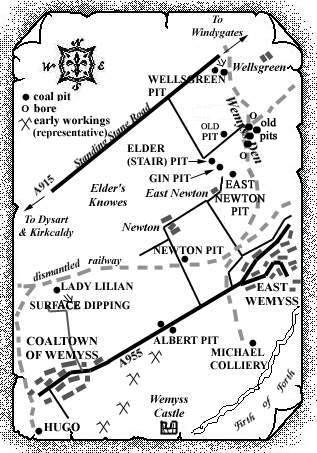
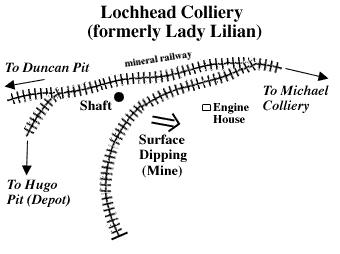
The Lochhead Pit lay three quarters of a mile to the north
of Coaltown of Wemyss and was linked underground to the old
Wemyss Collieries No. 7 Pit (later the Victoria Pit) which
was under a mile to the south of Coaltown, on the seashore by
West Wemyss harbour. The pit is recorded as being sited on
older workings (1839) and was originally called the 'Lady
Lilian'. However, when Randolph Wemyss and Lady Lilian
divorced, it was re-named Lochhead Pit (1898). The Lochhead
farm, not far to the south, is the probable source of the
name. The first Wemyss Private Railway locomotive was also
named "Lady Lilian" and it was given a number later
when the name was painted out. The Lochhead/Victoria closed
in 1970.
[The uncle of Ian Cameron (Dalgety Bay) by marriage, Alex
Spowart, was the chief engineer at Lochhead Pit. He worked
night and day, especially during the war 1939-45, and died in
1949, aged 48.]
M. Martin & Webmasters.
 |
 |
 |
For those site visitors who think that much must remain of the Fife
coal mines, we are sorry to report that most sites have been cleared
completely leaving little evidence that a once great colliery operated
there. We continue to be grateful to Peter Hall, Cupar, who trecks
around Fife locations photographing sites/remnants of former coal mines.
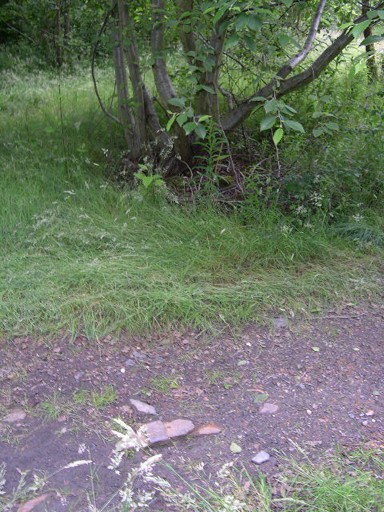
Below is the site of the Lochhead Colliery as photographed in July
2008.
 |
---------------------------------------------
We are always grateful when website visitors pass on contributions to enhance our content and we wish to thank Gordon Sutherland, Methil, Fife, for giving permission to display his unique colourful projects based on photographs of bygone collieries.
Colin Martin & Chris Sparling, Webmasters.
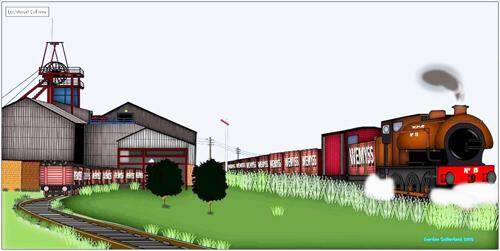
PLEASE NOTE THAT THE ABOVE IMAGE IS © GORDON SUTHERLAND
---------------------------------------------------------
| Pit opened: 1890 | Pit closed: March 1970 |
|---|
| Source Date of Information Supplied |
|---|
| Manager / Under-Manager / Men underground / Men above ground / Coal seams worked / Shaft Details |
| 1890 (R. G. E. Wemyss) |
| Lady Lilian: Andrew Crookston / ------------ / 11 / 11 / Dysart Main / D'cast (15 x 9) 390 ft. : U'cast ------- |
| 1904 (Wemyss Coal Co. Ltd.) |
| Lochhead: James
Burgess / ------------ / 497* / 65*
* Figures may have also included the Lochhead Surface Dipping |
| Household, manufacturing and steam coals. |
| 1905 (Wemyss Coal Co. Ltd.) |
| Lochhead: ---------- / ------------ / 532 / 76 |
| 1908 (Wemyss Coal Co. Ltd.) |
| Lochhead: J. Brown / ------------ / 636 / 101 |
| 1911 (Wemyss Coal Co. Ltd.) |
| Lochhead: ---------- / ------------ / 938 / 127 |
| 1918 (Wemyss Coal Co. Ltd.) |
| Lochhead and Victoria: George Welsh / Isaac Young / 375 / 71 |
| 1920 (Wemyss Coal Co. Ltd.) |
| Lochhead and Victoria: George Welsh / Isaac Young / 718 / 134 |
| 1928 (Wemyss Coal Co. Ltd.) |
| Lochhead and Victoria: George Welsh / Isaac Young / 711 / 145 |
| Household and steam coals and fireclay. Dysart Main and Lower Dysart. |
| 1938 (Wemyss Coal Co. Ltd.) |
| Lochhead and Victoria: George Welsh / William Hampson / 697 / 155 |
| 1945 (Wemyss Coal Co. Ltd.) |
| Lochhead and Victoria: George Welsh / William Hampson / 327 / 115 |
| Household and steam coals. Dysart Main and Mangie. |
| 1947 (NCB) |
| Lochhead and Victoria: William Hampson / ---------- / 491 / 140 |
| Gas, household, industrial and steam coals. Approx. annual output = 171,700 tons |
| 1948 (NCB) |
| Lochhead and Victoria: William Hampson / D. Paterson / 324 / 137 |
| Household and steam coals. Mangie, Dysart Main and Lower Dysart. |
| 1949 (NCB) |
| Lochhead and Victoria: William Hampson / T. Christie : A. Cairns / 324 / 128 |
| Household and steam coals.
Dysart Main, Lower Dysart and Mangie.
System of ventilation partly in common with Lochhead (Surface Dipping) and Michael Mine. |
| 1950 (NCB) |
| Lochhead and Victoria: William Hampson / A.Cairns / 438 / 129 |
| Household and steam coals.
Dysart Main and Lower Dysart..
System of ventilation partly in common with Lochhead (Surface Dipping) and Michael Mine. |
| 1951 (NCB) |
| Lochhead and Victoria: William Hampson / A. Cairns / 438 / 129 |
| Household and steam
coals. Dysart Main and Lower Dysart.
System of ventilation partly in common with Lochhead (Surface Dipping) and Michael Mine. |
| 1958 (NCB) |
| Lochhead: William B. Hampson / R. McGhie / 682 / 159 |
| Gas, household, industrial and steam coals. Dysart Main and Lower Dysart. |
| 1959 (NCB) |
| Lochhead: W. J. Forbes / R. McGhie / 627 / 138 |
| Gas, household, industrial and steam coals. Dysart Main, Lower Dysart and Boreland. |
| 1961 (NCB) |
| Lochhead: W. J. Forbes / W. Band / 376 / 73 |
| Gas, household, industrial and steam coals. Lower Dysart. |
| 1964 (NCB) |
| Lochhead: W. J. Forbes / W. Band / 358 / 52 |
| Household, industrial and steam coals. Lower Dysart. |
| This pit had a system of ventilation partly in common with the Victoria Pit and the Michael Colliery. |
---------------------------------

"Dunfermline Press"
2 July, 1904
On Thursday, a miner named Stevens, residing in East Smeaton Street, Kirkcaldy, met with a fatal accident in one of the Wemyss Colliery pits. He was struck by a runaway hutch. The unfortunate man leaves a widow and nine of a family to mourn his untimely end.
[We believe this to be David Stevenson killed at the
Lady Lilian Pit, Lochhead Colliery.]
M. Martin &
Webmasters.
---------------------------------
H. M. Inspector of Mines Report 1907
Mr. Robert McLaren's Report
Fatal Accident at Lochhead, Fife
Owner: Wemyss Coal Co., Ltd.
25 March, 1907
Stuart Band, 18, Miner. Deceased was filling coal, which he had taken down from the roof into a tub, when some more coal fell, which struck him on the head and killed him instantly.
---------------------
"The Scotsman"
26 March, 1907
PIT FATALITY AT WEMYSS. - Yesterday afternoon, Stewart Band (17), Alexander Place, Dysart, was accidentally killed at Lochhead Pit, near Coaltown of Wemyss. He was filling coal at the face, when he was caught by a fall of rubbish from the roof, and instantaneously killed.
---------------------------------
H. M. Inspector of Mines Report 1907
Mr. Robert McLaren's Report
Fatal Accident at Lochhead, Fife
Owner: Wemyss Coal Co., Ltd.
15 August, 1907
James Christie, 20, Miner. A tub of a rake running on an inclined plane left the rails and striking some timber, caused the roof to fall opposite a place of refuge where deceased was, and he was crushed beneath the debris.
---------------------------------
"The Scotsman"
16 August, 1907
FIFE MINING FATALITY. - Since the July holidays a great number of accidents have taken place in Fife. The second in Wemyss parish this week was reported yesterday. Allan Christie (20), residing at Methil, and employed in Lochhead pit, Wemyss Coal Company, was running a hutch, when it struck a tree. As the prop fell, it brought away a mass of rubbish, which instantaneously killed the lad.
---------------------------------
H. M. Inspector of Mines Report 1907
Mr. Robert McLaren's Report
Fatal Accident at Lochhead, Fife
Owner: Wemyss Coal Co., Ltd.
10 October, 1907
James Brown, 61, Fireman. A fall had taken place in a roadway to the upper portion of the Dysart Main Coal seam, and deceased was on the top punching off some loose parts, when more coal fell and striking the crowbar drove it through his body inflicting injuries to which he succumbed in a few hours.
---------------------------------
H. M. Inspector of Mines Report 1907
Mr. Robert McLaren's Report
Fatal Accident at Lochhead, Fife
Owner: Wemyss Coal Co., Ltd.
16 December, 1907
Robert Duff, 62, Miner. While deceased was holing, a piece of coal fell away between two sprags and, striking him on the chest, caused internal injuries from which he died five days afterwards.
---------------------------------
"The Scotsman"
20 December, 1907
PIT ACCIDENT AT WEMYSS. Yesterday morning an accident happened at the Lochhead mine, belonging to the Wemyss Coal Company. A race of hutches, containing about forty miners, was being dashed down the incline at a great speed. At the pit bottom the hutches came in contact with the props which support the roof, knocking them down, with the result that a large quantity of material fell upon the men. Some time elapsed before the miners were extricated, when it was found that ten of them had been injured, some of them seriously.
---------------------------------
1st Class Medals for Bravery
"Heroic Endeavour" by D. V. Henderson.
"They saved two men overcome by gas after a fire at the mine near East Wemyss, Fife."
London Gazette, 28 July, 1908
(page 5529)
"On the 29th December, 1907, a fire broke out at Lochhead Colliery, Fife. It was feared that a fireman who was in the pit was in danger. Two men descended to rescue him but they were overcome by the poisonous gas in the mine. James and George Dryburgh, in spite of great risk, descended the shaft and rescued these two men."
See below for the full story
| The Victoria and the Lochhead Pits were linked
underground.
The newspaper report below indicates this and describes how both pits were affected in the incident. |
|---|
"Cowdenbeath & Lochgelly Times
& Advertiser"
Wednesday 1 January 1908
FIFE PIT ON FIRE
THRILLING BATTLE WITH DEADLY GAS
THREE MEN SUFFOCATED
An accident of a very serious nature occurred early on Sunday morning in the Victoria Pit, Wemyss Colliery, Fifeshire.
It appears that about 6.30 John Kilpatrick, 42 years of age, a pit inspector, residing at West Wemyss, went down the pit to make the usual inspection. As he was much longer than usual in returning to the surface, the engineman, David Block, became alarmed for Kilpatrick's safety, and sent for Andrew Morris, pit inspector, and William Scott, pit wright, both residing at West Wemyss.
| THE THREE MEN THAT SUFFOCATED | |||
|---|---|---|---|
| NAME | AGE | JOB | LIVED |
| John Kilpatrick | 42 | Pit Inspector | West Wemyss |
| Andrew Morris | - | Pit Inspector | West Wemyss |
| William Scott | - | Pit Wright | West Wemyss |
About 8.45 these two men descended the shaft for the purpose of ascertaining what was wrong. Immediately the cage in which they descended reached the bottom of the shaft they struck three on the bell, which is the first signal to the engineman that men desire to ascend.
The engineman rung back for the final signal before commencing to draw up the cage. He got no reply, and, fearing that something was seriously wrong, he sent for further assistance.
TO THE RESCUE
A large number of miners residing in the vicinity were soon on the scene. Volunteers being called for to descend the pit, Geo. and Jas. Dryburgh offered their services, and were lowered down the pit. On reaching the bottom they found Morris and Scott lying at the cage entrance. They found the gas so strong that they were only able to place Morris on the cage and signal to be raised. By the time they reached the surface, one of the Dryburghs was about overcome. All efforts were made to restore Morris, but without avail, life being extinct. The shaft was then tested with naked lamps, and, on being raised, two of the three lamps were found to have been extinguished by the foul air. Other volunteers were called for, when David Block, the engineman, and Alexander Walker offered to descend.
When they reached the bottom, Walker rushed about 50 yards into the pit in search of Kilpatrick but, as he was about overcome by the gas, he returned and assisted Block to put the body of Scott on the cage, and they returned to the surface. Scott was then found to be dead.
David Rodger, the under-manager, now arrived at the pithead, tested the shaft with a bird, and the volume of foul gas ascending was so great that the bird only lived for five seconds at the mouth of the shaft.
CERTAIN DEATH
Seeing that it was certain death for any person to descend, he refused to allow others to go down, especially knowing that Kilpatrick could not be found near the shaft bottom.
Rodger then went to Lochhead Pit and proceeded along the communication road leading to the Victoria. He saw Kilpatrick about midway between the two pits with his lamp burning, but as Rodger by this time was almost overcome he had to rush back to get fresh air and others to assist him.
John Brown, colliery manager, and a young man named Watson returned with Rodger into the workings, and they found Kilpatrick sitting as if resting, but quite dead, and his lamp still burning. They had the body taken to the pithead - the accident having thus resulted in three deaths.
Dr Watson and his assistant were early on the ground, and gave all possible assistance. It is supposed that an old fire in the mine had burst out, setting free a large quantity of poisonous gases. Shortly after the accident, smoke in great volumes commenced to ascend an air-shaft near Earlseat in connection with the Victoria and Lochhead Pits. Up until last night a large staff of men were engaged in the pit fighting the fire.
The three deceased were married, and leave widows and families. It is impossible to conjecture the extent of the accident which might have taken place had it been any other day but Sunday, as over 50 men are employed in the pit
FIRE BREAKS OUT
Groups of miners are gathered at the corners of streets discussing the disaster of the previous day. It appears that when Kilpatrick was lowered down in the cage there was no indication that there was anything wrong. When the efforts of the rescue party were directed to the Lochhead Pit, a distance of about a mile, it was ascertained that fire had broken out from an old working at the shaft. David Rodger, a miner, forged his way ahead up the main road, and discovered Kilpatrick about 800 yards in the haulage road in a kneeling position. The three bodies were brought up from the bottom of Victoria Pit. One of the ponies has not been recovered yet. It was fortunate that the fire occurred on Sunday, otherwise the death-roll must have been very large, especially amongst the miners who were working the west side of the pit. They would have been caught like rats in a trap.
About 400 men will be thrown idle in the Lochhead Pit and 80 in the Victoria Pit.
EXTRACT FROM REPORTS OF INSPECTORS OF MINES
The Dysart Main Coal Seam, which is worked to a considerable extent in East Fife, is very liable to fires by spontaneous combustion, and in the Wemyss coalfield there has been much difficulty in preventing the spreading of fires already in existence, and in building off affected areas. Especially has this been the case at Lochhead Colliery which adjoins the old workings of the Duncan's pit, which bad to be abandoned some years ago owing to the prevalence of fires in the seam.
The Lochhead Colliery, where accident took place, has, in common with the other collieries, been troubled by underground fires and up to the day of the accident the management had been successful in building the parts affected off but were constantly on the watch to observe the least sign of fire, and for this purpose, examinations of the workings were made constantly, including Sundays.
The Colliery consists of two shafts, Lochhead and Victoria, about 2,700 yards apart; the latter is situated close on the Firth of Forth, at West Wemyss, where there is a dock for loading coal, and by means of stone mines, joining the Lochhead workings, there is a haulage road between the shafts, so that coal can be taken to either shaft as required for loading, either into boats or waggons, to suit the trade.
The workings are ventilated by Fan--forcing in duplicate--Walker producing 100,000 cubic feet per minute, and Sirocco producing 150,000 cubic feet per minute, placed at Lochhead shaft. At the time of the accident the latter fan was in use, and air currents passed in and around workings to Victoria shaft, as shown by arrows on plan. On the morning of the accident, John Kilpatrick, fireman, descended Victoria shaft at 6.30 a.m. for the purpose of making his usual examination of the workings and stoppings, and as he did not return to the shaft bottom about eight o'clock, the engineman on duty--David Black--became anxious for his safety, and sent for two men--Andrew Morris, fireman, and William Scott, pitwright--in order that they might go in search of Kilpatrick. By this time a strong smell of 'coal stink'---- a sure sign of an underground fire--was felt coming up the shaft, and without any hesitation these men descended. On reaching the bottom they had evidently begun to feel the effects of the "coal stink," and signalled to be raised, and the engineman gave the return signal that he was ready, but they seemingly had become helpless, and were unable to give the signal and reach the cage. The alarm was raised and a number of miners flocked to the shaft to render assistance. Before anyone went down the shaft in search of Morris and Scott, three large lamps were lighted and lowered on the cage and were extinguished. Again they were lighted and lowered, when two were extinguished. Immediately after, two men--James Dryburgh and George Dryburgh--descended with the same lamps which continued to burn, and on reaching the bottom saw both men near the cage seat. They managed to pick up Morris and place him in the cage, and then came to the surface. A second party consisting of Black, the engineman and Alexander Walker, next descended the shaft, and succeeded in bringing Scott to the surface, and a third party--Alexander Kilpatrick and James Anderson--went down immediately the second party came up, to search for the fireman, but were forced to come back after travelling some distance in the roadway. All, except James Dryburgh, were very much affected by the foul gas. Shortly after this the oversman of the pit arrived and on seeing the condition of matters he prohibited any others going down. An idea of the deadly nature of the gas was shown by the fact that a canary, placed over the shaft mouth, succumbed in five seconds.
A search party afterwards went by Lochhead, and found Kilpatrick, quite dead, near the end of the stone mines, sitting as if he had been resting, with his lamp still burning.
About the time when the alarm was raised at Victoria shaft that something was wrong, a fireman in Lochhead discovered that fire had broken out near Lochhead shaft, and in a short time a large area was ablaze in the old Duncan's workings, as was evidenced by the huge volumes of smoke at one of the air shafts, and flames coming to the surface at an air shaft near the old Duncan's pit.
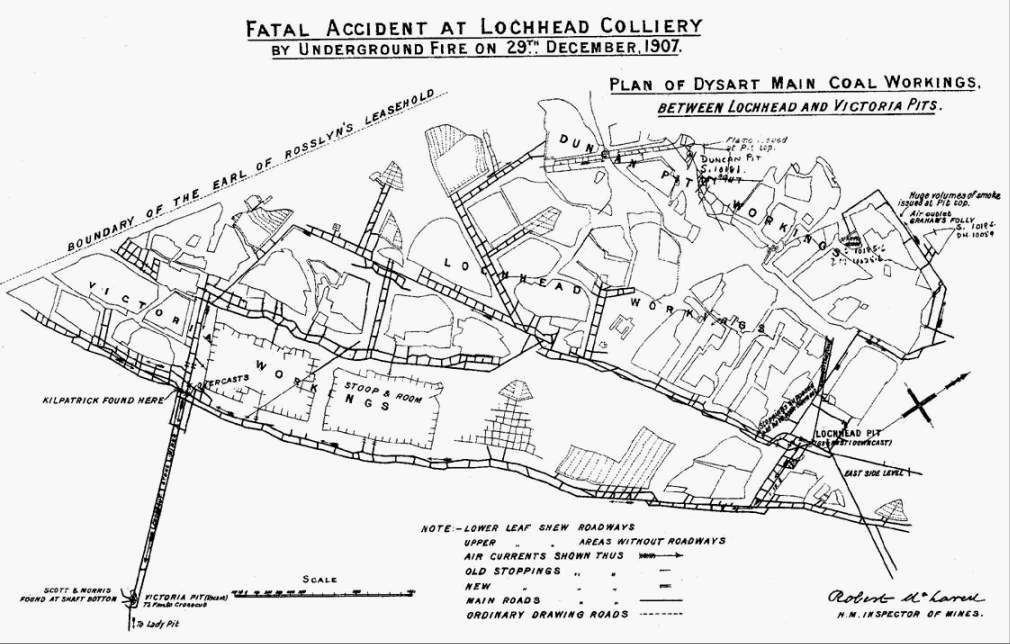 |
It is not known how the fire burst out near the shaft, but in my opinion it was caused by the presence of the combustion gases coming off an existing fire in the old Duncan's workings, forcing out the stoppings--marked on plan--similar to what took place at No.1 Lumphinnans last year.
The burst seems to have taken place when Kilpatrick was in the workings, and the extinguishing of the lights when put down Victoria shaft was due to an excess of Carbonic Acid gas, and when this excess had passed off, Carbon Monoxide came off in large volume; hence the reason the lights burned when the first rescuers descended, and it was due to the same cause that Kilpatrick's light continued to burn long after he was dead.
The rescuers deserve great credit in the bravery displayed in descending the shaft in face of a known danger.
Had pneumatophors been available, two of the lives would, in all likelihood, have been saved, and the risk of searching for Kilpatrick from the Lochhead side would have been obviated.
---------------------------------
"Dunfermline Press"
11 January, 1908
WEMYSS PIT FIRE
For ten days the officials and nearly 200 men fought the outbreak of fire in Lochhead pit. A great hold had been gained; sections of fifty to sixty feet and ten feet high could be seen a mass of flames. Night and day the men toiled to close up all openings which gave air to feed the fire. Here and there stoppings were breached, but on Wednesday the managers announced that their task was completed. Air-tight brick and cement walls surrounded the outbreak. The fire is in the Dysart main seam, and is the greatest underground fire of recent years. It was only fifty yards from the bottom of the shaft, and much anxiety was felt for it during the first days of the year. Over 200 men were thrown out of employment by the closing up of the faces, but the management have arranged for these men back-shifting the miners employed in the other sections, and work was resumed on Wednesday.
---------------------------------
"Dunfermline Press"
3 June, 1911
MINER KILLED IN A WEMYSS PIT
As the result of an accident in Lochhead Pit, West Wemyss, belonging to the Wemyss Coal Company, on Tuesday, a miner named Alexander Williamson, 17 years of age, residing at 12 Arthur Street, Kirkcaldy, was killed. Deceased had been engaged in the underground workings, when a large quantity of coal fell from the roof, completely burying him. When the debris had been cleared away, the lifeless body was found, the base of the skull being fractured, and the upper part of the body bruised.
---------------------------------
"Dunfermline Press"
18 May, 1912
William Shepherd, miner (18), 24 Miller Street, Kirkcaldy, died in Kirkcaldy Hospital on Sunday from injuries received on Saturday morning. Shepherd was employed at Wemyss Colliery, and was about to descend the shaft to commence work for the day. He attempted to enter the cage while it was in motion, and was badly crushed. His leg was broken in two places. Several of his ribs had also been fractured and had torn his lung.
---------------------------------
"Dunfermline Press"
22 June, 1912
EAST FIFE PIT FATALITIES
Two mining fatalities were investigated by Sheriff Armour-Hanney and a jury at
Cupar on Tuesday. The victim in the first case was William Shepherd, miner, 24 Miller
Street, Gallatown, Kirkcaldy, who was killed at the Lochhead Pit of the Wemyss
Coal Company, Ltd., on Saturday, 11 May. The evidence showed that the
deceased, while in the act of stepping into the cage for the purpose of descending
the shaft, was accidentally caught and crushed between the top of the cage and
the side of the shaft. The jury found that the cause of death was due to the deceased
having attempted to get into the cage after the signal had been given for it being lowered.
The other case had reference to the death of William McCormack, pithead worker,
Sinclairtown, who met his end at the Pannie Pit on 22 May. ... In both cases formal verdicts
were returned.
---------------------------------
"Dunfermline Press"
18 August, 1917
FIRE AT FIFE COAL BINGS
Wemyss Coal Coy., Ltd., are confronted with serious loss as the result of fires at Rosie and Lochhead pit bings. For weeks they have battled with the former outbreak, and now having isolated the part affected it is left to burn out. About 30,000 tons were in the Lochhead bing at first. Most of it is cut off from the fire, but a considerable quantity is doomed.
---------------------------------
"The Scotsman"
15 March, 1920
FATAL MINING ACCIDENT AT METHIL. - As he finished work in Lochhead Pit, Wemyss Coal Company, on Friday night, Thomas Buist, Aberhill, Methil, was caught by a fall of coal and killed. He was 27 years of age, and leaves a widow and child.
----------------
"Dunfermline Press"
20 March, 1920
Just as he finished on the back shift in Lochhead Pit, Wemyss Coal Co., Thomas Buist, Aberhill, Methil, was caught by a fall of coal, and killed. Deceased was 27 years of age, and leaves a widow and child. He was demobilised not long ago after serving in France with the Royal Field Artillery.
---------------------------------
"Dunfermline Press"
1 January, 1927
WEMYSS COLLIERY FATALITY
An explanation as to the manner in which Robert Pryde,
miner, 22 Union Street, Kirkcaldy, met his death while
working in the Lochhead Colliery, Wemyss, was given at the
inquiry held by Sheriff Dudley Stuart and a jury at Kirkcaldy
Sheriff Court. Deceased was killed by an explosion, the shot
having been stemmed and fired by himself.
In reply to George Brandon, Procurator Fiscal, George Welsh,
colliery manager, expressed the opinion that Pryde had
unwittingly ignited the fuse and had gone back again to light
it. It was the practice to call "Fire" when a shot
was being fired, and in the course of his inquiries he found
this had not been done. John McLauchlan, who was drawing for
the deceased, said he (Pryde) was preparing to fire the shot
at his working place. When he last saw Pryde he was on his
knees with his hand up. His lamp was in his right hand, and
he was firing the shot. It went off suddenly, and the lamp
was blown out.
Sheriff - Did you see him twice trying to light the fuse? -
Yes.
Sheriff - The first time nothing happened, and the second
time the thing exploded? - Yes.
A formal verdict was returned.
---------------------------------
"The Scotsman"
18 August, 1930
PITHEAD BATHS
Wemyss Lead in Mining Amenities.
Fashioned in the most modern lines, baths for miners were on Saturday formally
handed over to the management and men at Lochhead Colliery of the Wemyss Coal Co.
They are provided by the Miners' Welfare Fund at a cost of £8200. Provision is
made for 704 men, and particular care has been taken to separate the dirty, wet
clothing from the dry clothes.
Mr Richard Kirkby, managing director, Wemyss Coal Co., presided, and recalled the
interesting fact that eighty years ago Mr J. Hay Erskine, Wemyss, erected baths at the
Victoria Colliery, West Wemyss, but these had to be cleared away owing to colliery
developments. In 1914, Wemyss Coal Co. erected baths at Wellesley Colliery, and
now found double the number of cubicles would be required. Unfortunately, they had
no money for this, and they could not convince the Miners' Welfare Fund that
this was a prior claim. (Laughter.) They welcomed the boon for the Lochhead men.
Mr J. Dempster, chairman of the Welfare Fund Committee, handing over the baths,
stated they had conducted experiments in Durham, Wales, and in Scotland, and
Lochhead baths, the fruits of these observations, might be considered the last
word in such institutions.
Mr Jas. Cook, financial secretary, Fife and Kinross Miners' Association,
accepting on behalf of the men, said while baths at home were highly desirable,
baths at the pit head were a step towards the realisation of an agitation long
conducted by the Trades Unions. He rejoiced to know similar boons were being
provided at other collieries in Fife and Clackmannan.
Captain Wemyss, chairman, Wemyss Coal Co., who was accompanied by Lord
Titchfield, accepting in name of the men, expressed the appreciation of all at Wemyss
for the excellent and practical use to which the money was applied when erecting pithead
baths. It must lighten the labours of a wife or mother when a miner could have a bath
before going home. What with the proverbial singing in the bath tub and the pleasure
of the wife in welcoming a newly-washed husband, there should be more smiles
about Wemyss. (Laughter and applause.) He thanked the Fund very cordially
on behalf of all who would use the baths.
---------------------------------
"Dunfermline Press"
23 August, 1930
Fashioned in the most modern lines, baths for miners were on Saturday formally handed over to the management and men at Lochhead Colliery of the Wemyss Coal Company. They are provided by the Miners' Welfare Fund at a cost of £8200. Provision is made for 704 men, and particular care has been taken to separate the dirty, wet clothing from the dry clothes. ...
---------------------------------
"Dunfermline Press"
19 December, 1931
EFFECT OF COAL QUOTA IN FIFE.
WEMYSS COMPANY'S EFFORT TO KEEP MEN EMPLOYED.
The threatened total suspension of work at Lochhead and Muiredge Collieries,
belonging to the Wemyss Coal Company, Ltd., has been partially averted. The
Company, it will be recollected, had to give notice to 1400 men employed at these
collieries owing to the Company's quota under the Coal Mines Act having been
exhausted. Mr Dugald Baird, general manager of the Company, in an interview
declared that every effort was being made to keep Lochhead Colliery working.
"Muiredge Colliery is idle," he said, "affecting between 500 and 600
men. At Lochhead we are working two shifts per day, and may manage to keep
that up till Monday or Tuesday. Our quota has now been exhausted, but we
have been able to buy unused quotas from other companies."
---------------------------------
"The Scotsman"
6 March, 1939
WASTE UNDERGROUND
Fife Pit Experiment's Success
PNEUMATIC STOWING
Following upon a successful experiment in pneumatic underground stowing - the first in
Great Britain - made at Lochhead Colliery, Coaltown of Wemyss, Fife, by Wemyss Coal Co., Ltd., the
Company has now introduced the system on a large scale at their Michael Colliery, East Wemyss,
where 3000 workers are employed.
The development of an economical system of stowing waste material underground encompasses
many far-reaching advantages over ordinary methods of coal mining. Where it can be and is employed,
the dumping of redd above ground is naturally reduced, sections can be wholly worked out instead of
leaving huge pillars of coal - "stoops", sometimes 30 yards square - to support the roof, no
pockets are left for accumulation of gas - thus effectively preventing fires - and subsidence is reduced
to a minimum.
When the system has been fully introduced into Michael Colliery, no refuse whatever from this colliery
will be dumped above ground.
GENERAL MANAGER'S STATEMENT
"I do not want it to be thought that this is a system which is going to get rid of redd bings,
however," stated Mr Dugald Baird, general manager of Wemyss Coal Co., in an interview. "The system
was adopted by us primarily to enable stoops in the thick Dysart Main Coal in Lochhead Colliery to be extracted,
to ensure proper control of spontaneous combustion. The system was not adopted to get rid of surface bings,
and can be done economically only in a thick seam."
Hydraulic stowing was at one time successfully employed in Lochhead Colliery, and a total of almost 347,000
tons of redd was stowed underground in this manner. Latterly the length of pipeline was 1900 yards, and the
amount of water that had to be used began to increase beyond the economic limit. For this and other reasons,
the system was abandoned a few years ago.
The pneumatic system, however, has solved many of the difficulties and disadvantages of the hydraulic system.
At Lochhead the stowing material is delivered by waggon and tip-ended into a below-ground hopper which has a
capacity of about 30 tons. Tubs are filled from the hopper, and then taken to the pit bottom. They proceed to
the stowing hopper and tip the material in, thereafter being diverted to the in-bye workings for normal use.
44,000 TONS OF COAL SALVAGED
The normal working of the colliery is thus not disturbed by the stowing operations. The tubs used to bring
down the stowing material are also used for the normal purpose of taking coal to the pithead. The stowing
plant at the moment is over 700 yards from the pit-bottom, and its ultimate position will be about a mile away.
Before removing the stoops, which are 30 yards square, leaving a "room" of 15 feet to 20 feet wide,
preliminary packing had to be done to the extent of 25,000 tons. After that the stowing was able to be done
at a ratio of one ton of dirt to one ton of coal extracted.
At Lochhead the machine is stowing approximately 150 tons to 200 tons per shift. This plant has been in
operation for fifteen months, and up to date over 64,000 tons of material have been used to pack the area
solidly, and 44,000 tons of coal have been extracted by the removal of the pillars - 44,000 tons of coal that
under the normal methods of coal mining would have had to be left unworked.
The question of extending the system to other collieries in addition to Lochhead and Michael Collieries, is being
contemplated by Wemyss Coal Co., but the universal application of the system is at the moment precluded by the
fact that it can be economically operated only in thick seams. It may, however, be introduced at Wellesley
Colliery, Buckhaven.
---------------------------------
"Dunfermline Press"
25 January, 1969
Comrie Colliery Productivity Record Broken
The pit that the late Herbert Morrison, Socialist leader, once described as the "cat's
pyjamas," Comrie Colliery, Oakley, has broken its own productivity record according to
figures released by the National Coal Board. ... Lochhead Colliery, Coaltown of Wemyss,
which has 370 men, had an output per manshift of 44.4 cwts., against their 1967 record of
41.4 cwts.
"Two records in successive weeks are certainly a most encouraging way to start the
year," commented Mr John Shaw, Deputy Director (Operations). "There is no doubt
we have what is needed for success."
---------------------------------
