Owners: Elgin Colliery
The name "Wallsend" was given to this important
pit of the Elgin Colliery after the area near Newcastle when
it became clear that the splint coal reached here matched the
quality of the best Newcastle coals! Later, the name
"Wallsend" was to become synonymous with the
Dunfermline Splint Coal seam.
The Wallsend Pit, in the Parkneuk district of Dunfermline,
began sinking early in 1837 - initially to the Seven Foot
Coal at a depth of 15 fathoms, and eventually, in 1840, to
the Dunfermline Splint seam at 103 fathoms. It was to be of
the most important pits of the Elgin Colliery and is reported
in local documents as having superseded the use of the
Baldridge Pit in the vicinity.
Fully operational from 1840, it was a very productive pit
yielding as much coal as all the other pits together
previously did at any one time. The pit probably closed in
the early 1870s.
--------------------------------------------
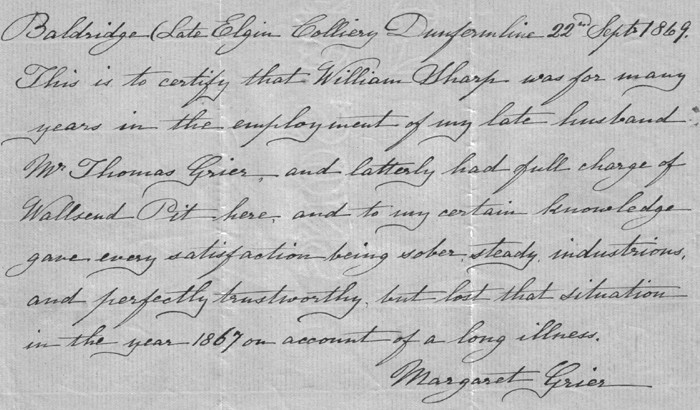
[We were delighted when Charlie Halpin, Dunfermline, got
in touch (April 2009) to inform us that his great-great-grandfather, William Sharp,
had been in charge of the Wallsend Pit for a period in the 1860s.
The letter of reference, written by Mrs Margaret Grier, widow of Thomas
Grier, is shown below.]
M. Martin & Webmasters.
--------------------------------------------
| The following table has detailed information on the various seams and strata at this famous pit. |
|---|
Section of the strata in the Wallsend Pit, West Baldridge,
the property of the Earl of Elgin.
Note:- The common name Wallsend means the end of the wall of Severus, on the northern bank of the Tyne, a few miles below Newcastle, where the best coal is got.
| Description | Coal | Various Strata |
| Fms. Ft. In. | Fms. Ft. In. | |
| 1. Soil and clay mixed with sand, | 2 4 0 | |
| 2. Soft brown sandstone, | 4 3 0 | |
| 3. Coal soft and foul, | 0 3 0 | 0 3 0 |
| 4. Soft brown sandstone, | 1 2 0 | |
| 5. Hard white sandstone, | 1 3 0 | |
| 6. Slate clay or blaes mixed with sand, | 0 1 6 | |
| 7. Coal, | 0 2 0 | |
| 8. Bituminous stone or slate, | 0 0 5 | |
| 9. Coal, | 0 1 7 | |
| __________ | 0 4 0 | |
| 10. Slate-clay or blaes, | 0 1 3 | |
| 11. Soft white sandstone, | 0 3 0 | |
| 12. Slate-clay or blaes, | 0 0 9 | |
| 13. Sandstone plies mixed with blaes, | 1 2 9 | |
| 14. Slate-clay or blaes, | 0 2 4 | |
| 15. Coal, | 0 3 6 | |
| 16. Bituminous stone, | 0 0 5 | |
| 17. Coal, | 0 2 9 | |
| __________ | 0 6 8 | |
| 18. Slate-clay or blaes, | 0 1 10 | |
| 19. Sandstone, | 0 2 1 | |
| 20. Sandstone plies and blaes alternately, | 0 3 0 | |
| 21. Sandstone, | 0 3 0 | |
| 22. Slate-clay or blaes, | 0 4 4 | |
| 23. Coal, | 0 0 7 | 0 0 7 |
| 24. Slate-clay, | 0 1 2 | |
| 25. Sandstone, | 0 3 7 | |
| 26. Slate-clay, | 1 3 3 | |
| 27. Slate-clay mixed with sandstone, | 0 1 2 | |
| 28. Slate-clay, | 0 3 6 | |
| 29. Sandstone, | 0 0 5 | |
| 30. Slate-clay, | 0 1 0 | |
| 31. Sandstone, | 3 1 6 | |
| 32. Slate-clay, | 1 4 8 | |
| 33. Coal, | 0 0 5 | 0 0 5 |
| 34. Slate-clay, | 0 3 2 | |
| 35. Coal, | 0 2 6 | |
| 36. Bituminous stone, | 0 0 3 | |
| 37. Coal, | 0 3 0 | |
| __________ | 0 5 9 | |
| 38. Sandstone plies and blaes alternately, | 1 2 8 | |
| 39. Slate-clay, | 0 4 0 | |
| 40. Coal, | 0 2 9 | |
| 41. Sandstone mixed with blaes, | 0 1 10 | |
| 42. Coal, | 0 2 7 | |
| __________ | 1 1 2 | |
| 43. Sandstone with a ply of slate-clay, | 2 2 8 | |
| 44. Slate-clay, | 0 2 1 | |
| 45. Coal, | 0 5 2 | 0 5 2 |
| 46. Slate-clay, | 0 4 0 | |
| 47. Sandstone, | 0 0 8 | |
| 48. Slate-clay, | 0 3 10 | |
| 49. Coal, | 0 2 5 | 0 2 5 |
| __________ | ||
| Depth of Pitfirrane level, | 41 0 3 | |
| 50. Slate-clay, | 0 2 4 | |
| 51. Coal, | 0 2 3 | 0 2 3 |
| 52. Slate-clay with balls of ironstone, | 0 3 0 | |
| 53. Fire-clay, | 0 0 3 | |
| 54. Slate-clay with balls of ironstone, | 0 2 5 | |
| 55. Coal, | 0 1 11 | |
| 56. Bituminous stone, | 0 0 4 | |
| 57. Coal, | 0 1 4 | |
| __________ | 0 3 7 | |
| 58. Slate-clay, | 0 4 5 | |
| 59. Ditto mixed with sandstone, | 0 4 2 | |
| 60. Sandstone, | 2 0 3 | |
| 61. Coal, | 0 3 9 | 0 3 9 |
| 62. Sandstone, | 2 0 11 | |
| 63. Ditto mixed with blaes, | 0 3 0 | |
| 64. Slate-clay, | 1 3 9 | |
| 65. Sandstone mixed with blaes, | 0 2 10 | |
| 66. Sandstone, | 0 2 8 | |
| 67. Sandstone mixed with blaes, | 0 3 0 | |
| 68. Sandstone, | 1 4 1 | |
| 69. Slate-clay, | 2 4 4 | |
| 70. Sandstone, hard, | 0 1 4 | |
| 71. Slate-clay, | 0 2 5 | |
| 72. Coal, | 0 0 7 | 0 0 7 |
| 73. Slate-clay, | 1 4 3 | |
| 74. Sandstone, | 0 6 9 | |
| 75. Coal, | 0 1 6 | 0 1 6 |
| 76. Slate-clay, | 0 2 3 | |
| 77. Ditto mixed with sandstone, | 0 2 3 | |
| 78. Slate-clay, | 0 3 1 | |
| 79. Coal, | 0 0 7 | 0 0 7 |
| 80. Sandstone mixed with blaes, | 3 2 5 | |
| 81. Coal, | 0 1 2 | 0 1 2 |
| 82. Slate-clay, | 0 1 8 | |
| 83. Sandstone mixed with blaes, | 0 4 6 | |
| 84. Sandstone, | 2 1 8 | |
| 85. Slate-clay, | 0 2 0 | |
| 86. Ditto mixed with sandstone, | 2 5 0 | |
| 87. Sandstone, | 1 3 0 | |
| 88. Ditto mixed with blaes, | 0 1 8 | |
| 89. Slate-clay or blaes, | 0 4 9 | |
| 90. Coal, | 0 1 7 | 0 1 7 |
| 91. Sandstone with petrifactions, | 2 3 7 | |
| 92. Slate-clay, | 1 5 6 | |
| 93. Coal, | 0 0 2 | 0 0 2 |
| 94. Slate-clay (light grey), | 0 5 0 | |
| 95. Ditto mixed with sandstone, | 0 5 3 | |
| 96. Sandstone, | 9 0 6 | |
| 97. Slate-clay, | 0 3 5 | |
| 98. Coal, | 0 2 8 | |
| 99. Bituminous stone | 0 0 3 | |
| 100. Coal, | 0 0 10 | |
| __________ | 0 3 0 | |
| 101. Slate-clay, | 0 3 0 | |
| 102. Ditto marked with sandstone, | 0 1 6 | |
| 103. Slate-clay, | 0 1 6 | |
| 104. Sandstone mixed with blaes, | 1 2 7 | |
| 105. Sandstone, | 3 3 0 | |
| 106. Slate-clay, | 0 1 7 | |
| 107. Coal, | 0 2 0 | 0 2 0 |
| 108. Sandstone plies mixed with blaes, | 3 1 0 | |
| 109. Slate-clay or blaes, | 1 0 0 | |
| 110. Coal, | 0 3 8 | 0 3 8 |
| 111. Sandstone, | 1 4 0 | |
| __________ | ||
| 105 1 0 |
"In the preceding section," the manager remarks, "there are 27 beds of coal of various thickness amounting to 56 feet 3 inches. Several of them are so thin that they cannot be wrought to advantage. But there are 19 of them containing 49 feet 8 inches of coal when taken in sections, as stated in the left hand columns, which can be wrought in 13 divisions or separate workings. Each of these divisions is generally denominated one seam, without any regard to the midstone which lies between the different beds or leaves. The whole of these seams partake less or more of the caking quality and soft texture of the Newcastle coal, and, in particular, the three undermost are of the very richest kind."
----------------------------------------------
[Note: This Wallsend Pit must not be confused with the
Wallsend (or Killiebone) pits to the north of Townhill in the
Bowershall area, west of Loch Fitty.]
M. Martin & Webmasters
 |
 |
| See West Fife Index Entry Elgin Colliery for additional information. |
Information on the Splint coal and workings at the Wallsend Elgin Pit, Dunfermline
(from an account by a late 19th century observer)
... I shall now approach the coals where they are found
in superior quality, not only the Dunfermline Splint Coal,
but all the other coals which have done so much to make
Dunfermline what it is as a great centre of the mining
industry, and upon which the town has to a very great extent
depended for support.
This coal was found at the Wallsend Pit in beautiful form at
a depth of upwards of 100 fathoms. Its thickness here was
about 3 feet 8 inches. This pit was sunk perhaps upwards of
half a century ago, at a time in which large outputs of coal
from one shaft was the exception rather than the rule.
This pit in its day was considered a very great undertaking,
and no doubt so it was, for machinery then, both for winding
and pumping purposes, was very defective to what it is at the
present time.
The various systems of working coal within the last 50 years
have also been very much revolutionised; which all materially
assisted not only in the cheapening of production, but also
in making accidents not so frequent in shafts nor at the
working face of the miners - timbering and every other thing
being more carefully and more strictly supervised.
In again reverting to the splint coal found in the Wallsend
Pit, I may state that it was found here exceptionally rich in
quality, and the splint coal worked here helped considerably
to enhance the value of this coal, and to spread its fame
abroad.
At this particular place it had a remarkably good roof and
holing, and was very easily worked. This, combined with its
good quality, had a marked effect in opening up and
developing the field in as short a time as was possible under
the circumstances. ....
| Plans of Abandoned Seams for Wallsend Pit, Dunfermline | Pits or Mines designated in Plans |
|---|---|
| COAL; Unnamed seam | Arthur,
Baldridge, Balmule, Bruce, Charles, Delight, Fernieknowe,
Gardener's, Hopper, Hunter, Jeanie, Lady Elgin,
Level, Patrician, Percy, Plantation, Quarry, Rosebank,
Sommerville, Success, Targate, Tom, Wallsend
[All above pits on Pitfirrane Water Level] |
| COAL; Three Feet; Four Feet; Six Feet; Overton Gas; Splint (1835) |
Baldridge, Balmule, Charles, Delight, Fernieknowe,
Hunter, James, Success, Tom, Urquhart, Wallsend
[Pitfirrane] |
--------------------------------------------
"Fifeshire Journal"
3 October, 1839
DUNFERMLINE
On Thursday the 19th ultimo, the splint-coal seam at the new level pit, on the Elgin Collieries, was reached at 2 o'clock in the morning, to the great joy of the miners and all concerned in this great undertaking. The pit was commenced on the 1st of January 1837, and its present depth is 95 fathoms. The seam and its thickness was ascertained by boring below this depth; so that there are several fathoms yet to be excavated; but the result is now certain. As soon as the discovery was announced, the workmen procured a couple of fiddlers and marched to the residence of Mr Grier, the manager of the works; him they aroused, nothing loth, after hearing the glad tidings, and the remainder of the morning was spent in feasting, drinking, singing and dancing.
["nothing loth" = not at all unwilling]
--------------------------------------------
"Fifeshire Journal"
14 May, 1840
DUNFERMLINE - COAL PIT
The most prominent event that has taken place of late in
our neighbourhood, is the termination of the shaft of the
grand new coal-pit on Lord Elgin's extensive works
at Baldridge-Burn, about a mile to the westward. This pit was
begun to be excavated above four years ago, and the pitmen
have been incessantly occupied during that period with this
extensive undertaking. It is a hundred fathoms deep, and the
area of the mouth or opening is ten feet by fifteen. The seam
of coal at the bottom is four feet thick, consisting of the
richest quality of coal, not excelled by any seam even in the
Newcastle district, and it is therefore to be named Wallsend
Pit.
The place where it is dug was formerly a hollow ground or
dell of considerable extent, but it is now filled up, and
rendered level with the adjoining fields, by the enormous
quantity of matter brought up from the shaft from year to
year, and regularly spread over the hollow. In descending
with the shaft, several seams were gone through, each of
which can, and probably will, be worked out from time to
time.
The water was directed into the channel of a small brook,
which is now arched over with strong masonry, and in height
capable of allowing a man to explore it. This arch extends
some hundreds of yards to the limits of the old dell, and
thence flows in its former channel, and furnishes water for
the steam-engines of two spinning-mills of great extent,
belonging to Mr Robertson and Mr Rutherford.
The mason work connected with this new pit is of an elegant
and picturesque appearance - all hewn eslar - and consists of
a grand centre and two wings, and all the other
accompaniments of a similar description. In short, no expense
has been spared in this undertaking. We have heard that the
amount exceeds £20,000! In the immediate neighbourhood
is a small square of buildings on a symmetrical plan, in
which is the sutlery or provision shops; besides those of
blacksmiths, joiners, and all other requisite in a work of
this extent; together with dwelling-houses and small gardens
outside, ornamented with shrubs and flowers in the most
tasteful fashion. This cottage elegance pervades of late
years all the little hamlets inhabited by Lord Elgin's
colliers; and, what could scarcely have been expected, their
inmates seem to have pleasure in keeping their miniature
flower-beds in the neatest style. Conceive the contrast of
the same being digging at a coal-wall 600 feet deep, and at
his leisure hours seemingly deriving pleasure from doing what
is needful to his little parterre of flowers! So plastic is
human nature even in a miner of coal! Tradition relates that,
about 70 or 80 years ago, an old man gained a livelihood by
distilling whisky, on a small scale, in this lone dell - a
rare article in those days, when strong ale and twopenny were
the common beverages of the population. Were this old man to
rise from the grave and behold his former abode, he would be
as much astonished as the drunken cobbler when he awakened
and found himself on a splendid bed in the palace of
Haroun-al-Raschid, as related in the Arabian Tales. It is
very extraordinary that, during the excavation of this pit,
through a period of four years, not a single disaster or
untoward accident has taken place in connection with it.
--------------------------------------------

"Fifeshire Journal"
13 August, 1840
FATAL ACCIDENT
On Saturday morning, the 8th inst., William Philp, a collier, was ascending with two others in a tub up the new Wallsend Pit on the Elgin works; when about half way up, a large stone, started from the pit above, and fell on the neck of Philp, which caused him to fall out of the tub; it is supposed that he fell about fifty fathoms. When taken up, his body was found to be crushed to pieces. The unfortunate man has left a wife and five children.
[It is believed that deceased was 28 years of age - pre 1855 Fife Deaths Records.]
--------------------------------------------
