Owners: Townhill Coal Co. (Dunfermline)
The No. 6 Pit of the Townhill Colliery was located to the
north of the village. It may have been sinking in 1859 to
initially work the splint coal seam. Later records show that
the pit also wrought the Five Foot Coal for a number of
years.
The pit closed for a period (date not known) but was refitted
and reopened in 1899. Final closure date is not known but the
pit worked for several years into the next century.
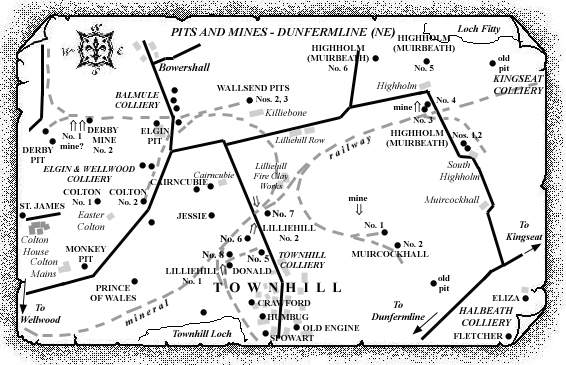 |
| See Townhill Colliery entry for general information. |
|---|
| Pit sinking: 1859 ? | Pit closed: November 1911. |
|---|---|
| Source Date of
Information Supplied
Manager / Under-Manager / Men underground / Men above ground / Coal seams worked / Shaft Details |
|
| 1873 (Townhill Coal Co.) | |
| George Hogg / ------------ / --- / --- / Splint; Five feet / D'cast (12 x 5) 372 ft. : U'cast (10 x 5) 270 ft. | |
| 1874 (Townhill Coal Co.) | |
| George Hogg / ------------ / 79 / 13 / Splint; Five feet / D'cast (12 x 5) 372 ft. : U'cast (10 x 5) 270 ft. | |
| 1875 (Townhill Coal Co.) | |
| W. Moody / ------------ / 86 / 17 / Splint; Five feet / D'cast (12 x 5) 372 ft. : U'cast (10 x 5) 270 ft. | |
| 1876 (Townhill Coal Co.) | |
| W. Moody / ------------ / 87 / 15 / Splint; Five feet / D'cast (12 x 5) 372 ft. : U'cast (10 x 5) 270 ft. | |
| 1877 (Townhill Coal Co.) | |
| James Wyllie / ------------ / 98 / 15 / Splint; Five feet / D'cast (12 x 5) 372 ft. : U'cast (10 x 5) 270 ft. | |
| 1878 (Townhill Coal Co.) | |
| James Wyllie / ------------ / 78 / 12 / Splint; Five feet / D'cast (12 x 5) 372 ft. : U'cast (10 x 5) 270 ft. | |
| 1879 (Townhill Coal Co.) | |
| James Wyllie / ------------ / 17 / 9 / Splint / D'cast (12 x 5) 372 ft. : U'cast (10 x 5) 300 ft. | |
| 1880 (Townhill Coal Co.) | |
| James Wyllie / ------------ / 4 / 3 / Splint / D'cast (12 x 5) 372 ft. : U'cast (10 x 5) 300 ft. | |
| 1881 (Townhill Coal Co.) | |
| James Wyllie / ------------ / 14 / 6 / Splint / D'cast (10 x 5) 360 ft. : U'cast (10 x 5) 300 ft. | |
| 1882 (Townhill Coal Co.) | |
| James Wyllie /
------------ / 16 / 6 / Splint / D'cast (11 x 5) 360
ft. : U'cast (10 x 5) 300 ft.
One fatality recorded. |
|
| 1902-07 (West of Fife Coal Co.) | |
| Mr Thomas Borland, manager, in post 1902. | |
| 1911 (Townhill [Dunfermline] Collieries, Limited) | |
| Nov: No. 6 pit being discarded - No. 7 pit fully re-opened with electrical installations. | |
---------------------------------------------------------
| Plans of Abandoned Seams for Townhill No. 6 | Pits or Mines designated in Plans |
|---|---|
| COAL; Five Feet; Splint (January, 1883) | Townhill No. 6 |
| COAL; Five Feet; Eight Feet; Splint | Townhill Nos. 6, 7, 8; Crawford; Donald |
| COAL; Upper Eight Feet; Lower Eight Feet (December, 1911) | Townhill Nos. 5, 6, 7, 8; Crawford; Donald |
| COAL; Splint (1883); Five Feet (1904); Eight Feet; Swallowdrum (1907); Upper Four Feet (1908); Ell (1923); Bright; Cairncubie (1924); Little Splint; Six Feet. | Townhill Nos. 5, 6, 7, 8; Crawford; Cube; Donald; Humbug; Whitefield |
| COAL; Six Feet; Cairncubie; Swallowdrum; Ell; Upper Bright; Lower Bright (November, 1925) | Townhill Nos. 6, 7, 8; Donald |
---------------------------------------------------------

Supplement: "Dunfermline Press"
1 June, 1861
ACCIDENT AT TOWNHILL COLLIERY
Through the kindness of Mr. Kilgour we have been favoured with a copy of a letter transmitted by Mr. Christie to the Lord Advocate, stating the particulars of the late fatal accident at Townhill Colliery, reported in our impression of Saturday:-
Townhill Colliery,
Dunfermline,
25th May, 1861
My Lord,
I have to report the death of William Dow, who lost his life
at the pumping engine of No. 6 Pit here yesterday afternoon.
He was employed with other workmen fitting up a winding
engine at the above pit, and when the others were busy
working, he left the place he was engaged at, and went
outside of the wall of the pumping crank then in motion, and
unobserved by any person, placed himself so near it that he
was struck by the turn of the crank and killed on the spot.
It is quite unaccountable how he should have gone there, as
he had nothing whatsoever to do at that place.
(Signed) A. Christie
------------------------------------
"Dunfermline Press"
29 May, 1869
On the afternoon of Saturday last an accident of a serious
nature occurred to a young man named John Hynd, a collier in
No. 6 Pit of the Townhill Colliery. From what can be learned
of the circumstances it appears that the unfortunate man had
been busily engaged at his work, and was in the act of
filling his hutch with coal. The tub was well filled, but
Hynd was still building some more pieces on the top of it
when a large stone, weighing several hundredweights, fell
from the roof and struck him on the back of the head. By the
force of this blow on the back of the head it made the poor
man's face fall forward, and by doing so he was severely
cut by the coals in the tub along the forehead, and had a
small hole driven in through his nose. The wounded man was at
once taken home, and the assistance of three medical
gentlemen was soon obtained, who, while they were engaged in
dressing the unfortunate man's injuries, found a piece of
the stone still sticking in the back of his head.
We understand he is now progressing as favourably as can be
expected under the able treatment of Dr. Douglas.
------------------------------------
"Dunfermline Press"
27 November, 1869
MELANCHOLY ACCIDENT AT TOWNHILL COLLIERY - TWO MEN
KILLED
Last night a very melancholy and fatal accident occurred
at No. 6 Pit, belonging to the Townhill Coal Company, whereby
two miners lost their lives, and other two made a very narrow
escape. It appears that the four men, whose names are Adam
Hynd, Alexander Hynd, James Milne, and William Burt were
working a piece of coal in company. They had last night
descended the pit to take down their brushing, and about
eight o'clock, while the men were so engaged, a larger
piece of the roof consisting of a stone, measuring somewhere
about twelve feet long, three feet broad, and nearly six
inches thick, suddenly broke off, and fell a distance of nine
feet upon Adam Hynd and James Milne, while the other two
escaped without injury.
With the exception of his head and neck, Hynd's body was
completely covered by the stone, so that death in his case
must have been instantaneous. The stone struck the lower part
of Milne's body, lacerating him fearfully, and inflicting
fatal internal injuries.
The companions of the unfortunate men used every means to
extricate them, but they were unable to do so, and had to go
to the pit-head for assistance. Upon the removal of the
stone, Hynd was taken up dead, and Milne was found to be
badly crushed and bleeding profusely. He was at once removed
to his residence, in Water Row, Townhill, and immediately
attended to by Dr. Douglas, who used his utmost skill for the
recovery of the wounded man but he never rallied and died in
about an hour afterwards. He has left a wife and four young
children to mourn his loss. Hynd was married only a few
months ago, and resided in Rumblingwell, where his body was
conveyed in a cart. From the appearance which the roof
presented before the accident, no persons, however
experienced, could have anticipated such a sad result. The
accident has cast quite a gloom over the miners in this
locality, and much sympathy is at present felt for the
bereaved.
----------------------------
"The Scotsman"
29 November, 1869
DUNFERMLINE. - Melancholy Death of Two Miners. - On Friday evening,
a little after seven o'clock, a fatal accident occurred at No. 6 Pit, belonging to the
Townhill Coal Company, whereby two miners, named James Milne, residing at Water Row,
and Adam Hynd, residing at Baldridgeburn, lost their lives; and two others, named
Alexander Hynd (a brother of the above), and William Burt, had both a narrow escape.
It appears that the four men had been employed in No. 6 Pit taking down rubbish from
the roof of an eight-feet seam of splint coal, and were in the act of driving a wedge in
between the rubbish and the roof, which was supposed to be solid rock, when a stone
measuring 10 feet in length, about 3 feet in breadth, and 6 inches in thickness, suddenly
fell upon Milne and Adam Hynd. The other two men escaped without injury, and immediately
took steps to extricate the unfortunate men, one of whom (Hynd) was able to speak once
to his brother before his voice was stilled in death. The utmost exertions of the two were
unequal to removing the heavy stone, and Burt came to the pit head to obtain assistance.
Upon returning to the pit, and removing the stone, it was found that Adam Hynd was dead.
The whole of his body, with the exception of the head and neck, had been covered by the
stone, and death, though not instantaneous, must have been almost so. Milne was alive
when taken out of the pit about nine o'clock, and was quite sensible, and spoke
to the men who carried him home. The injuries he had sustained were of the most
distressing nature, and notwithstanding the utmost efforts of Dr Douglas, who had been
sent for, he died in half an hour after being brought home.
Milne was 29 years of age, and has left behind him a widow and four young children;
Hynd was twenty-two years of age, and has left a young widow, who will shortly
become a mother. Much sympathy has been felt for the bereaved.
------------------------------------
"Dunfermline Press"
22 January, 1870
THE LATE COLLIERY ACCIDENT AT TOWNHILL
The subscribers to the fund raised for the benefit of the sufferers by the late fatal accident at the Townhill Colliery will be glad to learn that a committee meeting was held on the evening of Tuesday last, for the purposes of winding up the affairs of the subscription. The whole amount received by the committee was £77, 9s. 6d. - of this sum Mrs. Hynd has been paid £10 in cash, and Mrs. Milne has got a mangle, which cost £5, and £3 in cash; while the other £2 is to be given her when required. After deducting the above, along with the expenses, the remainder of the money, which is £53, 3s. 5d. was agreed to be placed in the bank for the benefit of the children of the late James Milne, and to be given them at the rate of four shillings per week so long as it lasts. The committee beg to tender their thanks to the subscribers for the amount received, and trust that the arrangement come to by them will meet the approbation of all.
------------------------------------
"Dunfermline Press"
12 November, 1870
On Tuesday morning an accident occurred in No. 6 Pit, Townhill Colliery, whereby a miner named John Anderson, residing in Pilmuir Street, was severely injured. It appears that he had just taken away a quantity of coal from the face, when a large stone unexpectedly fell upon him, crushing him severely about the lower part of the spine, and breaking his left leg in two places near the ankle joint. The poor fellow was at once conveyed home, where Dr. Douglas was awaiting his arrival and dressed his wounds.
------------------------------------
"Dunfermline Press"
1 July, 1871
On the afternoon of Wednesday, an accident of a rather serious nature happened at Townhill Colliery. It appears that two men named McIntosh (father and son) were engaged at the face in No. 6 Pit, when a large quantity of "blae" suddenly gave way and buried the men beneath it. Fortunately, several men were working close by, and they ran at once to render what assistance they could in the circumstances; by dint of great exertion, they managed, in about 5 minutes, to extricate both father and son from the very perilous position in which they were placed. It was found that the father had escaped without a mark, but with the son the case was different, as he sustained such injuries (chiefly spinal) as rendered it necessary for him to have the close attendance of a medical gentleman - Dr. Douglas, Dunfermline.
------------------------------------
"Dunfermline Press"
5 October, 1872
On the forenoon of Monday, a man named John Allan met with his death by accident in No. 6 Pit, Townhill Colliery. He was engaged in grooving a block of coals (of about 24 cwt.) at the face, and while sheering it at the bottom the piece gave way, and buried him beneath it, the result being that he was killed on the spot. The body was extricated in about ten minutes after the accident and conveyed to the house in which the deceased resided with his father. Dr. Douglas was quickly in attendance but at once saw that death had taken place (as we have already stated) almost instantaneously. Allan was about 20 years of age, and unmarried.
------------------------------------
"Dunfermline Press"
29 March, 1873
A man named Patrick Glancy met with a rather serious accident in No. 6 Pit, Townhill Colliery, on Monday afternoon. He was working at the face when a lump of blae fell from the roof and knocked him down in such a manner that his pick was forced right through his left leg. Dr. Douglas was in immediate attendance, and had the wound dressed.
------------------------------------
"Dunfermline Press"
29 November, 1873
On Monday, a lad named James McIntosh, met with an accident in No. 6 Pit, belonging to the Townhill Coal Company. He was engaged in attending to some hutches which were being drawn up an incline, when, in some way, one of the hutches lost coupling, and running back, jammed the unfortunate lad between it and the "post". The consequence was that McIntosh got his left thigh bone broken. He was promptly attended by Dr. Douglas, who set the broken limb.
------------------------------------
"Dunfermline Press"
24 April, 1875
On Saturday morning, a lad named George Robertson met with a serious accident while employed in No. 6 Pit, Townhill Colliery. He was attending a train of hutches which was being conveyed from the level at the top of the engine incline, when three of the hutches lost coupling, and carried him down for about 30 yards - the result being that he sustained fracture of the skull and other injuries. He was very promptly attended by Dr. Douglas, and we are glad to say that he is now in a favourable condition.
------------------------------------
"Dunfermline Press"
29 July, 1876
On Thursday a man named David Burt was injured in No. 6 Pit, Townhill Colliery, by a quantity of blae falling on him from the roof.
------------------------------------
30 December, 1876
On Saturday morning, while Thomas Robertson, brusher, was
employed in No. 6 Pit, Townhill Colliery, a large quantity of
blae came suddenly down upon him - crushing him against the
wall on the high side of the level. He was speedily conveyed
to his place of residence, where he was attended by Drs.
Dewar-Durie and Drysdale.
It was found that Robertson had sustained fracture of his
left shoulder bone, and other injuries of a serious
nature.
------------------------------------
"Dunfermline Press"
22 April, 1882
About half-past one o'clock on Wednesday afternoon, an accident, which resulted fatally, occurred to William Allan, miner, Townhill. At that time, Allan was engaged in a lying position in "holing" in No. 6 Pit, of the Townhill Coal Company, when a large mass of coal parted from the roof and fell upon him. The accident was noticed by several of his fellow-workmen, who at once ran to his assistance; but when extricated, Allan, though alive, was found to be fast sinking, and before he could be conveyed to his home had expired. Allan was 53 years of age, and has left a widow and large family, most of whom are grown up. He was passionately fond of music and was long connected with the Elgin Instrumental Band, of which for a time he was the leader. It was mainly owing to his efforts that the Townhill Band started a number of years ago, and he has all along continued an active member of it.
----------------------------------------------
"Dunfermline Press"
3 April, 1897
Two of the victims of the Devon Pit disaster [in which six men were drowned] belonged to Townhill. The names of the unfortunate men were Peter Allan, the pit oversman, and his brother David. The former was 39 years of age, was married and leaves a widow and eight children. David was unmarried. The mother of the deceased resides in Stable Row, Townhill. Much sympathy is felt for Mrs Allan, particularly in view of the fact that her husband was also the victim of a colliery accident - he having met with his death in a Townhill pit fifteen or sixteen years ago.
----------------------------------------------
"Dunfermline Press"
7 January, 1899
A pitheadman met with a terrible death yesterday
at No. 6 Pit, Townhill Coal Company, Limited. At half-past three
o'clock in the afternoon, John Williamson, residing at 163
Baldridgeburn, Dunfermline, was engaged with four other men in
lowering a pony down the shaft. The cage was removed, and the pony
was to be let down in a net. Just as the engine was about to raise
the pony preparatory to lowering it to the pit bottom, Williamson
was standing at the pony's shoulder, and when the engine was
set agoing he was lifted bodily off his feet along with the pony.
It is thought that one of his hands had, in some way or other, got
entangled in the net. He was swung over the mouth of the open
shaft, four feet above the level of the plates. Before there was
time to pull the tail rope attached to the net, or even almost to
realise what had happened, the unfortunate man lost his hold and
was dashed to the bottom of the shaft, a distance of sixteen
fathoms. There were some men underground at the time waiting to
receive the pony. They heard a rumbling noise in the shaft, and
fearing that something was wrong they stood out of the way. On
going forwards afterwards they found Williamson lying in an
apparently lifeless condition. Meanwhile, the cage by which the
miners ascend and descend the shaft had been replaced, and some men
went below. Williamson was brought to the surface without loss of
time, and conveyed to the Dunfermline Cottage Hospital, where he
was seen by Drs Drysdale and Tuke.
The unfortunate man died within an hour or so
after his admission to the hospital. His head had been badly
injured, and one of his legs was broken, as also one of his arms -
the body being in a terribly mutilated condition. Williamson was
about thirty years of age. He was married, and leaves a widow and
one child.
------------------------
"Dunfermline Press"
28 January, 1899
The Fatal Accident Inquiry into the death of
John Williamson, pitheadman, Baldridgeburn, was held in Dunfermline
Sheriff Court. Among those giving evidence were:- Robert Robertson,
manager; Charles Parker, pitheadman, Water Row, Townhill; Robert
Beveridge, pit-inspector, Kingseathill; William Beveridge,
blacksmith, Old School Row, Townhill; William Beveridge, Lochview
House, Townhill; and, James Gray, oversman, Whiting Row,
Townhill.
The Jury found that the deceased was killed
by falling down the shaft of No. 6 Pit, Townhill Colliery, when
assisting to lower a pony to the bottom.
--------------------------------------------------
--------------------------------------------------
"Dunfermline Press"
15 June, 1901
In No. 6 Pit, Townhill Colliery, on Thursday, David Weir, nineteen years of age, a hanger-on, residing at Music Hall Lane, Dunfermline, met with an accident which might have been attended with more serious results. He was knocked down by a hutch at the foot of the brae in the underground workings, and was jammed against the building. His left leg was severely bruised, but Dr Tuke, who attended to him, found that no bones were broken.
--------------------------------------------------
"Dunfermline Press"
19 April, 1902
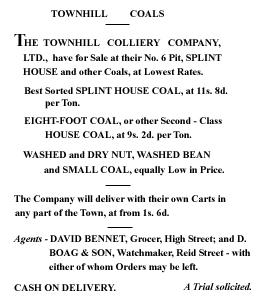
TOWNHILL COALS
........
REDUCTION IN PRICES
THE WEST OF FIFE COAL CO., LTD.
(formerly The Townhill Colliery Co., Ltd.)
have for Sale at their No. 6 Pit, SPLINT HOUSE and other Coals, at Lowest Rates.
Best Sorted SPLINT HOUSE COAL, at 12s 6d per Ton.
EIGHT-FOOT COAL, or other Second-Class HOUSE COAL, at 11s 8d per
Ton.
Best SCREENED STEAM COAL, 10s 10d per
Ton.
.........
The Company will deliver with their own Carts in any part of the Town, at from 1s 6d to 2s per Cart extra.
.........
Agents - DAVID BENNET, Grocer, High Street; and D. BOAG & SON, Watchmakers, Reid Street - with either of whom Orders may be left.
.........
CASH ON DELIVERY. A Trial solicited.
--------------------------------------------------
"Dunfermline Press"
4 October, 1902
William Simpson, employed as an engineer at Townhill Colliery, was fatally injured on Thursday morning. He had been repairing a joint in a steam pipe at No. 6 Pit, while some waggons were being shunted in the vicinity. There being no one in the immediate neighbourhood to assist in the shunting operations, Simpson undertook the duty. He put in a prop into the first waggon, and was in the act of inserting another prop, measuring 4½ feet in length, into the second vehicle when the spokes of the wheel caught the point of the prop and forced backwards the end which he held in his hands. He was thrown below the wheel, which passed over his shoulders, and he was killed instantaneously. Simpson, who was 26 years of age, was married and is survived by a widow and one child.
---------------
"Dunfermline Press"
25 October, 1902
This issue carried a Report of the Fatal Accident Inquiry held before Sheriff Gillespie and a Jury in Dunfermline Sheriff Court on Monday, into the death of William Simpson, on 2nd October, at Townhill No. 6 Pit. Those giving evidence included:- Thomas Borland, colliery manager, Woodside House, Townhill; John McQueen, pithead labourer, Pittencrieff Street, Dunfermline; John Lunn, pithead labourer, Dunfermline Model Lodging-House; and Alexander Wishart, shunter, 122 Rose Street, Dunfermline. The Jury returned a formal verdict.
-------------------------------------------------
"Dunfermline Press"
4 August, 1906
For some time a redding bing at No. 6 Pit, Townhill, of the West of Fife Coal Company, has been on fire.
-------------------------------------------------
"Dunfermline Press"
13 October, 1906
WEST OF FIFE COLLIERIES
WHAT IS PORTENDED?
Important changes are about to take place in connection with the management of the West of Fife Coal Company. The first fact that has become public is that Mr Robert Leitch, who from his boyhood was associated with the commercial department of Townhill Colliery, under the late Mr John Stevenson, and had afterwards a controlling power, is to resume duty at an early date at Townhill, in which he has more than a personal interest. The second fact is that Mr Thos. Borland, who was at one time colliery manager at Halbeath, has been appointed to superintend operations not only at Townhill, but at Saline Valley. ...
-------------------------------------------------
H. M. Inspector of Mines Report 1907
Mr. Robert McLaren's Report
Fatal Accident at Townhill No. 6 Pit
Owner: West of Fife Coal Co., Ltd.
13 May, 1907
George Henderson, 42, Boiler
fireman.
A boiler exploded at No. 6 Pit, Townhill, Fife, whereby one man was killed. There were four boilers in the range, all of the cylindrical egg-end type, of different sizes, coupled together, with a working pressure of 45 lbs. per square inch.
On the morning of the accident - Monday - the furnaceman,
George Henderson, who had worked his long turn, agreed to
remain on duty. His duties were to keep up steam and attend
to the water in the boilers. Each boiler in the range was
fitted with a float, in addition to a glass water-gauge, but
for some time prior to the accident there had been no glass
in the water-gauge of the boiler which exploded.
The pit appeared to be short of boiler power, and
consequently there was difficulty in keeping up a regular
supply of steam. About 4.30 p.m. one boiler - the outside one
of the range - suddenly exploded, and divided into three
parts, one part, the largest, going a distance of fully 70
yards, and wrecking the chimney in its passage, a second part
going in the opposite direction, and destroying the pithead
scaffold, and a third part went against the wall of the stoke
hole. Deceased was found on the stairs at the stoke hole.
An examination of the parts showed that the cause was overheating due to shortness of water.
The Board of Trade Commissioners, after hearing evidence,
concluded that:-
(1) "If a new glass water-gauge had been fitted
to the boiler, so that Henderson could, by a glance, have
ascertained the level of the water, or,
(2) if Henderson had not been allowed to work for
nearly 36 hours on end, the explosion would not have
occurred."
There was no reason why the glass should not have been
fitted into the water-gauge, immediately after it had broken,
and the engineman was seriously at fault in not having this
done. At every pit the furnaceman has to work a long turn to
change the shifts, and during the Sunday and Sunday night the
work is comparatively light as compared with the winding
shift. It is quite a common thing for a workman to stand an
extra shift, in order to oblige his neighbour, without any
hardship except that a few hours sleep are lost, but the most
important reason is that if a man did not occasionally work
an extra shift, when a particular man fails to turn out to
his work, the operations would cease for the day to the loss
of all concerned. The deceased man volunteered to do the
work, and considering the easy shifts he had on the two
shifts previous, he was quite able for the work.
I do not think the manager was in any way to blame.
-------------------------------------------------
"The Scotsman"
14 May, 1907
SERIOUS BOILER EXPLOSION.
MAN KILLED : OTHERS INJURED.
Havoc was wrought yesterday afternoon at the West of Fife Coal
Company's No. 6 pit, Townhill Colliery, through a boiler explosion.
The few men who were at the time engaged at the pithead were almost
paralysed, and some rendered temporarily unconscious. Two men, who
were in charge of a cart loaded with pit props, were blown a distance of
about a dozen yards along with the horse, whose skull was pierced.
Beyond shock these men appeared to suffer little injury. The west-most
portion of the boiler, which remained almost intact, flew in a westerly
direction. In its course, which did not seem to be much impeded, it struck
the base of the chimney stalk, a square structure standing from fifty to sixty
feet high, and landed fully 100 yards further on. The stalk fell in various
directions, and the bricks were shot long distances away. Two or more
of them broke the windows of the winding engine-house, and John Bell,
the engineman, received a violent blow on the right arm.
Robert Tosh, a shunting engineman, was in the haulage engine-house
when he heard the unusual noise, and on rushing out he was struck
on the back of the head by a flying brick. William McLean, a labourer,
who had been engaged in clearing the fireholes, had a marvellous escape,
having temporarily left the boiler-house only a few seconds before the explosion
occurred.
Not long after the outburst it was discovered that George Henderson, the
boiler fireman, was missing. An hour elapsed, however, before his body was
recovered from among the rubbish on a short stair leading down to the boilers.
About 200 men are thrown idle.
-------------------------------------------------
"Dunfermline Press"
8 June, 1907
TOWNHILL - THE RECENT EXPLOSION
A start has been made with the erection of the chimney stalk at No. 6 pit, Townhill, and the boilers will be forward next week. The pithead frame is now connected by a new construction, which will soon be completed.
-------------------------------------------------
"Dunfermline Press"
27 July, 1907
The reconstruction of the No. 6 pithead and the work in connection with the new boilers has this week been practically finished. The air fanners have been going all the week, and squads of the miners resumed work on Thursday to clear up the roads and the parts of the workings that have subsided during the time that has elapsed since the boiler explosion in the month of May. It is expected that work in the pit will be in full swing by the end of another week.
-------------------------------------------------
"Dunfermline Press"
18 January, 1908
On Saturday morning, Betsy Adamson or Philp, residing with her brother in Main Street, Townhill, narrowly escaped serious injury. She was employed as a pithead worker at No. 6 Pit, and was engaged pushing empty hutches on the cage. Owing to a difficulty in getting a full hutch to run off the cage, she got in between the empty and the full one, and was pushing the latter tub when the cage was lowered away and she overbalanced herself and fell into the tub on the descending cage. She had a boot torn off and was bruised a little, but she was able to walk home.
-------------------------------------------------
"Dunfermline Press"
21 March, 1908
Mr John Walker, engine-keeper at No. 6 Pit, Townhill, received the present of an easy chair from his fellow-workers on the occasion of his marriage.
-------------------------------------------------
"Dunfermline Press"
18 September, 1909
On Tuesday evening, Thomas Campbell, miner, Townhill, while working at the coal cutting machine in the No. 6 Pit of the Townhill Colliery met with an accident, his left leg being fractured above the knee, as the result of a stone falling upon him.
-------------------------------------------------
"Dunfermline Press"
19 March, 1910
Thomas Harrower (14), son of John Harrower, joiner, Back Row, Townhill, met with a bad accident in the West Fife Coal Company's No. 6 Pit on Wednesday morning. As engine haulage boy, it was Harrower's duty to take rakes of loaded hutches from the face to the pit bottom, his custom being to ride on the rear hutch. Between nine and ten o'clock on Wednesday, just as he had signalled a rake of full hutches away, his light was extinguished, and in the darkness he was knocked down, and dragged along the side of the road for a considerable distance. The boy, who was seen to have been badly hurt, was taken home. Dr Dalgleish, who was called, found him suffering from several fractured ribs, one of which had apparently penetrated the left lung. There was also a lacerated wound on the left side.
-------------------------------------------------
"Dunfermline Press"
18 June, 1910
A striking illustration of the danger of the pit was afforded in No. 6 Pit, Townhill Colliery, yesterday forenoon. Shortly before eleven o'clock an extraordinary roof movement took place at a point between the pit bottom and a number of faces at which nearly thirty men were at work. It was in the haulage road, where the roof is six feet high, that a fall took place. The strata which was dislodged completely cut off the ordinary means of communication between sections of the pit; and the men, among whom a good deal of alarm was naturally created, had perforce to resort to the return airway in order to effect their escape. As a result of the fall, operations at the pit were suspended for the day. It is expected that the haulage road will be cleared in time for the resumption of work this morning.
-------------------------------------------------
"Dunfermline Press"
23 July, 1910
It is reported that a fire at No. 6 Pit, Townhill, set light to an upright wooden support of the scaffolding. The actual damage caused will, it is said, not exceed £50, one coal screen and other parts of the scaffolding being destroyed.
-------------------------------------------------
"Dunfermline Press"
1 April, 1911
Robert Stewart, miner, Chisholm's Crescent, Townhill, had his left collar bone fractured in No. 6 Pit, Townhill, on Wednesday. Stewart was struck by a piece of coal and stone which came away from the roof.
-------------------------------------------------
"Dunfermline Press"
10 June, 1911
David Hutton Lindsay, a haulage engineman, residing at Viewfield Place, Townhill, was admitted to the Dunfermline and West Fife Hospital on Tuesday morning suffering from terrible injuries received at No. 6 Pit, Townhill Colliery. Lindsay was drawing empty waggons to the pithead, when something went wrong with his engine, which stuck. In an endeavour to restart the engine he put his left foot on a spoke of the fly-wheel. Just as he did so the engine went off suddenly. The result was that Lindsay's leg was dragged into the fly-wheel, and he was carried round the wheel several times before being thrown clear. Mr Shepherd, the manager of the pits, and George Robertson, the pitheadman, discovered Lindsay at the door of the engine-house in a state of collapse. In addition to having received severe abdominal injuries, the left leg was completely shattered. On Lindsay's admission to the hospital, Dr Tuke found it necessary to amputate the injured limb below the hip joint.
----------------------------------------------
"Dunfermline Press"
18 November, 1911
TOWNHILL COLLIERY DEVELOPMENTS.
AN ELECTRICALLY DRIVEN PIT.
No. 7 Pit, Townhill, which was shut down eight years ago, has now been put in complete operation, and No. 6 pit, through which all the coal from the Townhill field was drawn, has been discarded. By the Townhill (Dunfermline) Collieries, Limited, an up-to-date electric installation has been introduced at No. 7, the winding and haulage in connection with which is wholly done by means of electric power. This is the first pit in Fife which is being wrought electrically. The pit may be described as a smokeless one, by reason of the fact that boilers and chimney stalk are dispensed with. Already the output in which the three upper seams are being wrought is about 220 tons per day. The Company expect that gradually the quantity of minerals brought to the surface will exceed 400 tons daily.
-----------------------------------------------
