Owners: NCB
Torry Mine was being
developed around 1951 and opened in 1953. It was located to
the north of the Valleyfield Colliery and to the north of the
Newmills-High Valleyfield road, just past the bridge over the
burn. There were no serious buildings on site, just the mine
entrance into the ground.
The coal from Torry Mine is believed to have been taken
straight to Valleyfield for sorting, etc. There is some
suspicion of a link under the road probably dating from the
1940s which was likely of short duration. This Torry mine
worked the Blairhall Main Coal to the north, the larger
Valleyfield Colliery to the south mining under the River
Forth and eventually joining up with Kinneil Colliery,
Bo'ness, on the other side of the River Forth.
Torry Mine was closed in June,1965.
 |
 |
| Mine developing: 1951 | Mine closed: June, 1965 |
|---|---|
| Source Date of Information Supplied | |
| Manager / Men underground / Men above ground / Coal seams worked | |
| 1952 (NCB) | |
| Mar: Mr A. Gibson, formerly assistant sub-area planning engineer, Fife area, to be manager. | |
| 1953-55 (NCB) | |
| A. Gibson / 31 / 13 / Developing. | |
| 1956 (NCB) | |
| W. W. Scott / 31 / 13 / Developing. | |
| 1957 (NCB) | |
| (Vacant) / 161 / 22 / Blairhall Main Coal. | |
| 1958/59 (NCB) | |
| Mr Norman Wallace / 168 / 22 / Gas, household, industrial and steam coals. Blairhall Main. | |
| 1960 (NCB) | |
| Sep: Mr N. Wallace appointed manager, Valleyfield Colliery. | |
| 1961 (NCB) | |
| Mr J. Tilston /
170 / 24 / Gas, household, industrial and steam coals.
Blairhall Main. Jan: Departure of Mr James Gay, under-manager. |
|
| 1964 (NCB) | |
| G. Wilson / 168 / 23 / Gas, household, industrial and steam coals. Blairhall Main. | |
| 1965 (NCB) | |
| Jan: George
Wilson, moved to manage Blairhall Colliery. Mr John Quinn, oversman, appointed acting manager of Torry Mine. |
|
--------------------------------------------------
"Dunfermline Press"
9 September, 1950
BORING FOR NEW MINE
Development Near Blairhall
The possibility of further mining developments to the west of Dunfermline
has been identified by boring operations which have been proceeding for
some time between Blairhall and Valleyfield.
It is understood that this work is in connection with the opening of a new
surface drift mine on the west side of the road.
The policy of developing drift mines to tackle seams of coal near the
surface was strongly advocated by the Fife Coal Company, Ltd., who
opened one of the first mines of its kind at Benarty, where remarkable
figures of man-shift production have been achieved.
The success of this mine led to developments of a similar nature in other
parts of the county, and as a result valuable contributions have been
made to coal production.
-----------------------------------------------
"Dunfermline Press"
28 October, 1950
PLANS FOR NEW SURFACE MINE
Torrie Development to Employ 160 Men
Something new in surface drift mines in West Fife is to be developed to the
west of Torrie golf course, about half a mile north of Valleyfield Colliery.
A feature of the new mine will be that, as a result of careful planning, the amenities
of the countryside will be preserved, and, apart from one haulage house, there
will be no above-ground indication of mining operations.
Work on this new venture will be commenced by the Fife and Clackmannan
Area of the National Coal Board within the next two or three months. When it is
fully developed, the mine will give employment to 160 men for over 15 years.
Two Good Seams
The area to be worked by the Torrie Mine is stated to be virgin ground which has
been fully explored by diamond drilling, and two seams of good quality coal have
been proved. One seam, the Lowrie Graham, is three and a half feet thick, and
the other, the Milton Main, is four and a half feet thick. Both seams, while untapped
at that part, have been worked elsewhere, and particularly from the former Lord
Dundonald Pit, the shaft of which was situated between Valleyfield and Culross.
The need for a car gantry and coal preparation plant at the mouth of the mine is to
be obviated by the provision of Diesel locomotive haulage, which will establish a
direct link between the mine and Valleyfield Colliery.
Mine cars operating on a railway, which will pass through tunnelled ground at
various parts of the route, will convey the coal direct from the mine to the pit
yard at Valleyfield Colliery, where it will be screened and prepared for handling.
A further advantage of this arrangement will be that the workmen at the mine
will enjoy the facilities of the baths and canteen at Valleyfield Colliery.
The mine will be equipped and completely mechanised with modern machinery,
and will compare with other surface mines, which have shown such outstanding
results, and which have been held up as an example in short-term surface drift
mining.
-----------------------------------------------
"Dunfermline Press"
29 December, 1951
MINING DEVELOPMENTS IN WEST FIFE
... At a number of collieries in the district, reconstruction schemes have been started during the year, and work is proceeding at Valleyfield, Blairhall, Glencraig, and Fordell collieries. Work at Torrie surface drift mine has also begun. ...
-----------------------------------------------
"Dunfermline Press"
8 March, 1952
COAL BOARD APPOINTMENTS
The Scottish Division of the National Coal Board announce the following appointments:- Mr G. Farquhar, formerly manager, Cardowan, Central West; to be agent, Valleyfield, West Fife. Mr A. Gibson, formerly assistant sub-area planning engineer, Fife area; to be manager, Torrie, West Fife.
-----------------------------------------------
"Dunfermline Press"
12 July, 1952
Valleyfield Colliery Development
The considerable activity which is to be found in and around Valleyfield
Colliery is part of development and construction schemes which the National
Coal Board have recently embarked upon.
A beginning has been made with the driving of the surface mine at Torry,
half a mile to the north of Valleyfield Colliery. When the mine is ready to
begin production, it will be linked by tunnel, which will pass over the Bluther Burn,
and underneath the main Dunfermline-Kincardine highway before entering the
yard at Valleyfield Colliery.
The coal, in two-ton mine cars, will be drawn through the tunnel by 65 h.p.
Diesel locomotives, and in the colliery yard the coal will be belt-conveyed
into the screening and preparation plant.
Torry Mine is expected to have an output of 400 tons per day, and
production is earmarked to commence in 1954. ...
-----------------------------------------------
"Dunfermline Press"
20 December, 1952
DEVELOPMENT OF DRIFT MINES
Production Soon at Torry
Benarty, Blairenbathie, and the Lady Helen surface drift mines in West Fife
are making a considerable contribution to the four million tons of coal which are
produced annually in the Scottish coalfield by this method of mining.
The working of shallow seams of coal is nothing new. It has been practised in
one way or another for centuries. Today the mining engineer is applying modern
ideas of development to an old problem to achieve highly successful results.
Benarty mine, which was planned by the Fife Coal Company, Ltd., has always
been regarded as an excellent example of the modern surface drift mine, and if
its average output per manshift, which has been given at various times as 50 cwts.,
is not by any means a record for the county, it is undoubtedly achieving noteworthy
results.
MODERN LAY-OUT
Like Blairenbathie, Lady Helen - and two new mines which will come into
production at Torry, near Dunfermline, and Dundonald No. 2 - Benarty is
equipped with direct rope haulage and drop-bottom mine cars. This form of
transport has proved highly successful in cutting down non-productive labour.
The estimated average output per manshift of surface mines in the Scottish
Division which are equipped with this modern type of transport is 46 cwts.,
or double the overall average for all collieries and mines in the Division.
"With this type of drift," Mr H. R. King, Production Director of the
Scottish Divisional Board, recently remarked, "an overall output per
manshift of over 50 cwts is not uncommon, while a few exceptional cases
have yielded an overall output per manshift of over 70 cwts."
The surface lay-out adopted by the Division for these drift mines follows a
fairly uniform pattern designed to cut costs and facilitate speedy erection.
It is also possible to dismantle the plant and transfer it to a fresh site when
the coal becomes exhausted.
There is no indication that Benarty is approaching the end of its life-time, but
the new Dundonald mine will be a replacement for the Lady Helen mine,
and it will be surprising if the rich surface seams in West Fife are not further
tapped by new units.
CONTRIBUTION TO PRODUCTION
The value of the surface drift mine in the battle of production is the subject
of a statement issued by the National Coal Board Scottish Division. It states:-
"In Scotland there are substantial reserves remaining to be worked between
the surface and a depth of say 500 or 600 feet, the recovery of which has received
special attention, in order to increase output in the short term pending the construction
and development of the new deep sinkings. Fittings of the size and depth of Rothes, in
Fife, for example, take at least ten years to construct, whereas a new surface drift
mine may be developed and brought into full production in about two years, or
sometimes less.
"At vesting date some 55 surface drifts, producing about one-and-three-quarter
million tons annually, were taken over by the National Coal Board in Scotland; about
eight of these have since been worked out. Over and above the 55, eight drifts started
under private enterprise were classified as suitable for immediate attention in order to
increase their efficiency and output. By the end of 1947 there were 15 new or reconstructed
N.C.B. surface drift mines in operation. Encouraged by the high output returns obtained
from these new modern surface drift units, the Divisional Board have initiated many more
schemes of a similar type within the last few years, with the result that the number of
new surface drifts now in full production is 30.
"Summarising the position, there are still 47 of the older drifts in operation, producing
fully two million tons annually, plus 30 new drifts and eight reconstructed units with a
combined output of nearly another two million tons, making an output in all of some
four million tons per annum - equivalent to 17 per cent of the Division's entire output.
To the 38 new and reconstructed drifts now in production, there will shortly be added some
10 others which are under construction, while a further 10 new schemes are under
investigation, making a total of 58 either in production, under construction, or at the
planning stage.
"During the next few years, however, about a dozen of the existing drifts will
exhaust their reserves, leaving the programme to be carried on with an effective total
of approximately 46 drifts. While the present annual output of the new surface drift
programme of 38 reconstructed and new units is about two million tons, it is estimated
that in a few years' time the 46 effective modern drifts then available will be
producing between 3¼ and 3½ million tons a year. The productivity
of these modern surface drifts is very high, the average output per manshift being
around 34 cwts."
DEVELOPMENT PROGRAMME HAS BEEN SPEEDED UP
Development of the coal industry in Scotland is not in a markedly different position
from that of the rest of the country, it was stated in a written Parliamentary answer
which Mr W. Hamilton (Lab., West Fife) has received from Mr Lloyd (Minister of Fuel and Power).
Mr Hamilton had wanted to know to what extent capital development in the Scottish coal industry
was keeping pace with the scheme outlined in "Plan for Coal," and what were
the prospects for speeding up development in the next few years.
Mr Lloyd explained that the National Coal Board's capital expenditure had recently
been below the level envisaged in "Plan for Coal."
The board were doing all in their power, however, to accelerate their programme and
had made some improvement this year.
-----------------------------------------------
"Dunfermline Press"
27 December, 1952
Collieries Will Be Reconstructed
Modernisation Schemes ...
.... MINE WILL EMPLOY 230 MEN
The N.C.B.'s statement also refers to the development of Torry mine, with its many
interesting features and to the fact that the mine will have a life of 20 years, producing 400 tons
of coal daily and giving employment to approximately 230 men when in full production.
"With a view to greater efficiency and labour saving detailed examination of steam-raising
plants took place at various collieries, and it has been decided to install automatic chain grate
stokers at Valleyfield, Blairhall, Minto, and Nellie collieries. Contracts for these boilers have been
placed. The introduction of the chain grate stokers will cut coal consumption considerably.
Pneumatic rams have been installed on the surface at Aitken Colliery, Kelty, with good results.
The installation of pneumatic rams at other collieries is now under consideration. Orders have
been placed for several compressed air creeper rams and for tub vibrating platforms to be installed
at main tub landing points underground. These will be delivered early in the year and if successful
will be more widely applied where conditions are suitable in other pits in the Fife area. ....
-----------------------------------------------
"Dunfermline Press"
2 January, 1954
MAKING WEST FIFE PITS UP-TO-DATE
IN PRODUCTION THIS YEAR
... The development of Torry Mine, which is situated to the north of Valleyfield Colliery, will be completed and in production
towards the end of 1954. One of the dip mines driven from the surface has made contact with the Blairhall Main seam at
a depth of 72 yards. The driving of the companion mine to the surface is now proceeding.
The tunnel underneath the main Kincardine-Dunfermline public highway near Valleyfield Colliery has been completed.
The coal will be belt conveyed from the face and loaded into two-ton mine cars, which will be hauled up the dip mine in
sets of six by a 250 h.p. balanced rope hauler and transported along the level tunnel to Valleyfield Colliery by Diesel
locomotive. The coal will be tippled into a 20 ton hopper and conveyed to the existing screening plant. The reinforced
concrete pit which contains the hoppers will be completed this year. Thereafter a start will be made with the installation
of the conveying and car control equipment manufactured in the Cowdenbeath Workshops. ...
BORING DEVELOPMENTS
In order to prove the coal seams to the west of Valleyfield and Blairhall a deep bore is being drilled at Culross. Similar
deep bores have also been put down at Airth and Grangemouth. The results from these bores will provide valuable information
as to the depth, thickness, quality, and inclination of all the seams, and will enable decisions to be made as to the
possibility of future new sinkings in the area.
Culross Bore, which has been drilled to a depth of 410 fathoms, encountered some difficulty resulting in the loss of a
diamond boring crown at a depth of 350 fathoms. To prove all the seams the bore will require to be drilled to a depth of
600 fathoms.
Another bore has been started at Righead to prove the coal seams in a virgin area approximately two miles west of Blairhall
Colliery. The bore, now down 140 fathoms, proved the Jenny Pate seam to be 7 feet thick at 95 fathoms, will probably be
drilled to a depth of 500 fathoms to contact the lower seams.
-----------------------------------------------
"Dunfermline Press"
26 March, 1960
Pit Safety Awards In West Fife
Concern at the trend towards an increased accident rate in the mines was expressed at a dinner held
at West Fife Area Headquarters of the National Coal Board at Cowdenbeath when safety diplomas were
awarded.
Diplomas were presented to Minto Colliery, winners of the Area Safety League for 1959; and to Torry Mine,
which showed the best improvement for 1959 over the previous three years. ...
-----------------------------------------------
"Dunfermline Press"
10 September, 1960
Colliery Manager Honoured
Employees of Torry Mine held a presentation dinner and social evening in Torryburn Public Hall on Saturday to mark Mr N. Wallace's appointment as manager at Valleyfield Colliery. Mr Charles McLennan presided. ...
-----------------------------------------------
"Dunfermline Press"
14 January, 1961
Presentation To Mine Manager
On the occasion of his relinquishing the post of under-manager at Torrie Mine, a presentation
was made to Mr James Gay at a dinner and dance held by Torrie Social Club in Torryburn Public
Hall on Saturday. Mr Charles McLennan presided.
Mr J. Tilston, manager, presented a clock to Mr Gay. Messrs A. Dewar, N. Wallace, and A.
Dalgleish spoke of their happy association with Mr Gay during his period of service at Torrie Mine.
Messrs James Downie and Peter McCrossan officiated as M.C.s at the dance, for which music
was provided by D. Birrell's band. Arrangements were made by Messrs P. McCrossan, J.
Hunter, J. Pratt. A. Dewar, Jas. Downie, C. McLennan, and Jas. Smith (convener).
-----------------------------------------------
"Dunfermline Press"
27 January, 1962
Output Of Pits
The West Fife pits of the Alloa Area of the N.C.B. made their contribution
to the increase of around 1800 tons for the week ending 20th January over the
previous week.
Last week's production figure for the area was 58,169 tons, giving an
output per manshift of 30.7 cwts. The four West Fife pits made the following
contributions:- Blairhall, 7652 tons; Comrie, 8861 tons; Torry, 1008 tons; and
Valleyfield, 3939 tons. Their output per manshift was as follows:- Blairhall, 33.4 cwts;
Comrie, 32.9 cwts; Torry, 22.3 cwts; and Valleyfield, 16.5 cwts.
-----------------------------------------------
"Dunfermline Press"
24 March, 1962
Coal Output
Unofficial stoppages in three of West Fife's four pits in the Alloa Area of the N.C.B.
lost an estimated total of 7810 tons during the week ended 17th March. Three Clackmannanshire
pits were also involved in unofficial stoppages, so that the estimated loss of coal for the last week
was 15,720 tons. The amount of coal produced by the 13 pits in the area totalled 44,770 tons,
giving an output per manshift of 28 cwts.
The production and output per manshift for the West Fife pits were as follows:- Blairhall, 4152
tons and 24.9 cwts; Comrie, 6277 tons and 29.6 cwts; Torry, 961 tons and 25.2 cwts;
Valleyfield, 2873 tons and 16 cwts.
-----------------------------------------------

"Dunfermline Press"
6 October, 1962
Mine Fatality
David Millar, 10 Erskine Place, Clackmannan, died after an accident at Torry Mine last Friday. Millar, who was 57, was a shot firer at the mine. He received fatal injuries when there was a collision between full and empty mine cars in the main coal haulage road.
----------------------
"Dunfermline Press"
15 December, 1962
Mine Fatality
A formal verdict was returned by a jury at Dunfermline Sheriff Court on Monday at an inquiry into
the death of David Millar, shot firer, 10 Erskine Place, Clackmannan, who was killed in an accident
in Torrie Mine, Low Valleyfield.
The jury found that Millar died on 29th September in the underground workings of the mine from a
compound fracture of the skull, sustained by him when two sets of mine cars collided in the main
haulage dook.
-----------------------------------------------
"Dunfermline Press"
24 April, 1965
Torry Mine To Close
The first pit to use closed-circuit television in Scotland is to close down. Torry Mine
will cease production on 7th May, but there will be no redundancies.
Most of the 158 men at present employed at Torry will be transferred to the adjoining
Valleyfield Colliery. The remainder will find employment in other pits in the neighbourhood,
most probably at Comrie.
For some time after 7th May a number of the men will remain on at Torry to carry out
necessary salvage work. When that task is completed, they too, will be redeployed to
other pits. Torry was due to close on 22nd March, but it was decided that production
would continue so long as the pit could pay its way. A fortnight ago the men received
the legal 28 days' notice of the closure.
A year ago there were 188 men on the books of the mine, which then had a daily output
of 300 tons-plus of large, saleable coal. Since then, a number of men have been transferred
to Valleyfield and to Longannet Mine.
Although it draws its personnel from a wide area - from Kelty, Lochgelly, Crossgates,
Cowdenbeath and Ballingry - harmony has always reigned there, the mine being strike-free
and with the reputation of being a happy place of work.
Torry Mine opened a little over a decade ago, being one of a series of small mines
sunk in the area to meet the then tremendous demand for coal. It is the last in West Fife
of these small conventionally-worked drift mines. It is run independently of the adjoining
Valleyfield Colliery, but its output goes by tunnel, which passes under the main road,
to the Valleyfield plant for treatment.
Torry Mine slopes a distance of a mile to a depth of about 200 fathoms. There the 6-feet
thick Blairhall Main seam is worked, the coal being Grade 4 household.
Mining experts claim that Torry Mine has one of the finest set-ups for a drift mine to be
found anywhere. Coal is machine-cut and hand-loaded, and is brought up the mine in two-ton
mine cars with double-drum haulage of 800 yards distance in rakes of five. Diesel
locomotives pull the cars through a tunnel to Valleyfield Pithead where they are tipped
into either of two bunkers - one for redd (debris), the other for coal.
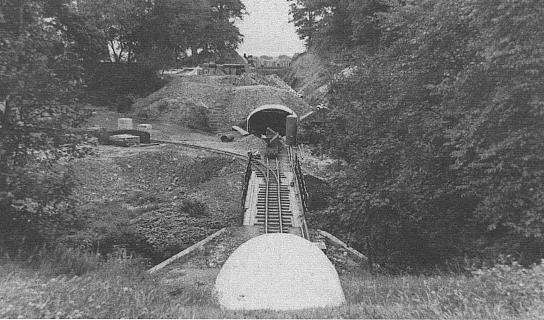
Torry Mine was linked with Valleyfield by driving a half-mile long, level tunnel through
a hill, bridging a burn, and underpassing a highway.
Its pioneer television installation released two or three men at the pit from the boring
job of watching a vibro-feeder. An "eye" must be kept on the vibro-feeder to
see that it does not become blocked, as it transfers from a chute to a conveyor belt,
so the process is monitored by a television camera, set above and a little to one
side of the feeder.
Camera, floodlights, etc., cost £700, but it paid for itself within nine months
of installation.
-----------------------------------------------
Some notes from James Wilson,
a retired miner from Oakley,
who has kindly supplied some
background to the small Fife Torry Mine.
"Drift mine - started 1950 when turf was
cut. The drift was driven 1 in 8 slope until seams were reached
when development of coal seams driven. Further development
occurred. In about 1956-57 production - 24 hour cycle - started
producing clean coal. It was cut in traditional way by coal-cutter.
Seams averaged 4 ft. - 6 ft. Rigid steel straps. Average of 20
strips per face line - approx 16 tons per strip - 320 tons. Only
one face produced at one time until others were developed. The coal
was hauled out of the mine by slope haulage (mine cars). Where the
coal was transported in level mine to (diesel) tumblers, where it
was tipped and taken by belt conveyor to tables at Valleyfield
Colliery to be washed.
The mine produced for 10-11 years to around
1965-66 when it closed. Torry Mine was driven between two main
faults between the Valleyfield and Blairhall Collieries.
It was proven to have been worked by monks near
the surface in an earlier period."

