The 'Dunfermline town coal pits', eventually to become the Townhill Colliery, were located to the north of Dunfermline. The minerals of the lands here belonged to the Burgh of Dunfermline and were leased to several individuals or companies over several centuries thus providing the Dunfermline Burgh with regular income.
| See also : Dunfermline - early coalworks |
|---|
The name 'Townhill Colliery' is also linked with
Appin or Whitefield during the 18th and 19th centuries. Typically,
Townhill Colliery lessees paid a royalty to the town of
Dunfermline of one tenth per ton, while the town burgesses
were allowed to purchase at a rate below the retail charge,
causing a loss of £400 in 1817, a sum greater than the
rent!
A number of small coal pits, about which little is known at
the present time, were obviously winning the coals in the
lands around Townhill many years before the appearance of the
larger, and more well-known, Townhill Nos. 5 - 9 pits and
Lilliehill mines.
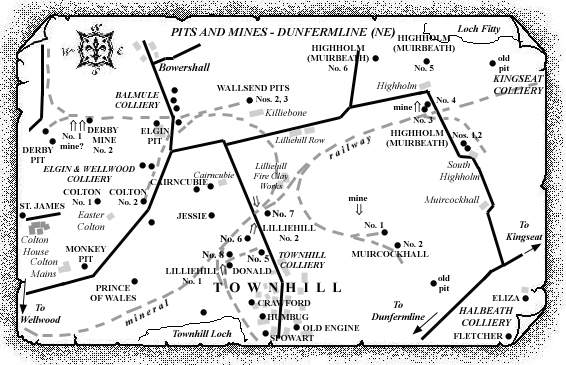
Pits or mines of the Townhill Colliery and surrounding area so far identified include:
Appin; Hutton; Loch; Lochside; March; Muir; Planting; Spowart; Jessie; Cairncubie; Humbug; Crawford; Cube; Whitefield; Townhill Nos. 5, 6, 7, 8; Donald (No. 9); Lilliehill Nos. 1, 2
 |
--------------------------------------------------------------
| Townhill - 18th C employees (dates when known at colliery) |
|---|
| Alexander
Williamson, coalhewer, Dec 1786. [Formerly at Knockhouse.] John Allan, coalhewer, Jul 1789 - Mar 1792. [Formerly at Northfod.] |
--------------------------------------------------------------
| Individual WEST FIFE INDEX entries for Townhill pits are on site but general information relating to facts and events of the Townhill Colliery which do not relate to a specific pit will be held in this entry. |
|---|
| Colliery opened: pits in 18th century (or earlier) | Colliery closed: 1925 |
|---|
| Source Date of
Information Supplied
Manager / Under-Manager / Men underground / Men above ground / Coal seams worked / Shaft Details |
|---|
| 1713
Dunfermline Burgh Records show that the Earl of Rothes borrowed colliers from the Burgh of Dunfermline to work in his coal mines further east in the county of Fife. |
| 1770
The sale of the small colliery at Townhill, and the lease of its minerals, advertised in a regional newspaper, apparently included "the colliers' houses, coal bearers and pertinents thereof," all for the price of £500! |
| 1810 (Townhill Colliery)
Robert Bald, mining engineer, wrote " ... this colliery is drained by a steam engine of the common construction cylinder 40 inches diameter, stroke 6 and a half feet; depth of pit 40 fathoms; 2 piles of cast-metal pumps; the lower level of 9 and a half inches diameter; two boilers 17 - 11 feet diameter ..." |
| 1815 (Townhill Colliery)
Robert Bald, mining engineer, proposed the expansion of the colliery. |
| 1825 (Townhill Colliery)
Townhill Colliery almost abandoned through Dunfermline council still refusing to agree that they, rather than a tenant, should fund the development, despite expecting the same or a larger royalty. |
| 1828 (Townhill Colliery)
" ... wrought at present only on a very small scale. " [Source : Mercer's History of Dunfermline] |
| 1838 (Dunfermline Coal Company) |
| 1840 (Townhill &
Appin Collieries)
A. F. Hopper, Manager / 84 employees (included 33 children/young persons) |
| 1842 (Townhill &
Appin Collieries)
A. F. Hopper, Manager [From Dunfermline Register] |
| 1848 (Town of Dunfermline
Colliery
Fifeshire Journal 18 May: letting of colliery advertised. |
| 1851-1855 (Townhill &
Whitefield Colliery)
Andrew Christie, Lessee [Dunfermline Registers] |
| 1856 (Townhill Colliery
Co.)
[Dunfermline Register] |
| 1857 (Townhill Colliery)
Andrew Christie, Lessee [Source : Hunts Mining Records] |
| 1858 (Townhill Colliery)
Andrew Christie, Lessee / 144 employees / Approx. annual output = 40,000 tons |
| 1859 (Townhill Colliery)
Andrew Christie, Lessee / new pit (No. 6 ?) sinking to the splint coal |
| 1861 (Townhill Colliery)
Andrew Christie [from Parochial Directory : Fife and Kinross] |
| 1869 (Townhill Coal Company) |
| 1870-1872 (Townhill
Colliery)
J. Stevenson, Manager |
| 1873 (Townhill Coal
Company)
George Hogg, Manager : Townhill Nos. 5, 6, 7 and Day Mine |
| 1874 (Townhill Coal
Company)
George Hogg, Manager : Townhill Nos. 5, 6, 7 and Day Mine Townhill No. 8 sinking. |
| 1875 (Townhill Coal
Company)
W. Moody, Manager : Townhill Nos. 5, 6, 7, 8 and Day Mine |
| 1876 (Townhill Coal
Company)
W. Moody, Manager : Townhill Nos. 5, 6, 7, 8, Donald and Day Mine |
| 1877/78 (Townhill Coal
Company)
James Wyllie, Manager : Townhill Nos. 5, 6, 7, 8, Donald and Day Mine |
| 1879/80 (Townhill Coal
Company)
James Wyllie, Manager : Townhill Nos. 5, 6, 7, 8, Day Mine, Donald - No. 9 |
| 1881 (Townhill Coal
Company)
James Wyllie, Manager : Townhill Nos. 6, 7, 8, 9 No. 7 Upcast by a Mine. |
| 1882 (Townhill Coal
Company)
James Wyllie, Manager : Townhill Nos. 6, 7, 9 or Donald 1 Fatality recorded at No. 6 Pit. |
| 1889 (Townhill Coal
Company)
Death of Mr Lacoure, partner with Mr A. Watson. |
| 1890 (Townhill Coal
Company)
James Wyllie, Manager : Townhill Nos. 7 and 8. |
| 1891 (Townhill Coal
Company)
April: John Sneddon, colliery clerk at Townhill for 13 years, died. October: Mr. James Wyllie, manager for 15 years, leaves Townhill Colliery. |
| 1893 (Townhill Coal
Company)
Mr James Strachan, manager. Mr John Stevenson, managing partner. |
| 1896 (Townhill Coal
Company)
James Strachan, Manager / 261 / 55 / Household, manufacturing & steam coals. November: Death of Mr John Stevenson, managing partner |
| 1897 (Townhill Colliery
Company, Limited) Formation of new company, headed by Mr Anthony Watson, to lease the Burgh minerals. |
| 1898
February: Mr Strachan, Manager, left to fill a similar situation at Brownhouse and Hughhouse Collieries, Uddingston. March: Death of John Stobie, 26 years farm-manager for Townhill Colliery Townhill No. 8 closed. |
| 1899
Townhill No. 6 refitted and reopened. |
| 1900 (West of Fife Coal
Co., Ltd.)
New Company formed to work Townhill minerals - also the Saline Valley Colliery. |
| 1901 (West of Fife Coal
Co., Ltd.)
Sept: Death of Mr Anderson Rodger, director and one of the principal shareholders in the Company. Mr Rodger acquired the lease of Townhill Collieries from the late Mr Anthony Watson, Leith. |
| 1902 (West of Fife Coal
Co., Ltd.)
Thomas Borland, Manager / 209 / 64 / Household, manufacturing & steam coals. |
| 1904 (West of Fife Coal
Co., Ltd.)
William Dryburgh, Manager / 303 / 65 / Household, manufacturing & steam coals. |
| 1905 (West of Fife Coal
Co., Ltd.)
---------- / ---------- / 164 / 44 |
| 1907 (West of Fife Coal
Co., Ltd.)
Boiler explosion with fatality at Townhill No. 6 |
| 1908 (West of Fife Coal
Co., Ltd.)
William Shepherd / ---------- / 164 / 47 |
| 1911 (Townhill
[Dunfermline] Colliery Ltd.)
William Shepherd / ---------- / 53 / 22 (Company formed in March, 1911) |
| 1912 (Townhill
[Dunfermline] Colliery Ltd.)
Dec: Mr William Shepherd leaves to take up manager post at Crofthead Collieries. |
| 1913 (Townhill
[Dunfermline] Colliery Ltd.)
Oct: Departure of Mr McGarrity, manager, to Largoward. |
| 1918 (Townhill
[Dunfermline] Colliery Ltd.)
David Scott / ---------- / 176 / 38 |
| 1920 (Townhill
[Dunfermline] Colliery Ltd.)
------------ / ---------- / 251 / 45 |
| 1923
Aug: Death of Mr James Strachan, former manager, Townhill Colliery (1891-98). |
| Townhill Colliery
closed April, 1925.
(Some redevelopment of the Lilliehill Mines at Townhill around 1930 extended coal working in the Townhill area for a few years.) |
A number of small pits in the Townhill area, later to be associated with the general name of Townhill Colliery, appear in abandonment plans under Elgin and Wellwood.
| Plans of Abandoned Seams for Elgin and Wellwood | Pits or Mines designated in Plans |
|---|---|
| COAL; Splint | Halbeath; Townhill |
| COAL; Splint (1892); Fourteen Feet (1893); Five Feet (1896); Ell (1899); Cairncubie (1903); Upper Eight Feet (1904); Lower Eight Feet (1906); Swallowdrum (1907); Mynheer; Three Feet; Six Feet or Upper Four Feet; Little Splint. | Broomhead; Colton Nos. 1, 2; Crawford; Derby No. 2; Donald; Humbug; Jessie; Killibone; Leadside; Lindsay's; Loch; Lochend; Prince; Prince of Wales; Spowart; Townhill; Wallsend Nos. 5, 6, 7, 8 |
| Plans of Abandoned Seams for Townhill | Pits or Mines designated in Plans |
|---|---|
| COAL; Five Feet; Splint (1813) | Hutton; Loch; March; Muir; Planting; Spowart |
| COAL; Five Feet; Upper Eight Feet (1865) | Townhill |
| COAL; Upper Eight Feet; Lower Eight Feet (February, 1878) | Townhill Nos. 5, 8; Donald |
| COAL; Five Feet; Splint (January, 1883) | Townhill No. 6 |
| COAL; Five Feet; Splint (Prior to March, 1885) | Donald |
| COAL; Six Feet; Upper Eight Feet; Lower Eight Feet; Swallowdrum; Cairncubie; Ell (August, 1899) | Townhill Nos. 5, 8; Donald |
| COAL; Five Feet; Eight Feet; Splint | Townhill Nos. 6, 7, 8; Crawford; Donald |
| COAL; Upper Bright; Lower Bright (April, 1910) | Townhill No. 7 |
| COAL; Upper Eight Feet; Lower Eight Feet (December, 1911) | Townhill Nos. 5, 6, 7, 8; Crawford; Donald |
| COAL; Splint (1883); Five Feet (1904); Eight Feet; Swallowdrum (1907); Upper Four Feet (1908); Ell (1923); Bright; Cairncubie (1924); Little Splint; Six Feet. | Townhill Nos. 5, 6, 7, 8; Crawford; Cube; Donald; Humbug; Whitefield |
| COAL; Six Feet; Cairncubie; Swallowdrum; Ell; Upper Bright; Lower Bright (November, 1925) | Townhill Nos. 6, 7, 8; Donald |
| COAL; Bright (Upper Leaf); Six Feet (May, 1929) | Lilliehill Nos. 1, 2 |
--------------------------------------------------
THE DUNFERMLINE PITS OF 1793.
[Extracted from a Dunfermline Press article of
4 January, 1913.
DUNFERMLINE A CENTURY AGO.
Writing of the "advantages and disadvantages" of Dunfermline 1793, the ministers of the parish tell us
that the "great abundance of coals, the short carriage, and comparatively easy rate at which coals can be
purchased render Dunfermline highly favourable for carrying on extensive manufactures. Coals may be had at half
a mile's distance. The inhabitants have the privilege of being served with coals at a hill belonging to the town
at a cheaper rate than they are sold to the country at large. At present they may have 4½ cwts. of coal on the
hill at 7d, or laid down at their doors for 1s, the carriage being 5d."
Despite the fact that the burgh coalfield was yielding a poor return, the custom of supplying cheap coals to residents
was continued up to the days of Fernie in 1815.
Fernie writes:- "At the Townhill Colliery - the property of the borough, and about a mile and a quarter distant
from it - the public are served with great coal at 7s. 6d. per ton, and burgesses have the same quantity at 5s. 5d."
The load of 4½ cwts. of 1793 was a very light one, but writers tell us that the roads "were terrible", and
the pit was worked in such a fashion that carters had often waits of hours before they could get service.
"THE GOOD OLD TIMES."
At the time the burgh coals were being sold to the Dunfermline burgesses at 5s. 5d. per ton, the poor miners who
were digging the mineral were slaves. An emancipation Act was passed in 1775, but the Act only applied to youths
who entered the mines after 1775. The result was that things remained much as they were at many collieries, and the
toilers were apt to be bought or sold with the gearing when the pits changed hands.
A complete emancipation Act was passed in 1799, and the colliers in the Dunfermline district hailed the advent of better
days with rejoicing. In the Collier Row (Bruce Street) flags were unfurled, and at all the pits in the western district of the
county there were evidences of rejoicing.
Reflecting on the days of bondage, the wretched conditions under which miners worked underground, and the small
wages, Mr Birrell, the Chief Secretary for Ireland, used often to protect against the olden time being spoken of as "good
old days". He stigmatised them as "bad old days". As applied to certain classes and their condition, the
days were "bad", but the burgesses of Dunfermline had evidently "good old times". Not only did they
enjoy cheap coals, but if the minutes of the Town Council can be credited, some of them had a high old time of it now
and again at the burgh's expense.
At a meeting of the Town Council, an account sent in by Mr Duncan McLean, innkeeper, was submitted. Duncan's
account reached the enormous total of £162, and without discussion the city fathers gave instructions to the Chancellor
of the Exchequer to "pay the bill immediately". A bill of £162! And yet there was not a single trip to London
included in it.
--------------------------------------------------
"The Monthly Advertiser"
Tuesday, March 1st, 1836
VALUABLE AND EXTENSIVE
COAL SEAMS
IN THE WEST OF FIFE TO LET
To be Exposed to Let by public Roup, (in terms of the Act of Parliament, 3. GEO. IV. cap 91.) within the Townhouse of Dunfermline, upon Tuesday, the 12th day of April first, at Twelve o'clock, noon, for Nineteen years after the term of Whitsunday next:- The whole Seams of COAL in and under the Lands belonging to the Town of Dunfermline, with the Collier Houses and whole Machinery and Utensils connected with the Work.
These Lands lie about a mile to the north of the Town, and contain various Seams of Coal. The lower Seam, or Splint Coal, is well known for its very superior quality, and is particularly suitable for Steam Vessels.
From the situation of the Premises, and the extent of the Coal Field, the Lessee might easily render the Colliery one of the best exporting Works on the Forth. ...
--------------------------------------------------
"The Monthly Advertiser"
Tuesday, 5th December, 1837
This issue, once again, contained a similar announcement as above, exposing to let by public roup the coalfields of Townhill. The date chosen was Friday 22nd December, at 2 o'clock in the afternoon.
--------------------------------------------------
"Fifeshire Journal"
7 December, 1837
VALUABLE AND EXTENSIVE COAL SEAMS
IN THE WEST OF FIFE
To be exposed to Let, by public roup (in terms of the Act of Parliament, 3d. Geo., IV., cap. 91) within the Town-House of Dunfermline, on Friday, the 5th day of January next, at Two o'clock afternoon, for nineteen years after the term of Candlemas next,
THE Whole SEAMS of COAL and MINES in and under
the Lands belonging to the Town of Dunfermline, with the COLLIER
HOUSES, and Whole MACHINERY and UTENSILS, connected with the
work.
These Lands lie about a mile to the north of the
town, and contain various Seams of Coal. The Lower Seam or Splint
Coal is well known for its very superior quality, and is
particularly suitable for steam-vessels.
From the local situation of the premises, and
extent of the Coalfield, the Lessee might easily make such
arrangements as to render this Colliery one of the best exporting
works in the Forth.
For further particulars apply to ROBERT CHRISTIE Esq., Accountant, Edinburgh, Trustee for the Burgh of Dunfermline and its Creditors; or to WM. BEVERIDGE and ALEXANDER KILGOUR, Writers in Dunfermline, in whose hands the Articles of Roup and Draft of the proposed Lease may be seen.
Dunfermline, 1st December, 1837.
--------------------------------------------------
"The Monthly Advertiser"
Tuesday, 5th March, 1839
TOWNHILL COLLIERY
A New Seam of excellent SPLINT COAL has now been won at this Colliery, which is selling at the Hill at the following prices, viz.
         Splint, Great Coal, 7s 6d per ton.
           Chews ........... 5s     "   "
                 Rough Coal, 5s 6d  "   "
For the convenience of the Inhabitants of Dunfermline, orders will be received and executed by
      Andrew Walls, Damside-street
      David Johnston, foot of Newrow
      Andrew Paton, Canmore-street, and
      John Ritchie, head of Newrow.
----------------------------------
Wanted immediately
Offers to CART COAL from Townhill to Limekilns.
Apply to A. Lyle, Manager.
Townhill and Appin Collieries,
4th March, 1839.
--------------------------------------------
"Fifeshire Journal"
21 May, 1840
DUNFERMLINE - COAL TRADE
There is at present certain prospects of a great addition to the trade of this burgh. The extensive coalfield of Halbeath, connected with Inverkeithing by a railway, has been taken by active and enterprising tenants - Messrs Gordon and Brown - who have now entered into possession. The Town-Hill Company of Dunfermline have acquired land to form a railway from their works to Inverkeithing, by Halbeath, which will be immediately connected; and parliamentary notices have been given of an intention to apply to parliament next session for leave to bring in a bill for making a railway from Inverkeithing, by Halbeath, to Lochgelly, which will connect five additional working collieries with the sea at Inverkeithing. This railway will intersect what is we believe the most extensive and valuable coalfield to the north of the Forth, and should, like the mineral railways in the west, make a large return to the shareholders. We wish it all success, and mean soon to refer to the subject at greater length.
--------------------------------------------
"Dunfermline Journal"
October, 1851
Townhill Sutlery
To be LET for such time, and with Entry at
Candlemas, or Whitsunday first, as may be arranged:-
THE SUTLERY at Townhill Coal Works, about two
miles from Dunfermline. These Works have been much increased of
later, and the present is a most favourable opportunity for a
tenant of capital and enterprise.
Offers will be received till the 2nd
December, and all information afforded by the proprietor, Mr
Christie, and by John Tannahill Anderson, Writer in
Dunfermline.
Dunfermline, 27th October, 1851.
--------------------------------------------
--------------------------------------------
"Dunfermline Journal"
25 August, 1855
FATAL ACCIDENT
On Saturday last, a distressing accident took place at the Townhill Colliery. Some of the miners, after the labours of the day were finished, were resting themselves near the bottom of the shaft, waiting on the tubs to take them up to the top, when suddenly a part of the roof gave way, and fell upon one of them. Before his comrades got him extricated, life was extinct.
--------------------------------------------
"Dunfermline Journal"
7 September, 1855
... the rental of the Burgh Colliery. The last six months return showed an income of £388, deducting from which the interest on bad debts, and expense of management, left no more to the disposal of the Treasurer than £46, and about the same to the Police Commissioners. ...
--------------------------------------------
"Dunfermline Press"
Thursday, June 23, 1859
ADJOURNED SALE
The colliery of Town Hill was exposed for sale in the Town-house, Inverkeithing, on Monday last; upset price £5000; but, as there were no bidders, the sale was postponed.
--------------------------------------------
"Dunfermline Press"
Thursday June 30, 1859
TOWNHILL COLLIERY
This colliery was put up for sale at the price of £6000 - not £5000, as mentioned in our last. We understand that, if not already disposed of, it will be sold immediately. A new pit will be sunk to the splint coal, and it will be worked vigorously.
--------------------------------------------
--------------------------------------------
"Dunfermline Journal"
1 June, 1860
IMPORTANT TO COALMASTERS & MINERS
At the Sheriff Court [Dunfermline], on the 8th instant, a decision of considerable importance to the mining interests, was pronounced in favour of the pursuer, Thomas Bain, miner, against Mr Christie, lessee of Townhill Colliery, for £8 10s. and expenses, as solatium for loss and damage sustained while ascending the shaft of the pit in a cage, owing to the want of some proper regulation in the engine-house, there being no indicator as to the elevation of the cage, or steam gauge or other proper instrument by which to stop the engine, the pursuer having leaped out on a cage being hoisted several feet above the proper landing place.
--------------------------------------------

"Dunfermline Press"
30 June, 1860
We regret to state that a woman named Margaret Paterson,
about twenty-eight years of age, met with a fatal accident on
the morning of Monday last, while engaged at Townhill
Colliery, where she had been employed as a pit-head worker.
About ten o'clock she had been assisting in running one
of the hutches along the gangway at the pithead. The passage
is very narrow, about five feet in all, the half of this
space being occupied centrally by a sort of rail on which the
hutches are conducted, thus leaving only about fifteen inches
on either side. It appears that on this limited space beside
the hutch rails the woman had been standing, in the act of
emptying the hutch, when she missed her footing and fell
backwards.
Behind was a sink of about twelve feet to a lower platform,
and the poor woman fell to the bottom, coming into contact
with an empty hutch below, the injuries sustained being
chiefly about the stomach. Assistance was immediately at
hand, and medical advice obtained; but her injuries were of
such a serious character that nothing could be done save to
afford temporary relief from suffering. She lingered in agony
until the following morning, about eight or nine o'clock,
when she expired. The deceased had been wont to reside with
her mother, and was the aged woman's only support.
Supplement: "Dunfermline Press"
27 April, 1861
On Saturday morning an accident, attended with a fatal result, occurred at Townhill Colliery. It appears that a cage containing rails to be laid in the workings underground, had been let down the shaft, which it was the duty of a man named Brookes, to remove. He appears to have been attending to this duty, but had neglected to make the necessary signal to the officials at the pit-head. While partly in the cage, engaged in removing the rails, the engineman, ignorant of the state of matters, started the engine, and the cage began to ascend. Not being able to get out of the machine in time, the poor fellow was jammed between the side of the pit, and the cage could not be got to move in the shaft. Communication having been cut off between the bottom and the pithead, the engineman remained for a considerable time ignorant of the poor fellow's condition, and it was not until a man had been let down by means of a rope, that his position was ascertained. He was found to be quite dead.
Foot Note
The Mines Report for 1861 names this man as Broggein and not Brookes as in the above newspaper report.
------------------------------------
Supplement: "Dunfermline Press"
3 August, 1861
On Saturday, an old man, named Brown, met with a serious accident in one of the pits at Townhill Colliery. It appears that he had been working underground, and while hewing at the coal-face, a large piece suddenly became detached, and slid upon his leg, breaking it above the knee. Dr. Douglas was immediately in attendance, and ordered him to be removed to Edinburgh Infirmary. A cart was accordingly procured, and he was conveyed to the Infirmary.
------------------------------------
"The Scotsman"
17 October, 1863
VALUABLE COAL-FIELD IN THE
WEST OF FIFE TO LET.
The present LEASE of the DUNFERMLINE TOWNHILL COLLIERY expires
at Candlemas 1865, and the WESTERN HALF of the COALFIELD is to be again
LET by PUBLIC ROUP on a day to be afterwards fixed.
In the meantime, all information wanted will be furnished by DAVID LANDALE, Esq.,
Mining Engineer, Edinburgh, or MR GILMOUR, Town-Clerk of Dunfermline, in the
hands either of whom the proposed Conditions of Let may be seen.
The superior quality of the Dunfermline Coal is well known, and the accommodation
for conveying it in all directions is now most ample.
Dunfermline, September 11, 1863.
------------------------------------
"The Scotsman"
6 June, 1866
VALUABLE COAL-FIELD IN THE WEST OF FIFE
TO LET.
THE WHOLE SEAMS of COAL, SHALE, IRONSTONE, and FIRECLAY, in and
under a Portion of the LANDS belonging to the BURGH of DUNFERMLINE, extending
to 130 Imperial Acres or thereby, and lying about two miles north-east of the Burgh.
Most of the Coal Seams which have rendered the Collieries of Wellwood, Townhill, and
Halbeath so famous, are known to be in these Lands. There is every facility for conveying
the Minerals now to be let by Railway or otherwise in all directions.
In the meantime, all information may be had, and the Conditions of Let seen, on
application to DAVID LANDALE, Esq., Mining Engineer, Edinburgh; or to JOHN LANDALE,
Esq., Town-Clerk of Dunfermline.
------------------------------------
"The Scotsman"
8 August, 1866
DUNFERMLINE. - Lease of the Town Hill Coal-Field. - Yesterday, the coal-field belonging to the burgh of Dunfermline, consisting of the whole seams of coal, shale, ironstone, and fire-clay, in and under a portion of the lands belonging to the burgh of Dunfermline, extending to 130 imperial acres, was exposed for roup in the Town-House for a lease of twenty-one years, or longer, as might be agreed upon. There was a considerable attendance, but there was no competition, and the field was sold at the upset price of £300 to Mr T. Anderson, writer, for Thomas Spowart & Co.
------------------------------------
"Dunfermline Press"
27 April, 1867
On Thursday, an accident of a serious nature occurred to a man named William Barclay. He was engaged in working coal in one of the coal pits, when the roof suddenly gave way and fell upon him, causing four of his ribs to be fractured, besides other injuries. The unfortunate man only survived a few minutes, and he leaves a widow and four children to mourn his loss. The falling of the roof was purely accidental and unforeseen.
------------------------------------
"Dunfermline Press"
13 July, 1867
On Monday, while John Watson was engaged in a pit belonging to the Townhill Coal Company, about a hundredweight of coal fell on his back and shoulder. He was taken to Dunfermline Hospital, where he died on Wednesday.
------------------------------------
"Dunfermline Press"
20 November, 1869
LET OF TOWNHILL COLLIERY
On Tuesday last the Provost, Magistrates, and several members of the Town Council, met in the Townhouse at mid-day, for the purpose of exposing to let by public roup the Townhill Colliery, which belongs to the Burgh. There were a large number of gentlemen present, and after the articles of roup had been read by the clerk, the colliery was exposed for public competition, and ultimately knocked down to the present tenants, the Townhill Coal Co., at an annual rent of £1000, and 9d. per ton of royalty on all coals sold. Mr. William Clark, jun., Dunfermline, officiated as auctioneer, and Mr. Duncanson, builder, Cairneyhill, acted as judge of roup. The lease extends over a period of 21 years, and during that time the tenant has the privilege of two breaks in it, one of which is at seven, and the other at fourteen years.
------------------------------------
"Dunfermline Press"
29 January, 1870
LET OF FEUING GROUND AT TOWNHILL COLLIERY
On Tuesday last, several of the Magistrates and Councillors met in the Townhouse, when a number of subjects situated at Townhill, and belonging to the Burgh, were exposed to feu by public roup, and two pieces were disposed of to Mr. Robert Leitch, and one piece to Messrs. Lindsay & Anderson, of Lilliehill Brickworks, at the upset price of 8d. per pole.
------------------------------------
"Dunfermline Press"
28 January, 1871
On Thursday afternoon, while a miner named James Beveridge, was engaged at his work in one of the pits at Townhill, a large piece of coal came away unexpectedly, and fell upon his left leg, fracturing it below the knee. He was at once conveyed home, where Dr. Douglas, of Dunfermline, was in immediate attendance, and set the injured limb. We learn that the injured man is now progressing favourably.
------------------------------------
"Dunfermline Press"
24 January, 1874
On Wednesday afternoon a man, named James Nicholson, sustained rather serious injuries while engaged in blasting operations in a pit at Townhill. It is understood that he incautiously used a piece of paper as a conductor. He was attended by Dr. Douglas with the utmost promptitude.
------------------------------------
"Dunfermline Press"
22 September, 1883
A NEW COALFIELD AT TOWNHILL
During the week the Townhill Coal Company have discovered a new seam of coal in one of the pits belonging to the Burgh of Dunfermline. The seam is what has been previously known as the "little splint or Cairncubie" coal, and was found at a depth of 30 fathoms. The seam was worked as far back as 1840, but on the other side of the main "dyke"; and it was understood then that there was not covering for it at the place where it has been found. The coal is from 2½ to 3 feet thick, and it is expected that there will be 25 acres of it. It is of excellent quality, and, although more dusty than the Dunfermline Splint, it has the merit of being much more lasting. Already the Company are beginning to run "levels" in the pit and so far as gone, the seam is likely to prove a very profitable one to them. The new seam will add considerably to the revenue of Dunfermline from the coal-fields, which has shown so many signs of being on the decrease for a number of years back.
------------------------------------
"Dunfermline Press"
2 October, 1886
This issue reported that Townhill Colliery had added to their plant, the latest adjunct of a well-equipped colliery, a dross-washing machine. Townhill is only the third colliery in Fife to have such a washer fitted up.
------------------------------------
"The Scotsman"
11 January, 1887
THE WORKING OUT OF DUNFERMLINE COAL FIELDS. - At a meeting of Dunfermline Town Council yesterday afternoon, a letter was read from Mr John Ross, solicitor, on behalf of the Dunfermline Coal Company, intimating that a few weeks ago, having previously passed through the 5-feet seam, which was of middling quality, they struck the Dunfermline splint seam of the usual thickness, but lying very steep, and the quality so bad that the greater portion of what was taken out of the mine had had to be cast on the rubbish heap. In the coal a heading has been driven up 20 yards, and a level to the south was still going. The coal at the top of the heading and in the level was looking a little better, though still unsaleable as good house coal. Under an arrangement expressed in a former letter, the lease would terminate on 25th February next. This allowed very little time for exploring the seam, while there was a hope that if it were further explored, it might so improve as to render it worth while to continue the working. Mr Ross, therefore, proposed that the date of terminating the lease be extended to 15th May next, upon the condition that in the event of coal being found worth working, the notice of termination might, in the option of his clients, be departed from. On the recommendation of Mr David Landale, mining engineer, Edinburgh, to whom the proposal had been submitted, the Council resolved to comply with the terms suggested.
------------------------------------
"Dunfermline Press"
28 May, 1892
FATAL RESULT OF AN ACCIDENT
Thomas Moyes, a waggon shunter, residing in Cemetery Road, died on Tuesday forenoon from the effects of injuries received at one of the Townhill Coal Company's pits on Monday. While engaged in coupling some waggons, he was caught between the buffers and his breast bone was splintered, some of his ribs were broken, and his left lung was pierced. Deceased was 28 years of age. He was married, and leaves a widow and a child.
----------------------------------------------
"Dunfermline Press"
14 November, 1896
DEATH OF A COALMASTER
This issue carried the news that Mr John Stevenson, Fife coalmaster, of Lilliehill, died at Stirling on Saturday last. Born 1830 in Cadzow, near Hamilton, Mr Stevenson was managing partner with Lauritz Lacoure, Anthony Watson, and D. S. Peddie, of the Townhill Coal Company which originally had only one pit (described as practically useless) working. In the period 1872-1876, Mr Stevenson had four pits working at Townhill with an output of no less than 136,000 tons per annum. Mr Stevenson was also a director of the Lochgelly Iron and Coal Company.
----------------------------------------------
"Dunfermline Press"
12 June, 1897
DUNFERMLINE BURGH MINERALS
Owing to the recent death of Mr John Stevenson,
managing partner of Townhill Coal Company, the lease of the
colliery was terminated at Whitsunday last, but negotiations were
entered into by the Town Council and Mr Anthony Watson, Edinburgh,
the sole surviving partner, for renewal of the lease.
The subject was exposed for sale by public roup
in the Burgh Court-Room on Tuesday, and a nineteen years' lease
secured for the Company without competition.
The fixed rent of the colliery is £800 per
annum, with optional royalties of one-tenth of the selling price at
the pithead for parrot or gas coal, and one-ninth for ordinary
coal. A nineteen years' lease of Lilliehill House and
colliers' houses at £50, and of the farms of Lilliehill,
Cairncubie, and Highholm at £280, was also taken by the
Company.
----------------------------------------------
"Dunfermline Press"
31 July, 1897
TOWNHILL COLLIERY COMPANY, LIMITED
This Company has been formed for the purpose of
acquiring, working, and further developing the Townhill Colliery,
held on lease from the Burgh of Dunfermline comprising - (a) The
coal and other minerals under the farms of Cairncubie, Lilliehill,
and Highholm; (b) the farms of Cairncubie, Lilliehill, and
Highholm; (c) all the workmen's houses and other houses and
erections in use in connection with the said colliery and farms,
and in the possession of the vendor; (d) the leases and other
agreements in connection with the colliery and farms; and (e) the
colliery as a going business, and trade marks of the vendor in
connection with the colliery; and (f) the colliery stock, plant,
workshops, farm stock and utensils, so far as they belong to or are
now in use in connection with the working of the colliery and
farms. The capital is £50,000 - 5000 Preference shares of
£5 each, and 5000 Ordinary £5 shares.
The colliery has been wrought for upwards of
thirty years by Mr Anthony Watson and others, but the mineral field
held on lease admits of a largely increased output. The Company has
been incorporated for the purpose of (1) paying out a deceased
partner's interest in the colliery, (2) to provide capital for
increasing the output, and (3) further developing the business
generally. ...
----------------------------------------------
"Dunfermline Press"
16 October, 1897
AN UNWORKED PORTION OF THE
BURGH COALFIELD
At a meeting of the Property Committee on the 22nd ult., there was read a letter from Messrs Street Brothers, Appin - Fire Clay Works, Townhill, dated 16th instant, making offer for a lease for a term of years of a piece of five-foot coal, supposed to be about 7 acres in extent, lying in the south east corner of the Burgh's coalfield, which had been left unworked by the former tenants of Townhill Colliery, and which had been excluded from the new lease of that Colliery. Messrs Street Brothers proposed to win the coal from their workings in Mr Macalpine Leny's lands. It was agreed to request Mr Miller, mining engineer, to consider and report upon the proposal. ...
----------------------------------------------
"Dunfermline Press"
14 January, 1899
At the examination held in Glasgow in November last, Mr James Gray, Townhill, obtained a second-class colliery manager's certificate. He was coached by Mr John Clark, certificated science teacher and colliery manager, Elgin Cottage, Milesmark, Dunfermline.
----------------------------------------------
"Dunfermline Press"
23 September, 1899
This issue contained news of a proposed
wholesale dismissal of the Directors of the Townhill Colliery
Company. The gentlemen identified are Anthony Watson, colliery
owner and coal exporter, Leith; David Russell, steamship owner,
Leith; John Mowbray Watson, coal exporter, Leith; and Robert Leith,
commercial manager.
There were calls for Alfred Alexander Murray,
W. S., Edinburgh, and William Forrest, contractor, residing at 1
Comiston Drive, Edinburgh, to be appointed directors of the
Dunfermline town coal company.
----------------------------------------------
"Dunfermline Press"
15 September, 1900
BURGH MINERALS
It looks as if the Town Council has made a
mistake in sanctioning the proposal of Messrs Thomas Spowart &
Company to work a portion of the Burgh's Mynheer seam of coal.
This seam is in the Townhill coalfield, but it is thought that
Messrs Spowart & Co. could work it more easily than the
Townhill Colliery Company, and that if the proprietors of the Elgin
and Wellwood Collieries do not take out the seam there is little
prospect of the lessees of the Townhill Colliery doing it. The
proposal, however, has been opposed all along by Mr W. M. Miller,
the Burgh Mining Engineer. The Provost and the Burgh Chamberlain
were appointed to meet with Mr Miller with a view to removing his
objections, but the outcome was that he "reiterated the strong
objections he had to the proposal." What chiefly weighs with
him, as he explains in a letter to the Town-Clerk, is the question
of the possible bringing of more water on the Townhill field,
which, he says, is very much burdened with water
already.
On the best possible terms the taking out of the
seams of coal in question would not yield the Burgh more than
£600, and for this sum Mr Miller does not think it is
worthwhile to run the risks of interference with the future working
of Townhill field. The most plausible argument in favour of
persisting in the face of Mr Miller's objections is that the
seam would be worked with the sanction of the Townhill Colliery
Company, and that that Company might be expected not to be blind to
the risks which would be run. In spite of this, and notwithstanding
Bailie Weir's "expert" opinion as well, the Council,
we think, should have been guided by the advice of their Mining
Engineer.
What is the use of appointing an Engineer if his
opinion is not to be acted upon? The Council have taken upon
themselves a grave responsibility. Perhaps it will be as well for
the town if Messrs Spowart & Company do not see their way to
agree to the mineral royalties now suggested.
----------------------------------------------
"Dunfermline Press"
3 November, 1900
The front page of this issue carried the Prospectus of the West of Fife Coal Company Ltd, the Company newly-formed to acquire and develop the Collieries known as the Saline Valley Colliery and the Townhill Colliery.
--------------------------------------------
"Dunfermline Press"
17 November, 1900
Mr Anthony Watson, whose name, along with the late John Stevenson, will always be associated with Townhill Colliery, died at his residence in Edinburgh on Saturday morning last at the age of sixty-nine years. ... His connection with Townhill Colliery dates back to the 1870s. Along with his partner Mr Lacour (who died in 1889), he completed the lease of the Townhill minerals held by Mr Andrew Christie, and on its expiring in 1871 a new lease was entered into with the late Mr John Stevenson. The lease expired in 1887 and was then renewed. On Mr Stevenson's death in 1897 a nineteen years' lease was entered into by Mr Watson himself. This lease has just been acquired by the newly-formed West Fife Coal Company.
---------------------------------------------------
"Dunfermline Press"
19 January, 1901
The Town-Clerk stated that the annual report by
Mr Millar, mining engineer, on the Burgh minerals had been
received. It appeared from the report that the royalties amounted
to £9807 15s 6d - an increase of £3497 2s 4d on the
preceding year.
The various collieries contributed to the
increase as follows:
Townhill £1605 16 1
Muircockhall 200 7 11
Muirbeath 1588 0 0
Kingseat 57 11 7
Street Brothers 45 6 9
... The rate of increase was 2.65d per ton. The increase was mainly due to the higher price of coal, the output having only increased to the extent of 13 per cent. ...
---------------------------------------------------
"Dunfermline Press"
7 December, 1901
Something like forty men at Townhill Colliery have received notice to quit the service of the Company. It is stated that the places where the men are employed cannot be worked profitably. As the men are unlikely to find employment in any other section of the colliery at the present time, they will require to leave the village.
---------------------------------------------------
"Dunfermline Press"
5 July, 1902
INTERESTING TO COLLIERY
PROPRIETORS
A TOWNHILL MAN'S
INVENTION
Mr John Beveridge, blacksmith, Townhill
Colliery, has recently patented an invention which should find a
speedy introduction into the collieries and all industries where
hutches or bogies are in use. The invention, which relates to axle
and similar bearings, and is particularly applicable to the axle
bearings of colliery hutches, has for its object (according to the
specification) "the provision of a separable bearing block
which may be readily applied and removed, and in which the use of a
cover or cotter for holding it on to the axle or shaft is dispensed
with. The improved bearing block is made in two parts or divided in
an approximately vertical line from its base through the centre of
the journal bush or bearing orifice, and the two parts are bound
together at the joint by a dovetailed or like groove or grooves
formed in one part into which a correspondingly formed projecting
dovetail or wedge-like portion or portions on the other part slips
endwise. The groove and wedge parts are slightly tapered so that
when the wedge is pressed home in the groove the parts of the block
are locked or securely bound together on the axle or shaft over
which they are fitted. The bearing block thus fitted may be secured
to the bottom of the hutch or other points to which it is to be
affixed by means of snags or bolts in the ordinary way. The axle
bush or orifice may be of any usual form, and it may entirely or
only partially encircle the axle or shaft, and in length it may
extend over only part of the breadth of the block as is usual for
colliery hutch axles."
Recently the improved axle was introduced at the
Townhill Colliery, where it has given the utmost
satisfaction.
---------------------------------------------------
"Dunfermline Press"
26 July, 1902
WEST OF FIFE COAL COY., LTD.
This Company have removed their office to 2 St Andrew Square, Edinburgh, from which all their business will be conducted in future. The Edinburgh Office will be managed by Mr Robert Leitch, the Company's commercial manager, who has been connected with the Townhill Colliery for many years.
---------------------------------------------------
"Dunfermline Press"
4 July, 1903
... Introduction of electrical coal-cutting machinery at Townhill is anticipated to be in operation within the next three months.
---------------------------------------------------
"Dunfermline Press"
26 December, 1903
This issue carried a news item intimating that Mr Robert Leitch was leaving Townhill Colliery. He had been connected with Townhill Colliery for over thirty years, first in the capacity as clerk under the late Mr John Stevenson, and latterly as managing director. It was nearly thirty-four years since he entered the service of the late Mr Stevenson and when Mr Stevenson died, the remaining partner, the late Mr Anthony Watson, appointed him Mr Stevenson's successor. Later, he was allowed to buy a partnership in the then Townhill Coal Company. He was only three weeks a partner when Mr Watson offered him a handsome sum to drop the partnership and allow him to have sole control of the business. He (Mr Leitch) accepted the money, investing it in the Townhill Colliery Company - and afterwards in the West of Fife Coal Company.
---------------------------------------------------
"Dunfermline Press"
16 January, 1904
The annual report by Mr Millar, mining engineer, on the Burgh minerals had been received and it showed that the revenue from the several subjects had been as under:-
Townhill Colliery £2707 1 2
Muircockhall Colliery 642 11 3
Muirbeath Colliery 3092 19 8
Messrs Street Brothers, Ltd. 58 7 0
--------------------------------------------------
"Dunfermline Press"
14 May, 1904
TULLIALLAN MINERALS
The manager of Townhill Colliery is leaving
Townhill to commence operations at a new colliery at Tulliallan for
Sir James Sivewright. Rumour has it that two pits are to be sunk,
and if success is met with other developments will follow. In Mr
Borland, Sir James has undoubtedly secured a very capable man to
carry on his new operations, and with his practical experience
there cannot be the slightest doubt that no opportunity will be
lost to develop the new field.
The Townhill people are to present some token of
regard to the manager before he leaves. Mr Borland has conducted
the colliery during the last five or six years with an immunity
from accidents that practically constitutes a record. Only one
fatal accident has occurred during his managership, and this
happened only the other day by a roof fall. But for this
unfortunate occurrence Mr Borland's record would have been
perfect so far as fatal accidents are concerned. As it is the
record is a very creditable one.
--------------------------------------------------
"Dunfermline Press"
14 May, 1904
COAL CUTTING MACHINES
A mining correspondent writes there are still complaints as to men working long hours at Townhill and other collieries where coal cutting machines are being employed. The machines are giving some trouble otherwise, and in some cases it is stated they have been dispensed with.
--------------------------------------------------
"Dunfermline Press"
9 June, 1906
Under an agreement with the Dunfermline Town Council, the West of Fife Coal Company, Limited, undertook to test the lower seams of Townhill Colliery.
--------------------------------------------------
"Dunfermline Press"
10 November, 1906
This issue carried news of the resignation of Mr W. M. Miller, Dunfermline Burgh's Mining Engineer.
--------------------------------------------------
H. M. Inspector of Mines Report
Mr. Robert McLaren's Report
Fatal Accident at Townhill, Fife
Owner: West of Fife
Coal Co., Ltd.
18 January, 1907
Adam Bower, 32, Miner. Deceased had just taken down coal at the working face, which relieved a mass of rock from the roof, and part striking him caused fatal injuries.
--------------------------------------------
"Dunfermline Press"
28 March, 1908
Mr William Dryburgh, some years manager of Townhill Colliery, was presented with a token of esteem from workers - a handsome pocket book and sovereigns.
[It is not clear if Mr Dryburgh was leaving the managership of the Townhill Colliery
at this time.]
M. Martin & Webmasters
--------------------------------------------
"Dunfermline Press"
18 September, 1909
The death is announced of Mr Anderson Rodger, shipbuilder, Port Glasgow, who was a director and one of the principal shareholders in the West of Fife Coal Company. Mr Rodger acquired the lease of the Townhill Collieries from the late Mr Anthony Watson, Leith, in 1901, and the Townhill Collieries Company, Limited, gave place to the West of Fife Coal Company, Limited. This latter Company also acquired the Saline Colliery, to the development of which the attention of the directors has been chiefly devoted. ...
--------------------------------------------
"Dunfermline Press"
26 November, 1910
TOWNHILL COLLIERY
PROBABLE SALE TO LONDON SYNDICATE
A meeting of the creditors of the West of Fife Coal Company, now in liquidation, was held in Dowell's Rooms, George Street, Edinburgh, on Thursday - Mr John Gibson, presiding. ... It was stated that there was likelihood of an offer for the Townhill Colliery by a London syndicate, in the event of its being exposed for sale. ...
--------------------------------------------
"Dunfermline Press"
10 December, 1910
Townhill Colliery has been purchased by Messrs Bonnar, Hunter, & Johnston, solicitors, Edinburgh, for clients, at the upset price of £7000. The subjects sold are exclusive of the coal waggons belonging to the Company.
--------------------------------------------
"The Scotsman"
17 December, 1910
DUNFERMLINE BURGH COLLIERIES. - Official intimation has been received of an offer on behalf of the West of Fife Coal Company to settle all claims by the burgh for payment of royalties, and it is understood that the further development of the field at Townhill will be continued.
--------------------------------------------
"Dunfermline Press"
17 December, 1910
TOWNHILL COLLIERY DEVELOPMENTS
It is stated in connection with the sale of Townhill Colliery that a new Company is to be formed, and that it is proposed to pump the water from the lower seams, and re-open the abandoned workings in the Dunfermline Splint and Five Feet. Operations were suspended in 1876 in the splint seam on the ground that the coal was badly burnt. Rightly or wrongly, it is held that this "burnt" coal is the navigation coal of the present day. All that can be done meantime is to wait and see what developments bring forth. If the "burnt" coal turns out to be genuine navigation, it will be a good thing for the burgh of Dunfermline as well as the Company who have the pluck to prospect in the waste which is today flooded with water.
--------------------------------------------
"Dunfermline Press"
11 February, 1911
TOWNHILL COLLIERY HOUSES
Mr Maxwell, Chief Sanitary Inspector, recommends that thirteen of the Townhill Colliery houses should be closed as soon as possible, and that steps should be taken to also close all the houses in Whiting Row (eight in number) and twelve of the houses in Back Row. ...
DECREASE IN MINERAL ROYALTIES
The report by the mining engineers on the burgh's collieries for the year to Martinmas 1910 shows that the lordships received were as under:-
Townhill
£875 6 9
Muircockhall 538 18 10
Muirbeath 1165 16 3
Kingseat
82 15 3
£2662 17 1
As compared with the preceding year's figures, this total represents a decrease of £458 5s 1d. As showing how serious has been the fall in royalties, the amount received some years ago was £9000.
--------------------------------------------
"West Fife Echo"
24 July, 1912
A DISASTROUS ENTERPRISE
WINDING UP OF WEST FIFE COAL COMPANY
10 YEARS' HEAVY LOSSES AND NO DIVIDENDS
More than eighteen months ago the shareholders
of the West of Fife Coal Company (Ltd.) passed a resolution setting
forth that it had been "proved to satisfaction" that the
company could not by reason of its liabilities continue its
business. It was accordingly decided to voluntarily wind up the
concern, and Mr George Henry Carphin, chartered accountants,
Edinburgh, was appointed liquidator. The company was formed in 1900
with a capital of £101,000 - £60,000 £1 preference
shares, and £45,000 £1 ordinary shares - to work the
Townhill Colliery, near Dunfermline, and the Saline Valley
Colliery, six miles to the north of Dunfermline.
Townhill Colliery was a work which had been
carried on successfully for many years, but Saline Valley was
practically a new venture. At the latter place the water turned out
to be extremely heavy in the new pits, and on coal being struck it
was found that the seams were much broken up by troubles in the
strata. After an expenditure of something like £110,000 Saline
Valley was, three years ago, disposed of for about £10,000.
Townhill Colliery was continued at a small profit, but the loans
and bank guarantees amounted to something like £59,000 and
ultimately the Townhill Colliery was put on the market, and was
sold for £7009. Three directors of the company had been the
guarantors, and the £59,000 was due to them. On Saturday a
general meeting of the shareholders was held in the office of the
liquidator "for the purpose of having an account laid before
them showing the manner in which the winding up had been
conducted." Sir James Siveright of Tulliallan
presided.
Mr Carfin, the liquidator, submitted a
statement, from which it appeared that more had been realised for
plant, stock of coals, etc., than had been anticipated, and it
worked out a composition to the ordinary creditors of 2s 4½ d
per £1. Through the kindness of the three directors who were
guarantors, however, the creditors had been paid in full. After
meeting all creditors' claims in full, a balance of something
like £6000 was left over to the guarantors, who were out fully
£59,000.
The Chairman said that it was sad that they
should have been compelled to wind up a company in which they had
had high hopes at one time. He extended his sympathy to the
shareholders, and regretted the fact that they had lost their
capital. In addition to being large share-holders, he and two of
his co-directors were the guarantors for the £59,000 spoken
to, and all they had to set against this was £6000. They had
been badly advised as to the prospects of the company, but he felt
that what was done could not be undone. He thought that they would
agree with him in paying Mr Carphin a compliment for the manner he
had carried through the work connected with the liquidation. He had
realised more than they had anticipated. He moved that the meeting
approve of the accounts submitted by Mr Carphin, and that such of
the books as might be desired be handed over to the company which
had acquired Townhill Colliery.
A lady shareholder asked why the company had not
been wound up long ago. The monthly losses at Saline Valley had
been very heavy, and it must have been apparent at an early stage
that the finances could only go from bad to worse.
The Chairman said that they started in 1900 with
good prospects, and in operating on the Saline Valley field as they
had done they had acted on what they considered to be the best of
advice. The fact that three directors had guaranteed up to
£59,000 showed that they had had hopes of ultimately
conquering the difficulties met with in the Saline Valley
field.
Mr Robert Leitch, who was at one time commercial
manager for the company, said that the whole thing had been a
regrettable affair. He had had long experience of Townhill Colliery
before the West Fife Coal Company was formed, and as commercial
manager he had questioned the wisdom, as the Chairman would bear
him out, of spending a large sum of money in attempting to develop
Saline Valley Colliery. He had left the company for some years, and
on returning in 1906 he found that his worst fears anent Saline
Valley had been realised. He then suggested that Saline Valley
should be dropped, and that Townhill should be carried on. With
Saline Valley disposed of, a small profit was made at Townhill
monthly, but from £100,000 to £120,000 had been lost in
Saline Valley, and Townhill Colliery could not carry the burden.
There was, therefore, no alternative but to wind up the concern,
and he seconded the motion proposed by the Chairman. Personally his
loss was considerable, and no one regretted the melancholy end more
than he did.
A shareholder said that, like Mr Leitch, he had
been entirely against a big expenditure on experiments at Saline
Valley, and had argued in favour of concentrating at Townhill
Colliery. However, as the Chairman had pointed out, the directors
were advised otherwise. The fact that the Chairman and two
co-directors had lost some £50,000 in addition to their share
capital showed that they had followed up their faith by works, and
had been extremely anxious to save, if possible, the share capital.
However much they all regretted the sinking of so much money at the
unprofitable end of the company's works, he felt that they had
reached the "end of an auld sang", and he supported the
motion. He was sure that the shareholders recognised the generosity
of Sir James Sivewright and his co-directors in paying the ordinary
creditors in full, and he proposed that their thanks be
minuted.
Another shareholder said that if there was
anything which was calculated to reconcile them to their loss, it
was the action of the Chairman and his co-directors in paying the
creditors in full, and the efforts which had been made to retrieve
the fortunes of the company.
The motions anent winding up and conveying the
thanks of the shareholders to Sir James Sivewright and other
directors were unanimously adopted.
The loss of the shareholders becomes greater
when it is kept in mind that they had no dividend for ten
years.
The winding up of the company means no financial
loss to the Dunfermline Corporation, who are the superiors of
Townhill Collieries, as the royalties were fully paid before the
new Townhill Company was formed.
--------------------------------------------
"Dunfermline Press"
14 December, 1912
Mr Wm. Shepherd, jun., manager at Townhill Colliery for the last five years, was presented with a bedroom suite and purse of sovereigns on the occasion of his leaving to take up the position of manager at Crofthead Collieries. ...
--------------------------------------------
"Dunfermline Press"
2 August, 1913
TOWNHILL - MINING CERTIFICATES
Mr Charles Hynd and Mr David Steedman have been successful in gaining second-class certificates in mining at the examination held in Edinburgh in May last. Both are students at the Lauder Technical School.
--------------------------------------------
"Dunfermline Press"
11 October, 1913
Between eighty and ninety of the workers of Townhill Colliery met in a social capacity on Saturday evening, when Mr McGarrity, manager, was presented with a handsome dining-room suite on the occasion of his leaving Townhill to fill a similar position in Largoward. ...
--------------------------------------------
"Dunfermline Press"
28 February, 1914
AN UNEXPECTED COAL FIND
In the course of excavations in connection with the extensions at the Fife Electric Power Company's generating station at Townhill, an outcrop seam of coal has been encountered. The coal is being utilised at the boilers of the Company.
--------------------------------------------
"Dunfermline Press"
11 July, 1914
The Townhill (Dunfermline) Colliery Ltd., are negotiating with Dunfermline Town Council for an extension of the lease of the colliery for a period of five years.
--------------------------------------------
"Dunfermline Press"
12 September, 1914
The Property Committee of Dunfermline Town Council have recommended that the rate of royalty from Martinmas 1914 payable by the Townhill (Dunfermline) Colliery Ltd., be 3¾ per triping ton of 20 cwts., with an addition of one-twelfth of the selling price in excess of 8s. The Company have obtained an extension of the lease of the minerals.
--------------------------------------------
"Dunfermline Press"
20 May, 1916
MINERS' MEETING. - At the usual monthly meeting of the miners of the Townhill district on Thursday - Mr James Russell presiding - it was stated that the contributions to the special drawing on behalf of the Edinburgh Royal Infirmary were as follows:- Townhill Colliery, £11 ; Muircockhall Colliery, £13 3s 6d ; Lochside Mine, £1 6s ; total - £25 9s 6d.
--------------------------------------------
"Dunfermline Press"
3 March, 1917
William Fleming (23), miner, residing at 14 Chisholm's Crescent, Townhill, met with an accident in Townhill Colliery on Monday evening. He was engaged at an electrical coal-cutter, when the men gave a jerk, which had the effect of dislodging several props. The result was that a quantity of material in the roof was liberated and fell upon him. His right leg was severed, and he was conveyed to the Dunfermline and West Fife Hospital, where he died on Tuesday morning.
--------------------------------------------
"Dunfermline Press"
12 May, 1917
SHORT TIME AT THE PITS
The pits in the Townhill district are still on short time, in some cases the idle hours being more numerous than the working ones. The earnings of the men in consequence are quite inadequate to maintain a family. Numbers of the miners have found employment at Rosyth Dockyard and at munitions making; while others are removing their household to the more favoured counties where steady work is being had.
--------------------------------------------
"Dunfermline Press"
17 November, 1917
MUIRCOCKHALL AND TOWNHILL COLLIERIES
At a meeting of the Property Committee on the 30th ult., there was submitted a letter from Messrs
Ness & Company, Ltd., intimating that the eight foot coal workings in Muircockhall Colliery
were approaching Townhill; that by their lease they were required to leave a barrier of solid coal
two chains in width, and that they would be glad to have the permission of the Town Council to
take out this coal, as they had done in the upper seams, and so keep the whole matter in line.
The Town Clerk reported that he had sent the letter to the Mining Engineers, and he submitted
and read a letter which he had received in reply, and in which the Mining Engineers recommended
that permission might be granted to reduce the barrier in the following terms:- "In the workings in
the upper eight foot coal now approaching the Townhill march, the barrier of two chains provided
by the lease may be reduced to 15 yards, but this permission should only apply to workings to the
north of the present level in this seam at the place in question."
The Committee resolved to recommend that the Council grant permission to reduce the barrier on
the conditions mentioned. The recommendation was approved.
--------------------------------------------
"Dunfermline Press"
8 December, 1917
MINING DEVELOPMENTS AT TOWNHILL
Subject to making a satisfactory arrangement with the proprietors of Lilliehill Brickworks, the Property Committee of the Dunfermline Town Council have granted permission to the Townhill (Dunfermline) Colliery, Limited, to work the Swallowdrum seam of coal in an area of six acres, and the Upper Bright, Lower Bright, Cairncubie, and Ell coals in an area of 4½ acres, from which it is estimated that a quantity of 84,000 tons of coal can be got.
--------------------------------------------
"Dunfermline Press"
9 February, 1918
MINING ROYALTIES
The report by the City's Mining Engineer on the burgh's collieries to Martinmas 1917 shows that the royalties received were as follows:- Townhill, £1767 9s 11d; Muircockhall, £416 0s 8½d; Kingseat, £251 12s 3d; wayleaves, £96 16s 8½d. This represents a decrease in lordships, including wayleaves, of £1684 18s 1d as compared with the preceding year.
--------------------------------------------
"Dunfermline Press"
21 August, 1920
TOWNHILL
MINING. - Mr Daniel Shepherd, son of Mr John Shepherd, Muir Road, Townhill, has been successful in gaining a first-class mine manager's certificate at the examination held in Edinburgh in May last.
--------------------------------------------
"Dunfermline Press"
13 November, 1920
Mr George Izatt, J.P., met with a serious accident on Saturday last while working at Townhill Colliery. A fall of stone from the roof caught him on the right shoulder and foot, severely bruising them. He was conveyed home. Mr Alex. Malcolm rendered first-aid pending the arrival of the doctor.
--------------------------------------------
"Dunfermline Press"
23 April, 1921
WORKING OUTCROP COAL.
ANIMATED SCENES AT PARKNEUK AND TOWNHILL.
During the week, there has been a continuation of the activity on the part of miners
and others at Parkneuk, where crop seams are yielding large supplies of coal. On Wednesday,
the Earl of Elgin visited the scene of operations. As superior of the land, his Lordship indicated
a desire that the operations in the bed of the stream and embankments should cease, in respect
that, in the event of a heavy rainfall, the water passing down the stream would find its way into
the excavated portions of the embankment and probably flow into the underground workings
of pits in the neighbourhood. The miners loyally acceded to his Lordship's desire. By Thursday
all the holes had been filled up. That the Earl's interview with the men was of quite a friendly
nature is indicated by an agreeable little incident which was associated with his visit to Parkneuk.
In course of conversation, his Lordship congratulated the men on their good fortune in being
able to possess themselves of such supplies of coal, and pointed out that his own domestic
supply was rapidly running out. Next day, a ton of crop coal was sent by the Parkneuk men
as a free gift to Broomhall.
With the new field for their activities, they repaired to the Tod Firr
plantation, on Rosebank Farm, of which Mr Bayne is proprietor, a little to the north of Parkneuk.
There coal in abundance was soon tapped. By Thursday, about a dozen working places
were in full operation. While some of the coal obtained is not of great quality, one seam which
was tapped - stated to be the Cairncubie seam - yielded an exceptionally good-burning variety.
As a recompense for the disturbance to his ground, Mr Bayne is exacting from each squad of
men a certain supply of coal, which is delivered at Rosebank farm-house. It is understood
that after today, the digging operations will be brought to a close.
Coal in great quantity is being obtained by the Townhill miners near the site of the old engine pit.
A considerable quantity of the coal is being utilised at the communal kitchens, of which there
are four in the village. Various estimates have been placed on the amount of money which
the miners engaged on these crop seams have been able to earn. Naturally, the men
themselves, when questioned pointedly. show some reticence. It is stated that one "hole"
has been capable of yielding a return of not less than £2 per day. As, however, four or
five men are engaged in each place, the remuneration, having regard to the labour involved,
does not, in the circumstances, seem out of the way.
--------------------------------------------
"Dunfermline Press"
2 July, 1921
... At Wellwood, Muircockhall, and Townhill, pumping is unnecessary, so that, as soon as the ventilation has been restarted, and the falls cleared away, work will be proceeded with on normal lines. ...
--------------------------------------------
"Dunfermline Press"
4 August, 1923
The death took place at his residence at Causewayhead, Stirling, on Wednesday, of Mr James Strachan, who was well-known in mining circles in Scotland. A native of Lassodie, Mr Strachan was for some years manager of Townhill Colliery, and he subsequently held a similar appointment in the West of Scotland. ...
--------------------------------------------
"Dunfermline Press"
1 September, 1923
TOWNHILL.
PIT ACCIDENT. - Harry Kilpatrick, miner, Mayflower Street, was the victim of an unfortunate accident on Thursday afternoon. He was caught by a piece of coal falling from the roof, which severely crushed his legs. He was conveyed home by motor car and quickly attended to by Dr Cairncross.
--------------------------------------------
"Dunfermline Press"
8 September, 1923
PIT SHAFT IN TOWNHILL STREET. - The Fife Electric Power Company have made an offer to fill up the disused pit shaft recently discovered in Loch Street, Townhill, by using it as a dump for ashes. The shaft is 180 feet deep.
--------------------------------------------
"Dunfermline Press"
29 December, 1923
A "smoker" held in the Cooperative Hall, Townhill, on Saturday evening, was largely attended by the officials and workers of Townhill Colliery in honour of Mr David Scott, the colliery manager, on the occasion of his approaching marriage. ...
--------------------------------------------
"The Scotsman"
15 January, 1924
DUNFERMLINE'S MINING ROYALTIES. - It was reported at Dunfermline Town Council meeting last night that the coal mining royalties payable to the burgh for the year 1923 in respect of their collieries at Townhill and Kingseat amounted to £2515, an increase of £501 compared with the previous year.
--------------------------------------------
"Dunfermline Press"
12 December, 1925
TOWNHILL COLLIERY
MINING ENGINEERS'
RECOMMENDATION
In view of a proposal that Townhill Colliery, which has been closed since April this year, might be taken over and worked by the Town Council of Dunfermline, who are owners of the minerals, the Property Committee of the Town Council instructed the Corporation mining engineers, Messrs Williamson, Miller, & Currie, Edinburgh, to report with regard to the present position and future prospects of the colliery. ...
--------------------------------------------
"Dunfermline Press"
9 January, 1926
REDUCED MINING ROYALTIES
The total revenue derived by the Town Council of Dunfermline in respect of the burgh
collieries for the year to Martinmas 1925 amounted to £1948 17s 2d, made up as
follows: - Townhill, £800 (fixed rent); Muircockhall (royalties), £1099 4s 2d;
Muircockhall (way leaves), £24 13s; and Kingseat (fixed rent), £25.
The decrease in revenue as compared with the previous year was £157 7s 5d.
There was a decrease of coal output amounting to 23,632 tons compared with the year
1924. These decreases, according to the Burgh Mining Engineers, were due to the
state of the coal trade and to the stoppage of operations at Townhill Colliery.
--------------------------------------------
"Dunfermline Press"
30 October, 1926
Townhill Colliery, which has become a burning topic during the municipal election campaign, has been advertised to let, with plant, by Dunfermline Town Council. Seven inquiries have been received, and the parties who have communicated with the Town Council are obtaining full information regarding the subjects from the mining engineers.
--------------------------------------------
"Dunfermline Press"
6 November, 1926
TOWNHILL COLLIERY.
MINING ENGINEERS' REPORT.
The Burgh Mining Engineers, reiterating the opinion that it would not be in the interests of the community for the Corporation to work Townhill Colliery on their own account, give the following estimate of the available coal in the field and probable future expenditure required:-
(a) Coal immediately available without any pumping from the Lower Bright seam, 10,000 tons at an output of 40 tons daily, equivalent to a year's working.
(b) Coal available with very little expense for pumping, 164,000 tons from the Upper Bright and 125,000 tons from the Lower Bright seam for a further output of 100 tons per day, equivalent to such output for 10 years.
(c) Coal available in two months from an expenditure of say £300 from the Cairncubie seam for an output of 100 tons for 4 years.
(d) The total amount of unworked coal in the field estimated at nearly 3 million tons,
but considerable outlay and a considerable charge for pumping spread over a period
of years would be required if it is desired to increase the output to say 500 tons daily.
After the first three or four years it should be possible to maintain such an output by an
expenditure of say £10,000 and an annual charge for pumping of £1400.
Marketing the coal. - In order that the coal may be properly prepared for market
and a better average selling price obtained than in the past, it seems desirable that
a washing plant for the dross should be provided, and the sooner the better. This
would probably mean an expenditure of £2500 to £3000, which is
not included in any of the foregoing figures.
Meanwhile, the Town Council are continuing their efforts to lease the colliery.
--------------------------------------------
"Dunfermline Press"
12 February, 1927
This edition carried the announcement that the Property Committee of Dunfermline Town Council have now intimated to Messrs. Scott and Tinman, Townhill, the terms upon which they are prepared to let to them Townhill Colliery which has been closed for over a year.
--------------------------------------------
"Dunfermline Press"
19 February, 1927
This edition carried the news that Messrs, Scott and Tinman had stated that they would have difficulty in working the colliery under the present level of production costs. They have requested an extension of their option to enable further negotiations to take place.
--------------------------------------------
"Dunfermline Press"
19 March, 1927
This edition carried the news that Messrs, Scott and Tinman have started operations for the re-opening of Townhill Colliery.
--------------------------------------------
"Dunfermline Press"
12 January, 1929
CORPORATION MINING ROYALTIES. - The amount paid to the Dunfermline Corporation as royalties and wayleaves in respect of the Burgh collieries for last year amounted to £1047.
--------------------------------------------
"Dunfermline Press"
6 July, 1929
Developments of the coalfield in the Townhill district belonging to the Corporation of Dunfermline are foreshadowed in negotiations which are proceeding between the Town Council and Messrs Henry Ness & Co., Ltd., lessees of Muircockhall Colliery. Messrs Ness have applied for permission to drive mines to the Mynheer and Glassee seams, lying to east and west of the Muircockhall workings. According to a report by the Burgh's Mining Engineers, there is an area of coal in these seams, estimated to amount to about 200,000 tons in all, and, as the coal is readily accessible from Muircockhall, the Engineers recommend that the seams be let to Messrs Ness. It is probable that suitable terms will be arranged.
--------------------------------------------
"Dunfermline Press"
2 October, 1954
Death of Former Pit Manager
Mr William Shepherd, 5 Muircockhall Road, Townhill, whose death has
occurred at the age of 82, was one of the village's best-known residents.
A native of the village, he began work with Townhill Colliery Company, studied
mining, and became manager of the colliery.
He was in charge there when coal-cutting machines were introduced to the pit
for the first time in this area. Leaving Townhill, Mr Shepherd was appointed
manager of Kinneddar Pit, Oakley, which was latterly taken over by the Fife Coal
Company, and he held that position until he retired in 1932. ... He is survived by
his widow and a family of three sons.
--------------------------------------------
