Owners: not known
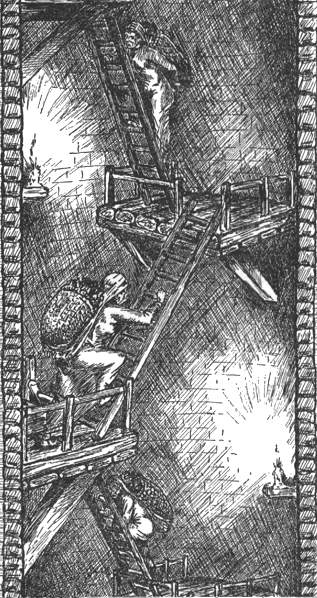
This Stair Pit was located between crops of Two Foot and Five Foot Coals in the north-west corner of the field close to Whyte's Pit.
 |
 |
| No.1 |
| No.1 | Some stair pits could be as deep as 100 feet. |
|---|
Extracts from Statistical Accounts of Scotland (1792)
Parish of Torryburn
"In the lands of Torry, the property of Sir
William Erskine, there are many different seams of coal, of
various qualities and thicknesses. Great fields of these
coals are still to work, (particularly the main coal of
Torry, which is of the best quality), but they are all under
level. The lands of Crombie were found to contain 6 seams of
coal, of a quality much the same with that of the Newcastle,
and, like it, turned out small. The seams above level are
wrought out. Parts of the others still remain, but cannot be
wrought but with the assistance of a powerful engine.
The following table of the thicknesses of the various seams
of coal, in both estates, was furnished by a gentleman, who
was proprietor of the one, and had a lease of the
other."
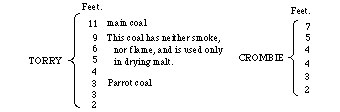
"Besides these different seams, there is, on the north parts of Torry, a fine parrot coal, in thickness 4 feet, which is very valuable, and is said to sell in the London market, at a higher price than any other. There is also very good ironstone in the parish, some of which has been wrought."
"In the first period [1772-81], the coal in the estate of Crombie was wrought to a pretty considerable extent; but, when it began to fail, numbers of the workmen went to collieries in the neighbourhood; and at present, very few families of them remain in the parish."
The few records of old workings at Crombie (18th - early 19th century) are vague and incomplete and, as in most coalfields, care should be taken in regard to the local names of seams. In the Crombie field, seams referred to as the 'Two Foot Coal', 'Three-and-a-half Foot Smithy Coal' and 'Seven Foot Coal' are possibly the equivalents, in current nomenclature, of the Sulphur (Stink), Two Foot and Five Foot Coal seams, respectively.
The Sulphur Coal seam, the lowest to be worked, appears to have been wrought to a limited extent at some of the old collieries at Crombie (see map for the many unidentified 'old pits' close to areas of this and the other seams).
Usually the Sulphur or Stink Coal occurred in two or more leaves and the total thickness never exceeded 4 ft. The coal was poor in quality on account of its appreciable content of iron pyrites (a mineral - also known as "Fools Gold"- containing the compound iron sulphide) which gave rise to the two expressive names applied to the coal. It was readily identified in diamond bores or natural sections by the overlying 18 ft. of shelly blaes. As seen from the map, the Dunfermline Splint seam cropped out across the field and was reported to have been around 5 ft. thick. There was much evidence that it was wrought to the outcrops on the foreshore.
| See Coalfields section of the site for a record of seams in the Crombie-Charlestown-Pitfirrane district. |
|---|
Comments from two of our site contributors
| Willie
Yorkston, from Dunfermline, has kindly communicated that
probably most of the 'old pits' indicated on the
map of the Crombie field were ancient bell pits. He
believes that bell pits were, at some point, joined up by
tunnels (possibly for ventilation or quite by accident
through extended workings) and that this led eventually
to the design of underground workings as we knew them in
the more modern mines. . .
. . . and Eileen Carson, who at one time lived between Crombie and Torryburn, recalls a farmer fencing off a large, gaping hole at the top of a hill in a field adjacent to her home. "I lay down and had a good squint inside and can say it looked to me like the roof of a bell pit had fallen in. I was a bit terrified as I was lying on ground no more than ½ foot thick!" |
|---|
