Owners: NCB
Scottish Coal
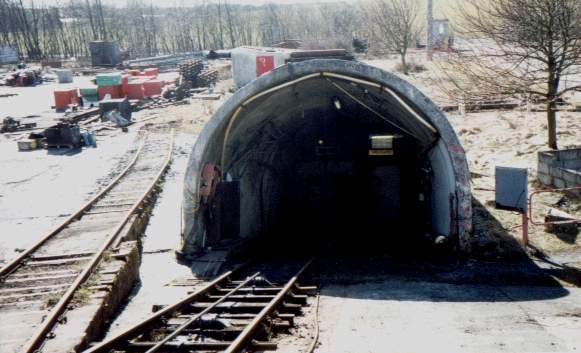
Solsgirth Mine, about four miles north of Bogside Mine,
opened in 1965. Work on the underground belt-conveyor system
to feed the coal-fired power station at Longannet (east of
Kincardine) commenced in 1964 and relied on the drift mine at
Solsgirth and several other ventures to access the conveyor.
Solsgirth was a high-production mine and even held a European
record for its coal output in 1975 when 25,260 tons of coal
was produced from a single coal-face in a 5-day period. Plans
to link the belt-conveyor system from Solsgirth to Dollar
Mine never materialised due to a large fault between the two
mines. Closed in January, 1990, it was used as part of the
ventilation system for the Castlebridge Colliery at Gartlove.
A small control hut remained on the site which has been
salvaged over recent years.
|
See also Longannet Mine (Longannet complex) entry |
|---|

|
 |
 |
 |
| Mine opened: 1965 | Mine closed: 1990 |
|---|---|
| Source Date of Information Supplied | |
| Manager / Under-Manager / Men underground / Men above ground / Coal Seams worked | |
| 1971 (Scottish Coal) | |
| W. M. I. Bell / T. T. Clark : J. H. Christie / 640 / 82 / Steam coal. Hirst. | |
| 1973 & 1974 (Scottish Coal) | |
| W. M. I. Bell / T. T. Clark : J. H. Christie / 713 / 65 / Steam coal. Hirst. | |
| 1974 (Scottish Coal) | |
| Nov: Mr James Johnston (Assistant to Mine Manager). | |
| 1977 (Scottish Coal) | |
| W. M. I. Bell
(General Manager) : T. Clark (Deputy
Manager) : W. K. Kerr ; J. H. Christie
(Undermanagers)
T. McNeill (Mechanical Engineer) : S. Rowan (Electrical Engineer) / 924 / 83 / Steam coal. Hirst. |
|
| 1978 & 1979 (Scottish Coal) | |
| W. M. I. Bell
(General Manager) : T. Clark (Deputy
Manager) : W. K. Kerr ; J. H. Christie ; W. Kennedy
(Undermanagers)
T. McNeill (Mechanical Engineer) : S. Rowan (Electrical Engineer) / 924 / 83 / Steam coal. Hirst. |
|
| 1980 (Scottish Coal) | |
| W. M. I. Bell
(General Manager) : W. Kennedy (Deputy
Manager) : W. K. Kerr ; J. H. Christie ; E. Bone
(Undermanagers)
T. McNeill (Mechanical Engineer) : S. Rowan (Electrical Engineer) / 924 / 83 / Steam coal. Hirst. |
|
| 1981 & 1982 (Scottish Coal) | |
| W. M. I. Bell
(General Manager) : W. Kennedy (Deputy
Manager) : S. McDonald ; E. G. Rushford ; E. Bone
(Undermanagers)
T. McNeill (Mechanical Engineer) : S. Rowan (Electrical Engineer) / 924 / 83 / Steam coal. Hirst. |
|
| 1984 (Scottish Coal) | |
| W. M. I. Bell
(General Manager) : H. Reston (Deputy
Manager) : S. McDonald ; E. G. Rushford ; E. White
(Undermanagers)
Vacant (Mechanical Engineer) : S. Rowan (Electrical Engineer) / 924 / 83 / Steam coal. Hirst. |
|
| 1987 (Scottish Coal) | |
| W. A. Kennedy
(General Manager) : W. R. Dow (Deputy
Manager) : I. S. McDonald ; E. G. Rushford ; D. B. Hood
(Undermanagers)
Vacant (Mechanical Engineer) : R. Gilfillan (Electrical Engineer) / 924 / 83 / Steam coal. Hirst. |
|
| 1988 (Scottish Coal) | |
| W. A. Kennedy
(General Manager) : W. R. Dow (Deputy
Manager) : I. S. McDonald ; E. G. Rushford ; D. B. Hood
(Undermanagers)
H. K. Trousdale (Mechanical Engineer) : R. Gilfillan (Electrical Engineer) / 855 / 70 / Steam coal. Hirst. |
|
--------------------------------------------------
"Dunfermline Press"
26 August, 1967
New Reserves Of House Coal At Comrie
... The order has been placed for the conveyor - one of the world's longest -
to be used in the mining complex which will feed the furnaces of the multi-million
pound electricity generating station which is rising on the banks of the Forth at
Longannet. About 10,000 tons of coal a day will be carried along the five-and-a-half
miles of belting direct from the mines to the new power station which, when fully
operational, will have a generating capacity of more than three times that of its
Kincardine counterpart.
There are just two years to go before the first part of the five-mines-in-one Longannet
project comes into operation. Five mines will be joined by the tunnel housing the
conveyor. Bogside No. 3 mine and the new mine at Castlehill should supply coal
via Longannet mine to the power station in April 1969, followed by Solsgirth and the
Dollar area some 12 months later.
--------------------------------------------------
"Dunfermline Press"
2 September, 1967
Coal Board Chief at Valleyfield
Mr R. W. Parker, Chairman of the Scottish Division of the National Coal Board, paid a
forenoon visit to Valleyfield Colliery on Thursday. An N.C.B. spokesman yesterday described
his visit as "purely routine."
The Coal Board chief also visited Kinneil Colliery, which is linked with Valleyfield by an
underground tunnel beneath the Forth.
In the near future all of Valleyfield's coal output will be washed and screened at
Kinneil, the cages at Valleyfield being used only for men and materials.
In August, Mr Parker paid a visit to Solsgirth, one of the new mines to feed the multi-million pound
power station at Longannet.
--------------------------------------------------
"Dunfermline Press"
6 April, 1968
WILL MINERS GO BACK TO SEVEN-DAY WEEK?
Lord Robens, Chairman of the National Coal Board, said on Thursday that the
Longannet Complex of mines would, on completion, be the most modern in the
world and was a project upon which the Board was basing a great deal of their
hopes for cheap coal in the 1970s. He was speaking after a visit to the complex
which will supply the South of Scotland Electricity Board's Longannet
Generating Station, at present in the course of construction. …
Lord Robens said that the five-mile conveyor belt which was being driven from
Longannet would be the longest in the world and, in addition, there would be
automatic weighing and sampling, and the rate of speed of the conveyor would
be controlled by computer, so that coal entering the Power Station would be of
consistent quality.
Work on the Longannet development is going according to plan. The project
began in September 1964 and, only recently, the completed drivage has gone
well past the halfway mark of 15,000 feet. In the process, more than 620,000
tons of stone have been removed.
The Hirst Coal Seam was more or less unworked until 1953, due to its inherent
high ash content, but construction of the Kincardine Power Station, with
modern boilers designed to suit this coal, led to the sinking of Bogside, Dollar,
Manor Powis and Bannockburn mines.
The field to be exploited covers 24 square miles containing an estimated 60
million tons of coal. It is traversed by east and west faults which split it naturally
into four separate areas. Dollar and Bogside mines are at present working two
of these areas. Under the plan, their outputs are designed to go up to 2500
tons per day. The new mines at Castlehill and Solsgirth will produce similar
amounts with all the coal coming up Longannet Mine.
Driving is underway at present from Bogside to Longannet and Castlehill,
Castlehill to Bogside and Solsgirth, and Solsgirth to Castlehill. Teams of
six men are at work on three shifts over five days in each of the drivages.
It is planned to hole Bogside-Castlehill in September, Bogside-Longannet at
the end of the year, and Castlehill-Solsgirth in September 1969.
--------------------------------------------------
"Coal News"
May, 1968
Work here for over 30 years - pledge by Robens
Don't worry about your future … there's work here for the next 30 years and more.
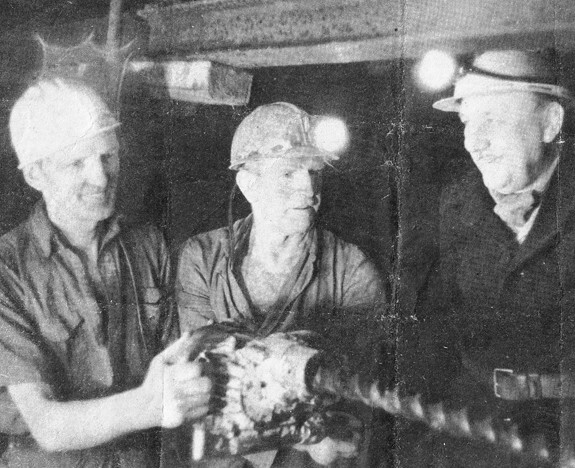
That's the answer driller Jim Bird got from the "gaffer" down Solsgirth Mine, one of five linked underground in the Longannet Complex.
"This project will provide jobs for 2,500 - and people will benefit from it long after we've gone," NCB Chairman Lord Robens told Jim.
They met in the Devonside section of the mine where two coal faces are being developed ready for production next year.
|
There's work here for years - Lord Robens tells face drillers William O'Donnell (left) and Jim Bird.
It's grand
"I last saw this project on a piece of paper," Lord Robens told Jim and fellow driller William O'Donnell, 56. "The work is really going along grand, and it's something we should be proud to be associated with."
He said a splendid engineering job has been done so far on the Longannet project.
"It's splendid to come to a development providing new jobs," he added.
Good job
"This project is going to give us a tremendous shot in the arm. With new techniques, new machines and good working relations we can be competitive.
"You've done a good job so far despite the problems you've had to overcome."
The computer-controlled, five-and-a-half mile underground conveyor belt linking the five mines will be the longest in the world. It will automatically weigh the coal and sample so that consistent quality is supplied to the giant new power station.
New faces to be set up in the Devonside section of Solsgirth mine will produce 1,000 tons a shift - 10,000 tons a day - for the conveyor belt. They will be worked by the retreat method, with possibly two shifts on one face and one shift on the other.
Huge shaft
Deputy Davie Wilson took Lord Robens along the coal road in the Devonside section to see the huge staple shaft - 24 feet in diameter and capable of holding 700 tons of coal - designed to take peak loads and prevent overloading of the cable belt.
The chairman also examined a bunker - thought up by Solsgirth manager Willie Bell - to take the dirt off the heading after a shot's fired and allow work to progress on a second cycle of drilling and shotfiring.
At the face, leading man Willie Malcolm, 42, operating an Eimco powered shovel told Lord Robens - "Since the bunker's been installed we've managed to hit 113 feet of advance in a week - the best that's ever been done at Solsgirth."
Over in No. 1 mine - which will house the conveyor belt - deputy George Wright said they'd advanced 5,600 feet.
--------------------------------------------------
"Dunfermline Press"
15 June, 1968
500 Miners asked to switch jobs
The gradual build-up of manpower at the Longannet (Kincardine) complex of
mines is continuing. Over the next two months there will be nearly 200 jobs on
offer, spread between Dollar, Bogside, Solsgirth and Castlehill mines.
Already the project employs 1900 men and by September 1970, this figure
should be up nearly another 900.
The build-up at Longannet means that jobs could be available for men at present
working in Seafield and Frances but who live in West Fife, since their homes
are within travelling distance.
If these men are prepared to switch - and 50 have already done so - this would
release jobs at Seafield and Frances for former Michael and Randolph men who
live in that area.
The Coal Board calculate that 500 men living in the Lochgelly area would have
the same length of journey or less to their work if they transferred westwards,
and 500 jobs could be offered to ex-Michael and Randolph men.
The Unions already have agreed to back the Board in the change.
Men who are transferred are guaranteed 80 per cent of their previous earnings
for three years but in the modern Longannet Project build-up it is calculated that
the transferred men will very soon be earning something similar to the power
loading rate.
It could be that the flatter workings at Longannet are more akin to workings in
former West Fife pits to which the West Fife men are accustomed whereas the
East Fife men may be more suited to the gradients which exist at Seafield.
In addition although the Longannet Complex as a whole is a large undertaking,
it may be that men used to working in smaller units in West Fife might feel
more at home in the individual units which make up Longannet.
--------------------------------------------------
"Dunfermline Press"
26 December, 1969
Solsgirth miners break record
Record breaking pit men working on the Longannet project have broken the
British record for narrow roadway drivage by cutting out 505 feet in a week.
Only weeks after teaching, organised to discuss methods of fast drivages,
teams of men at Solsgirth Mine - one of the three production units in the
Longannet complex - set up a new record.
They beat the previous record set up two months ago by men at Castlehill Mine
by more than 100 feet.
Already one face line at Solsgirth Mine has been opened out and is being fitted
up ready for production in the New Year and the new record has been established
in the tailgate roadway being driven to open out a second face.
Working with a Dosco Dint heading machine, the record breakers excavated a
roadway 14 feet wide by 7 feet high. It has to advance a total of 1300 yards in
an undulating gradient to set up a new face.
Said Area Director, Mr William Rowell, "This is a really fine effort by both
management and men at Solsgirth, indicative of what must be achieved at
Longannet in the 1970s."
--------------------------------------------------
"Dunfermline Press"
23 January, 1970
RECORD BREAKERS AT SOLSGIRTH
A "teach-in" preceded the record-breaking effort at Solsgirth Mine in
December, when 505 feet of underground roadway was driven in a single week, to
smash the British record by close on 200 feet. This conference, attended by all
concerned in the effort, was held in a Dunfermline hotel.
A brochure, with maps and all available information about the strata through which
the road would be driven, had been prepared.
A copy was issued to each of the 66 men taking part in the "teach-in."
Then, throughout the day, every aspect of the problem was analysed and discussed,
and ideas invited as to how best difficulties could be overcome.
The road-driving team thus knew what they had to do. They also knew that they could
do it, for Solsgirth already held the stone mine-driving record of tunnelling through 156
feet of rock in five days, in July 1968.
It is this kind of co-operation between management and men, that not only makes for
record-breaking efforts, but raises morale to the heights.
Solsgirth, with the Castlehill and Bogside Mines, and later with Dollar, will form the
complex feeding coal by underground tunnel direct to the £100 million Longannet
Electricity Generating Station, which, when fully commissioned, will be consuming
more than 4½ million tons a year.
Scheduled to go into production on 1st March, Solsgirth will be the first pit in Britain
to operate a full retreating face system. This is a much more economic method of
coal-getting than the orthodox advance face system.
The new method involves driving roadways to the boundaries of the coalfield, and
marking off 3000 feet panels of coal for exploitation. Ten Dosco machines, made at
Aylesbury, and each costing £23,000, are engaged in the drivage.
In 19 months of road driving, the Solsgirth teams have tunnelled out eight miles of
underground roads. At present, the men are averaging 1500 feet a week.
And, although it does not go into coal production officially until 1st March, Solsgirth
is actually sending to the surface something like 1100 tons of coals a day. This
goes to the Blairhall washers, before being sent, along with Dollar and Bogside coal,
to Kincardine Power Station.
Solsgirth has already sent 200,000 tons to Kincardine. When the first face line of
O4 Unit, as the initial panel is called, goes into production on 1st March, 19 men
will produce a thousand tons of coal a shift, on a 550 face line. Three shifts will
operate, to give the colossal output of three thousand tons a day!
No waste will be brought to the surface. The roof collapses as the miners cut out the
coal. Every bit of coal will travel by conveyor belt through underground tunnels to
Longannet.
The coal will be extracted from that tremendous reservoir of coal, known as the Hirst
Seam. The first face at Solsgirth will be 5 feet 6 inches in height.
In the Devonside area of the pit, there is estimated to be sufficient coal to last for
10 years, at an annual extraction rate of 1½ million tons.
Consumption
In full production, Solsgirth will send 6000 tons a day to Longannet, and the
complex a total of 12½ thousand tons a day. As Longannet, in full production,
will consume 20,000 tons a day, the balance will be provided by the open-cast
workings at Westfield and the giant Seafield Colliery at Kirkcaldy.
Most of the men on road drivage will be diverted to coal-winning when the first
unit goes into production in March. They have been trained on AB 125 Shearers.
These machines should be installed and ready to start operating by 23rd February.
A week's trial will thus be given them before they start digging into the Hirst
Seam in earnest on 1st March.
On 2nd March another "teach-in" will be held at Dunfermline when all
the problems of coal-winning will be as critically examined as was that of record-breaking
road driving.
Morale at mine is high
The observant visitor does not require the assurance of the manager, Mr William
Bell, that industrial relations at Solsgirth are first-class.
As Mr Tom Clark, under-manager, who came to Solsgirth in December, said to the "Dunfermline
Press": "This pit has the most spirit in the North Area; it hits you between the
eyes as soon as you go through the gates."
Mr Clark added: "There are no demarcation lines in this pit."
Mr William Clark, senior oversman, attributed the achievement to the spirit of the men
and to the provision of all necessary facilities by the management. "Mr Bell and his
management team gave the men the fullest co-operation, and we did a bonanza."
Mr William Bell, manager, a product of Auchterderran and Beath High Schools, is the son
and grandson of a miner. He began work at the Mary Pit at Lochore, and then moved as
under-manager to Blairhall. He was appointed manager of Solsgirth when work began
there five years ago.
--------------------------------------------------
"Dunfermline Press"
13 August, 1971
INJURED IN ACCIDENT AT MINE
Father-of-four Mr Roy Maxwell, 15 Wilson Street, sustained an injury to his right hand in an accident underground at Solsgirth Mine on Sunday. Mr Maxwell was taken to Dunfermline and West Fife Hospital, where he had stitches inserted in his wounds.
--------------------------------------------------
"Dunfermline Press"
14 January, 1972
Miners' bus hits bridge
Four miners were taken to hospital on Wednesday morning, after the bus taking them
to Longannet Power Station to join the picket at Kincardine crashed into a railway bridge. …
The bus was carrying 15 miners employed at Solsgirth, Castlehill and Valleyfield mines,
from their homes in the Ballingry - Cowdenbeath - Lochgelly area. … Mr William Martin,
67 Ochilview, Lumphinnans, sustained bruising to his ribs, and Mr Henry MacLean, the
Union delegate at Solsgirth Mine, who resides at Bridgend Cottages, Lumphinnans,
received bruising to his right knee. Both were discharged the same morning.
The driver, Gavin Winsborough (25), a part-time bus driver, 49 Keltyhill Avenue, Kelty,
was uninjured.
The miners transferred to another bus to join the picket at the Power Station. …
--------------------------------------------------
"Dunfermline Press"
16 November, 1973
MINE DISPUTE
Production at Solsgirth Mine - part of the Longannet complex - was at a standstill
for two days this week and almost 900 men were idle, due to a tradesmen's dispute.
About 50 members of the Scottish Colliery Engineer, Boilermen and Tradesmen's
Association are in dispute over certain duties, involving carrying materials.
The mine went back to work on Wednesday evening, although the tradesmen are still on strike.
--------------------------------------------------
"Dunfermline Press"
21 June, 1974
Four are injured in explosion
Four men were burned, one very seriously, in a workshop explosion at Solsgirth Mine at the weekend.
The accident occurred on Saturday morning when an oxy-acetylene cutter was being used on a metal barrel
which had contained a highly inflammable liquid.
FITTERS
Four men, all fitters, employed in the repair shop, were engulfed in flames, and they were rushed to
Dunfermline and West Fife Hospital for treatment.
Three of them, Mr Laurie Veale (42), 150 Broad Street, Cowdenbeath; Mr Alex Mitchell (32), 98 Station Road,
Lochgelly; and Mr Alex Weir (48), 39 Main Street, Tullibody, were discharged after treatment.
The fourth man, Mr Daniel McNab (24), 34 Stirling Road, Tullibody, was badly burned and he was
transferred to the specialist unit at Bangour Hospital. His condition was later said to be satisfactory.
--------------------------------------------------

"Dunfermline Press"
9 August, 1974
Miner killed
A West Fife woman's holiday ended in tragedy on Sunday when she was told of her
husband's death in an underground accident at Solsgirth Mine, near Saline.
Mineworker Robert Lawson (57), 8 East Avenue, Blairhall, was working in the Devonside District E3-03
junction of Solsgirth Mine at 12.43 pm when the accident happened. He and two others were moving
in a three-ton gearhead from a chain conveyor, when it toppled over and pinned Mr Lawson to the ground,
killing him instantly. Police informed Mrs Charlotte Lawson, who was on holiday with her daughter,
son-in-law and two grandchildren in Blackpool.
---------------------
"Dunfermline Press"
22 November, 1974
JURY PROBES MINE DEATH
A family's holiday in Blackpool ended in tragedy when mineworker, Robert
Lawson, was fatally injured in an accident at Solsgirth Mine, a fatal accident inquiry
heard on Wednesday.
Mr Thomas Philp (34), 14 Woodlands Terrace, Blairhall, told the inquiry that he was
on holiday in Blackpool when the Police informed him of his father-in-law's death
in an underground accident.
IMMEDIATELY
He returned immediately with his mother-in-law, Mrs Charlotte Lawson, to identify the body.
A formal verdict was returned on the death of Mr Lawson (59), an NCB ropeman, of 8 East Avenue,
Blairhall.
The jury unanimously agreed that, on 4th August, in the underground workings at Solsgirth Mine,
Saline, an armoured face conveyor toppled on top of Robert Lawson, while he was working,
causing him injuries from which he died instantly.
HAEMORRHAGE
The causes of death were internal haemorrhage of the chest and crushing injuries.
Mr James Johnston (40), of 6 Causeway Lane, Torryburn, Assistant to the Manager of Solsgirth
Mine, said that they were making a new road underground and Mr Lawson was involved in
moving the conveyor approximately four feet, when the accident occurred.
--------------------------------------------------
"Dunfermline Press"
7 February, 1975
MINERS SET THE PACE
Miners from Solsgirth Mine, near Dollar, have broken the European record
by producing 25,260 tons of coal last week.
Now, their aim is to produce one million tons in one year, a target they hope
to achieve by next month.
--------------------------------------------------
"Dunfermline Press"
15 August, 1975
Man dies in mining accident
A Cowdenbeath miner was killed in an accident at Solsgirth Mine on Wednesday.
Mr Alastair Cunningham (34), 26 Blackburn Drive, was employed as a power loader at the
Mine.
The accident happened shortly after 12 noon in the section known as the No. 10 West
Tailgate. Mr Cunningham is believed to have been crushed in an accident involving a coolie
car. This is a type of transport used underground, both man-riding and for materials.
After the accident, Mr Cunningham was brought to the surface, where he was found to be dead.
He is survived by his wife, Jessie, and his only son, Paul (7). Mr Cunningham, who was known
as Alex., worked in the pits around his native area of Lochore, before going to Solsgirth.
Mrs Cunningham works as a barmaid in the Claymore in Cowdenbeath High Street.
--------------------------------------------------
"Dunfermline Press"
14 November, 1975
DEPUTY'S DEATH
A 52-year-old mine deputy, Mr George Stein, collapsed and died in
Solsgirth Mine, on Wednesday morning.
Mr Stein, a keen golfer, of 80 Woodmill Crescent, Dunfermline, was
married, with five children.
His brother, John, who also works at Solsgirth, was with him when he died.
Mr Stein and his wife, Christine, who both belong to Cowdenbeath, moved to
Dunfermline only two years ago.
They had lived in the North of England, where Mr Stein worked as a
miner, for many years.
--------------------------------------------------
"Daily Record"
27 January, 1977
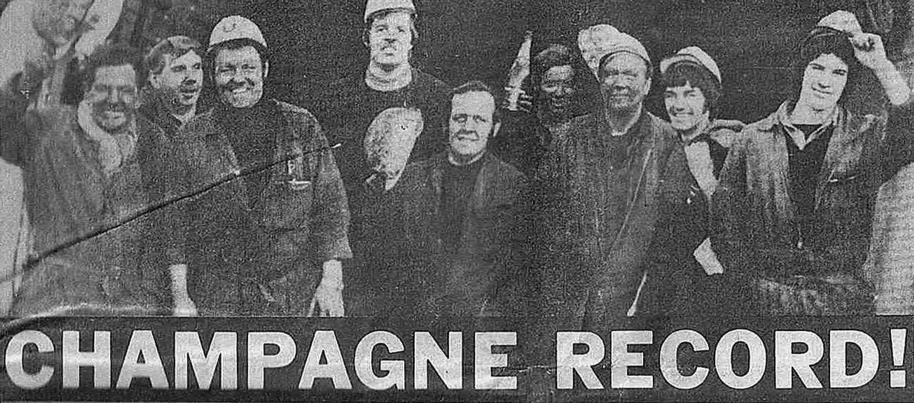
'CHAMPAGNE RECORD!'
|
These record-breaking miners have done it again. And yesterday, after a gruelling shift, the men of Solsgirth pit in Fife toasted their latest success in champagne.
The bubbly marked an amazing British record in coal production in which they cut more than 10,000 tons in just 24 hours.
The figure of 10,310 tons was confirmed by the Coal Board 10 minutes after the day-shift finished at the showpiece mine - part of the Longannet complex.
That's where 1000 miners proudly boast they produce almost three times as much coal as any of their mates elsewhere in the country.
But the Solsgirth miners, who work round-the-clock shifts and claim they have a great relationship with their bosses, won't see the coal. It goes underground by conveyor-belt to Longannet Power Station.
Colliery deputy general manager Tom Clark said: "We're delighted because we have hit around 9000 tons without achieving this magic figure of 10,000. Last year we achieved a European record in coal production, but we have never pulled out so much coal in 20 hours. Our output per man-shift is 125 cwt, almost three times the national average. And the lads have done a great job."
------------------------
We are very grateful to Kevin J. Rushford B.Sc. M.Sc. MBA LLM for the above information. Kevin points out that the person third from the left in the photograph is E. G. Rushford (Ted), his father, who led the team. Ted Rushford also became Under Manager at Solsgirth from 1980 onwards and then to Longannet before taking early retirement.
M. Martin & Webmasters
--------------------------------------------------
"Dunfermline Press"
17 June, 1977
'KING COAL IS BACK ON ITS THRONE'
A confident assurance for the mining industry and praise for Solsgirth
Colliery came last week from Mr Tony Benn, Secretary of State for Energy,
during a visit to the mine.
"King Coal is back on its Throne," he said after going underground
at Solsgirth on Friday. And he acknowledged the colliery's role in putting it there.
Solsgirth is a record-holder in the British mining industry, having taken the title for
producing more coal from one seam in a week than any other colliery in Britain -
25,260 tons. …
--------------------------------------------------
"Dunfermline Press"
16 December, 1977
MINERS REBEL AT RULING
The confrontation between men from Solsgirth Mine and their leader, Mr Michael
McGahey, President of the Scottish branch of the NUM, will take place on Sunday
morning, at Lochgelly.
Over 1100 men from the Mine walked out on Tuesday morning, in protest against the
decision, the previous day, of a special Scottish Area miners' conference which
rejected local productivity deals. …
--------------------------------------------------
"Dunfermline Press"
23 December, 1977
Miners dig in their heels …
Despite the efforts of the Solsgirth miners, the Scottish area executive of the NUM have rejected a bid for pit by pit productivity deals, and now the miners at the Clackmannanshire mine, many of them from Central Fife, are working an overtime ban. …
--------------------------------------------------
"Dunfermline Press"
13 January, 1978
SOLSGIRTH OVERTIME BAN ENDS
Solsgirth branch of the National Union of Mineworkers has called off the
overtime ban which has been affecting production at the mine.
At a branch meeting on Saturday, it was recommended that the overtime
ban, imposed by the men in protest against the policy of the Scottish Area
of the NUM, should be ended, as from Monday. …
--------------------------------------------------
"Dunfermline Press"
2 June, 1978
Miners go back after mistake over bonus
Over 300 miners at Solsgirth Mine resumed work on Monday, after
a five-day unofficial stoppage over a bonus dispute.
Power-loaders, working dayshift, last Wednesday stopped work, because
they claimed bonus payments were not as high as they should have been.
The dispute spread to other shifts and over 300 men stopped work. …
--------------------------------------------------
"Dunfermline Press"
8 December, 1978
Strikes hit coalfield
Strikes, involving over 1300 miners, rocked the West Fife coalfield this week.
In separate disputes, over 700 miners have brought Castlehill Colliery to a virtual standstill,
while around 600 of the 1100 miners at Solsgirth Colliery staged a walkout.
The Castlehill strike was called on Monday after a long brewing complaint by National
Union of Mineworkers' members over negotiating procedure involving time-off for
Union officials.
Miners have called for a top-level inquiry, by both Union and Management, into what
they see as "deteriorating industrial relations" at the pit.
On Tuesday, they rejected a plea by Scottish miners' leader, Mr Mick McGahey,
to return to work immediately. Instead, they intend to return to work on Monday
when they will begin an overtime ban, until the dispute is settled.
DETERIORATED
Said NUM pit delegate, Mr Tom Coulter: "We are not wild cat guys. Castlehill
had a good industrial relations record in the past, but things have deteriorated recently -
almost to the point of a communications breakdown."
Mr Coulter was reluctant to discuss the dispute in detail - "That will all come out in
the inquiry," he said - but told the Press: "There were several events
which brought this to a head."
Of the branch's rejection of Mr McGahey's appeal, Mr Coulter said: "We
have every confidence in the NUM and its officials but, with all due respect to Mr McGahey,
we felt we had to make a stand."
The decision to reject the request, he said, was made at a well-attended meeting at
which only two people dissented.
Mr Coulter stressed that the dispute involved only NUM members. Miners were providing
full safety coverage at the pit and members of other Unions were working "as normally
as the conditions permit."
Meanwhile, at nearby Solsgirth Colliery, over 600 miners began a campaign of unofficial
industrial action on Tuesday.
BONUS PAYMENTS
The men, over half the Colliery's total workforce, called their strike in a dispute
concerning bonus payments.
On Wednesday, by which time the National Coal Board reported production losses of 13,300 tons,
as a result of the strike (and that in Scotland's most productive pit) one-third of the men in
dispute rejected a call by the National Union of Mineworkers to return to work.
"Some men are working and some are not," said NUM delegate Mr Harry McLean
(Thursday): "I have no idea of the exact figures."
Mr McLean added: "I would hope that this matter will be resolved as quickly as possible.
The Union had advised the men to go back to work, but some have decided to stay out."
--------------------------------------------------
"Dunfermline Press"
15 December, 1978
Strikers return to work at collieries
After a week-long strike, over a bonus dispute, around 250 miners at Solsgirth Colliery have been persuaded to return to work. At a meeting in Lumphinnans at the weekend, National Union of Mineworkers' officials told the men that they were striking for something they would not achieve. And, in a vote, the men decided unanimously to call the strike off. …
--------------------------------------------------
"Dunfermline Press"
20 February, 1981
MINERS START TO RETURN
The Longannet Complex of mines, employing about 3000 men, was still idle yesterday
(Thursday) after the dramatic turnabout in the dispute over the National Coal Board's
proposals for pit closures.
A few miles away, at Comrie Colliery, near Oakley, striking miners returned to work, within
a few hours of the announcement that the Coal Board had withdrawn the proposals.
The announcement, made after a top level meeting between leaders of the National Union
of Mineworkers, the Coal Board and the Government, followed lightning action throughout
the Scottish coalfield on Wednesday.
Men at the Longannet Complex of three mines, Castlehill, Bogside and Solsgirth, led a
walk-out which, within hours, had paralysed pits throughout Scotland.
Indications are that the men could be back at work on Monday. A delegates conference
is being held in Edinburgh today (Friday) when Scottish President, Mr Michael McGahey
and his colleague at the London talks, Mr Eric Clarke, will report the details of the Coal
Board's decision to withdraw the controversial pit closures plan.
An NUM spokesman at Solsgirth said that, if the report were favourable, the probability
was that the men would be back to work on Monday. Meanwhile, pickets were on duty
at Solsgirth yesterday.
Miners at Comrie did not wait for the conference, however. Some of them reported for duty
for the night shift and it was claimed that the day shift was as normal as possible,
considering the uncertainty of the situation.
Comrie was the last of the Fife pits to join the strike which escalated with such pace on
Wednesday that Coal Board officials were taken completely by surprise.
With stoppages spreading through the Welsh coalfield earlier, miners at Bogside and
Castlehill sparked off the Scottish action, when the nightshifts stopped the work and
they were followed very quickly at Solsgirth where the day shift joined the strike.
For over 1000 men at Solsgirth, the stoppage came only two days after normal production
had been resumed following a fire in a section of the highly-productive mine.
Emergency rescue units tackled the outbreak which was discovered last Wednesday
and at one stage threatened to put the pit out of action indefinitely.
A NCB spokesman reported this week, however, that the situation was under control and
normal production resumed on Monday.
Comrie Colliery, which employs over 1000 miners, joined the stoppage when the back
shift stayed up, and with Seafield and Frances Pits also agreeing to stay out, the
complete Fife coalfield came to a halt.
--------------------------------------------------
"Dunfermline Press"
4 March, 1983
Miners split on strike call
Miners in West Fife collieries seemed split yesterday over Monday's strike-call.
Voting at the pitheads began on Wednesday and, while there was a reported strong "Yes"
vote for the strike-call at Castlehill Mine, miners elsewhere were not so keen to strike.
At Bogside and Solsgirth Collieries, with the back-shift workers still to vote, the mood appeared to be
50-50.
Meanwhile, at Comrie Colliery, the men are believed to have refused to vote, opting instead for
a ballot.
At Seafield Pit there was a reported 2-1 vote in favour of a national ballot.
The men had been urged by the NUM's Scottish Executive to strike as from Monday,
in response to South Wales miners' campaign to save the Lewis Merthyr pit, near Pontypridd.
At a special delegate meeting in Edinburgh on Tuesday, the 19 delegates voted unanimously in favour
of indefinite strike action from Monday.
Those delegates voted 12-7, in December, in favour of allowing Kinneil Colliery in West Lothian to
close and miners being moved to work at other pits, including those in the Longannet Complex.
Yesterday (Thursday) staff at the NUM's Scottish Headquarters in Edinburgh declined to confirm
the outcome of pithead voting so far, saying that there were no NUM officials available for comment.
A meeting of the Scottish NUM Executive was due to be held last night in Edinburgh to discuss the
results of the voting, and yesterday afternoon local executive member, Mr William Clarke declined to
comment in advance of the talks.
--------------------------------------------------
"Dunfermline Press"
1 April, 1983
TALKS OVER MINING TRANSFERS
National Coal Board proposals to cut the workforce at Solsgirth Mine, which, at
one time, achieved record levels of production, will be under discussion this weekend.
Mining Unions have arranged meetings to consider plans to trim the workforce by transferring
140 men over the next three months.
The proposal is to find jobs for the men at the Frances and Seafield Pits at Kirkcaldy.
A meeting between management officials of the Coal Board, including the Northern Group
Production Manager, Mr George McAlpine, and representatives of the Unions involved
was held at Fishcross on Monday.
The Coal Board proposals were outlined in detail, and branch meetings will be held this
weekend to consider the position.
It is understood that the long-term future of the Colliery is not in question, and Mr Alan
Gray, an Executive Member of the NUM, said after the meeting that he was satisfied
that there was a future at Solsgirth.
Talks involving the NUM and the Coal Board have only just been resumed, following
dissatisfaction over the NCB's policy on pit closures.
A Coal Board spokesman said this week that discussions were going on with the
Unions on proposals to streamline Solsgirth to come out of difficult conditions in the
Devon area of the mine.
The workforce at Solsgirth at present stands at about 1300.
--------------------------------------------------
"Dunfermline Press"
22 June, 1984
MINE RESCUE
The future of Solsgirth Mine, one of the biggest producers of coal in the country,
hung in the balance this week in an inter-Union flare-up over safety cover. There were
fears of "another Bogside," as the management, with no safety cover at the
pit, switched off the power. The NUM, who had mounted a picket amid growing unrest
over the position of their non-striking colleagues in NACODS, withdrew at the eleventh
hour with the condition of the mine at a critical stage.
Mr George Aitken, Chairman of the NUM branch at Solsgirth and acting delegate, said: "We
had only three hours to get the safety cover back in operation, or we would have lost the pit.
We regret having to tell our pickets to withdraw, but Solsgirth is the third largest producing
pit in Britain and we could not let her go down. It could have been another Bogside."
It prompted a bitter attack by Mr Aitken on the National Coal Board, whom he accused of
using NACODS members as a pawn to entice the miners back to work.
And he hit out at the "selfish actions of the NACODS members through which the pit
had nearly been lost."
NACODS, the Union for overseers, deputies, etc., are not in dispute with the Coal Board,
and their members have gone to work normally throughout the strike. A national ballot of
the members voted 54 per cent against strike action, although Mr Aitken claimed a
substantial majority at Solsgirth had been in favour of striking.
Amid reports that miners at the Bilston Glen Colliery were drifting back to work and that
coal was being produced, the NUM branch at Solsgirth asked NACODS members not
involved in safety work not to cross the picket line.
The attitude of NACODS was that everyone worked or no-one worked, with the result
that safety cover could not be provided.
On Tuesday night and Wednesday, there was no safety cover and subsequently part
of the power was switched off, although not the mine pumps.
Yesterday, Mr Aitken said that by Wednesday night the pit had reached a critical stage
in that all machinery had been switched off, the water level had risen to between eight
and 10 feet in some areas and ventilation was affected.
"We again asked NACODS men to provide safety cover only, but they refused. We
had to think of the pit first, so the Liaison Committee told our men that, in the interests
of the pit, we had to withdraw our picket and let the NACODS men go to work," he said.
"The management are using NACODS as a pawn to entice our men back to work.
Only five or six NACODS men are required at the pit and the remaining 160-odd are lazing
about on the surface. They are playing cards and football and some are even taking their
golf clubs. My men are on starvation diets and have been for 14 weeks - when they go
to the pit to collect blank wage slips they see these NACODS boys doing nothing and
getting paid."
--------------------------------------------------
"Dunfermline Press"
24 August, 1984
Pickets close in on Solsgirth
As the war of words over the coalface closures at Castlehill Colliery continued this
week, NUM attention was focussed on another Longannet mine - Solsgirth - where a
man crossed picket lines for the first time. Dunfermline miner, Mr Frank Boyle, turned
up for work on the Monday day-shift, taking a six-man picket line by surprise.
Picket strength had increased considerably when he left the pit in the afternoon, and,
on Tuesday morning, the numbers had increased to an estimated 400.
The confrontation, which had earlier been reported by both the NUM and the Police
to have been good-humoured, resulted in two men being arrested in the afternoon.
Both were charged with breach of the peace.
On Wednesday, despite a decrease in the number of pickets to about 150, no
attempt was made to get the lone miner into the pit, although he was escorted
from his Dunfermline home to the Central Region border, by Fife Police. …
--------------------------------------------------
"Dunfermline Press"
30 November, 1984
More picket-line arrests
At least 12 people were arrested, and four others injured, in a week of clashes between striking miners and Police outside West Fife pits.
In the 37th week of the strike in Scotland, all mines of the Longannet Complex, together with Comrie Colliery, saw mass confrontation almost daily.
But, while the numbers of working miners continued to rise steadily in other parts of the country, the "drift back" figures for West Fife showed little change.
The National Coal Board claimed that the increased level of picketing and intimidation were responsible.
A burning barricade was erected at Solsgirth Mine, just outside Dunfermline District boundary, last Thursday as the number of working miners there rose from one to four.
The men had apparently taken the picket presence by surprise when entering the colliery, but around 350 striking miners had gathered by the afternoon.
According to reports, the pickets constructed a large barricade, at the mine entrance, using an overturned security guard hut, wooden batons, tyres and drums of diesel, which were set alight.
The roadway was strewn with large stones, broken glass and diesel oil.
An estimated 250 Police were on duty, and the retained Fire Brigade staff at Tillicoultry were alerted to extinguish the blazing barricade.
The fire appliance was escorted by Police to the scene, and the working miners were able to leave the colliery when the road was cleared of debris.
One picket was arrested and held in Police custody to appear the following day at Alloa Sheriff Court, charged with obstruction.
A Police Constable and a picket were also taken to hospital in Dunfermline from a picket line outside Castlehill Mine last Thursday.
Both suffered chest injuries as up to 400 pickets pressed against Police lines. They were allowed home after treatment.
At Solsgirth on Friday two people were injured in clashes, despite a reduced number of pickets.
A Policeman was taken to hospital, suffering from a dislocated jaw, and a picket received hospital treatment for a slight cut, caused by a fall.
No arrests were reported, and the injured were released from hospital after treatment.
Five striking miners and two students were arrested following incidents on picket lines outside Longannet Mine on Monday.
The incident took place as female clerical workers entered the pit gates at 8.30 am. An estimated 300 pickets were in attendance, but no-one was injured.
There was a 200-strong picket presence the following day, but no incidents were reported.
Two pickets were arrested outside Castlehill Mine and two more outside Comrie - practically the first at this pit since the dispute began - on Wednesday.
Four men apparently entered Comrie on Tuesday when there was no picket line. According to the NUM, they left after about three hours.
On Wednesday, when arrests were made, the NCB said six men turned up for work. The NUM disputed the number, saying it was only two.
Police estimated picket strength at about 300, and the NUM said about 400 Police from Forces throughout Scotland were on duty.
The working miners were escorted through the picket lines, but the pickets then asked members of Deputies Union, NACODS, not to cross.
It is understood senior management were working up to 16-hour shifts to provide safety cover.
An NCB spokesman told the Press on Wednesday that the number of working miners in West Fife that day was less than the previous day, though up on last week.
The figures given were:- Longannet 12; Castlehill 16; Solsgirth 4; Bogside 1 and Comrie 6.
The spokesman added: "There has been quite heavy picketing at all West Fife pits, and this is having an effect on the drift-back figures, which are continuing apace elsewhere.
"The upward trend is very slow in Fife. We put it down to increased picketing and intimidation."
He added that miners returning to work after today (Friday) would not receive their holiday pay and accrued bonus settlements by the New Year, but would receive them after working four weeks.
NUM Comrie Branch Chairman and organiser for the Dunfermline area, Mr Bob Young, claimed only 12 men were working on Wednesday at Castlehill, two at Solsgirth, two at Comrie and none at Bogside.
"The NCB says that it is increased picketing that is preventing men from returning to work. If that is the case, I would have expected a lot more at Comrie on Monday and Tuesday when there were no pickets. The NCB's attempts to bolster their drift-back figures are pathetic. Men are only going in for three-hour shifts, or are being paid for sitting at a pit bottom doing nothing."
--------------------------------------------------
"Dunfermline Press"
22 March, 1985
SOLSGIRTH MINERS WALK OUT
Coal production ground to a halt at Solsgirth Colliery on Wednesday because of a strike.
The latest dispute, which centres around one man, erupted only eight days after the mass return to work at the mine after the year-long dispute.
Several men walked out on Tuesday evening, after a conveyor belt attendant had been ordered to the surface for refusing to restart the belt. He had switched it off for his 20-minute statutory break. His action, said the NUM, was within the national agreement.
The Coal Board claimed, however, that the man had refused to carry out a reasonable request from the management.
Although coal was produced on Tuesday night-shift, production had ceased by Wednesday as more men joined the strike, which was still continuing yesterday (Thursday).
As the Press went to print, an apparent stalemate had been reached, with the NUM demanding talks with management before a return to work, and management demanding a return to normal work before they would talk.
--------------------------------------------------
"Dunfermline Press"
22 March, 1985
'FRAGILE' PEACE AT COLLIERY
Solsgirth Colliery was back in production this week but it was a fragile peace with angry miners claiming that the management is refusing to hold any dialogue with the NUM.
The 500-plus workforce voted overwhelmingly on Saturday to return to work after a walk-out last Tuesday had signalled the start of four days' disruption.
Despite the return, Solsgirth NUM delegate, Mr George Aitken, said there was still a feeling of bitterness among the workforce.
He criticised the mine manager, Mr William Kennedy, for failing to re-introduce any conciliation procedures between union and management.
According to the NUM delegate, Mr Kennedy will not set up any dialogue until the mineworkers' union call off their national overtime ban. …
--------------------------------------------------
"Dunfermline Press"
19 April, 1985
BUS BILL SHOCK FOR MINERS
West Fife miners' last act of defiance against the coal board has ended - after an NUM official had been landed with a £20,000 bill for hiring buses.
Solsgirth pit delegate, Mr George Aitken, signed a lease agreement with W. Alexander & Sons to transport men to the colliery after the year-long strike ended.
His action came in the light of repeated vows by the miners that they would not use NCB-subsidised Parks of Hamilton buses which had been used to take working miners through the picket lines.
The men agreed at meetings in Alva and of the Solsgirth branch to pay for their own transport from Messrs Alexander, whose drivers had recognised NUM picket lines.
Contributions
But, when the bill for the first month's hire was received from the Scottish Bus Group subsidiary, Mr Aitken had collected only about £2500 in contributions from his members.
Earlier this week, Mr Aitken, 66 Leighton Street, High Valleyfield, said, "Under the circumstances, we cannot hire Alexander's buses any longer. Parks of Hamilton are taking the men to work."
Contrary to some reports, however, Mr Aitken denied he was faced with paying the hire bill himself. He is confident the pit's 900-strong workforce will fulfil the obligations of their earlier decisions.
Bitter pill
Said Mr Aitken, "I put it to the men, and they said they would pay it. I have told them it will cost around £24 each. It may take time, but it will be paid. Our only difficulty will be if Alexanders come out with some ultimatum that it has to be paid within two or three weeks."
Mr Aitken said that having to use parks of Hamilton buses was a bitter pill to swallow for many of the men. "The whole idea of our stand was to show solidarity with our union colleagues who drive for Alexanders. The coal board contract meant a lot to the company."
Mr Aitken said he expected to collect a substantial contribution towards the bill today when the men received their holiday pay.
The NCB, who suspended Alexanders' contract to bus the West Fife pitmen at the end of the strike and gave it to Parks of Hamilton, have said the contract is to be put out to tender in the near future.
--------------------------------------------------
"Dunfermline Press"
3 May, 1985
Recovery cash for coalfield
The clearest indication yet of the National Coal Board's future plans for the industry in Fife and Scotland came after a meeting with unions on Friday. Area director, Mr Albert Wheeler, announced that the flooded Polkemmet Colliery was to be abandoned, but the bad news for West Lothian was sweetened with some good news for Fife.
The board plans to invest £20 million in the Scottish area this year - with a "reasonable share" coming to the pits of the Longannet Complex, Comrie Colliery and the Frances/Seafield complex, near Kirkcaldy. ... Drivages to link Castlebridge with Solsgirth Colliery will also proceed, with Solsgirth to receive new chop shields - the very latest in underground technology. ...
--------------------------------------------------
"Dunfermline Press"
23 January, 1987
MIDAS touch
Pitmen at Solsgirth Colliery, part of the Longannet Complex, have the MIDAS touch.
But that doesn't mean the coal mine is about to turn into a gold mine.
MIDAS, to the uninitiated, stands for Machine Information Display and Automatic Steering equipment, and the West Fife mine is the first in the country to have it installed.
The sophisticated, hi-tech equipment controls the movements of the massive double-edged shearer at the colliery's new S81 section which is scheduled to begin production this month.
The computer-controlled MIDAS system will guide the shearer along the 2.44-metre thick, 230-metre long faceline, ensuring the maximum coal is cut - without any intrusion into the roof or pavement.
A British Coal spokesman said, "The point of the exercise is to win as much dirt-free coal as possible. MIDAS represents part of the multi-million pound investment in Solsgirth since the end of the year-long industrial dispute, in the industry. We have created a number of high-technology faces in Scottish pits since the strike, to ensure maximum production and output. It's part of our Coalfield Strategy scheme to keep coal competitive with other fuels."
--------------------------------------------------
"Dunfermline Press"
13 February, 1987
Miners clear pit blockage
Miners who battled around the clock for almost a week reopened the main tunnel between the Longannet Mining Complex and the power station on Wednesday morning.
Around 90 feet of the tunnel, at a point 500 metres from the entrance to the new Castlebridge Colliery, was blocked in a roof fall last Thursday.
The conveyor belt carrying coal from both Castlebridge and Solsgirth Colliery was buried under hundreds of tonnes of rock and earth. Production at both units ceased.
A round-the-clock operation to clear the roof fall, which caused no injuries, was mounted immediately.
A statement issued by British Coal in Edinburgh on Wednesday morning announced that the tunnel had just been unblocked and the conveyor belt and production re-started.
Work on consolidating the damaged section of tunnel had begun and was likely to continue for some time.
British Coal estimated lost coal production at around 7000 tonnes per day from the two record-breaking pits.
A spokesman said, "That represents a very serious blow to the hopes of the Scottish coalfield - in a revenue sense, it is a considerable loss and it will be quite a hurdle to overcome."
Longannet Power Station was apparently unaffected by the break in production, because of large stock piles of coal.
--------------------------------------------------
"Dunfermline Press"
10 July, 1987
Pitmen dig deep for a new high
Fife pits have made a substantial contribution to a new productivity record set up by Scotland's coal workers.
Scottish pitmen hit a new productivity high of 3.49 tonnes-a-manshift for the week ending 6th June, beating the previous best set up the month before, of 3.33 tonnes.
The area's top performer was the C67 face at Scotland's newest colliery, Castlebridge, which headed Britain's faces of more than 209 cm. In the five weeks to 13th June, the Fife face notched up an average of 3522 tonnes a day - fifth top in Britain.
.. In 1986-87, colliery costs fell by 13 per cent and productivity rose by more than 21 per cent.
British Coal expects that the productivity rise will level off at about 8-10 per cent per year.
Scottish figures should be helped by new investment. At the Longannet Complex at Kincardine, work to link Castlebridge Colliery with Solsgirth Mine continues. ...
--------------------------------------------------
"Dunfermline Press"
4 December, 1987
Fife loses colliery claim?
Central set to win Solsgirth in boundary move
Despite a counter-claim by Fife Regional Council, Solsgirth Mine complex - whose surface workings at present extend into the areas of three regional authorities - is set to be transferred to Central Region.
In a report to the Secretary of State for Scotland, the Local Government Boundary Commission for Scotland are recommending the transfer of areas in the vicinity of Solsgirth from Fife and Tayside to Central.
The commission states, "We make our recommendation on the grounds that the revised boundary we have proposed will correct an anomalous situation whereby the curtilage of the surface workings of the Solsgirth Mine extend into three regional authority areas, resulting in split responsibility for the provision of local authority services.
"Whilst local authorities have made every effort to co-ordinate local authority services under the present tripartite arrangement, we consider it important that the mine should be served by one authority, which will result in more effective and convenient local government." …
British Coal had previously confirmed that they would welcome the surface workings being sited within one regional authority area with regard to the provision of local authority functions and had declared a preference for Central Region.
The commission considered an objection from Fife Regional Council, who maintained that the surface workings should be contained in Fife Region, because of the mine's links with Longannet Power Station, but they have adopted their provisional proposal as their final recommendation.
--------------------------------------------------
"Dunfermline Press"
12 February, 1988
Miners rally support in power struggle …
A West Fife initiative, designed to mobilise grass-roots support for the campaign to force the Scottish electricity industry to continue using local coal supplies, has been ditched in favour of a high-powered special conference in Edinburgh on Tuesday.
Unions at Solsgirth Colliery earlier this week announced a meeting to be held on Sunday at Oakley Miners' Welfare Club, to which miners from other pits, MPs, local councillors, church leaders and trades council representatives were invited.
But that meeting has now been cancelled and yesterday Mr George Bolton, the National Union of Mineworkers' Scottish president, said, "This is too big a battle for it to be left to the miners alone."
He explained that the special conference would involve all mining trade unions and would be addressed by Campbell Christie, of the Scottish TUC. MPs and other interested parties, such as power station workers, would also be invited.
The South of Scotland Electricity Board has formally invited international coal suppliers to tender for its requirement of power station coal following the failure to negotiate an agreed price for the coming year with British Coal.
The letters invite tenders for quantities of one million, two million and three million tonnes per annum, suggesting that the SSEB is ready to replace its entire intake from the Scottish coalfield.
That has plunged the future of the Longannet mines complex, which includes Solsgirth and supplies Longannet Power Station, into uncertainty. It would be likely to lead to the closure of all of Scotland's deep mines, except Bilston Glen, with the loss of more than 2000 jobs, according to the unions.
The probable cancellation of British Coal's proposed development at the Frances pit near Kirkcaldy will be high on the agenda when Mr Bolton meets with Fife Regional Council convener, Mr Bert Gough, on Monday.
The NUM Scottish president hoped that the following day's conference would put pressure on Mr Malcolm Rifkind, the Secretary of State for Scotland, to intervene to change the SSEB's policy.
Solsgirth miner, Mr Pat Callaghan, a Dunfermline District Councillor, who had been nominated as spokesman for the all-union group who had called the Oakley meeting, said he was disappointed that the meeting would not now take place.
British Coal said it deeply regretted the SSEB move, as it had already cut its price in real terms by 25 per cent in three years.
Euro MP Alex Falconer, along with Dr Richard Saville of the Labour-backed Scottish Coal Project, met Mr Dan Millar, the SSEB chairman, on Friday and said afterwards that with "his free-market philosophy, he is the wrong type of person to be in charge of a public enterprise."
At a public meeting in Kincardine on Monday night, Scottish National Party leader Mr Gordon Wilson, said, "For the SSEB, it would be the most short-sighted act of stupidity to put themselves at the mercy of fluctuations in the international coal market. This is already a stalking horse for electricity privatisation."
- The pay dispute involving the pit deputies union NACODS had no effect this week on the Longannet Complex, according to British Coal, despite predictions that the lack of essential safety and maintenance work over the weekend would see miners being sent home on Monday.
--------------------------------------------------
"Dunfermline Press"
19 February, 1988
Pitmen on tenter-hooks over tenders
Hundreds of West Fife people face a nervous weekend as they await the result of a high-level battle which could decide the fate of their jobs. The South of Scotland Electricity Board have set Monday as the deadline for tenders from rival coal suppliers who wish to deliver to its power stations. And should British Coal fail to win the race, it is likely to lead to the closure of Solsgirth and Castlebridge collieries, which serve the Longannet Power Station in Kincardine, with devastating effects on the economy of West Fife.
Some believe the power station itself could be under threat.
Dunfermline District Council is so worried at the prospect that it called a special Press conference on Wednesday.
Chief executive George Brown explained, "Longannet is, of course, perhaps the only remaining bit of the coal industry to which people in Dunfermline District are attached - about two to three hundred people from the district work there. So the council would like to be at the forefront of any local demonstrations that are organised, as this could close down many in the district, in Fife and in Scotland."
Provost Bob Mill said that the demise of the Scottish coalfield would also put at risk the 100 or so jobs at British Coal's Cowdenbeath Workshops, which act as a repair base for Scotland's pits.
Councillor John Connelly attended Tuesday's meeting in Edinburgh called by the STUC.
Mr Connelly yesterday represented Dunfermline District in a lobby of Parliament where delegates were due to meet their MPs and Scottish Industry Minister, Mr Ian Lang, was to have talks with Mr Donald Dewar, the Shadow Scottish Secretary, Mr Campbell Christie, general secretary of the STUC, and Scots NUM president, Mr George Bolton.
This is to be followed by a national rally to protest at the SSEB's stance and a deputation which will meet with the board's controversial chairman, Mr Don Miller.
Fellow councillor, Mr Pat Callaghan, who has been advising the council on the situation, pointed out that the SSEB was only tendering for half its coal needs.
If foreign coal were preferred, then he thought Solsgirth would have to be run down, while Castlebridge was kept ticking over until the next round of tenders. With the Torness nuclear power station coming on stream, he also warned that the SSEB would not need any of its coal burning stations - including Longannet.
"One thousand jobs are vulnerable, which would cause a £1 million deficit to Dunfermline District."
British Coal this week threatened the SSEB with Court action should it fail to honour what it sees as "long-standing contractual agreements" for the supply of coal from Scottish mines.
The agreement for Longannet lasts until 1995, says BC.
The coal board stress that they had already reduced their prices to the SSEB by 25 per cent in real terms since 1985. Further cuts had been offered, with a guarantee on price until the end of the century.
However, the SSEB want a further 10 per cent cut.
- Meanwhile, British Coal confirmed that a number of men had been transferred from Solsgirth to Castlebridge "to increase efficiency." It is believed that 50 men - mainly power loaders are involved - following geological difficulties at Solsgirth.
- The BC spokesman said that 50 men had also been transferred from the doomed Seafield Colliery to Castlebridge on a one-to-one basis to allow older men from Castlebridge who wish to retire to do so. Work at Castlebridge is at present concentrated on one face, C65.
--------------------------------------------------
"Dunfermline Press"
17 June, 1988
Footballer is injured in pit accident
British Coal are investigating an accident at Solsgirth Colliery last week which left a young footballer in hospital suffering from a broken back.
Clark Allison (25) underwent an operation at Dunfermline and West Fife Hospital on Saturday after last Tuesday's tragic accident deep underground.
He is expected to have to remain in a body plaster for about three months.
Clark, who lives with his wife Beverley (23) at 100 Porterfield, Comrie, is regarded as one of the best Junior football players in Fife.
The accident cast a shadow over the last Thursday's final of the Radio Forth Cup in which Clark's team, Kelty Hearts, were narrowly beaten by Newtongrange Star.
His parents, who live in Rintoul Avenue, Blairhall, were shattered by the accident. His father, Clark senior, a miner at Castlebridge Colliery, told the Press, "Our whole family is devastated. I haven't been able to go back to my work since it happened."
Clark sustained the injury apparently as a result of being struck by part of a moving bogey and falling on his back on a metal rail.
He was taken to hospital in Dunfermline and underwent surgery on Saturday.
Mr Allison said, "He is as well as can be expected in the circumstances. He can move his shoulders and legs and the doctors are quite pleased with his progress. He even asked them when he would be able to play football, and they told him it wouldn't be for a little while. We hope that he will be able to play again but that will come after he gets back on his feet. He will be kept in hospital for at least six weeks and he will have to wear a plaster cast for three months."
Mr Allison disclosed that one of son's first visitors had been Dunfermline Athletic boss, Jim Leishman, who had occupied an adjoining room in the hospital until his discharge on Saturday.
Jim underwent surgery to adjust a metal plate inserted in his leg after a bad leg break 14 years ago.
Clark signed for Cowdenbeath in 1981 but was freed after a season to join Kelty Hearts, with whom he has played since.
His younger brother, John (18), signed provisionally for Forfar last year but still plays juvenile football with Kinross. He is also a miner - at Castlebridge Colliery.
Mr Allison was a well-known footballer, playing for Oakley United and many Junior sides in the area.
A spokesman for British Coal confirmed yesterday that an accident involving Clark had occurred underground at Solsgirth and that was being investigated.
--------------------------------------------------
"Dunfermline Press"
13 January, 1989
Too much to ask of clubs?
Doubts that miners' welfare clubs - the traditional bulwark and heart of mining communities - are the best-equipped organisations to lead the regeneration of West Fife villages have been voiced in an in-depth study undertaken by Fife Regional Council's policy planning unit. …
Short-term job prospects bleak
The study concludes that immediate employment prospects in the area are bleak. "Although a large number of jobs have already been lost in the mining industry in the study area, the majority of the male employment is still within that sector," they affirm.
"The two West Fife collieries still in operation, Solsgirth and Castlehill, do not appear to have a very secure future and many local people are convinced that substantial job losses will take place there very soon. The privatisation of the SSEB is thought to provide another threat to mining jobs, since a private company may have even less loyalty to Scottish coal than the SSEB.
"As Torness nuclear power station reaches full capacity, it is also thought likely that there may be over-production of electricity which could lead to a reduction in generation at Longannet and a corresponding drop in the demand for coal. These factions combined with doubts over British Coal's plans for the Scottish coalfield, make local people very uncertain about their immediate economic future. The overwhelming likelihood is that male unemployment will continue to grow in the short-term. Female unemployment, on the other hand, may not grow, and might even reduce. A significant number of women from the area are employed in the burgeoning Fife electronic industry which now has a number of factories in Dunfermline and elsewhere. Such employment tends to be poorly paid, short-term and tedious." …
--------------------------------------------------
"Dunfermline Press"
26 May, 1989
Pitting their skills against the best
... Meanwhile, the Solsgirth Mine first-aid team, representing British Coal, won an all-industry competition in Glasgow.
The Miller Trophy was their ninth of the year so far and they are well on their way to beat their best-ever total of 11 last year.
First-aid contests
On Wednesday, Solsgirth were taking part in what is regarded as the Scottish Cup of first-aid competitions, the Presidents' Cup, organised by the St Andrew's Ambulance Association.
The team which took the Miller Trophy was captain David Hynd, Cairneyhill; John Young, Dunfermline; Ian Fox and David Walker, both Cowdenbeath; and George Egan, Lanarkshire. Their instructor was David Duncan, Saline.
--------------------------------------------------
"Dunfermline Press"
8 March, 1991
IRON-CURTAIN RATIONS
|
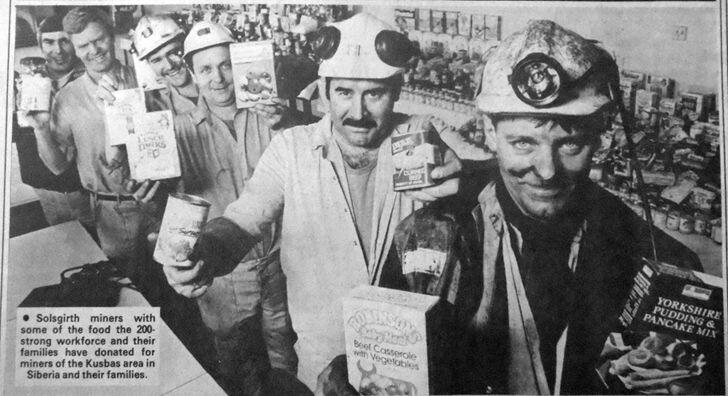
Longannet Complex miners are aiming to raise more than £2000 for their comrades in Siberia. This is in addition to the large quantities of non-perishable foods donated in a joint appeal with Fife Regional Council and the NUM (Scottish Area).
The cash - around £1100 has come from Castlebridge while the 200 workers at Solsgirth are hoping to double the £500 already collected - will be used to buy more food which will then be sent to the Kusbas area of the Soviet Union. …
--------------------------------------------------
[Ray McGeever, who is compiling his family history - they formerly lived in Oakley, not so long ago - also worked in the coal industry and is looking for photographs of Solsgirth miners. Can you help?
M. Martin & Webmasters.]
--------------------------------------------------
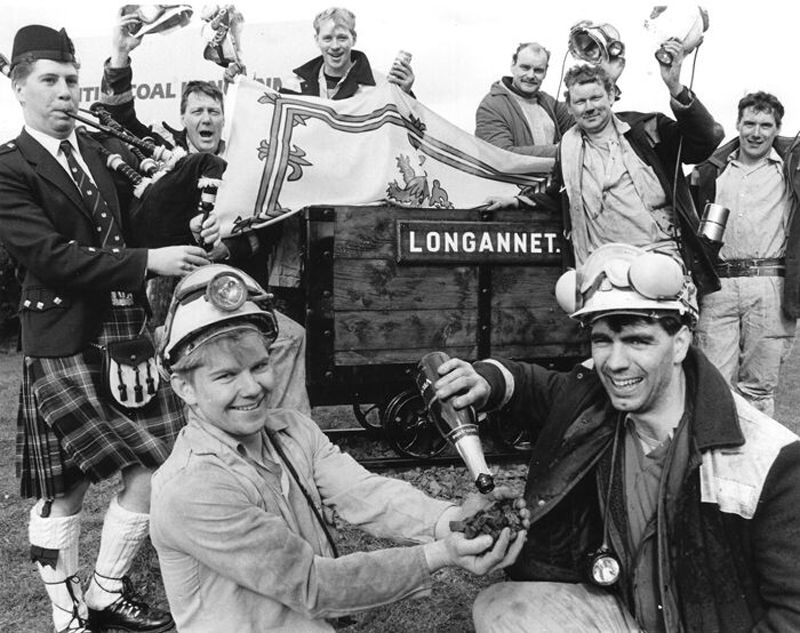
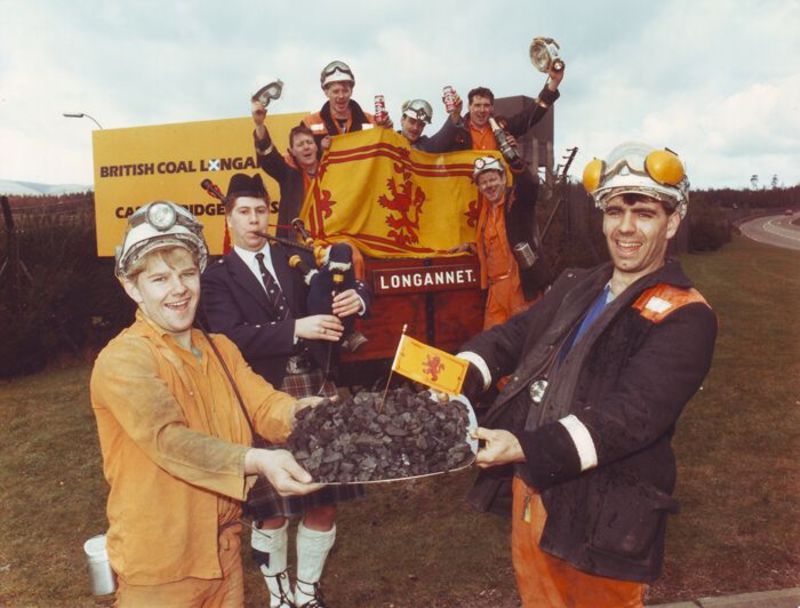
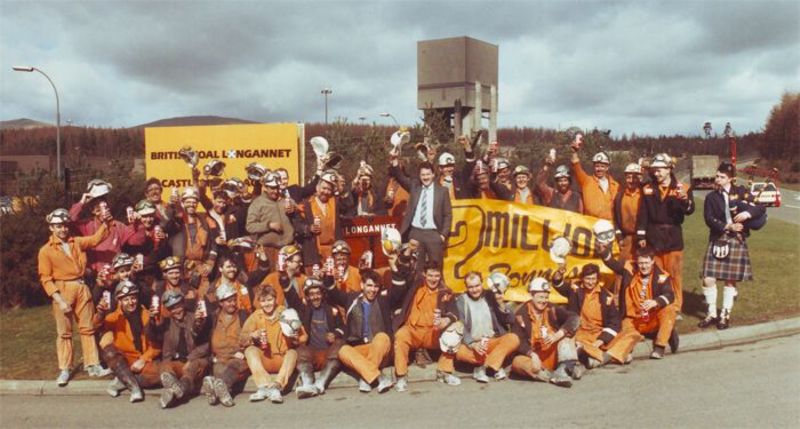
[In late January, 2014, webmaster, Chris Sparling, was delighted when a surprise encounter with former Solsgirth miner, David Carmichael, Oakley, led to the kind offer to provide photographs of groups of miners, including himself, for display on the website. David informed Chris that he thought these were taken in 1985 (date probably March 1991) when Longannet Mine achieved the national record for mining 2 million tonnes of coal. We hope that Ray McGeever, and other site visitors, may be able to put names to the faces of the miners who appear in these photographs.
M. Martin & Webmasters.]
 |
 |
 |
--------------------------------------------------
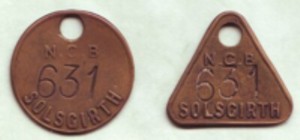 |
| NCB Solsgirth Mine checks No. 631. David Carmichael, Oakley. |
