Owners: Sir Robert Preston of
Valleyfield
Messrs Hutton & Co.,
Culross Coal Company
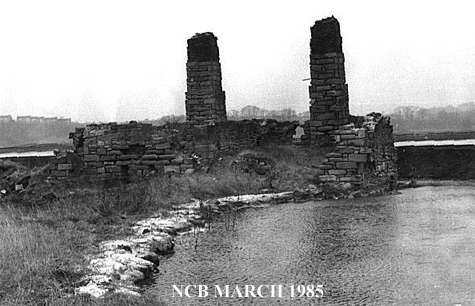
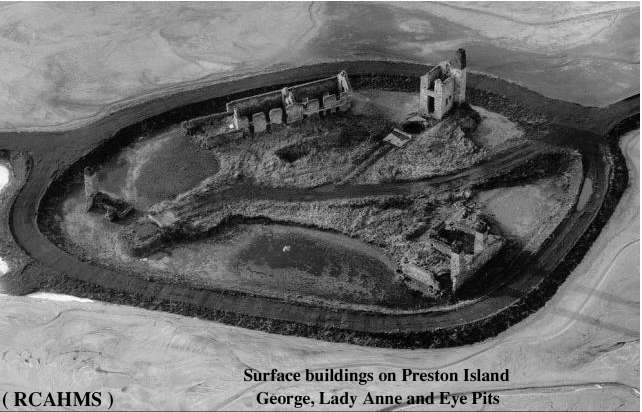
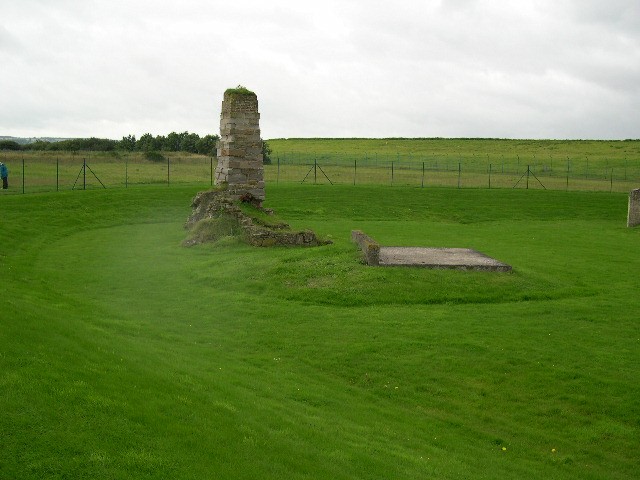
Lying in Torry Bay, Preston Island can be seen as one moves along the coast from Torryburn to Culross. The island is the highest part of the half-tide reef known as Craigmore Rock with retaining walls constructed to ensure the three pits forming the old colliery remained clear of the sea at all states of the tide. Every part of Preston Island was utilised for the mining operations and for salt pans. From the shore, the buildings on the island look like a castle but they are just the debris of the pit buildings, old salt works and World War II fortifications.

Click on Map to Zoom In
 |
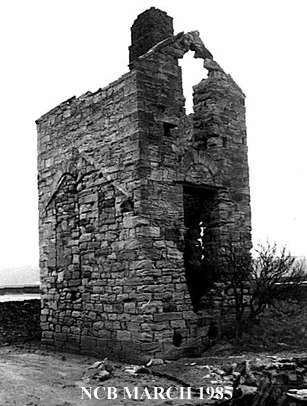 |
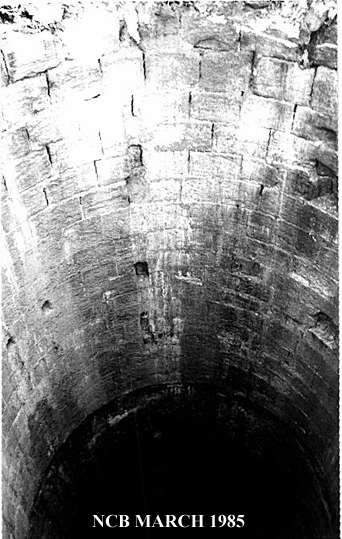
| Looking down the main shaft | Pump House, Preston Island |
|
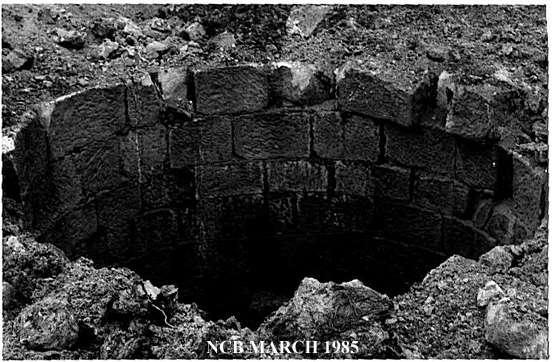 |
| Salt Distillery boilers | Top of the main shaft |
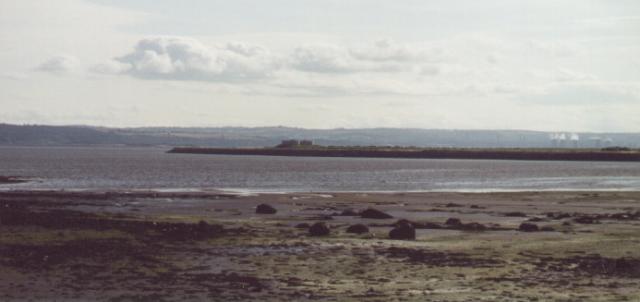 |
Apparently the buildings on the island have been repaired and there are plans for a tourist walk. It is eventually to be landscaped by Scottish Power with trees, walkways, etc. Since 1979, Preston Island has been imprisoned in the fifth lagoon of Longannet Power Station. The lagoons are constructed to take the waste ash from the power station. It is pumped from the power station in the form of slurry and on arrival at the lagoons, lying along the shore, the water is filtered off leaving a solid base. The ash looks like white sand but has a finer texture. Eventually it will be possible to walk out to the island but until that time comes the area will be fenced off. But it wasn't always like this .....
 |

|
We are grateful to Peter Hall, Cupar, for his photographic contributions
which are taken during his walks to former mining sites around Fife.
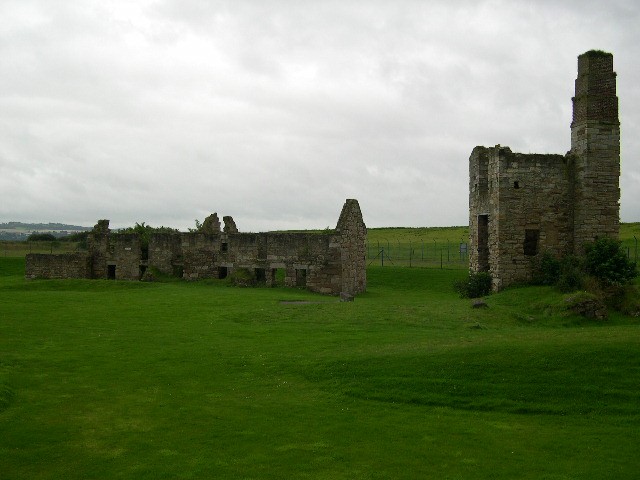
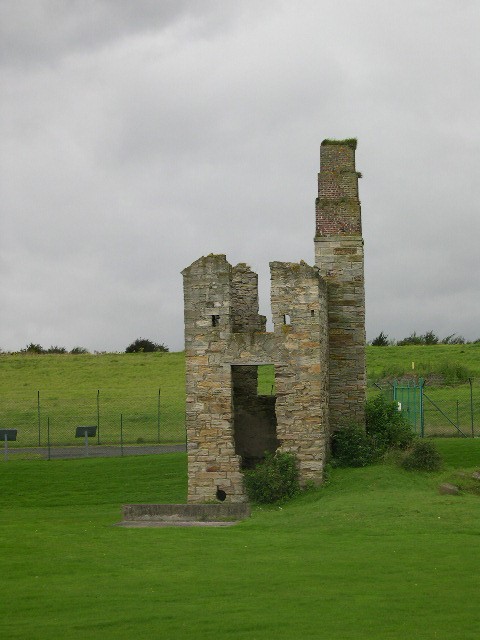
Below we see some of the colliery ruins on Preston Island as they were
in 2008.
M. Martin & Webmasters.
 |
 |
 |
-------------------------------------------------------
The Pits of Preston Island Colliery
The old colliery on Preston Island had three pits - the George, Lady Anne and Eye Pits - sunk by Sir Robert Preston, the 6th Baronet, of the Prestons of Valleyfield, who had held the lands since 1543. The Eye Pit was 52 feet deep, the Lady Anne Pit 75 feet but the George Pit was really the successful pit with a depth of 276 feet. The pit shafts were sunk towards the end of the 18th century but production ceased after a disaster in 1811 when an explosion occurred on Preston Island with a resulting loss of life. It is told that there was an explosion of fire-damp (methane gas) in the George Pit when the Lochgelly Splint was being mined at 250 feet down, which killed all the men and destroyed the pit due to the river breaking through into the workings.
In 1814, Robert Bald, mining engineer, noted that the two
saltpans at Preston Island were operated by four men and a
woman producing 130 bushels of salt fortnightly at a profit
of £10 4/-. But this was not a balanced situation as
"attention must be paid to observe that in working
the coal to supply the saltworks, the loss occasioned in
working the coal, does not more than exhaust all the profits
made by the salt."
Bald saw no reason to extend the saltworks until the
problems of the coalfield were sorted out, even if the water
from the pit bottom produced better salt than drawn directly
from the sea. The repeal of the Salt Duties in 1823 soon
ended the works at Preston Island.
Although known records are somewhat at variance, old plans gave some indication of the coals worked though no details of the intervening strata are known. The Preston Island Colliery pits recorded:
| Description | Thickness |
| Lowrie Graham's Coal | 3 ft. |
| Ironstone | 6 in. |
| Six Foot Coal | 6 ft. |
| Coal | 3 ft. 6 in. |
| Coal | 2 ft. |
| Coal and ironstone | 9 in. |
| Nine Foot Coal | 9 ft. |
| Five Foot Coal | 5 ft. |
| Coal | 2 ft. 6 in. |
These nine seams have been correlated with the sequence at neighbouring Valleyfield Colliery and are believed to be:
| Description | Thickness |
| Blairhall Main Coal | 3 ft. |
| Lochgelly Blackband Ironstone | 6 in. |
| Milton Main Coal | 6 ft. |
| Coal No. 3
Blackband Ironstone Position |
3 ft. 6 in. |
| Comrie Two Foot Coal | 2 ft. |
| Kelty Blackband Ironstone | 9 in. |
| Diamond Coal | 9 ft. |
| ? Lower Jersey Coal | 5 ft. |
| ? Jewel Coal | 2 ft. 6 in. |
| Plans of Abandoned Seams for Preston Island | Pits or Mines designated in Plans |
|---|---|
| COAL; Five Feet; Janet Peat; Laurie Graham; Ell or Splint (1811) |
Barclays, Ding Dong, Garden, Gladney's, Magmay, Mary,
Milton Engine, Moat, Preston Island
[Culross and Valleyfield] |
| COAL; Five Feet; Nine Feet (1811) |
Engine
[Preston Island] |
Later, the colliery buildings were taken over for the distilling of illicit whisky. The island made an excellent base, as it was ideally suited for smuggling the "moonshine" down the River Forth on dark nights! Output ceased suddenly, however, when the revenue men raided the island!
In his 19th century newspaper article 'About
Torryburn', Jonnie Kennedy briefly recalled tales of the
old pits of Preston Island:
"... Auld Connel used to 'mind whan they wrocht
coal oot there'. Sandy Armour used to 'hear his
faither speakin' o' workin' the Island pits, but
they were fair fleein' wi' fire, and hed to be
stopit'.
And, indeed, evidence there is plenty to show that coal at
least was wrought pretty extensively on that rocky ridge in
the middle of the Forth. Two most dangerous circular and
built pit-mouths of the old basket carrying days still yawn
to the skies, and breathe their incense in fine July weather,
fit to tie knots upon the nose of a County Councillor - for
they are pretty well filled up with inky water and defunct
dogs, &. c. A third pit of the same type, now filled up,
fortunately, bears the name of 'The Leddie's
E'e'.
Then there is a deep 'Bucket Pat', evidently which
gives colour to the 'Saut Pans' theory.
..."
Another tale, from a local person in more recent times,
describes an attempt to re-open the pits on Preston Island:
"My brother's father-in-law's father was
winding engineman in Preston Island in 1899 when they tried
to re-open the pits. There was a man, James Hutton, who
floated a small company to revive the island colliery. He got
all the water pumped out to a certain depth, but he took ill
and died as a result of the wettings he got. He had employed
Will's father, and Will's mother had had to use a
lantern to guide him across from the island, when the tide
was in at Newmills. Then the Fife Coal Company considered
opening the mine again, but they settled for sinking the
shaft at Low Valleyfield."
--------------------------------------------
"The Scotsman"
12 March, 1836
VALUABLE AND EXTENSIVE COAL
FIELDS, AND SALT PANS
To be disposed of, by way of SALE or SUB-LEASE,
THE whole COAL and COALHEUGHS within the Lands and Estate
of VALLEYFIELD, the Lands of Newmills, and Sea opposite to them, the
Lands of Overton, and part of the Lands of Woodhead and Pitsoulie, in the
parish of Culross, and shire of Perth; with the power of making and erecting
SALT PANS, SALT GRANARIES, and others; all as contained in a Lease
granted in the year 1770, and still current for a period of 34 years from Whitsunday
next, and for an indefinite period thereafter, at the tenant's option. The
premises comprehend the well-known Colliery and Works of Preston Island, which, if
again put in operation upon proper principles, would, it is perfectly understood, be
attended with results of magnitude and importance in the present state of this trade.
Particulars will be communicated on application to Mr PAUL, W. S., 21, Hill Street;
or Mr HOGG, factor, Valleyfield, by Dunfermline.
--------------------------------------------
"The Scotsman"
1 May, 1895
COAL MINING UNDER THE FIRTH OF FORTH. - Messrs Hutton & Co., Culross Coal Company, have begun operations with a view to raising coal from Preston Island, which lies about the middle of the Firth of Forth, between Bo'ness and Culross. The island is about 300 square yards in area, and is known locally as Saltpans. At one time it was occupied by a number of families engaged in making salt from sea water, and the houses which were built in circular form, so as to form a wall round the island, still remain standing, though in a ruinous condition. About a century ago coal was first worked on the island by Sir Robert Preston of Valleyfield, who spent a great amount of money in sinking shafts and erecting machinery. The coal was only raised in small quantities, and after a serious accident in one of the mines work was discontinued, and the island afterwards passed into other hands. It is believed, however, that there is abundance of coal at no great depth on the island. The Culross Coal Company are sending machinery in barges from Bo'ness to the island, with the view of having the existing shafts pumped out. The Company will then be able to know the nature of the strata, and whether it would be a paying concern to work the coal.
--------------------------------------------
"Dunfermline Saturday Press"
22 May, 1897
THE CULROSS COAL FIELDS
Mr James Hutton, Valleyfield, who has been for a
considerable time proving the minerals in the Culross district, is
the principal promoter of the proposed light railway to Kincardine.
Mr Hutton (says a Dundee contemporary) has written several
interesting papers from time to time on the surface geology of the
firth, in one of which he states that his attention was first
attracted by the peculiar features possessed by Torry Bay, with its
island in the centre, which forms the north end of a long reef of
rocks which strike far out in the Forth.
There is to be seen on the surface of Craigmore
rocks, some 300 yards due west of the island, the outcrops of
several seams of coal, as well as a splendid seam of blackband
ironstone of good average thickness. This led Mr Hutton to test the
growth of water in Sir Robert Preston's old pits.
It had been currently reported that the sea had
broken through upon the mines, which had led to the abandonment of
the workings. This, Mr Hutton found, was not the case, for in less
than three months, the water was reduced to below the second seam -
the only one which had been worked - the other seams being almost
intact.
The growth of water in the mine he found to be
comparatively light. The coals he found to in the carboniferous
series, the second seam from the surface (which is there nine feet
thick) having a well-marked feature of that seam known through the
West of Fife by the name of the Blawlowan. According to borings,
both to the east and west of the island, all the seams common to
the West of Fife, down to the famed Dunfermline Splint, are found
here.
It still seems a matter of conjecture why these
works had been abandoned after the princely fortune that must have
been expended in making the island and fitting the pits. From the
appearance of the mouth of the mine it is evident that there had
been an explosion of fire damp. which may have led to the
abandonment of the venture; but if such was the cause, there is no
reason why, with our vastly improved system of ventilation, some
benefit should not be derived from Sir Robert's
expenditure.
There are, it seems, no lack of good coal and
other minerals lying between the island and the shore, which has
been fully reported on by two eminent mining engineers of the day,
who estimate after making a liberal deduction for waste, in winning
an available output of 17,600,000 tons on Valleyfield estate alone.
There can be little doubt but the same will hold good through Torry
bay to the east as well as along the foreshore to Culross on the
west; so that as far as minerals are concerned, the proposed
railway cannot fail to be a financial success. It is understood
that immediately after the levels of the railway are definitely
fixed, a commencement is to be made in deepening the two shafts on
the island down to the Dunfermline Splint, which lies at a depth of
100 fathoms from the surface. Other two shafts sunk on shore would
allow of a large output for many years.
--------------------------------------------
"Dunfermline Press"
8 October, 1898
SUDDEN DEATH OF MR JAMES HUTTON,
LOW VALLEYFIELD
We regret to record the death of Mr James
Hutton, Viewforth, Lowvalleyfield, Culross, which occurred with
startling suddenness at Bonnyrigg on Monday morning, where he had
been spending a few days with his son-in-law. ... The deceased
gentleman was fifty-six years of age. He was a native of East Fife,
having been born in Wemyss. ... In May, 1890, Mr Hutton removed to
Dollar, where he acquired the Castle Campbell Hotel. He gave up the
business after a few years, and then took a lease of coalfields in
the vicinity of Culross. Trial pits were sunk with a view to
proving the coal. Mr Hutton also thought it possible to work the
old disused coal pits on Preston Island, in the Forth off
Valleyfield. These pits were sunk a century ago.
Mr Hutton had the water pumped out of the pits,
and thus proved the fallacy of the general belief that the sea had
broken into the workings.
With a view to developing the coalfields,
Mr Hutton was the promoter of the recently-projected light railway
from Dunfermline to Kincardine. The project was abandoned on the
North British Railway Company undertaking to extend their
Charlestown line along the shore to Culross and
Kincardine.
Early this year Mr Hutton had a terrible
experience while out at Preston Island. He sank more than
waist-deep in mud between the Island and Lowvalleyfield and he was
only relieved from his perilous position by the inflowing tide.
From his experience then, he sustained a shock from which he never
fully recovered. The deceased gentleman was twice married. He is
survived by a widow and family.
--------------------------------------------
"Dunfermline Press"
2 October, 1926
OUTCROP COAL ON PRESTON ISLAND.
BO'NESS MEN'S ALARMING EXPERIENCE.
An alarming experience befell six young men belonging to Bo'ness in the
Firth of Forth late on Thursday night. Earlier in the day they set out in two rowing boats
to Preston Island, off Torryburn, for the purpose of taking coal from the outcrop.
After working all day they loaded their coal into the boats and waited for the incoming tide
to float them off the rocks. A strong south-west wind sprang up and the water became
so rough that when almost half way across the estuary they were not able to pull against
the force of the gale.
To avoid being driven back to the island, they decided to throw their coal overboard. This
helped them a little, but after their hard work during the day and their rowing exertions,
they had not the energy to fight against the wind and were carried back towards the island.
They had the good fortune to escape striking the rocks and ultimately landed at the redd
bing of the Valleyfield Colliery.
From thence they went to the pit fire holes where they had their clothes dried, and
patiently waited till morning.
--------------------------------------------
"Dunfermline Press"
2 February, 1935
PRESTON ISLAND.
SIR ROBERT PRESTON'S COAL AND SALT WORKS.
HOW THE PITS WERE ABANDONED.
Being within low water mark, Preston Island, which is a landmark in the Forth, is included
in the estate of Valleyfield, which is the property of the Fife Coal Company, Limited. As a matter
of fact, the stretch of rock which rises slightly above the water had not, until the beginning of
the nineteenth century, the designation of island.
The estate of Valleyfield was acquired as far back as 1543 by James Preston, a grandson of
William Preston, of Craigmillar Castle, near Edinburgh.
A grandson of James Preston received the honour of knighthood from James VI., and his
son, George, was made a baronet by Charles I.
Sir George, fourth Baronet of Valleyfield, married Anne, daughter of William and Lady Mary
Cochran, by whom he had a family of five sons and two daughters. Three of the sons
died young, and Sir George was succeeded by his son, Charles.
On Charles' death, Robert, whose name figures prominently in Culross history,
succeeded to the baronetcy and the estate of Valleyfield. It was Robert, who was the
sixth baronet, who sunk two pits on the island, so called, and erected a range of salt pans.
AN EXPANSE OF GREEN TURF.
Previous to Sir Robert commencing operations, the site of the pits was an expanse of green
turf at the eastern extremity of Craigmore Rocks, which cross the entrance of Culross Bay and
extend some distance up the Forth in a direction parallel to the shore.
When the sun is striking on the bay, the ruined buildings present a picturesque appearance,
and visitors to the upper reaches of the Forth are apt to jump to the conclusion that they are
looking on links of a monastic institution of far-off days.
TWO PITS SUNK AND FITTED.
In the beginning of the nineteenth century patches of crop seams of coal peeped out of the
turf and at various points of the rocks, and evidently being impressed by the success of Sir
George Bruce's moat pit, Sir Robert Preston launched his enterprising industrial scheme.
Two pits were sunk and fitted, drainage being effected by a powerful steam pumping engine.
Houses were built for the operatives, and being anxious that the tenants should have abundance
of clean, fresh water, a supply was introduced by a pipe connected with a water fountain at Valleyfield.
Coal was struck at forty fathoms in depth in the pits, and at the same time operations were commenced
to manufacture salt, the coal cut in the mine providing what was termed "the pan-wood".
Sloops arrived from various ports on the Forth for salt, and orders for coal began to come in, and it
looked as if the great venture was going to be crowned with a genuine success. The fates were
against Sir Robert, however.
FIRE DAMP CHANGES THE ASPECT.
One day, when all was activity on the island, an incident which occurred underground changed
the whole aspect of things. At a point where the mine was nearly driven to the shore and
developments east and west were taking place in the seam, an explosion of fire damp took
place, and several operatives lost their lives.
Sir Robert was much affected by the tragic occurrence, and ultimately he decided to
abandon coal working. Instead of amassing a fortune, as Sir George Bruce did, by working
coal under the sea, Sir Robert dropped as much as £30,000 on the project, a large
sum in those days.
Sir Robert was a man of considerable wealth, however, and in the Pond Cottages he
continued, despite his loss, to "Feast the great, ne'er forgot the small."
SALT PANS LET ON LEASE.
Sir Robert let the salt pans on lease, and for many years the industry was carried
on with considerable enterprise.
According to Mr David Beveridge, the gifted author of "Culross and Tulliallan",
the last lessee would have made money had he stuck to salt. He took up the "perilous
occupation of an unlicensed distiller of whisky", however, and hearing that the
Excise officers were on his track, he made "a sudden flight."
"Old Hannah", the salt wife, declared that the whisky turned out was "gude
drink", and she was of opinion that the Excise men "would ne'er hae found
it oot had it no been for the difference in the reek."
SIR WALTER SCOTT AND SIR ROBERT PRESTON.
In June 1830, the Blairadam Club paid a visit to Culross, and were entertained to lunch by
Sir Robert Preston. Sir Walter Scott was one of the members of the Club who had the honour
of meeting Sir Robert.
Scott's description of the Laird of Valleyfield of more than a century ago is somewhat
amusing. He states that "life has done as much" for Sir Robert "as most people",
and goes on to say:- "In his ninety-second year, he has an ample fortune, a sound understanding,
not the least decay of eyes, ears, or taste, is as big as two men and eats like three."
Sir Robert died in May 1834, in his 96th year. The Pond Cottage in which he entertained rich and
poor is still in existence, but Valleyfield House, which was one of the most imposing mansions in
West Fife, has disappeared.
It is amazing the number of mansions which were landmarks that have in recent years been
torn down throughout the country or allowed to become uninhabitable because of the increase
of taxation. Could Sir Robert Preston come back to the scene of his earthly labours, he might
rejoice at the preservation of Pond Cottage, but he would be bewildered at the fact that the
stately mansion of the once proud Preston family had gone - there is not a stone left upon
another - and that the only links with his days which remain on the cliffs overlooking the
Forth are the centenarian trees which he and his predecessors planted, many of them with
their own hands.
THE HERO OF SERINGAPATAM.
Sir Robert Preston had no children, and three nieces benefited largely from the estates
on his death. In 1864 the Valleyfield estate went to the Rev. W. Clarke Preston, and Sir
Robert's Blairhall and Culross estate to the Elgin family. Miss Anne Campbell Preston,
one of Sir Robert's nieces, was the heiress, through her mother, of Ferntower, near Crieff.
In 1809 Miss Preston married Sir David Baird, the hero of Seringapatam, who afterwards lost
an arm at Corunna.
Lady Baird, who was very wealthy, had a great love for her husband, and she erected a
granite obelisk to his memory at Crieff at a cost of £15,000. She also paid Sir
David Wilkie 1500 guineas for his picture of her husband finding Tippoo Saib's body.
Incidents of considerable interest are connected with Sir David Baird's experiences
at Seringapatam, Mysore, India. He was wounded while fighting against Hyder Ali, and
was taken prisoner and kept in a dungeon for four years at Seringapatam. He was
two years on furlough in England after his return from India.
In 1793 he took Pondicherry, and in 1799 he led the assault on Seringapatam and
captured it, finding Tippoo Saib's body. Baird had a distinguished military
career, and in the end closed his career in Ferntower, Crieff.
"PEETY THE LAD THAT'S CHAINED TO DAVIE."
As a boy at school in Edinburgh, David Baird was restless and pugilistic. On his mother
hearing that he had been taken prisoner with others at Seringapatam, and was chained
by Hyder Ali, she exclaimed, "Lord, peety the lad that's chained to oor Davie."
She seemed to think that "Davie's" companion in arms, to whom he was
chained, would have a restless time.
--------------------------------------------
"Dunfermline Press"
11 August, 1951
Preston Island - a Warning
It is well-known that Sir Robert Preston, of Valleyfield, sank three pits on Preston Island
at the beginning of the nineteenth century. Following an explosion of gas in 1811, in which
several men were burned, the pits were closed and salt-works erected, the ruins of which still remain.
The "Eye Pit," so-called through having been sunk near the "Lady's Eye," a gap
in the rocks to the east of the Island, is completely filled in with debris. The two shafts on the main body of
the Island are still open, and, until a comparatively recent date, were filled with water to sea-level - about
10 ft. below the surface of the Island.
These shafts are now dry. Both are about 10 ft. in diameter and finely "cradled" - built around with
blocks of hewn sandstone. The western shaft is about 45 fathoms deep.
Although the workings from Valleyfield are not going exactly in the direction of Preston island, but to the
southwest, it is evident that the water from the Island pits has been gradually seeping through breaks in the
strata as a result of the mining of coal beneath.
No one need imagine that the sea will "break in" to the Valleyfield workings; there is too great
a covering of boulder clay and sedimentary rocks. Young folks, however, who make expeditions to the
Island should be careful lest they stumble into the shafts which at present are partly concealed by the
highly-grown grasses that surround them.
J. W. NESS
--------------------------------------------
"Dunfermline Press"
11 February, 1967
Why Preston Island Venture Was Failure
Engineers at work on the sea embankment, which is to enclose the ash lagoons of Longannet
Power Station, have found the cause of failure of the daring Preston Island coal-mining experiment
of a century and a half ago.
The troubled nature of the strata, local historians claim, caused the failure of the venture into which
Sir Robert Preston of Valleyfield sank the then very substantial sum of £30,000. Now, borings
made for the foundation of the sea wall have revealed that the original channels of the River Forth
lay between the island and the north shore. It was infilled with boulders and other debris during the Ice Age.
The borings went down 200 feet without finding bedrock near Preston Island although for the remainder
of the three-mile long embankment there will be a firm rock base.
It was this barrier of a debris filled pre-glacial channel that made impossible a link-up of the shafts sunk
on Preston Island with the coal workings on the Fife shore. A tunnel, with the methods then available,
could not be cut through such unstable material.
Preston Island, lying in the centre of Culross or Torrie Bay, has a most romantic appearance. Its ruins,
seen from the Fife shore, have the appearance of some ancient castle or monastery, yet they are
but the remains of a pithead and salt works.
At the beginning of the 19th century, Sir Robert Preston, sixth baronet of Valleyfield, decided to work
the coal on the island. Three pits were sunk, steam plant installed, and cottages were built for the
colliers. A conduit was also laid from the shore to supply fresh water to the island.
It was a profitless venture, and following an explosion in 1811 when several lives were lost, he
decided to abandon the enterprise.
Sir Robert was a wealthy man, and although he had lost a considerable sum, he was still determined
to make Preston Island a place of industry. He established salt pans. The salters remained after his
death in 1834. Eventually, when the suspicions of the Customs authorities were aroused that spirits
were being illegally distilled on the island, it was vacated and has never since been inhabited.
Until Sir Robert conceived the idea of converting Preston Island into a centre of the coal and salt trades,
it was merely an expanse of green turf at the eastern extremity of the reef known as the Craigmore Rocks,
which, being within low water mark, all belonged to his estate.
The seams of coal which underlie the basin of the Forth outcropped here, and it seemed feasible to
undertake an enterprise similar to that which had been so brilliantly accomplished a few miles west at
Culross by Sir George Bruce two centuries earlier.
Sir Robert was accustomed to success in commercial enterprises, having accumulated great wealth,
partly through trade as a captain of an East Indiaman, partly by successful speculation in the Funds,
and partly derived from marriage with the daughter of a wealthy citizen of London.
Soon, Beveridge tells us in "Between the Ochils and the Forth," the river was "resounding
with the working of the engines, and sloops lying constantly alongside for loading with coals. But whether
the preparations had been made, like all Sir Robert's undertakings, on too magnificent a scale,
or whether, as is extremely likely, there was gross mismanagement in the conduct of the business, the
affair was not long in showing itself to be a losing concern, and ere long completely collapsed, leaving
the baronet out of pocket to the extent of at least £30,000."
Westwood, in "That Portion of Scotland," tells us that Sir Robert built retaining walls on the
highest point of the Craigmore reef, thereafter called Preston Island, and sank three pits, with the object
of connecting them with those upon shore.
"Steam plant was installed at the collieries. Levels were driven in quest of coal, but owing to the
troubled nature of the strata the venture was a complete failure. The pits were abandoned following
an explosion of gas in 1811."
The fact that Sir Robert Preston used steam plant for winding and pumping machinery on the island is
indicative of the progressive nature of the man. Although it was common in England to put the steam
engine to such use, Scots coalmasters of that time were reluctant to employ machinery.
--------------------------------------------
"Dunfermline Press"
8 March, 1985
FORESHORE FACELIFT
Preston Island, site of a 200-year-old pit, is soon to be absorbed in reclamation of the foreshore at Valleyfield, Fife, with ash from Longannet.
The outermost of the five lagoons - which contains Preston Island - is already partly filled by ash, and a causeway has been built out to the island.
The Preston Island ruins, from a romantic distance they could be an abbey or a castle, are in fact eighteenth century colliery surface buildings, engine shed, engineering shop and accommodation for colliers. They will be less noticeable in future since they will be embedded in four feet of ash, and sections deemed unsafe demolished.
The island is at present a strict no smoking area due to seepage of methane gas in considerable quantities through gaps in the underlying reef. A mix of only 10 per cent with air is enough to cause an explosion if ignited.
Recently, concrete caps placed on pit shafts in 1959 were broken to allow the dumping of 2000 tonnes of rock down the shafts to prevent subsidence, and also to allow the shafts to continue to act as drains, with water filtering away underground.
Over the rest of the area work has begun on raising new bunds to contain ash from the burning of a further 33 m tonnes of coal, and landscaping has started on the area nearest the old shore with top-soiling, seeding and planting of trees.
As bunds are filled, landscaping will proceed, and the site will be progressively covered with a good growing medium to support grass and trees.
An island of pits and pans
The island is an artificial creation, having been formed in the middle of the eighteenth century by Sir Robert Preston of Valleyfield for the purpose of mining coal.
Sir Robert built a sea wall around Craigmore reef to form an island of two-thirds of an acre.
Three shafts were sunk, Engine Pit, Lady Pit and Eye Pit, and surface buildings to house machinery and colliers built. A fresh water supply was piped out from the shore three-quarters of a mile away.
Sir Robert was encouraged by the fact that seams of coal extensively developed on the mainland out-cropped at the reef, and he no doubt hoped to realise a vast profit.
However, it was not all that successful, and after an explosion of firedamp in 1811 which killed several men, he gave up, having lost £30,000.
The island continued to be used for salt pans by a lessee who with his family worked the pans. Their wild gipsy style of life led to them being outcasts from the social life of the area.
Once the wild family left, the pans were taken over by another lessee who, however, added to the business of drying salt the business of illicit distilling.
The colliery was reopened in 1889 by the Fife Coal Company, but it was again unsuccessful, and in 1900 the Company sank two new shafts on shore at Valleyfield.
There is an old tale that the famous Moat Pit of George Bruce, in the sea off Culross, was visited by James VI, and that he was brought to the surface at Preston Island.
Finding himself surrounded by water the chicken-hearted king set up a great outcry imagining he had been brought there to be murdered.
--------------------------------------------
"Dunfermline Press"
7 August, 1992
Preston Island off Culross is no longer an island thanks to the ash lagoons. Now screened sewage will be passed through reed beds at the lagoons in a new project designed to cut North Sea pollution.
--------------------------------------------
"Dunfermline Press"
27 August, 1993
History rises from the ashes
Preston Island was the 18th century's answer to "Silicone Glen." Salt pans were common along the Forth, but its symbiotic single-site production of salt and coal probably made it unique in Europe.
The pride of Valleyfield baronet Sir Robert Preston, its golden-sandstone salt-pan houses bellowing smoke from round-the-clock shifts, would have been one of the great Forthside landmarks.
"They were not just bland, stone buildings - they were really an attractive, physical manifestation of wealth and power," said Fife Regional Council archaeological officer, Peter Yeoman. "Two hundred years ago they would have been as state-of-the-art as Silicone Glen."
Today the island is a crumbling relic of Fife's role in the industrial revolution, swamped by the debris of modern industry - ash from coal burning at nearby Longannet Power Station.
But the current consciousness of the need to remind future generations of their industrial heritage will save Preston Island from the fly-ash sea.
Five years ago the Secretary of State elevated it to the status of a site of national importance. And now Scottish Power, Fife Regional Council, Dunfermline District Council, Historic Scotland and Fife Enterprise are collaborating in a £10,000 project to ensure what remains survives.
Archaeologists are currently removing up to a metre of ash from the remaining two salt-pan houses, a row of salters' cottages, a bonded excise house and two pump or engine houses.
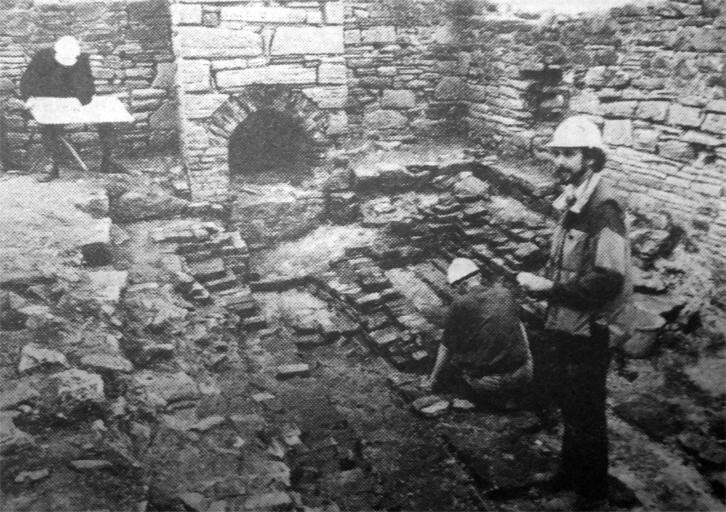 |
Archaeologist David Stewart and his team clear ash from
the remains of one of Preston Island's salt-pan houses.
Next year the stonework will be repaired using authentic materials, and in 1995 the site should be ready for public visiting.
Fife's medieval monks may have started mining coal at what was originally a rocky outcrop a mile from the shore. Then it was built up into a "crannog" or artificial island, eventually adding another few acres to the ample landholdings of the Preston family. Around 1795 Sir Robert - anxious to ape the earlier efforts of Culross coal and salt baron, Sir George Bruce - sunk three mineshafts; the Eye, the Lady Ann and the deepest, the 276-feet George.
Water was pumped from the Forth to salt-pan houses, and while the quality coal was exported from the island, the dross or "pan coal" was used to evaporate the saline solution.
For the families resident in the island's three houses it was a tough life, father and son working in 14 hour shifts for meagre wages. But Peter believes they may have supplemented their income by selling some of the highly-taxed salt by the back door: "Life was cheap during the industrial revolution and it must have been horrible working with such poor-quality coal in the heat and steam of the salt pans."
Prohibitive taxes on the Cheshire-mined product and the Napoleonic wars blocking imports from La Rochelle, in France, meant salt - essential for everything from preparing food to textiles - was worth its weight in gold. Then the bubble burst for Preston Island's coal industry with a disastrous mine explosion in 1811.
Salt production continued, but its death-knell was sounded in 1823 when tax on the English product was removed, leaving Sir Robert Preston £30,000 out of pocket. As Peter explained, "When people could get nice, white, English rock-salt, why pay good money for the grey, horrible product that was coming out of the Forth?"
The salt pans were let out and in use until the end of the 19th century. The island then became the home to travelling people and even an illicit still, and in the 1960s, it started to be cut off by the SSEB.
But Preston Island could play a vital role in the revolution of the late 20th century tourism, leisure and the search for heritage. As Peter said, "Over 200,000 people were once employed in the coal industry in Fife and it was at the heart of why communities existed. There is such an interest in industrial heritage because people who today feel rootless need to know about their past."
--------------------------------------------
"Dunfermline Press"
23 September, 1994
Kilns project points up industrial past
A pioneering West Fife lime project is helping to restore an historic Forthside coal and salt works.
The Charlestown-based Scottish Lime Centre Trust is contributing expertise to prevent further deterioration of stonework at the Preston Island complex, which has been described as the 18th century's answer to Silicone Glen.
The unique integrated coal-extraction and salt-panning centre, which dates back to medieval times and is now surrounded by the Valleyfield ash lagoons, is due to be re-opened to the public next year.
Experts paved the way for establishment of the lime centre at Merryhill Farm earlier this year with successful test limestone firings in a field kiln, as first reported by the Press. The lime produced was the first in Scotland for 40 years.
Remaining supplies of Charlestown's limestone will be used for the project, which is also expected to help restore the village's historic kilns complex, hailed as the birthplace of the Scottish industrial revolution.
Trust director Pat Gibbons said the centre had been established in response to concern that traditional building skills were dying out.
She explained that old stone buildings had to be repaired with lime mortar to allow them to 'breathe,' which cement prevented.
The centre includes a workshop and training facilities, with Fife Enterprise initially funding 11 trainees.
--------------------------------------------
