Owners: George Chalmers, Laird of Pittencrieff (1765-1782)
Earl of Elgin
Forth Iron Co. (1854-1860)
Elgin & Wellwood Collieries (1891-92)
| This was one of the oldest collieries in the Dunfermline area (located to the west of the old town) about which few records and plans appear to exist. Little has been uncovered also about the ventures in the 1890s to re-open the colliery here. |
The many small 17th, 18th and 19th century pits making up the
early Pittencrieff Colliery, to the immediate west of Dunfermline,
were all nearly worked
out by the 1840s, the minerals being then owned by the Earl of
Elgin. The re-appearance of old workings in 1890, due to
subsidence, led to a re-opening of a mine by Thomas Spowart
& Co., Elgin & Wellwood Collieries. However, it would
appear that due to the poor quality of the coal found, this
venture and the 'new Pittencrieff Colliery' were
short-lived.
A record of mines in 1893 lists Pittencrieff
Colliery, Pittencrieff Coal Co., Pittencrieff, Dunfermline.
The listed manager is Mr R. Cook.
 |
 |
Click on Maps to Zoom In
---------------------------------------------------------
Old Parish records are a great source of information in spite of the many variations in spellings of names, etc., laid down in these documents. The names of some early miners, and the dates when they were working the early, small coalworks, are revealed in records of births, deaths, and marriages.
22 Jan 1643, Robert Allatt, grieve at Pittincreef heuch, and Magdalene Chirnside had Robert; witnesses, Robert Sharp, George Meldrum and Thomas Chrystie.
---------------------------------------------------------
| Pittencrieff - 18th C employees (dates when known at colliery) |
|---|
| John Pope, collier, 1721; oversman, 1746. Robt. Morries (later Morrice, Morrison, Moris), collier, Feb 1723 - Aug 1734. Alexander Beveridge, coalhewer, Oct 1751 - Oct 1759. Peter Scot(?), coalhewer, Oct 1751. James Davidson, coalhewer, Oct 1751. John Morice, coalhewer, Jul 1757. William Morice, coalhewer, Jul 1757 - Oct 1759. James Morice, coalhewer, Oct 1759. Robert Beveridge, coalhewer, May 1766. Alexander Penman, coalhewer, May 1766. Henry Allan, coalhewer, Feb 1794. [Formerly at Baldridge Colliery.] |
---------------------------------------------------------
Information on coals worked at, or near, Pittencrieff Colliery
(based on historical reports and information from 1856-1930)
In 1291, William de Oberwill, Laird of Pittencrieff (an estate next to the town and Abbey of Dunfermline) granted the abbot and convent of Dunfermline the rights to dig for coal on his lands at Pittencrieff. The churchmen were free to open up a coal working wherever they pleased, except on arable ground, and when it was exhausted, they were entitled to open up another as often as they felt it necessary, it being understood that while they could take coal for their own use, they were not allowed to sell it on to anyone else.
They also had permission to quarry stones for their own use on any part of the estate, except on arable ground; and they could have free use of all roads and pathways on the estates of Pittencrieff (west of the Abbey) and Gallowridge (south-west of the Abbey).
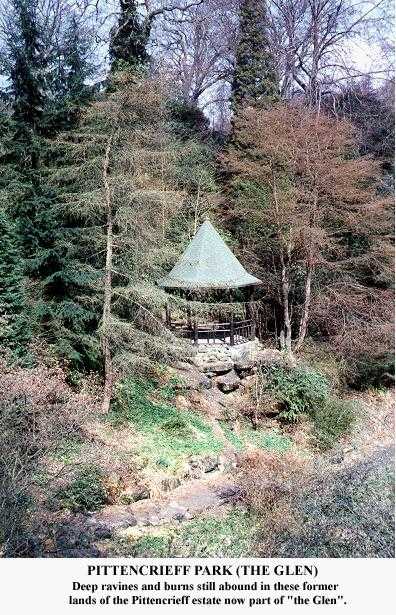
The original way of working coal, as the language of the Charter shows, was to quarry it along the outcrop of the seam and to abandon it when, owing to the increase of water, or otherwise, it became too deep to be further worked. This was in the days before the invention of pumping machines, and this way of working coals continued in use until almost the end of the nineteenth century. The surface of the ground on the estate therefore became covered with large holes, and as the coals could often only be reached when they came near the surface, these old workings would usually be found along the banks of a river, or a burn, where the seams cropped out. The broken form of the ground on some parts of the banks and along the ravines of the many burns at Dunfermline, may indicate some of these most ancient diggings for coal in Scotland.
--------------------------------------------------------
The following article, reported in the Dunfermline Press of 25th April, 1914, expands on the above information and gives further details about the early mining at Pittencrieff.
WHEN COALS WERE WORKED IN PITTENCRIEFF GLEN.
GLIMPSES AT THE MINING OPERATIONS OF FAR-OFF DAYS.
A THIRTEENTH CENTURY CHARTER.
In his "Annals of Dunfermline", Dr Henderson thus translates a charter
which was granted to the monks of Dunfermline by the proprietor of Pittencrieff in 1291:-
"To all who shall hear or see this Charter, William de Oberwill, of Pittencrieff, wishes
eternal Salvation in the Lord. Be it known to you that I have granted, from my mere good
pleasure and my own free will, to the religious men, the Abbot and Convent of Dunfermline,
a coal pit in my land of Pittencrieff, wherever they may wish, excluding the arable land, in
such a way that they may get from thence sufficiency of coal for their own use, and may
not presume to sell to others; moreover, one failing, they may make another, according to
their own free will, as often as they may see it expedient for themselves. In addition I am
willing to grant and do grant to the same, free power to quarry, take and cut stones in the
said land of mine, for their own use, according to their own free will excluding the arable land.
I grant also to them and to those belonging to them that they may use freely all the roads and
paths through my lands of Pittencrieff and Galrig, without any hindrance, which they have
used at any time or have been wont to use. In testimony whereof I have allowed my seal to
these presents along with the official seal of my Lord Bishop of St Andrews and the Seal of
Robert Melville, who have attached their Seals to these presents at my instance. Given at
Dunfermline on the Tuesday next before the Feast of St Ambrose, Bishop and Confessor,
in the year of grace 1291."
Dr Henderson writes of this as the oldest Scottish coal charter extant. The learned
writer of the "Annals" is in error here. Nearly 80 years before the Oberwill
charter was granted, the proprietor of the lands of Preston on the south side of the Forth
had given the monks of Newbattle power to "yearly" coals on his lands. Although
the monks of Newbattle had granted to them "carbonarium et quararium" at Preston in
1218 and 1285, it does not by any means follow that the "black stones", as coal was
called, were discovered first on the south side of the Forth.
William de Oberwill granted the ecclesiastical fathers in 1291 power to open, not a coal pit as
put by Dr Henderson, but a coal quarry on the lands of Pittencrieff, and how long before this
coal had been discovered it is impossible to say.
THE FIRST USE OF COALS.
The Dunfermline charter is particularly interesting inasmuch as it throws light on the working
of the mineral and the use to which it was put. The Abbot and Convent were allowed to open
a quarry for coals to get from "thence sufficiency of coal for their own use", and they
were not to "presume to sell" coal to others.
In connection with excavations which took place in Pittencrieff Glen after the romantic spot
became the property of the Carnegie Dunfermline Trust, a section of strata was laid bare
showing thin seams of coal peeping out here and there.
The seams opened out were undoubtedly the seams operated upon by the labourers who
were the slaves of the Abbot and Convent of Dunfermline.
The coalheughs of the thirteenth and fourteenth centuries were open quarries, and the
output must have been extremely small. As time wore on the open coalheughs system was
abandoned, and mines were run in the seams from the banks of streams, the rabbit-like warrens
being abandoned where the workings got below the level of the stream and therefore
became flooded with surface water.
Even in the opencast William de Oberwill contemplated flooding, and he gave the Abbot
and the Convent power to make "another mine" on the one from which coals had
been gotten "failing".
A PECULIAR "FUEL".
In the amusing interview which the Yankee had with Councillor Robert H. Robertson, the
Councillor was represented to say that "the natives away back in ten hundred and
something according to a French monk that visited the town, were burning a most peculiar
fuel, a sort of black rock that gives off great heat." The Yankee imaginative journalists
here give us an earlier glimpse at Dunfermline than Dr Henderson or any writer ever attempted
to give.
It may be interesting to say, however, that the Yankee scribes have paraphrased the records
of the visits to Fife of two Church dignitaries, but the visits were not in "ten hundred and
something", but in the fifteenth and sixteenth centuries.
Early in the reign of James II (1436-60), Aeneas Sylvius, who became Pope Pius II, visited Fife,
and he was astounded to see poor people begging in rags at the church doors, and for alms
they obtained pieces of "black stones".
What astonished the Pope-elect was the fact that the poor ragged creatures left the church
doors happy and contented when a piece of stone was placed into their hands in place of bread.
His astonishment ceased, however, on his finding that the stones were "impregnated with
an inflammable substance", and that the people "burned them in place of wood".
In 1526, Hector Boece, a professor in Aberdeen University, visited the "Kingdom". Hector
was as much impressed by the coals of the "Kingdom" as Pius II was, and he has left
on record these words:- "In Fiffe are won black stanes quilk has sa intolerable heit quhen they
are kindillet that they resolve and meltis irne, and are therefore recht profitable for operation of
smiths and such artificers as deal with other metals".
In the days of Pius II and Boece, coals were being gotten in many parishes in Fife, and the
works were carried on by the landlords, the Church claiming a teind of the coal output in the
same way as they ear-marked a tenth of the grain raised on farms which were not Church lands.
If in any parish ten saltpans were in operation, the output of the tenth pan went to the Church.
WHEN DUNFERMLINE MINERS WERE SLAVES.
The Bruce Street of today was at one time known as the Collier Row. There from time immemorial
the Dunfermline miners, who were slaves, had been resident. As far back as 1478 the port which
stood at the top of Bruce Street was known as Collier Row Port. By a series of Acts passed by the
Scots Parliament, the salters and miners became slaves, and they were liable to be bought and sold
with the collieries with which they for years had been connected. So completely were the miners
considered outwith the pale of the law, that the Habeas Corpus Act of Scotland did not apply to "colliers
and salters". This was an Act setting forth that persons shall not be imprisoned without the reasons
being stated by the authorities, and that wanton delays of trial shall be held to be contrary to law. For
many years the Town Council of Dunfermline worked the minerals of the burgh for behoof of the
community. Here is a minute from the Burgh Records which throws some light on the coal working
of the seventeenth century:-
"10th Oct 1670. - This day the Provost, Baillies, and Counsell being informed yt the Earls of
Dunfermline and Tweeddale wr satisfied the coill in the town's muire be wrought be the toun,
and the yeirlie profit to be devydit equallie betwixt the said Earls and the toun: Thairfoir resolve to
agrie yr anent, and the toun to deburse 200 lib. to be payed to ym again in yr awin hand wth the
profit of the coill."
The "profit" the burgh had on the minerals did not amount to much, although the miners
who worked to the Corporation were slaves and toiled in the mines of the "Muir" for a mere
pittance. The conditions of employment are well brought out in a minute which bears the date
October 1713.
It appears from this minute that the Earl of Rothes sent a letter to the Town Council from Leslie,
asking for the loan of two colliers. The Council passed a minute, in which they "warranted the
Bailies to lend to the Earl, David Murgain and George Brown, upon the Earl's bond to restore
them on demands without expense. And in case that the Lady of Pittencrieff want William Watson,
warrants the Bailies to lend Watson to her." From this it appears that the Town Council
dispatched two men to Leslie, and a third man was held in readiness for the owner of Pittencrieff.
In 1701, Pittencrieff belonged to Colonel John Forbes, and the chances are that the lady referred
to was his wife.
A GRACEFUL ACT.
Although the city and other slave-holders trafficked in flesh and blood, it appears from the
Burgh Records that they could do a graceful thing now and again. Slaves were allowed to marry,
and here is a minute which will be read with interest, because it shows that the city fathers were
not exactly without heart:-
"27th March 1754. - This day the council ordered William Dickie, late treasurer, to advance
to James Wilson, one of the town's coalliers, who is just now about to be married, twenty
shillings sterling money, being what the town usually give to their workmen on that occasion."
The sum was not by any means a big one, and it is hoped that James was able to pay the town
back with interest.
---------------------------------------------------------
| See also : Dunfermline - early coalworks |
|---|
---------------------------------------------------------
From the Geological Survey of 1928, a section in Pittencrieff Glen had the following composition:
| Sandstone and blaes | 10 ft. + |
| Coal Rib | 5 in. |
| Fakes, fireclay and blaes | 6 ft. |
| Ironstone and Coal Rib | 5 in. |
| U. Kininny Limestone | 2 ft. |
| Blaes | 5 ft. |
| Sandstone | 30 ft. |
| Fakes and blaes | 10 ft. |
---------------------------------------------------------
Splint Coal was worked on the Pittencrieff estates, and was probably the seam (or one of the seams) mined by the monks of the nearby Dunfermline Abbey. The outcrop of the Splint ran from Dean Plantation to the west, through Lundin and into the old Berrylaw and Pittencrieff collieries.
The Splint (Dunfermline Splint) Coal - also known as the Four Foot Coal - was the lowest workable seam here and it varied between 3 ft. and 4 ft., sometimes exceeding the latter. Limited areas may even remain untouched near the old pits of this colliery about which no plans and few records exist.
A thick sandstone which occurred between the Two Foot and
Five Foot Coals was quarried at one time in Pittencrieff
quarry situated just west of Chalmers Street and the crop of
the Five Foot lay just west of the site of the quarry.
An inconstant ironstone horizon occurred about 6 fathoms
above the Five Foot Coal at Pittencrieff and at Baldridge,
just to the north. This was the Pittencrieff or Elgin
Blackband Ironstone, about which little is known now, though
it must have been mined here long ago at the time when the
Dunfermline coals were wrought in the Pittencrieff
neighbourhood. It is reported to have been 6 in. thick in the
Pittencrieff workings, and an old bore at Rosebank records
this ironstone as thick as 14 in. It was sometimes absent,
however, and at other times was represented by a rib of
coal.
The Main Group of coals (lower Eight Foot to Six Foot) never exceeded 20 fathoms in total in this district and the more usual distance was about 16 fathoms. It included six coals, most of which contained partings, while the intervening strata varied considerably in thickness. The Eight Foot Coal was the lowest seam of the group and it occurred in two leaves separated by 3 to 48 ft. of barren strata. Both leaves were worked in most parts of the district, often as separate seams. At Pittencrieff Colliery, each leaf was reported to be 3 ft. thick but the coal was described as "black and useless".
The Swallowdrum Coal, sometimes known as the Upper Swallowdrum, was found in two leaves at Pittencrieff:
| Swallowdrum Coal (Pittencrieff Colliery) | |
| Fireclay | - |
| Coal | 2 ft. |
| Stone | 3 in. |
| Coal | 1 ft. 11 in. |
| Fireclay | - |
The Silkstone or Cairncubie Coal generally occurred in leaves throughout the district but a section at Pittencrieff recorded only a single leaf:
| Silkstone or Cairncubie seam (Pittencrieff Colliery) | |
| Sandstone | - |
| Plies | 9 in. |
| Coal | 2 ft. |
| Fireclay | - |
Approximate locations and names for the old pits
identified are shown on the map which also features the
course of the Urquhart Drainage Level through the Baldridge
and Pittencrieff Collieries. A considerable volume of water
constantly flowed from this level and its line was marked at
the surface by the lines of air shafts.
A number of old pit shafts in the Pittencrieff Colliery, to
the north and to the east of the James Pit (see above map),
have still to be identified by name or number. One
abandonment plan, however, indicates that at least one pit
working coals in this area was named the
'Pittencrieff'.
---------------------------------------
| Plan of Abandoned Seams for Pittencrieff Pit, Dunfermline | Pits or Mines designated in Plan |
|---|---|
| COAL; seam unnamed |
Pittencrieff
[Urquhart] |
---------------------------------------
"Dunfermline Saturday Press"
1 August, 1891
NEW COLLIERY AT DUNFERMLINE
A new colliery, or rather an old one, is about to be
started near Dunfermline. Some time ago, a subsidence
occurred in one of the fields on Pittencrieff estate, and an
opening in the ground was made sufficiently wide to permit a
man to enter what was discovered to be a disused coal mine.
Since then a thorough exploration of the locality has been
made by the trustees of the late Mr. Thomas Spowart, of the
Elgin and Wellwood Collieries.
As a result, a lease of the coal has been taken by these
parties, and a day mine is now being driven to win the coal.
The colliery is practically within the Burgh of Dunfermline,
and if the trustees are successful in getting a moderately
good household coal it cannot fail to be a very remunerative
concern.
The coal about to be opened is part of the old Elgin field,
and was wrought in the days when blasting operations in mines
were practically unknown. There were therefore seams and
large portions of coal left which could not then be
profitably worked.
The prospect of this colliery being opened out has given
lively satisfaction to the miners near Dunfermline. Of late,
mining operations have been drifting away from the Burgh,
causing not a few old residenters to leave the district.
---------------------------------------
"Dunfermline Saturday Press"
27 August, 1892
PITTENCRIEFF COLLIERY
This colliery, which was opened upwards of a year ago, and
lies quite adjacent to Dunfermline, has been closed. It is an
old coalfield, previously worked by the Earl of Elgin, and
was abandoned about 50 years ago. About two years ago, a part
of the surface caved in, and disclosed what was considered a
seam of coal of fair quality.
Explorations of the old workings were made, with a result
that the Wellwood Coal Company took a trial lease of the
ground. Unfortunately, after the outlay of a considerable
sum, it has been found that the quality of the coal will not
warrant further operations.
---------------------------------------
"Dunfermline Press"
12 August, 1961
A Famous Laird Of Pittencrieff
The fourth of this series of articles written and illustrated by COLIN DYMOCK on George Chalmers, Laird of Pittencrieff from 1765 to 1782, throws fresh light on Chalmers' wide interests in mining and agriculture.
... Excluding the benefits accrued from the cultivation of crops (on Blackburn of Pittencrieff, Wester Rosyth, Windylaw, Hilton, and Bantaskine, in the parish of Falkirk), for which he was his own agent of sale, the territories yielded a valuable store of coal, and ironstone.
Private Harbour
The distribution of these commodities was facilitated by the laird's private harbour
at Brucehaven, close to the fishing port of Limekilns, on the Firth.
George Chalmers' hope of perfecting his coal and ironstone trade was never
entirely fulfilled, for, on the sale of the Fife properties, notice was given of an incomplete
waggon-way at West Baldridge to carry the coal from the pithead, and much expense
was incurred by the construction of a great inclined plane, or "level," cut from
the coal face to the surface, whereby the coal could be manhandled to waiting transport.
It is important to realise the position of the colliers at this time, when their condition was
little better than slavery. This virtual serfdom was a matter of serious concern to certain
enlightened persons, who discussed the problem, at a session of the Convention of
Royal Burghs. The entry of 12th July 1770, reads: "Committee of the Convention -
proposed petition to the Parliament concerning the emancipation of the colliers (coalmasters
interested). Provost Buchanan (Edinburgh), Commissioner George Clerk, Messrs Peter
Colvill, William Alexander, George Chalmers, and Messrs McLeod, and Cullen, advocates,
to look into the affair."
Restless Nature
Besides owning the lands of Pittencrieff and Baldridge, Chalmers could boast of these
additional estates, including the agricultural and mineral appurtenances thereto. They
were Clune, Luscar (aforementioned), and Gowkhall. ...
---------------------------------------
