| Pitdinnie is one of the areas to the west of
Dunfermline town about which few records and no plans
would appear to exist. We commented some time ago that,
perhaps, researching old parish records may provide some
detailed items and we are pleased to include below
information from 1790 and 1845 which indicate the
existence of Merrylees and Whinnyhill Collieries (see
individual entries) in the lands of Pitdinnie during the
18th century.
The Author and Webmasters |

Statistical Account of Scotland
Parish of Carnock
(1791)
"This parish is plentifully supplied with coals, there being at least 5 different coal mines in it, belonging to as many different proprietors; viz. Sir John Halket of Pitfirran - the Rev. Dr. John Erskine of Carnock - Mr. Mill of Blair - Mr. Mutter of Annfield - and Mr. Hogg of New Liston. There is also some iron-stone on the estates of these gentlemen. The produce of the mines is uncertain. Mr. Mutter's coal lets at £100 a year, and Dr. Erskine's at £40. Mr Mill's, which is wrought for his own emolument, is supposed to produce from £80 to £100 per annum."
The account indicates that 6 miners and about 35 or 40 colliers were employed in the parish at this time.
"There is a small quantity of moss in the S.E. part of the parish, from which a few peats are dug, but these are solely appropriated to the kindling of fires, coals being the only fuels used in this district, as they abound both in this parish and in the neighbourhood. The average price of great coal is 2s. 6d. for 40 stones, and, for the same quantity of chows, or small coal, 1s. 3d. The carriage paid for a single horse cart of coals is 4d. per mile."
Statistical Account of Scotland
Parish of Carnock
(1845)
"Ironstone is frequently met with in the parish,
especially on the lands of Pitdinnies and Blair. The quality
is considered rich, particularly of that which is found on
the Pitdinnies; but on neither estate has the ore been
wrought.
Coal is diffused generally throughout the parish, and was at
no distant period wrought in five different places. The only
mine at present in operation, is on the estate of Blair, in
the west of the parish. It has been wrought for a long time
past, but with greater spirit of late years than formerly.
It consists of four different seams of coal. The uppermost,
a three feet seam, is a blind coal, used by brewers
and maltsters. The others are house-coal of different
qualities, and are 6, 4 and 2½ feet in thickness,
respectively. Part of all these seams have been wrought, and
are at present working.
The produce, which is about 2000 tons annually, is almost
wholly used in home consumption. The entire depth of the pit,
which is at present wrought, is twenty-three fathoms. A dike
cuts one of the seams near to the pit, causing a considerable
derangement in the strata, and changing altogether the
quality of the coal. The coals were, till of late, drawn up
by a horse gin; but a small engine, upon the high pressure
principle, which was set up for keeping the pit clear of
water, now draws up the coals also.
The coal in other parts of the parish, though not wrought,
is not exhausted. On the north-east, most of the upper seams,
branching off from Lord Elgin's coal-works, in the parish
of Dunfermline, and cropping out in Carnock, have been
wrought out. The lower seams, however, have not, it is
understood, been yet touched."
Information on coals worked at, or near, the Pitdinnie collieries
(based on items from 1856-1930)
The Dunfermline coalfield began about Carnock and the
history of the working of coal around Pitdinnie probably
takes us back to some of the most ancient diggings for coal
in Scotland, perhaps even to around the 12th or 13th century
when the mode of coal working was to quarry it along the
outcrop of a coal seam and then to abandon the excavation
when it became flooded or when it became too deep to be
further worked.
No other mining method was available before the invention of
pumping machinery and it continued in use well into the 19th
century. The surface of the mined ground would therefore be
pitted over with large holes, and as the coal could only be
gained when it reached or came near the surface, these old
workings would commonly be situated along the banks of a
river, or a burn, where the coal strata might be seen
cropping out.
Signs of old pits, believed to be to the Stink and Dunfermline Splint Coals, were seen near Whinnyhill, 2½ miles east of Blairhall, and these are believed to be the coal-works of the Merrylees and Whinnyhill Collieries of the late 18th century. This was a small faulted area, the structure of which was obscure. A little further south, round Pitdinnie, the structure was also quite unknown.
The Stink or Sulphur Coal, 30 fathoms above the Upper Kinniny Limestone, was a variable seam up to 2½ ft. thick although no records of workings are known. From reports, the coal appeared to have a pyritous character, i.e. it had a high iron sulphide content. More recently, the Sulphur Coal is known to have been worked over a small area from a shallow pit south of East Camps (see separate West Fife Index entry). A mid-nineteenth map indicates two trial coal pits to the south-west of Pitdinnie, near Drumfin, and an old coal pit - Carnock Pit, by the quarry, just south-west of Carneil.
The outcrop of the Dunfermline Splint Coal, long-exhausted
in this southern shallow part of the basin which has been
worked for a very long time, followed a winding course,
interrupted by faults, from the southern end of the Dean
Plantation in the west, where traces of old mines and bores
were found, eastwards through Lundin and into the old
Berrylaw and Pittencrieff Collieries on the western edge of
old Dunfermline. The Splint Coal was the lowest workable seam
in the district and was sometimes known as the Four Foot
Coal, its thickness varying between three and four feet and
sometimes exceeding the latter. Small isolated basins of the
Dunfermline Splint, along with the Two Foot and Five Foot
Coals, were believed to occur under Camps Bank, south-east of
Carnock, and near Pitdinnie.
The Splint has been wrought since ancient times in the
Dunfermline district and was probably the seam (or one of the
seams) mined by the monks of Dunfermline Abbey in the 13th
and 14th century.
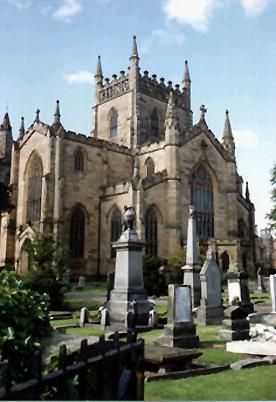
Notwithstanding the long period during which it has been
wrought in this district, relics of the Dunfermline Splint
seam were still being mined in the early years of the 20th
century. Limited areas may also remain untouched in the
vicinity of these old collieries.
The Dunfermline Splint eventually gained a great reputation
as an excellent steam coal and also as a top-grade, household
coal. It is not known if the Two Foot Coal, which lay 3 to 6
fathoms above the Dunfermline Splint, was one of the coals
wrought in the long-abandoned collieries in the
Cairneyhill-Crossford area which seems to have had the only
intrusive "whinstone" in the whole of the
Dunfermline coalfield.
This poster is one of several displayed by Fife Regional Council by the side of the former mineral railway (now part of the Kingdom cycle ways) which ran westwards from Dunfermline to Saline. It is sited close to the old mining areas of Oakley, Carnock and Pitdinnie, and the villages of Crossford and Cairneyhill.
 |
Quotes on this poster pertaining to the coal mining which formerly went on in this area are:
"FAIR THEE WELL YE MINING MEN, YOU GAVE YOUR LIFE TO THE PIT"
(from 'The Life o' the Collier' by Dave Spittal)
"Hear the echo of pick and shovel deep down as miners dig for black gold."
