Owners: probably the Earls of Dundonald
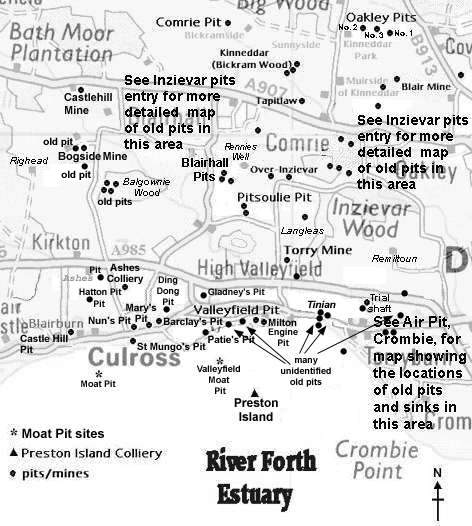
Nun's Pit was just east of Culross, on the north side of the road and only a few hundred yards north of St. Mungo's Pit.
|
 |
Although authentic records are wanting regarding the
working of coal at Culross from the thirteenth to the
sixteenth centuries, there seems no doubt that the monks of
Culross Abbey imitated their brethren of Dunfermline in
digging coal, as traces of ancient 'coal heughs' are
found at several places in the neighbourhood. At the
beginning of the seventeenth century, the famous colliery of
Sir George Bruce at Culross (Castle Hill and Moat Pits) is
stated to have been at the height of its prosperity. The date
at which the Nun's Pit was first worked is not known but
for nearly five centuries, coal was wrought in this part of
West Fife wherever it could be easily reached from the
surface. The shallow holes and collapsed 'bell pits'
of these early mines still mark the outcrops of the thicker
seams.
There also exists the possibility that this was one of a
number of later pits known to have been sunk, and worked, in
the seventeenth and eighteenth centuries by the Dundonald
estates probably to the shallow Jenny Pate Coal seam, or
deeper seams, just to the east of Culross village.
Ventilation at the Nun's Pit is believed to have been by
"sink" or "air hole".
Information on coals worked at, or near, Nun's Pit, Culross
 |
| Plans of Abandoned Seams for Nun's Pit, Culross | Pits or Mines designated in Plans |
|---|---|
| COAL; Main. |
CULROSS (FORESHORE):
Barony; Engine; Garden; Gladney's; Lord Dundonald; Mary; Mill Sink; Milton Engine; Moat; Nun's; Valleyfield Moat |
| COAL; Janet Peat (1782); Laurie Graham (1787); Ell or Splint (1788) |
CULROSS AND VALLEYFIELD:
Ding Dong; Garden; Lord Dundonald; Mary; Mill; Nun's; St Mungo |
