Owners: West of Fife Coal Co.
Henry Ness & Co. Ltd., Townhill
NCB
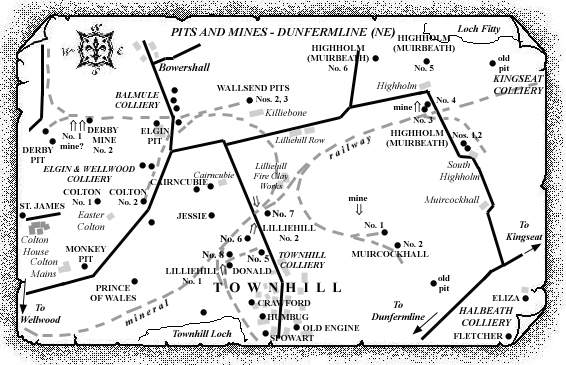
The Muircockhall Nos. 1, 2 Pits were located at the north-
east corner of Townhill Wood, north of Dunfermline, and half
a mile west of the Eliza Pit, Halbeath Colliery.
In 1868, operations were commenced on the Dunfermline Burgh
minerals at Muircockhall by the West of Fife Coal Company,
and this meant that during the 1870s the Townhill mineral
field was being operated upon at every point and the
population rose dynamically in this decade. The Ordinance
Gazetteer quoted that the population was 855 in 1871
rising to 1862 by the year 1881.
Rate of production was averaging 80,000 tons per annum in
the 1890s rising to 100,000 tons per annum in the years
between 1898 and 1902. At the time of this increase, the West
of Fife Coal Company had lost unspecified, but apparently
ominous, amounts of money on Muircockhall, and when it was
taken over by Henry Ness and Company around 1889, pits were
eventually sunk to depths of 105 and 150 fathoms to gain
access to the Dunfermline Splint coal.
After many years as a working coal mine, Muircockhall ended
its life as a Training Centre.
 |
|
|
|
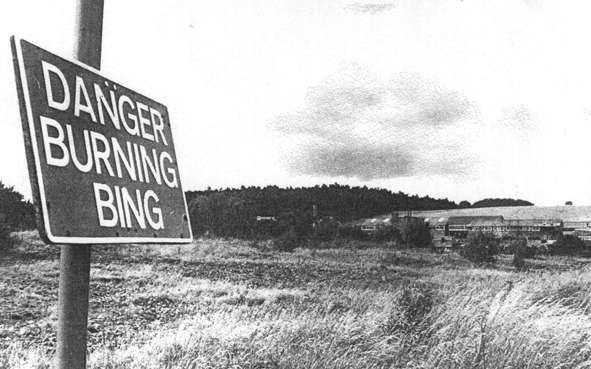
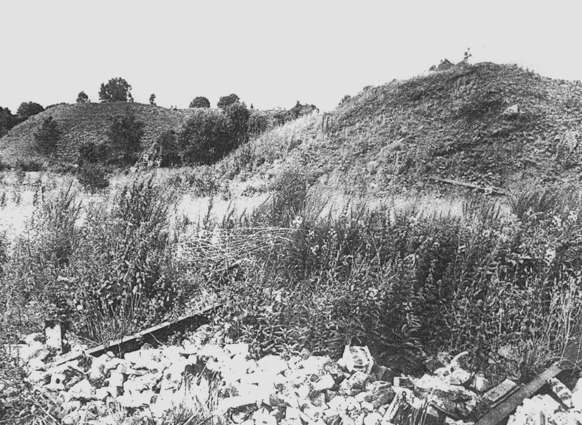
Burning bing
of Muircockhall |
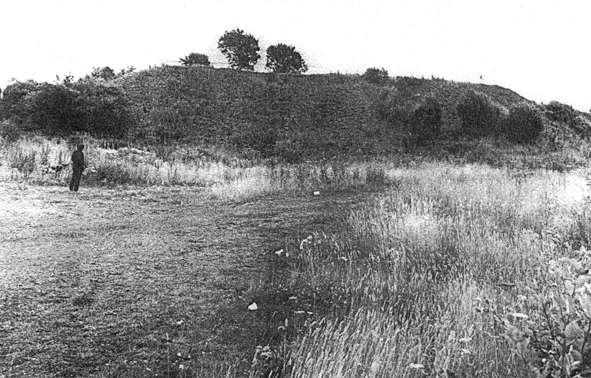
Old pit bing |
 |
 |
|
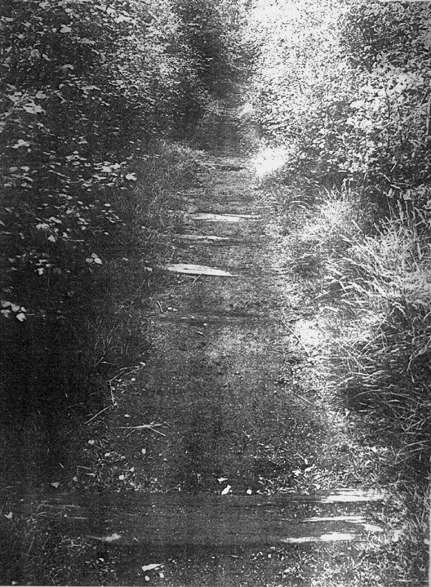
Old railway track
towards the pit |
Muircockhall old shaft
plugged with debris |
A personal note
My older brother, Jim Martin, did his mining training
at this colliery in the late 1950s.
M. Martin
| Colliery opened: 1868 | Colliery closed: 1969 * |
|---|
| Source Date of Information Supplied |
|---|
| Manager / Under-Manager / Men underground / Men above ground / Coals seams worked / Shaft Details |
| 1871 & 1872 (West of Fife Coal Co.) |
| [From Dunfermline Registers] |
| 1873 (West of Fife Coal Co.) |
| George Birrell /
------------
No. 1 / --- / --- / Splint / D'cast (10½ x 6) 552 ft. : U'cast (7 x 6) 552 ft. No. 1 / --- / --- / 5 feet / D'cast (13½ x 6) 612 ft. : U'cast (7 x 6) 500 ft. No. 2 / --- / --- / Splint / D'cast (13½ x 6) 612 ft. : U'cast (7 x 6) 552 ft. No. 2 / --- / --- / 5 feet / D'cast (13½ x 6) 612 ft. : U'cast (7 x 6) 500 ft. |
| 1874 (West of Fife Coal Co.) |
| Henry Ness / ------------
No. 1 / 130 / 29 / Splint / D'cast (10½ x 6) 552 ft. : U'cast (7 x 6) 552 ft. No. 2 / --- / --- / 5 feet / D'cast (13½ x 6) 612 ft. : U'cast ----- |
| 1875 (West of Fife Coal Co.) |
| Henry Ness / ------------
No. 1 / 123 / 24 / Splint / D'cast ----- : U'cast (17½ x 6) 552 ft. No. 2 / --- / --- / 5 feet / D'cast (13½ x 6) 612 ft. : U'cast ----- |
| 1876 (West of Fife Coal Co.) |
| Henry Ness / ------------
No. 1 / 140 / 29 / Splint, 8 feet / D'cast ----- : U'cast (17½ x 6) 552 ft. No. 2 / --- / --- / 5 feet, 6 feet, 3 feet / D'cast (13½ x 6) 612 ft. : U'cast ----- |
| 1877 (West of Fife Coal Co.) |
| Henry Ness / ------------
No. 1 / 151 / 30 / Splint, 5 feet / D'cast ----- : U'cast (17½ x 6) 552 ft. No. 2 / --- / --- / 8 feet, 6 feet, 3 feet / D'cast (13½ x 6) 612 ft. : U'cast ----- |
| 1878 (West of Fife Coal Co.) |
| Henry Ness / ------------
No. 1 / 140 / 25 / Splint, 5 feet / D'cast ----- : U'cast (17½ x 6) 552 ft. No. 2 / --- / --- / 8 feet, 6 feet, 3 feet / D'cast (13½ x 6) 612 ft. : U'cast ----- |
| 1879 (West of Fife Coal Co.) |
| Henry Ness / ------------
No. 1 / 160 / 28 / Splint, 5 feet / D'cast ----- : U'cast (17½ x 6) 552 ft. No. 2 / --- / --- / 8 feet, 6 feet, 3 feet / D'cast (13½ x 6) 612 ft. : U'cast ----- |
| 1880 (West of Fife Coal Co.) |
| Henry Ness / ------------
No. 1 / --- / --- / Splint, 5 feet / D'cast ----- : U'cast (17½ x 6) 552 ft. No. 2 / 154 / 41 / 8 feet, 6 feet, 3 feet / D'cast (13½ x 6) 612 ft. : U'cast ----- |
| 1881 (West of Fife Coal Co.) |
| Henry Ness / ------------
No. 1 / * / * / 3 feet / D'cast ----- : U'cast (13½ x 6) 240 ft. No. 2 / 120* / 29* / 6 feet / D'cast ----- : U'cast (10½ x 6) 180 ft. * Total miners for Nos. 1, 2 |
| 1882 (West of Fife Coal Co.) |
| Henry Ness / ------------
No. 2 / 119 / 25 / Three feet, Six feet / D'cast (13½ x 6) 240 ft : U'cast (17½ x 6) 180 ft. Furnace at No. 1 Pit |
| 1883 (West of Fife Coal Co.) |
| June, 1883, Mr. Henry
Ness, manager of 10 years, leaving Muircockhall and
Highholm to be a managing partner at Benarty Colliery.
The new manager, filling the vacancy left by the departure of Mr. Ness, is Mr. A. Sharp. |
| 1884 |
| March: Mr. A. Sharp,
manager, leaving to take up management of Devonside
Colliery, near Tillicoultry.
Mr. Robert Andrews, manager at Halbeath Colliery for 26 years, assuming the management at Muircockhall and Highholm. |
| 1889 |
| March: An increased offer
by Mr. Henry Ness for Muircockhall Colliery and Buildings
is reported in the local press.
April: Auction Sale of Muircockhall Colliery plant and materials takes place (Messrs. Shirlaw, Allan, & Co., auctioneers, Hamilton) |
| 1890 (Henry Ness & Co.) |
| No. 2: Henry Ness
/ ------------ / 61 / 11 / Cairncubie
D'cast (14 x 6) 228 ft. : U'cast (17 x 6) 162 ft. Furnace ventilation. |
| 1896 (Henry Ness & Co.) |
| Henry Ness / ------------ / 63 / 11 / Household, manufacturing and steam coals. |
| 1902 (Henry Ness & Co.) |
| Joseph Cochrane / J. Wylie / 79 / 10 / Household, manufacturing and steam coals. |
| 1904 (Henry Ness & Co.) |
| Joseph Cochrane / ------------ / 51 / 10 / Household, manufacturing and steam coals. |
| 1905 (Henry Ness & Co.) |
| ------------ / ------------ / 76 / 12 |
| 1908 (Henry Ness & Co.) |
| David Howison / J. Duncan / 64 / 10 |
| 1911 (Henry Ness & Co.) |
| ------------ / J. Duncan / 46 / 7 |
| 1913 (Henry Ness & Co.) |
| Mar: Departure of Mr John Duncan,
oversman, to Cowie. Apr: Mr David Holmes, former under-manager Marion Pit, appointed to Muircockhall. |
| 1918 (Henry Ness & Co.) |
| William Weir / William Kyle / 159 / 50 |
| 1919 (Henry Ness & Co.) |
| Mr James Erskine, manager; Mr Alexander Wilson, under-manager. |
| 1920 (Henry Ness & Co.) |
| James Erskine / Alexander Wilson / 259 / 55 |
| 1928 (Henry Ness & Co.) |
| James Erskine / Alexander
Wilson / 127 / 35
Household and steam coals. Three Feet, Cairncubie, Fourteen Feet and Upper and Lower Eight Feet. |
| 1938 (Henry Ness & Co.) |
| James Erskine / Alexander Wilson / 222 / 51 |
| 1940 (Henry Ness & Co.) |
| Oct: Mr James Erskine, colliery manager, retires. |
| 1944 (Henry Ness & Co.) |
| Mar: Mr James Robertson, manager of the centre; Mr T. J. Macoustra, technical manager. |
| 1945 (Henry Ness & Co.) |
| T. J. Macoustra /
Alexander Wilson / 27 / 6
Household and steam coals. Three Feet, Ell, Fourteen Feet, Six Feet, Cairncubie and Upper and Lower Eight Feet. |
| Muircockhall Colliery ceased coal raising in December, 1944. |
| 1947 (NCB) |
| T. J. Macoustra / Alexander Wilson / ----- / ----- / Training Centre. |
| 1948 (NCB) |
| T. J. Macoustra /
Alexander Wilson / 22 / 8 / Maintenance. Mr Alexander Wilson, under-manager, died 1st April. |
| 1949 (NCB) |
| T. J. Macoustra / ------------ / 22 / 8 / Training Centre. |
| 1950 (NCB) |
| T. J. Macoustra / ------------ / 12 / 3 / Training Centre. |
| 1951 (NCB) |
| T. J. Macoustra / ------------ / 13 / 3 / Training Centre. |
| 1952-56 (NCB) |
| T. J. Macoustra / ------------ / 15 / 3 / Training Centre. |
| 1957-59 (NCB) |
| T. J. Macoustra / Training Centre. |
| 1961 (NCB) |
| D. W. Sneddon / Training Centre. |
| 1964 (NCB) |
| D. W. Sneddon / J. Delaney / Training Centre. |
| * Muircockhall Colliery ceased coal production in December, 1944, but continued as a Mining Training Centre until 1969. |
Muircockhall Colliery (19th century report)
| Name of Coal | Thickness | Quality | Class |
|---|---|---|---|
| Six Foot Coal | 5 ft. 6 in. | Fair | Steam |
| Cairncubie Coal | 3 ft. 6 in. | Fair | 2nd class Household |
| Three Foot Coal | 3 ft. | Fair | Steam |
| Eight Foot Coal | 4 ft. 6 in. | Fair | Steam |
Writing in 1889, an observer had this to say about the
Muircockhall coalfield: "... This coalfield, like the
Townhill coalfield, belongs to the Burgh of Dunfermline, and
was leased from them. The first pits sunk on the lands were
the No. 1 and No. 2 Pits.
These pits were sunk, as near as I am able to determine,
perhaps fully eighteen years ago to the splint coal, and
everything looked favourable - the quality of the coal at the
bottom of the shafts gave fair prospects that the capital
invested on the sinking and fitting might, in a number of
years, be able to remunerate the speculator for his outlay.
The splint coal, which was the principal coal for household
purposes, was counted on very much here, as has been the case
in every Fife colliery.
The pit bottom stoops were turned in No. 1 pit, the workings
shaped off - I believe in a very systematic form - to produce
a large output, as the pits were fitted with winding
machinery which was able to meet every emergency; but,
unfortunately, foul coal was encountered for which no sale
could be found. This, under all circumstances, has a very
damping influence even to the boldest and bravest speculator.
In the No. 2 pit, a lengthy downset or dook was resorted to
to prove the seam, and in it some of the coal was found to be
of excellent quality, but, unfortunately, again, when
something might have been done to retrieve some of the
expense laid out to prove the seam, the Queen Pit and the
Eliza Pit were suddenly stopped, and the result was the
downset or dook was submerged or flooded with water.
All hope was then abandoned, and it had to be left to its
fate, and, as far as I know, remains there still.
I may also state that in the 5-feet coal in this field, some
good patches were found, but in many places it was foul,
thin, and, in some places, nipped out altogether.
After these seams were flooded the next best policy to be
pursued, was to open up some of the upper coals, and this was
done with great spirit. There was the Swallowdrum,
Cairncubie, and the 6-feet or main coal, which could be
worked comparatively dry.
The Swallowdrum coal here was not a very easy coal to get,
and its quality was not the best. It had a remarkably bad
parting from the roof, and was a little hard to hole.
The only redeeming trait in its character was, on its bottom
it had six inches of superior gas coal which gave a good
coke, and which also commanded a good price in the market;
and if this gas coal had held on through all the field,
brighter prospects would have been in store; but as the
workings got developed to the east and west it became patent
that it was not a paying concern.
The Cairncubie has also been tried, and, like the coal I
have already referred to, a considerable area has been
worked, but the most of it latterly got into foul coal, and
was not even saleable.
The 6-feet or main coal here is of a very soft nature, and
has been tried both by the stoop-and-room and longwall
system. Tried by stoop-and-room, it being soft, to make lump
coal, but under every system of working it was always soft
and made much dross, and if binged and exposed to the
weather, suffered in a remarkable degree.
It might have suited better for shipping coal if a good seam
of 5-feet had been working on the field to have mixed with
it. This not being the case, when sold for shipping purposes
it had to be sold cheap, and combined with all its other bad
features, this told hard against it. ..."
Information on coals worked at Muircockhall Pits
(based on a report from 1930)
In the ground between Muircockhall Colliery and the Hill
of Beath, several bores have proved the Glassee Coal. In
character and development it was similar to the seam at the
Burn Pit, Cuttlehill. A boring at the south end of Kingseat
village, which cut it at 79 fathoms, proved it to be 2 ft. 10
in. with a roof of blaes and a pavement of fireclay.
Towards Muircockhall. a sandstone appeared between the
Lochgelly Splint and Parrot Coal seams. In the Townhill
coalfield these two seams were wrought as the Upper and Lower
Eight Foot Coals. The lower coal at Muircockhall was about 3
ft. with a stone parting; the upper was 3 ft. 6 in. with a 7
in. foul coal in its blaes roof.
The Ell Coal lay from 5 to 7 fathoms above the Upper Eight
Foot Coal and was separated from it by, fine-grained sediments
which contained a thin coal. At Muircockhall, where the Ell
Coal was encountered at 34 fathoms in the No. 2 Pit, it was 4
ft. thick and rested on a pavement of fakes.
The Swallowdrum Coal was cut at 30½ fathoms in No. 2
Pit and was wrought here as the Three Foot Coal, its average
thickness not being less than 3 ft. Between the Swallowdrum
and Ell Coals in this field, there was a local development of
blackband ironstone, the Muircockhall Parrot, which could be
traced northwards into the Muirbeath (Highholm) Collieries.
Above the Swallowdrum seam, lay another good coal which went
by the general name of Jersey Coals. These usually consisted
of two main seams which were given various names at the
different collieries. In the Townhill coalfield these were
known as the Upper and Lower Cairncubie Coals, a name derived
from the farm near the centre of the basin.
At Muircockhall, the Cairncubie Coals were 6 to 8 ft. above
the Swallowdrum and were separated from each other by 6 in.
to 12 in. of fireclay. An average section at Muircockhall is
given below:
| CAIRNCUBIE COALS (Muircockhall Colliery) | |
| Sandstone | 1 ft. 1 in. |
| Fakes | 10 in. |
| Coal (UPPER) | 2 ft. 2 in. |
| Stone | 2 in. |
| Coal (inferior) | 7 in. |
| Fireclay | 8 in. |
| Coal (LOWER) | 5 in. |
| Coal (inferior) | 2 in. |
| Sandstone plies | 6 ft. |
The name most generally used in Fife for the highest member of the Main Group of Coals was Kelty Main Coal but, like other members of the Group, it had a number of local names which led to some confusion in correlating the seam from district to district. It was known as the Six Foot Coal of Townhill here and was a thick seam at Muircockhall containing a wandering rib of stone. An average section had the following composition:
| KELTY MAIN / TOWNHILL 6 FT. COAL | |
| Blaes | 2 ft. 6 in. |
| Coal | 2 ft. 11 in. - 3 ft. 6 in. |
| Stone | 1½ in. |
| Coal | 2 ft. 9 in. - 3 ft. 2 in. |
| Fireclay | 3 in. |
The Rough Coal was the lowest member of the Blairhall
Group of coals and its distance above the top of the Main
Group of coals was very variable, ranging from 10 to 18
fathoms. In the Townhill coalfield, where it was worked as
the Fourteen Foot or Bright Coal, it was a thick seam in two
or more leaves which differed in quality.
At Muircockhall, the Bright Coal lay about 4 fathoms below a
whinstone sill* which was exposed in the
shaft of the No. 2 Pit and in Craigwell Quarry, just west of
the pit. The coal was in two leaves with a 2 ft. parting; the
upper leaf was 5 ft. 3 in. and the lower leaf was 3 ft.
* Several of the faults in this coalfield were
important in largely determining the sites of the collieries.
A fault, with a downthrow to the north, started between the
Fletcher and Eliza Pits and crossed the basin to Lilliehill
where it joined the Townhill fault. It had a throw at
Muircockhall Colliery of not less than 50 fathoms and brought
the top of the Dunfermline Group of coals very near the
surface in Townhill Wood. Although the Limestone Coals were
remarkably free from disturbance by intrusive rocks, in the
Townhill field, this thin "whinstone" sill
(olivine-basalt) lay above the Rough (Bright) Coal at
Muircockhall.
| Plans of Abandoned Seams for Muircockhall | Pits or Mines designated in Plans |
|---|---|
| COAL;
Three Feet; Five Feet; Six Feet; Upper Eight Feet;
Lower Eight Feet; Cairncubie; Splint (1877) |
MUIRCOCKHALL |
| COAL; Five Feet; Splint (1881) | MUIRCOCKHALL Nos. 1, 2 |
| COAL;
Three Feet; Five Feet; Six Feet; Upper Eight Feet;
Lower Eight Feet; Fourteen Feet; Cairncubie; Splint (1888) |
MUIRCOCKHALL Nos. 1, 2 |
| COAL; Fourteen Foot (Upper and Lower Leaf) - September 1928 | MUIRCOCKHALL No. 3, Eliza |
| COAL; Glassee (Abandoned 19th December, 1936). | MUIRCOCKHALL No. 2 |
------------------------------------
"Dunfermline Saturday Press"
4 December, 1869
SUPPER
On Monday night, the workmen employed at the West of Fife
Colliery were entertained to a supper in Mr. Aitken's
Royal Hotel. About twenty five sat down, and in the
unavoidable absence of Mr. Birrell, Mr. Lindsay of Lilliehill
Brick Works, occupied the chair. Mr. Anderson, manager,
discharged the duties of croupier. After the usual loyal and
patriotic toasts, the chairman proposed "Success to the
West of Fife Colliery". He adverted to the state of
trade at present and the future prospects of the coal trade
in the West of Fife, and ardently hoped that the great
undertaking of the Tay Bridge would cause coalmasters to
increase their sales to a large extent, and get a natural
inlet to the markets of Forfar.
Referring to the extensive works carried on since the
commencement of the undertaking, he was happy to say that
amongst all the many men employed, not a single accident had
taken place. This was noted by the Government Inspector who
lately had called, and it showed the superior way in which
machinery and the usual appliances had been got up and
carried through at the works. The other toasts were,
"The Manager, Mr. Anderson", "The
Contractors", "Lilliehill Brick Works",
"The Chairman and Croupier"; after which the
meeting separated, having enjoyed a most pleasant
evening.
------------------------------------
"Dunfermline Saturday Press"
18 February, 1871
RECENT IMPROVEMENTS AT TOWNHILL
Recent improvements effected at Townhill are worthy of
notice. Since the West of Fife Coal Company commenced
business, nearly two dozen double houses have been erected in
the village. These are constructed of brick and are well
finished, due attention having been given to sanitary and
sewerage matters. The West of Fife Coal Company have sunk two
pits in close proximity to the village - one of these being
in full working order. No. 1 Pit is 92 fathoms deep. A pair
of coupled engines are used for winding purposes - the
cylinders being 20 inches in diameter, with a 4 feet stroke.
The engine seat is constructed of cast iron, which, we
believe, is something new in Fifeshire. This pit has four
workable seams of coal.
No. 2 Pit is in process of being sunk, and will be fully
100 fathoms deep. The coal found at both pits is of
first-rate quality.
-----------------------------------------------
"Dunfermline Journal"
12 October, 1872
MUIRCOCKHALL COALS
ORDERS for these very Superior COALS left at Office, GUILDHALL STREET, will receive every attention from
THE WEST OF FIFE COAL COMPANY.
-----------------------------------------------
"Dunfermline Journal"
12 October, 1872
MUIRCOCKHALL COLLIERY
THREATENED REDUCTION OF WAGES
On Thursday forenoon a meeting of the employees of Muircockhall Colliery took place in the Ante-Room of the Music Hall. There was a large attendance. The meeting was called with reference to the threatened reduction of wages. The general Council of the Miners Association of Fife were communicated with, to see what steps could be adopted to prevent the threatened reduction. Nothing definite could be arrived at until the decision of the Council could be obtained.
------------------------------------------------
"Dunfermline Journal"
8 February, 1873
THE WEST OF FIFE COAL COMPANY
Invite Offers for the Drawing of the COALS from
Working Face to Pit-Bottom.
Particulars from MR ANDERSON, Manager,
Muircockhall Colliery, and Offers to be lodged with him, or at the
Office, by TUESDAY First.
Dunfermline, 7th Feb. 1873.
------------------------------------------------
"Dunfermline Saturday Press"
23 May, 1874
On Tuesday, while a man, named George McQueen, was employed in No. 1 Pit, Muircockhall Colliery, a lump of blae fell from the roof, and struck him in such a manner that he received rather serious injuries on various parts of his body. He was speedily attended by Dr. Bell.
------------------------------------

"Dunfermline Saturday Press"
12 June, 1875
On Thursday afternoon, while a man named Robert Sinclair
was engaged in blasting operations in No. 2 Pit, Muircockhall
Colliery, a fuse which he had set ignited unexpectedly,
causing an explosion by which he was killed instantaneously.
Deceased, who resided in Pilmuir Street, was thirty years of
age, and has left a widow and three of a family. He was a man
of very quiet demeanour, and enjoyed the esteem of his
fellow-workmen.
------------------------------------
"Dunfermline Saturday Press"
25 December 1875
On Thursday, a lad named Hugh Wilson, met with an accident in No. 1 Pit, Muircockhall Colliery. He was going down the incline when he somehow got pressed in between a hutch and a prop, and thereby sustained injuries of a serious nature. He was attended by Dr. Morris.
------------------------------------
"Dunfermline Saturday Press"
4 March, 1876
On Wednesday, John Allan, a brakesman, while employed in No. 2 Pit, Muircockhall Colliery, fell down the shaft - a depth of about 50 feet. He was speedily taken to the bank, and conveyed home, when he was attended by Dr. Bell. The injuries he received were found to be of a very serious nature. He now lies in a dangerous condition.
------------------------------------
8 April, 1876
LET OF COLLIERY
On Tuesday, the Muircockhall Colliery was re-let by auction, to the West of Fife Coal Company, at a fixed rental of £600, with a royalty of 8d. per ton of 28 cwts.
------------------------------------
"Dunfermline Saturday Press"
15 December, 1877
On Monday, a miner named Alexander Izatt, met with an accident while employed in No. 1 Pit, Muircockhall Colliery. A heavy mass of stone suddenly fell upon him from the roof of the pit the result being that he sustained spinal concussion, while his right foot was greatly injured. Dr. Bell was in attendance.
------------------------------------
"Dunfermline Saturday Press"
1 December, 1883
FAILURE OF THE WEST OF FIFE COAL COMPANY
Towards the end of last week, disquieting rumours
prevailed in Dunfermline as to the solvency of the West of
Fife Coal Company, and this week the Company have suspended
payment. A private meeting of the principal creditors was
held in St. Margaret's Hall on Thursday, when a full
statement of the affairs of the Company was submitted. After
a good deal of discussion, no settlement was arrived at, and
sequestration will be taken out. The liabilities are stated
to amount to £20,000.
The Company have carried on operations at Muircockhall,
Dunfermline, since 1867, and leased their minerals from the
Burgh of Dunfermline, to whom they are behind in royalties to
the extent of £1700. One of the partners, it is said,
started with a capital of £15,000 and several people
have invested money in this concern. The principal creditors
belong to Glasgow and Alloa, but a good few reside in
Dunfermline.
The total assets have not transpired, but it is generally
believed they are not large.
Since the Company was formed they have conducted mining
operations on an extensive scale. Their seams, they state,
have been greatly interrupted by "faults" or
"dykes". Four years ago their lower seams were
completely flooded with water from an adjoining colliery, and
the operations had to be entirely confined to the higher
workings.
To these difficulties, combined with the prevalent low
prices of coal since 1875, is attributed the failure. The
Company have just sunk a couple of new shafts at Highholm, in
one of which the splint - the best seam in Fife - has been
struck.
Here the prospects are stated to be good. The failure has
caused a great sensation in Dunfermline and district, and as
usual some wild rumours have been circulated regarding the
matter.
Yesterday, Sheriff Gillespie appointed Mr. Brownlie, of
Lassodie, judicial factor, so that the 200 workmen at the
pits will be still employed, and work carried on in the
ordinary way.
------------------------------------
"Dunfermline Saturday Press"
19 January, 1884
In this edition, Messrs. Mitchell & Wallace, Alloa Coal Company, are described as applying for lease of the West of Fife Company's coalfields.
------------------------------------
"Dunfermline Saturday Press"
7 March, 1885
On Tuesday afternoon, Richard Roxburgh, who was engaged as a waggon shunter at No. 2 Pit, Muircockhall Colliery, met his death in a shocking manner. He had, it is supposed, been inching forward a waggon, and had been unaware of the approach of another waggon, when he was caught between two buffers. His head was severely crushed - his skull being fractured - and death ensued a few minutes after the accident. Deceased, who was about forty years of age, leaves a widow.
------------------------------------
"Dunfermline Saturday Press"
3 November, 1888
THE BURGH MINERALS
The working of Muircockhall and Highholm Colliery, belonging to the Burgh, was abandoned on Wednesday.
------------------------------------
"Dunfermline Saturday Press"
4 May, 1895
John Oswald, miner, Greenside Place, Townhill,
was fatally injured while working in No. 2 Pit, Muircockhall
Colliery, belonging to Mr Henry Ness, on Tuesday
forenoon. Shortly after eleven o'clock, he was engaged
holing a piece of coal, when a large quantity of coal came away
unexpectedly and fell upon him. One of his sons who was working a
short distance off was the first to discover what had occurred. On
Oswald being extricated from the "fall", it was
ascertained that he had been severely injured. Without loss of time
he was conveyed to the surface and speedily removed home. Dr Bell
was telephoned for, and was promptly in attendance. The Doctor
found the unfortunate man suffering from fracture of the spine, and
the case was regarded as hopeless.
Oswald expired at twenty minutes to three
o'clock in the afternoon. Deceased, who was 48 years of age,
was married, and leaves a widow and grown-up family.
------------------------------------
Supplement: "Dunfermline Saturday Press"
19 October, 1895
At a meeting of the Land, Coal, and Finance Committee, on the 9th inst., the draft articles of roup and draft tack of Muircockhall Colliery, as revised by Mr Miller, M. E., were gone over and finally adjusted - the upset yearly fixed rent being reduced from £300 to £250, which is the same as that paid by Mr Ness.
------------------------------------
"Dunfermline Saturday Press"
14 December, 1895
In the absence of any offer for Muircockhall Colliery, the Town Council have agreed to allow Mr Henry Ness, the present tenant, to continue the tenancy under old conditions.
------------------------------------
"Dunfermline Saturday Press"
26 September, 1896
James McMillan, a pit brusher, residing at 38 Lady Campbell's Walk, Dunfermline, met with an accident in Muircockhall pit on Wednesday morning. He was putting up a prop, when part of the roof gave way, and fell upon him. Dr Bell found him suffering from a scalp wound and slight injuries to the back and shoulder.
------------------------------------
"Dunfermline Press"
13 November, 1897
NEW LEASE OF MUIRBEATH AND
MUIRCOCKHALL
COLLIERIES
The Property Committee, at a meeting on the 14th ult., heard a statement by Mr Macbeth, agent for Messrs Henry Ness & Co., Limited, and Mr Henry Ness, tenants, respectively of Highholm or Muirbeath Colliery and Muircockhall Colliery, in support of an application that the Town Council should grant a new lease to the Limited Company of the two collieries together for an extended period. ...
------------------------------------
"Dunfermline Press"
19 February, 1898
At a meeting on the 10th ult., the Property Committee, on the recommendation of Mr Miller, M. E., agreed that Mr Ness, tenant of Muircockhall Colliery, be allowed to work the barrier coal between that colliery and Townhill Colliery, from certain places off a dook which Mr Ness had driven, and which places were above the level at which the water got away level-free, but not further to the dip than the dook had been driven, and on condition that the barrier should not be reduced to less than ten yards in thickness.
------------------------------------
"Dunfermline Press"
26 March, 1898
DUNFERMLINE BURGH MINERALS
MUIRBEATH AND MUIRCOCKHALL COLLIERIES
Further examination of the new seams of coal which have been struck at Muirbeath Colliery - the "five feet" and the "Dunfermline splint" (the latter constituting the best Scotch household coal) - confirms the opinion that they are of the best quality, and not only will repay Messrs Ness & Co., for their enterprise in sinking to these seams, but should for many years to come give a good return to the Burgh as royalty owners. The seams that are being worked in Muirbeath Colliery at the present time are as follows:-
| Thickness | |
| The six feet | 4 feet |
| Cairncubie (upper & lower leaf) | 4 feet 3 ins |
| The three feet | 3 feet |
| The eight feet (upper & lower leaf) | 9 feet |
| The five feet | 4 feet 6 ins |
| Dunfermline splint | 4 feet 2 ins |
| This gives a total thickness of 28 feet 11 inches of coal. | |
In addition to these, Messrs Ness are working at
the present time a valuable seam of cannel coal of the first
quality, which lies under the 3 feet seam. There are other seams in
Muirbeath which are not being worked at the present
time.
A new lease of the colliery has been obtained
for 30 years, so that the lessees have ample coal to provide a
large output during the currency of the lease.
Muircockhall Colliery, which has been for over
10 years worked by Mr Ness as a separate concern, is to be
amalgamated with Muirbeath Colliery, and both collieries are to be
worked under a new Company which it is understood is to be
incorporated on an early date.
Muirbeath Colliery last year paid a dividend of
5 per cent., and a considerable sum was carried to reserve. What
Muircockhall Colliery has paid has never been made public, but it
is well known that Mr Ness, by his thorough practical knowledge and
efficient management, has been able to work the colliery to a
considerable profit. It is understood that the arrangement in
connection with the new Company will be that Mr Ness takes all his
interest in both places in ordinary shares, and that there will be
only issued to the public a limited number of £10 five per
cent. accumulative preference shares.
------------------------------------
"Dunfermline Press"
9 July, 1898
HENRY NESS & COMPANY, LIMITED
We publish today in our advertisement columns the prospectus of Henry Ness & Company, Limited, in connection with the amalgamation of Muirbeath and Muircockhall Collieries. The Company is being floated for the purpose of working the two collieries together, and providing additional capital for the development of the new seams of coal which have been found at Muirbeath. From the prospectus it will be seen that only the preference shares are open for public subscription. We understand that nearly one half of the issue has already been applied for privately. The Company should have no difficulty in placing the balance of the shares, as the seams of coal which have been struck at Muirbeath promise a good future alike for the Company and for the Burgh of Dunfermline, who, as is well known, are the royalty owners. Mr Ness himself is to act as managing director of the Company, and this of itself should be a sufficient guarantee of the efficient working of the concern.
----------------------------------------------------
"Dunfermline Press"
17 June, 1899
At a meeting of the Property Committee [Dunfermline Burgh] on the 22nd ult., there was read a letter from Messrs Henry Ness & Co., Limited, to the Chamberlain, applying for permission to work the six-feet and Cairncubie seams of coal at Muircockhall Colliery up to the west boundary march, the same distance as they were allowed to work the three-feet seam, and the following letter from Mr Miller, M. E., reporting on the application, viz.:-
Edinburgh, 2 nd May, 1899.
Burgh Minerals.
DEAR SIR, - I have your favour of yesterday,
with enclosed letter from Mr Ness, asking permission to work the
six-feet and Cairncubie seams up to the west boundary.
The Cairncubie workings are not yet so near the
two-chain barrier as to render it necessary to deal with that seam,
and I think, as regards it, you should request Mr Ness to renew his
application in regard to it when the workings approach the barrier
more nearly. The width to which I would recommend the barrier to be
reduced would depend on whether one or both leaves of the
Cairncubie seam were being worked at the same time.
As regards the six-feet, where now being worked,
the water gets away level free, and I do not think a two-chain
barrier is necessary. With the barrier on the Townhill side I think
ten yards on the Muircockhall side should be sufficient to divide
the two fields. I would suggest, therefore, that to the
"rise", that is northwards of the six-feet level now
approaching the west boundary, this barrier may be reduced to ten
yards in width. -
Yours faithfully, W. M. MILLER.
Andrew Burt, Esq., Burgh Chamberlain,
                         Dunfermline.
--------------------------------------------------
"Dunfermline Press"
13 October, 1900
BURGH MINERALS
In consequence of the presence of a large volume of water in the lower seams of the Muircockhall pits, Messrs Ness & Company have been compelled to devote their attention entirely to the working of the upper seams, which in some cases, are being rapidly worked out. Recent operations by the Messrs Ness have resulted in the striking of the Cairncubie Splint and Swallowdrum seams, which will afford work at the old colliery for at least ten years. This is highly gratifying alike for Messrs Ness & Co. and the Burgh of Dunfermline.
--------------------------------------------------
"Dunfermline Press"
19 January, 1901
The Town-Clerk stated that the annual report by
Mr Millar, mining engineer, on the Burgh minerals had been
received. It appeared from the report that the royalties amounted
to £9807 15s 6d - an increase of £3497 2s 4d on the
preceding year.
The various collieries contributed to the
increase as follows:
Townhill £1605 16 1
Muircockhall 200 7 11
Muirbeath 1588 0 0
Kingseat 57 11 7
Street Brothers 45 6 9
... The rate of increase was 2.65d per ton. The increase was mainly due to the higher price of coal, the output having only increased to the extent of 13 per cent. ...
--------------------------------------------------
"Dunfermline Press"
6 December, 1902
John Hynd, miner, Houston Place, Loch Street, Townhill, met with an accident on Thursday while he was at work driving a heading in the eight-feet seam, Muircockhall Colliery. A stone weighing about one cwt, fell from the roof upon his right foot, injuring the foot so severely that on his removal to the Dunfermline Cottage Hospital, three of the toes had to be amputated by Dr Tuke.
--------------------------------------------------
"Dunfermline Press"
7 November, 1903
William Jackson, pithead labourer, residing in Dunfermline Model Lodging-House, had the two bones of his right forearm broken while employed at Muircockhall Pit, Townhill, on Tuesday.
--------------------------------------------------
"Dunfermline Press"
16 January, 1904
The annual report by Mr Millar, mining engineer, on the Burgh minerals had been received and it showed that the revenue from the several subjects had been as under:-
Townhill Colliery £2707 1 2
Muircockhall Colliery £642 11 3
Muirbeath Colliery £3092 19 8
Messrs Street Brothers, Ltd. £58 7 0
--------------------------------------------------
"Dunfermline Press"
18 November, 1905
At a meeting of the Property Committee of the Dunfermline Town Council on Tuesday evening, a letter was read from Messrs H. Ness & Company, Ltd., lessees of the Muirbeath and Muircockhall Collieries, intimating that it is their intention to take advantage of the break in their lease of the coalfields in 1906.
--------------------------------------------------
"Dunfermline Press"
19 May, 1906
This issue announced that Muirbeath Colliery and Muircockhall Colliery, presently leased to Messrs Henry Ness & Company, Limited, were to exposed to Let by Public Roup, on a day to be fixed, on a lease of thirty years from Martinmas 1906.
--------------------------------------------------
"Dunfermline Press"
30 June, 1906
It is understood that there are several inquiries regarding the Muirbeath and Muircockhall Collieries. There is a probability of the West of Fife Coal Company, Limited, making an offer for a lease of the coalfields.
--------------------------------------------------
"The Scotsman"
4 August, 1906
COLLIERIES IN WEST FIFE TO LET.
To be Exposed to LET, within the Burgh Court-Room, Dunfermline, on Tuesday
the 28th day of August current, at Two o'clock Afternoon, on a lease for fifteen
years from Martinmas next, with breaks in the tenant's favour at the end of five
years, and each year thereafter on twelve months' previous notice.
The Whole SEAMS of COAL, IRONSTONE, and FIRECLAY, in the following portions
of the LANDS belonging to the BURGH of DUNFERMLINE, and lying about two miles
to the North-East of the Town of Dunfermline, viz.:-
(1.) MUIRBEATH COLLIERY, having a surface area of 225 Acres or thereby; and
(2.) MUIRCOCKHALL COLLIERY, having a surface area of 150 Acres or thereby.
There is believed to be a large quantity of Coal, amounting to over Two Million Tons,
unworked, including the Dunfermline Splint and over-lying seams. At Muircockhall the
upper seams are being worked without water having to be pumped to the surface.
Upset Rent for both Collieries, £500 per annum, with optional lordships.
Further particulars may be obtained from Mr W. M. MILLER, M.E.,12 St Andrew Square,
Edinburgh; or Mr WILLIAM SIMPSON, Town-Clerk, Dunfermline, either of whom will
exhibit the Conditions of Let.
Dunfermline, 3d August 1906.
--------------------------------------------------
"Dunfermline Press"
1 September, 1906
THE ROUP OF THE COLLIERIES - NO OFFERER
The roup of the collieries [Muircockhall and Muirbeath] was fixed for Thursday in the Burgh Court-Room, but at the advertised hour there only appeared Bailie Houston, Bailie Russell, Councillor Wilson, Mr Wm. Simpson (Town-Clerk), and Mr A Dodds, auctioneers, and no offer was made for the collieries.
--------------------------------------------------
"Dunfermline Press"
10 November, 1906
This issue carried news of the resignation of Mr W. M. Miller, Dunfermline Burgh's Mining Engineer.
--------------------------------------------------
"Dunfermline Press"
17 November, 1906
Mr G. M. Stewart, banker, Cupar, has been elected a director of Messrs Henry Ness & Co., Ltd., Muirbeath and Muircockhall Collieries, in room of the late Mr John Drummond, manufacturer, Dunfermline.
--------------------------------------------------
"Dunfermline Press"
17 November, 1906
Messrs Henry Ness & Company, Limited, had formally accepted the proposals of the Dunfermline Town Council for a continuation of the lease of Muirbeath and Muircockhall Collieries. ... The lease was entered into in January 1898, and extends over a period of thirty years, so that there are twenty-two years still to run. ...
--------------------------------------------------
"Dunfermline Press"
Saturday 26 March 1910
MORE MINING DEVELOPMENTS
HALBEATH TO BE RE-OPENED
It is understood that Messrs. Henry Ness & Company
Limited, lessees of Muirbeath and Muircockhall minerals, are
negotiating with Mr. R. W. Wallace, of Halbeath, for a lease
of a portion of the minerals on the latter estate.
Should the negotiations prove successful, Messrs. Ness &
Company intend to work several seams above the water level.
Access to these seams was obtained from the shaft of the
Eliza Pit, Halbeath, the working of which was abandoned
several years ago. In order to reach the Halbeath minerals,
it will be necessary to drive a mine from Muircockhall, a
distance of about half a mile, and the coal will be brought
to the surface at the latter colliery, which may thus
continue to be a scene of activity for a period of at least
twenty years. The question of way-leave will have to be dealt
with by the Corporation of Dunfermline, who are the superiors
of Muircockhall.
-------------------------------------------------
"Dunfermline Press"
22 April, 1911
PROPOSED COLLIERY DEVELOPMENT AT TOWNHILL
Mr Henry Ness of Bandrum, along with his agent, Mr James Currie Macbeth, had an interview on Thursday with the Property Committee of the Dunfermline Town Council with regard to a project for the further development of Muircockhall Colliery, of which Messrs Henry Ness & Company, Ltd., are lessees. As is well-known, there is a large area of coal in the Townhill field submerged in water, which is removed, would give a long lease of life to the colliery developments in the neighbourhood. What Mr Ness has in view is the driving of a mine from Muircockhall to the old Eliza Pit, Halbeath. It is contemplated that this would have the effect of draining off a large accumulation of the Muircockhall water. which, it is believed, could be got rid of by means of the Halbeath shaft. The Property Committee decided to place the proposals of Mr Ness before the Burgh Mining Engineers, who will be asked to report on this and other matters affecting the coalfield.
-------------------------------------------------
"Dunfermline Press"
13 May, 1911
The Property Committee of Dunfermline Town Council, at a meeting on Wednesday, had under consideration the proposal by Messrs Henry Ness & Company, Ltd., to further develop the burgh minerals. The intention of the Company is to drive a mine to the Eliza Pit, Halbeath, in the belief that thereby the water submerging the strata in Muircockhall will be drained off. A report by the burgh's mining engineers regarding the scheme was submitted, and it is understood that they expressed approval of it. In the event of the proposal being carried through, coal which is covered by water to a depth of forty feet will be workable, and it is estimated that the life of Muircockhall Colliery will be lengthened by sixteen or eighteen years. The Messrs Ness are negotiating with Mr R. W. Wallace and Mr Mungall (the latter as owner of Whitefield estate) with view to obtaining their consent to the proposed arrangement.
-------------------------------------------------
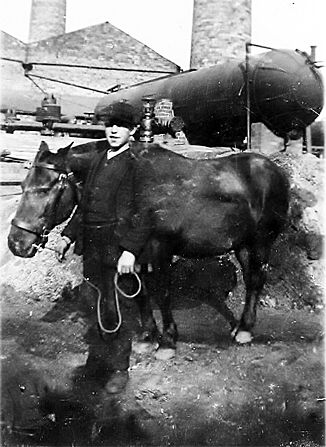
Townhill lad
John S. Hunter
leading a pit pony
Muircockhall Colliery
circa 1913
|
-------------------------------------------------
"Dunfermline Press"
22 March, 1913
On the occasion of his leaving for Cowie, Mr John Duncan, oversman, Muircockhall, was met by a few of his fellow-workers in Victoria Restaurant and presented with a silver mounted walking stick and pipe, and a gold necklace and trinket for Miss Duncan.
-------------------------------------------------
"Dunfermline Press"
19 April, 1913
... Mr Burt, Kelty, has been appointed under-manager of the Marion Pit, Donibristle, in succession to Mr David Holmes, who has secured an appointment at Muircockhall Colliery.
-------------------------------------------------
"Dunfermline Press"
2 January, 1915
A case of overwinding, happily unattended with any serious consequences, occurred at Muircockhall Colliery on Saturday. ...
-------------------------------------------------
"Dunfermline Press"
24 April, 1915
MUIRCOCKHALL COLLIERY
Muircockhall, leased by the Dunfermline Corporation to Messrs Henry Ness & Company,
Ltd., now ranks as one of the most up-to-date collieries in Fife, in respect of conditions of working
underground roads, and the system of ventilation. Within the last two years, vast improvements have
been carried out, both above and below-ground, the result being a production of something like four
hundred tons per day, compared with about fifty tons two years ago.
On Saturday afternoon the colliery was visited by the students of the Dunfermline Mining School,
accompanied by their teacher, Mr Robertson. Under the direction of Mr John Finnie, the colliery
manager, the students were given an opportunity of inspecting the complete electrical plant by
which the colliery is wrought. Below-ground, where general appreciation was expressed with respect
to the condition of matters prevailing, the students saw a couple of Anderson-Boyce electrical coal-cutters
in operation; and there was described to them an electrical endless haulage which is in course of being
completed, and an electrical turbine pump at the bottom of the shaft, which sends to the surface water
in sufficient volume to supply the coal-washing apparatus at the pithead. In regard to what was described
to them at the pithead, the students were equally appreciative, special interest being bestowed upon the
recently introduced Bash coal-washer, which washes something like two hundred tons of dross per day.
The duty of inspection over, the students were entertained at lunch in the Company's office. There
Mr Finnie imparted some useful hints to the students. He told them that if they wanted to be competent
managers, they must do more than attend classes and fill up their time by working underground. What was
of prime importance was that they must make themselves competent workmen in every branch of mining.
The provisions of the Coal Mines Act, he said, were such that the manager's position was not by
any means a bed of roses. He must know every detail not only of the laws governing colliery undertakings,
but of the actual working of the pit.
Before the students left, cordial thanks were extended to Messrs Ness & Company and to Mr Finnie.
-------------------------------------------------
"Dunfermline Press"
5 February, 1916
While in the execution of his duties as a "clipper" on the haulage road in Muircockhall Colliery on Wednesday night, James Russell, residing at Shamrock Street, Dunfermline, had one of his legs fractured and received severe injuries to his foot by a fall from the roof. After first aid had been rendered at the pithead, he was taken home in the ambulance van and was attended to by Dr A. L. Bell.
-------------------------------------------------
"Dunfermline Press"
20 May, 1916
MINERS' MEETING. - At the usual monthly meeting of the miners of the Townhill district on Thursday - Mr James Russell presiding - it was stated that the contributions to the special drawing on behalf of the Edinburgh Royal Infirmary were as follows:- Townhill Colliery, £11 ; Muircockhall Colliery, £13 3s 6d ; Lochside Mine, £1 6s ; total - £25 9s 6d.
-------------------------------------------------
"Dunfermline Press"
8 July, 1916
On Wednesday, David Lindsay, miner, working in Muircockhall Colliery, had the misfortune to receive injuries to his back and legs through a piece of coal and stone falling on him. The injured man was conveyed to his home at Halbeath, where he was medically attended to.
-------------------------------------------------
"Dunfermline Press"
15 July, 1916
DEATH OF MR HENRY NESS

The death took place at Hillpark, Townhill Road, Dunfermline, on Sunday, of Mr Henry Ness,
coalmaster, in his seventy-eighth year.
For close upon a twelvemonth he had been feeling the infirmities of age, and although he had only
been confined to bed during the last few weeks, he had of late very seldom visited his colliery at
Muircockhall, the management of which had very largely devolved upon his sons, who were
associated with him in business.
A native of Lochgelly, Mr Ness was at an early age sent to work in the mines. Keenly interested in
his occupation, he was a diligent student of mining, in its theoretic as well as its practical aspects,
and in due course he acquired the necessary qualifications for mine management.
His first appointment in that capacity was with the West of Fife Coal Company at the Dunfermline
Corporation coalfields of Muirbeath and Muircockhall. But he had higher aspirations. These found
expression in his acquisition of a lease of the Benarty coalfield, an undertaking in which he had
ample reward for his enterprise. On Benarty becoming the property of the Lochore and Capledrae
Company, Mr Ness retired from business.
Having acquired considerable means, it was his intention to eschew, for a time at least, the worries
associated with the mining industry. For a man of his energy and business acumen, however, a life
of leisure held out no attractions. In later years he was wont to confide to his more intimate friends
that it was chiefly health reasons which induced him to seek a new outlet for his activities. During his
short period of retirement, he used to say, he felt far from being well, and it was consequent upon
an interview with his medical adviser that he returned to the industrial turmoil. An opportunity having
been afforded him of obtaining a lease of the Dunfermline burgh coalfields of Muirbeath and
Muircockhall, he proceeded to develop on an unprecedented scale the collieries in which in his
earlier days he had acted as manager. While his enterprise resulted in much personal enrichment
to himself, it was also highly beneficial to the inhabitants of Dunfermline, for, with a rapid extension
of the collieries, the mining royalties rose to a figure which had not been attained previously.
As the head of the firm of Henry Ness & Company, Ltd., Mr Ness insisted upon perfect
accuracy in the details of management. To the observance of this commendable order may
undoubtedly be ascribed the remarkable immunity from accident which was a feature of all the
mining enterprises with which Mr Ness was identified.
Several years ago the deceased gentleman acquired the estate of Bandrum. With a view to
developing the minerals on the estate, he sunk a pit and erected cottages near Steelend
for the workmen. The venture, however, was not attended with success and was abandoned.
For a long series of years Mr Ness was a member of the Dunfermline Parish School Board, in
which capacity he performed much useful work. He was also a Justice of the Peace for the
county, and for many years he was an elder in St Margaret's United Free Church, Dunfermline.
Mr Ness was twice married, his second wife being a daughter of the late Bailie Blair.
The funeral, which was of a private nature, took place to the Dunfermline Cemetery on
Wednesday afternoon. At Hillpark and at the graveside short services were conducted by the
Rev John Sanderson. The pall-bearers were Mr Thomas Ness, Mr Henry Ness, Mr David Ness,
and Mr Robert Ness, sons; Mr Henry Ness and Mr Peter Ness, grandsons; Mr Harry Street, son-in-law;
and Mr David D. Blair, brother-in-law.
-------------------------------------------------
"Dunfermline Press"
17 February, 1917
On Monday evening a deputation of the night shift workers in Muircockhall Colliery waited on Mr Patrick O'Donnell, brusher, at his home, and presented him with a handsome pipe, tobacco pouch, and tobacco, and also a gold brooch for Mrs O'Donnell, subscribed for by his fellow-workers, on the occasion of his leaving the district to take up residence and important work in Ireland. ...
-------------------------------------------------
"Dunfermline Press"
17 November, 1917
MUIRCOCKHALL AND TOWNHILL COLLIERIES
At a meeting of the Property Committee on the 30th ult., there was submitted a letter from Messrs
Ness & Company, Ltd., intimating that the eight foot coal workings in Muircockhall Colliery
were approaching Townhill; that by their lease they were required to leave a barrier of solid coal
two chains in width, and that they would be glad to have the permission of the Town Council to
take out this coal, as they had done in the upper seams, and so keep the whole matter in line.
The Town Clerk reported that he had sent the letter to the Mining Engineers, and he submitted
and read a letter which he had received in reply, and in which the Mining Engineers recommended
that permission might be granted to reduce the barrier in the following terms:- "In the workings in
the upper eight foot coal now approaching the Townhill march, the barrier of two chains provided
by the lease may be reduced to 15 yards, but this permission should only apply to workings to the
north of the present level in this seam at the place in question."
The Committee resolved to recommend that the Council grant permission to reduce the barrier on
the conditions mentioned. The recommendation was approved.
-------------------------------------------------
"Dunfermline Press"
9 February, 1918
MINING ROYALTIES
The report by the City's Mining Engineer on the burgh's collieries to Martinmas 1917 shows that the royalties received were as follows:- Townhill, £1767 9s 11d; Muircockhall, £416 0s 8½d; Kingseat, £251 12s 3d; wayleaves, £96 16s 8½d. This represents a decrease in lordships, including wayleaves, of £1684 18s 1d as compared with the preceding year.
-------------------------------------------------
"Dunfermline Press"
19 October, 1918
Peter Canning, miner, residing at Victoria Terrace, Dunfermline, had one of his legs fractured while he was at work in Muircockhall Pit yesterday morning. He was conveyed to the Dunfermline and West Fife Hospital.
-------------------------------------------------
"Dunfermline Press"
6 September, 1919
Wm. Magee, drawer, residing at West Nethertown Street, Dunfermline, had one of his legs fractured by being crushed between two hutches at Muircockhall Colliery on Monday. He was conveyed to Dunfermline and West Fife Hospital.
-------------------------------------------------
"Dunfermline Press"
2 July, 1921
... At Wellwood, Muircockhall, and Townhill, pumping is unnecessary, so that, as soon as the ventilation has been restarted, and the falls cleared away, work will be proceeded with on normal lines. ...
-------------------------------------------------
"The Scotsman"
8 December, 1924
FATAL ACCIDENT TO FIFE MINER. - As the result of injuries received in an accident at Muircockhall Colliery, Charles Finlay (60), miner, 99 Main Street, Townhill, near Dunfermline, died in Dunfermline and West Fife Hospital on Saturday morning. He was working in the fourteen feet section, and was engaged in taking down head coal, when there was a fall of coal from the roof. His skull was fractured and several ribs broken.
-------------------------------------------------
"Dunfermline Press"
9 January, 1926
REDUCED MINING ROYALTIES
The total revenue derived by the Town Council of Dunfermline in respect of the burgh
collieries for the year to Martinmas 1925 amounted to £1948 17s 2d, made up as
follows: - Townhill, £800 (fixed rent); Muircockhall (royalties), £1099 4s 2d;
Muircockhall (way leaves), £24 13s; and Kingseat (fixed rent), £25.
The decrease in revenue as compared with the previous year was £157 7s 5d.
There was a decrease of coal output amounting to 23,632 tons compared with the year
1924. These decreases, according to the Burgh Mining Engineers, were due to the
state of the coal trade and to the stoppage of operations at Townhill Colliery.
-------------------------------------------------
"Dunfermline Press"
31 August, 1929
ACCIDENT. - While at work in Muircockhall Colliery on Wednesday morning, Alex. Stevens, Dundas Street, met with an accident. His head was severely cut, and one of his hands was badly cut, and one of his hands was badly injured by a fall of stone from the roof of his working place. It is only a short time since Mr Stevens resumed work following an accident which incapacitated him for seven months.
-------------------------------------------------
"Dunfermline Press"
28 September, 1929
Mr James Erskine, junior, who is an electrical engineer with Messrs Henry Ness & Co., Muircockhall Colliery, has received an appointment in the Federal Malay States, to which he sails on 16th October. ... He is a son of Mr James Erskine, E.M., colliery manager, Struan House, Forest Road, Townhill.
-------------------------------------------------
"Lochgelly Times"
15 January, 1930
The coal royalties payable to the Dunfermline Corporation in respect of the operations by their lessees for the year to Martinmas, 1929, amount to £665 (including wayleaves) for Muircockhall Colliery, and £502 for Kingseat Colliery, a total revenue of £1167. ...
-------------------------------------------------
"Dunfermline Press"
16 August, 1930
While Frank Hynd, Loch Street, was in the course of his employment in Muircockhall Colliery on Monday morning, a piece of stone coming away from the side of his working place caught his foot, which was severely bruised.
-------------------------------------------------
"Dunfermline Press"
11 April, 1931
While engaged at his usual employment in Muircockhall Pit, on Monday morning, David Leighton, Wilson Street, Townhill, had two of his ribs broken and received other injuries through a fall of stone from the roof. He was conveyed to his home and attended to by Dr Paul, and is now making satisfactory progress toward recovery.
-------------------------------------------------
"Dunfermline Press"
9 January, 1932
BURGH MINERALS
INCREASED ROYALTIES
The lordships in respect of the Dunfermline Corporation coalfields for the year 1931 amounted to, in the case of Muircockhall, £539 5s 4d, and in the case of Kingseat, to £342 12s 0d - a total of £881 17s 4d. Wayleaves in respect of Muircockhall amounted to £26 6s 8d, making the total revenue £908 4s 0d. The revenue from Muircockhall is more by £100 2s 8d than in the previous year, and in the case of Kingseat there is a decrease of £95 13s 5d.
-------------------------------------------------
"Dunfermline Press"
6 May, 1933
TOWN COUNCIL AND COAL MINES AMALGAMATION.
POSITION OF BURGH COALFIELDS.
As owners of the coalfields at Townhill and Muircockhall, the Town Council of Dunfermline have had under consideration the possible compulsory amalgamation of the colliery companies of the county as recommended by the Coal Mines Re-Organisation Committee. Communication on the subject has taken place with Mr John Wallace, M.P., who has promised to take an opportunity of having the whole subject discussed with the officials at the Ministry of Mines.
-------------------------------------------------
"Dunfermline Press"
27 May, 1933
While employed as a shunter at the sidings at Muircockhall Colliery on Saturday forenoon, John Grant, 59 Muir Road, Townhill, was struck by a waggon and had one of his ribs fractured. He was removed to the Dunfermline and West Fife Hospital, where it was found that the fractured rib had punctured one of his lungs. On inquiry at the hospital later in the week, it was learned that the injured man was making good progress.
-------------------------------------------------
"Dunfermline Press"
9 September, 1933
ACCIDENT. - Walter McInally, Wilson Street, had the misfortune to lose the points of three fingers of his left hand while he was working on Monday at the elevators at Muircockhall Colliery.
-------------------------------------------------
"Dunfermline Press"
15 September, 1934
William Brown, Miner, 36 Dundas Street, Townhill, had his feet badly crushed when he was caught by a fall of coal from the face in Muircockhall Colliery on Thursday morning. After being attended to by a doctor, he was removed to his home.
-------------------------------------------------
"Dunfermline Press"
29 June, 1935
TOWNHILL PIT ACCIDENT.
YOUNG WELLWOOD MINER KILLED.
Robert Dewar Forrester (20), a miner, who resided at North Square,
Wellwood, was fatally injured as the result of an accident in Muircockhall
Colliery, Townhill, yesterday afternoon.
While he was coupling his hutches, during the last hour of his shift, a
stone weighing about a hundredweight, fell from the roof and struck
him on the head. He received a fracture of the base of the skull,
and died shortly afterwards. Deceased, who was unmarried, was
due to leave for a Territorial camp in about a week's time.
-------------------------------------------------
"Dunfermline Press"
11 January, 1936
MINING ROYALTIES.
The royalties payable to Dunfermline Town Council in respect of the burgh minerals for the year to Martinmas 1935 were as follows:- Muircockhall, £836 6s; Kingseat, £128 15s 6d; Derby mine, £252 9s 2d; Lochside (blae and fireclay), £47 13s 2d; - a total of £1282 3s 10d.
-------------------------------------------------
"Dunfermline Press"
13 March, 1937
This issue carried news of strike action threatened by the men of
Muircockhall Colliery, where about 260 persons are employed. It is believed
to be in connection with the 'make-up' system, the system of
paying wages in force at the colliery.
Two weeks later, it was announced in the Press that the threatened
strike had been averted at the last moment.
-------------------------------------------------
"Scotsman"
3 February, 1940
FIRE AT COLLIERY OFFICE.
Slight damage was caused by an outbreak of fire shortly before six o'clock on Wednesday evening in the despatch office at Muircockhall Colliery, Townhill. The alarm was given by an employee at the colliery, and workmen were able to check the outbreak. Dunfermline Fire Brigade, who were summoned, quickly extinguished the flames. The damage was confined to a mantelpiece and the wood-lining of a wall and the ceiling of the office.
---------------------------
"Dunfermline Press"
8 February, 1941
PITHEAD FIRE.
Dunfermline Fire Brigade were called shortly after four o'clock on Tuesday morning to an outbreak of fire at Muircockhall Colliery, Townhill. A wooden structure adjoining the pithead was involved. The Fire Brigade, who were on the scene within nine minutes of the alarm, had the outbreak subdued within a short time. Only slight damage was done, and there was no interference with the working of the colliery.
-------------------------------------------------
"Dunfermline Press"
8 August, 1942
SUDDEN DEATH IN PIT.
David Leighton, miner (58), Wilson Street, Townhill, died suddenly in Muircockhall Colliery, Townhill, on Saturday. He had just descended the pit to work on night shift when he collapsed and passed away. Death was certified to be due to natural causes.
-------------------------------------------------
"Dunfermline Press"
15 August, 1942
PIT ACCIDENTS.
While at work in Muircockhall Colliery on Thursday morning, William Fisher, machineman, 8 Forest Road, Townhill, received injuries to his face when a stone from the roof fell on him while he was attending a coal-cutting machine. The injured man was taken to Dunfermline and West Fife Hospital, where he was detained. ...
-------------------------------------------------
"Dunfermline Press"
31 July, 1943
MUIRCOCKHALL COLLIERY.
To Be Placed On Care And Maintenance.
Negotiations in connection with the scheme for the concentration of the coal industry in
West Fife reached a conclusion on Wednesday when Lord Traprain, Scottish Regional Controller,
and other representatives of the Ministry of Fuel and Power had a meeting at Muircockhall Colliery,
Townhill, with the directors of Henry Ness & Co., Ltd. Accompanying Lord Traprain were
Mr C. C. Reid, Regional Director of Production and Mr James Barbour, Regional Director of
Labour. Mr James Cook, general secretary, and Mr James Potter, agent, attended on behalf
of the Fife, Clackmannan, and Kinross Miners' Union, representing the men employed
at the colliery.
After the meeting it was learned that Muircockhall Colliery, at which about 230 men are
employed, is to be placed on a care and maintenance basis. It is understood that many
of the men will be transferred to other larger collieries, including Comrie Colliery. Work
will probably be found for a number of the older men at collieries nearer their homes,
such as Wellwood and Kingseat. The reduction of Muircockhall to a care and
maintenance basis means that a sufficient number of men will be retained for the
purpose of operating the pumps and maintaining roads, etc.
The process of transferring the men from Muircockhall to other collieries will receive
fourteen days' notice contracts. A number of these men will be re-engaged, and
a second batch of notices will be served later.
-------------------------------------------------
"Dunfermline Press"
14 August, 1943
It was intimated in this issue that the bulk of the 230 men employed at Muircockhall Colliery would be transferred to the large new colliery at Comrie, while opportunity would be given to some of the older men to transfer to collieries nearer their home.
-------------------------------------------------
"Dunfermline Press"
23 October, 1943
Arrangements are being made by the Ministry of Labour for the setting up of a training centre for recruits to the mining industry at Muircockhall Colliery, Townhill. ... It is proposed to provide at the colliery a canteen, baths, lecture rooms, and recreation facilities for the trainees, who will undergo a course of practical instruction at the centre before being drafted to other collieries.
-------------------------------------------------
"Dunfermline Press"
22 January, 1944
Preparations on an extensive scale are being made at Muircockhall Colliery, Townhill, for the reception of recruits to the mining industry who are to receive instruction at the training centre which is being established there by the Ministry of Labour. ...
-------------------------------------------------
"The Scotsman"
Friday 10 March, 1944
SCOTTISH MINING TRAINING CENTRE.
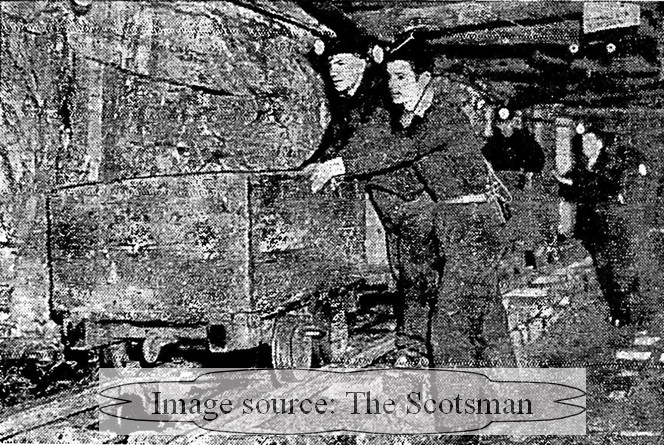 |
Trainees from Falkirk and Blairgowrie seen at work at Muircockhall Colliery.
A start has been made with Scotland's first Government-sponsored scheme for the training
of miners at Muircockhall Colliery, near Dunfermline. The serious man-power shortage in the coal industry
is responsible for this war-time innovation, and a visit to the centre yesterday suggested that the recruits
who will go forward in due course to take their places alongside the skilled and experience men in this
sector of the industrial front will constitute a useful reinforcement of the ranks. The trainees are men who
have opted for mining on being called up or have volunteered, including some over-thirty-fives from the
Army, but they who will be joined in the next few days by those who are officially known as ballotees,
and popularly as the "Bevin boys".
The scheme has been in operation for about ten days. There are between 60 and 70 undergoing training
at the moment, but when the necessary accommodation is completed in the near future facilities will be
available for about 500 in the centre, from which a flow of 300 to 400 tyros monthly will proceed first to
a working colliery for further training, and then to actual work on the surface or underground. At present
the trainees live in a hostel near Comrie Colliery. A special hostel is in course of erection at Townhill,
about fifteen minutes walk from Muircockhall, and with pit-baths, canteen, and so on at the centre, the
welfare side of the scheme is being satisfactorily organised.
AN EYE-OPENER
"We are now in our second week," said an official with many years experience both as a
miner and on the managerial side, and I can say definitely that the start has been most promising and
encouraging. The quality of the young men we have here is of the highest order. The discipline is good,
and the trainees are very enthusiastic and adaptable. It has really been an eye-opener to most of us who
have had to handle them."
How the recruits will fare when the theory merges finally into practice is problematical to a certain extent. Account
has to be taken of diverse personal factors. there is every confidence, however, that they will prove to be valuable
workers, given sympathetic understanding on the part of managements and miners, and there is every reason to feel
that that will be forthcoming in full measure.
Muircockhall Colliery has been adapted as a training centre. It is on a care-and-maintenance basis, the miners having
been transferred some months ago to another part of the county under the arrangements for concentration of output,
and it is well suited to afford an introduction to coal mining. The four weeks course here consists of practical training
underground and on the surface, classroom instruction, and physical training, including running, football, and boxing.
The second stage at a working colliery takes the form approximately of a fortnight on the surface and four weeks
underground. There is no pretence that at the end of this double course the result is a finished miner, with nothing
more to learn about the winning of black diamonds, but the flow from this source will expedite upgrading of workers
already in the industry, and where a novice shows aptitude and keenness he may be working at the coal face
within four or five months. Technical experts are on the staff at the preliminary centre to initiate the trainees into
the working conditions, and to imbue them with the requisite pit sense.
MANAGING DIRECTOR AS TRAINEE
All manner of operations, except the actual cutting of coal, are overtaken, and when the party of Press
representatives went down the pit, duly furnished with overalls, pit helmet, and safety lamp, they saw one group
of trainees receiving practical instruction in the haulage system. In the dim light and cramped surroundings there
were lads who a fortnight ago were employed in a shipping office in Ayr, a fish trader's business, and a
butcher's shop in Aberdeen, and wood-cutting in the airy expanse of a forest in the Highlands.
The trainees, whose ages range from 17½ to 43, come from every social grade in the community. One, a
man of 37, is the managing director of a firm of wholesale and retail chemists in Glasgow. Being on the commercial
side of the business and not a qualified chemist, he opted for mining as his form of national service on being called
up, and so far is finding the training less arduous than he had anticipated, with this advantage as compared with
business life, that when he leaves the colliery at 4 p.m. and gets back to the hostel for a meal an hour later the rest
of the day is his own. He has no ambitions to become a regular miner, but thinks some of the younger lads are likely
to stay on after the war.
Physical training, designed to develop those muscles most required for underground employment, form a quarter of the
daily schedule of training. The trainees are under the eyes of Service P.T. instructors, and among the young men
who were being put through their paces yesterday was a 19-year-old engineering student of Edinburgh University,
who opted for the mines because he felt he would both be doing a vital form of national service and getting engineering
experience which he could not expect to get in the Forces. He is hoping to get a pit job near Edinburgh when his
training is completed. The attitude of the Ministry of Labour and National Service on that question is that, whenever
possible, they give sanction when boarding arrangements can be made with friends.
The visitors yesterday were under the guidance of Mr Glennie, Depute Regional Controller, Ministry of Labour and
National Service; Mr James Robertson, manager of the centre; Mr T. J. Macoustra, technical manager; and Dr A. L.
Tuke, Dunfermline, the medical officer.
-------------------------------------------------
"Dunfermline Press"
18 March, 1944
This issue carried news of the death of Mr Henry Ness, managing director of
Henry Ness & Co. Ltd., Muircockhall Colliery, Dunfermline, and of Lochside
Coal ad Fireclay Co. Ltd., Dunfermline.
Third son of the late Mr Henry Ness, who was for many years actively interested in coal
development in West Fife, Mr Ness and other members of the family devoted themselves
to the advancement of the industry at Muirbeath, Bandrum, and other enterprises with
which they were directly associated.
-------------------------------------------------
"Dunfermline Press"
18 March, 1944
The death took place yesterday morning at his home at Lambert Drive, Dunfermline, of Mr James Erskine, retired colliery manager. Well-known in mining circles throughout Scotland, Mr Erskine, who was a native of Dunfermline, held managerial appointments under the Fife Coal Company, Ltd., and in 1919 he was appointed manager of Muircockhall Colliery, Townhill, belonging to Henry Ness & Co. Ltd., a position which he occupied for about twenty years, retiring in October 1940. He was 60 years of age.
-------------------------------------------------
"Dunfermline Press"
29 April, 1944
FATALITY AT MUIRCOCKHALL COLLIERY
Man Falls Down Shaft
James Anderson, oncost worker, 32 Craigmyle Street, Dunfermline, was killed while at work at Muircockhall Colliery, Dunfermline, on Tuesday afternoon. He was doing some repair work on the pithead when he stumbled into the shaft and fell to the bottom, death being instantaneous. His body was found on the top of a cage which was resting at the pit bottom. After the accident, the men employed at the colliery and trainees, who have been there for some time, ceased work for the day. Anderson, who was 56 years of age, was a widower, his wife's death having taken place ten weeks ago.
----------------------
"Dunfermline Press"
20 May, 1944
Under the Fatal Accidents Inquiry Act, an inquiry was held in the Sheriff Court, Dunfermline, on Thursday - before Sheriff MacLean and a Jury - into the circumstances attending the death of James Meiklejohn Anderson, 26 Craigmyle Street, Dunfermline, who was killed on 25 April at Muircockhall Colliery, Townhill, by a fall down the shaft in course of his work as a shaftsman. Those giving evidence included:- Peter Wishart, miner, 2 Main Street, Kingseat; William McIntosh, pit bottomer, 22 Chamberfield Road, Dunfermline; and Thomas Jamieson Macoustra, colliery manager, who stated that the shaft was 252 feet deep. The Sheriff recorded a formal verdict.
-------------------------------------------------
"We were delighted to receive the following article from Malcolm Hall,
Kingseat Community Council, in April 2011. Malcolm, in fact, has spoken to a number
of Kingseat residents who remember Mr McGreavie living in Church Street."
Michael Martin & Webmasters.
"Dunfermline and West Fife Journal"
Wednesday, July 10, 1946
Death Takes a Holiday
Kingseat Man's Mine Invention
Death will take a holiday from the mines when Thomas McGreavie's invention
is installed in pits throughout Britain.
Mr McGreavie, who resides at Church Street, Kingseat, has invented a device for
stopping runaway hutches, cause of death and serious injury in pits throughout the
world. Keenly interested in the invention is the Fife Coal Company who intend to install
a token gadget in one of their mines for a trial. Mr William Watson, MP for Dunfermline Burgh,
Mr Willie Gallacher, MP for West Fife, and the Minister for Fuel and Power, all have seen
the device at work and agree it promises to revolutionise mining safety.
"My device will cost around £30 to install in each pit but this is not
much compared with the number of lives it will certainly save and the great cut in the
award of compensation paid each year to disabled miners and the dependants of those
miners killed in pit accidents by runaway hutches," said Mr McGreavie to the "Journal".
Explaining the function of the invention, he told me it is attached to the side of the haulage
road, passing hutches strike a knocker, and provided the speed of the hutch is normal, it will
pass through safely. If the speed is excessive, a steel bar drops on front of the hutch and stops
it from careering along the roadway. "Eighty per cent of the runaway hutch accidents
occur at the top of the wheelbraes and dooks, often through some form of negligence," said
Mr McGreavie. "But to make absolutely certain that my invention stops runaway hutches,
one device should be installed at the top, and one at the bottom."
Mr McGreavie works as a colliery electrician at Muircockhall Colliery, near Dunfermline, and
has tried his invention nearly 40 times at the colliery. Every test has been successful. The
invention, now patented, took eighteen months to complete.
-------------------------------------------------
"Dunfermline Press"
7 September, 1946
IRISHMEN FOR FIFE PITS.
The first party of volunteers from Northern Ireland for the Scottish coalfields arrived in
Glasgow on Tuesday. There were 49 in the party, which split into two for preliminary training
at Muircockhall Colliery, Dunfermline, and Michael Colliery, Buckhaven. The men's ages
range from 18 to 36, and during training they will stay in two hostels.
None of the trainees has any experience of coal mining.
-------------------------------------------------
"Dunfermline Press"
16 August, 1947
MUIRCOCKHALL TRAINING CENTRE.
National Coal Board to Assume Control.
Within the next few weeks, the Training Centre
at Muircockhall Colliery, where both mining and building trainees
have been under instruction, is to be taken over by the National
Coal Board.
The centre will be devoted to the training of
miners only, and has been adapted to provide facilities for 800
such trainees at a time. Many interesting methods of instruction in
mining practice have been devised, including covered surface
haulage roads, to be used for the training of men in wet
weather.
At the moment there are still approximately
fifty building trainees at the centre, where they are doing useful
production work for the Ministry of Works by extending existing
buildings such as the kitchen, rest room, and offices.
-------------------------------------------------
"Dunfermline Press"
1 November, 1947
EIGHTY EUROPEAN VOLUNTEERS ARRIVE
IN DUNFERMLINE.
On Wednesday evening, eighty European volunteer workers, who
at the end of the war were displaced persons in Germany, arrived at Dunfermline
Lower Station. They were met by members of the staff of the Dunfermline Employment
Exchange and conveyed by bus to the Townhill Miners' Hostel, where
they are to be accommodated while undergoing mining training at Muircockhall Colliery.
The party consisted entirely of young men who arrived from a holding camp near York,
and are representative of Estonia, Latvia, Lithuania, the Ukraine, and Yugoslavia.
Valuable assistance in overcoming the language difficulties, both at the station
and hostel, was given by Miss Logie, lady supervisor, Dunfermline High School,
and Captain Baczkowski of the Polish Resettlement Corps.
-------------------------------------------------
"Dunfermline Press"
3 April, 1948
Obituary
MR ALEXANDER WILSON
After a two days' illness, Mr Alexander Wilson (63), colliery
under-manager, 19 Forest Road, Townhill, died in Dunfermline and West
Fife Hospital on Thursday.
Mr Wilson, who was a native of the village, was for the last thirty years
under-manager at Muircockhall Colliery. ... He is survived by a married
daughter, his wife having predeceased him a few years ago.
-------------------------------------------------
"Dunfermline Press"
2 April, 1949
MUIRCOCKHALL STAFF REDUCTIONS
Redundant Mining Instructors
Between forty and fifty members of the technical staff of Muircockhall Training
Centre, Townhill, Dunfermline, will become redundant, and will be transferred to
collieries on production work, when the single-shift system of work is re-introduced
at Muircockhall in about a fortnight's time.
This step has been taken on account of the fact that recruitment of foreign labour
has now ceased and in place of eight hundred men being trained on day- and
night-shifts, the trainees will be reduced to exactly half that number on day-shift only.
The Centre will come under the control of the Scottish Division of the National Coal
Board, in place of the London headquarters of the Board.
-------------------------------------------------
"Dunfermline Press"
11 June, 1949
MUIRCOCKHALL TRAINING CENTRE
MORE INSTRUCTORS REDUNDANT
A further seventeen instructors at Muircockhall Mining Training Centre will
shortly become redundant, and are at present under notice terminating their employment.
This has resulted from the fact that training of European volunteer workers has now
ceased, and the centre will be devoted entirely to the training of men from Scotland
and the North of England.
Hitherto, the number of men under training was in the region of 800, a figure which
was reduced to 400 some time ago, resulting in forty instructors being returned to
productive employment in the industry. The number of trainees for whom the
Centre will now cater will be in the region of 250.
-------------------------------------------------
"Dunfermline Press"
22 October, 1949
MINING INSTRUCTOR'S SUDDEN DEATH
On Friday of last week, Mr Andrew Hunter Simpson (50), mining trainee instructor, Buchan Cottage, Cardenden, collapsed and died while at work in the pit bottom at the adult residential training centre, Muircockhall, Dunfermline.
-------------------------------------------------
"Dunfermline Press"
1 December, 1951
Late Mr Peter M. Ness
The death occurred suddenly on Saturday of a member of a well-known
Dunfermline family, Mr Peter M. Ness, 143 Townhill Road. Mr Ness was
returning by car from the Cowdenbeath offices of the National Coal Board on
Friday afternoon when he complained of feeling unwell. He was taken to
Dunfermline and West Fife Hospital, where he died the following day.
Mr Ness, who was 57 years of age, had been associated for many years
with the firm of Henry Ness & Company., Ltd., Muircockhall Colliery,
Townhill. When the colliery became a training centre for miners during the
war, he continued to discharge secretarial duties for the firm, and on the
nationalisation of the mines he received an appointment with the National
Coal Board at Cowdenbeath. ...
-------------------------------------------------
"Dunfermline Press"
22 March, 1952
ITALIAN TRAINEES AT MUIRCOCKHALL
Thirty Italian trainee miners are undertaking an eight weeks' training
course at Muircockhall Training Centre, Dunfermline. The men are conveyed
to and from a miners' hostel at Sauchie each morning and evening.
Before coming to Scotland, the Italians received a 10 to 12 weeks' course
of instruction in basic English. On completion of their training at Muircockhall,
they will be sent to pits in England.
-------------------------------------------------
"Dunfermline Press"
14 June, 1952
ITALIAN TRAINEES LEAVE FOR BELGIUM
Arising out of the decision not to employ Italian miners in British mines, 48
of the 80 Italians who have been undergoing training at Muircockhall Colliery,
Dunfermline, left on Wednesday for Belgium where they are to work in coal mines.
Another 12 Italians have been placed in local employment. The remainder will leave
Scotland at the beginning of next week to return to their native Italy, unless
they are able to find employment in this country.
-------------------------------------------------
"Dunfermline Press"
4 September, 1954
70 Years in Mining Industry
Dunfermline Veteran's Service Recognised
Mr James Thomson, 49 Pittencrieff Street, Dunfermline, who has retired after 70 years' service in the mining industry, has been presented with the National Coal Board's certificate "for long and meritorious service." The certificate is signed by Sir Hubert Houldsworth, chairman of the National Coal Board, and Dr Wm. Reid, chairman of the Scottish Division Board. ... Now in his 83rd year, Mr Thomson is a native of Airdrie, but it was as a young lad that he came to Dunfermline district with his parents. He was 12 or 13 years of age when he started work at Rosebank Colliery, Parkneuk, where, under the supervision of his father, he trained to be a winding engineman. He followed this occupation for practically the whole of his working life, and for 33 years until his retiral was employed at Muircockhall where latterly he was engaged as a watchman.
MUIRCOCKHALL PRESENTATION
At Muircockhall Training Centre, a deputation waited upon Mr Thomson to mark his retrial from the mining industry. Mr J. T. Macoustra, colliery manager, presided, and commented upon Mr Thomson's sterling qualities and the faithful service which he had given in his 70 years' association with the industry. ...
-------------------------------------------------
"Dunfermline Press"
13 April, 1957
60 Years' Service in Mines
Last Friday, a deputation of officials and workmen waited on Mr Thomas Cuthbert, 126 Main
Street, Townhill, to mark the occasion of his retirement from Muircockhall Colliery after 60 years' service
in the mining industry.
Mr MacLean occupied the chair and Mr T. J. Macoustra, colliery manager, on behalf of the staff of
Muircockhall Colliery, presented Mr Cuthbert with an electric shaver, as a token of their appreciation
and esteem. ...
-------------------------------------------------
"Dunfermline Press"
8 March, 1958
61 Years' Service in Mines
On Tuesday, a large deputation consisting of officials, instructional staff, and workmen at the Muircockhall training centre waited upon Mr David Sneddon, to mark the occasion of his retirement from the mining industry after 61 years' service. ...
-------------------------------------------------
"Dunfermline Press"
18 October, 1958
55 Years in the Mining Industry
Mr Peter Blair, an employee at Muircockhall Colliery, has concluded over 55 years' service in the mining industry. ...
-------------------------------------------------
"Dunfermline Press"
14 February, 1959
Over 50 Years in Mining Industry
Mr David Woods, 52 Loch Street, Townhill, was presented with a
clock on the occasion of his retirement at Muircockhall Training Centre,
after 53 years' service in the mining industry.
Mr T. Macoustra, manager, made the presentation, and emphasised the
lengthy and excellent service Mr Woods had rendered to the mining industry,
and, on behalf of the officials and workmen at the colliery, he expressed
the hope that Mr Woods would have good health and happiness during
his retirement.
-------------------------------------------------
"Dunfermline Press"
20 February, 1960
54 Years' Service In Mines
On Wednesday a deputation of workmen and staff at Muircockhall training centre waited upon Mr Wm. Thomson to mark the occasion of his retirement from the mining industry after 54 years' service. Mr J. Delaney, under-manager, presided, and Mr T. J. Macoustra, colliery manager, on behalf of the workmen and staff, presented Mr Thomson with a canteen of cutlery. ...
-------------------------------------------------
"Dunfermline Press"
3 February, 1962
Output Of Coal Has Increased
... NEW ENTRANTS
During the year the Area accepted 408 new entrants, including 238 juveniles,
and in addition 1080 men previously employed in the industry were re-engaged.
Notwithstanding this intake, overall manpower decreased by 586. The Board's
scheme for training indentured craft apprentices continued to function during 1961,
the number of entrants being 44, an increase of 12 over 1960. With the intensification
of mechanisation there is an increasing need for skilled craftsmen and more boys
are being trained with this object in view.
Training of boys other than craft apprentices for underground work continues at the
Board's Juvenile Residential Training Centre at Sauchie and at the Training
Centre at Muircockhall, near Dunfermline. At Sauchie 114 boys were trained during
the year and 48 boys were trained at Muircockhall. ...
-------------------------------------------------
Each apprentice received a Certificate of Training.
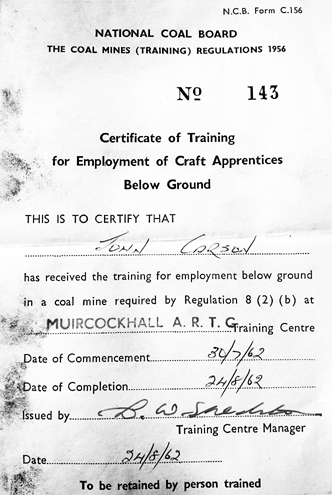
-------------------------------------------------
"Dunfermline Press"
18 January, 1964
Mine Safety Competition
A sixteen-week training period culminated in a safety competition for trainees
at the National Coal Board's Centre at Muircockhall, Townhill, last Friday.
The competition was held in a gallery laid out to represent an underground haulage
plane. Faults were purposely made on it, and the competitors were asked to examine
and rectify the faults.
Those competing from the West Fife Area, and those successful were:- 1 Charles
Williams, 4 Hilton View, Lumphinnans (Lumphinnans No. XI Colliery); 2 Raymond
Whitehead, 34 Kirktoun Park, Ballingry (Glencraig Colliery); 3 John Small, 20
Hope Street, Lumphinnans (Lindsay Colliery); 4 Robert Hodge, 42 Rosewell Drive,
Lochore (Glencraig Colliery); 5 James Fairgrieve, 12 Benarty Avenue, Lochgelly
(Nellie Colliery).
The adjudicator was Mr J. McClelland, Area Safety Engineer, Alloa Area, who
pointed out to the boys what was expected of them. He complimented the
competitors on their performance, and said that before an audience they had done
very well. …
-------------------------------------------------
"Dunfermline Press"
14 March, 1964
Mining Trainees' Safety Contest
Last Friday, the Valleyfield Juvenile Group ended their preliminary training of 16 weeks
at Muircockhall Training Centre with a safety competition. Five boys took part in an individual
test, which was to examine a haulage plane, observe faults, and rectify them, if it was in
their power to do so.
The winners in the competition were:- 1 John Dalrymple, Blairhall Colliery; 2 William Jewell,
Blairhall Colliery; 3 Richard McAlpine, Comrie Colliery; 4 Andrew Bernard, Blairhall
Colliery; and 5 Thomas Gorman, Comrie Colliery.
Prizes were also awarded to J. Dalrymple, Blairhall Colliery, for the best boy in the first-aid
examination, and to A. Bernard, Blairhall Colliery, for the best boy in theoretical work at
Cowdenbeath Technical College. …
-------------------------------------------------
"Dunfermline Press"
13 November, 1965
Muircockhall Lease
The Ministry of Public Buildings and Works intimated that they had been asked by the Ministry of Labour to provide an extension to Muircockhall Training Centre. The Ministry's lease from the National Coal Board expires at Martinmas 1972, and the Board's lease from the Town Council also expires at that date. ...
-------------------------------------------------
"Dunfermline Press"
13 January, 1968
Was Manager At Muircockhall Training Centre
The death occurred on Tuesday at his home at 42 Gowanbrae Drive, Halbeath Road,
of Mr Thomas J. Macoustra, who was technical manager of Muircockhall Training Centre,
Townhill, when it first set up in 1943, until his retiral about seven years ago.
Mr Macoustra, who was 76, had been in indifferent health for some time, although he
became ill only a few weeks ago. …
-------------------------------------------------
"Dunfermline Press"
4 April, 1969
Training Centre for miners to close
The National Coal Board Training Centre at Muircockhall, which has been training miners
since 1944, is to close down, within three months.
This move, however, will lead to better training facilities for those attending the centre, as they
will be transferred to new centres being built at Comrie and Frances Collieries. Mr James
Delaney, manager at Muircockhall Training Centre, said this week that the present centre
was based on an old pit, and they were hoping to give the trainees a more modern outlook
on mining.
"Preparations are already underway to allow us to move to Comrie," he said. "We
have been allocated a section there where we will be able to do our underground work. We think
it will be much better to train people in a live pit, where they will have experience of modern mining
methods.
"We are actually just waiting for planning permission to erect a prefabricated classroom
block. This training centre has been here for 25 years. It was started in order to train miners
under the Bevin scheme, as wartime recruits."
At present, there are 85 trainees at Muircockhall where they go through their preliminary
training in safety and underground work. When they leave, the shaft of the 100-year-old pit
will be filled in, and some of the buildings will be taken over by the nearby Government
Training Centre.
-------------------------------------------------
