Owners: West of Fife Coal Co.
Dunfermline Coal Co.
Henry Ness & Co.
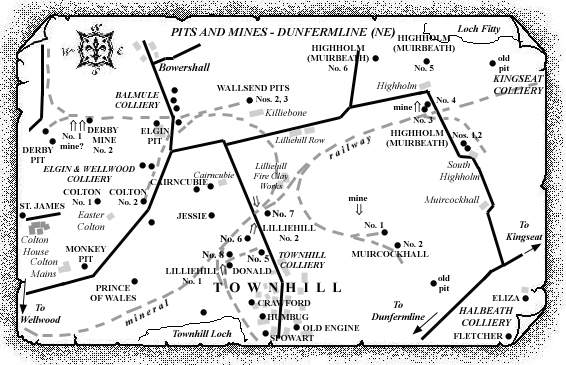
These two shafts, close to the West of Fife mineral
railway line near Highholm Farm, were sunk around 1880/81, as
a development of the Muircockhall and Highholm Colliery,
following the failure at Muircockhall Nos. 1, 2 Pits to work
the lower coals economically. A mine to the Dunfermline
Splint is also known to have operated not far from the
Highholm Nos. 3, 4 shafts, a good description of these being
given by a late 19th century observer (see below).
Unfortunately, the strata in this field were greatly
affected by numerous small hitches, dykes and dislocations
and the field proved to be one of the most troubled in Fife
for the small pits working in this district. They were
abandoned by the Company around 1888 but interest in this
coalfield was to re-emerge, about four years later, when
Henry Ness & Co. Ltd. took a lease on the Highholm
minerals from the Burgh of Dunfermline. Records suggest that
this new venture tapped into the coal reserves of these
Highham Nos. 3, 4 Pits possibly from newly sunk shafts to the
south - Muirbeath (Highholm) Nos. 1, 2 pits.
 |
 |
 |
------------------------------------
| Pits sinking: 1876/84 ? | Pits closed: 1888 but seams worked from other pits at a later date(?) |
|---|---|
| Source Date of Information Supplied | |
| Manager / Under-Manager / Men underground / Men above ground / Coal seams worked | |
| 1883 (West of Fife Coal. Co.) | |
| June, 1883: Departure of Mr. H. Ness from the West of Fife Coal Company's Muircockhall and Highholm Collieries after 15 years of service, 5 years as contractor, oversman, and 10 years as general manager. Mr. Ness leaves to be a managing partner of a colliery at Benarty. The new manager is Mr. Sharp. | |
| 1888 | |
| Dunfermline Coal Company abandons Highholm Colliery. | |
------------------------------------
Writing in 1889, an observer had this to say about the
Muircockhall and Highholm coalfield: "... The Company
then having none of the superior coals, commenced sinking
operations at the front of the Highholm Farmhouse, at the
side of the West of Fife mineral railway. These pits were
commenced to sink perhaps eight or nine years ago, and the
best coals were expected to be found at a considerable depth.
A large double pithead frame was erected and two pair of
winding engines of the most modern construction; and it was
only discovered, after these pits had been sunk down over 50
fathoms that something was materially wrong with the strata.
Bore-holes were put down in the bottom and clearly
demonstrated this as facts, and for a number of years mines
have been driven in the upper coals to try and prove the
field. These mines have gone in every direction, and have
been able to prove nothing, but that the field is one of the
worst description on record - being nothing but a mass of
hitches, dykes, and dislocations, combined with burnt foul
coal, lying a great deal of it at the angle of 45 degrees of
dip and rise.
This dip and rise is always a very bad feature in any
working - even although the seam is of good quality. It
materially enhances the cost of digging the coal by the
miner; the disadvantages of drawing the coal is also much
greater, and the cost for brushing and upkeep of roads is
very much augmented - so that the facts are clear and
palpable, even to the most limited capacity that this field,
even although surrounded by collieries where much good coal
has been found, is, and has proved itself to be, one of the
worst, in my opinion, that has ever been tested in Fifeshire.
...
... a little to the north of the Highholm pits a mine from
the Day was put in to strike a patch of the splint coal that
was left in below the west end of Lochfitty by the No. 1 at
Kingseat.
This pit had worked this coal up to a barrier, this barrier
had to be stripped on the one side by Kingseat Pit, and on
the other side by the Muirsbeath Mine.
As far as I have been able to ascertain, this barrier was to
be somewhere about 22 yards broad. The coal stripped off the
Kingseat side, up to the very last, was of very superior
quality, and comparatively free from troubles of any kind.
Strange to say, when the Muirbeath Mine struck this coal on
the opposite side of the barrier, a very great change had
taken place.
It was very hard to work, and a large price had to be paid
to the miner, the coal also in many places being mixed with
foul, brassy, sulphury stone which had to be all picked out;
and, even although carefully picked, this helped considerably
to hurt the sale of coal as first-class household, and some
portions of it had to be sold for other purposes, the profits
from which is always very small.
Another thing that told hard against this mine was the
shallowness of the surface between the Loch and the coal. The
working had to be prosecuted with very great care, as with
any sudden burst of the superincumbent strata, the Loch might
at once have come in, and this, I consider, would have been a
settler to the whole question.
To guard against this, very long walls could not be worked,
and the roads had to be kept close together in order that the
brushing would be able to build through and through between
the roads and pack the waste to allow the subsidence to come
on in as gradual a form as possible.
Another thing I may refer to was much against it. The small
coal, which is rich in quality, instead of being brought to
the surface and put into the market, had mostly to be kept
below, to help to do the packing I have already made mention
of.
A large hitch up to the north unexpectedly made its
appearance, and cut off a considerable area that was expected
to be good and clean.
A bore-hole was prosecuted up to prove its size, but it was
found to be too near the Loch to undertake the working of it
with safety. All these difficulties experienced in other
parts of the field, caused the Company to see that it was a
losing game all round, and I may be safe in saying, threw up
the field in disgust. .... "
------------------------------------
| Plans of Abandoned Seams for Highholm Nos. 3, 4 | Pits or Mines designated in Plans |
|---|---|
| COAL; Splint | Highholm |
| COAL; Seam unnamed (1882) |
Muircockhall Nos. 3, 4
(probably Highholm Pits Nos. 3, 4) |
| COAL; Three Feet; Five Feet; Six Feet; Upper Eight Feet; Lower Eight Feet; Fourteen Feet; Cairncubie; Splint (October, 1888) | Muircockhall Nos. 1, 2; Highholm Nos. 3, 4, 5, 6 |
| COAL; Five Feet; Little; Dunfermline Splint (November, 1906); Mynheer (January, 1912); Wee or Two Feet; Three Feet; Six Feet; Upper Eight Feet; Lower Eight Feet; Fourteen Feet; Cairncubie (November, 1914) | Muirbeath Nos. 1, 2 ; Highholm Nos. 3, 4, 6 |
| COAL; Fourteen Feet (Upper and Lower Leaf) (Abandoned 17th September, 1928) |
Muircockhall No. 3; Eliza |
------------------------------------
Information on coal seams worked at, or near, Highholm Nos. 3, 4 Pits
(based on a report from 1930)
The Rough Coal - the lowest member of the Blairhall Group of coals - was worked as the Fourteen Foot Coal at a depth of 66 fathoms; and a mine, driven from the Fourteen Foot or Bright Coal workings at No. 4 Pit cut through the Lochhead fault and reached the Splint Coal to the north. The seam was found to dip steeply to the east at about 2 in 3, and was somewhat burned to the rise.
------------------------------------
"The Scotsman"
19 November, 1883
DUNFERMLINE - FIRE AT A COAL PIT. - At a late hour on Saturday night, fire broke out in the temporary wooden engine-house at No. 1 [4?] pit, Highholm colliery, belonging to the West Office [sic of Fife] Coal Company. The house was burned to the ground, but very little damage was done to the machinery.
------------------------------------
"The Scotsman"
27 November, 1883
DUNFERMLINE - FLOODING OF A FIFESHIRE MINE. - No. 4 pit, Highholm Collieries, near Dunfermline, belonging to the West of Fife Coal Company, has become flooded to a depth of 50 fathoms in consequence of the stoppage of the pumping machinery. A fire occurred at the pit a week ago, in connection with which a good deal of damage was done to the engine. All labour has been suspended, and it is not expected that the pumping gear will be set agoing for some time.
------------------------------------
"Dunfermline Saturday Press"
1 December, 1883
FAILURE OF THE WEST OF FIFE COAL COMPANY
Towards the end of last week, disquieting rumours
prevailed in Dunfermline as to the solvency of the West of
Fife Coal Company, and this week the Company have suspended
payment. A private meeting of the principal creditors was
held in St. Margaret's Hall on Thursday, when a full
statement of the affairs of the Company was submitted. After
a good deal of discussion, no settlement was arrived at, and
sequestration will be taken out. The liabilities are stated
to amount to £20,000.
The Company have carried on operations at Muircockhall,
Dunfermline, since 1867, and leased their minerals from the
Burgh of Dunfermline, to whom they are behind in royalties to
the extent of £1700. One of the partners, it is said,
started with a capital of £15,000 and several people
have invested money in this concern. The principal creditors
belong to Glasgow and Alloa, but a good few reside in
Dunfermline.
The total assets have not transpired, but it is generally
believed they are not large.
Since the Company was formed they have conducted mining
operations on an extensive scale. Their seams, they state,
have been greatly interrupted by "faults" or
"dykes". Four years ago their lower seams were
completely flooded with water from an adjoining colliery, and
the operations had to be entirely confined to the higher
workings.
To these difficulties, combined with the prevalent low
prices of coal since 1875, is attributed the failure. The
Company have just sunk a couple of new shafts at Highholm, in
one of which the splint - the best seam in Fife - has been
struck.
Here the prospects are stated to be good. The failure has
caused a great sensation in Dunfermline and district, and as
usual some wild rumours have been circulated regarding the
matter.
Yesterday, Sheriff Gillespie appointed Mr. Brownlie, of
Lassodie, judicial factor, so that the 200 workmen at the
pits will be still employed, and work carried on in the
ordinary way.
------------------------------------
"The Scotsman"
29 December, 1883
DUNFERMLINE - THE FAILURE OF THE WEST OF FIFE COAL COMPANY. - In
the Dunfermline Bankruptcy Court yesterday, the partners of the West of Fife Coal
Company were examined in bankruptcy. Sheriff Gillespie presided. There were present
Mr T. Gourlay, C. A., Glasgow, the trustee; Mr A. Fraser, solicitor (for Messrs W. Beveridge,
solicitors, Dunfermline, agents in the sequestration); and Mr D. Mackenzie, solicitor,
Dunfermline, for several creditors.
George Birrell, one of the partners, in answer to the trustee, said the Company, with
five partners, began business in 1869. The representatives of two of the partners, who
had died, had been paid £4080 out of the business. Since 1869 £18,000 had been
paid into the business, including the partners' capital and the borrowed money.
The Company was successful for six years, and during that time the profits amounted to
£30,000, less £5,000 for depreciation. Over £10,000 of that profit was put into the
business.
The Company began to be unsuccessful in 1877. He attributed the want of success
to bad coal and the bad state of the coal market. They had only three or four acres of
good coal in the whole field. The splint household coal, instead of being saleable, as
such, had to be sold for steam and shipping coal, at a difference in price of at least 3s.
per ton. The coal was inferior to that of their neighbours, and had been excluded from
the principal ports of the Baltic for the last five or six years.
In 1876 they opened a new coal field called Highholm. They touched the coal about
two months ago, but had not begun working it. The boring of that pit cost over £1500.
The sinkings and fittings cost over £3200, and they got no returns for that expenditure.
They stopped working because they had no more money. They lost £2881 in railway
waggons. In the actual working of coal for the last six and a half years the loss had been
£3030. In depreciation and difference of valuation of plant and fittings between 1877
and the present time, the loss was £13,103. There had also been a loss of £3808 in
connection with a steamer and a Leith house. The whole loss had been £23,922.
In answer to Mr Mackenzie, bankrupt stated that Messrs J. & W. S. Manners, Leith,
were the registered owners of the steamer, which was sold for £12,000. The Company
got bills to the amount of £2250 for it, but Mr Manners got none of it.
There were two mortgages at the time of the sale of the ship amounting to fully £8850.
The ship was sold to a Mr Stevens at a profit of £2000; but on inquiry he was found to
be worth nothing. The examination was adjourned to the 8th of January, to allow all
the partners to subscribe the statutory oath. The state of affairs showed the liabilities
to amount to £20,600, 1s. 9d., and the assets £8660, leaving a deficiency of £11,940,
1s. 9d.
------------------------------------
"Dunfermline Saturday Press"
19 January, 1884
In this edition, Messrs. Mitchell & Wallace, Alloa Coal Company, are described as applying for lease of the West of Fife Company's coalfields.
------------------------------------

"Dunfermline Saturday Press"
10 May, 1884
FATAL RESULT OF A PIT ACCIDENT
On Wednesday afternoon, John Russell, a pitheadman at Highholm Colliery, died from the effects of an accident he sustained last week. He had been sitting in front of a race of hutches which were being drawn up an incline running from the surface to the splint seam, when his head caught the roof, and he was thrown back on the hutch, having his back broken. Deceased, who was about forty years of age, leaves a widow and two children to mourn his loss.
------------------------------------
"The Scotsman"
5 December, 1884
DUNFERMLINE - FATAL ACCIDENT. - Yesterday, a labourer named James Stobie fell down a pit in process of being sunk at Highholm Colliery, near Dunfermline, and was killed. The pit is thirty fathoms deep. Stobie was 50 years of age, married, and leaves a family.
------------------------------------
"Dunfermline Saturday Press"
3 November, 1888
THE BURGH MINERALS
The working of Muircockhall and Highholm Colliery, belonging to the Burgh, was abandoned on Wednesday.
------------------------------------
"Dunfermline Saturday Press"
22 December, 1888
FATAL ACCIDENT
A man named John Sanders (38), belonging to Lassodie, was fatally injured while employed at Highholm Colliery, Dunfermline, on Wednesday. Sanders had been engaged loading machinery into waggons, when the leg of a crane unexpectedly canted over and struck the poor man on the head. Dr. McNab, assistant to Dr. A. Lees Bell, Dunfermline, was speedily in attendance, but medical aid was of no avail - Sanders almost immediately expiring.
------------------------------------
"Dunfermline Saturday Press"
14 November, 1891
THE BURGH MINERALS
RE-LETTING OF HIGHHOLM COLLIERY
The coalfield of Highholm, belonging to the Burgh of
Dunfermline, and extending to 225 Imperial acres, or thereby,
was exposed to let, for a period of 19 years, by public roup
in the Burgh Court-room, Dunfermline, last Tuesday.
It will be remembered that Highholm Colliery was wrought by
the Dunfermline Coal Co. along with Muircockhall Colliery,
also belonging to the Burgh of Dunfermline.
About three years ago, however, the Dunfermline Coal Co.
found the working of these mineral fields so unprofitable
that they ceased operations. Muircockhall was immediately
thereafter leased to Messrs. Henry Ness & Co., formerly
of Benarty Colliery. Mr. Ness is well-acquainted with the
whole of these mineral fields, and during the time that he
has had Muircockhall minerals, he has been both energetic and
enterprising in connection with the carrying out of the work.
On Tuesday, Mr. John Ross, solicitor, agent for the Rosewell
Coal Co., Fife, offered the upset price of a fixed rent of
£300, or an optional royalty of one-twelfth of the
selling price per ton at the pit-head for common coal.
Thereafter, Mr. Jas. Currie Macbeth, solicitor, as agent for
Messrs. Henry Ness & Co., offered a fixed rental of
£320, or an optional royalty of ½d. per ton beyond
one-twelfth of the selling price. There being no further
offerers, Messrs. Henry Ness & Co. became the lessees. It
is to be hoped that Mr. Ness's new venture will turn out
a satisfactory one, not only for himself but for the Burgh.
Ultimately, Mr. Ness may be induced to work out the splint
and five-feet seams in Muircockhall by the Highholm pits.
These seams are at present drowned out with water.
------------------------------------
"Dunfermline Saturday Press"
14 May, 1892
HIGHHOLM COLLIERY
There has been registered this week by the Registrar of Joint Stock Companies, a new Company for working these minerals. The Company is named Henry Ness & Co., Limited. The capital of the Company is £25,000. It is understood that Mr. Ness himself is to act as managing director, and not only for the sake of the new Company, but also for the town - the proprietors of the minerals - it is to be hoped that the new Company will be a success.
| Also see Highholm (Muirbeath) Nos. 1, 2 Pits entry |
|---|
