Owners: Henry Ness and Co. Ltd., Dunfermline
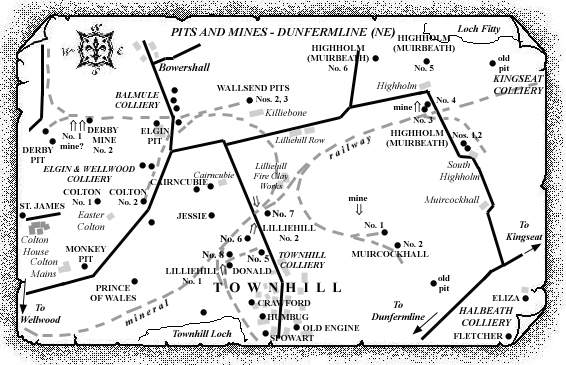
The Highholm or Muirbeath Nos. 1, 2 Pits, close to South
Highholm farm, may have been the last shafts sunk in the
Highholm coalfield. Henry Ness & Co. Ltd. had leased the
minerals in 1892 and went on to work coals from this troubled
field into the next century even tapping into the seams of
some of the former Highholm pits which were part of the
Muircockhall and Highholm Colliery of the 1880s.
Development of these pits began in October, 1892, and
they became known locally as the Muirbeath Pits.
 |
 |
 |
| Pits opened: 1894 | Pits closed: 1914 |
|---|---|
| Source Date of Information Supplied | |
| Manager / Under-Manager / Men underground / Men above ground / Coal seams worked | |
| 1896 | |
| Muirbeath: Henry Ness / ------------ / 88 / 22 | |
| Household, manufacturing and steam coals. | |
| 1902 | |
| March: Thomas
Ness, above-ground manager Muirbeath: Joseph Cochrane / W. Lyle / 261 / 42 |
|
| Household, manufacturing and steam coals. | |
| 1904 | |
| Muirbeath: Joseph Cochrane / ------------ / 263 / 39 | |
| Household, manufacturing and steam coals. | |
| 1905 | |
| Muirbeath: Joseph Cochrane / ------------ / 264 / 43 | |
| 1908 | |
| Muirbeath: David Howieson / ------------ / 220 / 41 | |
| 1911 | |
| Muirbeath: ------------ / ------------ / 162 / 28 | |
Muirbeath Colliery (19th century report)
| Name of Coal | Thickness | Quality | Class |
|---|---|---|---|
| Six Foot Coal | 3 ft. | Good | Steam |
| Cairncubbie Coal | 4 ft. 6 in. | Good | 2nd class Household |
| Three Foot Coal | 4 ft. | Good | Gas Splint, 6 in.
1st class Cannel on bottom of coal |
| Eight Foot Coal { Upper Leaf.
{ Under Leaf. |
3 ft. 3 in.
4 ft. 3 in. |
Good | Steam |
| Five Foot Coal | 5 ft. | Good | Steam |
| Dunfermline Splint Coal | 3 ft. 6 in. | Good | 1st class Household |
Information on coal seams worked at, or near, Highholm (Muirbeath) Nos. 1, 2 Pits
(based on a report from 1930)
Between the Wester Craigduckie and Loch Fitty faults, the
Dunfermline Splint Coal had been extensively worked, from its
outcrop under the alluvium west of Loch Fitty to the region
of the Dalbeath dolerite sill in the east.
In Muirbeath Colliery, only half a mile north of Townhill
Wood, the Splint Coal had not been reached until a depth of
150 fathoms of strata had been passed through. A strip of
Dunfermline Splint Coal was worked from No. 1 and No. 2 Pits
with an average thickness of 4 ft. 2 in.
A persistent stone rib 1½ in. thick lay above the lower leaf of the Five Foot Coal seam here which was 2 ft. thick on a fireclay pavement. Some thinning of the Five Foot seam was also noted in the workings at Muirbeath. The cause of this thinning is not certain but there is reason to suppose that it occurred before the coal was consolidated and may have been the result of some erosion in Carboniferous times.
The Pittencrieff Ironstone, which lay from 3 to 5 fathoms above the Five Foot Coal, was around 2 in. thick and lay above a 10 in. coal but further east, and at Halbeath, it was more often recorded as a 'foul coal' occasionally with a clayband ironstone in the roof.
A small section of the Mynheer Coal was known to have been opened out at Muirbeath but no information is available as to its condition. A diamond bore to the Dunfermline Splint Coal, put down at the south-west corner of Kingseat village, recorded 18 fathoms of sandstone below the Glassee Coal but there was no trace of a coal at the Mynheer position. The extent of this 'want' in the coal was very uncertain but it seemed likely that it occupied the greater part of the coalfield from the Loch Fitty fault to Kingseat and may have extended from near Muirbeath Colliery to the margin of the Dalbeath dolerite sill.
At Muirbeath Colliery, where the Eight Foot or Lochgelly Splint and Parrot Coals have been worked on the south or downthrow side of the Lochhead fault, they were similar in development to those in the Townhill basin:
| UPPER LEAF | |
| Blaes, soft | - |
| COAL, coarse | 4 in. |
| Stone | 1 in. |
| COAL | 2 ft. |
| Stone | 2 in. |
| COAL | 10 in. |
| COAL, foul | 4 in. |
| Blaes, coaly | 1 ft. 6 in. |
| Fakes | 1 ft. 6 in. |
| LOWER LEAF | |
| COAL | 1 ft. 10 in. |
| Stone | 2 in. |
| COAL | 1 ft. 10 in. |
| Sandstone | - |
The lower leaf frequently had a fake or stone rib, and the upper leaf was inclined to be soft with a thin, foul coal in the blaes roof. A further indication of the thinning of coal seams around Kingseat was found in the eastern extension of the Muirbeath workings where a 'want' was reported at the abandoned faces 300 yds. west from the Halbeath Diamond Bore.
At No. 1 Pit, the Ell Coal, lying from 5 to 7 fathoms above the Upper Eight Foot Coal, was cut at 93 fathoms and was recorded as 3 ft. 3 in. of 'foul coal'. In No. 20 Bore just 150 yds. north-west of this pit, the coal was 4 ft. 1 in. thick with a 3 in. parting of foul coal. The roof was of hard fakes and the pavement of fireclay.
Between the Swallowdrum and Ell Coals, there was a local development of blackband ironstone, the Muircockhall Parrot, which could be traced northwards into Muirbeath Colliery. Here the Swallowdrum Coal lay 5 fathoms above the Ell Coal and 15 ft. above the Muircockhall Parrot. Its total thickness was about 4 ft., including 6 in. of parrot and 6 in. of parrot and ironstone in the base of the seam. The roof was usually a hard fake and the pavement a faky fireclay.
At No. 1 Pit, the Upper and Lower Cairncubie Coals lay close together about 5 fathoms above the Swallowdrum Coal. The upper seam was 3 ft. 3 in. with a stone parting 3 in. from the base; the lower seam was 2 ft. 3 in. thick.
In the bore to the north-west of the pit, the coals were of a similar development and the parting in the upper seam was recorded as a yellow fake.
At Muirbeath, the Kelty Main Coal - the highest member of
the Main Group - was called the Six Foot Coal and was from 3
to 5½ ft. thick. To the south-east of the pits, the coal
became black and soft, the change being due to the
continuation of the invasive sill met with at Kingseat
village.
The Rough Coal - the lowest member of the Blairhall Group of
coals - was worked as the Fourteen Foot Coal at a depth of 66
fathoms; and a cross-cut mine through the Lochhead fault
reached the Dunfermline Splint Coal. The Rough Coal was in
three leaves with a total thickness of about 7 ft., but
towards the south-east it thinned out and only 2 ft. 10 in.
of coal was recorded in No. 4 Bore, Highholm, where 5½
ft. of blaes separated two thin leaves.
At these pits, a coal also lay above the Rough Coal in the position of the composite seam (Lower, Middle and Upper) and the succeeding strata were variable. Near the pits, the Three Foot Coals thinned out and the intervening strata became coarser.
------------------------------------
| Plans of Abandoned Seams for Highholm/Muirbeath, Dunfermline | Pits or Mines designated in Plans |
|---|---|
| COAL; Dunfermline Splint (November, 1906) | Highholm or Muirbeath Nos. 1, 2 |
| COAL; Five Feet; Little; Dunfermline Splint (November, 1906); Mynheer (January, 1912); Wee or Two Feet; Three Feet; Six Feet; Upper Eight Feet; Lower Eight Feet; Fourteen Feet; Cairncubie (November, 1914) | Muirbeath Nos. 1, 2 ; Highholm Nos. 3, 4, 6 |
------------------------------------
"Dunfermline Saturday Press"
14 November, 1891
THE BURGH MINERALS
RE-LETTING OF HIGHHOLM COLLIERY
The coalfield of Highholm, belonging to the Burgh of
Dunfermline, and extending to 225 Imperial acres, or thereby,
was exposed to let, for a period of 19 years, by public roup
in the Burgh Court-room, Dunfermline, last Tuesday.
It will be remembered that Highholm Colliery was wrought by
the Dunfermline Coal Co. along with Muircockhall Colliery,
also belonging to the Burgh of Dunfermline.
About three years ago, however, the Dunfermline Coal Co.
found the working of these mineral fields so unprofitable
that they ceased operations. Muircockhall was immediately
thereafter leased to Messrs. Henry Ness & Co., formerly
of Benarty Colliery. Mr. Ness is well-acquainted with the
whole of these mineral fields, and during the time that he
has had Muircockhall minerals, he has been both energetic and
enterprising in connection with the carrying out of the work.
On Tuesday, Mr. John Ross, solicitor, agent for the Rosewell
Coal Co., Fife, offered the upset price of a fixed rent of
£300, or an optional royalty of one-twelfth of the
selling price per ton at the pit-head for common coal.
Thereafter, Mr. Jas. Currie Macbeth, solicitor, as agent for
Messrs. Henry Ness & Co., offered a fixed rental of
£320, or an optional royalty of ½d. per ton beyond
one-twelfth of the selling price. There being no further
offerers, Messrs. Henry Ness & Co. became the lessees. It
is to be hoped that Mr. Ness's new venture will turn out
a satisfactory one, not only for himself but for the Burgh.
Ultimately, Mr. Ness may be induced to work out the splint
and five-feet seams in Muircockhall by the Highholm pits.
These seams are at present drowned out with water.
------------------------------------
"Dunfermline Saturday Press"
14 May, 1892
HIGHHOLM COLLIERY
There has been registered this week by the Registrar of Joint Stock Companies, a new Company for working these minerals. The Company is named Henry Ness & Co., Limited. The capital of the Company is £25,000. It is understood that Mr. Ness himself is to act as managing director, and not only for the sake of the new Company, but also for the town - the proprietors of the minerals - it is to be hoped that the new Company will be a success.
------------------------------------
"Dunfermline Saturday Press"
8 October, 1892
INCREASED OUT-PUT OF COAL IN FIFE
... A new colliery is in course of development at Highholm, north of Dunfermline; and at Steelend another colliery is being opened up.
------------------------------------
"Dunfermline Saturday Press"
28 October, 1893
ACCIDENT AT A PIT - MIRACULOUS ESCAPE
On Saturday afternoon, an accident happened at
the new pit being sunk on Highholm Farm by Messrs Henry Ness &
Coy. (Limited). Happily, the accident was not attended by loss of
life. Three men, however, most narrowly escaped, and their safety
is simply miraculous.
The pit is in the process of being sunk, and is
about 70 fathoms in depth. The kettle fell down the shaft, and it
was felt by the men in charge that, if one or any of the 3 men
working in the pit bottom were safe, it would be truly wonderful. A
time of awful suspense was endured till a signal from beneath,
conveying the welcome intelligence that, at any rate, one of the 3
men was safe.
The signal was to raise the other rope to the
surface, and on it there hung one of the men, who, white with
pallor, and hardly able to speak, gave the welcome news that his
comrades too were safe. All were quickly raised to the surface. The
kettle that fell was smashed flat. The men it seems heard a most
unusual noise caused by the falling kettle, striking in its descent
the side of the pit and they all rushed to a corner.
But for that warning certain it is that one or
all of these men could have had a violent and instantaneous
death.
------------------------------------
"Dunfermline Saturday Press"
2 June, 1894
BURGH MINERALS
Messrs Henry Ness & Co.'s new pit on the lands of Highholm was opened this week. Sinking operations in connection with the other new pit at Highholm are almost completed, and miners will soon be at work at this pit also.
------------------------------------
"Dunfermline Saturday Press"
11 May, 1895
James Black, aged 14, residing at Engine Row, Townhill, got his hand injured in the pinion wheel of the fanners at Muirbeath Colliery, on Tuesday last. Dr. Bell found it necessary to amputate the middle finger.
------------------------------------
"Dunfermline Saturday Press"
18 May, 1895
Simon Dunn, pitsinker, Muircockhall Cottar Houses, had his right arm broken between the elbow and wrist on Wednesday while engaged shanking the new pit, at present being sunk by Messrs Henry Ness & Co. at Muirbeath. Dunn was attended by Dr. Bell, Dunfermline, who set the injured arm.
------------------------------------
"Dunfermline Saturday Press"
24 August, 1895
FLOODING AT MUIRBEATH COLLIERY
One of the pits at Muirbeath Colliery, Dunfermline, belonging to Messrs Henry Ness & Co., has been completely flooded by an inrush of water from an old mine. The men engaged at Muirbeath Colliery were working at a much lower level than the workings of the disused pit. they struck a bore, however, which communicated with the old working immediately overhead, and after some time had elapsed, the water began to rush through the bore. The rush being confined to a small space, the miners had ample time to escape. Meantime, the Muirbeath pit is flooded to the point well up the shaft, but the pumping machinery is very powerful, and the management expect to be able to take down the water in a comparatively short time.
------------------------------------
"Dunfermline Saturday Press"
31 August 1895
THE FLOODING AT MUIRBEATH
The water which rose to a height of 60 feet in the shaft of the Muirbeath pit has now been reduced to a point only six feet above the plates. It is anticipated that the water will be entirely removed by Monday, and that work will be resumed early next week.
------------------------------------
"Dunfermline Saturday Press"
7 September, 1895
PROPOSED "OUT-OF-WORK" FUND
FOR MINERS
The men thrown idle for a fortnight through the flooding of the Muirbeath Pit have made an appeal to the Fife Miners' Association for financial assistance. The Miners' Board, in submitting the appeal to the members, point out that if the precedent formed by the vote in favour of Kinneddar men is to be followed, the members must face the question of increasing their contributions and establishing an out-of-work fund, so that every member may be treated equally.
------------------------------------
------------------------------------
"Dunfermline Saturday Press"
17 October, 1896
Thomas Bell, miner, Carnegie Street, had his left leg broken in the underground workings of Muirbeath Pit yesterday.
------------------------------------
"Dunfermline Press"
13 November, 1897
NEW LEASE OF MUIRBEATH AND
MUIRCOCKHALL
COLLIERIES
The Property Committee, at a meeting on the 14th ult., heard a statement by Mr Macbeth, agent for Messrs Henry Ness & Co., Limited, and Mr Henry Ness, tenants, respectively of Highholm or Muirbeath Colliery and Muircockhall Colliery, in support of an application that the Town Council should grant a new lease to the Limited Company of the two collieries together for an extended period. ...
------------------------------------
"Dunfermline Press"
26 March, 1898
DUNFERMLINE BURGH MINERALS
MUIRBEATH AND MUIRCOCKHALL COLLIERIES
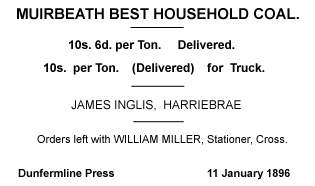
Further examination of the new seams of coal which have been struck at Muirbeath Colliery - the "five feet" and the "Dunfermline splint" (the latter constituting the best Scotch household coal) - confirms the opinion that they are of the best quality, and not only will repay Messrs Ness & Co., for their enterprise in sinking to these seams, but should for many years to come give a good return to the Burgh as royalty owners. The seams that are being worked in Muirbeath Colliery at the present time are as follows:-
| Thickness | |
| The six feet | 4 feet |
| Cairncubie (upper & lower leaf) | 4 feet 3 ins |
| The three feet | 3 feet |
| The eight feet (upper & lower leaf) | 9 feet |
| The five feet | 4 feet 6 ins |
| Dunfermline splint | 4 feet 2 ins |
| This gives a total thickness of 28 feet 11 inches of coal. | |
In addition to these, Messrs Ness are working at
the present time a valuable seam of cannel coal of the first
quality, which lies under the 3 feet seam. There are other seams in
Muirbeath which are not being worked at the present
time.
A new lease of the colliery has been obtained
for 30 years, so that the lessees have ample coal to provide a
large output during the currency of the lease.
Muircockhall Colliery, which has been for over
10 years worked by Mr Ness as a separate concern, is to be
amalgamated with Muirbeath Colliery, and both collieries are to be
worked under a new Company which it is understood is to be
incorporated on an early date.
Muirbeath Colliery last year paid a dividend of
5 per cent., and a considerable sum was carried to reserve. What
Muircockhall Colliery has paid has never been made public, but it
is well known that Mr Ness, by his thorough practical knowledge and
efficient management, has been able to work the colliery to a
considerable profit. It is understood that the arrangement in
connection with the new Company will be that Mr Ness takes all his
interest in both places in ordinary shares, and that there will be
only issued to the public a limited number of £10 five per
cent. accumulative preference shares.
------------------------------------
"Dunfermline Press"
9 July, 1898
HENRY NESS & COMPANY, LIMITED
We publish today in our advertisement columns the prospectus of Henry Ness & Company, Limited, in connection with the amalgamation of Muirbeath and Muircockhall Collieries. The Company is being floated for the purpose of working the two collieries together, and providing additional capital for the development of the new seams of coal which have been found at Muirbeath. From the prospectus it will be seen that only the preference shares are open for public subscription. We understand that nearly one half of the issue has already been applied for privately. The Company should have no difficulty in placing the balance of the shares, as the seams of coal which have been struck at Muirbeath promise a good future alike for the Company and for the Burgh of Dunfermline, who, as is well known, are the royalty owners. Mr Ness himself is to act as managing director of the Company, and this of itself should be a sufficient guarantee of the efficient working of the concern.
------------------------------------
"Dunfermline Press"
20 August, 1898
Mr. John Kellock, oversman, Muirbeath Colliery, was presented by the workmen with a handsome gold albert and appendage, with inscriptions, on the occasion of his leaving to fill a similar position in Hill of Beath.
------------------------------------
"Dunfermline Press"
15 October, 1898
The miners at Muirbeath have been complaining for some time about the weighing of their coal. A satisfactory arrangement has now been come to.
------------------------------------
"Dunfermline Press"
29 October, 1898
The men employed at Muirbeath Colliery are said to be still dissatisfied. It appears that the recent arrangement made as to weighing and "billying" the coal is not working so well as was expected.
------------------------------------
"Dunfermline Press"
5 August, 1899
Alexander Whyte, twenty-four years of age, miner, Victoria Street, Dunfermline, met with an accident on Saturday last in Muirbeath Pit, belonging to Messrs Henry Ness & Company, Limited. Whyte was working in the three feet seam. He undermined a large piece of coal, which, however, did not come away when he pulled out the gib. Using a lever he managed to bring down the coal, but unfortunately the falling coal displaced a prop supporting the roof, and a large stone fell from the roof upon him, inflicting serious internal injuries. He was removed to the Cottage Hospital, where he was attended by Dr Bell.
------------------------------------
"Dunfermline Press"
3 February, 1900
James Cairns, miner, Main Street, Townhill, met with an accident in Muirbeath Pit on Tuesday morning. While he was working at the face, shortly after making a start fro the day, the coal which he had been holing came away unexpectedly. Part of the coal, which weighed in all about two tons, struck him on the left side, breaking two ribs and injuring his legs and arms. He was promptly conveyed home and attended to by Dr Bell.
------------------------------------
"Dunfermline Press"
24 February, 1900
Peter Laing, miner, Muirbeath, met with an accident in Muirbeath Pit, on Wednesday morning. While descending the shaft to start work for the day he happened to lean against the side of the cage, and his right arm came in contact with the woodwork in the shaft. The arm was fractured. Had the cage been going quicker at the time the result could not but have been more serious. Dr Bell attended the injured man.
------------------------------------
"Dunfermline Press"
7 April, 1900
While John Campbell, a young pithead worker, residing at Viewfield Place, Townhill, was engaged at the nut-picking table at Muirbeath Pit yesterday, his foot slipped in between two pinion wheels, and was so severely crushed that on the lad's removal to the Cottage Hospital, Dr Bell found it necessary to amputate the foot at the ankle.
------------------------------------
"Dunfermline Press"
23 June, 1900
On 6th April, John Campbell, pithead worker, Viewfield Place, Townhill, met with an accident in the Muirbeath Pit, which necessitated the amputation of one of his feet. Shortly after, a younger brother fell off a tree and broke an arm and now a third brother has met with an accident (though happily not serious) in the Muirbeath Pit.
------------------------------------
"Dunfermline Press"
19 January, 1901
The Town-Clerk stated that the annual report by
Mr Millar, mining engineer, on the Burgh minerals had been
received. It appeared from the report that the royalties amounted
to £9807 15s 6d - an increase of £3497 2s 4d on the
preceding year.
The various collieries contributed to the
increase as follows:
| Townhill | £1605 16 1 | |
| Muircockhall | 200 7 11 | |
| Muirbeath | 1588 0 0 | |
| Kingseat | 57 11 7 | |
| Street Brothers | 45 6 9 |
... The rate of increase was 2.65d per ton. The increase was mainly due to the higher price of coal, the output having only increased to the extent of 13 per cent. ...
------------------------------------

"Dunfermline Press"
15 February, 1902
John Gray, Albany Street, Dunfermline, and
Robert Gibson, Townhill, met with an accident at Muirbeath Colliery
on Saturday. Along with some other men they were filling waggons
with ashes from an ash bing, when a quantity of the material
slipped forward. The ashes being hot they were burned about the
face and arms. The men were removed to an adjoining house, where
their injuries were attended to. They were afterwards conveyed to
the Dunfermline Cottage Hospital. Only recently, a similar accident
occurred at Oakley, and it proved fatal.
Gibson succumbed to his injuries in the Hospital
on Friday morning.
See Fatal Accident Inquiry Report below.
-------------------------------------------------
"Dunfermline Press"
22 February, 1902
Alexander White, miner, was slightly injured at Muirbeath Colliery, on Monday, by the cage, on which he was about to descend, moving away before he had got properly within the cover.
---------------------------------------------------
"Dunfermline Press"
15 March, 1902
This issue carries the Report of the Fatal Accident Inquiry held before Sheriff Gillespie and a jury in Dunfermline Sheriff Court yesterday into the death of Robert Gibson, labourer, Townhill. Those giving evidence included:- Thomas Ness, above-ground manager, Muircockhall; William Clark, despatch clerk, Muircockhall; John Terris, platelayer, Store Row, Townhill; and Nurse Logan, Dunfermline Cottage Hospital. The jury returned a formal verdict.
---------------------------------------------------
"Dunfermline Press"
10 May, 1902
Robert McDonald, miner, Carnegie Street, Dunfermline, was seriously injured in the Muirbeath Pit, Henry Ness & Co., Ltd., on Monday. He was engaged in the eight-foot seam driving a heading, and was in the act of taking a small piece of coal from the face when a stone weighing about ten cwts fell upon him. Robert Urquhart and Archibald Anderson, who were working in close proximity, at once went to his assistance, and had him extricated and conveyed to the surface. He was removed to the Dunfermline Cottage Hospital, where it was found that in addition to wounds on the back of the head and right eyebrow, he had sustained such a severe fracture of the left leg that it was necessary to amputate the limb.
---------------------------------------------------
"Dunfermline Press"
4 April, 1903
Thomas Philp, fireman, Beechmount Place,
Townhill, met with an accident at Muirbeath Pit on Monday, which
might have terminated much more seriously than it did. An engine
was pushing two waggons past the screen. The engine and waggons
were on different sets of rails - the waggons being propelled by
means of a pole attached to the engine. The pole slipped and struck
Philp across the breast and chin, knocking him down and injuring
him somewhat severely.
Luckily, Philp fell between the two sets of
rails and was unharmed by the wheels of either the engine or
waggons. He was attended to by Dr Bell, Dunfermline.
---------------------------------------------------
"Dunfermline Press"
Saturday, 11 July, 1903
A fatal accident occurred on Wednesday morning
in the Upper Eight-Feet Seam of the Muirbeath Pit, Townhill,
wrought by Henry Ness & Company, Limited.
John Campbell White, nineteen years of age, a
drawer, residing with his father at Campbell's Buildings, Main
Street, Kingseat, was at work in the seam mentioned at half-past
seven o'clock in the morning. He was standing at the foot of a
wheel brae, waiting for a full hutch being sent down. A miner,
named Watson, who was at the top of the brae, cried down to White
enquiring if he was "all right" - that is, if he had
attached his empty hutch to the chain. Immediately on the full
hutch being sent off, what is known as a false link in the chain
slipped, and the hutch went down the brae at a rapid
rate.
A short time before, Watson, in looking down the
brae saw White at the foot of it, sitting waiting for the hutch. He
now heard a smash, and saw White's light extinguished. On
proceeding to the spot he found that the unfortunate man had been
killed. It is conjectured that White had been in the act of taking
hold of the hutch - not knowing that it was a runaway - when he was
dashed with violence against the wall. Dr Bell, Dunfermline, who
saw the body, found that deceased's skull had been badly
fractured, and death must have been instantaneous.
The funeral of deceased took place yesterday -
the remains being interred in the Dunfermline Cemetery. The
fellow-workers of the unfortunate young man paid their tribute of
respect to his memory by attending the funeral in large numbers,
there being present about 130 mourners, including representatives
of the Townhill and Kingseat Foresters' Societies.
-------------
"Dunfermline Press"
1 August, 1903
Under the Fatal Accidents Inquiry Act, an inquiry was held in the Sheriff Court, Dunfermline, on Thursday - before Sheriff Gillespie and a jury - into the circumstances attending the death of a miner named John Campbell White, drawer, Kingseat, killed in Muirbeath No. 2 Pit on 8th July. Those giving evidence included:- Joseph Cochrane, Store Row, Townhill, manager; William Watson, drawer, Main Street, Townhill; David Adamson, drawer, New Row, Halbeath; and James Wilson, pit inspector, Robertson's Buildings, Kingseat. A formal verdict was returned by the jury.
------------------------------------------------
"Dunfermline Press"
16 January, 1904
The annual report by Mr Millar, mining engineer, on the Burgh minerals had been received and it showed that the revenue from the several subjects had been as under:-
Townhill Colliery £2707 1 2
Muircockhall Colliery 642 11 3
Muirbeath Colliery 3092 19 8
Messrs Street Brothers, Ltd. 58 7 0
-------------------------------------------------
"Dunfermline Press"
4 June, 1904
While employed in Henry Ness & Company's Muirbeath Pit on Tuesday, James McIntosh, miner, Main Street, Townhill, had his left foot very severely injured by a fall of coal from the roof, while a fellow-worker, George Paterson, miner, Dunfermline, had the fingers of his right hand badly crushed.
-------------------------------------------------
"Dunfermline Press"
9 July, 1904
It is understood that some members of the Property Committee of the Town Council are now inclined to view favourably the request by Messrs Henry Ness & Company, Ltd., the lessees of Muirbeath Colliery, for a reduction of the royalties.
-------------------------------------------------
"Dunfermline Press"
24 September, 1904
There is cause for some alarm regarding the future of the [Dunfermline] Burgh's coalfield. The threatened closing of Muirbeath Colliery by Messrs Henry Ness & Company, Limited, has been followed by an intimation that work at No. 7 Pit, Townhill Colliery, leased to the West of Fife Coal Company, Limited, is to be stopped within a fortnight. ...
-------------------------------------------------
"Dunfermline Press"
16 September, 1905
On Wednesday morning, a sad fatality occurred in the underground workings of Muirbeath pit, Townhill, leased by the Burgh of Dunfermline to Messrs Henry Ness & Co., Limited. Alexander Penman Campbell (14), son of James Campbell, contractor brusher, Main Street, Townhill, whose duties consisted of taking away the empty hutches sent from the pithead and bringing forward the full hutches, was standing in a siding near the pit bottom when a large stone fell from the roof upon him, killing him instantaneously.
-----------
"Dunfermline Press"
4 November, 1905
Under the Fatal Accidents Inquiry Act, an inquiry was held in the Sheriff Court, Dunfermline, on Thursday - before Sheriff Shennan and a Jury - into the circumstances attending the death of a coupler named Alexander Penman Campbell, Townhill, killed at Muirbeath Colliery on Wednesday, 13th September, by a stone falling upon him from the roof. Evidence was presented by Joseph Cochrane, colliery manager, the Jury returning a formal verdict in this instance.
---------------------------------------------------
"Dunfermline Press"
18 November, 1905
At a meeting of the Property Committee of the Dunfermline Town Council on Tuesday evening, a letter was read from Messrs H. Ness & Company, Ltd., lessees of the Muirbeath and Muircockhall Collieries, intimating that it is their intention to take advantage of the break in their lease of the coalfields in 1906.
---------------------------------------------------
"Dunfermline Press"
17 February, 1906
Under the Fatal Accidents Inquiry Act, an inquiry was held in the Sheriff Court, Dunfermline, on Thursday - before Sheriff Shennan and a Jury - into the circumstances attending the death of a miner named James Whyte, 9 Rose Crescent, Dunfermline, who was killed by a fall of redd from the roof in Muirbeath Pit on 29th December. Those giving evidence at the inquiry included Nurse Paterson, Dunfermline and West Fife Hospital; Robert Duncan (28), wheeler, 27 North Inglis Street, Dunfermline; Adam Dawson, miner, 17 Gardener's Land, Dunfermline; and James Millar, pit inspector, Townhill. The Jury returned a formal verdict.
---------------------------------------------------
"Dunfermline Press"
19 May, 1906
This issue announced that Muirbeath Colliery and Muircockhall Colliery, presently leased to Messrs Henry Ness & Company, Limited, were to exposed to Let by Public Roup, on a day to be fixed, on a lease of thirty years from Martinmas 1906.
---------------------------------------------------
"Dunfermline Press"
30 June, 1906
It is understood that there are several inquiries regarding the Muirbeath and Muircockhall Collieries. There is a probability of the West of Fife Coal Company, Limited, making an offer for a lease of the coalfields.
---------------------------------------------------
"The Scotsman"
4 August, 1906
COLLIERIES IN WEST FIFE TO LET.
To be Exposed to LET, within the Burgh Court-Room, Dunfermline, on Tuesday
the 28th day of August current, at Two o'clock Afternoon, on a lease for fifteen
years from Martinmas next, with breaks in the tenant's favour at the end of five
years, and each year thereafter on twelve months' previous notice.
The Whole SEAMS of COAL, IRONSTONE, and FIRECLAY, in the following portions
of the LANDS belonging to the BURGH of DUNFERMLINE, and lying about two miles
to the North-East of the Town of Dunfermline, viz.:-
(1.) MUIRBEATH COLLIERY, having a surface area of 225 Acres or thereby; and
(2.) MUIRCOCKHALL COLLIERY, having a surface area of 150 Acres or thereby.
There is believed to be a large quantity of Coal, amounting to over Two Million Tons,
unworked, including the Dunfermline Splint and over-lying seams. At Muircockhall the
upper seams are being worked without water having to be pumped to the surface.
Upset Rent for both Collieries, £500 per annum, with optional lordships.
Further particulars may be obtained from Mr W. M. MILLER, M.E.,12 St Andrew Square,
Edinburgh; or Mr WILLIAM SIMPSON, Town-Clerk, Dunfermline, either of whom will
exhibit the Conditions of Let.
Dunfermline, 3d August 1906.
---------------------------------------------------
"Dunfermline Press"
1 September, 1906
THE ROUP OF THE COLLIERIES - NO OFFERER
The roup of the collieries [Muircockhall and Muirbeath] was fixed for Thursday in the Burgh Court-Room, but at the advertised hour there only appeared Bailie Houston, Bailie Russell, Councillor Wilson, Mr Wm. Simpson (Town-Clerk), and Mr A Dodds, auctioneers, and no offer was made for the collieries.
---------------------------------------------------
"Dunfermline Press"
10 November, 1906
This issue carried news of the resignation of Mr W. M. Miller, Dunfermline Burgh's Mining Engineer.
--------------------------------------------------
"Dunfermline Press"
17 November, 1906
Mr G. M. Stewart, banker, Cupar, has been elected a director of Messrs Henry Ness & Co., Ltd., Muirbeath and Muircockhall Collieries, in room of the late Mr John Drummond, manufacturer, Dunfermline.
--------------------------------------------------
"Dunfermline Press"
17 November, 1906
Messrs Henry Ness & Company, Limited, had formally accepted the proposals of the Dunfermline Town Council for a continuation of the lease of Muirbeath and Muircockhall Collieries. ... The lease was entered into in January 1898, and extends over a period of thirty years, so that there are twenty-two years still to run. ...
--------------------------------------------------
"Dunfermline Press"
22 June, 1907
Henry Allan, repairer in the Muirbeath Collieries, residing in Townhill, had a narrow escape on Monday evening. While he was working a large stone came away and fell partly upon him, bruising his back and legs.
--------------------------------------------------
"Dunfermline Press"
10 August, 1907
John Bavis, a miner, residing at Kingseathill, met with a somewhat serious accident in the Muirbeath Colliery on Saturday morning. He was working at a rake of hutches on a wheelbrae when the hutches moved away, jamming him and injuring him seriously about the lower part of the body. He was conveyed to the Dunfermline and West Fife Hospital, where he was attended to by Dr Bell.
--------------------------------------------------
"Dunfermline Press"
2 November, 1907
John Adamson, pit fireman, residing at Long Row, Halbeath, had his left arm fractured while at work in Muirbeath pit on Wednesday morning.
--------------------------------------------------
"Dunfermline Press"
16 November, 1907
On Monday, between one and two o'clock, Joseph Easson met with a serious accident while working at the coal face in the Highholm Pit. A large quantity of coal, weighing nearly two tons, fell upon him, injuring his head and back and causing a serious wound on one of his legs. - Wm. Emsworth, while employed in Muirbeath Pit, had one of his legs seriously injured on Thursday forenoon.
--------------------------------------------------
Mines Inspectors Report - 1907
by Mr. Robert McLaren
Appendix III.
Abandoned Plans - Muirbeath - Dunfermline Splint Coal.
--------------------------------------------------
"Dunfermline Press"
27 March, 1909
On Thursday morning, David Reid, Ramsay's Place, Townhill, met with an accident in Muirbeath Pit, being seriously injured about the head. He was conveyed to the Dunfermline and West Fife Hospital.
--------------------------------------------------
"Dunfermline Press"
28 May, 1910
Henry Allan, a pit repairer, lately residing at Main Street, Townhill, died in the Dunfermline and West Fife Hospital on Saturday morning from the effects of injuries received on Monday, 16th inst. Deceased was engaged in Muirbeath Pit (Messrs Henry Ness & Company, Ltd.) replacing timber which had given way in the Cairncubie seam. A large stone fell from the roof, pinning Allan against a pillar. He had been in this position for several hours before the discovery was made. Apparently not much the worse for his trying experience, he expressed a disinclination to go to the hospital, whither, however, he was ultimately removed by the order of Dr Bell. It was not until Friday that grave symptoms manifested themselves. Deceased, who was unmarried, was about fifty years of age.
------------------------------
"Dunfermline Press"
18 June, 1910
Under the Fatal Accidents Inquiry Act, an inquiry was held in the Sheriff Court, Dunfermline,
on Thursday - before Sheriff Shennan and a Jury - into the circumstances attending the death of
Henry Allan, miner, Main Street, Townhill, who was killed by a fall from the roof in Muirbeath Pit,
Townhill, on 16 May. Those giving evidence included:- Dr Evan Owen Bowen, assistant to Dr A.
L. Bell, Dunfermline; John Adamson, pit fireman, Long Row, Halbeath; William Kyle, colliery oversman;
Hugh Smith; John Campbell, contractor brusher; and David Howieson, colliery manager.
The Jury, in their verdict, recommended that in all cases of repair two men should be sent to the work;
and, further, that even when two men are sent, five hours should not elapse between
two inspections.
--------------------------------------------------
"Dunfermline Press"
1 July, 1911
James Bavis (54), miner, residing at Kingseathill, met with a somewhat serious accident in the Muirbeath Colliery, on Wednesday forenoon. Bavis was in the act of putting in bars to support the roof, when a stone came away, weighing fully 2 cwts., and, falling upon him, broke his right leg near the thigh. He was removed to the Dunfermline and West Fife Hospital.
--------------------------------------------------
"Dunfermline Press"
9 September, 1911
PROBABLE ABANDONMENT OF MUIRBEATH COLLIERY
It is understood that Messrs Henry Ness & Company, Limited, have intimated to Dunfermline
Town Council their intention of abandoning Muirbeath Colliery before the next break in the lease at
Martinmas 1912. They are willing to give up the colliery now if another tenant can be found. Meantime
they ask authority to work out what are known as the pit bottom stoops or shaft pillars - i.e., blocks
of coal left for the support of the shafts.
A report by the burgh's mining engineers on the proposal of the lessees, was submitted at a
meeting of the Property Committee on Monday. Further consideration of the matter was deferred.
It is presumed that it is the intention of Messrs Ness & Company to continue the working of
Muircockhall Colliery after Martinmas 1912.
--------------------------------------------------
"Dunfermline Press"
2 March, 1912
Robert Hunter, one of the Townhill delegates to the Executive Board of the Fife and Kinross Miners' Association was admitted to the Dunfermline and West Fife Hospital on Thursday suffering from severe injuries which he received while at work in Muirbeath Pit. Along with another man he had been engaged preparing to fire a shot, when the coal came away and fell upon him. His injuries consisted of a broken rib and a fractured collar bone.
--------------------------------------------------
"Dunfermline Press"
20 April, 1912
Through the breaking of a wheel-brae chain in one of the Muirbeath Pits on Tuesday morning, a young man named Robert Paterson had one of his legs fractured above the knee. He was conveyed to the Dunfermline and West Fife Hospital.
--------------------------------------------------
"Dunfermline Press"
17 August, 1912
On Monday, while at his working place in Muirbeath Colliery, John Liddle, Townhill, had his collar bone broken through a piece of coal falling upon him. The injured man was medically attended to in his own home.
--------------------------------------------------
"Cowdenbeath & Lochgelly Times"
16 April, 1913
IS DUNFERMLINE'S COALFIELD GIVING OUT?
Mr A. Scobie, at a meeting of Dunfermline Town Council on Monday indicated a fear that
Muirbeath Colliery, situated in the Townfield (sic) coalfield, which has been a valuable
source of revenue to the Corporation, would have to be closed down after the expiry of the
present briskness in the coal trade.
Mr T. J. Kenny objected to a recommendation of the Property Committee that three months' notice
be given on either side to terminate the lease of the colliery, of which Messrs. Henry Ness & Co.
are the tenants. He said they heard the statement twenty years ago that the coal was nearly done,
but the colliery appeared to be more done than it was then. (Laughter.)
Hon. Treasurer Henley - An Irish bull.
Mr A. Scobie stated that the Muirbeath Colliery at the particular part referred to had not gone on for
twenty years or anything like it. He believed the present tenants would be very glad to give up the
colliery in three days instead of three months.
The Council was very glad to encourage tenants to get as much coal during the boom as they could,
but he was afraid this would continue during only the present briskness in the coal trade.
A three months' notice was approved of.
--------------------------------------------------
"Dunfermline Press"
7 June, 1913
MUIRBEATH COLLIERY.
Subject to certain conditions the Property Committee of Dunfermline Town Council, on the advice of the burgh mining engineers, have recommended that permission be granted to Messrs Henry Ness & Company, Ltd., to work some of the coal in the pit bottom stoops at Muirbeath Colliery.
--------------------------------------------------
"Dunfermline Press"
21 November, 1914
STOPPAGE OF MUIRBEATH COLLIERY.
The stoppage of Muirbeath Colliery has created a feeling approaching consternation among a large number of the workers. It was hoped almost to the last that a way would be found out of the difficulty and the threatened stoppage averted. Indeed, by a large section of the men the warning notices were not taken seriously, the feeling being that, with an output approximately 200 tons per day, a way out of the difficulty would be found. The costly alterations and repairs needed, consequent on recent mining legislation, had, no doubt, much to do with the winding up of the colliery. The older generation of miners maintain that there are still large tracks of coal in the Muirbeath field, and future years may witness the reopening of the pits now closed, as was the case with the neighbouring collieries of Townhill and Kingseat. Up to the present a goodly number of the men affected by the stoppage have failed to find employment elsewhere.
--------------------------------------------------
"The Scotsman"
8 February, 1915
SALE of COLLIERY PLANT, COUPLED WINDING ENGINES, DRIVING and PUMPING ENGINES,
LANCASHIRE BOILERS, BRANCH RAILWAY, &c., at MUIRBEATH COLLIERIES, TOWNHILL,
DUNFERMLINE, on THURSDAY, 18th February 1915, at 11.30.
SHIRLAW, ALLAN, & CO., Auctioneers, Hamilton, have received instructions from Henry Ness &
Co., Ltd., Coalmasters, owing to Termination of Lease, to Sell by Auction as follows:-
2 Pairs 20 In. Coupled Winding Engines, with 12 Ft. Drums; Horz. Compound Pumping Engine, H.P. Cylinder
18 In. L.P. Cylinder 32 In., and 6 In., Cylinders; 4 Double-Flued Lancashire Steam Boilers, 28 Ft. by 7½ Ft.,
with Mountings, Insured at 80 lb. Pressure; 28 Ft., Guibal Fan, with 16 In., Engine; Electric Lighting Set for 80
Lights - Dynamo 110 volts, 6 In., Horz. Engine, Switch Board, and Connections; 4 In., Double Ram Donkey
Pump; Two 54 Ft. Trestle Pithead Frames; 2 Pairs 10 Ft. Pithead Spider Pulleys; 3 Plate Coal Picking Tables,
from 14 Ft.; Shaking Scree, 11½ Ft.; 6 Scraper Conveyors, from 88½ Ft. Long; 2 Sets Elevators,
40 Ft. by 3 Ft.; Pair 9 Ft. C.I. Bell Cranks, 112 Fathoms 14 In. C.I. Flanged Pit Pump Pipes, with Connections;
C.I. Flanged Steam and Water Pipes, from 12 In. to 2 In.; 3 In. M.I. Flanged and Screwed Tubing; 1062 Yards
Railway Sidings - Permanent Rails, about 70 lb. per Yard, with Points, Crossings, and Connections; Bridge and
F.B. Service Rails, from 12 lb. per Yard; Steel and M.I. Plates; 20 Ton Waggon Weighing Machine, by Pooley,
14 Ft. Table, with Relieving Gear; 1 Ton Hutch Weighing Machine, by Pooley; 3 In. Blast Fan; Driving Shafts,
from 3½ In., with Gear; Loose Shafting, from 5 In, to 2½ In.; 2 New 3/8 In. Galvanised Flexible
Plough Steel Wire Ropes, each 150 Fathoms; 2 D.P. Pit Cranes; Haulage Pulleys; Large Number P.P. Pump
Rods, from 12 In. by 12 In. to 8 In. by 8 In., with M.I. Plates; 10 Ton Tangye Hydraulic Traversing Jack; Sight
Feed Lubricators; Safe, 30 In. by 22 In. by 21½ In.; Office Furniture; Large Quantity C.I., M.I., and Steel
Scrap; Old Wire Ropes, &c.
Corrugated Iron of 2 Bays of Pithead Scaffold, each 86 Ft. by 25 Ft.; Corrugated Iron of Roof of Picking Table
House, 38 Ft. by 29½ Ft.
Timber of 2 Pithead Scaffolds, each 86 Ft. by 25 Ft., with P.P. Uprights from 12 In. by 12 In.; Timber of Picking
Table, Engine, and other Houses; Timber of Gangways, &c. Catalogues from Auctioneers.
Hamilton, February 1915.
--------------------------------------------------
"Dunfermline Press"
22 May, 1915
A fatal accident took place on Wednesday at Muirbeath Colliery, wrought by Messrs Henry Ness & Company, Ltd., the victim being Fergus Ferguson, a skilled labourer in the employment of Mr William Glass, contractor, Glasgow. Mr Glass is engaged upon the contract of dismantling the pithead framework preparatory to the installation of modern apparatus. Ferguson, who was in employment of the contractor, was endeavouring to disconnect a pair of shear legs at the top when a bolt holding them together unexpectedly snapped. One of the legs upon which the man was standing swung from its position, and he fell a distance of fifty feet, and died almost instantaneously. The deceased was fifty years of age.
---------------------------------
"Dunfermline Press"
5 June, 1915
Under the Fatal Accidents Inquiry Act, an inquiry was held in the Sheriff Court, Dunfermline, on Friday - before Sheriff Fleming and a Jury - into the circumstances attending the death of Fergus Ferguson, labourer, 31 Soho Street, Glasgow, who on 19 May died from injuries received by pithead frames falling when he was on the top of it. It was elicited in the evidence that deceased was engaged dismantling the pithead trestle frames, which has been purchased by the Glasgow firm. Several of the witnesses stated that, recognising that the man was engaged in a dangerous operation, they cautioned him to be careful. The man was working on the top of the frames, which were connected by means of a bolt, which was loosened, with the result that the frames split apart, throwing Ferguson to the ground. Death was stated to be almost instantaneous. A formal verdict was returned.
--------------------------------------------------
"Dunfermline Press"
15 July, 1916
DEATH OF MR HENRY NESS

The death took place at Hillpark, Townhill Road, Dunfermline, on Sunday, of Mr Henry Ness,
coalmaster, in his seventy-eighth year.
For close upon a twelvemonth he had been feeling the infirmities of age, and although he had only
been confined to bed during the last few weeks, he had of late very seldom visited his colliery at
Muircockhall, the management of which had very largely devolved upon his sons, who were
associated with him in business.
A native of Lochgelly, Mr Ness was at an early age sent to work in the mines. Keenly interested in
his occupation, he was a diligent student of mining, in its theoretic as well as its practical aspects,
and in due course he acquired the necessary qualifications for mine management.
His first appointment in that capacity was with the West of Fife Coal Company at the Dunfermline
Corporation coalfields of Muirbeath and Muircockhall. But he had higher aspirations. These found
expression in his acquisition of a lease of the Benarty coalfield, an undertaking in which he had
ample reward for his enterprise. On Benarty becoming the property of the Lochore and Capledrae
Company, Mr Ness retired from business.
Having acquired considerable means, it was his intention to eschew, for a time at least, the worries
associated with the mining industry. For a man of his energy and business acumen, however, a life
of leisure held out no attractions. In later years he was wont to confide to his more intimate friends
that it was chiefly health reasons which induced him to seek a new outlet for his activities. During his
short period of retirement, he used to say, he felt far from being well, and it was consequent upon
an interview with his medical adviser that he returned to the industrial turmoil. An opportunity having
been afforded him of obtaining a lease of the Dunfermline burgh coalfields of Muirbeath and
Muircockhall, he proceeded to develop on an unprecedented scale the collieries in which in his
earlier days he had acted as manager. While his enterprise resulted in much personal enrichment
to himself, it was also highly beneficial to the inhabitants of Dunfermline, for, with a rapid extension
of the collieries, the mining royalties rose to a figure which had not been attained previously.
As the head of the firm of Henry Ness & Company, Ltd., Mr Ness insisted upon perfect
accuracy in the details of management. To the observance of this commendable order may
undoubtedly be ascribed the remarkable immunity from accident which was a feature of all the
mining enterprises with which Mr Ness was identified.
Several years ago the deceased gentleman acquired the estate of Bandrum. With a view to
developing the minerals on the estate, he sunk a pit and erected cottages near Steelend
for the workmen. The venture, however, was not attended with success and was abandoned.
For a long series of years Mr Ness was a member of the Dunfermline Parish School Board, in
which capacity he performed much useful work. He was also a Justice of the Peace for the
county, and for many years he was an elder in St Margaret's United Free Church, Dunfermline.
Mr Ness was twice married, his second wife being a daughter of the late Bailie Blair.
The funeral, which was of a private nature, took place to the Dunfermline Cemetery on
Wednesday afternoon. At Hillpark and at the graveside short services were conducted by the
Rev John Sanderson. The pall-bearers were Mr Thomas Ness, Mr Henry Ness, Mr David Ness,
and Mr Robert Ness, sons; Mr Henry Ness and Mr Peter Ness, grandsons; Mr Harry Street, son-in-law;
and Mr David D. Blair, brother-in-law.
--------------------------------------------------
"Dunfermline Press"
18 June, 1921
COAL GUM AT MUIRBEATH COLLIERY.
This week, a number of miners made the discovery that there was a considerable quantity of coal gum lying underneath debris near Muirbeath Colliery. The gum had evidently been deposited there several years ago. A start was made to dig the coal out, and a number of men commenced to retail the commodity on Tuesday afternoon without first having secured the necessary permit to do so. The police interfered and the practice was stopped. On Thursday morning, however, the men obtained permission to work some of the coal.
--------------------------------------------------
"Dunfermline Press"
12 December, 1925
FILLING UP AN OLD PIT SHAFT
The Property Committee of Dunfermline Town Council have accepted an offer by William Penman and Robert Hunter, Townhill, to fill in for £405, the disused shaft at Muirbeath Colliery, Townhill. The offerers have undertaken to engage, as far as possible, the other unemployed men from whom offers have been received.
--------------------------------------------------
