Owners: Earl of Elgin - Broomhall Estate,
near Charlestown, Fife
Thomas Spowart & Co. Ltd., Dunfermline
The Elgin Colliery of the late 18th and early 19th centuries was located across the Parkneuk-Baldridge-Rosebank areas to the west and north-west of Dunfermline town. The many pits of the old Elgin Colliery, which included the famous Wallsend Elgin Pit (see separate entry), shipped all their coals through Charlestown, on the north shore of the River Forth via the famous Elgin Railway.
 |
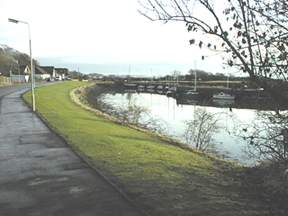 |
| Charlestown Harbour - 2004 |
| See : Dunfermline - early coalworks |
|---|
--------------------------------------------------
The Elgin family claim direct descent from King Robert the
Bruce and have the large estate of Broomhall in the valley
between Dunfermline and the Firth of Forth.
Wellwood Colliery lay immediately to the east of the Elgin
and belonged to Andrew Wellwood of Garvock, Esq.
Approximately one mile to the north of old Dunfermline,
Wellwood Colliery was leased by James Spowart of Venturefair
and Bellfield, Esq., a very enterprising and successful
coalmaster.
In the mid-nineteenth century, the Elgin Colliery united
with the Wellwood Colliery, which lay to the east, becoming
the very extensive Elgin and Wellwood Colliery which opened
up many pits on sites to the north of Dunfermline and to the
north of Townhill.
Newspaper articles (see later) continued
to supply historical background of the Elgin family and its
role in early coal working of the Dunfermline area.
From research and records, we can indicate the existence of the following pits or mines belonging to Elgin, Wellwood and Elgin and Wellwood Collieries:
Elgin Colliery
Albert; Colton Nos. 1, 2; Derby; Drumtuthil; Killiebone; Killiebone Nos. 2, 3; Prince of Wales; Rosebank; Wallsend
Wellwood Colliery
Albert; Balmule; John; Leadside; March; Tom; Union; Venture Fair; Victoria; Waterloo
Elgin and Wellwood Colliery
Albert; Arthur; Baldridge; Balmule; Bank; Beveridge; Broomhead; Bruce; Bye; Colton; Crawford; Derby; Donald; Drumtuthil; George; Humbug; Hunter; James; Jessie; John; Leadside Nos. 1, 2; Lindsay's; Loch; Lochend; Lochhead; March; Prince; Prince of Wales; Rosebank; Spowart; Tom; Union; Venture Fair; Victoria; Wallsend Nos. 5, 6, 7, 8
The locations of a number of these pits or mines are identified on maps (see individual entries in West Fife Index) while some locations still require verification.
--------------------------------------------------
Links to the past
| Elgin - 18th C employees (dates when known at colliery) |
|---|
| Henry Allan,
coalhewer, Sep 1792. David Allan, coalhewer, Sep 1792. William Russell, coalhewer, Sep 1792. |
--------------------------------------------------
James Grier, born in 1787, in Shotts, was an early manager of the old Elgin Colliery. 1834-42 records viewed list him as the manager of the Elgin Colliery, a post he probably held until his death in 1849. James Grier was the great-great-great-grandfather of Gordon Masterton, Bridge of Weir, one of our regular site visitors. Gordon also informs us that one of James Grier's sons, Thomas, succeeded his father as Elgin Colliery manager, several records viewed for the period 1851-1861 confirming this fact.
--------------------------------------------------
Elgin Colliery ... from 1842
Mr. James Grier, manager of the mines belonging to the Earl of Elgin, Elgin Colliery, Fife: "The roads in our mines are all railed, and the roofs cut from four and a half to five feet high, but the workings are the same height as the seams of coal, which are three feet eight inches, four and five feet".
Margaret Drylie, sixteen years old, putter, Elgin Collieries, Fife: "The work is sore straining; was laid by for three months short time since with pains in the limbs, caused by overwork".
--------------------------------------------------
Elgin and Wellwood Collieries, Dunfermline
| Source Date of Information Supplied |
|---|
| Manager / Under-Manager / Men underground / Men above ground / Coal seams worked |
| 1826
Elgin Colliery - Mr Henderson, Manager |
| 1829-1842?
Elgin Colliery - James Grier, Manager |
| 1836-1842?
Wellwood Colliery - James Spowart, Esq. |
| 1851?-1870?
Elgin Colliery - Thomas Grier, Manager |
| 1851?-1869? ( Wellwood
Colliery)
Thomas Spowart & Co. |
| 1870 and beyond ( Elgin & Wellwood - Thomas Spowart & Co.) |
| 1873 |
| Robert Muir, Manager |
| 1890 |
| Elgin, Derby, Wallsend No. 3 Pits and Derby Mine listed (Archibald Brownlee, Manager) |
| 1896 |
| Thomas Cook / ------------ / 133 / 40 / Household, manufacturing and steam coals. |
| 1902 |
| Rob. Stanners / ------------ / 164 / 43 / Household, manufacturing and steam coals. |
| 1904 |
| Rob. Stanners / ------------ / 191 / 39 / Household, manufacturing and steam coals. |
| 1905 |
| ------------ / ------------ / 185 / 39 |
| 1908 |
| William Wilkinson / ------------ / 208 / 47 |
| 1911 |
| ------------ / ------------ / 259 / 51 |
| 1918 |
| Arthur Pit, Leadside Pit and Mine listed. |
| 1928 - individual Elgin
& Wellwood pits in records.
See entries for Arthur Pit, Leadside Pit and Mine. |
------------------------------------
"The Scotsman"
4 January, 1826
On Friday last the colliers at the Elgin Colliery presented a richly chased silver cup, value £20, to Mr Henderson, the manager, as “a testimony of their esteem for his disinterested exertions in promoting their happiness.” They, at the same time, presented a gold ring to Mrs Henderson. Mr Henderson, in returning thanks for this present, the symbol of harmony restored, mentions it as a fact honourable to the colliers, that during the late outstand there, not a single breach of the peace took place.
------------------------------------
"Fifeshire Journal"
12 December, 1839
DUNFERMLINE - COLLIERS' STRIKE
A fortnight ago all the workmen in Lord Elgin's pits got notice to quit the works, unless they would agree to be bound to the works for six months - to give six weeks' warning - and to suffer a reduction of twopence a mett. The fortnight expired on Saturday last; and as they would not submit to these terms, the greater number have left the works and gone to other collieries.
------------------------------------
"Fifeshire Journal"
19 December, 1839
ELGIN COLLIERIES
We regret exceedingly that a paragraph should have appeared in a late number of the Journal, stating that a strike had taken place among the colliers at these collieries. We are assured that no such circumstance as that detailed had taken place, and that the coal-works never had been stopped for a day. Of course, for local intelligence so distant we are dependent on our correspondent, and he, it would appear, had been misinformed in this matter.
------------------------------------

"Fifeshire Journal"
30 September, 1841
DEATH BY SCALDING
On Saturday last, part of a boiler on one of the Elgin coal-works was rent, and one of the workmen was so scalded by the steam that he died the next day. His name was Robert Paterson, and although a collier, he was a first-rate violinist and much esteemed. He has left a wife and family.
------------------------------------
"Fifeshire Journal"
November, 1841
It was announced that the Right Hon. Thomas Earl of Elgin and Kincardine had died on 14th November, 1841.
------------------------------------
"Fifeshire Journal"
24 October, 1844
FATAL ACCIDENT
On Thursday last, as a young man named McKenzie was working in one of the pits of the Elgin Colliery, a large stone fell upon him from the roof, and ere it could be removed life was extinct. Other two individuals who were near him were hurt by the fall of the stone, one of them rather seriously.
------------------------------------
"The Scotsman"
Saturday, 26 October, 1844
DUNFERMLINE. - Last week, a melancholy accident occurred in one of the Elgin colliery pits, a great mass of rock forming the roof of one of the chambers having fallen down, whereby one of the colliers was crushed to death; while his companions near him made a very narrow escape. It was a considerable time ere the mass could be broken, and taken off the mangled remains of the unfortunate man. - Fife Herald.
"Fifeshire Journal"
3 June, 1847
On Thursday last, as David Anderson was working in one of the pits of the Elgin Colliery, a large stone fell from the roof and killed him on the spot. The deceased was a young man highly respected; he was more than ordinarily intelligent, and of the most industrious and moral habits.
"Fifeshire Journal"
Thursday, 6 September, 1849
As a young man named Campbell was on Friday last dragging a waggon underground in a coal pit at the Elgin Colliery down an incline, the velocity of the waggon increased to such an extent that it run down the young man, who had no means of getting out of its way, and he was killed on the spot.
"DUNFERMLINE MONTHLY ADVERTISER"
September, 1858
Early on Tuesday morning last, a miner of the name of Whitehead, while at work in the Elgin Pit, Berrylaw, was so severely injured by a fall from the roof, that he died almost immediately. He was young, and unmarried.
[We believe this miner to be Daniel Whitehead who was killed on 7th August.]
------------------------------------
"The Scotsman"
2 February, 1861
DUNFERMLINE. - ... Scarlatina, so fatal in the town during the last six months, seems to have exhausted itself, though still committing ravages in the surrounding villages. Elgin Colliery has been severely dealt with, the juvenile population being nearly decimated by the scourge. At one of the pits of this colliery two ponies were this week killed by choke-damp; and two lads made a narrow escape from a similar cause. ...
------------------------------------
"Dunfermline Saturday Press"
27 July, 1861
DUNFERMLINE - ELGIN COLLIERY STRIKE
A meeting of the miners employed at Elgin Colliery - the whole of whom are on strike - was held in the City Music Hall on Thursday ...
... Another meeting of the men employed at Elgin Colliery
was held at Milesmark, at six o'clock, for the purpose of
having the result of the interview between Mr. Grier and the
deputation appointed to wait upon him at the mid-day meeting.
The deputation reported that Mr. Grier had refused to
restore to the day's wage the third by which it has been
reduced. The miners present then resolved unanimously to
leave the colliery, and seek work elsewhere. We understand
that last night nearly 100 had obtained employment, while
considerably over 100 remained idle. At eight o'clock
another meeting was held, at which Mr. Alexander McDonald -
who arrived in Dunfermline by the last train from the west on
Thursday night - addressed the men on the system of weighing
coals at the pit-head, as practised in the west of Scotland.
He stated that 20 cwt. was there always reckoned to the ton,
while at Elgin Colliery, and many of the other works in Fife,
24 cwt. is reckoned a ton at the pit-head, besides which
4½ cwt. is reckoned for bad coal. Thus the miner has to
dig out 28½ cwt., instead of 20, for every ton of coal
for which he is paid. The result of the meeting was that a
petition should be sent to the Earl of Elgin, setting forth
these injustices, and praying for redress. The petition was
accordingly sent off yesterday morning.
------------------------------------
"Dunfermline Saturday Press"
10 August, 1861
The Elgin miners are to return to their work on Monday. The Earl of Elgin has agreed that they should employ a man at the pit-head to weigh the coal on their behalf as it is brought to the surface.
------------------------------------
------------------------------------
"The Scotsman"
24 November, 1888
DEATH OF MR THOMAS SPOWART COALOWNER. - Mr Thomas Spowart, coalowner, died yesterday at his residence, Broomhead House, near Dunfermline. The deceased gentleman. who was in his 61st year, was well known in mining circles throughout Scotland, having been identified with colliery business during the last forty years. While a youth he was apprenticed as a civil engineer to Messrs Bald & Geddes, Edinburgh, but on the death of his father he assumed the management of Wellwood Colliery, Dunfermline. Later on he acquired Elgin Colliery, which adjoined his own, and for many years conducted a successful and extensive business. He also sank pits at Lassodie. Mr Spowart was one of the promoters of the Linlithgow Oil Company, and was appointed its chairman. He was also president of the Scottish Mineral Oil Association.
------------------------------------
Mines Inspectors Report - 1907
by Mr. Robert McLaren
Appendix III.
Abandoned Plans - Elgin - Upper, Mid and Lower Three Feet Coal.
------------------------------------
"Dunfermline Saturday Press"
27 July, 1912
[Within a lengthy article covering, amongst other topics, the Rosebank Colliery developments, was this extract relating to the old Elgin Colliery and the place of Charlestown harbour in the history of coal mining in Fife.]
... The Earl [Thomas, the seventh Earl of Elgin] was a man of great business enterprise,
and as far back as 1830, when selling prices of steam coal were low, and many coalmasters
were contenting themselves with operating on the seams which were at no great depth from
the surface, he came to the conclusion that the only salvation of a large colliery would be the
tapping of the lower and finer seams. He accordingly sank the "Wallsend" pit,
striking the Dunfermline splint seam at a depth of 105 fathoms. The Earl fitted up a pumping
engine of 100 horse power, and to draw the coals two winding engines were erected. In 1839
the Wallsend was the greatest colliery fitting in Scotland, and annually it was visited by mining
experts from all parts of the country.
The village of Parkneuk sprung into existence with the advent of the Wallsend Pit, and at Elgin
Colliery from 400 to 500 persons were employed - 170 of the number being females. In 1840,
when the Royal Commission visited the colliery in connection with the employment of women
and children, the pits were reported to be model ones as compared with the many collieries in
the Lothians. In the Lothians the females were drawing the coals with "slypes" on
roads without rails.
The manager of Elgin Colliery reported that the roads were all railed, and the main roads cut
to from four feet to five feet in height.
MATHEMATICS IN 1840.
A splendid school was in existence. It was reported to be the best conducted colliery
school in the East of Scotland, "many of the lads having, at an examination in 1840,
taken prizes for mathematics." James, the eighth Earl of Elgin, the famous statesman
and diplomatist, leased the Elgin minerals in 1865, and since then the collieries have been
in the hands of lessees. Even before the days of Thomas, the seventh Earl of Elgin, great
enterprise was exhibited in connection with the working of the mineral in the Milesmark and
Parkneuk districts of Dunfermline. In the olden time the pits were drained by day levels - levels
run from a point, so that the lowest seam operated upon would be drained of water. To this
day the Elgin levels are wonders to mining men.
The Rosebank level, which comes to the surface at Blackburn, drains to a point 18 fathoms in
depth; the Urquhart level, which issues at Urquhart farm, to 43 fathoms in depth, and the
Pitfirrane level to 50 fathoms. The latter water-way was driven from the Lyne Burn, near Pitliver
House, in 1729-30, and is something like three miles in extent. Even calculating the wages
at an extremely low rate, the day levels of the Elgin Colliery of far-off days could not have
cost less than from £40,000 to £50,000.
The enterprise of the early days of mining in the Milesmark district did not end with great
water-ways, nor yet with the wonderful fittings.
CHARLESTOWN RAILWAY OF 1821.
The man who secured the "Elgin Marbles" for the nation was not slow in
grasping that it would be impossible to get rid of a big coal output without some means of
conveyance to the ship's side other than that common to his day, by carts and horses,
and he hit upon the idea of constructing a railway from the pits to Charlestown. The railway
was completed in 1841, the waggons being drawn by horses. The Wellwood coal was
ultimately conveyed, as well as that of Elgin, to Charlestown by this line.
During the busy shipping season as many as from 24 to 30 horses were daily at work on
the railway, which was about six miles in length.
Some days as many as 500 tons of coal were carried along the railway. These were the
days of sailing vessels, and during the summer months the masts of the small craft from
the Baltic, Norway, and the Mediterranean ports were so numerous that Charlestown
harbour presented all the appearance of a forest. The Charlestown railway was one of
the sights of Dunfermline.
In these days a very large proportion of the output of Elgin and Wellwood Collieries was
stacked during the winter months, and in the summer and autumn men and women filled
all night from the huge bings which had accumulated when orders were confined practically
to the home trade. In the months of May and June it was no uncommon thing for the drivers
of the waggon horses to be on duty for 16 long hours, and in the late autumn, when a
rush came to be made in connection with the final trips for the season before the closing
of the Baltic ports, the crack of the driver's whip could be heard in the Coal Road
and on the bridge at Pittencrieff Street at all hours of the night and morning.
In the long summer days people liked to linger on the Coal Road and the Lovers' Loan
and watch the traffic, the work on "the two inclined planes," says a writer of the
times, "being much admired."
In 1856 the Bill for the construction of the West of Fife Mineral Railway received the
Royal ascent, and in 1860 the Charlestown harbour was acquired by the North British
Railway Company. The construction of the railway brought about the abolition of many
colliery private lines, and gave an impulse to mineral developments in the western
district of the county. Charlestown soon bounded into an important coal shipping
port, the iron horse, with long strings of waggons, arriving at repeated intervals during
the course of the day. In place of 50,000 tons a year the shipments went on expanding,
and 100,000 tons were soon reached.
In the early seventies the total rose considerably beyond 100,000 tons, and in 1877 the
returns figured out 140,025 tons. In the following year this total was exceeded by 20,000 tons.
In 1879, the increase was even more marked, and on December 31st, 1880, the enthusiasm
of the harbour officials knew no bounds when it was announced that the shipments figured
out 192,869 tons. The hope was expressed that 200,000 tons would be reached in the
following year. Alas, the hope was destined never to be realised. A dock was opened at
Burntisland in 1877, and shipmasters preferred the dock to load in to a tidal harbour. In
1881 the shipments had fallen to 176,074 tons, and annually the decrease became
greater, the total in 1891 being only 64,578 tons.
In 1893 there was a revival, the total being 94,852 tons, but the falling off the following
year was appalling, and by 1901 the returns only worked out at 34,644 tons.
A second dock at Burntisland, and great docks at Methil, have practically wiped out
Charlestown as a shipping port, and the coal shipments of 1911 were only 8320 tons.
At Methil 12,000 tons can at present be shipped in a single day, and when No. 3 dock is
opened at the end of the year the officials will be able to tackle 20,000 tons daily with
comparative comfort. ...
A COMMERCIAL HARBOUR FOR DUNFERMLINE.
In the olden time the little harbour of Crombie, which is now in the hands of the
Government in connection with the Explosives Works, was the commercial harbour
for Dunfermline.
In 1793 two boats plied regularly between the pier and Borrowstounness with
passengers and goods. The larger of the two boats was built by the manufacturers
of Dunfermline for transporting linen goods to Borrowstounness, and from this port
the goods were shipped for London.
Horses and carts were the means of conveyance from Dunfermline to Crombie.
As a coal shipping port the days of Charlestown are over. Is it not possible to utilise
the harbour as a commercial harbour for Dunfermline? A light railway and a commercial
harbour have been proposed, the site of the harbour being near Rosyth. It is apparent
that Rosyth is going to be a greater thing than was anticipated at first, and some people
argue that the whole of the coast from North Queensferry to a point near Limekilns
may yet be utilised for Government purposes. To this circumstance there falls to be
added the fact that the North British Railway Company would resolutely oppose either
a light railway or a harbour.
The sum spent on fighting a Bill or a Provisional Order would therefore be large, and
a conference between the city fathers and the directors of the North British Railway
Company might at least result in something practicable being submitted for the
consideration of the Town Council and the men who are responsible for carrying
on the great linen and other industries.
Today Limekilns is participating in the prosperity which has come to the district
through the Naval Base.
Now that Dunfermline has extended its boundaries and has blossomed into a
seaport town, a commercial harbour would be a great advantage to the
community, and if a reasonable bargain could be struck with the North British
Railway Company, Charlestown might become as closely identified with
Dunfermline as it was when it was the shipping port of Elgin and Wellwood
Collieries.
------------------------------------
"Dunfermline Saturday Press"
3 August, 1918
ELGIN COLLIERY.
Elgin Colliery took its name from the Elgin family. The ancient Abbey of Dunfermline, the Palace,
and the greater part of the "Auld Grey Toun" were built from stones drawn from the grey
stone quarry of Rosyth, and the lime was got from the historic kilns of Limekilns. In the eighteenth
century the quarries at Limekilns were worked on a comparatively small scale. In the last quarter
of the century agriculturalists began to realise the value of lime on land, and an extraordinary
demand for lime arose throughout the entire country.
Charles, the fifth Earl of Elgin, was not slow to grasp the situation, and at a cost of £14,000 he
constructed nine large draw-kilns, and a harbour and waggon-ways at Charlestown. It was then that
the village of Charlestown sprang into existence. The industry prospered enormously, and it was
computed that in 1794 the output of lime amounted to from 90,000 to 100,000 tons.
Charlestown lime was shipped to all parts of Scotland, and it was no uncommon thing for the
people of Limekilns and Charlestown to see as many as from twenty to thirty coasters lying
in the harbour awaiting cargoes.
Charlestown was very much isolated from the West Fife collieries in these days, and the difficulty
of procuring a completely satisfactory supply of coal for lime-burning led to the acquisition of the
coalfield of West and Mid Baldridge, Clunie, and Rosebank. The development of the coalfields
was taken up with great enterprise, and pits were sunk. The founder of the colliery was a
thorough believer in personal supervision, and industrial developments at Rosebank and Charlestown
had his undivided attention.
A TRIUMPH OF 1830
In 1830, when many pits in Fife were only a few fathoms in depth, he [Thomas Bruce,
seventh Earl of Elgin and eleventh Earl of Kincardine] had the famous Wallsend shaft sunk
to the Dunfermline splint coal seam, a depth of 105 fathoms. The machinery was a marvel for the
times, and the developments were on such an extensive scale that the colliery very soon gave
employment to something like 500 male and female operatives.
Finding it an expensive job to convey coals from the pits to the limeworks and Charlestown harbour,
the Earl sanctioned the construction of a railway. the railway was one of the engineering triumphs
of the times, and in the summer months as many as thirty horses were at work upon it drawing the
waggons between the pits and the harbour.
In its early days the Wallsend Pit was one of the finest in Scotland, and mining experts from all
parts of the country spent days in inspecting the pit and the Charlestown-Elgin colliery railway. The
seventh Earl of Elgin was twice married, and he was succeeded by the eldest son of the
second marriage, James,
THE FAMOUS DIPLOMATIST,
and the grandfather of the present Earl of Elgin. His Lordship did not, on his succession, confine
himself to the minerals of West Baldridge. He had a 999 years' lease of the Lochend minerals,
which were included in the barony of Balmule, from the Pitfirrane family. In 1859 the output of the
colliery was from 90,000 to 100,000 tons, and about two-thirds of the total were exported to Norway,
Sweden and Germany. At the pit mouth coals were then selling at from 7s 6d to 9s per ton.
The Elgin family ceased to work coal on their own account in 1865, and the greater part of the field
was leased to Messrs Thomas Spowart & Company, the lessees of Wellwood Colliery. On
extending their hold of the coalfields of the district, Messrs Spowart & Company adopted
the title of Elgin and Wellwood Collieries.
HOW THE PITS WERE DRAINED IN THE OLDEN TIME
In the olden time shafts were not thought of in connection with mining. At points where the
upper seams of coal cropped out by the sides of burns or glens, operations were commenced
and mines were run in level, the water running out of the opening on "its own feet", to
use an old mining term. When the workings got to the dip the mine was abandoned, and a new "heugh"
commenced. As time wore on shafts began to be sunk, and the workings on the rising ground were
drained by levels or water-ways driven through the strata from a point much lower than that of the pit
mouth.
The Fordell pits were in the seventeenth century drained by a level whose opening was from two to
three miles from the pits. The cost of that water-way cannot have been less than from £30,000 to £40,000.
The same enterprise was shown in connection with the minerals to the west of Dunfermline. Rosebank
Colliery has a connection with three levels - one which comes to the surface at Blackburn, one which to
this day flows at Urquhart, and another at Pitfirrane.
The last-named was driven from the Lyne burn, near Pitliver House, to the pits in 1730, and must have cost
from £40,000 to £50,000.
------------------------------------
