Owners: Thomas Spowart & Co. Ltd.
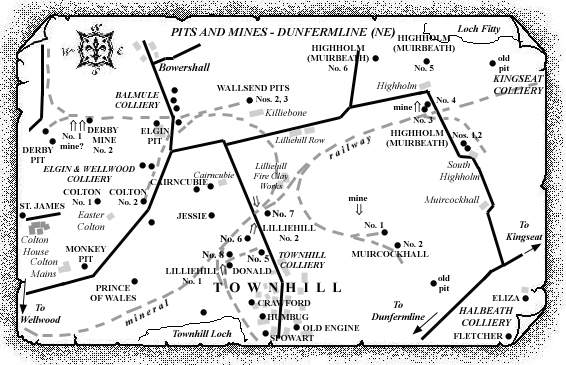
This Elgin Pit lay between Derby Mine and the Wallsend
(Killiebone) Pits near Bowershall, north of Dunfermline,
while the original Elgin Colliery of the early 19th century
was located in the Parkneuk-Baldridge areas in the west of
Dunfermline (see maps).
An Elgin 8 Feet Pit or Mine (location not established)
appears for the first time in the colliery record of 1879
and, a year later, a working of the Mynheer seam is
listed.
 |
 |
| Source Date of Information Supplied | |
|---|---|
| Manager / Under- Manager / Men underground / Men above ground / Coals and Seams worked / Shaft Details | |
| 1873 | |
| Robert Muir /
------------ / --- / --- / 3 feet, Swallowdrum, 8 feet /
D'cast (12 x 6) 120 ft. : U'cast (10 x 5) 96 ft.
Furnace at Wallsend Pit ventilated this pit. |
|
| 1874 | |
| Robert Muir /
------------ / 105 / 11 / 3 feet, Swallowdrum, 8 feet /
D'cast (12 x 6) 120 ft. : U'cast (10 x 5) 96 ft.
Furnace ventilation. |
|
| 1875 | |
| Robert Muir /
------------ / 62 / 15 / 3 feet, Swallowdrum, 8 feet /
D'cast (12 x 6) 120 ft. : U'cast (10 x 5) 96 ft.
Furnace ventilation. |
|
| 1876 | |
| James Russell
/ ------------ / 46 / 19 / 5 feet, 8 feet / D'cast
(12 x 6) 450 ft. : U'cast (10 x 5) 96 ft.
Furnace ventilation. |
|
| 1877 | |
| James Russell
/ ------------ / 80 / 24 / 5 feet, Splint / D'cast
(12 x 6) 450 ft. : U'cast ------
Furnace ventilation. |
|
| 1878 | |
| James Russell
/ ------------ / 128 / 35 / 5 feet, Splint / D'cast
(12 x 6) 450 ft. : U'cast (5 x 3) 240 ft.
Furnace ventilation. |
|
| 1879 | |
| Elgin:
James Russell / ------------ / 108 / 32 / 5 feet, Splint
/ D'cast (12 x 6) 450 ft. : U'cast -----
Furnace ventilation. |
|
| Elgin 8
feet: James Russell / ------------ / 20 / 14 / 8 feet
/ D'cast (10 x 6) 120 ft. : U'cast (7 x 5) 72 ft.
Furnace ventilation. |
|
| 1880 | |
| Elgin:
James Russell / ------------ / 117 / 52 / 5 feet, Splint
/ D'cast (12 x 6) 450 ft. : U'cast (6 x 3) 470
ft.
Furnace ventilation. |
|
| Elgin 8
feet: James Russell / ------------ / 44 / 15 / 8 feet
/ D'cast (10 x 6) 120 ft. : U'cast (7 x 5) 72 ft.
Furnace ventilation. |
|
| 1881 | |
| Elgin:
James Russell / ------------ / 10 / 12 / Mynheer /
D'cast (10 x 6) 318 ft. : U'cast (10 x 5) 258 ft.
Furnace ventilation. |
|
| Elgin:
James Russell / ------------ / 98 / 38 / 5 feet, Splint /
D'cast (12 x 6) 450 ft. : U'cast (5 x 3) 288 ft.
Furnace ventilation. |
|
| Elgin 8
feet: James Russell / ------------ / 61 / 10 / 8 feet
/ D'cast (10 x 6) 120 ft. : U'cast (10 x 6) 132
ft.
Furnace ventilation. |
|
| 1882 | |
| Elgin:
James Russell / ------------ / 77 / 32 / Mynheer, 5 feet,
Splint / D'cast (12 x 6) 450 ft. : U'cast (5 x 3)
288 ft.
Furnace ventilation. |
|
| Elgin 8
feet: James Russell / ------------ / 56 / 9 / 8 feet
/ D'cast (12 x 6) 120 ft. : U'cast (10 x 6) 132
ft.
Furnace ventilation. |
|
| 1890 (Elgin Colliery) | |
| Elgin:
Archibald Brownlee / ------------ / 25 / 8 / Ell /
D'cast (12 x 6) 120 ft. : U'cast (10 x 6) 132 ft.
Furnace ventilation. |
Information on coals worked at, or near, Elgin Pit, Townhill
(based on a report from 1930)
In the Townhill basin, the Five Foot Coal seam was well
known and was wrought from a series of pits at depths from 25
to 100 fathoms. It lay about 7 fathoms above the Splint and
was recorded as 5 ft. 1 in. thick in the Elgin Pit.
A bore in the bottom of the Elgin Pit proved the Mynheer
Coal to be 2 ft. 7 in. thick, 11½ fathoms above the Five
Foot Coal.
From the scanty records at the nearby Colton and Townhill
collieries, the coal does not appear to have been considered
a profitable working proposition.
At this pit, where the Glassee Coal was 34 fathoms from the
surface, the upper leaf was 2 ft. 2 in. thick and separated
from a 9 in. lower leaf by 6 in. of fakes. The roof was of
blaes and a thick fireclay formed the pavement.
Between the Colton and the Elgin pits, the Eight Foot or
Lochgelly and Parrot Coals were brought to the surface by a
series of small folds. In the Townhill coalfield, the two
seams were wrought as the Upper and Lower Eight Foot Coals
and were separated by a variable thickness of strata. In the
west, near the Elgin Pit, the lower leaf was 3 ft. 3 in.
thick with a roof of coaly blaes; the upper leaf was about 4
ft. thick and lay 8 ft. above the lower.
The Ell Coal lay from 5 to 7 fathoms above the Upper Eight
Foot Coal, and was separated from it by fine-grained
sediments which may have contained a thin coal. It was
3½ ft. thick at the Elgin Pit and had a blaes roof and
fireclay pavement.
The Swallowdrum Coal lay from 3 to 5 fathoms above the Ell
Coal from which it was separated by fine-grained sediments.
It was of variable quality and could contain a considerable
percentage of parrot and ironstone.
At the Elgin Pit, the total thickness of the coal was 5 ft.
1 in., including 10 in. of soft coal and a thin parting of
blaes.
From 1 to 3 fathoms above the Swallowdrum Coal was a thick
group to which was assigned the name Jersey Coals. These
usually consisted of two main seams which were given
different names at the different collieries.
In the Townhill field, they were known as the Upper and
Lower Cairncubie Coals. At the Elgin Pit, the upper seam was
recorded as a 4½ ft. 'coal waste', and was
separated by a few feet of fakes and blaes from a 2ft. 10 in.
lower coal.
In the Townhill field, the Kelty Main Coal was known as the
Six Foot Coal. In No. 11 Bore, Bowershall, 200 yds. east of
the Elgin Pit, the Six Foot Coal was cut at 30 fathoms and
was recorded as a 2 ft. 9 in. coal with a soft layer at the
top of the seam. The Six Foot Coal lay about 5 fathoms above
the Upper Cairncubie Coal.
------------------------------------
"Dunfermline Saturday Press"
18 May, 1872
PIT ACCIDENT
While a lad, about 14 years of age, named James Johnstone, was engagd, on Tuesday night, in filling a hutch in the Elgin Pit, Wellwood Colliery, a portion of the pit roof gave way and crushed him beneath it, whereby he sustained injuries of a rather serious nature, chiefly about the head - part of the scalp having been laid bare. Dr. Douglas was quickly in attendance on the lad, and dressed his wounds.
------------------------------------
"Dunfermline Saturday Press"
13 November, 1875
SERIOUS PIT ACCIDENT
On Wednesday evening, a serious accident happened at the Elgin Pit, Elgin and Wellwood Colliery. Three men, named Robert Houston, Peter Drylie, and Henry Hunter, were engaged in blasting operations (for the purpose of deepening the pit from the 8-feet seam to the 9-feet seam), and just as Houston was in the act of applying the "stemmer" to a charge, the cartridge exploded, the consequence being that Houston was dreadfully burned and scarred on the face, while one of the fingers of his left hand was almost entirely blown off; and Drylie, who was quite close to the charge, got his right arm considerably injured from the wrist to the elbow. Houston has been deprived of his eyesight by the accident, but it is hoped that this is only a temporary injury. The men were attended with promptitude by Dr. Drysdale.
------------------------------------
