Owners: Thomas Spowart & Co. Ltd.
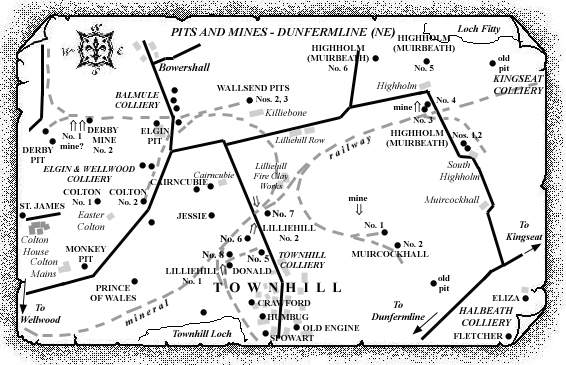
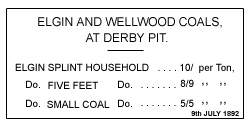
The Derby Pit was located a few miles north of Dunfermline, and beyond Wellwood. The pit was ½ mile north of Colton Mains and was north-west of the Colton pits. Probably sunk around 1877 to 50 fathoms, workings at 'Derby' are first recorded in 1878 and continue well into the 20th century.
 |
| Pit opened: 1878 | Pit closed: ca 1939 ? |
|---|
| Source Date of Information Supplied |
|---|
| Manager / Under-Manager / Men underground / Men above ground / Coal seams worked / Shaft Details |
| 1878 |
| James Russell /
----------- / 5 feet, Splint / 13 / 4 / D'cast (11 x
6½) 300 ft. : U'cast (7 x 6½) 300 ft.
Ventilation by means of steam jet. |
| 1879 |
| James Russell /
----------- / 5 feet, Splint / 26 / 4 / D'cast (11 x
6½) 300 ft. : U'cast (7 x 6½) 300 ft.
Ventilation by means of steam jet. |
| 1880 |
| James Russell /
----------- / 5 feet, Splint / 40 / 7 / D'cast (11 x
6½) 300 ft. : U'cast (7 x 6½) 300 ft.
Ventilation by means of steam jet. |
| 1881 |
| James Russell /
----------- / 5 feet, Splint / 72 / 14 / D'cast (18 x
6½) 252 ft. : U'cast (6 x 4) 120 ft.
Ventilation by means of steam jet. |
| 1882 |
| William Andrew /
----------- / 5 feet, Splint / 60 / 22 / D'cast (18 x
6½) 252 ft. : U'cast (6 x 4) 120 ft.
Ventilation by means of steam jet. |
| 1890 |
| Archibald Brownlee /
----------- / 5 foot, Splint / 62 / 10 / D'cast (18 x
6½) 252 ft. : U'cast (6 x 4) 120 ft.
Ventilation by fan 9' diameter. |
| 1928 |
| George Livingstone / Alexander Shepherd / 46 / 15 / Glassee Coal (household) |
| 1938 (as Derby) |
| C. Palmer / Robert Aitken / 82 / 17 |
------------------------------------
A 19th century observer had this to say of the Derby Pit:
"There is also another pit called Derby, out of
which, I believe, for 5-feet and splint coal its quality
could stand comparison with any spot in Fifeshire. It has
been worked for a number of years in a dook that goes off at
about a right angle from a level mine from the pit bottom.
The metals here lie at a very great angle, and being so very
steep increases the difficulty both in the working and in the
haulage. From the bottom of this incline a cross-cut mine is
driven to the 5-feet coal, and up this dook is drawn both
splint and 5-feet.
The system of haulage adopted here is the endless rope. An
engine is fitted on the surface, which transmits the power to
the machinery below, both for haulage and drainage purposes.
This rope referred to has two half-turns on the drum on the
surface, with a half-turn on the tension wheel in front. The
purpose of this tension wheel is to keep the rope always
rigid. The rope then passes down the shaft, being cased in
wooden boxes to prevent, in case of breakage, the rope coming
in contact with the ascending or descending cage. It then
goes round pulleys in the bottom to place it in proper
position to be extended away in the level mine, being guided
there on small pulleys along the side of the road.
At the top of the dook or incline is fixed another driving
wheel, and also a tension wheel in front. This rope gets two
half-turns again on this driving wheel, and one half-turn on
the tension wheel. This completes the arrangement as far as
power is concerned.
This driving-wheel that I have made mention of is fixed on a
shaft, upon which is also fixed a drum. The purpose of this
drum is to contain rope for the purpose of drawing up the
loaded train, and lowering the empty train when necessary.
On the end of this shaft, also, is a tumbling crank for the
purpose of pumping. It can be disconnected when winding
operations are going on, and can be connected at pleasure,
and pump water when necessary, pumping generally being done
after the day's work is past. The moment the engine on
the surface moves, this shaft and drum also revolves, the
power being transmitted from the surface, and the load is
raised and lowered to suit the wants of the workmen, who are
at the bottom generally always waiting for the empties, with
loaded hutches to give in exchange. This system of haulage is
wholly by friction which the bite or hold the rope has on the
driving-wheels, and the larger the wheel the more power can
be transmitted, and less liable for slips taking place, as is
sometimes the case if the rope gets slack, or perhaps an
additional load being accidentally put on.
I have seen some haulages much better than this where there
was a double road, and perfectly straight; but, taking all
the circumstances into consideration, it suited the purpose
pretty well. I am describing this as I saw it some years ago.
Perhaps some improvement has been wrought on it now that I
have not been able as yet to view, nor had the opportunity to
ascertain if such is the case.
The haulage from top of incline was done then by horses. The
level mine was somehow or other rather twisted - perhaps this
was necessary in driving it - caused, I have no doubt, by
some fluctuations in the dip and rise; but, whether or not,
it was not a level adapted to haul the coals along to the pit
bottom with the aid of an endless rope, or it would, in my
opinion, have to be subjected to a very great deal of
alterations.
There is another pit with a haulage, the engine also on the
surface. From what I could see then it was the ordinary
system for dook working, especially where the dook is set off
contiguous to the bottom of the shaft."
------------------------------------
Information on coals worked at, or near, the Derby Pit, Dunfermline
(based on a report from 1930)
The Derby Pit was described as active at the time of the
publication of the report, in an area of the Dunfermline
Coalfield where the average thickness of the Limestone Coal
Group was 1030 ft. (approximately 172 fathoms). A whinstone
intruded into the strata between the Index Limestone and the
Stink or Sulphur Coal near Derby, north of the Lochhead
fault. The Stink Coal lay 30 fathoms above the Upper Kinniny
Limestone and was a variable seam up to 2½ ft. in the
district.
The Five Foot Coal seam lay above the Dunfermline Splint and
was here a single seam, 5 ft. 8 in. thick. The Mynheer Coal
was a variable seam which had been wrought only in the
north-east (Leadside) part of this district as a steam coal.
At the Derby Pit, the Mynheer Coal seam was 3 ft. thick,
whereas in the west and south-west of this district it never
exceeded 1 ft. 6 in., and in some places the horizon was not
recognisable.
The Mynheer Coal occurred roughly 16 fathoms above the Five
Foot Coal, and the overlying blaes were often irony. The seam
had the name 'Crow' or 'Craw Coal' applied to
it occasionally.
The Glassee Coal was even more variable within the district
than the Mynheer Coal although, like the Mynheer, it
sometimes had an irony roof.
| Plans of Abandoned Seams for Derby Pit | Pits or Mines designated in Plans |
|---|---|
| COAL; Five Feet (1875); Four Feet (1884); Cairncubie Splint (1890); Fourteen Feet (1894); Upper Eight Feet; Lower Eight Feet; Swallowdrum (1898); Ell (1899); Six Feet (1900); Cairncubie Upper (1903); Mynheer (1904) | ELGIN
Albert, Colton Nos. 1, 2; Derby, Killiebone, Prince of Wales |
| COAL; Dunfermline Splint (1876); Mynheer (1891); Lower Eight Feet (1900) | ELGIN
AND WELLWOOD Arthur, Derby, Lochhead |
| COAL;
Swallowdrum; Cairncubie; Mynheer; Splint or Four Feet;
Five Feet; Six Feet; Eight Feet. IRONSTONE (1925) |
ELGIN
AND WELLWOOD Albert, Arthur, Baldridge, Balmule, Bank, Beveridge, Bruce, Bye, Colton, Derby, Drumtuthil, George, Hunter, James, Leadside, March, Prince of Wales, Rosebank, Tom, Union, Venture Fair, Victoria |
| COAL; Ell; Upper Eight Feet (Abandoned 6th April, 1937). | ELGIN AND WELLWOOD; Derby |

Derby Pit, Dunfermline
On the 30th March, 1884, three men lost their lives in an effort to locate the seat of a fire which had broken out in workings. The rescue parties found that the three men had succumbed to dense smoke which had filled the section.
| Name | Age |
| Andrew Beveridge | 44 |
| William Hunter | 44 |
| Thomas Stenhouse | 27 |
---------------
"DUNFERMLINE JOURNAL"
5 April, 1884
SAD CALAMITY AT WELLWOOD COLLIERY.
THREE MEN SUFFOCATED.
HEROIC CONDUCT AND NARROW
ESCAPES
OF THE SEARCHING PARTIES.
Scarcely have the shocks inflicted on the
mining community of Fifeshire by the recent Little Raith Colliery
overwinding catastrophe and the Townhill dynamite explosion been
recovered from, than another melancholy accident has occurred
involving the death of three miners in the prime of life. The
accident occurred on Sunday evening last, and the scene of it was
the Derby Pit, Wellwood Colliery, belonging to Messrs Thomas
Spowart & Coy., and situated about two miles north from
Dunfermline. The story is indeed a melancholy one, and is briefly
told.
It appears that about six o'clock in the
evening, Alexander Wallace, enginekeeper, as is the custom at the
colliery, descended the "Derby" Pit for the purpose of
starting the engine, erected about 200 yards from the bottom of the
shaft for keeping the "dook" workings of the splint seam
clear of water. On reaching the bottom of the shaft, however,
Wallace found it was quite impossible to get near his engine, the
air current being partially stopped by a dense volume of smoke. So
great in fact was the volume of smoke that it seemed to be baffling
the air current to force it on to the upcast shaft.
He at once came to the conclusion that the
engine seat and the wooden roof propping was on fire, and without
delay ascended the pit for the purpose of organising an
"extinguishing" party. In about an hour Wallace, with
other five men - named respectively Robert Greig, miner; John
Drylie, miner; Wm. Hunter, roadsman; Andrew Beveridge, oversman;
and Thomas Stenhouse, roadsman, descended the pit.
The party found, however, that the smoke was in
some degree defying the operation of the ventilation, and they
completely failed in their attempts to get to the fire, although
they discovered that it had originated in the engine seat. The men
seemed to be at a loss to know what should be done, but, after
consultation, Beveridge, Hunter, and Stenhouse were told off to
endeavour to reach a "trap-door" a few yards inside the
engine by travelling a circuitous route through the various
workings - the object being to open the door, and to allow the
smoke to have a more free passage to the upcast shaft. After the
men had been gone for a couple of hours, and there were no signs of
their re-appearance, the three left behind became alarmed as to the
safety of their fellows. It was very apparent that the smoke, from
the time the burning had been going on, must have penetrated every
corner of the pit, so that the three men, in taking the route they
did, must have been travelling in very impure air. Greig, Drylie,
and Wallace fully realised the situation, and, when ten o'clock
was reached, they were out of all patience for the return of their
comrades. Accordingly, the two former made up their minds that
something must be done, and plunged into the "Geenna"
past the engine, and pushed the "trap-door" open. After
they had proceeded into the workings for two hundred yards, they
discovered Beveridge lying on the "pavement" with his
face downwards. He showed signs of life, and the men at once raised
him in their arms to carry him to the bottom of the shaft. So
stifling was the smoke, however, that the brave fellows were forced
most unwillingly to leave their comrade and beat a hasty retreat,
in order to save their own lives. On reaching the spot from which
they started, both men fell on to the "pavement", where
they lay for a considerable time in a comatose state, having
ultimately to be conveyed home.
About eleven o'clock the manager, Mr
Alexander Ferguson, accompanied by a fresh searching party,
descended the shaft and made an attempt to reach the place where it
was now well known the unfortunate men were. They had only got in
the vicinity of the spot where it was assumed Beveridge was lying,
however, when Mr Ferguson became completely overpowered, and his
comrades were forced to take hold of him and return to the bottom
of the shaft. A second attempt, after Mr Ferguson had recovered,
proved as futile, and all hopes of getting the unfortunate men out
alive were abandoned. The fire continued to rage with unabated
fury, and attention was entirely directed towards extinguishing the
fire, the most important step taken by the manager in this
connection being to turn a burn, which runs close to the pit,
into the steam pipes by which the steam was conveyed from the pit
bank to the engine underground. By six o'clock in the morning the
flames were completely got under, and in an hour afterwards the
smoke had been sufficiently cleared away to admit of a search party
proceeding through the "trap-door". In a very short time
the bodies of the three men were found at a distance of from 200 to
300 yards from the door - life having apparently been extinct for
several hours. The faces of the men were all turned inwards, which
showed that on opening the door they had tried to run in front of
the smoke. Beveridge's shoes were thrown off, and on all hands
there were the most apparent signs that the men had died with a
severe struggle.
Although the fate of the unfortunate men was
well known at an early hour in the morning to those underground,
they judiciously kept the matter to themselves, so that until the
bodies were really discovered, nothing whatever was known of the
calamity in the village. One by one the unfortunate victims were
raised to the surface, and then the news spread like wildfire.
Women and children could be seen in every row, making enquiries at
passers-by to find out whether or not their little households had
been affected. By eight o'clock the bodies had been conveyed
home, where the scenes were of a very heartrending
description.
Beveridge was 44 years of age, and leaves a widow and
five children; Stenhouse, 27, leaves a widow and four of a
family; and Hunter, 43, also leaves a widow and two
children.
How the fire originated is a good deal of
mystery, but it is supposed that some of the lamps must have been
left burning on Saturday night, the result being that, the woodwork
had become ignited. The engineman, Wallace, is not exactly in a
position to state whether or not any lamp was left burning, and it
appears that Beveridge, one of the men suffocated, was the last to
leave the pit on Saturday night. The damage to property was very
considerable, the machinery, from the enormous heat, being a good
deal tangled and twisted. The place was also totally wrecked by the
burning of the prop wood, and rendered quite unsafe for any work
being proceeded with until repairs were executed.
The remains of the deceased were interred in the
New Cemetery on Wednesday. A large number of mourners attended the
funeral, and the Rev. Mr Binns, Dunfermline, conducted a short
service at the graves.
A RELIEF FUND INSTITUTED.
At a public meeting at Wellwood on Thursday evening - Mr Hayworth, missionary, presiding - a committee was appointed to solicit subscriptions for behoof of the families of the unfortunate men. The committee includes the names of Provost Donald, Dunfermline, Rev. Mr Dunbar, Mr Brown of Colton, Mr W. Robertson, jun., manufacturer; Mr Weir, Secretary of the Miners' Association; Mr Andrews, manager, Lassodie; and Mr Ferguson, manager, Wellwood. The Provost has generously headed the subscription list with a donation of £5. Reference has been made to the fund elsewhere.
------------------------------------
"Dunfermline Saturday Press"
18 July, 1885
MINING ACCIDENTS IN THE YEAR 1884
... The accident [March, 1884] at the Elgin Colliery was a
melancholy one. It was due to the foolhardiness or ignorance
of the man in charge. Something left burning at an
underground engine had set fire to the woodwork, and
deceased, who was an oversman, and some others, were trying
to extinguish the fire before the arrival of the manager. It
seems not to have occurred to him that if he opened a door
leading into the air-course beyond the engine-house that a
greater current of air would pass and, failing to reach it
from where they stood, he and other two went to the shaft,
and passed along the return air-course to it.
When they reached the door and opened it, the smoke
overpowered them, and they died before assistance was got.
When the manager arrived, about two hours afterwards, the
fire, which was of a trifling importance, was put out, and a
search made for the bodies, which were found at various
points on the road. It is seldom that so much ignorance is
displayed by an oversman.
------------------------------------
"Dunfermline Saturday Press"
23 July, 1887
PIT ACCIDENT
Yesterday, a fall from the face took place in the Derby Pit, Wellwood, and the coal alighting on William Masterton, three of his ribs were fractured. (He was attended by Dr. Drysdale).
------------------------------------
"Dunfermline Saturday Press"
17 March, 1888
MINING ACCIDENT
On Tuesday, William Hynd, an oversman employed in the Derby Pit, Wellwood Colliery, Dunfermline, met with a serious accident. Hynd had been employed on an incline when the chain gave way. The result was that a loaded hutch came down the "brae" at a great speed and ran against Hynd, inflicting injuries of a dangerous character. The poor fellow is reported to have lost the sight of his right eye.
------------------------------------
"Dunfermline Saturday Press"
1 June, 1895
WELLWOOD - PIT ACCIDENT
On Friday last week, Peter Drylie (66), miner, Wellwood, received severe injuries to his back by a fall of coal in the Derby Pit, Elgin and Wellwood Colliery. Drylie was engaged hewing coal at the time.
------------------------------------
We first learned of the feature of the Derby Pit ventilation system from Mr Willie Yorkston, Dunfermline. Apparently, it was powered by steam jets in one of the shafts to heat the cold, dank air thus making it rise. This, of course, caused fresh air to be drawn in to take its place via the other shafts, thereby keeping the air circulating.
Subsequent coal working in the area
Derby Opencast, north of Wellwood, started coaling in 1952 but all work on the opencast site had ceased by February, 1954.
------------------------------------
| See West Fife Index Entries Elgin and Wellwood for more information |
|---|
