Owners: Townhill Coal Co. Ltd.
The Donald Pit of Townhill Colliery was also its No. 9 Pit. It was sinking around 1875/76 to a depth of 100 fathoms just to the south-west of the No. 8 Pit location, and may have been named after the Provost of Dunfermline.
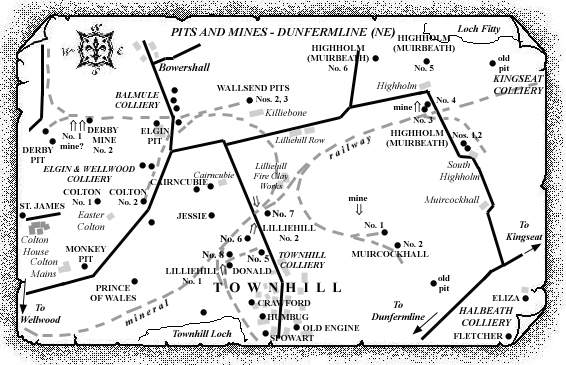 |
| See Townhill Colliery entry for general information. |
|---|
| Pit sinking: 1875/76 | Pit closed: ca 1882 Attempts to re-open 1914. |
|---|---|
| Source Date
of Information Supplied
Manager / Under-Manager / Men underground / Men above ground / Coal seams worked / Shaft Details |
|
| 1876 (Townhill Coal Co.) | |
| W. Moody / ------------ / 50 / 13 / Five Feet; Splint / D'cast (9 x 8) 599 ft. : U'cast (9 x 9) 549 ft. | |
| 1877 (Townhill Coal Co.) | |
| James Wyllie / ------------ / 68 / 10 / Five Feet; Splint / D'cast (10 x 5) 516 ft. : U'cast (8 x 8) 516 ft. | |
| 1878 (Townhill Coal Co.) | |
| James Wyllie / ------------ / 88 / 15 / Five Feet; Splint / D'cast (12 x 5) 360 ft. : U'cast (17 x 9) 516 ft. | |
| 1879 (Townhill Coal Co.) | |
| James Wyllie / ------------ / 150 / 21 / Five Feet; Splint / D'cast (12 x 8) 360 ft. : U'cast (12 x 9) 516 ft. | |
| 1880 (Townhill Coal Co.) | |
| James
Wyllie / ------------ / 152 / 20 / Five Feet; Splint /
D'cast (11 x 5) 360 ft. : U'cast (9 x 9) 576 ft.
D'cast (9 x 8) 576 ft. : U'cast ----- |
|
| 1881 (Townhill Coal Co.) | |
| James
Wyllie / ------------ / 120 / 21 / Five Feet / D'cast
(11 x 5) 360 ft. : U'cast (9 x 9) 576 ft.
33 / 4 / Splint / D'cast (9 x 8) 576 ft. : U'cast (9 x 9) 576 ft. |
|
| 1882 (Townhill Coal Co.) | |
| James
Wyllie / ------------ / 118 / 16 / Five Feet / D'cast
(11 x 5) 360 ft. : U'cast (9 x 9) 576 ft.
36 / 8 / Splint / D'cast (9 x 8) 576 ft. : U'cast ----- |
|
| Plans of Abandoned Seams for Donald Pit | Pits or Mines designated in Plans |
|---|---|
| COAL; Upper Eight Feet; Lower Eight Feet (25 February, 1878) |
TOWNHILL
Nos. 5, 8; Donald |
| COAL; Five Feet; Splint (Prior to March, 1885) |
TOWNHILL
Donald |
| COAL; Six Feet; Upper Eight Feet; Lower Eight Feet: Swallowdrum; Cairncubie; Ell (August, 1899) |
Townhill Nos. 5, 8; Donald
[Townhill] |
| COAL; Splint (1883); Five Feet (1904); Eight Feet; Swallowdrum (1907); Upper Four Feet (1908); Ell (1923); Bright; Cairncubie (1924); Little Splint; Six Feet. |
TOWNHILL
Nos. 5, 6, 7, 8; Crawford, Cube, Donald, Humbug, Whitefield |
| COAL; Five Feet; Eight Feet; Splint |
TOWNHILL
Nos. 6, 7, 8; Crawford, Donald |
| COAL; Splint (1892); Fourteen Feet (1893); Five Feet (1896); Ell (1899); Cairncubie (1903); Upper Eight Feet (1904); Lower Eight Feet (1906); Swallowdrum (1907); Mynheer; Three Feet; Six Feet or Upper Four Feet; Little Splint. |
ELGIN AND WELLWOOD
Broomhead; Colton Nos. 1, 2; Crawford; Derby No. 2; Donald; Humbug; Jessie; Killibone; Leadside; Lindsay's; Loch; Lochend; Prince; Prince of Wales; Spowart; Townhill; Wallsend Nos. 5, 6, 7, 8. |
| COAL; Six Feet; Cairncubie; Swallowdrum; Ell; Upper Bright; Lower Bright (17 November, 1925) |
TOWNHILL
Nos. 6, 7, 8; Donald |
An observer in the late 19th century gave this account of
the Donald Pit: "I may take notice of the last pit
sunk at Townhill, which was called the Donald Pit. This pit
was considered to be a pit that would for many years produce
an output of perhaps 400 tons per day. The appliances fully
verified this as being a fact - fitted with the very best of
winding machinery, and pumping machinery of the most noble
order.
But it is a bad practice to count the chickens before they
are hatched - although in mining this is very often done. ...
In the pit I have called attention to, the turn out was not
what was anticipated. It went down on some dislocation of the
strata, and after a considerable outlay of capital the coals
were got, but the area of 5 feet and splint coal, which was
particularly wanted, was limited in extent, and much of that
black, useless, cinder coal was got, which is not a coal to
send to the market.
Some good patches of the first-class coals were, however,
found. I think the last fine splint coal in this colliery was
worked in this pit. The 8 foot coal is getting pretty well
exhausted, and the output of coal is kept very much from the
Swallowdrum, Cairncubbie, and Main Coal, or 6-foot, as
designated at Townhill; although my opinion is that some of
the coals even above these will ultimately be worth while
paying attention to get.
Some modern improvements have been instituted at the
colliery within a number of years. One is the erection of a
washing machine for washing the dross. I may here explain
that some of these upper coals have fireclay pavements and
fireclay holing. This is to a certain extent against the
dross coal, as it always gets mixed with this ingredient,
which spoils the coal even for firing boilers, or for any
steam purpose.
This washing process cleans it of fireclay or stone, and
produces coal in what is called bean and nut form, and a fair
sale can be effected for this form of coal for close stoves,
kitchen ranges, and many other useful purposes that in its
unwashed state it would not be an easy matter to get disposed
of for any purpose.
I may also state that this colliery is ventilated by a fan.
The old system of the furnace has been dispensed with, and a
fan substituted, which contributes more to the age; and the
miner who has to toil from morning to night in the dull
caverns of the earth has a better chance of getting a fresh
breeze, which costs nothing, and does so much for the
prolongation of his days in this world, and which perhaps 40
or 50 years ago was an utter stranger to him.
..."

"Dunfermline Saturday Press"
22 April, 1876
FATAL ACCIDENT
On Thursday, a young man named John Taylor, a sinker, met his death by accident in the Donald Pit, Townhill Colliery. He was standing on a "slung" platform while engaged in fitting up a partition in the shaft, when he somehow lost his balance and fell to the bottom. He was speedily brought to the bank, but expired immediately afterwards. The deceased was 21 years of age, and unmarried.
------------------------------------
"Dunfermline Saturday Press"
10 July, 1880
INTERESTING EXPERIMENT AT TOWNHILL COLLIERY
An appliance, which may justly be called an innovation at
Fife Collieries, has lately been erected at the Donald Pit,
Townhill, belonging to the Townhill Coal Company. The design
of the machine is to prevent over-winding - a species of
accident peculiar to a colliery and one which is not unknown
in the history of Townhill.
The appliance is designated "Ormerod's Improved
Patent Detaching Hook", and consists of three plates,
joined in a peculiar manner, and attached to the winding rope
on the upper end, and to the cage on the lower - forming a
firm and reliable connection between rope and cage.
In regular work, the hook has no tendency to disconnect
itself from the cage; indeed, its arrangement is such that
additional perpendicular weight diminishes that tendency. Its
action to prevent over-winding is this:- Close to the
under-side of the pulley is erected a strong cross-beam of
wood, supported from the ground on either side, and into this
cross-beam is inserted a bell-mouthed cylinder of iron,
through which the rope works. Should the hook be raised to
the cylinder, the upper part is admitted unimpeded; but on
being drawn farther through the cylinder, horizontal pressure
is brought to bear on the lower part of the plates of the
hook, which pressure reverses a small copper bolt - allowing
the top part to expand, and setting the rope free.
Its action, however, does not stop here. The plates that
expand are furnished with projections which catch over the
top of the cylinder and hing the cage, the weight of which
locks the hook firmly in position. By another simple
contrivance, also a part of the hook, the rope, after the
would-be over-wind, being joined to the middle plate and a
bolt removed, the cage can be easily lowered to the ground,
and there have a new copper bolt inserted, and again set to
work.
The foregoing is a description of the apparatus, and a trial
was made of it yesterday in presence of Mr. Stevenson,
Lilliehill; Mr. J. Mungall, Lumphinnans; Mr. Russell,
Wellwood; Mr. Adams, Hill of Beath; Mr. Andrews, Lassodie;
Mr. Symington Macdonald, Lochgelly; Mr. Ireland, colliery
engineer, Halbeath; Mr. Hamilton, Edinburgh; and a large
number of the workmen.
At twenty-four minutes past two o'clock, the order was
given to the engineman to overwind his engine. This was
accordingly done, and in seventeen minutes the rope was
brought over the pulley and attached to the cage, and
everything put in proper working order again.
All the gentlemen present expressed themselves highly
satisfied with the operations of the hook, which has been
supplied from the agency of Mr. Robt. Hamilton, Edinburgh,
and Douglas Street, Dunfermline, and fitted up under the
superintendence of Mr. Robert Leitch, colliery engineer. The
weight of the hook, along with the muzzle, is 3 qrs. 14
lbs.
------------------------------------
"Dunfermline Saturday Press"
30 April, 1881
SERIOUS ACCIDENT
On Wednesday morning, Daniel Morgan, a roadsman, employed at the Townhill Coal Co.'s Donald Pit, sustained a severe fracture of the leg, both bones being badly broken. He was ascending a wheel brae, following a load of empty hutches, when the chain broke, allowing the hutches to run back and crush him against the buildings. The train of loaded hutches which was descending also contributed to make the accident more serious. Dr. Drysdale, Dunfermline, was speedily summoned, and Morgan is now progressing as well as can be expected.
------------------------------------
"Dunfermline Saturday Press"
9 February, 1884
MINER CRUSHED TO DEATH AT TOWNHILL
On Monday forenoon, a miner named John Mackintosh, residing in Townhill, met his death in a shocking manner in the Donald Pit, Townhill Colliery. He was employed boring, and was in a stooping position, when a large quantity of coal fell and crushed him to death. His body was soon extricated, and conveyed home. Deceased was 42 years of age, and has left a widow and four of a family.
------------------------------------
"Dunfermline Saturday Press"
21 February, 1914
Preparations are in progress for the re-opening of the Donald Pit, Townhill, from which no coal has been raised for a number of years. The present erection is of a temporary nature, and is intended only for repair purposes. It is understood that the Mynheer and Two-foot are the seams intended to be worked.
------------------------------------
"Dunfermline Saturday Press"
11 April, 1914
THE RE-OPENING OF THE DONALD PIT
Threatened collieries are like threatened men; they live long. It is more than a
quarter of a century since Dr David Landale, the famous mining engineer, began
to warn the Town Council of a daily decreasing coalfield at Townhill colliery, and in
view of the warnings of the eighties and the nineties, laymen might be excused if they
jumped to the conclusion that before the twentieth century had come the steam would
be blown off, and that some disused pits would be left as a memorial of the days that
were gone. Much has happened in mining since the eighties and the nineties,
however.
Electricity, coal-cutters, coal washers, and other devices have made the working of
seams practicable which were often abandoned. No better illustration of the change
could be cited than that provided by the history of the Donald Pit. This pit was sunk
to the Dunfermline Splint seam in 1876.
In the lower seams burnt coal - coal thought to be rendered useless by the heat of the
days when the metals were a molten mass - was encountered, and operations were
after a few years abandoned. The eight feet and other upper seams were not burnt,
but in those days the Dunfermline Splint and the five feet were the coals most sought
after by customers, and ultimately a complete suspension of labour took place at the
Donald and the pit was dismantled. Now the pit is to be re-opened, re-fitted with
gearing, and the upper seams tackled.
The Navigation Coal which in recent years has become a great asset at some West
Fife Collieries is a coal whose heating and caking powers have been intensified by its
being brought into contact with heat. Some people allege that the Dunfermline splint
coal abandonment at Townhill more than thirty years ago in the Donald and the pit adjoining,
No. 6, was a navigation coal, and would now be worked to profit. Other miners on the
other hand who worked the coal are of opinion that the seam was calcined like a "daunder"
beyond the navigation coal stage, and was therefore rendered useless. Neither theory
can well be put to the proof, for the very good reason that the abandoned coal, which
was at the greatest depth reached in Townhill, is flooded with water.
The Dunfermline company who are re-opening the Donald Pit do not propose to go
deeper than the upper seams meantime, but some day they may get right above the
burnt coal, and they may be able to put down a bore from the upper seams, and thus
carry through an experiment which will at least be interesting. Some years ago several
tests were made by boring, and the results, it must be conferred, were not encouraging.
Meantime it is satisfactory to find that the upper seams are to be tackled, and that the
Donald Pit is once more to become a scene of industrial activity.
The electrical plant has been a great success at the Dunfermline company's No. 7
Pit, and if a decent hold of the upper seams of coal is got from the Donald shaft,
Townhill Colliery may have a longer life than the most sanguine would be inclined to
prophesy.
In 1911-12 the coal royalty of Townhill was only £642 10s 6d. Last year it was £2242 9s 7d.
The success of the past year is a complete vindication of the electrical fitting, and may be
accepted as an earnest of what is to come in connection with the refitting of the Donald Pit. ...
However great a success the re-opening of the Donald Pit may be, it cannot be
expected to bring the revenue to the point touched when Townhill and Muirbeath
Collieries were at their best. From 1902 to 1911, when the lower point was touched, the
decrease was gradual.
------------------------------------
