Owners: Thomas Spowart & Co.
John Nimmo & Son.
The Drumtuthil pits were located to the south-east of the Craigluscar Reservoirs and a few hundred yards west of Balmule Pit. This location is now on the site of the Dunfermline land-fill/waste-management centre to the north of Wellwood.
 |
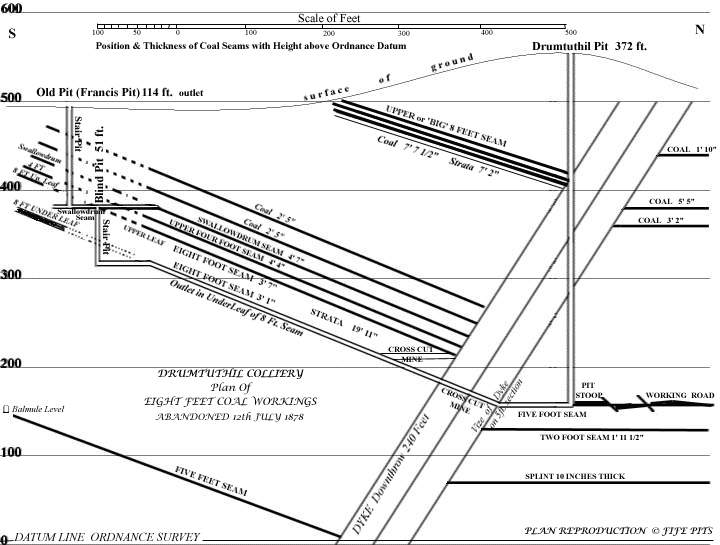 |
 |
| Plan of Layout |
Sunk in 1875, originally to a depth of 372 ft. (62 fathoms), to work the 5 feet and 8 feet seams, the Elgin & Wellwood Drumtuthil Pit was operated by Thomas Spowart & Co. until it was abandoned in July, 1878.
| Pit sinking: 1875 | Pit closed: July, 1878 |
|---|---|
| Source Date of Information Supplied | |
| Manager / Under-Manager / Men underground / Men above ground / Coal seams worked / Shaft Details | |
| 1875 | |
| Robert Muir / ----------- / ------ / 12 / 8 / D'cast (14 x 6) 372 ft. : U'cast (6 x 4) 372 ft. | |
| 1876 | |
| James Russell /
----------- / 5 feet, 8 feet / 26 / 9 / D'cast (14 x
6) 390 ft. : U'cast (6 x 4) 390 ft.
Ventilated by steam jet. |
|
| 1877 | |
| James Russell /
----------- / 5 feet, 8 feet / 24 / 6 / D'cast (14 x
6) 390 ft. : U'cast (5 x 5) 90 ft.
Ventilated by steam jet. |
|
| 1878
Pit abandoned July, 1878. |
|
--------------------------------------------
"The Scotsman"
3 October, 1868
MINERALS IN THE WEST OF FIFE.
To be LET, COAL, IRONSTONE, and FIRE-CLAY under the Lands of Drumtuthil and
others adjoining, belonging to the Earl of Elgin.
The Minerals are level-free to a considerable depth, and a Pit is open to the Five Feet Coal at
Rosebank, where it can be reached. The Ironstone (Blackband) is similar to that of Lochhead.
Offers, stating a fixed Yearly Rent or optional Royalty on the Minerals, will be received by Messrs
WATSON & DICKSON, C. A., 3 North St David Street; and Messrs JOHN & G. H.
GEDDES, M. E., Melville Crescent, Edinburgh, till 30th October.
Edinburgh, 2d October 1868.
--------------------------------------------
Elgin & Wellwood Collieries
Dunfermline 6th Sept. 1878
The Right. Hon. R. A. Crop Esq. M. P.
Secretary of State
Home Office
Whitehall
London
Right. Hon. Sir
We beg to intimate to you that we have abandoned the Drumtuthil Pit on the 12th day of July 1878. We send per Rail Copies of Plans of Coal Workings of said Pit. Please Acknowledge Receipt of Same and oblige.
Yours truly
Pro Thomas Spowart & Coy
HA
P.S. We have sent notice of Abandonment to the District Inspector of Mines
HA
[HA = Henry Arnott whose signature appears on both plans - Eight Foot Workings and Five Foot Workings]
--------------------------------------------
In 1880, Drumtuthil Colliery, Dunfermline, appears in colliery records (no details) under the ownership of John Nimmo & Son, and the following year, the Drumtuthil Pit is designated the No. 1 Pit of the Rosebank Colliery.
| Rosebank Drumtuthil No. 1 Pit opened: 1881 | Rosebank Drumtuthil No. 1 Pit closed: 1917 |
|---|
| Source Date of Information Supplied |
|---|
| Manager / Under-Manager / Men underground / Men above ground / Coal seams worked / Shaft Details |
| 1881 |
| Robert Grant /
----------- / Big 8 feet, Upper and Under Swallowdrum /
54 / 8
D'cast (18 x 6) 258 ft. : U'cast (6 ft.) 170 ft. |
| 1882 |
| Robert Grant /
----------- / Big 8 feet, Upper and Under Swallowdrum, 8
feet / 75 / 5
D'cast (18 x 6) 258 ft. : U'cast (6 ft.) 170 ft. |
| 1890 |
| J. M. Hunter /
----------- / Silkstone; Eight foot; Swallowdrum / 76 /
18
D'cast (11 x 5) 150 ft. : U'cast (18 x 6) 330 ft. Fan, 15' x 5'. |
| 1892 |
| Mr John Clark, manager. |
| 1912 |
| Jun: Mr John Clark, manager,
appointed agent. Mr David Birrell, under-manager, appointed colliery manager. |
| 1914 |
| Aug: Mr Birrell, manager.
Mr Alexander Hynd, under-manager, promoted within John Nimmo & Son. |
| Other coals worked in
later years included the Upper and Lower 7 Feet seams and
the 3 Feet or Blairhall seam.
The pit is believed to have closed in 1917. |
-----------------------------------------
Information on coals worked at Drumtuthil No. 1 Pit, Rosebank
(based on a report from 1930)
Workings at Drumtuthil Pit in the Dunfermline Splint
recorded 3 ft. 8 in. coal with a sandstone roof and a
pavement of blaes. Another name occasionally used in the
district for this seam was the "Four Foot Coal".
Silkstone or Cairncubie Coal, the equivalent of the Lower
and Upper Jersey Coals, occurred in two leaves at Drumtuthil
Pit where the parting measured 6 ft.
The Six Foot or Swallowdrum Five Foot seam, at the top of
the Main Group of coals, was correlated with the Kelty Main
Coal. Its extent was limited to the northern half of the
Dunfermline coalfield and this good steam coal was recorded
at Drumtuthil as having a fakes roof, coal (1 ft. 11 in.),
parting (2 in.) and coal (4 in.) lying on faky fireclay.
Above the Main Group of coals, the strata were very variable
and the sequence was only partly known. About 17 fathoms of
layers, largely consisting of sandstones, with blaes beds and
a fireclay overlay the Six Foot Coal.
Bores near Drumtuthil Pit showed the thickness of this part
of the sequence to be as much as 28 fathoms. Above this
sandstone lay three coals separated by partings: the Seven
Foot, the Quarry and the Three Foot Coals. Here, however,
there was only one coal, a thick composite seam called the
Fourteen Foot Coal. A section of the Seven Foot Coal, also
called the Lower Seven Foot, was part of the Fourteen
Foot.
The following section was wrought at Drumtuthil Pit as a steam coal:
| Seven Foot Coal seam (1917) | |
| Fakey soft bands | - |
| Coal | 3 ft. 2 in. |
| Rib | 4 in. |
| Coal | 2 ft. 2 in. |
| Fireclay | - |
The Quarry Coal, also a steam coal and sometimes called
the Upper Seven Foot Coal, was thought to be another portion
of the Fourteen Foot Coal. An abandonment plan from 1917
showed one small working in this seam dated March, 1917 -
north of the Steelend-Dunfermline Road.
A section of the seam at Drumtuthil had the following
composition:
| Quarry Coal seam (1917) | |
| Sandy fakes | - |
| Coal | 9 in. |
| Rib | 4 in. |
| Coal | 11 in. |
| Rib | 3 in. |
| Coal | 6 in. |
| Rib | 3 in. |
| Coal | 1 ft. 3 in. |
| Sandy fakes | - |
The Three Foot Coal, average thickness 3 ft., was limited in extent in this district but at Drumtuthil Pit it was wrought as the Blairhall or Lower Blairhall Coal. One 1917 abandonment plan viewed showed workings in this seam dated 1899/1900 - all north of the Steelend-Dunfermline Road.
| Three Foot/Blairhall seam (1917) | |
| Blaes | - |
| Coal | 1 ft. 10 in. |
| Stone | 5 in. |
| Coal | 1 ft. 9 in. |
| Fireclay | 2 in. |
| Coal | 3 in. |
| Sclaty Coal | - |
Many faults were met with in the workings at Drumtuthil and their general direction was north-westerly; they appeared to converge on the greater east-and-west Lochhead fault. Borings put down within this area were also difficult to read.
The area north-west of Dunfermline was remarkably free
from water, except perhaps in its deeper parts, and this to a
large extent was due to gravitational drainage in the
Dunfermline coalfield by means of two old levels, the
construction of which was rendered possible by the
configuration of the ground.
The Pitfirrane Level extended for 4½ miles from its
outlet on the Lyne Burn south of the old collieries of
Berrylaw, Pittencrieff, Baldridge, Elgin, Drumtuthil and
Wellwood to beyond the Arthur Pit, where it lay about 350
feet below the surface.
The subsidiary level, called the Balmule, drained the
Rosebank area and united with the Pitfirrane Level under
Rumblingwell which lay to the south-east of the Rosebank
district.
| Plans of Abandoned Seams for Drumtuthil Pits, Dunfermline | Pits or Mines designated in Plans |
|---|---|
| COAL; Five Feet; Eight Feet (12 July, 1878) | ELGIN
Drumtuthil, Rosebank (including portion of Wester Baldridge) |
| COAL;
Swallowdrum; Cairncubie; Mynheer; Splint or Four Feet;
Five Feet; Six Feet; Eight Feet. IRONSTONE (1925) |
ELGIN
AND WELLWOOD Albert, Arthur, Baldridge, Balmule, Bank, Beveridge, Bruce, Bye, Colton, Derby, Drumtuthil, George, Hunter, James, Leadside, March, Prince of Wales, Rosebank, Tom, Union, Venturefair, Victoria |
| COAL; Five Feet; Eight Feet; Fourteen Feet; Duddie Davie; Ell; Splint (1915) |
ROSEBANK Baldridge, Balmule, Drumtuthil, Hunter, Tom, Wallsend |
| COAL; Upper Eight Feet; Lower Eight Feet; Upper Swallowdrum; Lower Swallowdrum; Upper Silkstone; Lower Silkstone (7 June, 1916) | ROSEBANK
Dixie Nos. 2, 3; Drumtuthil No. 1 |
| COAL; Three Feet or Blairhall; Upper Seven Feet; Lower Seven Feet (24 May, 1917) |
ROSEBANK Drumtuthil No. 1 |
| See West Fife entry for Rosebank Pits and Mines
for information on coals worked at Rosebank Colliery. |
| See West Fife Index Entry Elgin & Wellwood Colliery for additional information. |
----------------------------------------------------
"Dunfermline Saturday Press"
11 August, 1888
While Henry Gould, miner, Parkneuk, was working at the coal face of No. 1 Pit, Rosebank Colliery, on Monday, a large piece of coal fell upon his left leg, breaking it between the knee and the ankle. Dr Tuke, Dunfermline, attended the injured man.
----------------------------------------------------
"Dunfermline Press"
16 July, 1898
While Andrew Morris, miner, Rosehall Terrace, was at work in the underground workings of the Drumtuthil Pit, Rosebank Colliery, on Wednesday morning, a piece of coal fell from the roof upon him, cutting and bruising his face and legs. He was conveyed to the Cottage Hospital.
----------------------------------------------------
"Dunfermline Press"
22 April, 1899
William Hynd, miner, Baldridgeburn, met with a serious accident at Drumtuthil Pit, Rosebank Colliery, on Saturday last. He was engaged holing at the coal face when a stone weighing about 5 cwt. came away unexpectedly from the roof and fell upon him. He was conveyed home. On Dr Drysdale being summoned, it was found that Hynd had been seriously injured about the back, and the doctor ordered his removal to the Cottage Hospital.
[William Hynd died later as a result of injuries received in this accident. See 29 June, 1901, item.]
----------------------------------------------------
"Dunfermline Press"
22 July, 1899
James Drylie, miner, Milesmark, a member of Dunfermline Parish Council, met with an accident yesterday in the Drumtuthil Pit, Rosebank Colliery. He was resting on his knees in front of the coal face, and was in the act of drawing forward coal with his hands when a stone fell upon him from the roof. He lay for about ten minutes before he was extricated. With some assistance, he was able to walk home, where he was attended to by Dr Drysdale. He was severely bruised, but his injuries are not of a serious nature.
----------------------------------------------------
"Dunfermline Press"
12 August, 1899
Matthew Donaldson, miner, Milesmark, had his right hand bruised and one of his fingers cut in the underground workings of No. 1 Drumtuthil Pit, Rosebank Colliery, on Monday. Mr Maitland Grant, station agent, Whitemyre, dressed the injured hand and put two stitches in the lacerated finger.
----------------------------------------------------
"Dunfermline Press"
28 October, 1899
Andrew Richmond, brusher, 113 Baldridgeburn Street, Dunfermline, met with an accident on Friday last in the Drumtuthil Pit, Rosebank Colliery. He was brushing the main road in the underground workings when a stone weighing about three cwt. fell from the roof upon his left leg, causing a fracture a little above the knee.
----------------------------------------------------

"Dunfermline Press"
20 January, 1900
Thomas Hynd, a drawer, residing at Milesmark, met with an accident on Thursday afternoon while employed brushing a road in Drumtuthil Pit, Rosebank Colliery, belonging to John Nimmo & Son, Limited. A stone weighing about 4 cwts. fell from the roof upon him, knocking him to the ground. He was conveyed home and attended to by Dr Lee, Dunfermline, who stated that the man's back was broken. Hynd was removed to the Cottage Hospital, where he lies in a critical condition.
[Thomas Hynd died later as a result of the injuries received in this accident.]
-------------
"Dunfermline Press"
1 December, 1900
FATAL RESULT OF AN ACCIDENT
The death is announced of Thomas Hynd, 23 years of age, brusher, Milesmark, who was injured in the Drumtuthil Pit, Rosebank Colliery, as far back as January last. A stone weighing about four cwt. had fallen from the roof upon Hynd, seriously injuring his spine.
-------------
"Dunfermline Press"
15 December, 1900
At the Fatal Accident Inquiry, held in Dunfermline yesterday, before Sheriff Gillespie, the Jury returned a formal verdict on the death of Thomas Hynd. Those giving evidence included:- Dr Tuke; John Clark, colliery manager; John Campbell, fireman, Rumblingwell; and, William Masterton, brusher, Milesmark.
----------------------------------------------------
"Dunfermline Press"
29 June, 1901
This issue carried the Report of the Fatal Accident Inquiry into the death of William Hynd, Baldridgeburn, on 30th May, 1901, who met with an accident in Drumtuthil Pit, Rosebank Colliery, on 15th April, 1899. Witnesses included:- John Clark, manager; Robert Drylie, son of James Drylie, miner, Milesmark; Alexander Hynd, miner, Parkneuk, brother of deceased; Dr Drysdale, Dunfermline; Alexander Burt, oversman, Milesmark; and, John Campbell, pit inspector, Rumblingwell. The Jury returned a verdict in accordance with the evidence led.
----------------------------------------------------
"Dunfermline Press"
5 April, 1902
While Adam Mathieson, miner, 19 Campbell Street, Dunfermline, was employed repairing the roads in the underground workings of the Drumtuthil Pit, Rosebank Colliery, on Monday, a stone weighing five cwts. and a quantity of redd suddenly fell from the roof upon him. He was completely buried, and on his being extricated, he was unconscious. He sustained a large wound on the left temple, and on his being conveyed to the Cottage Hospital it was found that he was suffering from concussion of the brain. In addition, two of his ribs were fractured. He was attended to by Dr. Tuke.
----------------------------------------------------
"Dunfermline Press"
30 August, 1902
PIT FLOODED
The workers in Drumtuthil Pit, Dunfermline, got a fright by a big inrush of water. It is understood that the inrush did not indicate anything serious, but the plans of the pit had to be produced to the men before they were convinced that their theories as to the cause of the unwelcome intrusion were incorrect.
----------------------------------------------------
"Dunfermline Press"
29 June, 1912
Mr John Clark, who has been manager at Rosebank Colliery for the last twenty years, has been promoted to the position of agent for the Company, Messrs John Nimmo & Son, Ltd. The present under-manager at No. 1 Pit, Mr David Birrell, now takes up the position of manager at the colliery. Sinking operations are in progress, and great developments are about to take place.
----------------------------------------------------
"Dunfermline Press"
29 August, 1914
On Monday evening, Mr Alexander Hynd, who has been under-manager at No. 1 Pit, Rosebank Colliery, for nearly three years, was presented with a barometer by the employees at the pit on the occasion of his leaving to take up a similar duties under the same Company. Mr Birrell, manager, presided, and spoke in high terms of Mr Hynd's abilities. ...
----------------------------------------------------
"The Scotsman"
Saturday, 30 June 1917
IMPORTANT SALE of COLLIERY PLANT, LANCASHIRE and E.E. STEAM BOILERS,
PAIR COUPLED WINDING ENGINES, WINDING and PUMPING ENGINES, COAL CUTTERS, SIROCCO
and GUIBAL VENTILATING FANS, Large Number STEEL BRIDGE and ANGLE RAILS, BRANCH RAILWAY
BUILDINGS, NEW PITWOOD, TIMBER, TOOLS, Etc, at ROSEBANK COLLIERIES, DUNFERMLINE, on FRIDAY
First, 6th July 1917, beginning at Wallsend Colliery at 11 o'clock.
SHIRLAW, ALLAN & CO., Auctioneers, Hamilton, have received instructions from Messrs John Nimmo & Son,
Ltd., Coalmasters, owing to stoppage of Wallsend and Drumtuthil Pits, to Sell, by Auction, as follows:-
2 Double-Flued Lancashire Steam Boilers, about 28 ft. by 7½ ft., by Ewing & Lawson, Glasgow, insured at 100lb.;
5 E.E. Steam Boilers, from 30 ft. by 5 ft., insured at 45 lb.; Pair Coupled Winding Engines, 18 in. cylinders, 4 ft stroke, by
Martyn Bros., Airdrie, with 2 Drums each 10 ft. dia. by 3 ft. broad; Horz. Winding Engine, 16 in. cylinder, 3½ ft. stroke,
with 8 ft. Drum; Horz. Pumping Engine, 18 in. cylinder, 3 ft, stroke; Horz Driving Engine, 14 in. cylinder, 3 ft. stroke; No. 8 (40 in. dia.)
Sirocco Centrifugal Cased Ventilating Fan, by Davidson, Belfast, almost new, capacity about 20,000 Cub. Ft., at 350 revs. per minute, ¾ in.
Water Gauge; 2 Guibal Fans, 20 ft. and 15 ft., with 12 in. and 10 in. Engines; Two 9 in. Plunger Pumps for Shaft with Connections;
Tangye Duplex Pump, 18 in. by 12 in. by 10 in.; Tangye Special Steam Pump, 10 in. by 5 in. by 12 in.; No. 7 Pulsometer Pump; Two "Baby"
Bar Coal Cutters, one new, by Mavor & Coulson, Ltd., to cut 3½ ft. deep, volts 440/500; about 2500 Yards Railway -
Permanent Rails from about 76 lbs. per yard, with Points, Crossings and Connections; about 5500 Steel Angle Pit Rails, 4 ft.
long; about 450 C.I. Pit Plates, from 4 ft. by 2 ft.; Two 20-Ton Waggon Weighing Machines, by Avery & Smith, Tables 14 ft.
and 13 ft. - one with Relieving Gear; Two 3-Ton Beam Cart Weighing Machines, by Pooley & Smith; Two 20 cwt. Hutch
Weighing Machines, by Pooley, with 3½ ft. Revolving Tables; Trestle Pithead Frame, 53 ft.; Pithead Frame, 42 ft.; 2
Pairs 8 ft. Pithead Spider Pulleys; Pair 6 ft. Bell Cranks, with Connections; Shaking Scree, 14 ft. by 4 ft., with Connections;
Set Elevators, 38 ft. between Centres, Steel Buckets 13½ in. by 10 in. by 9 in.; 3 Double-deck Cages, 3 ft. 4 in.
between Slides; 2 Single Pit Cages, 3 ft. 4 in. between Slides; 2 Heavy D.P. Pit Cranes; about 180 Hutches, with
Flanged and Edge Steel Wheels, 24 in. and 18 in. gauge; Large Number Loose Hutch Wheels and Axles, 24 in. and 18 in.
gauge; 5 Hutch Tipplers; Large Number M.I. Scree Bars and Bearers; Riddle Screen, 6 ft. by 3½ ft. by 1 in. Mesh,
with Shafting and Connections; 2 Pairs Stephen Humble's Improved Patent Detaching Hooks for 3-Ton Load, with
Connections; Large Number C.I. Flanged Steam Pipes, 9 in., 8 in., 7 in., 6 in., 4 in., and 3 in., with Bends and Branches; 15 ft.
of New 2 in. Copper Flexible Piping, with Brass connections; New I.R. Coil Suction Hose, 15 ft. by 5 in.; C.I. Wheel Valves,
from 6 in. to 2 in.; Large Number Rope Pulleys, from 6 ft.; C.I. Cousie Pulleys from 4 ft.; 6 Steel Wire Winding Ropes, 1 in.
dia., from 80 Fathoms long; Two 1 in. and ¾ in. Galvanised Flexible Steel Wire Ropes, from 80 Fathoms long; Large
Number M.I. Plates various; M.I. Pump Rod Plates; Bell Hammers and Connections; Large Quantity Cousie Chain; Edney's
Recording Mine Ventilation Gauge (Suction), by Baird & Tatlock, Glasgow; Colliery Barometers and Thermometers;
Hygrometers; Ring-Rose Patent Lubricator - 2 pint; 2 Salter's Registered Spring Balances, to 1 cwt., with Scoops; Fire
Extinguishers; 5 Safety Body Belts, for Shaft Work; Large Quantity C.I., M.I., and Steel Scrap; Light Scrap; Old Wire Ropes, etc.
Large Number Corrugated Iron Sheets.
P.P. Logs from 14 in. by 13½ in., from 27 ft. long; Short P.P. Logs various; Planks, Battens, P.P. Pump Rods; P.P.
Slides; Large Number New Pit Props, from 6 ft. by 3½ in. by 3½ in.; New Heavy Round Timber; Large Number
New and Used Pit Sleepers, from 3 ft. by 5 in. by 2 in.; Timber, various; Firewood, etc.
Also Timber of Pithead Scaffolds and Gangways, with Corrugated Iron Roofs, Brick and Wooden Erections of Engine-Houses,
Workshops, and Powder Magazines, etc.
NOTE. - The Exposers will load the Material on Railway Waggons Free of Charge.
Catalogues from Auctioneers.
Hamilton, June, 1917.
----------------------------------------------------
