Owners:- Sir George Bruce
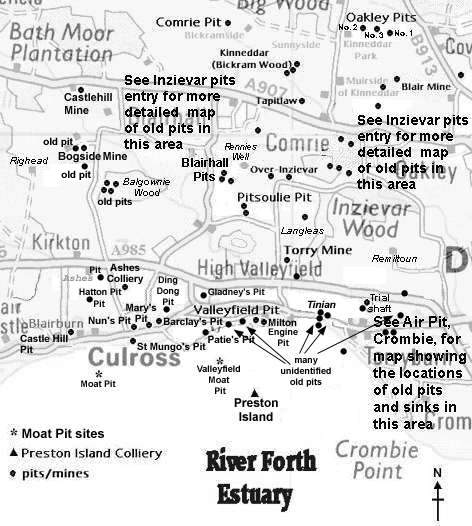
For nearly five centuries, coal was wrought in West Fife wherever it could easily be reached from the surface. In the l6th century, Dunimarle Estate, Culross, was known as Castle Hill (Castlehill) and it was here, in 1575, that Sir George Bruce took over the workings of Castle Hill Pit (original date not known). The workings of this 'land mine' were extended seawards under the foreshore and when work started on sinking the Moat Pit, off shore in the River Forth, in 1590, this 'sea mine', along with the Castle Hill Pit, formed the prosperous colliery of Sir George Bruce.
 |
|
 |
The Culross colliery was noteworthy for the introduction
into Scotland of mechanical drainage of its workings.
Sir George Bruce, a remarkable man, was far ahead of his
time and his ideas for the use of machinery in his colliery
are believed to have come from Germany. Easily the most
fascinating theme was his means of drainage at the
eventually combined pits of Castle Hill and Moat.
Having experienced the same difficulties with drainage as
the monks did at Castle Hill (because of the proximity of
the Dean Burn) he dammed the burn and diverted its waters
down to the shore where they powered a water-wheel
(probably at the high water mark). This drew the water,
which had drained to the sump at the lower end of the pit
workings, by a chain and bucket‘ method. Later,
around 1590, an 'Egyptian Waterwheel‘ was also
installed which apparently used three horses to drive an
axle to operate a much larger chain and bucket assembly
enabling coal seams to be worked at a depth of 40 fathoms
(the old workings were only around 5 fathoms in depth).
However, the earlier water-wheel was not dispensed with
but worked alongside the new Egyptian Wheel, the remains of
which were apparently still visible at the beginning of the
19th century (probably the 'Bucket Pat' at
Blairburn). Sir George had also arranged for a tunnel to be
cut from his Castle Hill Pit to the Moat Pit, the latter
built up above high-water level and thus an island, except
at low tide. A report from 1618 mentions the complicated
(for its day) linking of these pits stating that there was
a road 'like a high arch or vault' cut through rock
between the two pits.
It would then be possible to ship the Castle Hill coal
underground, and then directly from the jetty built at the
Moat Pit out in the River Forth. The tunnel link also
appears to have provided a good through-draught of air
(there seems to be no record of using fires for drawing air
to aid ventilation of the pits).
Some information on coals worked at, or near, Castle Hill Pit, Culross
(based on a report from 1930)
 |
Footnote
