Owners: Dunfermline Coal Company
Townhill Coal Company *
West of Fife Coal Co., Ltd. **
Townhill (Dunfermline) Colliery Ltd. *** [formed
1911]
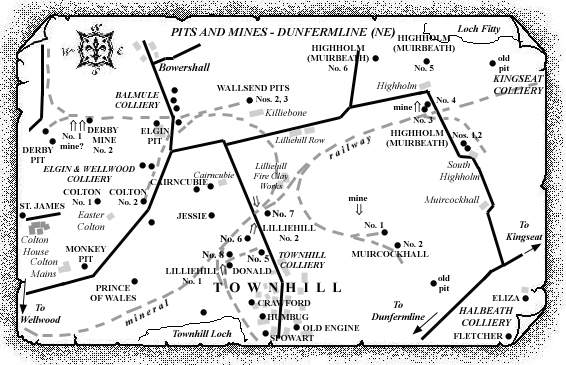
Townhill's Crawford Pit lay just north-east of the Town Loch and to the west of Townhill, north of Dunfermline.
 |
 |
The economic malaise of Dunfermline Burgh, which worked
its own coal in the Townhill area in the late 18th and early
19th centuries, encouraged it to lease its mineral field to
the wealthy Dunfermline Coal Company in early 1838.
The Company quickly realised that the strongest likelihood
of success lay in the basin of the small coalfield and they
commenced the sinking of the Crawford Pit to the Splint Coal
or Four Feet seam at a depth of about 64 fathoms.
The Crawford Pit had probably the longest lifespan of any of
the Townhill pits and its mineral worth was still being
considered as late as 1931.
From the outset, the Crawford Pit was apparently handicapped
by the flooding of "heavy water" and this
continued to be the character of it. Every winter, its
engines were under such great strain that the Company had to
go to the great expense of raising the bottom and cutting the
roof. It was later discovered that by turning off the
engines, much of the water found its way to the sea by the
old workings of Whitefield, Halbeath and Fordell. The water
was described by the miners as "running to the sea on
its own feet!"
By the first decade of the twentieth century it had been
sunk lower than any of the surrounding pits in order to drain
much of the water from the coalfield as a whole.
In the 1840s it used high-pressure steam engines - high
pressure at that time being considered 170 h.p. - for the
purposes of raising coal and pumping out water. Ninety years
later, the pumping engines were of such power that one old
miner said, "Those engines would have pumped the sea
dry if there was somewhere to put it!"
When the Crawford Pit finally closed in the early 1930s, it
was believed that anything up to 500,000 tons of coal might
still be available. Due to water, however, engineers reported
that "a large part of the area might be
unworkable" and the cost of production would prove
prohibitive.
| Pit opened: 1838 | Pit closed: early 1930s |
|---|---|
| Source Date of Information Supplied | |
| Manager / Under- Manager / Men underground / Men above ground / Coal seams worked | |
| 1869 * (as Townhill Colliery) | |
| James Strachan / ------------ / 261 / 55 | |
| Household, manufacturing and steam coals. | |
| 1904 ** (as Townhill Colliery) | |
| William Dryburgh / ------------ / 209 / 64 | |
| Household, manufacturing and steam coals. | |
| 1911 *** (as Townhill Colliery) | |
| ------------ / ------------ / 53 / 22 | |
| Household, manufacturing and steam coals. | |
---------------------------------
Information on coals worked at, or near, Crawford Pit, Townhill
Townhill Colliery (19th century report)
| Name of Coal | Thickness | Quality | Class |
|---|---|---|---|
| Bride Coal | 4 ft. 3 in. | Fair to Good | Splint and Steam |
| Six Foot Coal | 4 ft. | Good | Steam |
| Cairncubie Coal | 2 ft. 8 in. | Excellent | Household |
| Swallowdrum Coal | 4 ft. 2 in. | Fair to poor | Steam |
| Ell Coal | 2 ft. 8 in. | Poor | Steam |
| Upper Eight Foot Coal | 3 ft. 3 in. | Fair | Steam |
| Lower Eight Foot Coal | 3 ft. 6 in. | Fair | Household |
| Five Foot Coal | 5 ft. | Excellent | Steam |
| Dunfermline Splint Coal | 4 ft. 6 in. | Excellent | Household |
A 19th century observer had this to say about the Crawford Pit: "On the Townhill field, many pits have been sunk, and to a considerable depth. There have been eight or nine pits altogether sunk on these lands, and difficulties have been encountered in the sinking, more particularly in connection with water. The pumping at the Crawford Pit is still continued, and is a very great drag on the colliery, as there is a constant supply of fuel necessary - not fuel alone, but attendance and upkeep - which, in a field where the best has always been already extracted, must, as a necessary consequence, have a telling effect upon its resources. "
A few available records reveal plans of abandonment dates of some coal seams which include the Crawford Pit of Townhill. They are included to give the reader a brief summary of the identity of the coal seams worked and an overall indication of the life-span of the individual pit or colliery.
| Plans of Abandoned Seams for Crawford Pit | Pits or Mines designated in Plans |
|---|---|
| COAL; Splint (1892); Fourteen Feet (1893); Five Feet (1896); Ell (1899); Cairncubie (1903); Upper Eight Feet (1904); Lower Eight Feet (1906); Swallowdrum (1907); Mynheer; Three Feet; Six Feet or Upper Four Feet; Little Splint. |
ELGIN AND WELLWOOD
Broomhead; Colton Nos. 1, 2; Crawford; Derby No. 2; Donald; Humbug; Jessie; Killibone; Leadside; Lindsay's; Loch; Lochend; Prince; Prince of Wales; Spowart; Townhill; Wallsend Nos. 5, 6, 7, 8. |
| COAL; Splint (1883); Five Feet (1904); Eight Feet; Swallowdrum (1907); Upper Four Feet (1908); Ell (1923); Bright; Cairncubie (1924); Little Splint; Six Feet. |
TOWNHILL
Townhill Nos. 5, 6, 7, 8; Crawford, Cube, Donald, Humbug, Whitefield |
| COAL; Five Feet; Eight Feet; Splint |
TOWNHILL
Townhill Nos. 6, 7, 8; Crawford, Donald |
| COAL;
Upper Eight Feet; Lower Eight Feet
(31 December, 1911) |
TOWNHILL
Townhill Nos. 5, 6, 7, 8; Crawford, Donald |
-------------------------------------------------

"Dunfermline Journal"
Friday, 5 October, 1855
FATAL ACCIDENT
On the afternoon of Saturday, the 29th Sept. a melancholy and fatal accident occurred in Crawford Pit, of Townhill Colliery, to Owen Welch, a coal-drawer there. The deceased was employed guiding a hutch loaded with coals, down a steep incline, from the workings in said pit to the bottom of the shaft, and in order to prevent the hutch running too fast down this incline, he walked in front of it, leaning against it with his back, and was either knocked down by the hutch, or stumbled in front of it, and the wheels passed over his body, causing instant death.
-------------------------------------------------
"Dunfermline Saturday Press"
8 March, 1862
DISTRESSING ACCIDENT AT TOWNHILL COLLIERY
Yesterday, a distressing accident occurred at the Crawford
or Water Engine Pit, Townhill Colliery, by which two men very
nearly met instant death.
The Crawford Pit is used to drain the water from the other
pits of the colliery, and to effect this purpose considerable
steam power is required. Three large boilers are employed in
raising steam, and it was at the middle and largest of the
three that the accident occurred, by the front part of the
boiler bursting.
So great was the force of the explosion, that a mass of
masonry, two feet in thickness, enclosing the boiler, was
driven to a distance of 70 or 80 yards, into a neighbouring
field. Other parts and appendages of the boiler were thrown
to a distance still greater. Fortunately enough, neither of
the men employed at the furnace were in the front of the
boiler at the time, otherwise they must have been blown to
atoms. As it is, the consequences of the accident are
melancholy enough. The fireman - a man named David Banks -
who was by the side of the boiler at the time, was thrown
down by the force of the explosion and severely scalded. When
brought out of the debris, he appeared almost lifeless, and
two thirds of his person bore the marks of the boiling water.
His assistant, William Adams - although in what would seem to
have been the place of danger, on the top of the boiler -
escaped more easily, although also much hurt.
The unfortunate men were attended to by Drs. Dewar and
Douglas. Banks was found to be so seriously injured that his
life was at first despaired of, but, up to the latest
intelligence, he was still in life. Both men are married and
have families. As to the cause of the accident, little can be
said - neither of the men being yet able to give a coherent
account of it, and until an official investigation is made,
we refrain from offering any remarks.
------------------------------------
"Dunfermline Saturday Press"
17 August, 1889
TOWNHILL - SERIOUS ACCIDENT TO A FIREMAN
Alexander Terris (21), a fireman in the employment of the Townhill Coal Company, and residing in Tradesman's Row, Townhill, met with a rather serious accident on Thursday forenoon. Some workmen had been employed about 200 yards from the Crawford Pit (where Terris was employed), in taking the wheels off a number of old waggons. To do this they found it necessary to use dynamite, and one of the shots went off with the result that what is supposed to be a piece of metal struck Terris on the left arm a little above the elbow. The limb was so much shattered that it was found necessary to amputate it.
------------------------------------
"Dunfermline Press"
26 August, 1899
On Tuesday, George Harrison, labourer, Dunfermline, fell from a temporary scaffold while at work at the pithead of the Crawford Pit, and sustained a fracture of the haunch bone.
------------------------------------
"Dunfermline Press"
16 September, 1899
John Kirkby, one of a number of Hamilton engineers, at present at work at the Crawford Pit, Fife Coal Company, met with an accident on Monday. ...
------------------------------------
