Owner: Lord Elgin
Robert Menzies, manager, 1810-1845?
Charlestown, near Limekilns, on the shores of the River Forth to the east of Culross, is more famous for the ancient limeworks than its associated coalworks. However, in the late 18th and early 19th centuries, before abundant coal supplies for 'lime burning' came down by rail from the pits of the Elgin Colliery, in the Parkneuk/Baldridgeburn district of Dunfermline, there is evidence that coal and ironstone was worked here and, it is believed, may account for the old day-levels seen in the glen of the Lyne Burn opposite the site of the former Charlestown Foundry.
 |
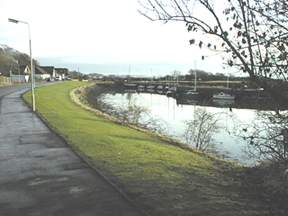 |
| Charlestown Harbour - 2004 |
----------------------------------------------
Information on the minerals worked at Charlestown Colliery
The coal and ironstone horizon worked from the
old day-levels at the Lyne Burn opposite the old Charlestown
Foundry is thought to represent the Lillie's Shale Coal of the
Central Coalfield. For many years in earlier times thin seams of
ironstone associated with the coals were profitably worked, the
foundry at Charlestown still working in 1845.
The limestone work at Charlestown was the last
remnant of a centuries-old industry. Charlestown Lime Works were
started about the year 1760 by Charles, fifth Earl of Elgin. As
many as eleven kilns were thought to have been in operation at one
time, and most of the lime was exported from the small harbour, a
very busy centre at that time. With the introduction of railways,
however, this industry dwindled and towards the end only two kilns
were in operation, each kiln producing around 20 to 25 tons of
'burned lime' per day.
In former times the limestone was quarried, but
in later years it was mined, the mines extending westwards to the
dip under Fiddlers Hall (see sketch map).
The strata in the Charlestown district contained
several thin coals in addition to limestones and these would
probably have been transported on the tram road from the mines to
the lime works to be used in 'lime burning'.
------------------------------------------------
"Fifeshire Journal"
30 January, 1840
CHARLESTON
It is gratifying to record instances where a
proper tribute of respect and good-will has been paid to the
deserving. On Friday week a public dinner was given to R. Menzies,
Esq., manager of the extensive coal and lime works here, belonging
to the Earl of Elgin, by a considerable number of his friends and
gentlemen from Dunfermline and neighbourhood. So general was the
desire to testify the estimation in which Mr Menzies is held, both
as a private gentleman and a public individual, that it became
necessary to limit the number, nearly 120 applications having been
made.
As it was, from 80 to 90 were accommodated, the
large dining-room of the Elgin Hotel being completely filled. The
duties of the chair were most ably discharged by J. Christie, Esq.,
of Crombie, who was supported on the right by their respected
guest, and on the left by his brother, W. Menzies, Esq., of
Tulliallan; Messrs W. B. Mackean and J. Stenhouse of Dunfermline,
croupiers.
After the usual loyal toasts, Mr Menzies'
health - the toast of the evening - was proposed; and most
enthusiastically received; neither is it saying too much to state,
that, from amidst the many gentlemen in the western district
holding situations equally responsible and important, we know no
one more deserving of such a generous expression of good feeling
and honour.
In reply, Mr M. said, that he had been thirty
years manager at Charleston, and he trusted had never given real
offence either to his noble employer or to the numerous tenantry
and workmen. Certainly this arose not so much from any merit of
his, as from the indulgence of the Earl of Elgin, and the very
ready support which he had always received from the tenantry and
others whom he employed. He was highly sensible of the honour done
him, and trusted that he would always be enabled to discharge his
duties in an honourable and conscientious manner. - The Rev. Mr
Johnstone of Limekilns gave the health of Mrs Menzies and her
family, and was glad to be present on such an occasion. - The Rev.
Mr Jardine of Kinghorn proposed the health of the Countess of
Elgin, to whose literary acquirements and benevolence of
disposition he paid a merited compliment. - The dinner and wines
were in excellent style, and did great credit to Mr Glasgow, who
has lately opened the Elgin Hotel, and furnished it in a
comfortable manner, and to whom we wish all success. The evening
passed off in the most felicitous manner, the object of the dinner
having given high gratification to all.
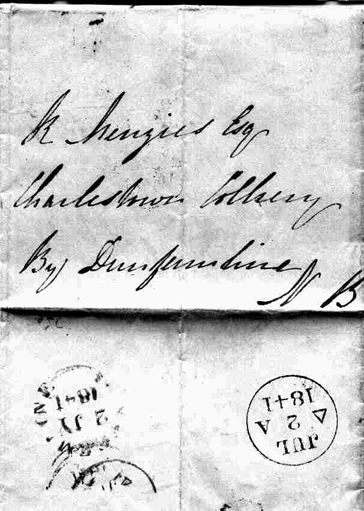 |
Letter dated 2 July, 1841
| We are very grateful to Bill Cochrane, Ontario, Canada, for general information and postal items relating to Mr Robert Menzies, manager, Charlestown Colliery, in the early decades of the nineteenth century. Bill informed us, in July 2005, that coastal shipping carried letters, containing orders for coals from Charlestown Colliery, across the Firth of Forth from Leith to the harbour at Charlestown. Mail carried by coastal/sea routes was apparently quite popular at the time, prior to 1840. This practice was obviously carried on after the introduction of the 1d post, still a cheaper mode of transport than the official post roads etc. and was still taking place in 1853. |
---------------------------------------------------
14th August, 1840
Letter from Robert Menzies, Charlestown, to William Thos Thomson Esq. 3 George Street, Edinburgh.
Charlestown, 14thAugust 1840
Sir,
I have just received your letter of this date p. And W May along with Two hundred and Ninety Pounds for the Colliery Pay due on Saturday first, which sum of £290. is placed to your Credit in the Books of this Office.
I am,
Sir
                    Your most obedient Servant,
                    Robt Menzies
James A Chayne Esq,
of Kilmarin
3 George Street
Edinburgh
---------------------------------------------------
30th June, 1841
Letter from a W. H. Brind, Brighton, to Robert Menzies, Esq, Charlestown Colliery, By Dunfermline, N.B. [N.B. = North Britain]
Mr Menzies, Sir,
I have agreed to ship from 2 to 300 Ton of your
Coal to Mr. David Chusman, Coals Mehr (Merchant), Albion Wharf,
Shoreham Harbour at 17/6 pr Ton delivered, the dues between you
& his Wharf are 1/- pr Ton, that will reduce them to 16/6 &
no further risk. He will have them used on the Steam Pkt between
this & Dieppe commanded by his Brother & also use his last
means to introduce them as a Household Coal. Please say if you have
a Coal which will answer this purpose generally & particularly
for the Port of London. Mr. C will also use his best exertions to
have them introduced into Dieppe generally. You will shaw (?) on
him at 3 months. I flatter myself by his exertions a good Trade may
be made here. Please ship these immediately, have no doubt you may
get a Repeat at a low Freight another shipment if the Coals answer
he will of course pray a better price. I wrote tonight to Mr C
Bruce - no doubt Lord Bruce is too much engaged for business if he
remains in Southampton I shall see him early in the ensuing weeks.
Please address me 33 King St, Portsea I am going to Havre & the
Channel Islands. If you can give me any information, I shall feel
obliged.
I remain
Dear Sir
Yours truly
W H Brind
---------------------------------------------------
"Fifeshire Journal"
4 January, 1844
MELANCHOLY ACCIDENT
On Wednesday morning last, about seven o'clock, as John Chalmers, a young man who was usually employed in driving the waggons on the Charlestown railroad was crossing the railroad about the middle of the run down the decline between Pittencrieff Street and Golfdrum, where the Berrylaw Road crosses the railroad, the rope which was attached to the waggons then on the run came in contact with his foot, he fell, and the whole train went over him. His leg was broken in several places, and his body was dreadfully mangled and bruised. He survived the accident only two hours, when death relieved him from the most excessive suffering.
---------------------------------------------------
"Dunfermline Journal"
1 June, 1860
CHARLESTON.
UNFORTUNATE ACCIDENT.
An accident of rather a serious nature occurred here a few days since to a workman named William Methven, by which one of his legs was broken and otherwise injured, while engaged superintending the coal waggons going down the incline to the harbour, owing to the sudden breaking of a rope. We hear, however, that his recovery is progressing satisfactorily.
---------------------------------------------------
