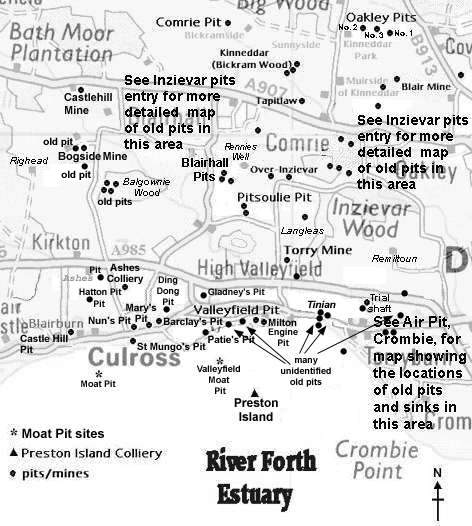
| We have individual entries for
a number of early Culross coal pits in the WEST INDEX of the
website. Many of these were located close by the shores of the
River Forth in, and around, the lands of Culross and
Valleyfield. These named pits include: Barony; Ding Dong; Engine; Garden; Gladney's; Lord Dundonald; Maggie May; Mary; Mill Sink; Milton Engine; Moat; Nun's; Pates; Preston Island; St Mungo; Woodside; Valleyfield Moat. We have also included relevant information within the history pages (see Menu 4). M. Martin & Webmasters. |
|
 |
---------------------------------------------
Old Parish records are a great source of information in spite of the many variations in spellings of names, etc., laid down in these documents. The names of some early miners, and the dates when they were working the early, small coalworks, are revealed in records of births, deaths, and marriages.
David Simpson, collier in Culross - died 27 Sep 1652.
---------------------------------------------
Statistical Account of Fife for Culross Parish - 1791
"Formerly, the coalworks of Culross were the most considerable in Scotland; it being ordained by act of Parliament in 1663, that the Culross chalder should be the standard measure for Scotland; and the number of salt-pans then in use amounted, as is asserted, to no less than 50. These works appear to have been in their most flourishing state in the reign of James VI, a little before, and some time after, his accession to the crown of England. They were then wrought a considerable way under the sea, or at least where the sea overflowed at full tide, and the coals were carried out to be shipped by a moat within the sea-mark, which had a subterraneous communication with the coal-pit.
There is a tradition, that James VI, revisiting his native country, made an excursion into Fife; and, resolving to take the diversion of hunting in the neighbourhood of Dunfermline, invited the company then attending him to dine along with him at a collier's house, meaning the Abbey of Culross, then belonging to Sir George Bruce. Being conducted, by his own desire, to see the works below ground, he was led insensibly by his host and guide to the moat above mentioned, it being then high water; upon which, having ascended from the coal-pit, and seeing himself, without any previous intimation, surrounded by the sea, he was seized with an immediate apprehension of some plot against his liberty or life, and called out, Treason. But his faithful guide quickly dispelled his fears, by assuring him that he was in perfect safety; and, pointing to an elegant pinnace that was made fast to the moat, desired to know whether it was most agreeable to his Majesty to be carried ashore in it, or to return by the same way he came; upon which the King, preferring the shortest way back, was carried directly ashore, expressing much satisfaction at what he had seen. ...
One cause to which the decline of these works, once so flourishing, is ascribed, is a violent storm which happened the very night on which King James died, by which moat, and different parts of the machinery, were either greatly damaged, or totally destroyed. From this shock, though they were afterwards wrought partially, they never entirely recovered, and were, for a time, wholly deserted. At present there is a temporary supply of coal procured from the croppings of the old works, and gleanings accidentally left. It is certain, however, that very rich seams of coal yet remain, especially on the lands of Valleyfield, belonging to Sir Charles Preston, under lease to the Earl of Dundonald, which, on account of the great depth at which they lie, cannot be wrought to any purpose without expenditure of a considerable sum of money; yet, situated as they are, close to the shore, and so commodiously for exportation, this obstacle, we are in hopes, will be soon removed."
-------------------------------------------------------
"The Scotsman"
21 April 1847
FOR SALE BY PUBLIC ROUP
THE ESTATE OF BLAIR CASTLE, in the Parish of Culross ... The Minerals are supposed to be very valuable; the Coal, Ironstone, Limestone, and Freestone, having been all partially wrought. ...
-------------------------------------------------------
"Dunfermline Press"
1 February, 1908
CULROSS COAL WORKINGS
SOCIAL CONDITIONS A CENTURY AGO
At the close of the eighteenth century in 1793, the Earl of Dundonald published a
pamphlet, entitled "Description of the Mineral and Coal Property belonging to the
Earl of Dundonald, wherein is given an Account of the Coal Workings at Culross since
the year 1572, together with a description of the Coal Mining Field of the Firth of Forth."
The pamphlet is so rare that not a copy could be found in any of our libraries or elsewhere.
It may, therefore, be of interest to our miners to give a brief view of what it incidentally says
again and again of their social condition. In the meantime we would only quote one sentence
as to the coal territory and other matters:-
"The coal territory extends to about 10,000 acres. It contains 27 different seams of coal
from 2 to 9 feet in thickness, only 7 of these seams have as yet been partially wrought."
The descriptions of the territory and pits are exceedingly picturesque and interesting, and may
be given in another form in the near future.
After describing at some length the superior methods of coal working in England, the author sums
up the state of our Scottish workers and their prospects in this brief sentence:- "In short, we
shall never get right till we get as far wrong as we can."
We quote the Earl's own words verbatim as to how the adoption of his views would work
out for the miners:-
" (1) A stop put to the barbarous and ultimately expensive method of converting the colliers'
wives and daughters into beasts of burden and causing them to carry coals to the pit-bottom or to
bank on their backs.
" (2) An abolition of the dirty and mean practice of many of the Scots owners of collieries acting
as Sutlers, and supplying their workmen, frequently at an advanced price, with oatmeal, salt herrings,
salt beef, cheese, butter, candles, soap, and such articles; receiving besides a bonus, or gratuity,
from the oversman of the colliery as a share of the profits on retailing small beer and whiskey. ... "
In contrast with this state of matters among the colliers in other pits in Dunfermline district, the Earl goes on to say of his own miners:-
" It is but justice to the colliers employed at Culross Colliery to say that they presented a
very different picture. They were steady, sober men of principle, well-clothed, neat in their persons,
and well supplied with household furniture. This favourable alteration in their conduct and manners is to be ascribed:-
First - In the pits, colliers, not miners, were principally employed. By this means their wives were
exempted from the drudgery of bearing coals in the pits; and by staying at home contracted a habit
of domestic attention, and care of their families, while the husbands, learning, adopted their manners
and were a very orderly, sober set of men.
Secondly - Few or no stranger colliers were employed in the works.
Thirdly - The colliers were not payed their full wages weekly, or once a fortnight, as is the practice in
other collieries. They were payed each fortnight as much as enabled them to support their families.
The balance or arrears was payed once in three or four months. This mode of paying them made
them economical, and the arrears enabled them to provide themselves with good clothes, household
furniture, etc., and to lay in a supply of beef for their families in November.
Indeed, they carried their taste for the elegantiorum of life further than necessary. Many of
them had silver watches; clocks in all their houses; several of them on a Sunday wore silk stockings,
tambour embroidered silk vests, with their hair well-dressed and powdered."
It is rather amusing to find the attraction of "Store Dividends" once a quarter practically in
favour over a century ago.
The Earl gives the principal cause of the disorderly conduct of Scots colliers as -
(1) The practice of bearing coals on women's backs.
(2) The encouragement given to colliers to run into debt.
(3) Weekly pays without stoppages.
(4) The cheapness of malt spirits.
(5) Colliers being put like swine into miserable, mean hovels or houses.
The Earl says of English colliers and their superiority over the Scots:-
"A Newcastle collier while he works, works hard, is stripped to the skin; does not take snuff; consider and cool upon his work; but pushes out quantity on which the masters profit depends."
Take a word in conclusion regarding the Earl's own case. Speaking of himself he says:- "His situation has been peculiarly hard - even to the small remains of a fortune - having of the Dundonald estate nothing but the Castle, he has endeavoured to increase his fortune by honest industry, etc. ... His having been a 'Scots Peer' has been extremely hurtful to his undertakings. Traders say we will have nothing to do with you because you are a Peer; and Peers say we will have nothing to do with you because you are a trader."
-------------------------------------------------------
"Dunfermline Press"
26 June, 1909
DISPUTE REGARDING CULROSS MINERALS
ACTION AGAINST THE MARQUIS OF LANSDOWNE
In the Court of Session on Thursday, judgement was given in the action by R. H. Millar, of Blair Castle, Fifeshire,
residing at The Linns, Montrose, against the Marquis of Lansdowne, K. G., for declarator that he has the exclusive
right to the coal under the lands of Blair, Possil, and others, near Culross.
The pursuer averred that he was infeft in the estates in 1885, and held immediately under the Crown the lands
abutting on the sea, and the pursuer and his authors had, he said, had possession of the foreshore ex adverso
of the lands, and from time to time worked the coal under the lands on the foreshore. The defender stated that the
pursuer had no title to the foreshore ex adverso of his lands, and that the pursuer's titles did not convey
the coal to him. He maintained that he was entitled to the coal under the lands of Blair, Possil, and Langside, and
also in and under the foreshore ex adverso of Blair and Possil. The coal and mines claimed by him, he alleged,
had from time immemorial constituted an estate situate and distinct from the surface. He claimed to have an
express right to the foreshore by charter dated 1663, and in the coal in the foreshore by charter dated 1792, and
he said that he and his authors had worked the coal under the foreshore.
Lord Mackenzie granted the pursuer decree in the case of the lands of Blair and Possil, Langside, Bruce Meadow,
Breadies Acre, Bordies Lands, and Birkenhead; and with regard to the coal under the foreshore of Blair and
Possil and Bordie he allowed a proof. The question of expenses was reserved.
Counsel for the pursuer - Mr Chree. Agent:- Macandrew, Wright, & Murray, W. S.
Counsel for the defender - Mr Macmillan. Agents - Dundas & Wilson, C. S.
-------------------------------------------------------
"Dunfermline Press"
18 September, 1909
MINING DEVELOPMENTS IN WEST FIFE
Now that the transaction by which the Fife Coal Company are to acquire the mineral rights of a portion of the lands of Culross, belonging to Lord Bruce, is all but completed, rumour is current that the Company have in immediate prospect still greater developments in a westerly direction. They are negotiating, at all events, for the acquisition of part of the glebe lands of the parish, and it is stated on good authority that the estate of Blair, and even Sands, still further west, may yet come within the scope of the Company's enterprise. A gentleman, intimately concerned in the Company's operations, is reported to have expressed the belief that the time is not far distant when there will be located between Lowvalleyfield on the east, and Sands on the west, a mining population numbering several thousands.
-------------------------------------------------------
"Dunfermline Press"
18 September, 1909
CULROSS FORESHORE DISPUTE
ANOTHER CLAIMANT TO THE MINERALS
Culross foreshore dispute, which, so far, has been a question between Lord Bruce on the one side and the inhabitants of the burgh on the other, and which is now the subject of judicial inquiry, is likely to be a much more complicated affair than was anticipated. In all probability there will be three separate claimants to the foreshore. The third to appear is no less a personage than Lord Dundonald, who, we have the best authority for stating, is considering the advisability of contesting his rights to the minerals underlying a considerable stretch of sea front. At one time, the Cochranes (the family name of the Dundonalds) were the superiors of the foreshore. A temporary set-back in the fortunes of the noble house necessitated the disposal of certain lands, including the foreshore at Culross. The Bruce family were the purchasers. Lord Dundonald's position is that the transaction had no reference to the minerals, the rights in which, it is said, were retained. Lord Dundonald visited Culross on Tuesday.
-------------------------------------------------------
"Dunfermline Press"
23 November, 1912
THE INDUSTRIAL REVIVAL OF CULROSS AND VALLEYFIELD.
PROSPECTS OF GREAT COLLIERIES.
NOTES ON THE DEVELOPMENTS.
Changed days at Culross and Valleyfield were the words with which a resident of the ancient burgh of
Culross greeted the writer the other day. Things are indeed changed.
A decade ago Torryburn, Newmills, Valleyfield, and Culross were numbered among the "sleepy hollows"
of the "Kingdom" which could only be reached from Dunfermline on the east, or Alloa on the west, by 'buses
which often encroached sadly upon the time of business men. Now the train has invaded Cairneyhill and Culross, and the
villages adjoining, and at all hours the motor 'bus may be seen on the highways. The changes do not by any means
end in the mode of travelling.
In his "Scotland Yesterday" Dr. William Wallace, who spent his boyhood days by the Sandhaven of Culross,
writes of "St Serf" as a "Comatose Burgh".
Culross has ceased to be a "Comatose Burgh", and the villages adjoining are participating in the industrial
activity which is being experienced through the reopening of the coalfields of the district.
As one approaches Newmills Bridge from the east, the Valleyfield Pits, belonging to the Fife Coal Company, Limited,
burst into view.
The two shafts occupy practically the same site as the pits did in which Lord Dundonald operated on the upper seams
between 1773 and 1793. Under the old workings the Fife Coal Company struck the following seams:-
Seam - depth - thickness.
Fourteen Feet - 80 fms. - 4 ft. 0 in.
Diamond - 83 fms. - 3 ft. 0 in.
Lochgelly Splint - 144 fms. - 2 ft. 6 in.
Mynheer - 178 fms. - 2 ft. 9 in.
Two Feet - 186 fms. - 2 ft. 0 in.
Five Feet - 192 fms. - 7 ft. 0 in.
Dunfermline Splint - 217 fms. - 3 ft. 9 in.
A feature worthy of note in connection with the five feet and Dunfermline splint seams is the fact that they add
another coalfield to the navigation coalfields of the county.
Both seams are harder than the navigation seams in the Fife Coal Company's Aitken Pit at Kelty, but some
experts favour the harder coal, and the five feet and splint seams combined make a navigation coal which is equal in
every respect to the Welsh coal which is so popular with our naval officers. It may therefore be taken for granted that
before the Naval Base at Rosyth has developed to any extent, the Valleyfield coals will be drawn upon for the fuel of the
Dreadnoughts which are likely to lie in the Firth of Forth.
THE EXTENT OF THE COALFIELD.
The estate of Valleyfield is owned by the Fife Coal Company, and in addition to the Valleyfield area extending
seawards to the south and inland to the north and west, they have procured a lease of the minerals on Torrie and
other estates.
About 100 yards from the bottom of the shafts faults were struck in the lower seams, and for some time the obtrusions
gave the management some little trouble and obstructed developments. It was at one of the faults that the great outburst
of gas took place in March 1911. On the faults being pierced the coal was struck at about the same level. During the
present year developments have gone on without interruption. The coal output is a daily increasing quantity, and from
a total of from 400 to 500 tons a day, the output will doubtless soon reach 1000 tons. The pits are fitted for grappling
with an output of 2000 tons a day, and the developments underground are being planned so that the management
will have no difficulty in reaching the maximum. It may be interesting to state that the splendid quality of the coal is
fully maintained in the area now being opened up beyond the faults. The trouble which arose over the intrusions of
the faults has been to some extent compensated for by the practical absence of water in the workings.
At some of the collieries in Fife it is no uncommon things for the water pumped night and day to reach a total of from
1000 to 1500 gallons per minute.
At Kinglassie, for instance, the water when sinking operations were going on was tremendous - from 2000 to 3000
gallons per minute.
At Valleyfield the water which falls to be dealt with is not more than 100 gallons a minute. This is due to the fact that
immediately under the surface there is a thick bed of boulder clay, and the clay protects the shafts and workings
from the surface water which at many collieries is a feature to be reckoned with, and which during the winter months
often tries the pumping machinery to its utmost capacity.
It was no doubt the protection afforded by the boulder clay which enabled Sir George Bruce and Lord Dundonald to
extend their colliery workings under the Forth in seams which were not many fathoms from the surface.
THE HOUSING.
Within the past two years the Fife Coal Company have erected as many as 150 houses, and as developments go on the number will largely be augmented. The policies of Valleyfield House afford an excellent site for houses, and under the shadow of the great house, which is a landmark of the district, a model mining village is likely to rise. The new houses present a striking contrast to the "buts and bens" which did duty as dwellings to the miners of the Valleyfield district of other days.
CUSTOMS OF OTHER DAYS.
The changes for the better in the housing are perhaps no more striking than the whole manner of life. In the middle of the seventeenth century the reformed church discovered the "Scarlet Lady" in many institutions, and on the assumption that the miners should not even mention the name of Christmas, the Privy Council enacted that "colliers shall cease to make the 25th December a flitting day." The church followed up the action of the Privy Council by enacting that Christmas shall not be observed as a festival. Despite all the enactments, the miners of Valleyfield ventured in 1644 to spend a merry Christmas and abstained from their work. The church and civic dignitaries of Culross looked upon the conduct of the poor miners as revolutionary, and seven Valleyfield men were hauled before their "betters". The minutes, dated 7th January 1644, reads as follows:- "The colyears of the Valleyfield, Thomas Watchman, Thomas Penman, Alex. Reid, Wm. Coustone, Thomas Maine, Robert Symson, and Thomas Younger, were accused for keeping of Yule day, in feasting and drinking and abstaining from their ordinare work; confessed their fault, and made their repentance according to the order, and payed every one of them 20 sh., and enacted with their own consent that if they should be found guiltie of the like hereafter, to pay in penaltie ilk one of them 10 lb., and mak their repentance in publick."
THE PRICES OF COAL IN 1702.
In the days of Sir George Bruce, Culross provided coals for all the parts of the county. In 1625, the days of George Bruce
the Second, the Moat Colliery of Culross was wrecked by a great storm. The Moat, surrounding the pit which stood in the
bay opposite Dunnimarle, was thrown down, and the sea invaded the coal workings. The wreck was complete, and
Culross colliery became a miserable pottering work.
Valleyfield blossomed into the great industrial centre of the district. Pits were opened up, girdle making was introduced,
and the village became a Burgh of Barony. The Culross people were indignant at the "upstart" and the Magistrates
met and ordained that nothing should be bought by residents of Culross at the markets and fairs held at Valleyfield.
Having no coal pits going the residents of Culross were compelled, however, to support the Valleyfield Colliery. Here is a
Culross Town Council minute, dated 1702, which throws some light on the customs and coal prices of the times:- "A bargone
which was cowmoned betwixt Colonel John Erskine of Carriden, William Robertson of Gladnay, taxmen of the coall works of Valyfield,
and the magistrates of this burgh, anent the satelling and establishing of the pryce of the Kartt and missure of great coall which
comes from the coal hill of Valyfield to the burgh, and for furnishing of the same, and that at the pryce of seven shillings Scots
the kart, as the pryce of former payments mead betwixt this toune and the awners of these works - upon this condition, that
the burgesses and other inhabitants of this burgh be restricted, bound, and obleidged that they recept nor buy any stolline
coals from the coall bearers or coal hewares in Valyfield, in recepting of burdens at any time either night or day."
This proviso is added - "And in the mayne tyme, if the seven shilling cannot be adhered to nor condeshended upon, with
power to the Magistrates to add or condeshend upon a babie or eight penyes more the load."
Mr Robertson stood out for "seven shilling and a baby the kairt"; and notwithstanding the bailies used "all therr
indevoures" to obtain the old rate of 7S., we are informed that they "yet could not prevail with him. The town
council now adheares to the od baby since thay could do no better." A bargain was accordingly struck at 7s. 8d. Scots
per cart. One cannot state the quantity carried in each cart, but these would be from half a ton to a ton in each load. A selling
price of 7s. 8d. Scots only works out at 7½d. sterling per cart. In view of the moderate charge most people in these
days will be inclined to argue that the coal-grieve of 1702 did well to fight for the "od baby" (bawbee) per cart.
As far back as 1661, Sir George Preston of Valleyfield complained to the Culross Magistrates of the clandestine sale by his
colliers of coals to the inhabitants of Culross, and he undertook, if this was put a stop to, to serve the town duly with coals
and to refrain from any future augmentation of prices.
TWO DEEP PITS.
While the Fife Coal Company are operating on the fringes of the Forth, the Coltness Iron and Coal Company, Limited, have
sunk two great shafts on the northern borders of the parish at Blairhall. The lowest seam has been struck at a depth of 324
fathoms, and there is abundance of coal in the field of the best quality. The pits are among the deepest in Fife, and are
designed for handling an output of 1500 tons a day.
As developments proceed the housing accommodations of the district will be added to.
With great pits operating on the coalfields at each end of the parish one is safe in assuming that Culross is destined to become
a mining centre second to no parish in the County of Fife.
-------------------------------------------------------
"Dunfermline Press"
17 February, 1917
Sir George Bruce of Carnock, who from time immemorial has been spoken of in the western district
of Fife as "The Captain of Culross Industries", appeared in Culross in the last quarter of the sixteenth
century, and he married Margaret, a daughter of Archibald Primrose of Burnbrae, Culross, and Margaret Blaw,
ancestors of the Earl of Roseberry.
The Blaw's were the owners of Castlehill, a charming little estate, which now takes the name of Dunimarle.
EARLY MINING
When Sir George Bruce took up residence in Culross in 1575, the little red-roofed town on the fringes of the
Forth was as poor as poor could be. The Abbot and monks had been driven from the ancient Abbey on the hill;
and for years previous to the Reformation of 1560, operations, owing to floods, had been suspended in the "coal-heughs"
or mines. The mines of these days were extremely simple. Like rabbit warrens they ran into the sloping grounds from
the shore, the water from the workings rushing out at the mouth of the mine. Alexander Colville, the Commendator of
the Abbey, granted a lease to Sir George in the hope that, through his "skill in machinery", he would be
able to "re-establish the colliery."
Time was when the magician with his wand was supposed to do wonders. No industrial magician ever appeared in the
county of Fife who did greater things than Sir George Bruce. He tackled the coalfield of Culross as no mineral field had
been tapped previously in Scotland, and established a colliery and salt works which became models for the entire
country. In place of rabbit-warren mines, shafts were sunk and fitted with novel machinery; and by night and by day
the extensive salt works, which ran along the shore from a point opposite the Sandhaven to the Pow at Pond
Cottage, lit up the Forth and made Culross the envy of the little towns on the southern fringe of the estuary. In the
days when the Church dominated every institution, Culross was only a Burgh of Barony. In 1588 the mining town
blossomed into a Royal Burgh.
The charter was granted by James VI., and it sets forth that the concession was made because of the trade done in
coals and salt. Sir George Bruce amassed a fortune off his coal and salt works. He died at Culross in the beginning
of January 1625, leaving three sons and four daughters.
Sir George Bruce's colliery was totally wrecked in a storm, and what had taken years to build up was thrown
down in a single night.
*** See Moat Pit entry ***
-------------------------------------------------------
"The Scotsman"
Saturday, 14th July 1923
THE ANCIENT BURGH OF CULROSS.
JAMES VI.'S EXCITING EXPERIENCES.
THE HOMES OF ANCESTORS OF
LORD ROSEBERRY AND ELGIN.
On ground rising from the fringes of the Forth, Culross, which was yesterday included in the itinerary of Their Majesties the King and Queen, lies on a summer day like a sunny dream.
ECCLESIASTICAL AND INDUSTRIAL CHANGES.
The ancient burgh is one of the smaller towns in the "Kingdom" of Fife which
have participated in many ecclesiastical and industrial changes. Time was when the monastery
echoed and re-echoed to the feet of abbots and other Church dignitaries, and upwards of 350
years ago Sir George Bruce of Carnock and Culross converted the town into a scene of great
industrial activity.
As far back as the thirteenth century the monks of Dunfermline were operating upon the crop
coal of Pittencrieff Glen. Following the example of the Dunfermline ecclesiastics, the monks of
Culross opened a coal-heugh on the banks of the Forth.
Immediately after the Reformation of 1560 Alexander Colville, a relative of the last abbot of
Culross, was appointed Commendator, or lay steward for the Crown. At the date of his appointment
the coal-heughs were flooded with water, and operations were entirely suspended. A lease of the
minerals was granted to Sir George Bruce, "whose knowledge and skill in machinery" was,
as the document set forth, "greater than that of any other man in these days."
Sir George found that every patch of coal had been worked which could be won level free, and
on the shore he sank a shaft to the coal to a depth of 40 fathoms, and drained the workings of
water by the Egyptian wheel system of pumping.
Finding that the coal ran under the Forth, Sir George had a moat erected in the shallow water half
a mile seawards, and here he sank a shaft. Ultimately the Egyptian wheel-pit and the moat shaft
were connected underground.
The Egyptian wheel was driven by three horses, and as a chain of 18 buckets of water ascended,
18 empty vessels were lowered. Because of the flooded coal-heughs, there was what old recorders
write of as "a scandalous dearth of coal" in Scotland.
Sir George's system of drainage gave the collieries a new lease of life, and pumping machinery
on the Culross model was erected at many collieries on the north and south banks of the Forth.
THE KING DESCENDS THE SHAFT.
As was indicated by "J.W.H." in The Scotsman of Thursday, there is a tradition
that King James was among the many people who flocked from all parts of the country to inspect
Sir George Bruce's great undertaking. The King and Sir George descended through the workings
to the bottom of the moat shaft. On reaching the surface the moat was surrounded by the flowing tide,
and, seized with the apprehension of a plot against his liberty or life, James called out "Treason."
The King's fears were dispelled by Sir George pointing to an elegant pinnace which lay near the moat.
On His Majesty being asked whether he would travel to the shore by the pinnace or return by the underground
tunnel, he chose the former.
The King was sumptuously entertained by Sir George in the Mansion of Culross Abbey. The room in which
the King was entertained still takes the name of the "King's Room," and some of the glasses
used at the lunch are preserved.
The moat was overthrown in a great storm in 1625, the same year as the King and Sir George Bruce
departed this life, and the pits were completely wrecked.
Sir George was married to Margaret, a daughter of Archibald Primrose of Burnbank, Culross, and Margaret
Blair, and David Primrose married Janet Blair, of the Castlehill family of Culross.
The Elgin family trace their lineage back to Sir George Bruce and Margaret Blair, while the Primroses of
Castlehill are the ancestors of Lord Roseberry. The blood of the Blairs, therefore, courses through the veins
of two distinguished families of the Scottish Peerage.
THE BIRTHPLACE OF ST MUNGO.
Culross is traditionally the birthplace of St Mungo, the patron saint of Glasgow. He was, in the sixth century,
born on a grassy knoll near the shore, which is pointed out to this day, and he fell into the hands of the original
St Serf, who had opened a religious establishment in the district.
St Serf undertook the education of the infant, and the pupil soon became greater than his master. A robin redbreast
was, according to the legendary details of St Mungo's sojourn at Culross, roughly handled one day by other
pupils of St Serf. The youth made the sign of the cross over the bird, and in an instant it was restored to life.
One cold night some careless pupils allowed the whole of the fires in the Monastery to go out. St Serf was in a
dilemma, but not so the promising youth. He pulled a twig of hazel, prayed over it, and at once the branch burst
into a flame.
Time came when an angel appeared to the youth, who originally took the name of Kentigern, and whispered
to him to go to the West Country. He crossed the Forth by the waters "being divided like the Red Sea,"
and, settling beside the Molendinar Burn, he established a religious community, which was the origin of the great
See of Glasgow.
THE FOUNDATION OF THE ABBEY.
The student of Culross history gets on firmer ground than the legends of monks when the Monastery
was founded by Malcolm, Earl of Fife, in 1217, in the reign of Alexander II. The Monastery was dedicated
to the Virgin Mary and St Serf, and the monks were of the Cistercian order. The colony came from the
Priory of Kinloss, in Morayshire. Abbot Hugh, the first Abbot, died in 1232, and an idea of the extent of
the sacred buildings may be formed from the fact that when he departed this life he left behind him 100
monks and 130 novices.
The Monastery of Dunfermline was wrecked by the "image-breakers," who had
"Knox and Calvin in their heads,
And hammers in their hands, and spades,"
in 1559-60, and Lindsay in his "Chronicles of Scotland" says - "The whole lordis and
barnes that ware on this syde of the Forth passed to Stirling to complete the work which had been begun
at Perth."
Culross Abbey and Monastery doubtless suffered when the leaders of the Reformation were on their way
to Stirling. In 1633 the Abbey, which was the Church of the Monastery, became, by Act of Parliament, the
Parish Church of Culross. Restoration schemes were carried out in 1640 and 1824, but internally many of
the finest architectural features were hidden by plastered wall surfaces, plastered ceilings, and galleries
or lofts.
In 1900 the edifice was found to be in a most unsatisfactory state, and in 1903, a reconstruction scheme
was begun, and carried through at a cost of £5000, according to plans prepared by Sir Rowand
Anderson, Edinburgh.
Speaking at the re-opening ceremony in 1906, the Right Reverend Dr. T. B. Niven, the Moderator of the
General Assembly, said:- "Another of our ancient Scottish churches has been rescued from decay. It
is restored to something of its original beauty."
In the excavations which were necessary in connection with the reconstruction, vaulted remains of a Culdee
church were discovered. Two recumbent stone figures in the arch on the left are believed to be effigies of
members of the Argyll family. The archway is supposed to have been the entrance to the burial aisle of Stewart
of Lorne, the first of the Argyll family. The Earls of Argyll are hereditary Bailies of the Abbey of Culross.
MURDER OF AN ABBOT.
On the spot traditionally associated with the birth of St Mungo, Robert Blackadder, the Archbishop of
Glasgow, in 1503, erected a memorial chapel. The chapel has long been in ruins, and today two beech trees
flourish in the floor space. The Archbishop was a brother of Patrick Blackadder, the laird of Tulliallan, near Culross.
The Abbots and the Blackadders were not on the best of terms, because of a change having been made in the
lease of lands, and with the erection of the chapel the relations became further strained. Sir James Balfour,
in his "Annals of Scotland," has the following entry:- "This zeire, 1530, the Laird of Tulliallane
was beheidit, the first day of Marche, for killing Mr (Sir) Patrick Inglis, Abbot of Culross, and with him a moneck
of the same Abbey, a chiefe author of the abbot's slaughter."
The Abbot and the laird had met on the highway near Rosyth. A dispute arose, and in a struggle which took
place the Abbot was slain and, as is indicated by Balfour, the laird and a monk forfeited their lives for the murder.
THE NINTH EARL OF DUNDONALD.
Archibald, the ninth Earl of Dundonald, opened collieries at Culross and at the adjoining village of Low Valleyfield.
On a site near the latter place the Earl manufactured coal-tar, and protected his discovery by a patent. Lord Cochrane,
the famous seaman, who became the tenth Earl of Dundonald, writing of the tar works, says:- "Here coal gas
became accidentally employed in illumination. Having noticed the inflammable nature of a vapour arising during the
distillation of coal-tar, the Earl, by way of experiment, fitted a gun barrel to the induction pipe leading from the condenser.
On applying fire to the muzzle a vivid light blazed forth across the waters of the Forth, becoming distinctly visible on the
opposite shore." This incident took place in 1782.
On their way to London the Earl of Dundonald and Lord Cochrane related the incident to James Watt, at Handsworth,
Birmingham. Years after, Mr Murdoch, one of Watt's assistants at Soho, applied coal gas to the illumination of
Soho Works.
Lord Cochrane assumed that illumination by coal gas may have been a subject of careful experiment by Watt and
Murdoch, and he adds:- "Mr Murdoch, so far as I am aware, never laid claim to a discovery of the illuminating
property of coal-gas, but to its useful application only."
The site of the old tar-kiln, through which the Forth was first illuminated by coal-gas, can still be traced near the
ancient burgh of Culross.
-------------------------------------------------------
"Dunfermline Press"
8 June, 1940
THE QUEST FOR COAL.
From Dunfermline-Culross.
By J. W. Ness
Having already – Valleyfield and Blairhall – two large collieries to its credit, the West Neuk, with the development of the super-colliery near Comrie Village, is being put once again into the forefront as a mining centre.
Valleyfield is a large colliery; Blairhall is the deepest shaft in the county and one of the most productive, and should the output expected, 400 tons an hour, be realised from the new colliery at Comrie, millions of tons will be exported from the district in which coal was dug among the first places in the country.
For almost 700 years coal has been dug in nearly every fashion from Dunfermline westwards. In the 13th century, monks burrowed into the lands around Pittencrieff and in the braes above Culross in quest of coal – "the black stone," as Marco Polo called it, "that runs in veins."
To the north of Dunfermline shafts and mines of every description have exhausted the Field, and coming westwards, wherever a handy "nibble" of coal could be obtained from any outcropping seam, men have sought to unearth the mineral.
In places which now bear no evidence of shafts or bings, coal and iron-stone have been mined to some extent.
MINES IN THE VICINITY OF CROSSFORD AND CAIRNEYHILL.
COAL EXPORTED AT LIMEKILNS.
We read in Dr Sibbald's "History of Fife" that both coal and ironstone were dug on Pitfirrane estate.
In his quaint wording he relates:- "There is a vast fond of small coal on the lands which is carried to the Port of Lyme Kilns, belonging to Pitferren, being a small burgh of barony, it is well provided with coal-yards and cellars."
In a footnote the remark is added:- "From a remote period the family of Pitfirran obtained from the Government the privilege of exporting their coal to foreign parts free of all duty whatever. The original privilege was renewed by Queen Anne, 21st December 1706, and ratified in Parliament, 21st March 1707.
The family continued to enjoy the privilege until 1788, when it was purchased by the Government for £40,000, when the property that could injure the revenue was nearly exhausted. The most remarkable in these lands are the seams consisting of 5 feet, 2 feet, and 4 feet each, all found within a space of 14 yards at a depth of 3½ fathoms from each other, and in their natural state, dipping from one foot in four to one foot in six, to the north-east.
Immediately above the two feet seam are two strata of iron-stone. The uppermost is four inches, the lower two inches thick. Being above a seam of coal they are wrought along with it. They are of excellent quality for making cannon, and have been exported to the Carron Company for that purpose.
The iron-stone began to be wrought by the company in 1771, and in 1773 and 1774 sixty miners and as many bearers were employed in the mines."
There is no doubt that the above-mentioned seams were the "Five Feet", "Two Feet", and "Dunfermline Splint", and since the Kinniny Limestone (beneath which there is no coal) is found near to the surface to the south and west of Crossford and Cairneyhill, the seams were wrought in the districts around Knockhouse, Lundin, and Pitdinnie, where the strata, though intersected by many throws and faults, yields patches of the lower coal which have been flung here and there quite close to the surface.
Less than two hundred years ago the Waggon Road at Crossford was a busy thoroughfare, along which coal was wheeled for export at Limekilns, a place which then exported over 60,000 tons of coal annually from the mines around Dunfermline.
THE FORTH IRON WORKS.
Coming further westwards, evidence of old workings is found in the vicinity of Carnock and Luscar, where the lowest seams of the Fife Field, the "Dunfermline Splint" and "Stink Coal", were wrought as outcrops.
Near to Comrie new colliery, some of the upper seams were tapped at Overton and Shepherdlands early in the 19th century. But the greatest and most spectacular effort of all was the venture made by the Forth Iron Company.
Many pits were sank to the south of Comrie Village and Oakley in the region of Inzievar, and both coal and iron-stone were mined during the middle of the last century; and up to 1869 six blast furnaces were in operation.
For some reason or other the results were profitless. Naught remains to bear testimony to the Company's endeavours except a few slag bings. No trace whatever is left of the rows that were termed "Sooth Oakley".
Many people who were born at South Oakley, and whose fathers wrought in the pits and iron works, still reside in the villages around West Fife.
A few of those who wrought in the mines may still be alive. All connected with the locality seem to have had a warm heart to the place. Some made a point of visiting the locality every year.
PITS AT CULROSS AND TORRYBURN.
It was at Culross, however, that the monks imitated their brethren of Dunfermline in the quarrying of coal. Traces of ancient coal heughs were found in the vicinity of the Abbey.
In the 17th century coal mining at Culross reached its height under the pioneership of Sir George Bruce. The methods adopted by Sir George, both draining and hauling, enabled men to drive roads a considerable distance into the seam.
His introduction of the Egyptian wheel system, whereby water could be raised from the mine in buckets, interested many mining authorities of that time.
In 1618, King James VI. is said to have been among the many who visited one of Sir George's collieries at Dunimarle.
The story of King James being taken into one of the workings, which extended for a considerable distance out into the Forth, and crying, "Treason! treason!" on finding himself being brought up the moat pit when the sea was full in, is well-known and as threadbare to those in the district as the stories concerning the Torryburn witch, Lilias Adie.
In the 18th century, Lord Dundonald, continuing Sir George Bruce's enterprises, wrought one of the uppermost of the Fife seams – the "Jenny Pate", as did Sir George, around Culross and Valleyfield; and, wishing to emulate his ancestor, Sir Robert Preston, at the close of the 18th century, made a venture on Preston Island which cost him £30,000.
Some of the coal in those days was exported, but most of it was used by the salters and girdle makers of the district.
Though much coal was mined and burrowed around Culross, it was perhaps at Torryburn, during the 17th and 18th centuries, where the most persistent efforts were made in raising coal for export.
The parrot coal is said to have commanded a higher price in the London market than any other.
The lower coals of the Fife Field are thrown nearer the surface at Torryburn by the volcanic intrusion that runs from Oakum Bay northwards through Torrie and the Shaw Hill.
The "Torrie Four Feet" and "Torrie Six Feet" were wrought on Torrie estate at the back of Tinian, and we read in the Rev. J. M. Webster's "History of Carnock" that the waters of the Carnock burn were diverted towards the Drumfin coal heughs and used for the driving of machinery.
"THE BLUIDY SINK."
There are few signs left of the old coal heughs on Torrie and Drumfin, but plenty evidence of shafts is shown upon Craigflower estate. To the east of the church at Torryburn, many shafts are still standing open by the side of the burn, and further up into Craigflower woods.
At the top of the Corsal Head brae, one open shaft, near to the burn, can be seen from the main road. This is called the "Bluidy Sink". A disaster caused by an inrush of water, not from the burn nearby but from a previously wrought shaft, is said to have taken place, and among the victims were some women creel-bearers.
At present, water still surges from the old shaft which is about 14 feet in diameter, and prior to the main being led into the district, pipes from the "Bluidy Sink" supplied the village with water.
Further to the right, from the lodge to the Craig, on the rising ground of Craigflower, there were numerous shafts pitting the ground in the direction of Bankhead Farm.
"Black Sink*quot;, "Myne Pit", the "Stair Pit", and "Loanhead Pit", were names given to a few that are recorded on the geological maps; and between the Craig, near to which runs the Meadowford Dyke and the Windmill Brae, through which strikes the Crombie Kirkcaldy Fault, pits with names such as "Brown's Sink", the "Denmark Pit" and many others are also recorded.
Further east, beyond Craigflower gardens, through Honeyfield toward Crombie Point, and west of Kinniny, the ground, too, has been riddled, one might say, with shafts of all kinds, which wrought the lower coals of the Fife Field at only a few fathoms from the surface.
In summing up, we can trace from Dunfermline westwards, the evolution of coal mining in all its stages – from the time that shallow seams were burrowed under the supervision of the monks – through the centuries of enslaved miners and women creel-bearers who toiled up and down stair pits, down to the present day when shafts, more than 300 fathoms deep, and with workings extending for miles below ground, are producing thousands of tons daily.
