Owners: NCB
Scottish Coal
Castlebridge Pit shaft was sinking in the late 1970s,
approximately 3 miles NW of Castlehill Mine, to improve
access to the western reserves of the Upper Hirst coal which
could not be accessed by a drift mine. The deep shaft was for
men and materials only, the coal being delivered by
belt-conveyor to Longannet.
There were 1600 men employed at the pit when it was in full
production.
Castlebridge Colliery was the last deep mine to be sunk by
the NCB in Scotland. It was operated by Scottish Coal.
The colliery was also earmarked for closure as the new
developments under the Forth took place and all
administrative functions were eventually transferred to
Longannet Mine.
 |
 |
 |
 |
 |
| Colliery sinking March 1979; on-stream: October 1986 | Colliery closed: 1999? |
|---|---|
| Source Date of Information Supplied | |
| Manager / Under-Manager / Men underground / Men above ground / Coal seams worked | |
| 1984 (Scottish Coal) | |
| Castlebridge Project: W. Routledge (Project Manager) | |
| 1987 (Scottish Coal) | |
| Castlebridge Project: D. R. Steele (Project Manager) | |
| 1988
(Scottish Coal)
Castlebridge Colliery |
|
| C. Fox
(Manager) : J. G. Thomson (Deputy Manager)
: D. Bauld ; W. A. Reid ; R. Parker ; D. P. Rodger
(Undermanagers)
J. M. Banks (Mechanical Engineer) : G. Rennie (Electrical Engineer) / 915 / 70 / Steam coal. Hirst. |
|
| See also Castlehill entry. | |
-----------------------------------------
"Dunfermline Press"
16 January, 1976
TEST BORES
The possibility of new mining developments in West Fife is foreshadowed
by the announcement that test bores, at a cost of £1 million, are to be
carried out in Scotland's coalfields.
The bores, part of a national plan, announced last week by Sir Derek Ezra,
Chairman of the National Coal Board, will be concentrated at Longannet,
Musselburgh and Polkemmet Collieries.
The Director of the Scottish Area, Mr James Cowan, said: "Twelve bores will
be drilled at Longannet, over a two-year period, to establish the structure of the Hirst
Seam, to the west of Castlehill and Solsgirth Mines.
"The main purpose of the Longannet bores are to establish the usefulness
of a new sinking to the west of Castlehill."
The Longannet Complex - Solsgirth, Bogside and Castlehill - is linked by a
five-mile-long conveyor system and is technically the most advanced complex in
Europe.
Mr Cowan added that he hoped the bores would show economic and workable
reserves.
-----------------------------------------
"Dunfermline Press"
29 October, 1976
Verdict soon on mining project
A decision is expected within the next few months on the sinking
of a new £10 million shaft at Castlehill Mine, near Blairhall.
Sir Derek Ezra, Chairman of the National Coal Board, told a Press
conference in Glasgow on Monday that the Board's Scottish
Area had been given the go-ahead to advance the planning of a new shaft.
Castlehill, which is a major contributor in the £100 million Longannet
Complex, the largest of its kind in Britain, has been gradually extending
westwards.
EXTENSIVE
The travel involved in miners getting to and from the faces has now
become quite extensive and the Board are investigating the economic
viability of sinking a new shaft, nearer the face.
A number of bore holes have been sunk, to determine the extent of the
reserves in the area, and the Scottish Area have now been given the job
of costing and planning the whole operation of sinking the £10 million
shaft.
If the National Board are satisfied with the figures prepared by the Scottish
Area, a decision could be taken early in the New Year.
A spokesman for the Board told the Press this week that continuity
of jobs at Castlehill would be ensured "for many years in the future."
-----------------------------------------
"Dunfermline Press"
20 January, 1978
NCB sink £22 million into shaft development
The National Coal Board has applied to Clackmannanshire District Council for
permission to sink a new shaft for a extension westwards of Castlehill Colliery which
is part of the Longannet Complex.
The shaft will give access for men and materials to 25 million tons of coal in the
ground in this new area.
The proposed site is three miles west of the present Castlehill Mine; west of the
Kincardine-Kinross road (A977) and north of the Alloa-Dunfermline railway line.
The service building will include offices, canteen, baths, engineering workshops and
stores area.
Great care has been devoted to the design and the colour of the buildings which
will blend by landscaping into the wooded site. Ultimately, 850 men will be based
at the new site.
The coal seam, the Hirst, has been proved by an extensive boring programme of
15 boreholes - equivalent to five miles in total depth - an a geophysical survey
using seismic techniques.
This seam has been proved to be up to eight feet thick and of suitable quality.
There will be an underground connection to Castlehill and ultimately to Solsgirth Mine,
the most northerly in the Longannet Complex.
The scheme will cost about £22 million and is expected to take five years to
complete.
The workings at Castlehill are now almost three miles from the surface mines at
Castlehill so that the new shaft will not only reduce the travelling time of the men
to the faces but provide a shorter route for materials and enable good standard
of ventilation to be maintained.
-----------------------------------------
"Dunfermline Press"
26 May, 1978
MINERS' SHAFT OF HOPE
A £25 million project to sink a new shaft at Castlehill Mine, near Blairhall,
ensuring jobs for miners in Fife until well into the next century, was announced this
week by the National Coal Board.
It will not only provide 200 new jobs at Castlehill, but safeguard also the jobs of the
approximately 1000 men already employed there.
Also given the go-ahead is the £8 million project to link Kinneil Colliery, Bo'ness,
with the Longannet Complex by driving a new mine under the Firth of Forth to Bogside.
It brings investment in the mining industry in Scotland to almost £50 million, the
highest figure at any one time since nationalisation in 1947.
Making the announcement at Comrie Colliery on Monday, Mr James Cowan, Scottish Area
Director of the NCB, said that the Hirst coal workings from the Longannet Complex were
among the most productive in Britain.
He said that it had not been a difficult decision to invest such a huge sum of money, "The
excellent results from the Longannet Complex pits and Comrie Colliery are a promise and a
pledge for the future from the men in the pits," he said.
Injection
The developments were described as a most welcome injection of new life for the industry in
Scotland by Mr Alex Eadie, Parliamentary Under-Secretary for Energy.
The announcement was timed to coincide with a visit by Mr Eadie to Comrie Colliery, where he
met workers at the coal face.
Giving details of the proposals, Mr Cowan said that 200 new jobs would be created at Castlehill,
100 on the new site and 100 underground. "It is one of our most productive pits, but it would
have been out of coal in seven years and this new shaft will ensure continuity of employment and
production and protect about 1000 jobs," he said.
The Kinneil-Bogside project, of course, involves the closure of Valleyfield Colliery but Mr Cowan
said that, with the agreement of the mining Unions, the transfers to other pits had already begun.
About 300 jobs would be retained at Kinneil, during the construction work on the new mine, but this
figure would eventually be doubled.
Mr Cowan said that the new drivages being worked at Bogside to develop reserves to the south of
the pit would provide jobs for about 300 of the men from Valleyfield.
At the moment, the Coal Board employed about 22,100 men, not including staff, and, within the next
five years, it was expected that this figure would be reduced, through early retirement and wastage,
to about 20,000. Nevertheless, Mr Cowan said, the Board was still recruiting 1000 people a year.
Investment
"The new developments mark another step in the nationalisation of the industry," he added. "We
are trying to replace old and inefficient pits with new capacity. Pits, sadly, have to close through exhaustion
of reserves - unlike factories - but we have to start again and this we are doing in Scotland."
Mr Cowan said that the projects had been helped by the Government's support for the supply of
Scottish coal to the power stations and it was not forgotten that the South of Scotland Electricity
Board was the Board's biggest customer by far.
He said that coal from the Longannet Complex would be flowing into the Electricity Board's Longannet
Power Station into the next century.
The Complex of Bogside, Castlehill and Solsgirth Mines, he said, produced some two million tons wholly
for the Power Station each year and this would be built up to 2.7 million tons going directly into the Power
Station via the conveyor belt.
By the end of the year, the Coal Board also hopes to announce a £30-£35 million project to
sink a new shaft at Musselburgh, to replace Midlothian pits which are almost worn out.
Recognised
In addition to the investment of £33 million on the Castlehill and Kinneil projects,
the Coal Board is at present working drivages at Bogside and mines are being driven at
Seafield Colliery, Kirkcaldy, to link with Frances Colliery and to gain reserves at the former
Michael Colliery.
Mr Eadie said that the new projects would be long-term and would ensure jobs in the industry
well into the next century. "Very few industries will be able to make this sort of claim,"
he said. "The investment plan is yet further proof of the Coal Board's and the
Government's faith in the future of the Scottish coal industry. It is a major development
which will help to secure employment in the industry. It is essential to pump new life into
an extractive industry in this way, if we are to continue developing our coal resources to the
full. In order that the coal industry may be ready to face the challenges of the future, it is vital
that we invest now - in new mines, in new machinery and new methods. And we must invest
in the development of new technology."
Mr Eadie said that the new developments would not only ensure long-term employment, but
there would be a "substantial" spin-off in the field of engineering through the supply
of mining equipment.
"Britain's going to need coal - a lot of coal," he said. "We must use the
most modern technology available to the industry. We cannot take away the hostile environment
for miners, but we can reduce the burden on them and make them more like coal engineers
than the pick and shovel days. For all our recent healthy supplies of oil and natural gas, the
time is not so far away when production of these fuels will decline. This country must be ready,
when the time comes, to manufacture substitute fuels and chemicals from coal."
Mr Eadie said that the need for improved coal conversion technology was widely recognised
and among the proposals looked at by the working party on research and development were
Coal Board plans on the liquefaction and gasification of coal.
The British Gas Corporation, he said, had put forward a proposal to further the work at the Westfield
Development Centre, a project which could increase the range and quality of coals which could be gasified.
The effect of such developments on the coal industry could be enormous - gold mines, not coal mines.
Mr Eadie spoke of - and he expected Scotland to share fully in - the prizes to be won.
-----------------------------------------
"Dunfermline Press"
23 March, 1979
NCB sinks £30 million into safeguarding 700 jobs
The jobs of 700 industry workers have been saved by the development of a new mineshaft at the
Longannet Complex. And up to 250 new jobs could be created over the next five years. That was the
optimistic message to emerge after work was officially started last Friday on a new shaft to the west
of the existing complex of SSEB Power Station feeder mines at Longannet.
Speaking at a ceremony to mark the sinking, Mr Alex Eadie, Parliamentary Under-Secretary of State for
Energy, said the new pit represented job security for all the workers at Longannet, and increased
the life expectancy of the complex by at least 20 years.
In opening up new resources of coal, the Castlebridge Shaft held out prospects of a bright future for
the local mining industry.
Later Mr J. R. Cowan, Scottish Director of the National Coal Board, said the new shaft would mean
150 jobs during the construction stage, and 100 new mining jobs when production started in 1983/84.
But, even more importantly, if the shaft had not been developed, as many as 700 jobs could have been lost.
Mr Eadie said that the new pit was significant, not only for the Scottish mining industry, but also for
service and engineering industries.
It was also significant as far as the Scottish economy was concerned.
He also stressed the importance of coal in meeting future energy needs. "I believe that before oil
and gas run out, we will start making synthetic oil from coal."
Already he had signed the first agreements giving the go-ahead for the liquefaction of coal.
Mr Eadie forecast that synthetic oil made from coal would be in use by the 1990s, and he was
certain the Longannet coalfield would play a major part.
He predicted that there would be oil produced from coal taken out of the Castlebridge Shaft.
"As I have always said, coal will be the basis of the petro-chemical industry."
The situation at Longannet was also bright from the productivity point of view. In the last year,
productivity at the coalface had gone up by 12 per cent, and overall output was four per cent.
Three of the coalfaces at Longannet were among the top ten in the country for productivity.
The Castlebridge Shaft will provide access for men and materials to 11 million tonnes of resources
at Longannet.
It is the latest addition to the Longannet Complex, which was designed to provide 10,200 tonnes
per day for the Longannet Generating Station.
It will mean more time will be available for men at the coalface, since it is not economical to travel
to the face from existing shafts.
It will also allow a more equal share of distribution of coal between the coalfield's three units.
And it will mean that good standards of ventilation will be maintained.
Construction work on the £30m project should take five years, and it is projected that the
first full output of coal will be in 1983/84.
-----------------------------------------
Children's shaft of brilliance
In naming the new shaft to be sunk into the Longannet Complex at Forestmill, the National
Coal Board picked the brains of school children in the Fife and Central Regions.
No fewer than 120 classes pitted their wits against the problem. And a shaft of brilliance won the
top prize for Primary 1/2 of Dunfermline's Pitcorthie School.
APPROPRIATE
The six-year-olds selected "Castlebridge" as the most appropriate name for the
new shaft, because they decided: "It shows a relationship between the old Castlehill Mine,
which it will replace, and Kincardine Bridge, near which the coal comes out at Longannet."
As a reward for their winning entry, the youngsters received a tape recorder and an inscribed
safety lamp and enjoyed a day out as guests of the NCB at the Longannet Complex.
-----------------------------------------
"Dunfermline Press"
9 May, 1980
A landmark in the National Coal Board's Castlebridge mining project was celebrated on
Wednesday with the unveiling of a plaque by Mr John Louden, a deputy director of the National
Coal Board (Scottish Area), at a "topping out" ceremony on the new pithead winder
tower 35 metres above ground level.
The tower, constructed of insitu concrete, will serve a new Castlebridge shaft - the first to be sunk
in Scotland for 15 years - and forms part of a drive to extract an extra 11 million tonnes of coal from
the Hirst Seam. … Contractors for the project are Fairclough Civil Engineering, Scottish Divisions,
of Paisley.
-----------------------------------------
"Dunfermline Press"
23 May, 1980
SAFETY PROBE AT MINE
A top level safety probe was carried out this week, after cracks were discovered in concrete
at the National Coal Board's brand new £25 million Castlebridge mining project. Work
was suspended and, as one member of the National Union of Mineworkers put it: "There was
a bit of a flap."
Earlier this month, there was a special ceremony to mark the "topping out" of the winder
tower at the pithead at Castlebridge, where a new shaft will take miners much nearer the coalface. …
-----------------------------------------
"Dunfermline Press"
3 May, 1985
Recovery cash for coalfield
The clearest indication yet of the National Coal Board's future plans for the industry in Fife and Scotland came after a meeting with unions on Friday. Area director, Mr Albert Wheeler, announced that the flooded Polkemmet Colliery was to be abandoned, but the bad news for West Lothian was sweetened with some good news for Fife.
The board plans to invest £20 million in the Scottish area this year - with a "reasonable share" coming to the pits of the Longannet Complex, Comrie Colliery and the Frances/Seafield complex, near Kirkcaldy. ... A slice of the investment will also go towards bringing the new £50 million Castlebridge project on stream. The development, already seriously behind schedule, had to be mothballed during the strike. Surface installations are almost complete, however, and work will begin soon on new winding gear for the shaft.
Drivages to link Castlebridge with Solsgirth Colliery will also proceed, with Solsgirth to receive new chop shields - the very latest in underground technology. ...
-----------------------------------------
"Dunfermline Press"
17 October, 1986
'Super pit' goes on-stream
Castlebridge Colliery, the new hi-tech "super pit" which will assure coal production in Central Scotland into the 21st century, is officially "on stream."
Around 500 miners, many from West Fife, have transferred over the last two weeks from Castlehill Mine to the new complex, which has been constructed on the Fife/Central Region border.
It represents the first pit sinking in Scotland in over 20 years, and an investment of £57 million in the industry.
At a Press "open day" yesterday, the Scottish Area Board's depute director, Mr Tom Clarke, said the pit would not mean new jobs in the mining industry, but it would help keep coal competitive with other energy sources.
Castlebridge cuts considerably the travelling time to massive coal deposits which otherwise would have had to be worked from Castlehill or Solsgirth, the other pits of the Longannet Complex.
The new mine has already been linked with Castlehill, and will eventually also be linked with Solsgirth Colliery.
The manager of the joint Castlehill/ Castlebridge complex is Mr Colin Fox, who lives in Rosyth.
Castlehill's last faceline, C19, is expected to be worked out by early next year, when another 400 men will transfer to Castlebridge.
-----------------------------------------
"Dunfermline Press"
13 February, 1987
Miners clear pit blockage
Miners who battled around the clock for almost a week reopened the main tunnel between the Longannet Mining Complex and the power station on Wednesday morning.
Around 90 feet of the tunnel, at a point 500 metres from the entrance to the new Castlebridge Colliery, was blocked in a roof fall last Thursday.
The conveyor belt carrying coal from both Castlebridge and Solsgirth Colliery was buried under hundreds of tonnes of rock and earth. Production at both units ceased.
A round-the-clock operation to clear the roof fall, which caused no injuries, was mounted immediately.
A statement issued by British Coal in Edinburgh on Wednesday morning announced that the tunnel had just been unblocked and the conveyor belt and production re-started.
Work on consolidating the damaged section of tunnel had begun and was likely to continue for some time.
British Coal estimated lost coal production at around 7000 tonnes per day from the two record-breaking pits.
A spokesman said, "That represents a very serious blow to the hopes of the Scottish coalfield - in a revenue sense, it is a considerable loss and it will be quite a hurdle to overcome."
Longannet Power Station was apparently unaffected by the break in production, because of large stock piles of coal.
-----------------------------------------
"Dunfermline Press"
10 July, 1987
Pitmen dig deep for a new high
Fife pits have made a substantial contribution to a new productivity record set up by Scotland's coal workers.
Scottish pitmen hit a new productivity high of 3.49 tonnes-a-manshift for the week ending 6th June, beating the previous best set up the month before, of 3.33 tonnes.
The area's top performer was the C67 face at Scotland's newest colliery, Castlebridge, which headed Britain's faces of more than 209 cm. In the five weeks to 13th June, the Fife face notched up an average of 3522 tonnes a day - fifth top in Britain.
Seafield's D19 came seventh in the same list, with 2292 tonnes a day.
However, not one Scottish colliery features in the industry's 20 safest in the eight weeks to 23rd May and overall the area has the highest accident rate per 100,000 manshifts of any in the country - 58.7.
The cost of extracting the coal, at £2.13 per gigajoule, was also £0.25 higher than any other area.
Despite this the encouraging productivity figures have further fuelled British Coal's hopes of reaching its four tonnes-a-manshift target - which it sees as the industry's financial break-even point.
It hopes to achieve that goal by 1989 and at an industry-wide average of 3.8 tonnes-a-manshift, is already within striking distance.
In 1986-87, colliery costs fell by 13 per cent and productivity rose by more than 21 per cent.
British Coal expects that the productivity rise will level off at about 8-10 per cent per year.
Scottish figures should be helped by new investment. At the Longannet Complex at Kincardine, work to link Castlebridge Colliery with Solsgirth Mine continues.
At Castlebridge a near-£1m bunker will also streamline coal flow to the main conveyor belt which feeds Scotland's biggest coal-fired power station.
The bunker and associated roadway is designed to iron out peaks and troughs in production.
At Seafield Colliery, preparatory work is continuing on a £10m face replacement development.
-----------------------------------------
"Dunfermline Press"
19 February, 1988
Pitmen on tenter-hooks over tenders
Hundreds of West Fife people face a nervous weekend as they await the result of a high-level battle which could decide the fate of their jobs. The South of Scotland Electricity Board have set Monday as the deadline for tenders from rival coal suppliers who wish to deliver to its power stations. And should British Coal fail to win the race, it is likely to lead to the closure of Solsgirth and Castlebridge collieries, which serve the Longannet Power Station in Kincardine, with devastating effects on the economy of West Fife.
Some believe the power station itself could be under threat.
Dunfermline District Council is so worried at the prospect that it called a special Press conference on Wednesday.
Chief executive George Brown explained, "Longannet is, of course, perhaps the only remaining bit of the coal industry to which people in Dunfermline District are attached - about two to three hundred people from the district work there. So the council would like to be at the forefront of any local demonstrations that are organised, as this could close down many in the district, in Fife and in Scotland."
Provost Bob Mill said that the demise of the Scottish coalfield would also put at risk the 100 or so jobs at British Coal's Cowdenbeath Workshops, which act as a repair base for Scotland's pits.
Councillor John Connelly attended Tuesday's meeting in Edinburgh called by the STUC.
Mr Connelly yesterday represented Dunfermline District in a lobby of Parliament where delegates were due to meet their MPs and Scottish Industry Minister, Mr Ian Lang, was to have talks with Mr Donald Dewar, the Shadow Scottish Secretary, Mr Campbell Christie, general secretary of the STUC, and Scots NUM president, Mr George Bolton.
This is to be followed by a national rally to protest at the SSEB's stance and a deputation which will meet with the board's controversial chairman, Mr Don Miller.
Fellow councillor, Mr Pat Callaghan, who has been advising the council on the situation, pointed out that the SSEB was only tendering for half its coal needs.
If foreign coal were preferred, then he thought Solsgirth would have to be run down, while Castlebridge was kept ticking over until the next round of tenders. With the Torness nuclear power station coming on stream, he also warned that the SSEB would not need any of its coal burning stations - including Longannet.
"One thousand jobs are vulnerable, which would cause a £1 million deficit to Dunfermline District."
British Coal this week threatened the SSEB with Court action should it fail to honour what it sees as "long-standing contractual agreements" for the supply of coal from Scottish mines.
The agreement for Longannet lasts until 1995, says BC.
The coal board stress that they had already reduced their prices to the SSEB by 25 per cent in real terms since 1985. Further cuts had been offered, with a guarantee on price until the end of the century.
However, the SSEB want a further 10 per cent cut.
- Meanwhile, British Coal confirmed that a number of men had been transferred from Solsgirth to Castlebridge "to increase efficiency." It is believed that 50 men - mainly power loaders are involved - following geological difficulties at Solsgirth.
- The BC spokesman said that 50 men had also been transferred from the doomed Seafield Colliery to Castlebridge on a one-to-one basis to allow older men from Castlebridge who wish to retire to do so. Work at Castlebridge is at present concentrated on one face, C65.
-----------------------------------------
"Dunfermline Press"
3 February, 1989
Record-breakers' jobs at risk
Miners at Castlebridge Colliery have toppled the European tunnel drivage record for a second time - but despite that achievement, their jobs hang in the balance.
The date, 31st March, is ringed on British Coal's calendar as decision day by the South of Scotland Electricity Board on imported coal. It is feared that if the SSEB bring in foreign coal, the pits which supply Longannet Power Station, near Kincardine, could close with the loss of 1625 jobs.
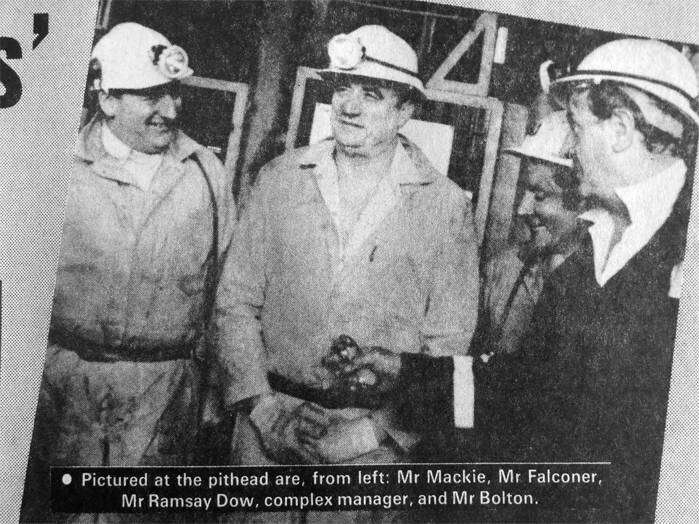
Fife's Euro MP, Mr Alex Falconer, visited Castlebridge last week when British Coal announced the new drivage record - 126.7 metres in one week. The previous British and European record, set at Castlebridge in March, was 113.15 metres.
Mr Falconer visited the new underground face accessed by the record-breaking tunnel.
Back on the surface, he congratulated the spirit and effort of the workforce who had been operating under arduous conditions.
He called for political and moral pressure to be brought to bear on the SSEB in an attempt to force them to back the Scottish mining industry and forget ideas of importing coal.
"The policy the SSEB is embarking on is folly," he maintained.
Castlebridge was nearing the end of a £56 million investment programme, the rewards of which were only just being realised.
"If this pit is allowed to develop, I have no doubt that it will be able to produce coal at world market prices," said Mr Falconer.
Mr John Mackie, British Coal Scottish Group technical manager, said it was understood 31st March was the date for a decision by the SSEB.
He commented, "This further drivage record is an indication of the spirit of co-operation existing between management and workforce at Longannet - a display of willingness to play their part to successfully cope with the pressure facing the mining industry in Scotland."
Castlebridge, along with Castlehill and Bogside, is dedicated to producing coal for Longannet Power Station. If foreign coal is brought in, the Longannet complex would have no other market for its coal.
Closure would then become a real possibility, and a major blow would be dealt to the local employment situation.
Generally speaking, Mr Mackie and Mr George Bolton, National Union of Mineworkers Scottish president, who visited the colliery along with Mr Falconer, felt the atmosphere within the pit was good, but acknowledged that there was apprehension about the future.
|
-----------------------------------------
"Dunfermline Press"
14 April, 1989
No more High Noons at coalface
The "High Noon" cowboy atmosphere between British Coal and the South of Scotland Electricity Board has disappeared, declared Secretary of State for Scotland Malcolm Rifkind during a one-day tour of Longannet mining complex and power station on Monday.
After visiting the 1300-foot deep Castlebridge shaft with British Coal's group general manager, Mr George McAlpine, Mr Rifkind said agreement between the SSEB and British Coal had still to be reached on pricing of the five-year contract to supply two million tonnes of coal to Longannet.
"There is a natural desire for British Coal to get as much as possible and for the SSEB to pay as little as possible," he said. "I am sure agreement can be reached - it took two years to get agreement on volume and duration and I would have been surprised if everything was sweetness and light now."
Mr Rifkind's visit to the two protagonists in the long-running dispute was promoted by a suggestion to him from representatives of the National Union of Mineworkers when he met the STUC three weeks ago.
The dispute over the SSEB's right to import cheaper coal from abroad to run its power stations threatened the future of deep-mined coal in Scotland.
But Lord Sutherland gave judgement in favour of British Coal at Edinburgh's Court of Session on 24th March and this was quickly followed by agreement on duration of contract - but not the price.
During his visit to the £55 million showpiece colliery, which was commissioned only two years ago, he travelled by manriding conveyor to the high-performance coalface half a mile from the shaft bottom.
This coalface in the Hirst seam holds the Scottish record for the highest output in a week from a single face - 31,228 tonnes during the week ended 27th January this year.
Meanwhile, Longannet Power Station's fight to maintain its competitive ability was outlined to Mr Rifkind when he later toured the station.
SSEB senior engineers and station staff told the Secretary of State of the major investments in efficiency, the reductions in running costs, the improved reliability of equipment and the increased flexibility of working practices which had been achieved in the drive to maintain competitiveness in the face of the reducing cost of alternative fuels to ensure a market for the station's output.
The SSEB is currently spending about £6 million a year at Longannet in schemes which are designed to improve the efficiency and competitiveness of the station.
A spokesman explained, "Thanks to improvements in operating and maintenance practices, and changes in work practices, backed by judicious investment in new equipment, Longannet Power Station is currently among the top four most efficient fossil fuel stations in the UK."
Like other major power stations it was built to burn very low-quality waste fuel which was originally inexpensive because no-one apart from electricity boards would use it.
Station staff told Mr Rifkind that the quality of the fuel had deteriorated but its cost had escalated.
"We have real difficulties burning the coal supplied from the Longannet mine," station deputy manager Allan Montgomery told the Secretary of State.
"The average quality of the coal received from BC is 10 per cent worse than the average quality delivered to English power stations and 20 per cent less than the quality of coal traded on the world market. The deep-mined coal from the Longannet mine can contain up to 30 per cent ash and 12 per cent moisture which means that only 58 per cent of it produces heat. The reducing quality of coal means that to meet the specification for full output from the boilers, better quality opencast coal has to be added by British Coal before delivery to the power station," said Mr Montgomery.
"This sweetener amounted to over 50 per cent of the coal supplied from the mine last year."
Mr Donald Miller, SSEB chairman, pointed out that despite this, Longannet Power Station had taken all the coal from the Longannet Castlebridge Mine and the tonnages agreed with BC could enable it to continue to do so in the future, subject to agreement on prices.
"The investments by SSEB in maintaining the performance of the Longannet power plant guarantees a long-term outlet for Scottish coal, but only provided it can be delivered at the right price and quality," said Mr Miller.
-----------------------------------------
"Dunfermline Press"
21 April, 1989
Pit pair lands computer prize
Dunfermline man George Rennie and William Barclay won the "Scottish Computer User of the Year" award at the Scottish Computer Show in Glasgow.
They won the award for a computer system they set up at Castlebridge Colliery to control the plant maintenance system. It covers 15,500 items and the weekly issue of 300 work introduction sheets.
It won first prize for manufacturing industry at the show. The prize is awarded for the installation which best offsets costs with savings in time, energy and money coupled with increased efficiency.
Mr Rennie is chief electrical engineer at the Longannet Complex and the architect of the submission.
Mr Barclay is his assistant in charge of maintenance and was responsible for getting the system up and running.
-----------------------------------------
"Dunfermline Press"
26 May, 1989
Pitting their skills against the best
|
While uncertainties remain about the future of the Longannet Complex, miners there can rest assured that their safety is in good hands.
For the mines rescue and first-aid teams have won national recognition for their expertise.
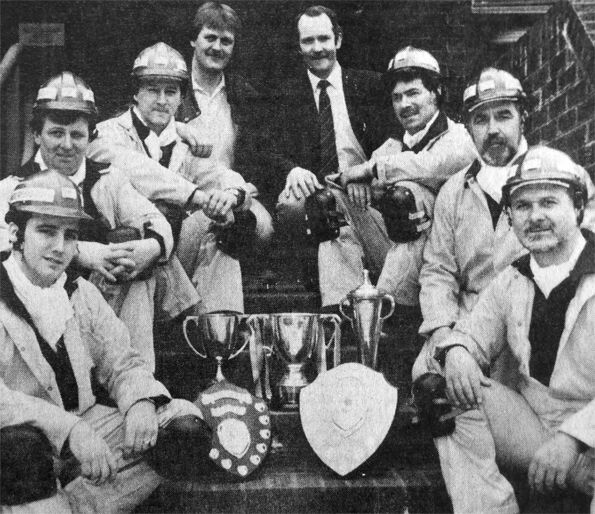
The team based at Castlebridge Colliery has won the first national mines rescue competition, held in Doncaster, against the top eight teams from around the United Kingdom.
Team captain
But as team captain Dennis Maddox explained, the final was not as difficult as the Scottish hear they had to win to qualify.
"The standard down there is not as high as up here, as we've been doing it up here for 35 years while they've only been at it for the last 10 or so."
Having not lost in the Scottish competition since 1983, the Castlebridge team nevertheless welcomed the chance to at last prove that they were the best in the UK.
Two parts
The competition was in two parts; an oral section and a mock underground explosion with several injured or dead.
Castlebridge won the oral section and came third in the practical, although Dennis Maddox won the best individual performance in that section. Rob McAulay took best number four team member in the oral section.
Team line-up
The full team line-up was: captain Dennis Maddox, from Halbeath; Nap Smith, Newmills; Jim Hunter, Cowdenbeath; Rob McAulay, Bannockburn; vice-captain Davie Keir, Sauchie; and reserve Rab McAlpine, Oakley. Their trainer was Andy Smith, Kelty.
Meanwhile, the Solsgirth Mine first-aid team, representing British Coal, won an all-industry competition in Glasgow.
The Miller Trophy was their ninth of the year so far and they are well on their way to beat their best-ever total of 11 last year.
First-aid contests
On Wednesday, Solsgirth were taking part in what is regarded as the Scottish Cup of first-aid competitions, the Presidents' Cup, organised by the St Andrew's Ambulance Association.
The team which took the Miller Trophy was captain David Hynd, Cairneyhill; John Young, Dunfermline; Ian Fox and David Walker, both Cowdenbeath; and George Egan, Lanarkshire. Their instructor was David Duncan, Saline.
-----------------------------------------
"Dunfermline Press"
6 July, 1990
Colliery's big success
Castlebridge Colliery's first Open Day, held on Sunday, was a "roaring success," according to one of the organisers.
One of the highlights of the day was the handing over of a cheque for £10,000 for the European Special Olympics "Adopt An Athlete" fund.
Mr John Doran, of the Joint Trades Union Committee at the Longannet Complex, presented the cheque to a representative from the "Adopt An Athlete" group.
"We organised and set up this fund-raising in under seven weeks," he said. "It takes £500 to adopt an athlete and cover their expenses, and at the end of the day, I think we have done well."
There will be more cash from Castlebridge for the fund once the fundraising carried out on Sunday has been added up.
Mr Doran estimated that about 3000 people came on the day, which could become an annual event. About 800 took advantage of trips underground.
Scottish Television personality Steve Hamilton drew the raffle, which had a car as prize. There were also stalls and a bouncy castle.
-----------------------------------------
"Dunfermline Press"
3 May, 1991
BEST OF BRITISH
|
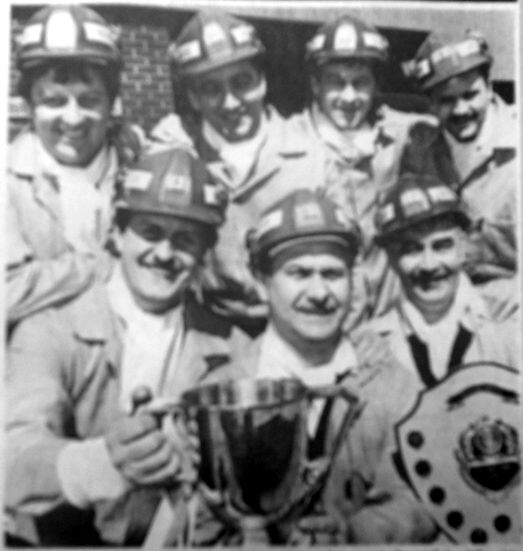
- From left: back, Robert McAuley, of Bannockburn; vice-captain David Keir, of Sauchie; Rab McAlpine, of Porterfield, Comrie; and Robert Clelland, of Sir George Bruce Road, Oakley; front, Andy Stark, of Blair Street, Kelty; captain Dennis Maddox, of Pleasance Court, Halbeath; and 'Nap' Smith, of Main Street, Newmills.
Castlebridge Colliery's miners rescue team pitted their wits against the best British teams in a national competition - and won.
The seven-man team beat around 10 other entrants in the national mines rescue competition staged in Stoke on Saturday.
The men regained the title which they first won in 1989 but lost last year.
"We are very pleased," said the safety officer at the Longannet complex, John Brown. "It's a very important competition," he explained. "Not only does it show what the men are capable of doing but it shows the competitive spirit in the teams throughout Britain."
Castlebridge got through to the national finals after winning a Scottish heat.
The competition consisted of an oral section and a simulated underground incident which involved rescuing trapped people.
Mr Brown emphasised the importance of the mines rescue brigade: "It's the life blood. If we have a major incident where people are trapped underground, the only people allowed to go there are the brigade."
-----------------------------------------
"Dunfermline Press"
13 March, 1992
Well done, men!
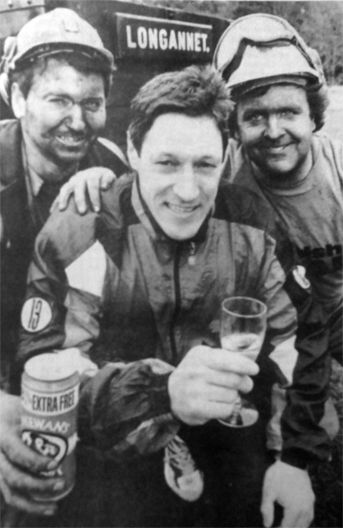
Record-breaking miners at Castlebridge Colliery have been toasted by Scotland's fastest athlete - Alan Wells. Wells joined miners at the Fife pit on Wednesday to celebrate the production of their quickest-ever two million tonnes.
|
- CHEERS: Alan Wells with Castlebridge miners Geordie Seath and Tam Smith
The flying Scot, who took gold with a 100-metre 10.11 second run in the 1980 Moscow Olympics, met the high-speed miners who broke their own record last year by 10 days with three weeks of the financial year to spare.
Productivity is running at an all-time high of 5.62 tonnes per man, and the 1300 workforce has brought on stream a new £3.5m coal face. This will add around 45,000 tonnes of high quality coal a week.
Mining teams are also driving twin tunnels through a major underground fault to reach 25 million tonnes of reserves. It is expected they will begin to be exploited in three years time and last about a decade.
Castlebridge manager, Ramsay Dow, added that as mining continues westwards there is a further 100 million tonnes of coal to exploit.
Mr Dow said they faced competition from the gas-powered Peterhead Power Station, which comes on stream at the end of this year, plus coal imports from Australia, South Africa, America and Columbia.
He added, "If we can keep our prices right we can compete on equal terms."
The pit took on six apprentices last year, the first intake since 1984, and Mr Dow hopes that if the mine continues their production achievements more apprentices will be taken on.
-----------------------------------------
"Dunfermline Press"
28 August, 1992
Thousands flock to open mines
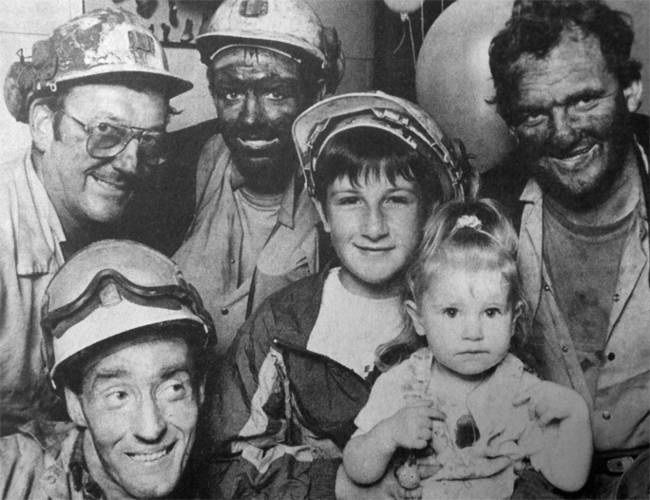
|
- Angels and dirty faces - 18-month-old Ashley Gavin with sister Elizabeth (12), from Ballingry, meet face workers at Castlebridge Colliery's open day.
The gates of the pit-head cage at Castlebridge Colliery were thrown open for the public on Saturday.
One thousand people ventured underground at the last deep-mine complex in Scotland, whilst a total of 4000 visited the colliery on its annual open day.
Fund-raising events - including raffles and tombolas - brought in over £2000 for a vast range of charities.
A spokesman for British Coal told the Press, "The open day was a major success with a giant number of visitors."
The opencast site at Lambhill, near Blairingone, was also opened for the day and 3000 people visited.
At Castlebridge, there was a display by Mines Rescue crews and information on how mines in Scotland are facing up to economic and environmental change.
For the youngsters, Thomas the Tank Engine got up a head of steam and there was a bouncy inflatable.
Ron Parker, chairman of the joint trade union committee which organises events at Longannet, said all the stops had been pulled out to make the day a success.
-----------------------------------------
"Dunfermline Press"
15 January, 1993
Lady of the lamp
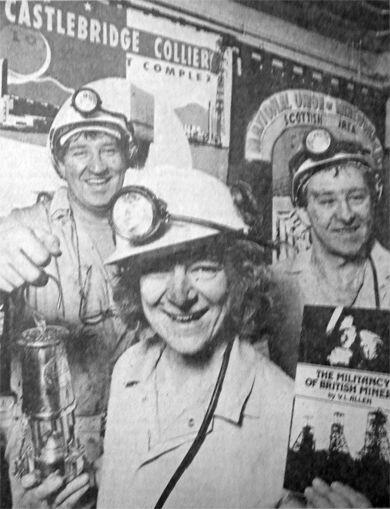
|
Dunfermline West MP Rachel Squire has gone underground - but Labour leader John Smith has nothing to worry about.
Last week Rachel made her third trip to Castlebridge Colliery and spent around two hours being shown around by guides Pat Rattray (left) and Willie Doolan, 510 metres below the surface.
She left a bottle of the House of Commons' Speaker's Malt Whisky and National Union of Mineworkers' officials presented her with a book, "The Militancy of British Miners" by V. L. Allen.
Later, Rachel, who also went on to visit Solsgirth, said, "My respect for miners increases every time I visit the collieries and see what is involved in their work."
Pat was one of the miners who was on the London march for jobs, and he commented, "The first 10 days were the worst."
Speaking of his memories of the march, he said, "At Sheffield the police stopped the whole city for us. That was one of the great welcomes, and in London, it was just like winning the World Cup, because we were driven around in an open-top bus."
-----------------------------------------
"Dunfermline Press"
2 August, 1996
Pledge to 670 on pit payroll
The jobs of 670 Longannet miners will not be affected by a decision to shut down one of two production faces at Castlebridge Colliery.
The assurance follows news that Mining Scotland is to shut the A1 face at Castlebridge - which accounts for around half of the Longannet complex's two million tonnes a year output - as a result of flooding and geological problems.
Switch
But 90 employees of outside contractors will be affected as a result of the move, it was confirmed on Wednesday.
Miners from the A1 face are being switched to the other productive face, S86, and to development work on three new retreat faces.
Meanwhile, plans are still on course for a £16 million capital investment to develop Longannet's Kincardine reserves by the end of the century, when numbers needed underground will fall to 450.
However, the company hopes jobs will be created at its proposed opencast development at Greenbank, north of Dunfermline.
-----------------------------------------
"Dunfermline Press"
8 November, 1996
Pit claims fan row over opencast
Scottish Coal has pledged its commitment to the future of Longannet as it rubbished rumours that Castlebridge Colliery was to be sold.
Mining Scotland, which trades as Scottish Coal, this week emphatically denied claims that board members wanted to offload the loss-making pit.
Unions said that when three new coal faces came on stream Longannet, which employs 670 people, would be in the strongest position it ever had been.
And director Willie McLucas said, "Longannet is an important part of the Scottish Coal Company. I am keen to see the new Kincardine reserves developed and that will call for profits from opencast operations to be invested in its future."
But protestors against opencast plans for Greenbank, near Kelty, have claimed that the newspaper reports vindicated their own claims.
West Fife Environmental Defence's Alistair Harper said it came as little surprise to hear allegations that Scottish Coal was in difficulties.
"If Greenbank is given planning permission, Scottish Coal will drop Longannet like a hot potato, with all the job misery that goes with it," he claimed.
He said deep-mining jobs and environmental concerns were now on the same side. …
-----------------------------------------
"Dunfermline Press"
14 February, 1997
Pitmen's new plea
Miners' union boss Peter Neilson has urged Scottish Coal to submit a fresh Greenbank opencast application - without blasting - in a bid to safeguard the future of Longannet Deep Mine.
The call came on Friday during Dunfermline West MP Rachel Squire's annual visit to Castlebridge Colliery where she labelled Fife Council's West Area development committee's decision last week to knock back the proposal as "regrettable."
Mr Neilson, vice-president of the NUM (Scotland), accused the council of "bending over backwards" to back Hyundai.
He said, "A serious question mark now exists over the long-term future of Longannet and 800 miners' jobs as without the sweetener coal from Greenbank, we would not be able to develop the Kincardine reserves and the complex's lifespan would only be around three more years.
"The importance of Greenbank cannot be over-estimated as it would mean production could continue at Longannet until 2025; we would support any new planning application, without blasting, by Scottish Coal. …

|
Dunfermline West MP Rachel Squire (centre), Fife councillors Helen Law and Alan Kenney, Clackmannan MP Martin O'Neill (rear, second left) and Scottish Labour Whip Eric Clarke MP (rear, far right) pose for the cameras following their tour on Friday of a new coal face at Castlebridge Colliery.
-----------------------------------------
"Dunfermline Press"
9 October, 1998
Today (Friday) Scottish Secretary Donald Dewar is set to unveil a plaque at Castlebridge to mark the completion of development work in reaching the new seam under the Forth. Mr Dewar is also expected to strike the first piece of coal from the reserves.
-----------------------------------------
"Dunfermline Press"
29 October, 1999
End of an era at exhausted coal face
Full production is due to begin in December at the coal-rich Kincardine Reserves beneath the Forth - signalling the end of an era at Longannet deep mine.
The final coal face at the old workings at Castlebridge is now being worked on and is expected to be exhausted by the end of the year.
A section of the 600-strong workforce has already switched to the new reserves - which are instead reached from the Longannet access close to the power station.
National Union of Mineworkers (Scotland) president Nicky Wilson said, "The end of many years of production will be quite poignant, but the move is vital to secure the miners' future for another 20 years. Eventually, everybody will move to Kincardine. The new face there is due to start production in a few weeks and new roadways are being driven to open a second face. At Castlebridge, the last face should be finished by the Christmas holidays, but work will still continue into next year. There will be a salvage operation and they'll have to look at ways of controlling the water level."
Most of the miners moved to Castlebridge around 1986 from other parts of the complex such as Solsgirth and Castlehill, he said.
Owners Scottish Coal have spent over £20 million opening up the new faces at Scotland's last deep mine.
A spokesman said they were carrying out a complete refurbishment at the Longannet pithead, as well as installing new machinery to transport coal and the miners.
Scottish Coal has permission to mine around half of the 40 million tonnes which are lying a mile below the Forth.
It decided a year ago to defer its planning bid to win the remainder after fears were raised that the protected mudflats area on the west bank of the river - an important bird-feeding ground - might suffer subsidence.
The spokesman revealed to the Press that a revised planning application would soon be submitted to Falkirk Council.
-----------------------------------------
"Dunfermline Press"
5 November, 1999
Pit-head property to go on sale
Scottish Coal is putting property surrounding its Castlebridge pit-head up for sale.
Production at Castlebridge is due to be exhausted by the end of the year, with the 600 workers at Longannet deep mine switching to the new reserves beneath the Forth and to a new pit-head close to the power station.
A Scottish Coal spokesman said, "The majority of buildings at Castlebridge will be surplus to our requirements and we intend to sell these as a complete package."
However, the spokesman refused to comment on public statements from union officials that Castlebridge would make an ideal industrial estate or business park.
Buildings at the new pit-head are being upgraded and new facilities such as shower blocks are to be built.
-----------------------------------------
"Dunfermline Press"
15 December, 2000
Coal Company on the move
Scottish Coal has announced it is to relocate its headquarters to Castlebridge.
Around 50 employees are being transferred to the complex from the company's former base in Livingston.
The announcement yesterday (Wednesday) coincided with confirmation of a £17.5 million European cash boost to safeguard the future of Longannet Mine and 450 jobs.
Scottish Coal's move to Castlebridge will bring employees to the same site as colleagues from sister company Scottish Coal (Deep Mine) Ltd, who operate Longannet deep mine. …
-----------------------------------------
"Dunfermline Press"
22 December, 2000
Coal firm considers leisure facilities at pit HQ
Castlebridge could benefit from new leisure facilities following Scottish Coal's decision to relocate its headquarters to the area.
Announcing the opening of the new base, Castlebridge project manager Jim Duffy said the company had major expansion plans which would have spin-offs for the local community.
Scottish Coal has transferred 50 employees from its former headquarters at Livingston to Castlebridge. …
-----------------------------------------
Featured in "The Scotsman" May 2001
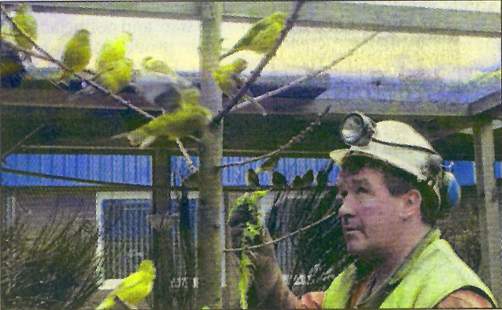
Pits canaries reprieved
CANARIES once used by workers at a Scots coal mine to
detect deadly carbon monoxide underground have been saved
despite the pit's closure.
The birds have been taken to a temporary rooftop aviary at
the Scottish Coal headquarters in Clackmannanshire, following
the closure of the nearby Castlebridge mine.
Miner Alex Park has lovingly cared for the life-saving
canaries for six years. The birds were used by the Scottish
Mines Rescue Service to detect carbon monoxide, but have been
replaced by gas detection equipment.
|
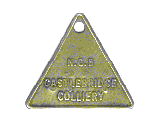
One of the checks (tallys) for the pit.
-----------------------------------------
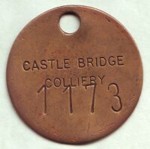
Check No. 1173 was used by David Carmichael, Oakley, during his time at Castlebridge Colliery.
-----------------------------------------
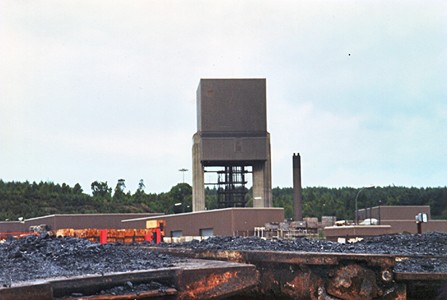
Castlebridge Colliery Remembered.
The late Andy Hunter's photographic memories.
In August 2011, Andy Hunter, Kirkcaldy, kindly gave the website
permission to display some of the photographs he had taken during a
visit to the Castlebridge site ahead of the colliery closing. We are delighted
to display these below.
M. Martin & Webmasters.
 |
 |
 |
|
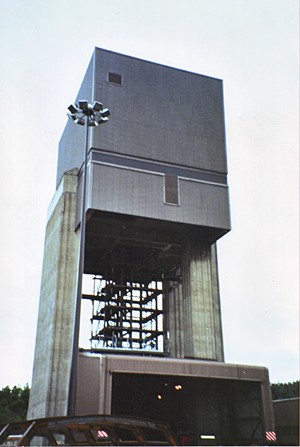
The tower which contains the G.E.C. winder. |
This was the last winding tower to be erected in Scotland. Notice the absence of windows. |
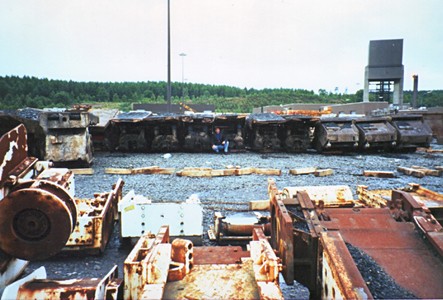
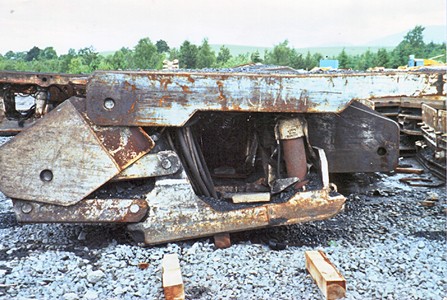
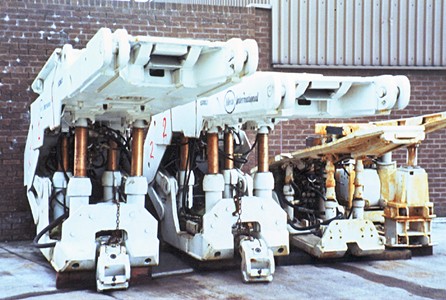
Faceline and other assorted equipment from below ground. |
 |
 |
 |
 |
|
Hydraulic roof supports for an advancing faceline. These are waiting to be serviced. |
Brand new self-advancing hydraulic roof supports waiting to go underground. |
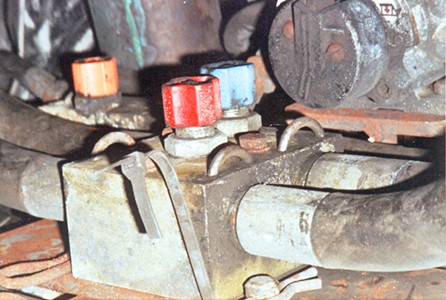
Hydraulic Control Valves, on faceline props, lying in the stock yard. |
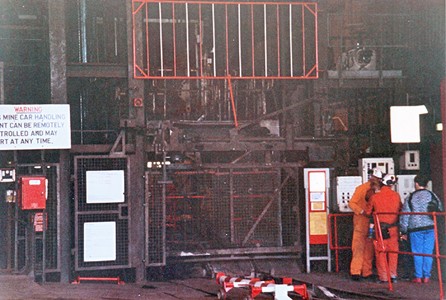
Cage loading area. Also known as the Red Zone, where the miners were checked for contraband. |
It is with much sadness that we announce the passing
of Andy, in June 2013, following a bout of face/mouth cancer.
Andy had been a science pupil of webmaster, Chris Sparling,
around 1972/73, at Kirkcaldy High School (Templehall Building).
Andy, who had long hair then - as did twin brother, Tam - was
ideal to be 'charged up' by the Van der Graaf
Generator. When Chris and Andy met up in Kirkcaldy, after 39 years,
Andy was quick to recall that he was unfortunate to have been the
one at the end of the line of pupils, and to have received the biggest
electric shock when the built-up charge was sent to earth via the
gas tap! You are greatly missed, dear friend.
M. Martin &
Webmasters.
-----------------------------------------
|
See also Longannet Mine (Longannet complex) entry |
|---|
