Owners: Oakley Coal Company
Fife Coal Co. Ltd.,
Leven.
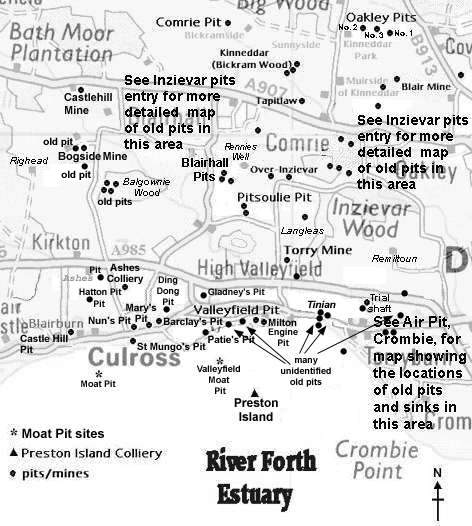
The Blair Mine lay between Oakley and Comrie on the north side of the A907 and just south of the Oakley/Kinneddar Colliery. When the Geological Survey of 1930 was produced, it was stated that the Kinneddar Pits and Blair Mine of the Oakley Coal Co., subsequently owned by the Fife Coal Co. Ltd., was the only working colliery in the ironstone and coalfield of the now vanished Forth Iron Works.
Kinneddar Colliery (19th century report)
| Name of coal | Thickness | Quality | Class |
|---|---|---|---|
| Five-Foot Coal | 3 ft. | Very good | Steam |
| Kinneddar Splint Coal | 3 ft. 6 in. | Fair | Household |
| Mine opened: not known | Mine closed: 1930s (?) |
|---|
| Source Date of Information Supplied |
|---|
| Manager / Under-Manager / Men underground / Men above ground / Coal seams worked |
| 1920 (Oakley Collieries Ltd.) |
| ------------ / --------- --- / 14 / 7 |
| 1928 (Fife Coal Co. Ltd.) |
| William Shepherd / --------- --- / 89 / 33 |
| Anthracite. Dunfermline Splint and Fife Feet. |
-------------------------------------
Information on coals worked at, or near, Blair Mine
(based on reports from 1930-34)
The structure of the Oakley-Kinneddar coalfield is comparatively simple. The rocks dip fairly uniformly to the north-west, but at Blair and Oakley, in the south-east of the district, are flatter and undulating. Numerous faults intersect the field but, apart from the two large boundary faults on the north and south, these do not appear to persist for any distance.
Eight significant coals were present within a depth of 236 fathoms in the Oakley-Kinneddar district, namely:- Oakley Main Coal, Ontake or Sour Milk Coal, Comrie Three Foot Coal, Kinneddar Splint Coal, Fife Foot Coal, Two Foot Coal, Dunfermline Splint Coal and Stink or Sulphur Coal.
The Dunfermline Splint lay 20 fathoms above the Sulphur or Stink Coal, which was not wrought in this district, and had an average thickness of 2½ ft. The following is the section from the workings in Blair Mine, Kinneddar:-
| Blaes | - |
| Faky blaes | 3 in. |
| COAL | 2 ft. |
| Blaes | 2 in. |
| Sandstone | - |
The coal was wrought as an anthracite.
The whinstone intruding into this seam was responsible for
this quality of coal and also for cutting out this seam, and
others of the Dunfermline Group, to the north-west in the
neighbourhood of Sunnyside and Kinneddar.
The Dunfermline Splint was not wrought to any extent
elsewhere in the district, probably on account of uncertainty
regarding its extent and quality due to intrusive whinstones and
faulting.
The Two Foot Coal, lying 8 fathoms above the
Dunfermline Splint, also does not appear to have been worked here.
The Five Foot Coal was also wrought as an anthracite at Blair Mine where a section is recorded as:-
| Blaes | - |
| COAL | 2 ft. |
| Fakes | 2 in. |
| COAL | 11 in. |
| Stone | ½ in. |
| COAL | 1 ft. 3 in. |
| Fakes and sandstone | - |
The seam was usually found in several leaves, and was 13 to 14 fathoms above the Dunfermline Splint.
An anthracitic coal which was probably the Five Foot was worked around 1863-64 in a small colliery three quarters of a mile north of Carnock. An old bore on Carnock Moor records this seam as the "Five Foot Stone Coal of Bonhard" and once again notes that the intrusive whinstone had spoiled the coal in many parts of the district.
Around Kinneddar and Blair, the coal sequence is not completely known as a number of whinstones are met with here, and faulting renders the interpretation of the available bore journals a matter of great difficulty. Many coals are recorded among these beds but they are inconstant and generally thin. One seam, which locally reaches 2 ft., can be recognised with fair certainty as the representative of the Torry Four Foot Coal; equivalents of the Mynheer and Glassee seams can sometimes be recognised.
The Kinneddar Splint or Comrie Lower Four Foot Coal is the most constant horizon of the Main Group and is readily recognisable throughout the district. The seam has also been wrought in the vicinity of Comrie, Oakley, and Blair as the Comrie Lower Four Foot. Also known as the Comrie Splint, Oakley Splint, and Comrie Main, this coal can be identified with the Lochgelly Splint and Parrot seam.
The next coal is an important seam known as the Comrie Six Foot or Kinneddar Five Foot and occasionally as the Oakley Five Foot. It lies 9 to 15 fathoms above the Kinneddar Splint and probably represents the Lower Jersey. In the west of the district it is usually a thick seam, up to 6½ ft. with one or more partings, but in the Kinneddar area occurs in two leaves separated by a fathom or more of sandstone. It is a good steam coal, and at one time was wrought as the Comrie Six Foot at Comrie, Oakley, and Blair.
At the old collieries of Comrie and Blair the Kinneddar or Comrie or Oakley Three Foot Coal is reported to have been 6 ft. in thickness with a stone rib 2½ ft. from the top. This seam has frequently been correlated with the Kelty Main Coal. Notwithstanding its occasional wide separation from the Six Foot, however, it is more probable that it represents the Upper Jersey.
---------------------------------------------------

"Dunfermline Press"
13 March, 1926
Under the Fatal Accidents Inquiry Act, an inquiry was held in the
Sheriff Court, Dunfermline, on Thursday - before Sheriff Umpherston and
a Jury - into the circumstances attending the death of Walter Robertson,
miner, lately residing at 72 Baldridgeburn Street, Dunfermline, who died
on 19th February at his home, from septicaemia, the result of injury to his
left hand, received when at work on 6 February, 1926, in Blair Mine,
Carnock, Fife Coal Company, Ltd.
Those giving evidence included:- Dr Duff; William Steedman, miner,
60 Baldridgeburn; and Helen Robertson, 26 Chalmers Street, a daughter
of deceased. The jury returned a formal verdict.
---------------------------------------------------
