Owners: NCB
Scottish Coal
Bogside Mine, opened in 1959, supplied coal from the Upper
Hirst seam to fire the Kincardine Power Station. In the 1960s
its miners were regular holders of several national
production records e.g. over 3000 tons per day!
Work on the underground belt-conveyor system to feed the
coal-fired power station at Longannet (east of Kincardine)
commenced in 1964 and relied on the newly created Bogside
drift mine and several other ventures to access the conveyor.
Bogside Mine closed in 1985.
|
See also Longannet Mine (Longannet complex) entry |
|---|

|
 |
 |
 |
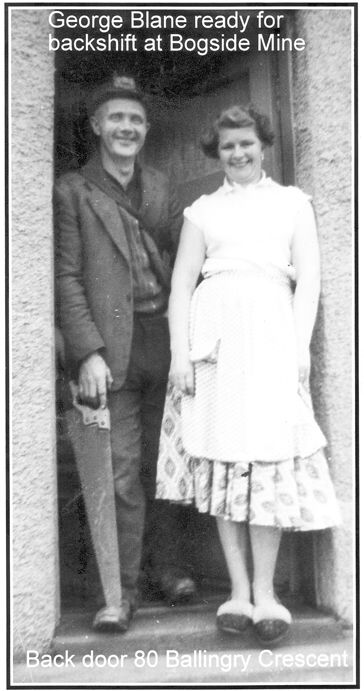 |
George Blane, Ballingry, ready for the backshift at Bogside Mine.
Photo kindly supplied by his son, David Blane, Ballingry.
| Mine opened: 1959 | Mine closed: 1985 |
|---|---|
| Source Date of Information Supplied | |
| Manager / Under-Manager / Men underground / Men above ground / Coal Seams worked | |
| 1961 (NCB) | |
| William Chalmers / A. Gibson / 232 / 41 / Steam coal. Hirst. | |
| 1964 (NCB) | |
| W. Chalmers / A. Gibson : K. Hess / 383 / 59 / Steam coal. Hirst. | |
| 1971 (Scottish Coal) | |
| W. Chalmers / H. Reston : W. Kennedy / 645 / 114 / Steam coal. Hirst. | |
| 1973 & 1974 (Scottish Coal) | |
| W. Chalmers / H. Reston : W. Kennedy / 720 / 89 / Steam coal. Hirst. | |
| 1977 (Scottish Coal) | |
| T. Rae
(Agent/Manager) : H. Reston (Deputy
Manager) : D. Seath ; W. Kennedy
(Undermanagers)
J. A. McLean (Mechanical Engineer) : J. Gray (Electrical Engineer) / 726 / 80 / Steam coal. Hirst. |
|
| 1978 (Scottish Coal) | |
| T. Rae
(Agent/Manager) : H. Reston (Deputy
Manager) : D. Seath (Undermanager)
J. A. McLean (Mechanical Engineer) : J. Gray (Electrical Engineer) / 726 / 80 / Steam coal. Hirst. |
|
| 1979/80/81/82 (Scottish Coal) | |
| T. Rae
(Agent/Manager) : H. Reston (Deputy
Manager) : D. Seath ; D. P. Rodger
(Undermanagers)
J. C. Malcolm (Mechanical Engineer) : J. Gray (Electrical Engineer) / 726 / 80 / Steam coal. Hirst. |
|
| 1984 (Scottish Coal) | |
| W. Miller
(Agent/Manager) : E. Bone (Deputy Manager)
: M. Williams ; D. P. Rodger (Undermanagers)
J. C. Malcolm (Mechanical Engineer) : J. Gray (Electrical Engineer) / 726 / 80 / Steam coal. Hirst. |
|
| 1987 (Scottish Coal) | |
| Vacant
(Agent/Manager) : Vacant (Deputy Manager) :
Vacant (Undermanagers)
Vacant (Mechanical Engineer) : J. Gray (Electrical Engineer) / 726 / 80 / Steam coal. Hirst. |
|
--------------------------------------------------------------
"Dunfermline Press"
16 November, 1957
New Collieries to Feed Power Station
Two new drift mines, each producing an estimated 1000 tons of coal a day, and each
employing about 325 men, are to be opened to supply coal for the new giant power station
at Kincardine, which, if it was working now, would be the biggest under one roof in Europe.
The drift mines - "Bogside," near Balgownie Mains Farm, which lies between Culross
and Kincardine, and "Dollar," on the outskirts of Dollar - will supply a low grade
coal especially suitable for the electrical industry.
A National Coal Board official told a Dunfermline Press representative: "Both collieries
will be completely new. They are being opened substantially for the purpose of supplying the power
station. Coal will be produced from Bogside by the middle of next year and the output will gradually
increase. Dollar will be going into production about the end of 1958. Naturally with these production
dates, preparation work is well advanced."
The new power station - while it will contribute its output to the national grid - is the main part of the
Fife Area of the South of Scotland Electricity Board's future development. Kincardine was chosen,
because it is on top of a coal belt and no transport problem will arise, because of the wonderful site
of flat ground, and because cooling water can be taken easily from the Forth. Fife Area is responsible
for the construction and the station manning force will be housed in the county.
The power station will have as a maximum output 760,000 kilowatts by 1963. This is equivalent to
about 800,000 horse power or 760,000 one kilowatt fires all burning at the same time. Even the
new atomic station at Hunterston, Ayrshire, will only have an output of 300,000 kilowatts when it is
completed.
Five Sets of Generators
Mr H. Walton, chief engineer of the Fife Area of the Board, told a Dunfermline Press
representative: "The new station will be powered by five generating sets which will be installed
one at a time. It is hoped the first will be ready for operation in about a year. The second set is expected
to go into operation in about two years. These two generators, with an output of 240,000 kilowatts,
are approximately equivalent to the biggest power station in Scotland. Even the first 120,000 kilowatt
set would supply enough power for the whole of Fife. We are expecting a load of about 100,000 kilowatts
will be required for the whole of Fife during this winter.
"Electricity is being used to bring the coal out of the ground and that coal will be used to make
electricity. Eight sub-stations have been specially built to supply power for the site workings at Balgownie.
A large sub-station will supply power to the mine."
The electrification of collieries in the county is another part of future development. "All the collieries
which have any length of life are being very quickly electrified," said Mr Walton. In many cases
we are being asked to supply the electricity. The Coal Board will not generate it themselves. At the
new colliery of Seafield, outside Kirkcaldy, for example, 4000 kilowatts are required which will ultimately rise
to 9000 kw. When Seafield makes a maximum demand of 9000 kw, it will be using about the same
amount of electricity as a town roughly the size of Dunfermline."
But Seafield is only one of the collieries. Others included in the Electricity Authority's scheme are
Michael, Valleyfield, Blairhall, Wellesley, and Bowhill Collieries.
Mr Walton concluded: "In the next few years, the N.C.B. in Fife will require a maximum of 50,000
kilowatts, which is half the estimated load required for all of Fife this winter."
--------------------------------------------------------------
"Dunfermline Press"
3 February, 1962
Output Of Coal Has Increased
A report for 1961 on the Alloa Area of the National Coal Board, points out that,
taking into account the merger of the Valleyfield Group into the Alloa Area, coal
output during 1961 totalled 2.35 million tons, an increase of 120,000 tons compared
with 1960. Productivity at 24.2 cwts per manshift showed a marked increase compared
with the 1960 average of 22.2 cwts; largely due to a further increase in power loading.
On 1st January 1961, as part of the reorganisation of Areas in the Scottish Division by
which the number of Areas was reduced from eight to seven, the Valleyfield Group of
pits consisting of Blairhall, Comrie, Valleyfield and Torry Mine was transferred from the
former West Fife Area to Alloa Area, bringing the number of operating collieries in the
Alloa Area up to 15. Subsequently, the closure of Brucefield Colliery in April and
Harviestoun Mine in August reduced the number of operating collieries to 13.
During the second half of 1961, the report continues, the additional power-loading
facilities that had been made available were reflected by steadily improving productivity
figures, and towards the end of the year the average weekly productivity figure for the
Alloa Area was 31.9 cwts per manshift worked overall. This encouraging trend was in
part attributable to the record high rates of productivity achieved at Dollar and Bogside
Mines, where outputs of as much as 90 cwts per manshift worked overall were secured.
The Area's end year output per manshift of 31.9 cwts is the highest in the Scottish
Division and above the national average for Britain.
Average daily output rose from 9000 tons per day in the early months of the year to
nearly 12,000 tons per day in December. Of this total 5000 tons per day was produced
from the Hirst Seam for supply to the Kincardine Electricity Generating Station.
Two collieries were closed during the year, Brucefield Colliery in April and Harviestoun
at the end of August. The manpower released from these closures was redeployed
mainly at Bogside, Dollar and Manor Powis. ...
... The drive for concentration on production of coal by power-loading methods continued.
During the year 60 per cent of the total output was produced by these methods,
representing a substantial improvement over the previous year. Blairhall, Bogside,
Dollar, Bannockburn, Polmaise 3/4, and Plean Colliery are now all fully mechanised.
Treble shift working has been introduced in Dollar Mine and, as a result, output
reached as high as 1700 tons per day from a single face in December. This method
of working will be extended to other suitable pits during this year. A further development
in methods of working has been the introduction of self-advancing hydraulically-operated
roof supports at Blairhall, Bogside, Bannockburn, and Manor Powis Collieries.
Major projects during the year included:-
... Bogside - Powered supports were introduced in January 1961, but at the same time
difficult geological conditions were encountered. These conditions improved in June
with a resulting improvement in productivity which was maintained until the end of the year.
During that period output per manshift frequently exceeded 80 cwts. ...
--------------------------------------------------------------

"Dunfermline Press"
29 February, 1964
Died At Pit
An Alloa man, Alexander Russell (57), colliery brusher, 19 Pitfarin Circle, collapsed and died suddenly in the colliery baths, Bogside Mine, near Blairhall, early on Tuesday morning.
--------------------------------------------------------------
"Dunfermline Press"
5 September, 1964
Output Record For Bogside Mine
A new coal output record for Bogside Mine is a feature of the statistics for collieries in the Alloa Area of the National Coal Board for the week ended 29th August. The new record of 7557 tons of saleable coal compares with a previous best for the mine of 7527 tons. …
--------------------------------------------------------------
"Dunfermline Press"
19 September, 1964
Mine Fatality
An Alloa man died in an accident at Bogside Mine, Culross, yesterday at lunchtime. He was Charles Ferguson (45), oncost worker, 21 South Croft. Working underground, he was apparently struck by a mine car and fatally injured.
--------------------------------------------------------------
"Dunfermline Press"
13 March, 1965
Record Output At Bogside
By a process of coal-winning which enhances the safety of miners, a
new weekly and daily record in coal production for Britain was set up at Bogside
Mine last week. During the week the miners of this West Fife pit sent up 12,188
tons of coal from one 655-foot long face. Last Thursday, the same coal-face
produced 2648 tons, which is also thought to be a British record for a single
coal face for a day. ...
A mechanical shearer which cuts into the face both in the outward and return
journey, has enabled the men of Bogside to set up these two new records for
Britain. The great majority of other mechanical aids in the mines cut only one way.
The first attempt at two-way cutting at Bogside failed. Righead No. 1 encountered
geological difficulties and was abandoned.
A new start was made with Righead No. 2 on 15th February, and it has produced
remarkable results.
Last week's production gave an average of 19 tons a man-shift from this one
coal face and 5 tons 8 cwt. from the whole mine, which employs 450 men.
The Scottish average is 31 cwt. a man-shift.
Mr William Rowell, Alloa Area general manager, said on Saturday that very
considerable enthusiasm must have been displayed by all concerned to achieve
this record, which was well above the design capacity of the mine.
Mr William McDougall, pit delegate, explained that the type of shearing machinery
used at Bogside took away the necessity of the men having actual contact with
the coal face, and was one of the greatest safety measures ever introduced in
Scottish mining.
All the coal produced at Bogside goes to Kincardine Power Station.
--------------------------------------------------------------
"Dunfermline Press"
27 March, 1965
Record Outputs At Collieries
Last week the Alloa Area of the Scottish Division of the N.C.B. produced a total
output of 71,475 tons of coal at an overall output-per-man-shift of 44.6 cwts. These
are both new records for Alloa Area. Alloa's previous best weekly output was
68,024 tons, obtained in February 1964.
The O.M.S. overall - the yardstick of productivity - at 44.6 cwts was the highest ever
recorded by any Area in Scottish Division, and is 2.5 cwts better than Alloa's
previous best (42.1 cwts in the week ended 5th March 1965).
Bogside Mine, also in the Alloa Area, again established a fresh new record output
last week of 13,136 tons of coal, the previous best weekly output from Bogside Mine
being 12,554 tons for the week ended 5th March 1965.
Last week's output was achieved at an overall o.m.s. of 108 cwts in the week
ended 5th March 1965 by no less than 4.3 cwts. This is a new record o.m.s. overall
for any Scottish pit or mine. It is also a new British record.
The new integrated mining unit, Valleyfield-Kinneil at Bo'ness (in the Alloa Area)
has again surpassed all previous performances at this colliery by producing last week
15,010 tons of coal at the substantially improved o.m.s. (overall) of 35.3 cwts. These
are the best figures so far attained by this unit. The output and o.m.s. both exceeded
all previous by Valleyfield-Kinneil. …
--------------------------------------------------------------
"Dunfermline Press"
10 July, 1965
Craftsmen's Strike At Collieries
A strike of nearly 400 craftsmen has put over 2500 miners out of work at collieries within the Alloa Group of the National Coal Board this week. The stoppage, which is unofficial, has stopped production in four pits - Bogside, Comrie, Valleyfield and Kinneil, although the output in the others within the Group is not so far affected. …
--------------------------------------------------------------
"Dunfermline Press"
21 May, 1966
Fatal Accident
A 41-year-old Hill of Beath man, James Alexander, died in an underground
accident at Bogside Mine, near Culross, on Sunday afternoon.
Mr Alexander, a switch gear operator, 50 Allan Park, was working in the Righead
district of the mine. He was helping to move an A.F.C. gearing motor when it
slipped forward and crushed him against a roof support. He died before he reached
the surface of the mine. The dead man was married and had three daughters
aged three, seven and 15.
-----------------------------
"Dunfermline Press"
9 July, 1966
Miner Was Crushed To Death In Pit
A formal verdict was returned at Dunfermline Sheriff Court on Monday at
a fatal accident inquiry into the death of 41-year-old Hill of Beath miner, James
Alexander, 50 Allan Park. Mr Alexander died shortly after being crushed between
a "pick-a-back" conveyor motor and a hydraulic roof prop in the
underground workings of Bogside Mine on 15th May.
A jury, who heard the evidence, was told that Alexander died as a result of
shock, due to severe crush injury to the chest and abdomen.
Those giving evidence included:- Donald E. Ryan (47), deputy, 12 Benview
Terrace, Edinburgh; Thomas Robertson Thompson (43), 108 Droverhall Avenue,
Crossgates; and Francis Fullarton, surface worker, 75 Delphwood Crescent, Tullibody.
--------------------------------------------------------------
"Dunfermline Press"
18 February, 1967
Teenage Surface Worker Killed.
A 15-year-old surface worker died last Friday in an accident at Bogside
Colliery, near Dunfermline, after being drawn into a conveyor belt and strangled
by his own clothing.
John Borkowski, 47 Ladywell Drive, Tullibody, the son of a coal miner, was
trapped between a redd conveyor belt and roller "sometime between 11.30
am and 10.30 pm." He was found at 10.30, trapped by the arms, with his
clothing tight around his neck, and it is presumed that he was drawn into the
conveyor belt while clearing spillage from beneath it.
A death certificate was subsequently issued, showing the cause of death to be "a
sphyxia (accidental strangulation) and multiple injuries."
A probe into the circumstances of the accident was later carried out by H. M. Inspector
of Mines and Quarries.
------------------------------
"Dunfermline Press"
27 May, 1967
Supervision Of Trainee Miners Probed
The supervision of trainee miners came under examination at a fatal accident inquiry at
Dunfermline Sheriff Court last week when a jury returned a formal verdict after hearing evidence
concerning the death of a 15-year-old youth at Bogside Mine, near Culross. The youth who had
only worked at the mine a fortnight, was trapped between a roller and a conveyor belt and his
body lay undiscovered for nearly 10 hours. ...
The jury found that John Borkowski died on 10th February at Bogside Mine from 1(a) asphyxia
(accidental strangulation) and (b) multiple injuries sustained in the course of his industrial occupation
as a pithead worker in the employment of the National Coal Board when he was caught between a
conveyor and a roller.
Those giving evidence included: Bronsilaw Borkowski, father of deceased; Dr Peter Jago, Sauchie;
Andrew J. Yates (59), surface worker, 92 Queen Street, Alva; Alexander Rae (50), bricklayer, 77
Livingston Crescent, Falkirk; Alexander Dick (56), surface foreman, 19 Elphinstone Crescent, Airth;
Robert Mitchell (59), surface foreman, 14 Zetland Street, Clackmannan; and William Chalmers (49),
mine manager, 7 Main Street, Clackmannan.
--------------------------------------------------------------
"Dunfermline Press"
5 August, 1967
MINE FATALITY
James Yeardley (59), oncost worker, 16 Touchhill Crescent, Plean, Stirlingshire, died after being hit by a mine car at Bogside Colliery on Thursday afternoon. He was severely injured on the legs and lower abdomen and was found to be dead when brought to the surface. The accident happened in No. 3 mine, where Mr Yeardley was working by himself at the time.
--------------------------------------------------------------
"Dunfermline Press"
26 August, 1967
New Reserves Of House Coal At Comrie
... The order has been placed for the conveyor - one of the world's longest -
to be used in the mining complex which will feed the furnaces of the multi-million
pound electricity generating station which is rising on the banks of the Forth at
Longannet. About 10,000 tons of coal a day will be carried along the five-and-a-half
miles of belting direct from the mines to the new power station which, when fully
operational, will have a generating capacity of more than three times that of its
Kincardine counterpart.
There are just two years to go before the first part of the five-mines-in-one Longannet
project comes into operation. Five mines will be joined by the tunnel housing the
conveyor. Bogside No. 3 mine and the new mine at Castlehill should supply coal
via Longannet mine to the power station in April 1969, followed by Solsgirth and the
Dollar area some 12 months later.
--------------------------------------------------------------
"Dunfermline Press"
6 April, 1968
WILL MINERS GO BACK TO SEVEN-DAY WEEK?
Lord Robens, Chairman of the National Coal Board, said on Thursday that the
Longannet Complex of mines would, on completion, be the most modern in the
world and was a project upon which the Board was basing a great deal of their
hopes for cheap coal in the 1970s. He was speaking after a visit to the complex
which will supply the South of Scotland Electricity Board's Longannet
Generating Station, at present in the course of construction. …
Lord Robens said that the five-mile conveyor belt which was being driven from
Longannet would be the longest in the world and, in addition, there would be
automatic weighing and sampling, and the rate of speed of the conveyor would
be controlled by computer, so that coal entering the Power Station would be of
consistent quality.
Work on the Longannet development is going according to plan. The project
began in September 1964 and, only recently, the completed drivage has gone
well past the halfway mark of 15,000 feet. In the process, more than 620,000
tons of stone have been removed.
The Hirst Coal Seam was more or less unworked until 1953, due to its inherent
high ash content, but construction of the Kincardine Power Station, with
modern boilers designed to suit this coal, led to the sinking of Bogside, Dollar,
Manor Powis and Bannockburn mines.
The field to be exploited covers 24 square miles containing an estimated 60
million tons of coal. It is traversed by east and west faults which split it naturally
into four separate areas. Dollar and Bogside mines are at present working two
of these areas. Under the plan, their outputs are designed to go up to 2500
tons per day. The new mines at Castlehill and Solsgirth will produce similar
amounts with all the coal coming up Longannet Mine.
Driving is underway at present from Bogside to Longannet and Castlehill,
Castlehill to Bogside and Solsgirth, and Solsgirth to Castlehill. Teams of
six men are at work on three shifts over five days in each of the drivages.
It is planned to hole Bogside-Castlehill in September, Bogside-Longannet at
the end of the year, and Castlehill-Solsgirth in September 1969.
--------------------------------------------------------------
"Dunfermline Press"
15 June, 1968
500 Miners asked to switch jobs
The gradual build-up of manpower at the Longannet (Kincardine) complex of
mines is continuing. Over the next two months there will be nearly 200 jobs on
offer, spread between Dollar, Bogside, Solsgirth and Castlehill mines.
Already the project employs 1900 men and by September 1970, this figure
should be up nearly another 900.
The build-up at Longannet means that jobs could be available for men at present
working in Seafield and Frances but who live in West Fife, since their homes
are within travelling distance.
If these men are prepared to switch - and 50 have already done so - this would
release jobs at Seafield and Frances for former Michael and Randolph men who
live in that area.
The Coal Board calculate that 500 men living in the Lochgelly area would have
the same length of journey or less to their work if they transferred westwards,
and 500 jobs could be offered to ex-Michael and Randolph men.
The Unions already have agreed to back the Board in the change.
Men who are transferred are guaranteed 80 per cent of their previous earnings
for three years but in the modern Longannet Project build-up it is calculated that
the transferred men will very soon be earning something similar to the power
loading rate.
It could be that the flatter workings at Longannet are more akin to workings in
former West Fife pits to which the West Fife men are accustomed whereas the
East Fife men may be more suited to the gradients which exist at Seafield.
In addition although the Longannet Complex as a whole is a large undertaking,
it may be that men used to working in smaller units in West Fife might feel
more at home in the individual units which make up Longannet.
--------------------------------------------------------------
"Alloa Advertiser"
Friday, 19 July, 1968
Missing Split-pin Caused Man's Death
Because a split pin which should have been holding the
coupling between a line of mine cars and the haulage wire was
not in place there was a crash underground at Bogside Mine,
and a man was fatally injured.
This was heard by a fatal accident inquiry held at
Dunfermline Sheriff Court on Thursday into the death of
39-year-old colliery deputy, James Cairney, 1 Northwood Road,
Tullibody.
MARRIED MAN
Mr Cairney, a married man with four children, died in
Edinburgh Royal Infirmary from head injuries two days after
the accident on May 21.
Haulageman Andrew Cunningham (57), 101 Kirktoun Gardens,
Ballingry, said he first realised something was wrong when he
saw that the haulage wire was stationary but that the rake of
mine cars was moving.
"I expected it to be stopped by the first barrier but
it went right through," he said.
ON THE TRACK
Mr Cunningham said he later found the nut which should
have been held by the split pin lying on the track.
Mr James Dick, colliery oversman, 14 Muirside Road,
Tullibody, said he and nine other men were in the deputy
station when the accident happened.
"We had no warning, except for someone shouting
'duck'," he said. There was a terrific noise
almost immediately, then the air was full of stone dust.
There was only a second between that shout and the crash so
we had no time to do much about taking cover. When the dust
cleared we found Mr Cairney lying on the ground just outside
the station, it looked as if he had been trying to get round
a corner to safety," he said.
SCATTERED PANS
Mr Dick said a number of trays or pans used to carry coal
on the conveyor system were lying scattered around. They had
been catapulted into the air when the mine cars crashed into
the barrier. There was one standing on its end just beside Mr
Cairney and it looked as if it had hit him when it came over
the top of the safety rail in front of the station,"
said Mr Dick.
A formal verdict was returned by the jury after a 30-minute
adjournment.
--------------------------------------------------------------
"Dunfermline Press"
17 March, 1972
Sudden death
Mr George Erskine (62), miner, 70 Launcherhead Road, Lochgelly, collapsed and died on Monday evening in the Pithead Baths at Bogside Mine, Culross.
--------------------------------------------------------------
"Dunfermline Press"
10 August, 1973
Sudden death at mine
A well-known Lochgelly miner, collapsed and died at Bogside Mine on Tuesday,
while working underground.
Mr James Douglas (58), 13 Watters Crescent, became ill during the morning and was
found by a mine deputy. Artificial respiration was applied, but all efforts to revive him
failed. It is thought that he died of a heart attack.
Mr Douglas was a well-known
figure in the congregation of Churchmount Church. He was an elder for nearly 20 years,
and prior to that he was deacon.
Mr Douglas worked most of his life in the pits. First at the Jenny Gray, and then at Bogside.
He is survived by his wife and two daughters.
--------------------------------------------------------------
"Dunfermline Press"
18 March, 1977
NCB to pay off 400 men
Approximately 400 miners from four West Fife pits are to lose their jobs, because
of severe faulting of coal seams at Bogside Mine, near Blairhall.
The men. All of them over the age of 60, come from Solsgirth, Castlehill and Comrie
Collieries, as well as Bogside.
Throughout this week, the National Coal Board has been involved in negotiations with
the Unions involved - all of whom support the move - in a bid to work out the mathematics
of the plan.
At present, some 800 men are employed at Bogside. Of those, less than 100 over-60-year-olds
will be made redundant. Around 300 will go to the other workings in the complex, and the
remainder will stay at Bogside.
Meanwhile, 300 workers - again over 60-year-old - from Solsgirth, Castlehill and Comrie,
will get an early retirement.
The spokesman for the Coal Board explained yesterday (Thursday) that there has been
difficulty in mining at Bogside for some time. But workings have become so awkward
that it has been decided to turn attention to undeveloped resources south of the mine.
The 400-or-so men who will remain at Bogside, therefore, will spend the next two years
developing these resources.
But the Board's spokesman could not say what will happen after those two years.
The redundancies are expected to take effect "within a matter of weeks."
--------------------------------------------------------------
"Dunfermline Press"
10 August, 1979
DEPUTY DIES IN ACCIDENT AT MINE
A 56-year-old Cowdenbeath man died this week in an underground accident at
Bogside Mine, Culross.
He was Mr Bruce Young, a mine deputy, whose home was at 233 Broad Street, Cowdenbeath.
Mr Young was working near machinery at about midnight on Monday when the accident
happened. He was brought to the surface but found to be dead.
Mr Young is survived by his wife and family.
---------------------------------
"Dunfermline Press"
25 January, 1980
DEPUTY CRUSHED IN MINE TRAGEDY
A fatal accident inquiry heard on Tuesday how an experienced mine deputy was
killed in Bogside Mine, Culross, last August.
The inquiry was held at Dunfermline Sheriff Court, into the death of 56-year-old Mr Bruce
Young, 233 Broad Street, Cowdenbeath, who died from multiple head injuries on 6th August.
Those giving evidence included:- Mr Francis Fullerton (46), 6 Newbigging Crescent, Tullibody;
Mr James Miehofer (56), 5 Henderson Place, Alva; Mr David Gibling (34), Kirkland Gardens,
Ballingry; and Mr Joseph Gauld (55), 50 Sinclair Drive, Cowdenbeath.
Sheriff J. S. Forbes returned a formal verdict that Mr Young had died from multiple head injuries,
when the tank, at which he was working, was forced forwards by the pressure of coal or redd in
the conveyor, against a base plate or base plates of the tank, crushing him between the tank
and a girder.
---------------------------------
"Dunfermline Press"
30 October, 1981
MINERS IN BONUS DISPUTE
Production was halted at Bogside Mine earlier this week because of
a dispute over bonus levels.
The dispute started when the backshift withdrew their labour on Friday, and
on Monday, the remainder of the 800 workforce joined them.
However, by Tuesday morning the dispute was over and the mine back in full
production.
--------------------------------------------------------------
"Dunfermline Press"
4 March, 1983
Miners split on strike call
Miners in West Fife collieries seemed split yesterday over Monday's strike-call.
Voting at the pitheads began on Wednesday and, while there was a reported strong "Yes"
vote for the strike-call at Castlehill Mine, miners elsewhere were not so keen to strike.
At Bogside and Solsgirth Collieries, with the back-shift workers still to vote, the mood appeared to be
50-50.
Meanwhile, at Comrie Colliery, the men are believed to have refused to vote, opting instead for
a ballot.
At Seafield Pit there was a reported 2-1 vote in favour of a national ballot.
The men had been urged by the NUM's Scottish Executive to strike as from Monday,
in response to South Wales miners' campaign to save the Lewis Merthyr pit, near Pontypridd.
At a special delegate meeting in Edinburgh on Tuesday, the 19 delegates voted unanimously in favour
of indefinite strike action from Monday.
Those delegates voted 12-7, in December, in favour of allowing Kinneil Colliery in West Lothian to
close and miners being moved to work at other pits, including those in the Longannet Complex.
Yesterday (Thursday) staff at the NUM's Scottish Headquarters in Edinburgh declined to confirm
the outcome of pithead voting so far, saying that there were no NUM officials available for comment.
A meeting of the Scottish NUM Executive was due to be held last night in Edinburgh to discuss the
results of the voting, and yesterday afternoon local executive member, Mr William Clarke declined to
comment in advance of the talks.
--------------------------------------------------------------
"Dunfermline Press"
10 February, 1984
MINERS DIG IN
While the exodus of men from the stricken Bogside Mine got underway this week, there
was a defiant claim from the National Union of Mineworkers that it should be re-opened within a
few weeks.
The Union's delegate at Bogside, Mr Jim McCallum, denied a charge by a colleague at
nearby Polmaise Colliery that the 850-strong workforce had "capitulated" in voting to
accept transfer to other pits in the Fife coalfield.
As the National Coal Board re-iterated that closure of Bogside meant permanent closure, the
NUM announced plans to draw up a case for its continued development - a case to be presented
to the Coal Board next month.
Meanwhile, the detailed exercise of accommodating the Bogside workforce in the five pits left
in Fife was well in hand.
It followed Friday's news that the Coal Board had decided to close the mine - a
decision described as "a bolt of lightning" by the Chairman of the Bogside
Liaison Committee, Mr Alex Bauld.
"It could be that the men were set up, and there is anger and bitterness at the way
it has been handled, but there is no doubt that, had the offer of safety cover been accepted
when it was made, the mine would not have been flooded and gassed to such an extent.
It has to be accepted, however, that there is bad geology at Bogside. We had a really
good run in the first half of last year but, for the last five months or so, production has
been really dropping."
The Coal Board's spokesman said that, apart from the 150 men retained at Bogside
to undertake salvage work, an operation likely to last three months, the workforce was
being offered the shortest possible travelling distance to and from home.
Those men over 50 years of age qualify for early retirement and the remainder would be
entitled to transfer allowance up to £1550.
At pithead meetings on Monday, the Bogside miners voted to accept transfers - a decision
criticised by the NUM's delegate at Polmaise Colliery where the workforce is
campaigning against the NCB's closure plan.
Mr McCallum, in reply, said that, when the Polmaise delegate was appraised of the full
facts, he would appreciate that there was very little else the Bogside men could do.
"The decision was taken, albeit reluctantly, on the advice of our full-time officials
and our mine engineers who, after talks with the Coal Board, firmly believed that in the
circumstances there was no way we could save the 850 jobs at stake," he said.
"Had we refused to accept the transfers at that stage, the Coal Board would simply
have issued redundancy notices because there is no way the men could have returned
to work at Bogside, such was its condition through flooding and gassing. The Bogside
miners have voted for the redevelopment of Bogside and Polmaise. We don't see
any difference between the two. They didn't capitulate and I am confident that,
when the time comes, the Bogside miners will also fight for Polmaise."
Mr McCallum said that a case would be drawn up for the re-opening and redevelopment
of Bogside, to be presented to the Coal Board at a meeting arranged for 17th March.
He said that it was estimated that the salvage work at Bogside could take between 12
and 16 weeks, after which the mine would be ready for re-development to recover the
large stocks of coal.
Meanwhile, there will be a call going out to branches to support the NUM's policy
of opposing pit closures, including Bogside and Polmaise, by, if necessary, industrial
action.
--------------------------------------------------------------
"Dunfermline Press"
10 February, 1984
CROSSFIRE OVER MINE CLOSURE
Friday's announcement that the NCB intended to close Bogside Mine
came after a day of talks with the NUM in Edinburgh, resulting in both sides
blaming each other for the flooding of the mine.
The NCB's Scottish Area Director, Mr Bert Wheeler, claimed that the
cost of salvaging the mine - which is seriously gassed and flooded - was prohibitive.
And he laid the blame on the workforce who "abandoned" the colliery,
occupying surface buildings and preventing access to the mine.
When safety cover was offered by the men, it was too late because the mine had
already been shut down.
However, Scottish NUM leader, Mr Mick McGahey, claimed that the NCB were
using the dispute as an excuse to stop production at Bogside. He claimed that
safety cover had been offered, but refused by management.
While agreeing that the situation underground at Bogside prohibited a return to work,
he said that the NCB could salvage the mine and resume production.
Mr Wheeler explained that one half of Bogside Mine was completely submerged in
water and, after assessing the extent of the damage, the Board had decided that
the cost of retrieving that part of the mine was prohibitive.
The remainder of the colliery was plagued with geological difficulties, he said.
He also revealed that Bogside had been losing money. In the previous nine months,
it had lost £3,000,000.
Overall output per shift had been running at 1.35 tonnes, compared with 3.64 tonnes
at Solsgirth and 2.41 tonnes at Castlehill, the two other mines in the Longannet Complex.
RETAINED
The 150 men retained for salvage work were expected to remain on-site for around
three months, rescuing machinery and generally closing down the mine.
Mr McGahey urged that, during those three months, talks should continue between the
union and management with a view to redeveloping the mine.
"We are insisting that, when the de-gassing and the de-watering takes place,
Bogside should be redeveloped and the mine built up. We are not prepared to accept
the closure of another Scottish colliery just at the whim of the NCB," he pledged.
"The NUM do not accept responsibility for the situation," he added.
CLAIM
Mr McGahey claimed that the Board could have called in BACM - the British
Association of Colliery Management - to provide the essential safety cover, instead
of simply shutting down the mine. "They argue that the workforce are responsible for
this arising in the first place. I can see no reason for closing the mine. It is just an excuse
on the part of the Board."
And Mr McGahey stated that the fight to retain Bogside as a working mine would be
linked to the campaign to save Polmaise Colliery, which the NCB have also decided to
close.
--------------------------------------------------------------
"Dunfermline Press"
10 February, 1984
COMRIE CONCERN
Voluntary redundancy among older miners at Comrie Colliery, as a result of the Bogside
closure, is almost certain.
A NUM official told the Press that numbers would depend on how many men were transferred
to Comrie from Bogside, but it could be as high as 150.
Eighty men from Bogside signed on at Comrie on Wednesday, and yesterday, 50 Comrie men, aged
54 and upwards, were asked by their Union to consider voluntary redundancy.
NUM branch Chairman at Comrie, Mr Robert Young, said: "This pit treads such a fine line
between viability and non-viability that we just cannot afford a large influx of men. We have
places here for only 30 extra men, so for every man above this figure, from Bogside, we will
have to have a corresponding redundancy here. The alternatives, as far as we are concerned, is
that we don't have the redundancies and the Coal Board declares the pit unviable in
about three months' time and closes it down. We have been told up to 180 men could
transfer to Comrie, so this would mean up to 150 redundancies here. Only those aged 54
and upwards are being asked this time, but we will have to go on until we get numbers right.
This could mean men aged 50 being asked to consider redundancy."
Mr Young added that the signing-on of men at Comrie could affect any plans to re-open
Bogside at a future date.
"Once the Bogside men sign on here, I don't see how they can leave again
without closing Comrie. We will have had redundancies among the men here by then."
--------------------------------------------------------------
"Dunfermline Press"
17 February, 1984
MINING MOVES
Overall job losses as a result of the Bogside Mine closure could take months to
calculate, according to the National Coal Board this week.
Meanwhile, the Board has all but completed its transfer of the Bogside men to other
collieries. Figures released yesterday (Thursday), show that 130 of the 850 Bogside
employees have accepted voluntary redundancy. All were aged 50 or over.
Retained at the mine to undertake salvage work are a further 150 men, and 100
men have yet to be interviewed about their transfers.
The remainder of the staff were transferred as follows: Comrie 100, Castlehill 50,
Solsgirth 160, Seafield 60, Frances 60, Bilston Glen, Lothians 20, Longannet Mine 10.
--------------------------------------------------------------
"Dunfermline Press"
24 February, 1984
MP IN MOVES OVER MINE
Dunfermline West MP, Mr Dick Douglas, is concerned about the impact the
closure of Bogside Mine and other closures will have on the overall economy of Fife.
Mr Douglas has written to the Secretary of State for Scotland, Mr George Younger,
and the Director of the National Coal Board, Scottish Area, Mr Albert Wheeler,
requesting an early meeting to discuss the situation. …
--------------------------------------------------------------
"Dunfermline Press"
30 March, 1984
MP to press for Bogside inquiry
An assurance was given by Dunfermline West MP, Mr Dick Douglas, last week, that he would continue to press the Government for a public inquiry into the closure of Bogside Mine. …
--------------------------------------------------------------
"Dunfermline Press"
1 June, 1984
NCB tight-lipped over Bogside
Discussions with National Coal Board Chairman, Mr Ian McGregor, on the
future of Bogside Colliery left Dunfermline West MP, Mr Dick Douglas, feeling "very
depressed."
After an apparently fruitless 20-minute meeting in Edinburgh on Monday forenoon Mr
Douglas confided, "It is very depressing to be firmly convinced that the Board have
a case to answer, but to find them totally non-forthcoming."
Mr Douglas, along with Clackmannan MP, Mr Martin O'Neill, met Mr McGregor,
his deputy, Mr James Cowan, and Scottish Area Director, Mr Albert Wheeler. …
--------------------------------------------------------------
"Dunfermline Press"
3 May, 1985
Recovery cash for coalfield
The clearest indication yet of the National Coal Board's future plans for the industry in Fife and Scotland came after a meeting with unions on Friday. Area director, Mr Albert Wheeler, announced that the flooded Polkemmet Colliery was to be abandoned, but the bad news for West Lothian was sweetened with some good news for Fife.
The board plans to invest £20 million in the Scottish area this year - with a "reasonable share" coming to the pits of the Longannet Complex, Comrie Colliery and the Frances/Seafield complex, near Kirkcaldy. ... He said that Castlehill Mine would receive a £3 million cash injection to open up new coal deposits. The pit lost two faces during the strike, although one had a very short life expectancy.
In addition, reserves at the doomed Bogside Mine which suffered flooding and gassing even before the strike began, are to be worked. Bogside is to be taken over by the Castlehill management, and the coal from it will also be worked from Castlehill. ...
--------------------------------------------------------------
