We have given this ancient mine the above name as it is
unlikely that further research will uncover the true name of
this very old coal-mine re-discovered in the late 19th
century in the Castleblair area, to the south of Broomhead
Park, Dunfermline.
We hope eventually to find out a little more about this
early Dunfermline coalwork, probably the oldest one
encountered in our research to date.
M. Martin & Webmasters
 |
 |
------------------------------------------------
"Dunfermline Saturday Press"
10 December, 1892
DISCOVERY OF AN OLD COAL MINE IN DUNFERMLINE
The operations now being carried on by Messrs Hay &
Robinson at Castleblair, whereby the old houses and steep
bank on the north side of the street are being removed, have
resulted in the discovery of an old mine. The part disclosed
by the digging away of the bank referred to, is doubtless the
entrance to the pit, and will probably have connection with
the other first-seam workings of the olden times.
There are no statements in our local histories as to coal
mines in this part of the town; and equally are there no
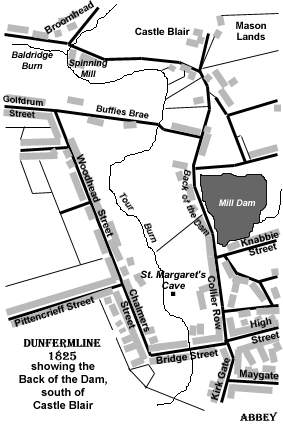
traditions among our miners of coal pits at the "Back of
the Dam" as this region was formerly designated.
The most probable origin of the mine just laid bare will be
found in the charter granted by William de Oberwill,
proprietor of the estate of Pittencrieff, at the close of the
13th century. This charter, dated the Tuesday
before the feast of St Ambrose, 1291, is referred to by
Chalmers, and translated by Henderson in his
"Annals".
By this charter the proprietor of the estate gave, to the
Abbot and Convent of Dunfermline, the liberty to open up one
coal mine on his estate, to work the same wherever they chose
on any part of his lands - except the arable portion - and of
opening another when one was exhausted, &c.
The Abbot was also granted the liberty to quarry and hew
stones, and to make "free use of all the roads and foot
paths through his lands of Petyncreff and Galurigs which they
had at any time employed or been in the practice of
employing."
The part now opened indicates mere superficial workings -
such workings as we might expect to be made by men, such as
the old monks, who had no help from pumping or lifting
machine.
The houses now being removed are probably about 130 to 150
years old, and whether the site was anciently occupied by the
"Castle of Blair", or other building, it is certain
that the mine mouth must have been closed for at least a
century and a half - probably for several centuries.
The road which here leads westward was the only way in old
times to Carnock, and must probably have been defined and
made safe while yet the matins and vespers were sung in the
Abbey.
------------------------------------------------
