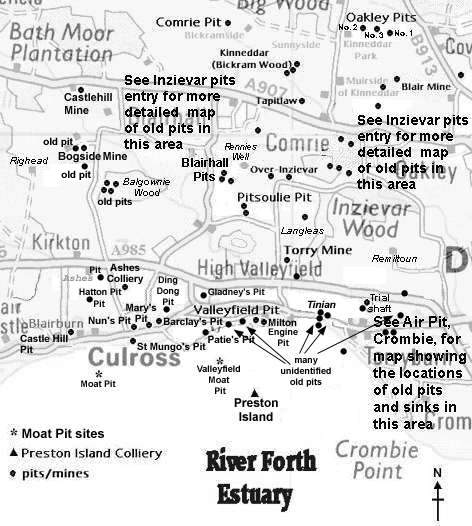
The coal-works of Blair and Blair House, just to the north-east of Oakley, are known to have operated for some considerable time, in particular in the 18th and 19th centuries from two small pits - one around 150 yds. to the north-east of Blair house; the other less than ¼ mile further north, in the southern part of the Black Wood.
 |
 |
Some very interesting information on the coals in this district has been uncovered from examination of the Statistical Accounts of Scotland.
Parish of Carnock (1791)
"This parish is plentifully supplied with coals, there being at least 5 different coal mines in it, belonging to as many different proprietors; viz. Sir John Halket of Pitfirran - the Rev. Dr. John Erskine of Carnock - Mr. Mill of Blair - Mr. Mutter of Annfield - and Mr. Hogg of New Liston. There is also some iron-stone on the estates of these gentlemen. The produce of the mines is uncertain. Mr. Mutter's coal lets at £100 a year, and Dr. Erskine's at £40. Mr Mill's, which is wrought for his own emolument, is supposed to produce from £80 to £100 per annum."
The account indicates that 6 miners and about 35 or 40 colliers were employed in the parish at this time.
"There is a small quantity of moss in the S.E. part of the parish, from which a few peats are dug, but these are solely appropriated to the kindling of fires, coals being the only fuels used in this district, as they abound both in this parish and in the neighbourhood. The average price of great coal is 2s. 6d. for 40 stones, and, for the same quantity of chows, or small coal, 1s. 3d. The carriage paid for a single horse cart of coals is 4d. per mile. But here it will be proper to give a particular account of the coal mines on the different estates in this parish."
"Blair Colliery. - There are two veins of
coal, the one 4 and the other 7 feet thick; both of which
have been wrought some years, and are still working. They are
of a stoney quality, and emit a very considerable heat when
used as house fuel. They are sold at 1s. 3d. per cart (of 40
stones weight), exclusive of carriage. The small coal has
been found to answer well for burning lime, and for
salt-works. Under these two veins of coal there are other
two; the one 2 feet 10 inches, and the other 3 feet thick.
The former is a splint coal, the latter a
smithy coal of a good quality. Of these two veins only
a small part has yet been wrought, as they are under level.
Preparations, however, are now making for working both.
On the Blair estate there is also iron stone, both of the
bed and ball kind, but no proper trial has yet
been made to ascertain its quality."
--------------------------------------------
"The Monthly Advertiser"
August, 1836
COAL GRIEVE WANTED
WANTED immediately, a Sober Man, and of good
character, as a Coal Grieve; he must be able to write and to figure
a little.
Also, a Steady Man who can work with an Axe, to
take care of Plantations, and Hedges, and Ditches,
&c.
Apply at Blair House, Carnock, by Dunfermline.
--------------------------------------------
"The Monthly Advertiser"
September, 1836
ENGINE MAN WANTED
WANTED immediately, a person to Work an Engine; he must be sober and attentive.
Apply at Blair, parish of Carnock.
Blair House, 30th August, 1836.
--------------------------------------------
"The Monthly Advertiser"
February, 1837
COLLIERS WANTED
WANTED, one or two Steady Men, with Families, who are accustomed to bear Coals.
Apply at Blair Colliery.
30th January, 1837.
--------------------------------------------

"Fifeshire Journal"
19 October, 1837
COAL PIT ACCIDENT
An unfortunate accident occurred at Blair Colliery, West of Fife, on Wednesday the 4th curt. The person whose business it was to ascertain the safety of the mine, with a Davy lamp, incautiously went into the mine, without using his Davy lamp; the fire-damp exploded, damaging the workings, and killing him and his son. Fortunately none of the other men had gone to their work. With ordinary precaution, and by the use of the Davy lamp, the mine is perfectly safe.
--------------------------------------------
"The Monthly Advertiser"
November, 1837
STEAM ENGINE BOILER FOR SALE
To be Sold at BLAIR COLLIERY, four
miles west from Dunfermline, a Low Pressure Steam Engine Boiler, 8
feet long, four feet 8 inches deep, and 4 feet broad. The boiler
has only been in use three years.
Apply to the Grieve at the
Colliery, Mr Campbell, Foundry, Dunfermline, or Messrs Burstall
& Sons, Engineers, Leith.
Blair, 30th October, 1837.
--------------------------------------------
"The Monthly Advertiser"
April, 1838
COLLIERY TO LET
TO LET for such period as may be agreed on, the
Colliery of BLAIR, parish of Carnock, at present working, with
Colliers' Houses, Steam Engine, and other Apparatus, all in
working order.
There are several Seams of IRONSTONE in the
Lands near the Colliery, of fair quality, which may be Let with the
Coal Works.
The Colliery is situated four miles west from
Dunfermline, and three miles north of the Shipping Port of
Torryburn. The Roads are good in every direction.
A second-hand Engine Boiler suitable for an
Engine of six horse power, to be Sold, - Price moderate.
Mr Wilson, Coal Grieve at the Works, will shew
the Works, Coal, and Ironstone.
Apply to the Proprietor at Blair House, by
Dunfermline, or to Mr Macdonald, Writer, Dunfermline.
30th March, 1838.
--------------------------------------------
"Fifeshire Journal"
6 March, 1845
ESTATE AND VALUABLE COAL AND IRONSTONE,
IN THE WEST OF FIFE.
To be exposed to Sale by Auction, within
Stevenson's Sale-Rooms, No. 5, George Street, Edinburgh, on
Wednesday the 19th day of March next, at Two o'clock
afternoon, if not previously disposed of by Private Bargain
-
THE ESTATE of BLAIR, in the Parish of Carnock,
and County of Fife.
... The Estate contains valuable seams of Coal
and Iron-stone. There is a going Coal-work possessing a good
country sale. If desired, the Steam-Engine, and other Machinery and
Utensils of the Coal-work, will be made over to the Purchaser of
the Property, at a valuation.
The Iron-stone, consisting of Blackband and Clay
Iron-stone, is understood to be very valuable, and offers have
already been made for a Lease of it.
It is understood that Iron-works are immediately
to be erected in this neighbourhood; and as this part of Fife is
likely soon to become an important Iron-making District, the
Property is well worth the attention of Iron-masters. .... The
Forester at Blair will show the Lands.
[We believe that the Lease on the Blair Estate coal and ironstone was eventually taken up by the owners of the ironworks, soon to be sited near Oakley.]
--------------------------------------------
Parish of Carnock (1845)
"Ironstone is frequently met with in the parish,
especially on the lands of Pitdinnies and Blair. The quality
is considered rich, particularly of that which is found on
the Pitdinnies; but on neither estate has the ore been
wrought.
Coal is diffused generally throughout the parish, and was at
no distant period wrought in five different places. The only
mine at present in operation, is on the estate of Blair, in
the west of the parish. It has been wrought for a long time
past, but with greater spirit of late years than formerly.
It consists of four different seams of coal. The uppermost,
a three feet seam, is a blind coal, used by brewers
and maltsters. The others are house-coal of different
qualities, and are 6, 4 and 2½ feet in thickness,
respectively. Part of all these seams have been wrought, and
are at present working.
The produce, which is about 2000 tons annually, is almost
wholly used in home consumption. The entire depth of the pit,
which is at present wrought, is twenty-three fathoms. A dike
cuts one of the seams near to the pit, causing a considerable
derangement in the strata, and changing altogether the
quality of the coal. The coals were, till of late, drawn up
by a horse gin; but a small engine, upon the high pressure
principle, which was set up for keeping the pit clear of
water, now draws up the coals also.
The coal in other parts of the parish, though not wrought,
is not exhausted. On the north-east, most of the upper seams,
branching off from Lord Elgin's coal-works, in the parish
of Dunfermline, and cropping out in Carnock, have been
wrought out. The lower seams, however, have not, it is
understood, been yet touched."
This early Blair Colliery preceded the Oakley Coal Company's Blair Mine (see separate entry) which was to be located to the north-east of this old colliery on the south side of Herd Hill Road, and which was eventually taken over by the Fife Coal Co. Ltd.
Two trial pits and one coal and ironstone pit are known to have been sunk in the fields to the west of Blair House but it is not known if these were part of this old Blair Colliery or if they were pits of Tapitlaw or Muirside, which were also just west of this location.
| Source Date of Information Supplied | |
|---|---|
| Manager / Under-Manager / Men underground / Men above ground / Coal seams worked | |
| 1791 (Mr.
George Mill of Blair)
[Blair Colliery] |
|
| 1840 (Mr George
Mill of Blair)
[Andrew Wilson, Blair Colliery] |
|
| 1842 (Mr George
Mill of Blair) [Andrew Wilson] [From Dunfermline Register] (Tacksman, Mr James A. Naysmith) [Blair Engine Colliery] |
Blair Engine Colliery, 1842
Mr. James A. Naysmith, tacksman: "The seam of coal being six to seven feet thick upon which I am now working, no very young children need to be employed - nor are they at any time."
Information on coals worked at, or near, Blair Engine Colliery, Oakley
A late 19th century observer had the following to say about one of the early Blair pits: I will not be able to clearly decipher where the under coals at Oakley are shown at the very surface, but I will be able to show where it has been found not very deep. I may here mention that the shallowest place where these coals were struck was about 100 yards north of the Blair House, at a depth of about 6 fathoms; and when this pit was working, the coal had to be carried on the backs of women to the surface - a very laborious undertaking no doubt; one that has been out of existence for a long time; one that is not likely ever to be in existence again; and one, I am confident in saying, none of the women in the age in which we live would have any notion of seeing made fashionable. This coal at its crop changes its nature very considerably, as at this particular spot it was found to be blind coal. I may here explain that blind coal is a coal in which there is no flame - the bituminous principle has already been extracted out of it. This is very often caused by some intrusive whinstone lying above or underneath the coal, and at a particular stage of the world's existence, this whinstone, being a molten mass, has burned the coal by the great heat; hence, the bituminous principle of the coal has been destroyed. Some coals, which are only slightly burnt, are very much improved by this, but some are rendered completely blind; and unless when there is a strong draught or blast applied it is impossible to get heat from them. At this particular place I have made mention of, the coal was non-bituminous; still, it was used for certain purposes, as a considerable area of this coal was worked in the district. Boring operations have been going on to the north of this for the last nine months, and it is well reported of, and some very good coals have been found. I have my own private opinion of a great area of ground all around this, and I am afraid that the coals in many parts, taking all the circumstances into consideration will be slightly burnt.
... and based on a report from 1930 ...
The Kinneddar Splint Coal seam was wrought in the vicinity
of Comrie, Oakley and Blair as the Comrie Lower Four Foot.
Also known as the Comrie Splint, Oakley Splint and Comrie
Main, this coal can be identified with the Lochgelly Splint
and Parrot Coal seams.
The next coal was an important seam known as the Comrie Six
Foot or Kinneddar Five Foot and occasionally as the Oakley
Five Foot. It lay 9 to 15 fathoms above the Kinneddar Splint
and probably represented the Lower Jersey. It was a good
steam coal, and at one time was wrought as the Comrie Six
Foot at Comrie, Oakley and Blair.
At the old collieries of Comrie and Blair, the Kinneddar or Comrie or Oakley Three Foot Coal was reported to have been 6 ft. thick with a stone rib 2½ ft. from the top. This seam has frequently been correlated with the Kelty Main.
The Comrie Two Foot Coal seam is thought to have outcropped in the Blair Burn and in the Muirside Quarry, just east of the Saline road, near Oakley, where the following sections, 350 yds. apart, were measured:-
| Description | Thickness |
| Flaggy sandstone | 3 ft. |
| Fakes | 2 ft. |
| Fireclay, sandy | 2 ft. |
| Blaes | 6 in. |
| COAL | 3 in. |
| Blaes | 3 in. |
| COAL | 2 ft. |
| Fireclay, sandy | 6 in. |
| Description | Thickness |
| Flaggy sandstone | 8 ft. |
| Fakes | 1 ft. |
| Faky fireclay | 3 ft. |
| Coaly blaes | 10 in. |
| COAL | 1 ft. 3 in. |
| Coaly blaes | 9 in. |
| COAL | 1 ft. |
| Sandstone | 5 ft. |
Can do with help on this colliery.
