Owners: Mr Downie
Dunfermline Coal Company (ca 1838)
Townhill & Appin Collieries (1840)
Scotland & Co. (1882 - ?)
Street Brothers, Dunfermline (ca 1890 - 1906)
Henry Ness & Company (1906 - 07)
Lochside Coal & Fireclay Co., Dunfermline (1908)
In January, 1838, the Dunfermline Coal Company obtained a
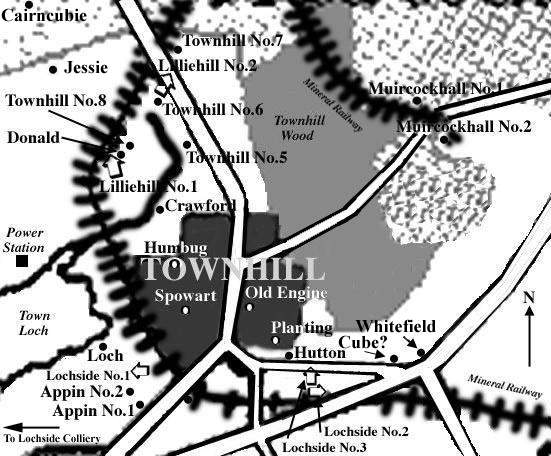
lease of the Appin minerals to the south-east of the Town
Loch. The No. 1 mine lay close to the south-east corner of
the Town Loch, Townhill, and the No. 2 Mine lay 250 ft. to
the south-east of the No. 1 Mine and close to the
Kingseathill-Townhill road.
Although the Appin Colliery was eclipsed in coal production
by the Crawford Pit, Townhill, and others locally, in the
mid-nineteenth century, it still contained rich beds of
fireclay as well as coal left of necessity when the mine was
worked on the old "Stoop and Room" system.
(See later for more colliery information).
| See also : Dunfermline - early coalworks |
|---|
 |
| Mines opened: ca 1838; re-opened 1880s | Mines closed: initially 1860s(?); finally mid-1950s |
|---|
| Source Date of Information Supplied |
|---|
| Manager / Under-Manager / Men underground / Men above ground / Minerals worked / Shaft Details |
| 1840 (Townhill &
Appin Collieries)
A. F. Hopper, Manager |
| 1842 (Townhill &
Appin Collieries)
A. F. Hopper, Manager |
| 1881 (Scotland & Co.) |
| No. 1 Mine: Robert
Muir / ---------- / 15 / 4 / Splint, 5 feet / D'cast
(6 x 4) 126 ft. : U'cast (10½ x 4½) 132 ft.
Ventilation by furnace. |
| 1882 (Scotland & Co.) |
| No. 2 Mine: A.
Scotland / ---------- / 15 / 3 / 5 feet / D'cast (6 x
4) 70 ft. : U'cast (10 x 6) 72 ft.
Ventilation by furnace. |
| 1890 (Street Bros.) |
| Appin Mine: J. S. Street / ---------- / 15 / 2 |
| 1896 (Street Bros.) |
| ----------- / David Bruce / 21 / 2 / Manufacturing coal and fireclay. |
| 1902 (Street Bros.) |
| Thomas. T. Street / David Bruce / 14 / 2 / Manufacturing coal and fireclay. |
| 1904 (Street Bros.) |
| ------------ / ------------ / 15 / 2 / Manufacturing coal and fireclay. |
| 1905 (Street Bros.) |
| ------------ / ------------ / 14 / 2 |
| 1906 (Street Bros.) |
| June: Colliery Company goes into liquidation |
| 1907 (Messrs. H. & D. Ness) |
| June: Announcement that the lease would be taken over by H. & D. Ness |
| 1908 (Lochside Coal & Fireclay Co., Dunfermline) |
| Appin: W. Johnstone / ------------ / 8 / 2 / Manufacturing coal and fireclay. |
| 1918 (Lochside Coal & Fireclay Co., Dunfermline) |
| Appin: William Wilson / ------------ / --- /--- / Not working since August 1914. |
| See also Lochside Pit entry WEST INDEX. |
|---|
| Plans of Abandoned Seams for Appin Mines, Townhill | Pits or Mines designated in Plans |
|---|---|
| COAL; Splint (1882) | Appin Nos. 1, 2 |
| COAL; Five Feet; Splint (1885) | Appin Nos. 1, 2 |
-------------------------------------------------
Information on coals worked at, or near, Appin No. 1 & No. 2 Mines
(based on a report from 1930)
When the early colliery was dismantled (exact date not
known) and the pits filled up, it was reported that corn grew
over the site for many years until Henry Ness & Company
established the Appin Fireclay works there. A mine at an
angle of one foot in three was run into the old workings from
the day-level and the blaes which lay on top of both seams
was said to be "admirably adapted for
brick-making."
The stoops of coal left as support from the previous
workings of the minerals conveniently provided coal for the
new brick-works.
Under the Five Foot Coal was a seam of fireclay which was
excellent material for the production of pipes, chimney cans
and other related items, and the level road at the bottom of
the incline ran along the south edge of the Town Loch for
approximately half a mile. By 1902, fourteen chamber Hoffman
kilns were used and were guaranteed, at that time, to produce
10,000 to 12,000 bricks per day!
(The establishment of the Lochside Fireclay and Coal Works
was a natural extension of the Appin Works only a few hundred
yards to the east.)
As late as 1926, a small quantity of the Five Foot Coal
seam, 3 ft. thick, with a roof of blaes and a fireclay
pavement, was being taken out from the No. 1 Appin Mine. The
underlying fireclay here was around 3 ft. thick but it was
reported as thinning out eastwards towards Whitefield Pit.
The Appin Mines were in operation until the mid-1950s when
it was considered that they were too expensive to work.
-------------------------------------------------
"Dunfermline Saturday Press"
10 March, 1883
A man named Walter Campbell, aged 22, was seriously injured in a pit at Appin Colliery on Tuesday forenoon. A large quantity of coal fell from the roof and crushed him severely. By order of Dr. Dow, he was removed to his residence, where he lies in a precarious condition.
----------------------------------------------------
"Dunfermline Press"
16 October, 1897
AN UNWORKED PORTION OF THE
BURGH COALFIELD
At a meeting of the Property Committee on the 22nd ult., there was read a letter from Messrs Street Brothers, Appin - Fire Clay Works, Townhill, dated 16th instant, making offer for a lease for a term of years of a piece of five-foot coal, supposed to be about 7 acres in extent, lying in the south east corner of the Burgh's coalfield, which had been left unworked by the former tenants of Townhill Colliery, and which had been excluded from the new lease of that Colliery. Messrs Street Brothers proposed to win the coal from their workings in Mr Macalpine Leny's lands. It was agreed to request Mr Miller, mining engineer, to consider and report upon the proposal. ...
--------------------------------------------------

"Dunfermline Press"
1 April, 1899
Patrick Connor, 70 years of age, labourer, No. 2 Second Row, Townhill, was fatally injured at Messrs Street Brothers' Fire-Clay Works at Townhill, on Monday afternoon. He was assisting George Leighton, carter, Thistle Street, Dunfermline, to fill a cart where some excavations were going on, when two tons of fire-clay, which had been partly undermined, came down upon him. He was speedily extricated and did not seem much hurt. He was able to stand, although he complained of a pain in his back. He was conveyed home in a cart. The accident happened at three o'clock, and Connor was in his own house by half-past three. While he was being assisted to bed he turned seriously ill, and was dead before four o'clock. He had been injured internally, and collapsed whenever his waist-belt was taken off. The body was afterwards examined by Dr Tuke, who found that one or other of the internal organs had been ruptured.
-------------
"Dunfermline Press"
15 April, 1899
A report on the Fatal Accident Inquiry into the death of Patrick Connor is in this issue. The jury returned a formal verdict.
--------------------------------------------------
"Dunfermline Press"
19 January, 1901
The Town-Clerk stated that the annual report by
Mr Millar, mining engineer, on the Burgh minerals had been
received. It appeared from the report that the royalties amounted
to £9807 15s 6d - an increase of £3497 2s 4d on the
preceding year.
The various collieries contributed to the
increase as follows:
Townhill £1605 16 1
Muircockhall 200 7 11
Muirbeath 1588 0 0
Kingseat 57 11 7
Street Brothers 45 6 9
... The rate of increase was 2.65d per ton. The increase was mainly due to the higher price of coal, the output having only increased to the extent of 13 per cent. ...
--------------------------------------------------
"Dunfermline Press"
16 January, 1904
The annual report by Mr Millar, mining engineer, on the Burgh minerals had been received and it showed that the revenue from the several subjects had been as under:-
Townhill Colliery £2707 1 2
Muircockhall Colliery £642 11 3
Muirbeath Colliery £3092 19 8
Messrs Street Brothers, Ltd. £58 7 0
--------------------------------------------------
"Dunfermline Press"
9 June, 1906
STOPPAGE OF APPIN FIRECLAY WORKS
Appin Fireclay Work, Townhill, owned by Messrs Street Brothers, Ltd., have been closed in consequence of dullness in trade. ... In the case of Appin Works about 100 men have been thrown idle, and this will tell heavily on Townhill. ...
--------------------------------------------------
"Dunfermline Press"
16 June, 1906
STREET BROTHERS LIMITED
PETITION TO WIND UP THE COMPANY
At a meeting of shareholders of the Appin Fireclay Works Company, Townhill, it was agreed to seek voluntary liquidation of the Company which had been formed in 1899 with a capital of £42,000.
--------------------------------------------------
"Dunfermline Press"
15 September, 1906
SUBSIDENCE AT WHITEFIELD
On Wednesday morning the road officials of the Dunfermline District Committee were notified that the public road known as Whitefield Brae had subsided at a point almost midway between the West Fife mineral railway and the road which leads eastwards from Kingseathill to Kingseat. When Mr Mackenzie and a staff of men arrived on the scene they found that an area of the roadway, measuring twenty feet by thirty feet had subsided, leaving a hole fourteen feet in depth. Vehicular traffic was suspended, and the Dunfermline and Lassodie and Kelty 'buses, and all other horse traffic, was conducted via Townhill Road. There was a plentiful supply of road scrapings in the vicinity, and with this material the chasm was speedily filled up. The cause of the mishap was the collapse of the mineral workings formerly leased to Messrs Street Brothers, Ltd.
--------------------------------------------------
"Dunfermline Press"
22 June, 1907
This edition carried news that Messrs H. & D. Ness would be taking over the lease at the presently unworked Appin Fireclay Works, Townhill.
--------------------------------------------------
"Dunfermline Press"
23 January, 1909
On Monday morning, John Wilson (37), miner, Street's Place, Townhill, was working in the coal mine at the Appin Brick Work, when a stone, weighing about five cwts., unexpectedly fell from the roof. He put out his left hand to keep it off him, and had his third and fourth fingers so severely injured that they had to be amputated at the top joint by Dr Henderson, Dunfermline.
--------------------------------------------------
