Mining Safety
-
 The greatest explosion hazard in coal mines comes from methane gas.
All coal seams contain methane and when
the barometer falls, during colder weather, more methane than normal
comes into the mine air. Pockets of methane gas may accumulate in areas
of a mine in which gas checks are infrequent. When an ignition source
is present in that area, there exists the potential for a deadly
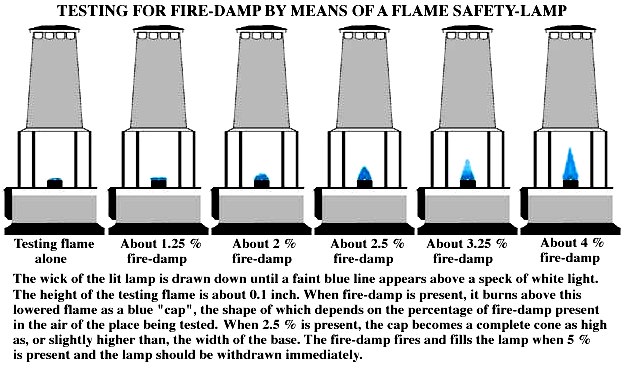
explosion. It was the changes in the shape of the burning flame in a
miner's safety lamp which told him if, and what percentage of, methane
was present in the air.
-
It was only the combined efforts
of managers and miners which prevented mine explosions and other mine
accidents by strictly adhering to the mine's approved ventilation plan
and following all other existing mine safety regulations and codes of
practice. Safety conscious mine managers would have encouraged frequent
checks for methane and maintained proper ventilation in all the
underground workings, paying special attention to the areas of the
mine that were not frequently travelled.

Another old friend of the miner - the canary
-
Canaries
were once kept at all mines
for safety purposes just in case an underground fire or an explosion
occurred with the release of poisonous gases into the air.
It was the swift reaction of the canaries (affected by gas more
quickly than man) which told the rescue team of the presence of
traces of the deadly gas, carbon monoxide. With the huge advancements
in technology, it was soon possible to check the atmosphere of a
mine by electrical methods and then, eventually, remotely from the
surface, thus making both the canary and the safety lamp things of
the past!
Ventilation in Coal Mines
-
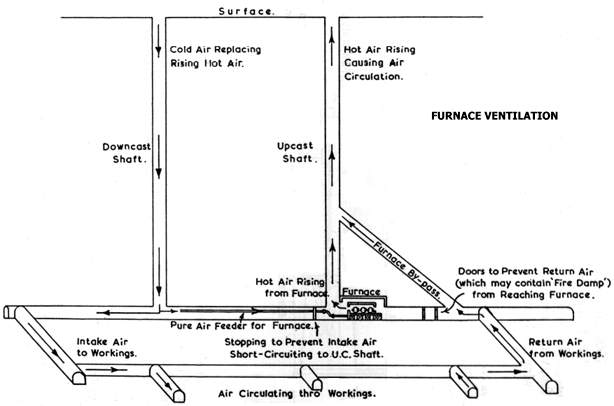
The old means of ventilation in a coal mine was to sink two shafts on
different levels, the air being drawn down one and rising in another to
create a circulating air current. To increase the current, a furnace was
usually placed at the bottom of the 'up-cast' shaft, which led to an
obvious danger of explosion. The system entailed keeping many passages
blocked for fear of a draught-circulation in the wrong direction, and to
this end small boys and girls were employed to open numbers of
trap-doors when trucks were passing, and then to close them immediately
afterwards. In these earlier times, an open candle was the usual means
of lighting down a coal mine - the mine being unfit to work only when
the flame would not burn! In such conditions, coupled with the constant
risk of collapse, loss of life was so common that inquests on victims
of pit disasters were never held.
Less dangerous conditions, however, came to most collieries with the
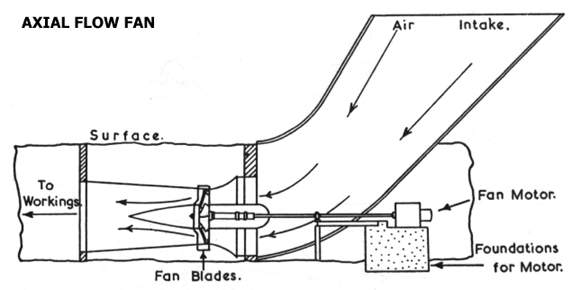
invention of exhaust fans to suck foul air out of the 'up-cast' shaft,
and thus cause fresh air to rush down the other shaft.
An ingenious - probably unique - ventilation system was employed at
the Derby Pit, Dunfermline, where steam jets, powering into one of the
shafts, heated the cold, dank air making it rise. The convection process
then resulted in fresh, cooler air being drawn in from the other two
shafts thereby keeping the air circulating!
A society for the prevention of accidents in mines was also formed and
it was this body which commissioned Sir Humphrey Davy to produce a
safety lamp. The result, the famous Davy lamp, together with the
improved ventilation, greatly reduced the danger of explosion in
coal mines.
Click on Images to Zoom In
Self-Rescuers in Pits and Mines
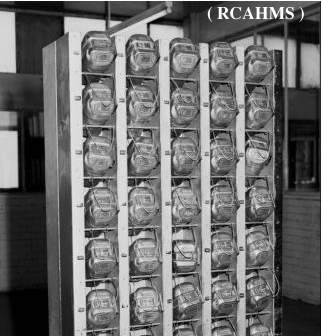
-
In spite of modern technology, coal mining was hard work often carried
out in unhealthy and unsafe conditions. Good ventilation in mines was
important because many had dangerous gases, and any fires underground,
however small, were guaranteed to produce smoke! Long before current
Health and Safety Regulations, management and mine workers paid great
attention to preventing and decreasing accidents, improving miners'
training and reducing unhealthy workplace conditions. In spite of most
mines having separate ventilation shafts, with fans to assist the
circulation of air, there were always some areas in underground
workings which were poorly ventilated as in 'dead-end' sections.
-
The 'self-rescuer' was a self-contained piece of breathing apparatus
in a lightweight, metal container which was collected and checked by
the miners, then attached to their waist belts, and taken with them
down the pit. In any situation where breathing was likely to be a
problem, the gaffer would give the order for the self-rescuer to be
fitted. It had a plastic mouthpiece and a nose-clip arrangement, and
elasticated straps ensured that the unit was held in place. By
breathing through their mouths, miners could make their way out of an
unsafe area without being overcome.
The units could prove effective for a period of about 1 - 1¼
hours, if necessary, but because of chemical reactions taking place
inside the self-rescuer unit, the mouthpiece would, on occasions,
heat up to such an extent that it caused some heat-blistering of the
lips - a small price to pay for a safe escape! Miners, of course, were
given a rigorous training in the use of self-rescuers before starting
work, and would usually attended refresher classes each year.
-
Mining
changed over the years
with the introduction of modern machinery but this was not always
for the best, e.g. there was a lot more dust created in a modern
working coal mine! Also, at one time the machine was the servant
of the worker but in today's modern mines, the miner seems to be
the servant of the machinery! And, finally, in some operations
in the coal mine, like heading work, this has got a lot harder
as the miner tries to keep up with the roof supports as machines
go rushing forward! Roadways in some mines can be as big as 4.57
metres wide and 3.65 metres high, and sometimes even bigger!
Things to Do and Not to Do.
-
Consistently follow the mine's approved Safety and
Ventilation plan;
-
Conduct thorough pre-shift, on-shift, and weekly checks
for methane and other hazards;
-
Keep potential ignition sources out of working
areas;
-
Complete stonedusting (blanket the whole area with stone dust) and, where necessary, put up overhead dust barriers in all areas
of the mine;
-
Never smoke or carry smoking materials into an
underground coal mine and never allow others to do
so.
-
We must encourage the miners' family to encourage them to
take heed of these hazards and, particularly, to encourage
smokers never to smoke in underground coal mines,
-
Managers are required to conduct a search program to
ensure that miners do not carry smoking materials into the
mine.
-
Keep your work area clear of obstacles.
"Dunfermline Press"
7 March, 1885
SAFETY IN MINES
-
Mr. Ellis Lever, who recently offered a prize of
£500 for a perfect safety lamp for miners, has intimated to
Mr. Thomas Burt, M.P., his willingness to offer a similar sum as a
premium for the invention or discovery of an economical, efficient,
and safe substitute for gunpowder or other dangerous explosives
used in the getting of coal.
"Dunfermline Press"
3 December, 1887
A SAFETY LAMP FOR MINERS
-
Mr. J. W. Swan, Newcastle, bids fair to supply
that much-felt desideration, an improved safety-lamp for
miners.
It appears that two hundred of the incandescent
electric lamps invented by that gentleman, and as manufactured by
the Edison-Swan Company, have recently been introduced into the
National Colliery in South Wales; and the Company are now preparing
2500 lamps for the colliers of Messrs. Watts, Ward & Co., in
the same district. The people of the North were afforded an
opportunity of judging of the qualities of these lamps during the
late Exhibition in Newcastle; and one of the lights was exhibited
by Professor Merivale in the course of one of the scientific
lectures which he delivered in the theatre. Should the experiments
in South Wales be found satisfactory, the result will doubtless be
the general application of the electric light to the prosecution of
mining operations.
"Dunfermline Press"
30 November, 1889
A NEW MINER'S LAMP
-
The Mining World states that Dr. James
Thorne, of 85 Gracechurch Street, London, has invented a
miner's lamp, which may be described as absolutely safe, and
the use of which will prevent explosions in coal mines, so far as
they may be due to defective lamps.
Those who have seen the miners working with the
ordinary Davy lamp must have marvelled how they were able to
conduct operations with a light that did little more than render
darkness visible. But the "Thorneburry Miner's Lamp"
is infinitely superior in this respect - that it enables the miner
without difficulty to see exactly what he is about.
We understand that in Sir. John Brown's
collieries some of these lamps have been in use for quite three
months, and Mr. C. E. Rhodes, president of the Midland Institute,
who is connected with these important mines, was very much
satisfied with them.
There are two gauzes, and the ingress and egress
of heated air are kept separate and distinct, and the presence of
explosive gases in a mine is immediately known by the circumstances
that they extinguish the lamp.
Exhaustive experiments have been tried, out of
which the lamp has come triumphantly, and even in abnormal
circumstances it has been found to fulfil all the conditions of
safety laid down in the report of the Mines' Commissioners, as
well as in the experience of colliery workers; the lamp is
economical, because a cheap kind of oil can be used, and when
filled, will burn from 12 to 14 hours, whereas, of course, the
miner's shift is but eight hours. It is impossible for the men
to tamper with it, in the sense of exposing the flame, without
detection; and, in fact, the excellency of the light removes the
temptation to do so.
The light of the Davy lamp was so bad that the
workman was tempted to expose the flame for the purpose of
expediting his progress. In the Thorneburry lamp the temptation
does not exist. At the same time, the light can be lowered, or
raised, at pleasure.
Reports have been furnished by Prof. Sir.
Frederick Abel and Prof. Dewar, which bear out all that is said
about this lamp, and point to it as a noteworthy invention, and as
likely to be a commercial success.
"Dunfermline Press"
25 February, 1899
GASES IN COAL MINES
-
Under the auspices of the Fife County Council
Technical Education Committee, the first of two lectures upon
"Gases in Coal Mines", with illustrative experiments, was
delivered in Cowdenbeath Public School on Monday evening. Mr John
Foggie, Fellow of the Chemical Society, lecturer Dundee Technical
College, was demonstrator, and his audience was composed mainly of
mining students attending the classes in Cowdenbeath, Wellwood, and
Coalton of Balgonie.
In the time at his disposal, Mr Foggie was able
to show effectively the laws of pressure and diffusion of gases.
While all his experiments were interesting and suggestive, the most
novel was that illustrating how the principle of diffusion has been
applied to an invention called the fire-damp detector. The
difference of pressure acting upon a column of mercury which
supports a metallic disc connected to an electric battery completes
the circuit and rings an alarm bell, and by this means warning is
given of the enemy's presence. This experiment being, like the
others, instantaneously successful, elicited loud applause. The
second lecture will be delivered on 6th
March.
"Dunfermline Press"
11 March, 1899
GASES IN COAL MINES
-
The second lecture of this series was delivered
by Mr Foggie, F. C. S., in Cowdenbeath School, on Monday night. As
on the former occasion, the composition and properties of the mine
gases were cleverly illustrated by numerous experiments, which,
with Mr Foggie, always come off. Referring to the deadly effects of
a very small percentage of carbon monoxide in the air, and the
failure of modern chemistry hitherto to detect its presence, he
noted the suggestion of Dr Haldane, of Oxford, that the miners
should be provided with cages containing mice - the sacrifice of
the little animal's life being obviously a gain to the miner,
and a glorified, if involuntary, martyrdom for the poor mouse. Mr
Mitchell, organising secretary, proposed a vote of thanks to the
lecturer.
"Cowdenbeath & Lochgelly Times &
Advertiser"
Wednesday 18 January 1911
RESCUE WORK IN COAL MINES
-
The various teams for this purpose throughout
Fife have now been called up to do their practical training with
the apparatus at the Rescue Station, Cowdenbeath.
-
The team from Lochgelly has been drawn from
Minto Colliery of which the following are members - Wm. Ferguson
(leader), Colin Methven, David Blane, Jas. Wilson, and John
Scott.
"Dunfermline Express"
25 April, 1911
SAMPLING OF THE AIR
-
The new Coal Mines Bill imposes new duties and
increased responsibility on all colliery managers. A most important
new feature is the requiring of samples of the air to be taken at
intervals of a fortnight and tested to determine the percentages of
firedamp, oxygen, and carbon dioxide they contain. The average of
six of these samples is to be taken as the usual state of the air,
and to determine whether or not safety lamps shall be used. This
work might be undertaken by a chemist attached to the colliery
staff, but to enable managers to make their own tests, arrangements
have been made at the Fife Mining School for all managers in the
county to meet there and undertake experiments in gas
testing.
"Cowdenbeath & Lochgelly Times &
Advertiser"
Wednesday 3 May 1911
MINING FIREMEN'S EXAMINATION
-
An examination was held last Thursday at
Cowdenbeath Mining School on the properties of mine gases, firing
of shots, coal mines' regulations, the testing of mine gases
and measuring of air.
-
The following firemen passed with a creditable
result - James Blair, Henry Eadie, and Walter Ness, Newton Pit,
Lochgelly; Archibald McDonald, Wm. Geddes, John Turner, George
Cunningham, Mary Pit, Lochgelly; Robert Moffat, Raith Colliery;
William Young, Brigghills, Lochgelly. The examiner was Mr Parker,
Principal of Cowdenbeath Mining School.
"Cowdenbeath & Lochgelly Times &
Advertiser"
Wednesday 10 May 1911
RESCUE TEAM
-
A rescue team has been chosen from the Mary Pit,
and made its appearance at the Rescue Station, Cowdenbeath, on
Saturday, under the charge of Mr David Pratt, night-shift oversman.
The men were fitted with the rescue apparatus and put through a
series of experiments, the whole being ably explained to them by
the rescue master. The men grasped the situations explained
thoroughly, and seemed to work well together, and were very
enthusiastic over their work.
-
The following men comprise the team - Jno.
Gillan, David Pratt, Richard Smith, Wm. Fotheringham and John
Donlevy, Mr D Pratt takes charge of the team.
"Cowdenbeath & Lochgelly Times &
Advertiser"
Wednesday 17 May 1911
MINING FIREMEN'S EXAMINATION
-
An examination was held last week at Cowdenbeath
Mining School on the properties of mine gases, shot firing and the
coal mining regulations, the testing of mine gases, and the
measuring of air, etc.
-
The following firemen passed successfully - John
Hunter, Archibald Crawford, James Watt, Robert Blair, Jas. Gilmour,
Newton Pit; John Crawford, Minto Colliery; William Motion, Jenny
Gray Pit. The examiner was Mr Parker, B.Sc. M.E.C.E.E.E.,
Principal, Mining School, Cowdenbeath.
"The Scotsman"
27 June, 1914
FIRE-DAMP IN MINES
NEW INDICATOR AND DANGER SIGNAL.
-
At a meeting of colliery managers and others interested in the working of coal mines,
held at the Hotel Cecil yesterday afternoon, a demonstration was given of an instrument
which indicates the presence of fire-damp in coal mines, and automatically measures the
percentage of methane present in the air of the mine.
The invention, if it fulfils the promises made on its behalf, should go far to reduce the toll
of lives which the mining industry has to pay. Not merely will the new invention safeguard
the miner against fire-damp, his primary and greatest danger, but, it will also, by enabling the
safe use of electric light in the mines, reduce the risk of injuries and fatal accidents from other
causes. The objection to enclosed electric lamps at the present time is that they afford no
indication of the presence of fire-damp, and therefore do not warn the miner of the existence
of danger. Flame lamps, notwithstanding their inherent danger, have still to be resorted to
because of the indication they give of the presence of fire-damp.
The invention of Mr Arthur Williams is not a lamp, but a simple instrument which indicates
the percentage of the methane present. It is based on the principle that platinum black,
if placed in an atmosphere containing even a small percentage of methane, experiences a
rise in temperature, such rise increasing with the percentage of methane present. Hitherto
attempts to make a practical use of this property of platinum black have failed because of the
difficulty of making a reliable indicator of this rise of temperature which will tell the percentage
of gas present, and because of the fact that platinum black, when cold, is very insensitive to
the presence of small percentages. In the invention of Mr Williams the first of these difficulties
has been overcome by the adoption of a thermo-electrical method of temperature measurement,
and the second by providing means for producing a preliminary heating of the platinum black.
A detector arrangement of platinum black, held always in contact with the mine air, is kept to
such a high degree of sensitiveness that it instantaneously responds to the smallest possible
percentage of fire-damp that may present itself, and directly the sensitised platinum black
detector responds to the presence of fire-damp, a specially designed galvanometer actuates
a pointer that, traversing a scale, shows at a glance and to a fraction the percentage of fire-damp
at that moment in the pit atmosphere. This scale and pointer can be fixed at any distance
from the spot at which the platinum black detector is receiving the gas impressions. Thus a
dial may be placed in the mine manager's office on the surface. The responsible official
on duty in the manager's office can see at a glance the condition of the atmosphere of
the mine. Should his attention be taken from the dial, and a danger point be reached, a
bell warns him of the fact.
Elsewhere at the surface runs continuously an automatic recorder that registers, dates, and
times the varying percentages of fire-damp in the mine. An inspector making his periodical
visit can thus at once inform himself as to the conditions the pit atmosphere has shown
since he was last there.
Below ground the fireman charged with seeing to the safety of the miners will be armed
with a portable methanometer. This is so constructed as to permit of its being raised roof
high and inserted into crevices. If gas is present in the workings, it will at once be
detected, and its percentage indicated on the dial of the instrument.
At yesterday's demonstration, which was presided over by Lord Ninian Crichton-Stuart,
testimony to the value of the new invention was given by Professor Sylvanus Thompson.
Messrs Smillie, Ashton, and Brace, M.P., were present on behalf of the Miners' Federation.
Mr Smillie said that when the invention had the approval of the Miners' Federation and
of the mining experts, the Government should be called upon to insist upon its introduction
in every mine.
Click on Images to Zoom In
-
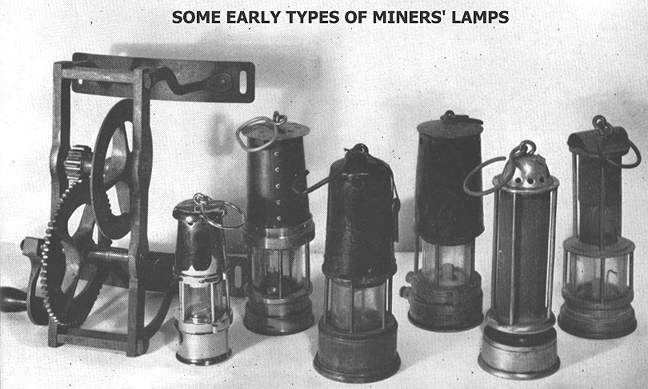
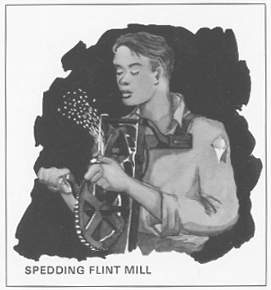
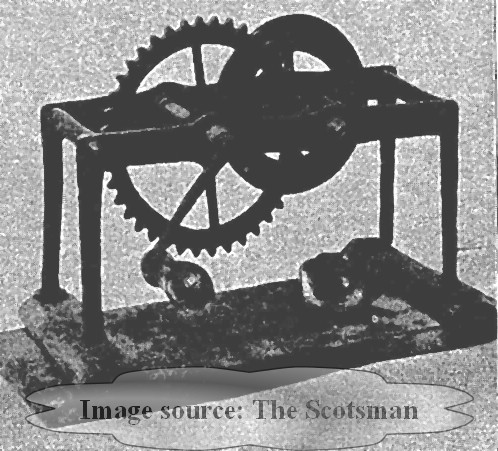
The item on the extreme left of the above picture left
is a Spedding Flint Mill. This early device was usually
carried by a boy (picture right) who accompanied a collier and produced a shower of
sparks by turning the toothed wheel of the mill which rubbed
against a flint. Unfortunately, some flints used in these mills
could produce sparks with enough energy to ignite the firedamp and,
consequently, it did not remain in use for long.
------------------------------------
"The Scotsman"
30 January, 1924
TESTING FOR FIRE-DAMP
A CENTURY'S PROGRESS.
-
Testing for fire-damp is the subject of a report of the Miner's Lamp Committee issued
yesterday.
For the provision of more accurate means of testing for gas, it is stated the design of the Clowes
hydrogen lamp should be used. The fuel should be of as low "flashpoint" as possible,
and the Committee suggest that the best gaseous fuel to employ would be fire-damp which could
be compressed in a small cylinder as in the present form of Clowes lamp though the cylinder should
be of smaller dimensions and less clumsy shape. No attempt need be made to use a large testing
flame, but a standard testing flame could be produced in the same manner as with an oil lamp. The
fire-damp caps that formed around such a fire-damp flame were readily visible.
Included in this highly technical report is an extract from a letter dated October 18, 1813, from John
Buddle to the Society in Sunderland for Preventing Accidents in Coal Mines, in which the method
then adopted is described. A common pit candle is recommended, forty-five to the pound, with wick
of cotton, made of ox or sheep tallow, but clean ox-tallow is the best.
MAKING THE OBSERVATION.
-
The letter proceeds:- "In the first place, the candle called by the colliers the "low" is trimmed,
that is, the liquid fat is wiped off, the wick snuffed short and carefully cleaned of red embers, so that the
flame may burn as purely as possible. The candle being thus prepared is holden between the fingers
and thumb of the one hand and the palm of the other, is placed between the eye of the observer and the
flame so that nothing but the spire of the flame can be seen as it gradually towers above the margin of
the hand. The observation is generally commenced near the floor of the mine, and the light and hand
are gently raised upwards till the true state of the circulating current be ascertained.
The first indication of the presence of inflammable air is a slight tinge of blue or bluish-grey colour shooting
up from the top of the spire of the candle and terminating in a fine extended point. This spire increases in size
and receives a deeper tinge of blue as it rises through an increased proportion of inflammable gas till it
reaches the firing point, but the experienced collier knows accurately enough all the gradations of "shew"
(as it is called) upon the candle, and is very rarely fired upon excepting in cases of sudden discharges of
inflammable gas."
------------------------------------
"Cowdenbeath & Lochgelly Times and Advertiser"
5 March, 1924
AUCHTERDERRAN
LECTURE - SAFETY IN MINES
- On Wednesday evening, Mr John Ford, of the Fife Coal Company, Ltd., gave a lecture in the Institute. Mr Ford took for his subject "The Safety in Mines," and illustrated methods whereby fatal and other accidents resulting from explosives could be greatly minimised or prevented. There was again a splendid turnout, and the lecturer's remarks were highly interesting. Mr Ford, at the close of his address, dealt in an able manner with a few important questions. Through family bereavement Mr McFarlane was unable to be present, and the chair was taken by Mr Chas. Annan, under manager.
------------------------------------
"Dunfermline Press"
2 January, 1926
SAFETY FIRST IN THE MINES.
MARKINCH MAN'S INVENTION.
-
Mr William Eadie, Milton, Markinch, who is a well-known inventor of many safety appliances,
has invented a device for firing shots in mines and quarries which will facilitate the tamping of
shots with greater rapidity and also lessen the danger of misfire to a considerable extent. The
instrument is made of strong copper, easy to fix, measures about eight inches in length,
weighs twelve ounces, and can be carried in the jacket. Mr Eadie intends to demonstrate
the advantages of his invention at the safety first lectures he is giving under the direction
of the Education Authority.
------------------------------------
"Dunfermline Press"
31 May, 1930
SAFETY IN THE MINES.
INVENTION BY DUNFERMLINE
ELECTRICAL FIRM.
-
It is well-known that a large percentage of electrical accidents in the mines are caused
by faulty trailing cables. This fact is recognised by His Majesty's Inspector of Mines,
and very stringent regulations are in force for the periodical inspection and testing of
such trailing cables.
Hitherto, no satisfactory and sure method of knowing when a cable was unsafe has
been possible, as the ordinary tests as usually carried out are practically useless for this
purpose.
Messrs James Scott & Co., electrical engineers, Dunfermline, have always kept
abreast with the rapid electrical development in the mines, and have been alive to
the need for some simple apparatus for testing trailing cables.
After careful research and experimenting, they have been successful in evolving a
portable appliance capable of being used by any electrician, which shows when a
cable is faulty, and definitely points to actually the position where such fault exists.
They claim for their apparatus, which is the only one of its kind in existence, that
any cable, when passed through this test, is bound to be safe.
The apparatus does not damage the cable in any way, does not involve immersion
in water in any manner, as some tests require, and it is very rapid. A standard
length of cable can be tested within 10-20 minutes, depending on the number of
faults.
They also claim for their invention that economy in the use of trailing cables will
result, as a cable can be repaired indefinitely as long as it is so repaired to withstand
the test applied by the apparatus.
We understand that the instrument is reasonably priced for such apparatus, and
that they are now ready on the market, and that Messrs. James Scott & Co.,
will be pleased to furnish any particulars to those interested, or demonstrate the
actual apparatus on clients' own trailing cables.
------------------------------------
"Dunfermline Press"
14 March, 1931
SAFETY IN THE PITS.
- In
Buckhaven Mining School on Thursday, in presence of a good attendance of
colliery officials, a lecture on "Safety in Longwall Working" was given by
Dr A. Winstanley, Mining Engineer to the Safety in Mines Research Board. This
was one of a series arranged by the Mining Institute of Scotland Safety Committee,
which was appointed last year to supervise the work of the Research Board in
Scotland. A summary of the lecture will appear in next week's Press.
Mr Dugald Baird, general manager of Wemyss Coal Company, Ltd., occupied the
chair. In his introductory remarks he stressed the importance of research work which
was now being directed to help in the safe working of our coal mines. The work
on the prevention of falls of roof and sides was particularly important because
about fifty per cent of the accidents in mines were from this cause.
The co-operation of the research worker with the colliery officials and workmen
was a step in the right direction.
------------------------------------
"The Scotsman"
1 August, 1932
ROYAL SCOTTISH MUSEUM
Interesting Mining Relic
AN 18TH CENTURY EXHIBIT.
- The special
exhibit of the Royal Scottish Museum for the month of August takes the form of a "flint and
steel mill", a very interesting relic of mining in the 18th century.
In the early days of the
coal mining industry the problem of noxious gases and foul vapours was shrouded in mystery and
superstition. Indeed, one early writer refers to these gases as subterranean demons, one of which
destroyed twelve men at a single blast of his breath. With the general spread of scientific knowledge,
however, a more reasonable view was taken of the observed facts, and means were adopted to get
rid of the gases by dispersion or, in the case of firedamp, by the hazardous proceeding of firing it in
small quantities as it was located. When the dangers due to noxious gases baffled the skill or
courage of the early miner, he would readily abandon a shallow working, and pursue his activities
elsewhere.
With the sinking of deeper pits in the 17th century, the miner had to deal with increasing quantities
of the explosive mixture known as firedamp, and the problem of overcoming the dangers of this
gas has been one of the chief concerns of the mining industry ever since.
Before the introduction of the safety lamp in 1815, it was the practice to test for firedamp by the
flame of a thin candle, its presence being indicated by the appearance of a blue cap above the
flame. A knowledge of the dangers due to this gas led to attempts to find a method of lighting
which might be used to find a method of lighting which might be used with safety, even in an
atmosphere where inflammable gases were known to be present.
What may be described as the first attempt to produce a safety light for use in fiery pits was
the flint and steel mill invented by Mr Carlyle Spedding, of Whitehaven, between the years 1730
and 1750. By turning a handle and holding a piece of flint against a steel wheel geared to the
handle, a shower of sparks was produced which, however inadequate it may seem, was
destined to form the sole means of lighting the miner at his work for many years to come.
According to Dr Clanny, of safety-lamp fame, these mills cost a guinea each to produce, and,
besides the constant employment of one workman to operate each mill, it required another man
to each half-dozen mills to keep them in repair. Their maintenance was thus very costly. Yet in
spite of this and the fact that they were known to have been the direct cause of more than one
explosion, they remained in general use underground up to the year 1815, in which year
Sir Humphry Davy introduced the first real safety lamp.
This specimen of a flint and steel
mill was presented to the Museum by the late Duke of
Buccleuch.
Click on Image to Zoom In
------------------------------------
"Dunfermline Press"
20 January, 1934
ADDRESS ON MINE SURVEYING.
- At
a meeting of the Cowdenbeath and District Collieries Safety Committees under the
Safety Department of the Fife Coal Company, Ltd., in the Rescue Station, Cowdenbeath,
a paper on "Mining from a Surveyor's Point of View" was read by Bailie P. W.
Brown, chief surveyor of the Fife Coal Company, Ltd. Mr John Ford, safety inspector,
presided. ...
------------------------------------
"Dunfermline Press"
10 February, 1934
SAFETY IN THE PITS.
-
The monthly meeting held under the auspices of the Safety Department
of the Fife Coal Company, Ltd., in the Rescue Station, Cowdenbeath, was presided
over by Mr John Ford, Safety Inspector, on Saturday evening. Mr Andrew Myles was
presented with a leather suitcase, the first prize for a paper on "Safety and Shot Firing".
The prize was handed over by Mr Archibald, manager, Aitken Colliery, who congratulated
Mr Myles on his success.
During the evening, Mr Neilands, Head Electrical Department, read a paper on the safe
handling of switch gear and portable electric machinery underground.
Mr Myles is at present engaged at Valleyfield Colliery, and is a popular member of a
firm of mine drivers.
------------------------------------
"Dunfermline Press"
29 September, 1934
SAFETY DEVICES IN COAL MINES.
LOCHGELLY MAN'S INVENTION.
- To Fife's
many contributions toward safety in mines, there fall to be added the
efforts of a Lochgelly miner, Andrew Nicol, 79 South Street, who has shown a remarkable
ability in several mining devices which have won the approval of mining engineers and
eminent mining men. The inventions cover a wide range of usefulness, and can be provided
at little cost.
The extent of the introduction of machinery into mines has been so great that workings
nowadays are so far distant from the pit bottom that the question of the conveyance of
men to the workings is now a big problem.
In some cases the workings may be two miles distant from the shaft, while it must be also
kept in mind that travelling underground is an entirely different proposition from travelling
above ground. In some cases it may take nearly three-quarters of an hour to travel from
the pit bottom to the workings, while it is also to be remembered that when the working
period is only a 7½ hours day, the actual working operations are confined to a few
hours, as allowance is made for meal-time and other incidental stoppages.
In many of the up-to-date collieries provision is made for the men being conveyed over these
long distances. Not only are they taken more quickly, but the energy of the men is thereby
conserved. But the question of safety arises. As a matter of fact, disasters have resulted in
certain collieries in England due to the breaking of the haulage rope when men were being
conveyed to and from their work.
Various devices have been introduced with a view to processing the safety of the miners
while being transported to distant workings. Mr Nicol has invented a carriage which will
ensure the safety of the men. He has had a model built, and has demonstrated that it is
possible to arrest a race of carriages within a few moments of the rope breaking. Mining
authorities have shown their satisfaction as to the efficiency of the device.
Inventions, it might be said, are Mr Nicol's principal hobby, and he is also responsible
for an improved safety block for use underground. The law requires the use of stop blocks
or other similar contrivances to be provided at the top of certain inclines but, unfortunately,
many of these blocks have to be put into operation by the men themselves, and, in some
cases, it has been proved that they either omit to put them in position or put them in faultily,
with the result that accidents sometimes of a serious nature are caused and men are killed.
Mr Nicol's device is of an automatic nature and cannot fail on account of the negligence
of the worker. As a matter of fact, the blocks automatically reduce the danger caused by
runaway hutches to the absolute minimum.
The wide scope of Mr Nicol's natural ability for devising safety appliances can be
judged further by his device for hutch drawbars, the coupling for which cannot be jerked
out as a result of the device which he has perfected. In many cases in Fife and elsewhere,
men have been killed and considerable damage to property caused through couplings
becoming detached.
Another invention of Mr Nicol's is a safety automatic brake, which, in the event of a
motor operator taking suddenly ill, operates and switches off the current and applies the
brakes. The inventor's other devices include a contrivance for winding engine ropes,
for taking up slack and letting out slack; and a belt conveyor, ideal for use at brick works
for loading and unloading.
A mining authority, to whom a Dunfermline Press representative spoke, referred to
Mr Nicol's devices as being the work of a genius. They were in every way practicable,
he said, and were a great contribution to the progress of safety in mines. Mr Nicol's
home at the moment is frequently visited by eminent mining men, to whom he is always
willing and ready to display his models and to illustrate the merits and efficiency of his
devices.
------------------------------------
"The Scotsman"
20 March, 1935
-
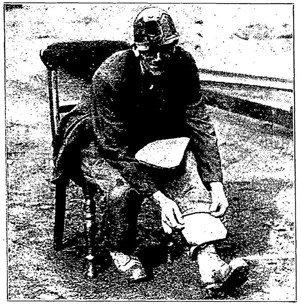
SAFER WORKING. - A Fife miner wearing leg guards of rubber and one of the
steel helmets issued to assist in making working conditions safer.
------------------------------------
"Dunfermline Press"
22 June, 1935
SAFETY IN THE MINES.
FIFE COAL COMPANY'S CAMPAIGN.
- The
last few months have seen the launching of a vigorous safety-first
campaign by the Fife Coal Company, in an effort to reduce the number of
accidents in their collieries to the absolute minimum.
At the Cowdenbeath group of collieries, posters with safety slogans are to
be seen at the pithead, while leaflets are issued to the men with advice with
a view to furthering the cause of safety. About eighty per cent of the men at
No. 7 Colliery are wearing the new safety hat, while there has been an
increase in the number of hats issued during the last two weeks at Mossbeath
and the two Lumphinnans collieries.
The accident rate during May showed a marked improvement. while in
severity improvement was also made.
A novel scheme, with which to ensure that the workers' interest in
Safety-First does not abate, has been inaugurated at No. 7 Colliery, where
each week every man receives a numbered card bearing a safety slogan.
On the following week, the numbers are drawn and prizes of 5s and 2s 6d
are awarded to the successful ticket-holders.
Considerable interest has been aroused by this innovation, which brings
the value of safety into personal contact with each individual. At that
colliery during the last month, there was only one accident resulting in
the loss of more than three days' work.
At each of the collieries there was a hat barometer, showing the increase
in the number of safety hats each day. The introduction of these has
resulted in the prevention of several accidents, and the following instances
will show the value of their advent as a very necessary part of the working
miner's equipment.
In No. 11 Colliery, Lumphinnans, a large stone fell on a brusher's head
but apart from bruising to the shoulders, the man was little the worse of the
accident. At the same colliery, a roadsman was caught between a brick
arch and a tub on the haulage road. His head became jammed, but he
was saved from serious injury by his hard hat.
A haulage worker in No. 1 Colliery, Lumphinnans, who was not wearing
a safety hat, received a scalp wound. He agreed that he would not have
received that injury had he been wearing a safety hat.
A stripper in No. 7 was struck by a stone at the coal face, which would
ordinarily have severely injured him. His safety hat took the impact, and
the only ill effect from which he suffered was a jarring on account of the
knock.
A worker at Mossbeath struck his head against a girder, but
his safety hat saved him from injury, and his only complaint was of slight
dizziness.
These hats are being sold at the low price of 1s 6d, which is half the
cost price. They are light and comfortable to wear, and are waterproof;
while another feature is, that they outlast two of the common lamp caps.
Those who are wearing them are satisfied that no underground worker
should be without one. Another innovation is the introduction of special
pit safety trousers, and a number of men are now to be seen wearing
them. A typical example of the posters to be found at the pithead is
- "DO YOUR FOLKS AT HOME KNOW THAT YOU HAVE NOT
TRIED THE SAFETY HAT?"
------------------------------------
"Dunfermline Press"
17 August, 1935
"SAFETY" TROUSERS FOR
MINERS.
- The
Fife Coal Company, Ltd., are supplying to the miners a new type of trousers, which
it is claimed will prevent damage to the miners' knees. The trousers are made
of strong cloth with pockets over the knees. In these pockets will be inserted a
rubber pad, or sponge.
The present method of protecting the knees is by means of leathery pads, strapped
round the outside of the trousers. This, it is stated, prevents the free use of the legs,
and, after a short period, is very uncomfortable to the wearer. In modern methods
of mining the men employed at the coal face work continuously on their
knees.
------------------------------------
"Dunfermline Press"
14 September, 1935
SAFETY ENGINEER FOR FIFE COAL COMPANY.
- An important
step in relation to the safety of underground workers has been taken by the Fife Coal
Company, Ltd., who have appointed Mr J. N. Williamson, of Leeds University, as Safety
Engineer.
A native of Wemyss, Mr Williamson graduated B.Sc., and Ph.D., at Edinburgh University,
and prior to taking over his new duties in Cowdenbeath, he was a lecturer in Leeds
University.
Mr Williamson, who will specialise in all matters relating to safety in the Company's
collieries, will be in charge of the training of officials, the selection of new entrants to
the industry, the training of boys, and in connection with this branch of his work
safety classes are to be arranged in the various districts.
Such an appointment is an evidence of the deep interest which the Company take
in the safety of their workmen.
The Safety Department of the Company has in previous years been under the
supervision of Mr John Ford, who has rendered much valuable service, and the
new appointment is intended to carry the work a stage further.
Mr Williamson has an outstanding knowledge of mining matters, and in addition
to being a certificated colliery manager, he is a member of the Institute of Mining
Engineers, a Dawson Scholar of Edinburgh University, and the holder of the
Diploma of the Heriot-Watt College, Edinburgh.
His previous connection with Cowdenbeath is not widely known but during the
war he was a member of the Mechanical Transport Corps, a body which was
commenced by Dr Parker of the Fife Mining School. He was awarded the
Meritorious Service Medal and was twice mentioned in despatches.
------------------------------------
"Dunfermline Press"
28 September, 1935
SAFETY CLASSES FOR BOYS.
- The safety
classes for boys employed at the Fife Coal Company's pits, or who desire such
employment, and, which are being inaugurated jointly with the Fife Education Authority,
are to commence on Wednesday next, 3rd October.
The centres of instruction for the various pits include:- The Fife Mining School,
Cowdenbeath (for Cowdenbeath pits); Oakfield Higher Grade School (for Aitken and
Lindsay pits); Ballingry Public School (for the Mary Pit, Lochore); Auchterderran Higher
Grade School (for Bowhill Pit); Kinglassie Public School (for Kinglassie Pit); Torryburn
School (for Valleyfield Pit); and Balcurvie School (for Wellsgreen).
Classes for the boys employed at the Frances and Randolph Collieries have already
started at Viewforth School, Kirkcaldy.
The teachers for the various centres are all officials of the Fife Coal Company, and
include Mr Andrew Bruce (Bowhill), Mr Thomas Duncan (Aitken Pit), Mr John Ford (Aitken
and Lindsay Pits), Mr Wm. Hunter (Mary Pit), Mr Wm. McCallum (Cowdenbeath and
Kelty Pits), Mr Andrew I. Mitchell (Bowhill and Viewforth), Mr Thos. Monaghan (Mary Pit),
Mr S. Patterson (Cowdenbeath), Mr Jas. Saunders (Frances and Randolph Pits), Mr
Chas. Taylor (Kinglassie Pit), Mr Thos. Thyne (Cowdenbeath pits), and Mr Chas.
Richardson (Wellsgreen).
------------------------------------
"Dunfermline Press"
11 April, 1936
COALOWNERS OFFER £500 FOR SAFETY LAMP.
- Impressed
with the importance of developing a thoroughly satisfactory lamp for use
underground in mines, which will not only give an automatic and unfailing signal of the
presence of fire damp, but will also provide the maximum illumination for working purposes
at the coal face, the Central Committee of the Mining Association have decided to offer a
prize of £500 for such a lamp as will pass the necessary official tests.
------------------------------------
"The Scotsman"
12 October, 1936
SAFETY IN MINES
Fife Coal Company's Work
SUCCESSFUL EFFORTS
- The success which
has attended safety in mines propaganda in Fifeshire, and other parts of the Scottish coalfields, was
emphasised at a meeting of the Scottish Branch of the National Association of Colliery Managers in
Glasgow on Saturday.
Mr James Frame, Kilwinning, the branch president, said the scheme of safety propaganda initiated by
the Fife Coal Company at a group of their collieries was deserving of commendation and emulation. It
was to the credit of its sponsors that such a scheme was in operation before anything was made
compulsory. He was inclined to think that extensive safety propaganda would be most effective
amongst youths who were entering the mines. Older miners, he feared, were prone to become
foolhardy, but if the younger school of mineworkers were taught to have "pit sense", the
benefits in the end would be substantial to the coal industry and all associated with it..
SAFETY CONSCIOUSNESS
- Dr A. Winstanley,
Edinburgh, said the Fife Coal Company were to be congratulated on the whole-hearted efforts they
were making to instil a greater measure of safety consciousness into the minds of both their officials
and workmen. He had visited many of the Company's collieries, and he could appreciate the
fact that the workmen were responding. There was not the slightest doubt, to his mind, that the
workmen were developing a safety consciousness when underground. Time must elapse, however,
before the full effect of that greater safety consciousness would be felt.
Dr Wm. Reid, of the Fife Coal Company, pointed out that the scheme in Fifeshire had made progress.
During the past nine months there had been an increase of 43 per cent in the man-shifts per
accident. That of itself was a notable step in the right direction.
In the course of discussion it transpired that other mining areas in Scotland were developing "a
sense of safety consciousness", and on the suggestion of Dr Reid it was remitted to the Council
to consider the setting up of a permanent Safety Committee in connection with the Scottish
Branch.
------------------------------------
"Dunfermline Press"
28 November, 1936
EMPLOYMENT OF BOYS IN PITS.
FIFE COAL CO.'S NEW SCHEME.
- A new system for the
training of boys has been inaugurated by the Fife Coal Company, Ltd. It
has been made a rule that boys will be given their first start at these collieries only if they are
attending the Safety Classes regularly.
A scheme has been devised, and extra boys will be given a short training in the colliery workshops
(for not more than three months) before he is taken on to the regular surface staff. Vacancies in the
junior surface staff will be filled as far as possible by boys who have had this short training.
This scheme has two objects in view. One is to give each boy some knowledge of the dangers of
machinery and electricity, and to train him to guard himself against accident by these.
The second is to fill any vacancies that arise in the engineering staff with boys who show a real
liking and aptitude for the work. The scheme has put more boys into employment than are really
required, but it is felt that the personal supervision the boys will now receive when they first start
work will be appreciated by their parents.
------------------------------------
"The Scotsman"
20 October, 1937
SAFETY GLASSES FOR MINERS
- The Fife Miners'
Welfare Committee has now obtained permission from the Central Welfare Committee to go ahead
with their scheme to provide safety glasses for all employees at Fife mines, both surface and
underground, who have defective vision. All colliery oversmen, firemen, and all grades of other
underground workers and surface workers will be eligible to receive safety glasses for use at their
work. While the glasses to be provided will be made of safety glass they will be suited to each
wearer's vision. There will be no expense to the men concerned but simply an obligation
to use the glasses while at work so as to protect their eyes from the danger of flying particles
which would otherwise break ordinary glasses. Several cases have occurred in Fife pits this
year of men losing an eye through their glasses being broken by splinters of coal, &c.
------------------------------------
"Dunfermline Press"
1 January, 1938
MINE LIGHTING AND MINERS' LAMPS.
- At the seventh of the
series of lectures arranged jointly by the Fife Education Authority and the Miners' Welfare
Committee and delivered in the Moray Institute, Kelty, Mr J. N. Williamson was the lecturer, his
subject being "Mine Lighting and Miners' Lamps." Mr John Archibald, manager,
Aitken Colliery, presided.
Mr Williamson described the forms of mine lighting which had been in use from the 16th century
up to the introduction of the new Lighting in Mines Regulations which came into force in 1936.
During the last two years, he said, the lamp industry had been, and indeed still was, in an evolutionary
stage, and until some degree of finality had been reached it would be most unwise for any colliery
company to make radical changes in their lamp equipment. As the merits and demerits of the
various available new types of lamps could only be determined by actual practical trials under pit
conditions, he considered it the wisest policy to go slowly in this connection.
To swap an existing lamp installation which still satisfied the new requirement, and install an entirely
new but untried type of lamp throughout a large colliery, would possibly court disaster. It would be
sounder for a company with a large group of collieries to fully try out the best of the new types of
lamps at its smaller collieries, say, at one colliery install all "A" lamps; at another, all "B"
lamps; and after a year's trial weigh up their respective merits and demerits. It was not as easy
a problem as it perhaps appeared. Probably, at the end of the trial period, another batch of new
types may have been produced by the same manufacturers whose previous products were undergoing
practical trials.
The lecturer also discussed the various forms of underground lighting in gassy pits other than by
means of safety lamps, and explained the reasons for the white-washing regulations.
Finally, various methods of assessing the candle-power of lamps was illustrated and explained,
the new photo-electric cell method being of special interest.
------------------------------------
"Dunfermline Press"
11 February, 1939
FIFE COAL COMPANY'S SAFETY RECORD.
- The manshifts-per-accident record
of the Fife Coal Company's collieries for the year 1938 is as follows:-
Wellsgreen, 11,626; Lumphinnans No. XI and XII., 8414; Mary Colliery, Lochore, 8319; No. 7, Cowdenbeath,
7204; Aitken Colliery, Kelty, 6004; Randolph, 5314; Kinglassie, 4475; Lumphinnans No. 1, 4333; Bowhill, 4191;
Mossbeath, 4092; Lindsay, 3328; Valleyfield, 2149; Frances, 1953; Donibristle, 1115; which gives an average
manshifts-per-accident figure of 4100.
This is 24 per cent. better than the previous year's figure, and three times better than the average for the
whole of Great Britain.
------------------------------------
"Dunfermline Press"
18 February, 1939
MINE GASES.
- In the fourth of the series
of lectures being given at the Kinglassie Miners' Welfare
Institute, under the joint aegis of the Fife Education Committee and the Miners' Welfare
Committee, Mr Robert Bell, safety inspector, Kinglassie Colliery, was the lecturer, his
subject being "Mine Gases."
Mr J. N. Williamson, safety engineer, acted as chairman.
Mr Bell said that it was a normal obligation of all those employed underground to appreciate
fully the relative dangers of mine gases, to know how to detect their presence as early as
possible, and, above all, to realise their individual responsibilities in the maintenance of
good ventilation, particularly in the region of the coal face.
------------------------------------
"Dunfermline Press"
18 February, 1939
SAFETY IN MINES CLASSES.
- The allegation that
a man who had not been down a pit for twenty years was teaching
safety in mines classes in Fife Continuation Schools was made at a meeting of Cowdenbeath
District School Management Committee at Lochgelly. County Councillor Alex. Moffat, Lumphinnans,
said the teaching of the theory and practical questions were two entirely different things. There
were plenty of young miners with first-class certificates who were capable of conducting the classes.
Three of the present teachers whom he knew had not been down a mine for 20 years, 10 years,
and 6 years respectively. The Committee agreed to inquire into the matter.
------------------------------------
"Dunfermline Press"
4 February, 1950
PIT SAFETY CAMPAIGN
A Novel Scheme
- This week, all the
22,000 workmen employed in the 42 pits in the Fife and Clackmannan area of the N.C.B. have
received a pamphlet giving details of the 1950 safety campaign which begins in earnest this
month at all the collieries. ...
------------------------------------
"Cowdenbeath Advertiser"
September 8, 1950
-
Details of a new laboratory set up at the central
workshops and offices of the NCB at Cowdenbeath were made public
for the first time following a visit by Mr Alfred Robens, MP.,
Parliamentary Secretary to the Minister of Fuel and Power. The
new laboratory is not yet completed but has been in use for some
time. Mr Robens, who was accompanied by Lord Balfour, chairman of
the Scottish Division, was met on his arrival at Cowdenbeath by
Mr L. B. Milligan, area production manager, and his deputy, Mr D.
Keir. The other members of the party were Mr H. Haddow of the
Information Branch of the Ministry of Fuel, London, and Mr J.
O´Connell, assistant private secretary to Mr Robens. As Mr
Robens was being conducted round the new laboratory by Mr L.
Cochrane, area scientist, details of this modern feature of the
coal industry were given to the representatives of the press
present. The Cowdenbeath Laboratory is the first of five to be
set up in Scotland; and is the logical development of the
original laboratory of the Fife Coal Company Limited. It serves
42 pits in the Fife and Clackmannan area with a daily output of
nearly 26,000 tons of coal per day. Its functions are designed to
produce greater safety in the mines against such occupation
diseases as pneumoconiosis and to assist the preparation
department in removing impurities from the coal. Samples of air
from all the pits in the area are analysed regularly to make
certain that air is safe to breathe and free from obnoxious gases
such as fire damp. Over 3000 samples of dust collected from the
underground roadways are analysed each month to ensure that the
dust is sufficiently mixed with stone dust to render it harmless
and non-explosive.
------------------------------------
"Dunfermline Press"
6 June, 1953
West Fife's Lead in Mine Safety
First Winners of New Scottish Trophy
- West
Fife Area of the National Coal Board, first winners of the J. N. Williamson
Safety Cup, were presented with the trophy in the North British Hotel, Edinburgh,
on Saturday by Sir Hubert Houldsworth, chairman of the N.C.B.
The Cup is competed for by the various areas in the Scottish Division of the N.C.B.,
the purpose of the competition being to raise the standard of safety in the pits. In 1952
the accident rate per hundred thousand manshifts worked was 82 in West Fife,
compared with an average for the Scottish Division of 108, and a national average of 132.
Dr J. N. Williamson, whose name the trophy commemorates, was a pioneer of safety
in the pits in West Fife before nationalisation of the industry. Dr William Reid, chairman
of the Divisional Board, paid tribute to Dr Williamson for his work.
FORDELL CONGRATULATED
In 1947 there were 73 fatal accidents in the Scottish Division. That was gradually
reduced to 47 in 1951, but in 1952 there were 58. This year again showed an improvement.
During the first four months there had been 12 fatal accidents in the pits in Scotland. For
the same four months last year there were 21. Counting all accidents causing over three
days' absence from work, the total was about 23,000 a year.
Mr King complimented Fordell Colliery, Fife. "I think it is remarkable that Fordell
Colliery had an accident rate of only 24 per hundred thousand shifts worked. The
average for the Scottish Division was 108 in 1952 and the national rate was 132."
Mr George Mullin, general manager of the West Fife area, accepted the cup from Sir
Hubert Houldsworth on behalf of his area. He pointed out that Fordell Colliery had a
safety committee 30 years ago.
------------------------------------
"Dunfermline Press"
11 August, 1962
Miners' Inventions
- Seven pitworkers
in Fife have received awards in connection with the National Coal
Board Scheme to encourage those engaged in the mining industry to put forward suggestions
and inventions to promote safety.
Mr John Reid, Randolph Colliery, Kirkcaldy, invented a device to stop a shearer when it gets
to the end of a run. He was assisted by the colliery chief electrician, Mr John Anderson.
Other recipients of awards were:- Mr J. Cramb, Central Workshops, Dysart - a key to fit all types
of hydraulic props; Mr G. Wishart, Glencraig Colliery - a special clamp for hydraulic hose; Mr R.
Jenkins, Michael Colliery - a special strut to link girders and prevent them slipping under roof
pressure; Mr W. Goodall, Nellie Colliery - a safety girder clamp; Mr J. Russell, Glencraig Colliery -
an indicator for testing winding drums; Mr W. Thomson, superintendent of Cowdenbeath Mine
Rescue Station - a new portable breathing apparatus for casualties being carried through
gas concentrations underground.
------------------------------------
"Dunfermline Press"
20 October, 1962
Mine Safety Awards
- Prizes won in the Alloa Area
Safety Draw by workmen of the National Coal Board were presented at the various collieries last week
by the Area Safety Engineer, Mr J. D. McClelland.
The major prize of £100, was won by Thomas Beattie, jun., 106 Rintoul Avenue, Blairhall,
who works at Blairhall Colliery as a roadsman. Two prizes of £5 also went to Blairhall Colliery
being won by Andrew Allan, face worker, 86 Woodmill Crescent, Dunfermline, and Thomas Bowman,
belt maintenance worker, 29 South Street, Cowdenbeath. Mr Beattie's father also works at Blairhall.
The men were eligible for the draw because of their accident-free record during the quarter to 30th
September and their attendance record during the same period.
Other prizes of £5 were won by John Gibb and William Wood, Torry Colliery; David McEwan
and James Rodgers, Comrie Colliery; and James White and James Brown, Valleyfield Colliery.
------------------------------------
"Dunfermline Press"
13 May, 1967
New-Style Self-Rescuers For Miners
-
New-style self-rescuers, the best safety device to come into the pit since the invention of
the Davy lamp, are to be issued on Monday to everyone employed at Comrie Colliery.
A stainless-steel container about the size of a 1lb. sugar bag, the self-rescuer is carried by
the miner on his belt. A mouthpiece is clenched between the teeth and, with a clip on the
nose, it allows the miner to breathe through a chemical filter which turns carbon monoxide
into non-dangerous carbon dioxide.
The Colliery will receive an issue of 1350 self-rescuers. The 1250 men employed underground
will carry this equipment every day, and the remaining 100 self-rescuers will be kept for
visitors and others who may have to go down the pit from time to time. ... Seafield is the next
Colliery in Fife on the list for the self-rescuer. It is intended by the North Area to supply the
device to every colliery in course of time.
------------------------------------
"Dunfermline Press"
25 October, 1985
- As an NUM workmen's inspector, Joe McArthur carried a miner's lamp while he and his mate made their checks on conditions at Fordell Colliery.
A tiny tallow lamp was the only hand lamp he used, during almost half a century of working down three pits.
Mr McArthur kept it when he retired and made it the first item in his now extensive collection of miners' lamps.
The unusual collection - amassed since his retiral 16 years ago - has been placed on public view for the first time, at Dunfermline District Museum, in Viewfield Terrace, Dunfermline, where it will remain in one of the glass display cases until the end of December.
Mr McArthur's collection, however, could have remained hidden to the public, had it not been for the efforts of a local antique dealer, Mr Felix Hudson.
"One of my best lamps is one which had been on display in Felix Hudson's shop, but he kept refusing to sell it to me," explained Mr McArthur. "I went in recently and asked again if he would sell it. Mr Hudson agreed on the condition that I contacted Dunfermline Museum and have my collection exhibited there. I wanted the lamp so I had to agree."
The 1940s brass Davy lamp was sold, and joined around 30 tallow, oil and battery lamps in Mr McArthur's collection.
"I was a workmen's inspector for 25 years and that was what led me to start a collection of miners' lamps," Mr McArthur said last week.
"The pits in Fordell were all worked with the naked light, so that when my mate and I were making our quarterly inspections for the NUM, I always carried one - it would tell you at once if there was the slightest sign of black damp. So, when I retired, I had my tallow lamp, a carbide lamp, and my next one was a Davy. From then on, I started visiting antique shops in every town."
Mr McArthur joined his father as a miner at Fordell Colliery in 1922, when he was only 14 years old. His first connection with the miners' union, however, came three years before that.
"I would have been 11-years-old then, and my part was to go round the village with a bell and announce the time and place for the miners' union meetings, as they were not allowed to [put] up notices on the pit head," he recalled. "I helped in the soup kitchen during the '26 strike, and from then on, I was a member of the committee in some capacity, right up to when Fordell Colliery closed down.
"During the time I was a delegate, I saw our union grow from the Fife, Kinross and Clackmannan, into the Scottish and later the National Union of Mineworkers. This to me, and all who fought for it, was a dream come true. Now I see it being torn apart, and I often wonder what Abe Moffat, John McArthur and John Wood would say today, if they were living."
Mr McArthur (77), lives with his wife, Charlotte, at 1 Droverhall Avenue, Mossgreen.
------------------------------------
Sunday, 30th September, 2001
Click on Picture to Zoom
In
-
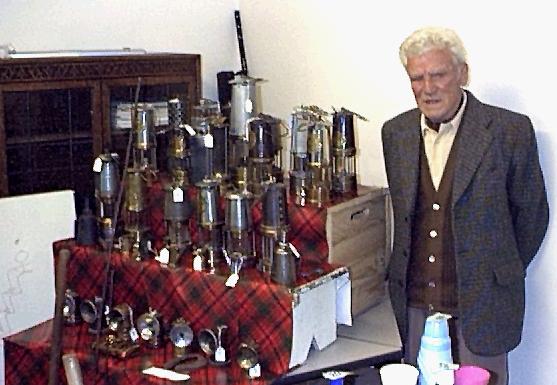
This is 94 year-old Crossgates man, Joe McArthur,
with his collection of lamps which were on display at the Mines Rescue
Centre, Crossgates.
------------------------------------
"Dunfermline Press"
17 May, 2002
Shedding light on life underground
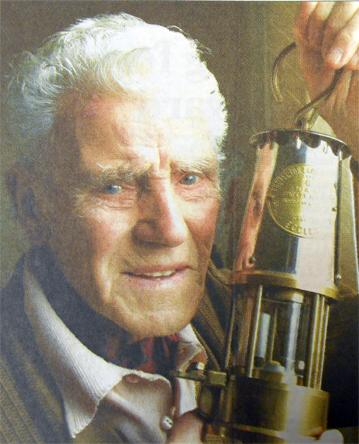
- Retired miner Joe McArthur has donated his collection of Davy lamps and other memorabilia from the pits as a reminder to future generations of the hey-day of coal.
Mr McArthur (94), from Mossgreen, Crossgates, followed in his father's footsteps to start work in the mines at the age of 14.
He retired almost 30 years ago and it was then he began his hobby of buying colliery artefacts.
Now he has decided that the Fife Mining Heritage Society should have his treasured relics of an industry now dead in Scotland, since the recent closure of Longannet.
Click on Picture to Zoom
In
Exhibits including a miner's harp, used to grade fuel, 30 lamps and an explosives box will, in years ahead, give a glimpse of conditions underground.
Mr McArthur, however, takes an unsentimental view of mining, recalling the colleagues who lost their lives.
"I would have liked the opencast mining to have come earlier simply because of the men who were killed," he said. "Before nationalisation, the conditions were terrible and at the end of the week you had to fight them for your money."
It is hoped that Mr McArthur's collection will eventually find a permanent home in a custom-built mining museum in the Kingdom.
------------------------------------
A Courier report from May 2002
Retired miner donates collection for display
- A Crossgates pensioner has donated his collection of mining memorabilia to the Fife Mining Heritage Society in a bid to keep the region's historic links with the defunct industry alive.
Joe McArthur (94) says he wants the collection which includes some of the earliest examples of miners' lamps, to stay in Fife and form part of a permanent museum display.
Mr McArthur, who was born in the neighbouring village of Mossgreen, left school aged 14 and followed his father Archie and older brother John into the pits.
He began his career at the William Colliery, which lay between Crossgates and Cowdenbeath, hauling tubs of coal through several inches of water from the coal face to the pit bottom.
During his time at the complex he worked alongside his father at the coal face and was involved in opening up new seams of coal and shafts.
Only after he retired did he begin his collection with a miner's lamp he spotted on a stall at an agricultural show in the Dundee area. For more than 30 years he built up the collection, which includes the tallow lamp he used in the William all those years ago.
Among his exhibits are one of the first types of Davy safety lamps, picks, a miner's harp, which was used for grading coal, and an explosives box.
Mr McArthur told The Courier yesterday, "There was no method involved in the collecting or any one particular reason for starting. I just felt that mining had been my life and thought it would be a good thing to collect the lamps."
He presented the collection to the heritage society this weekend on the understanding that it would be kept intact and ultimately put on display.
"I was going to give them to my grandson but I knew he wasn't really interested in them," he said. "I felt I would like the collection to be kept together for all times. I wanted to give them to Dunfermline Museum at one time, but they said they couldn't keep the collection together because they didn't have the room. I felt the heritage society would do that for me. I would like to see a mining museum at Lochore Meadows. That would be the best place for it - there's always a lot of new folk coming to the Meadows every year."
Mr McArthur recently witnessed the demise of deep mining in Scotland with the closure of Longannet Colliery at Kincardine.
"That's mining for all times, I believe," he said. "I have always said it was a pity they couldn't have had opencast mining in my day, because they would have saved a lot of lives and a lot of hard graft."
Heritage society secretary Dave Reid was delighted at Mr McArthur's gesture. "This is the first major collection donated to the society with a view to us having a mining heritage centre in Fife," he said. "The preferred option is Lochore Meadows but other sites are being considered throughout Fife."
The public will have a chance to see Mr McArthur's collection at the Scottish Vintage Bus Museum at Lathalmond, near Dunfermline, this weekend. It has been included in a mobile display on Fife Council's museums and arts coach, which has been fitted out to resemble the interior of a Fife miner's home from the 1920s.
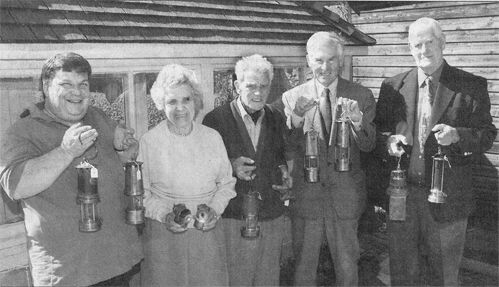
At Mr McArthur's home in Crossgates are (from left) Dave Reid; Mrs Charlotte McArthur
and Mr McArthur; heritage society member Ronnie Watt, and society chairman Bill Riddell.
------------------------------------
- We report, with much sadness, that Joe, who earlier in 2002
donated his collection of mining lamps to the Fife Mining Heritage
Society, passed away at the age of 95 years this month - December,
2002. Joe, from Mossgreen, was brought up in Fordell and had followed his dad 'down the pits' at 14 years of age.
------------------------------------
Mining history recalled through collection
The Central Fife Times, 30 Jan, 2003
A COLLECTION of mining memorabilia takes pride of place in the
display cabinet at the vestibule entrance to Lochgelly Library.
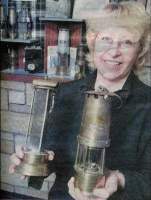 Secretary of the Fife Mining Heritage Society, Dave Reid, put
together the collection of mining lamps, which belonged to the late
Joe McArthur of Crossgates.
Mr McArthur from Mossgreen, was brought up in the village of
Fordell and followed in his father's footsteps to start a
lifetime down the pits at the age of 14.
He retired over 30 years ago and it was after his retiral that he
started collecting traditional miners lamps.
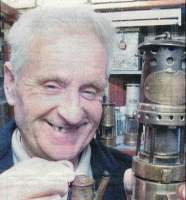 Mr Mc Arthur decided that his treasured relics of bygone mining
days should be passed on to future generations, The collection is
now in the hands of the Fife Mining Heritage Society. The temporary
display of the collection has been welcomed by Ann Bahlaj, library
supervisor (pictured left, with some of the exhibits), who said the
lamps have generated a lot of interest including that of former
miner, Mr Thomas Muir (also pictured).
The collection can be seen for the next month and Anne said the
library would welcome ideas for future displays. One of the next
displays will be in April and will tie in with Local History week.
Dave Reid has also organised "The History of Bakelite"
collection which is on display until Valentine's Day - 14th
February - in The Lochgelly Centre.
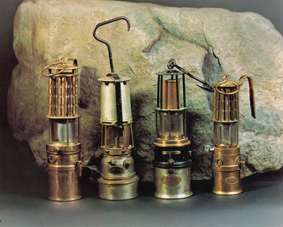
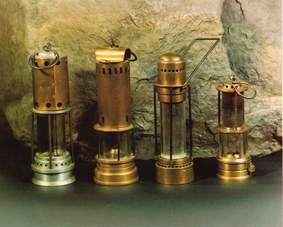
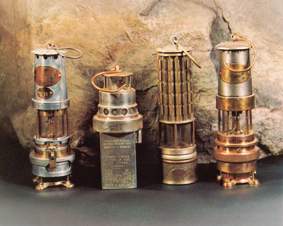
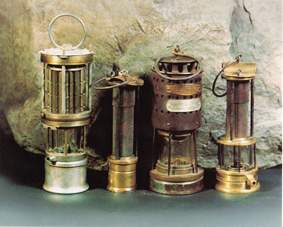
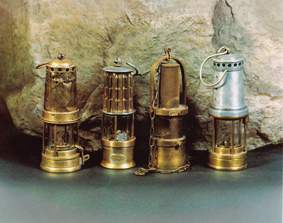
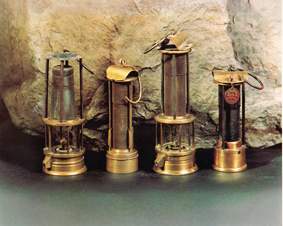
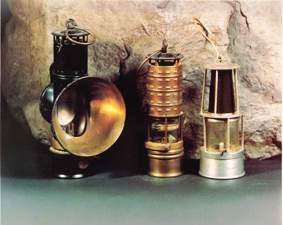
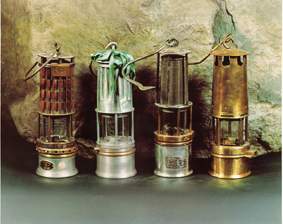
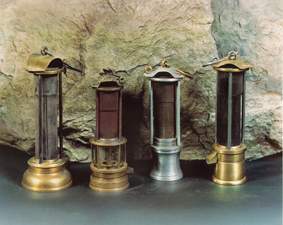
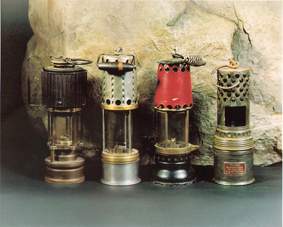
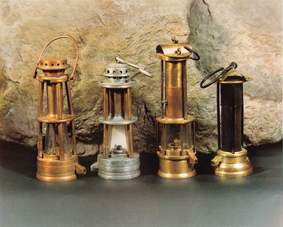
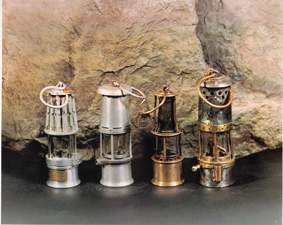
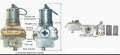
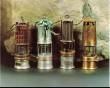
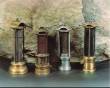
Miners' safety lamps from the past.
A selection of flame safety lamps from the Harry
Adamson collection.
We would be grateful for further information
on these lamps.
 |
 |
 |
 |
| Lamp-1 |
Lamp-2 |
Lamp-3 |
Lamp-4 |
Click on Lamp Images to Zoom
In
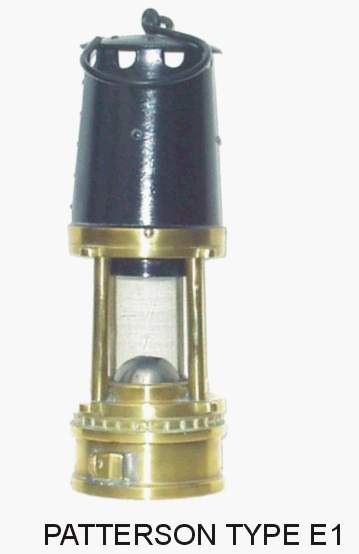
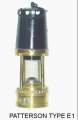
| Lamp-1
|
PATTERSON TYPE E1
The bottom ring plate of this lamp carries the stamp - Patterson
& Co. Newcastle-on-Tyne, Type E1. It is a flat wick lamp
without internal relighting means. Electrodes in the base and
adjacent to the wick tube allow it to be relit from an external
induction source.
We understand the Company amalgamated to become Wolf-Patterson and
finally Wolf. |
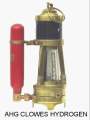
| Lamp-2
|
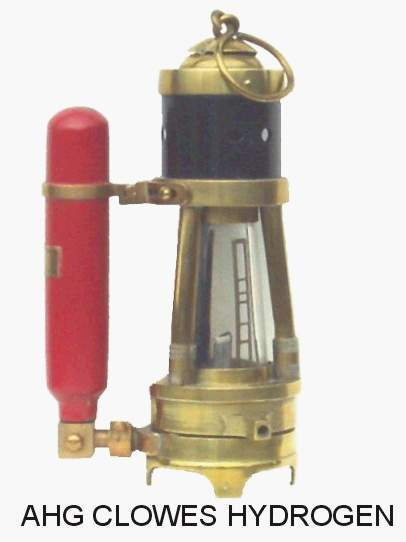
AHG CLOWES HYDROGEN
This lamp is a standard Ashworth-Hepplewhite-Gray (AHG) lamp
modified to use the patent application made by Clowes. This patent
is in the form of a detachable cylinder containing compressed
hydrogen which, when turned on by the cylinder valve, replaces the
oil wick flame to give a much better indication of firedamp in the
lower concentrations of 0.25% to 3%.
Apparently the lamp was in use from about 1892 until the late
1920's but did not get approval for use in 'safety
lamp' mines. |
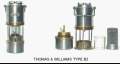
| Lamp-3
|
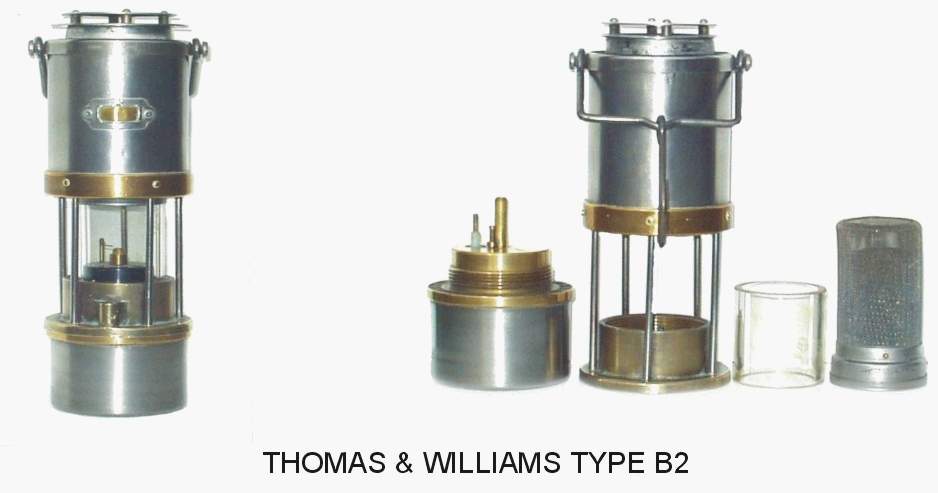
THOMAS & WILLIAMS TYPE B2
According to a circular plate on the topmost ring, this lamp was
manufactured by Thomas and Williams Ltd. Aberdare, Glamorgan. It is
a Type B2 with Ministry of Power Safety Lamp Approval No. B2/209.
It has the innovative features of a double skinned ventilated
bonnet with a single gauze and an internal relighting source
provided from a hand operated induction generator in the base of
the lamp. |
| Lamp-4
|
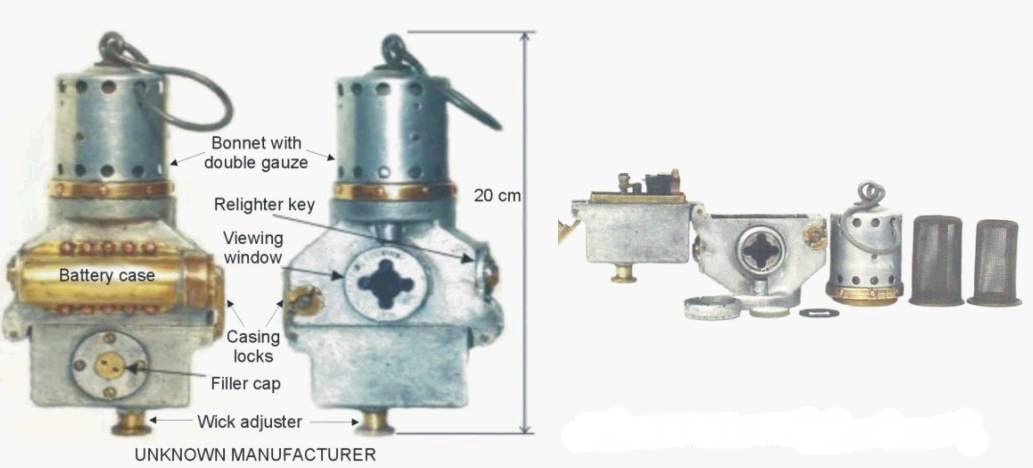
UNKNOWN MANUFACTURER
This lamp is a bit of a mystery. It uses the principle of the
flame safety lamp purely as a firedamp detector, without provision
for illumination. A platinum/tungsten filament powered by a 1.5 V
dry cell provides the internal relighting. The flame of the round
wick is observed through a viewing window of toughened glass.
The only distinguishing marks are found on the circular brass end
cap of the battery case - Oldham & Sons Denton Manchester Type
OD, but this may only apply to the battery/battery case.
|
 |
 |
 |
| Lamps, Set-1 |
Lamps, Set-2 |
Lamps, Set-3 |
Click on Lamp Images to Zoom
In
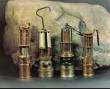
| Set - 1 |
Set - 2 |
Set - 3 |
|
Acetylene Safety Lamp, Wolf of America
|
Bonneted Marsaut Beard-Mackie Sight Indicator, A.M. Safety Lamp
& M.S. Co. America
|
Spiralarm Methane Indicator Lamp, J.H.Naylor of England
|
|
Acetylene Safety Lamp, Arras of France
|
Bonneted Clanny Lamp, probably English manufacture
|
Methane Indicator Lamp, International Gas Detectors of England
|
|
Acetylene Safety Lamp, Wilhelm Seippel of Germany
|
Shielded Davy Lamp, Upton & Roberts of England
|
Fleissner Singing Methane Indicator Lamp, Wolf of America
|
|
Acetylene Safety Lamp, Wolf of America
|
Unbonneted Clanny Lamp, J.H. Naylor of England
|
Spiralarm Methane Indicator Lamp, J.H.Naylor of England
|
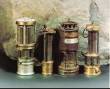 |
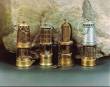 |
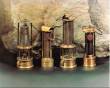 |
| Lamps, Set-4 |
Lamps, Set-5 |
Lamps, Set-6 |
Click on Lamp Images to Zoom
In
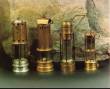
| Set - 4 |
Set - 5 |
Set - 6 |
|
Surveyors/Engineers Lamp, Wolf/Mullins Manufacturing Co. of America
|
Bonneted Clanny Lamp, Davis of Derby, England
|
Unbonneted Clanny Lamp, A.M. Safety Lamp & M.S. Co. America
|
|
Unbonneted "Fire Boss" Davy Lamp, English Manufacture
|
"Junior Wolf" Lamp, Wolf of America
|
Davy Lamp, English Manufacture
|
|
Bonneted Mueseler Lamp, Hailwood & Ackroyd, England
|
Unbonneted Surveyors/Engineers Lamp, Wolf of America
|
Unbonneted Clanny Lamp, Hughes Bros., America
|
|
Unbonneted Clanny Lamp, J.W. Queen & Co., America
|
Bonneted Clanny Lamp, Thomas & Williams, Wales
|
Davy Lamp, Everhart, America
|
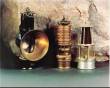 |
 |
 |
| Lamps, Set-7 |
Lamps, Set-8 |
Lamps, Set-9 |
Click on Lamp Images to Zoom
In
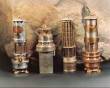
| Set - 7 |
Set - 8 |
Set - 9 |
|
Twin Burner Station Lamp, Wolf & Co., America
|
Standard Flame Safety Lamp, Japanese Manufacture
|
Davy Lamp, E.Thomas, Wales
|
|
Special Lamp for use in Turkey, Wolf & Co., America
|
Standard Flame Safety Lamp, Chinese Manufacture
|
Unbonneted Clanny Lamp, E. Thomas, Wales
|
|
Unbonneted Marsaut Lamp, I.J. Szombathy Co., America
|
Standard Flame Safety Lamp, Friemann & Wolf, Germany
|
Davy Lamp, A.S.I. & M.S. Co., America
|
|
|
Standard Flame Safety Lamp, Spanish Manufacture
|
Davy Lamp, English Manufacture
|
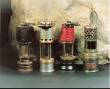 |
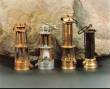 |
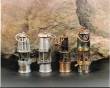 |
| Lamps, Set-10 |
Lamps, Set-11 |
Lamps, Set-12 |
Click on Lamp Images to Zoom
In
| Set - 10 |
Set - 11 |
Set - 12 |
|
Bonneted Clanny Type Lamp, Patterson Lamps Ltd., England
|
Ashworth-Hepplewhite-Gray Type, A.S.L. & M.S. Co., America
|
Bonneted Baby Wolf Lamp, Wolf Co., America
|
|
Standard Safety Lamp, Koehler/Seippel, Germany
|
Ashworth-Hepplewhite-Gray Type, Davis & Son Ltd., America
|
Bonneted Baby Wolf Lamp, Wolf Co., America
|
|
Station/Storehouse Lamp, Wolf Co., America
|
Shielded Clanny Lamp, A.S.L. & M.S. Co., America
|
Unbonneted Baby Wolf Lamp, Wolf Co., America
|
|
Radiator Lamp, Wolf Co., Germany
|
Newcastle Type Davy Lamp, Maker Unknown
|
Dwarf Officials Lamp, Davis of Derby, England
|