The lands of the Wemyss estate around the small villages
of East and West Wemyss were mined for many centuries,
probably since the 13th century, and some of its ancient
underground workings may in fact date from the same period
when serfs first wrought coal for the monks of Dunfermline
Abbey, to the west of this area.
Coal used to outcrop on the shore of the River Forth, at
Wemyss and at Methil, and level mines, or heughs, were driven
into these seams until the coal was exhausted. Shafts had to
be sunk to reach the lower coal seams which, in many cases,
stretched out under the River Forth.
The earliest documentary record of coal working in the Wemyss
area is from November, 1428, and it refers to coal works
which had already been in existence for some time.

|

|
 |
 |
 |
 |
 |
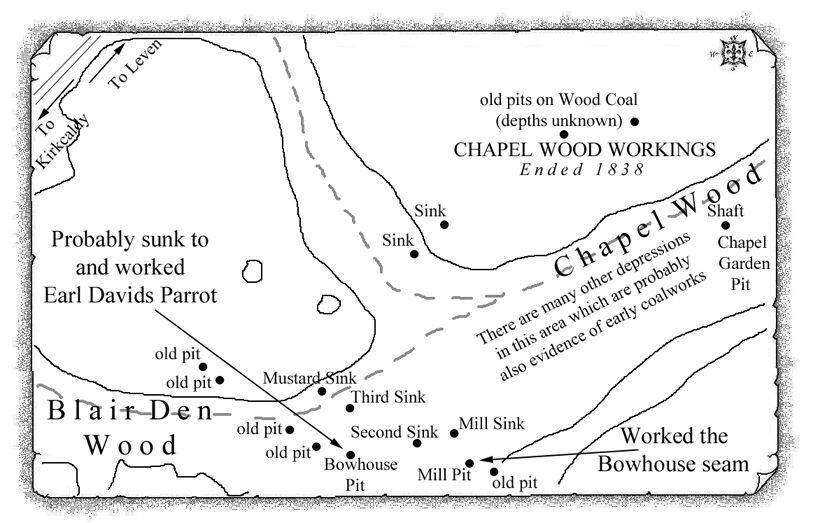 |
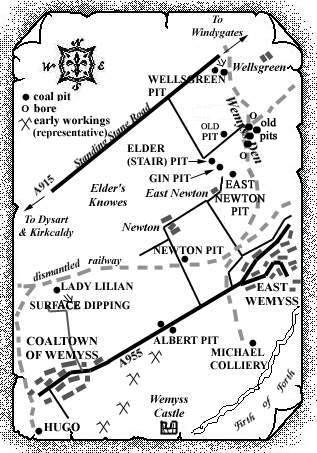 |
Extract from the Statistical Account of Scotland - Wemyss Parish (1791)
"... Ironstone has lately begun to be wrought; but what deserves here particularly to be noticed is the excellent coal with which this parish abounds and which has been wrought for some centuries. In the west ground of the parish, besides what is called Dysart coal, (which is 21 feet thick, with 3 feet of coarse coal left for a roof) of which a very extensive field remains to be wrought in the estate of Wemyss, there are other 10 or 11 workable seams of coal, most of which have been wrought above the level of the sea. The principal seam of the 10 or 11 is now working between 50 or 60 fathoms below the surface. This seam is 10 feet thick, but 8 feet of it is only wrought, viz. 5 feet of very fine splint, and 3 feet of free, the other 2 feet being left for a roof. The water is raised by a steam-engine. The coal is brought to the pit-bottom by horses under ground, and then raised by horse-gins. Coal for exportation is driven in large waggons from the pits to the harbour of Wester Wemyss. The other seams in this part of the parish, which have been wrought, are all entire below the level of the sea, excepting one, a small part of which was wrought near the sea, about the year 1656, at which time the water was drawn off by horses.
In the east ground of the parish, there are several workable seams of coal. The Right Hon. David Earl of Wemyss, (a nobleman of a great and public spirit), who kept a particular account of the coal, written with his own hand, mentions seven seams of coal which he had cut through in making a level mine from the sea-shore, which he drove upwards of 600 fathoms across the metals. In working this level in 1671, he observes, 'I am still working that level in stone, with two men in it day and night (except Sundays). I give them 10 s. Scots a-day, their bearers 4 s. Scots a-day, the windles men get 6 s. Scots a day or night. I sharp their picks and furnish their candles.'
The only seams that have been wrought in this part of the parish for a considerable time were, one 8 feet thick, and 20 fathoms from the surface, and another much about the same thickness, and 7 fathoms deeper. The main coal is 12 feet thick, of an excellent quality, and was always preferred at the foreign markets. It was formerly wrought to a considerable depth by two engines, at Kirkland of Methil, which were driven by the water of Leven. To the S. of Kirkland this coal is cut off by a hitch or dike, which throws it down 30 fathoms. This has lately been cut out under the care of a very ingenious and active engineer, and the coal is now working level free. A waggon-way of 2 miles from the pits to the harbour of Methil is now completed, and everything promises an extensive trade; and indeed, from this seam of coal, with others lying contiguous, it would not be at all surprising to see, in a few years, Methil rank among the first coal-ports in Scotland.... "
Extract from the Statistical Account of Scotland - Wemyss Parish (1838)
"... This parish rests upon rocks which belong wholly to the coal formation. From the river Leven, even as far west as Wemyss Castle, the strata are composed of dark red sandstone of various degrees of hardness, colour, and durability. From Wemyss Castle, along the shore and western boundary, there are twelve workable seams of coal, of the aggregate thickness of 89 feet 5 inches. The rocks between these seams of coal are, shale, sandstone, slate clay, and argillaceous ironstone, in bands and balls. These rocks alternate in beds of very various thickness. There is also a seam of yellow ochre, but not a particle of limestone; neither is there any greenstone (or whin) belonging to the strata. ...."
"... There are four coal-pits in this parish, one
ironstone pit, and one ochre pit. The Wemyss coal-pit employs
140 men, 24 boys and 42 girls. The yearly produce is about
40,000 tons. The selling price of the splint is 8s. 6d. per
ton. This pit is sunk upon the main seam, which is 9 feet
thick, and has been wrought to the depth of 100 yards below
sea level, through the whole length of the parish, and has
been working constantly for the last two centuries.
The next working is the parrot or gas coal, which is wrought
level free, no machinery being necessary. It employs about 20
men, and is sold for 10s. per ton.
The other two pits are wrought exclusively for land sale;
they employ about 50 men, 20 boys, and 7 girls.
The ironstone working employs about 35 men and 3 girls.
The ochre pit is but newly commenced. The whole number of
people employed in mining and mining operations may amount to
300 men, (170 of whom are colliers), 44 boys, and 52 girls.
Their operations, however, require the employment of many
other hands, such as smiths, wrights, masons, &c. They
all receive their wages every two weeks, the payment of which
is upwards of £400.
There are several very powerful engines employed in this
very extensive coal establishment. And it is but justice to
add, that all the recent improvements in mining machinery
have been here very successfully and advantageously
introduced and applied, and are all under the very active and
efficient management and direction of Mr David Landale,
mining engineer. ...."
"... and East and West Coaltowns are inhabited by colliers, and who are all in the employ of Captain Wemyss. ...."
| Wemyss coal-works -
18th C employees
(service dates unknown) |
|---|
| Andrew Thomson,
coal grieve, to Earl of Wemyss - died 2 Mar 1737
John Hutton, coal grieve, at Weems, pre 1792 |
We have entered a large number of individual entries for Wemyss area pits or mines in the West Fife Index, including:
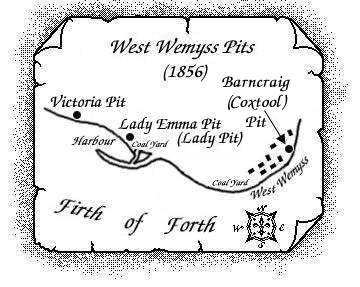
Albert, Bowhouse, Chapel Garden, Chapel Wood, Denbeath (later Wellesley), Duncan, Earlseat, Engine, Hugo, Lady (Emma), Lady Lillian, Lochhead, Michael, Mill, Muiredge, Newton, Percival, Pirnie, Leven, Victoria, Wellesley (formerly Denbeath), Wellsgreen
----------------------------------------------------
William MacLeod, Guardbridge, passed these snippets of information to Chris Sparling,
'Webmaster':
"Hi Chris,
On reading your email, I turned to A. Brotchie's "Wemyss Private Railway".
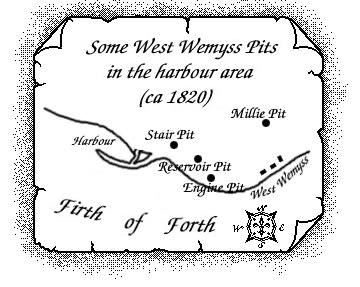
... He also refers to a survey and plan made by a James Knox in 1803 which indicates the Stair,
Reservoir, Engine and Millie Pits. This refers to a tramway that ran from the salt pans to the Dip Pit
at East Newton. (I imagine this to be east of Newton farm which was approached by Scott's
Road that headed north to the farm at right angles to the Coalton-East Wemyss road. The
WPR loco workshops were located east of Scott's Road in my early years.
Reservoir obviously referred to the collected sea water that was fed to the pans for evaporation to
obtain salt. There was such a reservoir at East Wemyss which the locals referred to as the 'Dookin
Dub'. However, I suspect that there was another on the shore, east of West Wemyss village, as close
to there can be seen the base of the original windmill (pumping sea water from the sea to the reservoir.)
The pan coal came by an ancient tramway from the Dip Pit at East Newton. Westwards of this location, and
on the shore, was the Barncraig Pit. This was said to have had a Boulton and Watt engine. Was this the same
pit as the engine pit, or had there been a space between the two? The Barncraig Pit was dated 1837 and I
suspect that my great-grandfather had worked there as a youth before going to the Dunnikier pits, but I have
no proof.
No. 7, or the Victoria, was opened in 1837 after the Barncraig was abandoned due to flooding. Perhaps you
could lay hands on Knox's plan? I had hoped to do some such thing years ago but never got round to it .
This data will be of little use to you but it might provide some sources of information."
----------------------------------------------------
Wemyss Colliery
| Source Date of Information (Owner) |
|---|
| Manager / Under-Manager / Men underground / Men above ground / Coal seams worked |
| 13th century
Sir John of Methil and Wemyss - early coal heughs. |
| 17th century
John, First Earl of Wemyss David, Second Earl of Wemyss |
| 18th century
Hon. James Wemyss |
| 1842 (Captain James
Erskine Wemyss, R. N.)
Thomas Bywater, agent to Wemyss Collieries |
| 1857-60 (J. H. E. Wemyss) |
| 1866
Mr. W. Carey, Manager - newly appointed |
| 1868
Mr. David Kerr, Underground Manager |
| 1869 (R. G. E.
Wemyss)
Mr. Terris, Foreman Engineer |
| 1872
Mr. Henry Hunter, Underground Manager |
| 1880 (J. H. B. Wemyss) |
| 1890 (R. G. E. Wemyss) |
| Andrew Crookston,
Manager
Duncan, Hugo, Lady, Lady Lilian and Victoria Pits operating. |
| 1894
Wemyss Coal Co. Ltd. formed - R. G. E. Wemyss (Chairman) |
| 1896 (Wemyss Coal Co. Ltd.) |
| Andrew Crookston / Hugh Meikle / 362 / 110 |
| Household, manufacturing and steam coals, and fireclay. |
| 1902 (Wemyss Coal Co. Ltd.) |
| James Hardie / James Wilkinson / 853 / 157 |
| Household, manufacturing and steam coals, and fireclay. |
| 1904 (Wemyss Coal
Co. Ltd.)
Earlseat, Lochhead and Michael Pits operating. |
| 1905 (Wemyss Coal
Co. Ltd.)
Cameron, Denbeath, Earlseat, Lochhead, Michael, Muiredge and Rosie Pits operating. |
| 1910 (Wemyss Coal Co. Ltd.) |
| April: Management changes
result in the appointment of agents: Eastern Division: Wellesley, Muiredge, Cameron and Rosie. Mr George Budge, formerly under-general manager. Western Division: Michael, Victoria, Lochhead, and Earlseat mines. Mr Howieson, formerly manager at the Michael pits. |
| April: Mr Archibald Bowman appointed manager
at Wellesley following death of Mr Peter Dunsire. Mr Archibald Sharp appointed manager at Michael Colliery. |
| 1933 (Wemyss Coal
Co. Ltd.)
Captain Michael Wemyss (Chairman) Lochhead, Michael, Rosie and Wellesley Pits operating. |
| Now refer to individual pit entries in EAST FIFE INDEX. |
--------------------------------------
| Plans of Abandoned Seams for Wemyss | Pits or Mines designated in Plans |
|---|---|
| COAL; Barncraig or Eight Feet; Chemiss; Parrot; Brankston; Bowhouse | WEMYSS |
| COAL; Chemiss (1837) |
RESERVOIR
Engine; Newton; Wemyss |
--------------------------------------

"Fifeshire Journal"
25 January, 1834
WEST WEMYSS
On Friday, while Mr. Crombie, mason, was employed in taking down a brick wall in one of the coal-pits in this neighbourhood, a piece of stone, at least a ton weight, fell on his head and crushed him to death. Being well known and generally respected, his untimely fate has caused much regret.
-------------------------------------------------
"The Scotsman"
27 February, 1836
TO COALMASTERS AND OTHERS.
ABSCONDED from his WORK, and FAMILY, about three months
since, THOMAS MARTIN, Collier.
The said THOMAS MARTIN is about
42 years of age, has dark hair and complexion, with several slight scars on
the face. Height from 5 feet 9 inches to 5 feet 10 inches. Halts a little in
walking.
Previous to absconding was employed at the WEMYSS COLLIERY,
FIFE, where he had been for the last seven years.
Any positive information
regarding the above person is requested to be sent to Mr Bywater, Wemyss Colliery,
by Kirkaldy.
Wemyss Colliery, 24th Feb. 1836.
-------------------------------------------------
"The Scotsman"
9 November, 1836
TO COAL-MASTERS AND CAPITALISTS
To be LET, for such number of years as may be agreed on,
THE extensive and very valuable COAL FIELD of METHILL, in Fifeshire, the
property of Captain Erskine Wemyss, M.P.
The above field contains seams of Gas-Coal, Splint, and Household or Cubical
Coal, severally varying in thickness from 10 or 12 feet to 2½ feet.
When formerly wrought, the Methill Coals bore the very first character in the
shipping markets especially; and from a survey made previous to the discovery
of several of the seams, it appears that a fitting of 100 fathoms, would win a
breast of coal capable of yielding 60,000 tons annually for 70 or 80 years.
The harbour of Methill (the lowest in the Frith of Forth at which coals can be
shipped) may, at comparatively little expense, be made to be one of the first class,
whether as regards capacity, depth of water, or security; and as the fitting on the
main coal would be within two or three hundred yards of it, the facilities for extensive
shipments would be all that could be desired.
A plan of the field, together with the surveys and reports, and the leading conditions
of a lease, may be seen on application to Captain ERSKINE WEMYSS, M.P.,
Wemyss Castle, Fife; to Mr BYWATER, factor on the estate; or to Messrs WALKER,
RICHARDSON, & MELVILLE, W. S., 110, George Street, Edinburgh.
Edinburgh, Nov. 8, 1836.
-------------------------------------------------
"Fifeshire Journal"
9 April, 1840
WEST WEMYSS - TESTIMONIAL
An elegant theodolite, by Abdie and Son, has
just been presented to Mr Landale, Mining Engineer, on the occasion
of his leaving the Wemyss works. The instrument, which is
beautifully finished, is enclosed in a neat mahogany box, bearing
the following inscription:-
"Presented to D. Landale, Esq., on his
leaving the Wemyss Collieries, by the Workmen, as a token of esteem
for personal worth, professional ability, persevering energy, and
the faithful discharge of arduous duties, during a period of 15
years - March, 1840."
During the long period of Mr
Landale's connection with these extensive works, which has
embraced the management of a system of operations peculiarly
complicated and difficult, he has in every way conducted himself so
as to command the esteem of all concerned, and he carries with him
their best wishes.
-------------------------------------------------
"Dunfermline Press"
19 October, 1861
WEST WEMYSS - ACCIDENT
On the afternoon of Saturday last, while a young lad, son of Mr. James Hughes, miner, was ascending the pit of the Wemyss Colliery in an empty hutch, one of the heavy planks with which the pit is lined fell in, striking him on the arm and carrying the lower part quite away.
-------------------------------------------------
"The Scotsman"
1 June, 1863
PROPOSED NEW RAILWAY IN FIFE.
For some time past the necessity of getting a line of railway laid down in the parish of Wemyss, for the convenience of the large traffic carried on in coal, &c., has been occupying the attention of the business men of the district; and, with a view of attaining the desired object, a deputation recently waited upon the manager of the North British Railway Company to urge the claims of the parish. Since then, statistics have been furnished showing the present amount of traffic, and, acting on these, the company's engineer has gone over the ground. From what we learn of his survey, the proposed line will be of easy construction. It is contemplated to lay down a single line leaving the main line about Dysart station, and proceeding eastwards to Methil, a distance of about six miles. The line will be kept close to the different coal-pits on the Wemyss estate, and suitable stations will be provided at West Wemyss, East Wemyss, Buckhaven, and Methil.
-------------------------------------------------
"The Scotsman"
Monday, 27 July, 1863
Saturday, about half-past twelve o'clock, an alarming fire was discovered in the library of Wemyss Castle, the residence of the respected member for the county of Fife, Mr J. H. E. Wemyss. ... A special messenger was sent to Kirkcaldy for the fire-engine, and orders given for the stoppage of the collieries in the neighbourhood, in order that the men might assist in carrying water. ...
-------------------------------------------------
"Dunfermline Press"
26 May, 1866
EXPECTED RISE OF WAGES
The colliers of Wemyss Colliery asked 4d. per ton of an
advance last week upon what is termed the rough coal, working
in the Victoria and Lady pits, longwall system.
A deputation waited on the new manager, Mr Carey, on Tuesday
evening, when they received an advance of 3d. per ton on
great coal, which will be a rise on the day's wage of
about 6d. on former wage. We may remark the weight the men
give for the ton is 23 cwt., exactly a penny per cwt. for
hewing, certainly not an exorbitant sum for so much labour in
such an extremely dangerous and very often ill-ventilated
atmosphere.
-------------------------------------------------
"Dunfermline Press"
2 February, 1867
WEMYSS
A new shaft is being sunk for a coal pit near Methil Hill.
-------------------------------------------------
"Dunfermline Press"
18 May, 1867
REDUCTION OF WAGES
The miners of Wemyss and Dysart collieries have had their wages reduced to the extent of threepence on the ton. Dysart commenced the reduction on the 13th inst., and Wemyss commences on the 20th. They had a penny per cwt. formerly, and we think a penny per cwt. should be the minimum price for hewing coal at the dullest time, as it is well known the labour of the miner is heavy, and he is exposed to a great amount of danger while at work, besides his liability to a premature loss of health for want of pure air to breathe while working.
-------------------------------------------------
"Dunfermline Press"
25 May, 1867
REDUCTION OF MINERS WAGES IN FIFE
The miners' wages have this week been all more or less reduced. In the Dunfermline districts the wages are reduced to the extent of 3d. and 4d. per ton, which tells sadly on a day's wage. In Wemyss and Dysart a similar reduction has been made.
-------------------------------------------------
"Dunfermline Press"
8 June, 1867
WEST WEMYSS - ACCIDENT
On Wednesday, while David Herd, a coal trimmer, was engaged at work, he got his hand severely bruised, fracturing one of his fingers.
-------------------------------------------------
"Dunfermline Press"
14 December, 1867
REDUCTION OF WAGES
The miners at Wemyss Colliery, along with other workmen, have had to submit to a reduction of their wages to the minimum standard (1s. 7d. per ton of 23 cwt). This is a very unpleasant state of matters, especially when they have to work on short time, and when provisions at this season are so high.
----------------------------------------------------
"Dunfermline Press"
7 March, 1868
Mr. David Kerr, lately underground manager of the Wemyss Collieries, has been admitted an ordained land-measurer and surveyor within the county of Fife.
--------------------------------------------------
"Dunfermline Press"
9 May, 1868
WEST WEMYSS - TRADE
The mining trade in this locality is still continuing dull - the miners only having eight or nine days' work in the fortnight.
--------------------------------------------------
"The Scotsman"
18 October, 1869
WEMYSS. ... The Mining Trade. - The coal trade is very brisk here at present, and at the several pitheads old stocks are much reduced, while the newly dug sells readily for foreign shipment and home consumption.
--------------------------------------------------
"Dunfermline Press"
27 November, 1869
WEST WEMYSS - ACCIDENT
On Tuesday afternoon an accident of a somewhat serious nature occurred to Mr. Terris, the foreman engineer of the colliery here. He had descended a pit for the purpose of superintending some repairs that were to be made on the underground engine. While it was in motion, he was caught by the rope which draws the coals up an incline, and dragged along till within a few feet of the drum before the engine could be stopped. He thereby sustained several severe internal injuries, but these are not expected to prove fatal.
----------------------------------------------------
"Dunfermline Press"
3 October, 1874
WEMYSS - VALUABLE COAL SEAM
A party of explorers have discovered a rich coal seam close upon the beach at Wemyss. It is fully six feet in thickness, crops out near the surface, and is of superior quality. Several tons had been removed before the proprietor was made aware of its existence.
---------------------------------------------------
"The Scotsman"
2 June, 1875
WEST WEMYSS - SHIPMENT OF COAL. - The shipment of coal at the Wemyss Colliery during the month of May amounts to 8495 tons, the greatest month's shipment that has ever taken place there. The new wet dock is a great inducement for vessels, especially foreign ships, to which the trade of the port is now almost wholly confined. At present an underground tramway is being constructed at an estimated cost of between £2000 and £3000 to connect the Hugo Pit with the harbour.
---------------------------------------------------
"Dunfermline Press"
2 August, 1879
WEMYSS - FATAL ACCIDENT
An accident that terminated fatally, occurred at Coaltown on Tuesday, to Walter Ness, miner, a young man of twenty-two, unmarried. Shortly after mid-day about two tons of the face where he was working gave way without the slightest warning, and buried him in its fall. He died the same evening.
---------------------------------------------------
"Dunfermline Press"
24 March, 1894
NEW COAL COMPANY IN FIFE
The Wemyss Coal Company, Limited, was registered
this week. The Company has been established to adopt and carry into
effect a minute of agreement with Randolph Gordon Erskine Wemyss of
Wemyss and Torrie, Fifeshire, and others, and to carry on the
business of coalmasters, ironmasters, smelters, colliery
proprietors, railway proprietors, coke, brick, briquette, and gas
makers, manufacturers of by-products, electricians, shipping
agents, harbour proprietors, merchants, &c.
Capital, £225,000 in 7500 six per cent.
cumulative preference shares of £10 each, and 1500 ordinary
shares of £100 each.
First subscribers - R. Wemyss of Wemyss and Torrie; J. Bridge, factor, Mains House, East Wemyss; Andrew Crookston, colliery manager, West Wemyss; G. W. Bruce, solicitor and bank agent, Leven; Charles Carlow, coalmaster, 8 Coates Gardens, Edinburgh; G. W. Wieland, J. P., Edinburgh; John Jordan, merchant, 125 Constitution Street, Leith.
First Directors - Randolph Gordon Erskine Wemyss of Wemyss and Torrie; George Bradley Wieland, Manor House, Shepperton; John Jordan, merchant, Leith; Charles Carlow, coalmaster, Edinburgh; Joseph Bridge, factor, Mains House, East Wemyss; and George Waugh Bruce, solicitor and bank agent, Leven - Randolph Gordon Erskine Wemyss, chairman.
Registered office - West Wemyss, Fife.
------------------------------------
"The Scotsman"
Tuesday, 26 October, 1897
THE SUBSCRIPTION LIST WILL CLOSE TODAY
(TUESDAY) THE 28TH.
WEMYSS COLLIERIES TRUST, LIMITED.
INCORPORATED UNDER THE COMPANIES ACTS, 1862 TO 1890.
CAPITAL ..... £500,000
DIVIDED INTO
25,000 ORDINARY SHARES of £10 each ... £250,000
25,000 CUMULATIVE 4½ PER CENT. PREFERENCE SHARES
of £10 each, ranking
in priority to the Ordinary Shares both as
to Capital and Dividend. ..... £250,000.
The Vendor takes one-third of the Preference Shares (being the maximum
allowed by the Rules of the Stock Exchange) and the whole of the Ordinary
Shares in part payment of the purchase price.
Mortgage Debenture Stock to the extent of £200,000 will be issued,
bearing interest at the rate of 3¼ per Cent. That Stock will be secured
heritably and otherwise by means of a Trust Deed, which will provide for its
redemption out of profits by an accumulating sinking fund of £2000 per
annum. At or after 11th November 1907, all or any of the Mortgage Debenture
Stock may be redeemed at 106 per Cent., on three months' notice. The
interest on the Mortgage Debenture Stock and the dividend on the Preference
Shares will be payable half-yearly, on 15th May and 11th November, the first
payment, for six months, being on 15th May 1898.
There is now OFFERED for SUBSCRIPTION:-
16,700 CUMULATIVE PREFERENCE SHARES at 4½ per Cent ....
£167,000
MORTGAGE DEBENTURE STOCK at 3¼ per Cent. .... £200,000
Total ..... £376,000
.................................
DIRECTORS.
R. G. E. WEMYSS of Wemyss - Chairman,
G. W. BRUCE, Solicitor and Bank Agent, Leven,
JOSEPH BUDGE, Mains House, Wemyss - Manager,
HENRY GRIERSON, Edinburgh,
JOHN OSWALD of Dunnikier,
G. B. WIELAND, Edinburgh.
TRUSTEES FOR MORTGAGE DEBENTURE STOCKHOLDERS.
JOHN JORDAN, Merchant, Leith,
CHARLES CARLOW, Coalmaster, Fife.
BANKERS.
THE BRITISH LINEN COMPANY BANK, EDINBURGH, LONDON, AND BRANCHES.
PARR'S BANK, LIMITED, LOMBARD STREET, LONDON.
SOLICITORS FOR THE TRUST.
WILKIE, YOUDEN, & BRUCE, Solicitors, Leven.
SOLICITORS FOR TRUSTEES FOR MORTGAGE DEBENTURE STOCKHOLDERS.
DAVIDSON & SYME, W.S., Edinburgh.
BROKERS - H. GILMOUR & SHAW, 18 St Andrew Square, Edinburgh.
AUDITORS - ROMANES & AITCHISON, C.A., Edinburgh.
MINING ENGINEERS - LANDALE, FREW, & GEMMELL, M.E., Edinburgh and
Glasgow.
SECRETARY AND REGISTERED OFFICE - JAMES CONN, Leven.
PROSPECTUS.
The WEMYSS COLLIERIES TRUST, LIMITED, has been formed to acquire - (FIRST)
by perpetual Feu Contract, from 11th November 1897, the Coalfields of Wemyss situated
in the County of Fife, belonging to R. G. E. Wemyss of Wemyss, including the whole coal,
ironstone, fireclay, common clay, and other metals and minerals (excepting only sand and
freestone) in the lands of Wemyss and of Little Raith, and also the Harbour of West
Wemyss; (SECOND) the rights of Mr Wemyss, under a lease from the Crown (which expires
at 1st January 1905), to work coal under the sea ex adverso of Wemyss for a
distance of two miles seaward, and also all rights he has or may be found to have in the
coal under the sea for a distance of three miles seaward ex adverso of Wemyss;
and (THIRD) the whole of the Ordinary Share Capital (less 12 shares) of The Wemyss
Coal Company, Limited, consisting of 1000 fully-paid £100 Shares, presently held
by Mr Wemyss.
The Wemyss Estate has a seaboard of nearly 6 miles along the Firth of Forth, and commands
the entrance to the great coalfield under the sea. The accompanying plan shows the
position of the mineral fields and the various harbours and railways, and from it will be seen
the quite exceptional harbour and railway facilities possessed by the Wemyss Coalfields.
The Estate of Little Raith is detached from Wemyss, but has the advantage of direct Railway
access to Methil and Burntisland Harbours.
Mr John Gemmell, of Messrs Landale, Frew, & Gemmell, Mining Engineers, and Mr Alex.
Simpson, of Messrs Simpson & Wilson, Mining Engineers, in their report dated 29th
September 1897, state that the coalfield under the lands of Wemyss (including the foreshore)
and Little Raith has an area of 12 square miles, and that under the sea out to the three-mile limit
there is a further area of 15¼ square miles. Practically the whole of the land areas
are let to the following tenants, viz.:- The Fife Coal Company, Limited; The Lochgelly Coal
and Iron Company, Limited; The Wemyss Coal Company, Limited; The Earl of Rosslyn's
Collieries, Limited; and Messrs Bowman & Co. - but excepting the lower seams of coal
in the whole of Wemyss Estate, which are unlet and intact. A vast amount of coal is unworked,
and while the quantity can scarcely be computed, the Engineers give 190,000,000 tons as
an estimate of workable coal which exists under land and sea, three-fifths of this being under
the land. This they report as "more than is necessary to maintain for 100 years the output
of 1,350,000 tons per annum, which we expect to be produced from the coalfields when the
new Michael Pits are in operation and other developments completed."
The output (on which lordships have been paid) of the whole mineral fields of Wemyss Estate,
during the last 5 years, has averaged 921,885 tons per year, and the net rents and lordships
received during that period have averaged £34,359, 9s. 11d. per annum, as per
Auditors' report dated 11th October 1897, of which a copy is hereto subjoined. These
results were obtained notwithstanding the disadvantage of insufficient accommodation at
Methil Harbour, which, however, is now being provided with an additional wet dock of about
7 acres, with 27 feet of water, already partially in use, and which will be completed in a few
months. The North British Railway line from Thornton to Methil (which was originally made
by Mr Wemyss for developing the Estate) intersects the Wemyss Property, and, by means
of branch railways serving each Pit, conveys coal direct to Methil Harbour and Docks.
The Wemyss Coal Company (Limited) has leases for 56 years yet to run of a very large
portion of the mineral fields (embracing Messrs Bowman's, whose leaseholds fall into
the Wemyss Coal Company, as they expire in 1905 and 1912) - viz., 4945 acres of land
minerals and all the rights of Mr Wemyss to 6570 acres of minerals under the sea. These
areas contained in their principal seams 134,671,000 tons of workable coal as at February
1894, per report then made to that Company by Messrs David Landale, LL.D., Alexander
Simpson, and John Gemmell, Mining Engineers. At present it has three Pits in operation,
and will in a few months complete a new winning with two Pits near East Wemyss,
capable of raising 1000 tons per day. In the above-mentioned report, dated 29th September
1897, the Engineers state:- "In conjunction with the late Dr Landale, we, on 10th March
1894, reported to the Wemyss Coal Company that their profits might be estimated at 1s. 3d.
per ton. Experience since then, and the circumstances of the Collieries, enable us to
confirm that rate of profit. On completion of the Michael Pits, that Company will have
fittings to work 500,000 tons per annum." With its own Harbour, and ready
access to Methil Docks, The Wemyss Coal Company occupies a specially favourable
position.
As the existing Coalmaster's Leases expire, the Trust may either grant new leases,
or, by working the minerals itself, secure both the lordships and the Coalmaster's
profits. Assuming that the Trust does not undertake working, but confines itself to
drawing the lordships, the following results may be anticipated:-
Average rents and Lordships or Royalties during the last five years, per Auditors' Report, appended hereto .... £34,359
Dividend on Ordinary Shares of Wemyss Coal Company, Limited, on basis of 400,000 Tons
per annum, which is expected to be reached in 1899, at 1s. 3d, as above, less £8000 for
Preferential Charges on Capital - £17,000, but tale only ..... £10,000
Annual Income ...... £44,359
From which the following will be payable:-
1. Feu-duty, payable for the Mineral Fields. ..... £8,000
2. Interest on £200,000 Debenture Stock at 3¾ per Cent. .... £7,500
3. Dividend on £250,000 Preference Shares at 4½ per Cent. ... £11,250
.... £25,750
Annual Surplus ...... £17,609
For Sinking Fund of £2000 per annum to redeem Debenture Stock, Depreciation,
Dividend on the Ordinary Shares, and Administration Expenses. The surplus of £17,609
will be increased to the extent of the Royalty now paid under the Crown lease in the event of
Mr Wemyss establishing his right to the under sea coal.
The Earning Capacity of the Wemyss Coal Company will be largely augmented on their coming
into possession of and developing Messrs Bowman's Mineral Field, and on the completion
of the extensions of the Earl of Rosslyn's Collieries, Limited, there must be large additions
to the Revenue of the Trust.
The Purchase Price is £367,000 in cash, £250,000 in Ordinary Shares, and
£83,000 in Preference Shares.
The only Contract entered into is - An Agreement between Randolph Gordon Erskine Wemyss
of Wemyss and Torrie, on the one part, and George Waugh Bruce, Solicitor and Bank Agent,
Leven, as Trustee on behalf of the Trust, on the other part, dated 21st October 1897. There
are also the current Leases between the Vendor and the various mineral Tenants, which
might be considered Contracts under Section 38 of the Companies Act, 1867. All applicants
for Shares will be held to have waived any right to further particulars of Contracts, whether
under the said Section of said Act or otherwise.
Copies of the Agreement above referred to, the Feu Contract, the Contract and Agreement
as to the Sea Coal, the Trust Deed, and the Reports of the Engineers and Auditors, can
be inspected at the office of the Solicitors to the Trust, or the Solicitors for the Debenture
Stockholders.
No promotion money has been or will be paid, and no part of the Preference Shares or
Debenture Stock has been or will be underwritten. The Vendor pays the whole expenses
incident to the formation of the Trust down to the date of allotment.
A Stock Exchange quotation will be applied for in due course.
Applications for Preference Shares or Debenture Stock should be made on the accompanying
Forms, and forwarded to the Bankers. When no allotment is made the deposit will be
returned, and if the amount allotted be less than that applied for the balance of the deposit
will be applied in reduction of the amount payable on allotment.
23d October 1897.
AUDITORS' REPORT.
44 QUEEN STREET, EDINBURGH, 11th October 1897.
We hereby certify that the output of the whole mineral fields proposed to be acquired by the Wemyss Collieries Trust, Limited, during the five years 1892 to 1896 inclusive, on which lordship has been paid, has averaged 921,885 tons per year, and that the net rents and lordships received during the period have averaged £34,359, 9s. 11d. per year. In the case of the Wemyss Coal Company the average has been taken on a period of two years and ten months, from 1st January 1894, when its operations commenced, to 31st October 1896, the date to which returns for 1896 were made up. We further certify that the average annual amount of under sea coal worked has been 23,365 tons, the lordship paid to the Crown in respect of such output amounting to an average of £201. 0s. 10d. annually, having been dealt with as a deduction in ascertaining the net royalties received by the Wemyss Estate.
ROMANES & AITCHISON, C.A.
------------------------------------
"Dunfermline Press"
11 December, 1897
WEMYSS COLLIERIES
An appeal has been made to the House of Lords against a judgement of the Court of Session in favour of Mr R. Randolph Gordon Erskine Wemyss, of Wemyss and Torry, and others, who claimed a right to work sea coal "ex adverso" of the baronies of West and East Wemyss and the barony of Methil.
-------------------------------------------
"Dunfermline Press"
14 January, 1899
ACTION AGAINST THE WEMYSS COAL COMPANY
An action for compensation, under the Workmen's Compensation Act, 1897, raising a somewhat novel question, was discussed in Dunfermline Sheriff Court on Tuesday. A man, Stewart Mulholland, was on 26th October 1898 killed in the defenders' Wemyss Pit, and the pursuer, Rachael Kilgour or Mulholland, his widow, raised the present action for the purpose of recovering £268, 2s. 6d. - three years' wages of the deceased. Defenders' agent denied responsibility for the fatal injuries, and asked the Court for an order to serve a notice of claim of indemnity, under the Workman's Compensation Act, on the contractor - the defenders' position being that, while under the Act they may be primarily liable to the pursuer in damages, the deceased not having been in their employment, but in the employment of John Keddie, a contractor, he is bound to free and relieve them of any compensation which they may have to pay. The defenders were ordered to intimate the claim of indemnity and the action to the contractor. The case was appointed to be further heard on Tuesday next.
-----------------------------------------------
"Dunfermline Press"
22 July, 1905
THE BUCKHAVEN COALFIELD
Wemyss Coal Company intend to take over the
Isabella Pit as well as Denbeath, Muiredge, and Rosie, from Messrs
Bowman & Co. The lease of the Buckhaven field expires in August
but the Isabella lease runs to 1912. It is expected there will be
an extension of capital by the Wemyss Coal Company to enable them
to effect this exchange, taking over the pits as going concerns.
Messrs Bowman & Co. entered on their lease in 1864, and greatly
developed the pits, Buckhaven in particular benefiting from their
enterprise.
Mr Archibald Bowman, the manager, is the last
survivor of the original partners in the active charge of the work,
and it is understood he will retain an important position in
connection with the works. Notices of the change were posted on
Saturday, but beyond that formal intimation the men will know no
difference. Valuators are engaged making returns as to the stocks,
machinery, timber, &c. When the new arrangements are in force,
the output of the Company will run about 2,000,000 tons a
year.
[The pits are believed to have been acquired
by the Fife Coal Company from Bowman & Co. on the
1st August, 1905.]
-----------------------------------------------
"Dunfermline Press"
19 August, 1905
THE NEW DIRECTOR OF WEMYSS
Mr Arch. Bowman, of Buckhaven, who has been appointed one of the directors of the Wemyss Coal Company, will be an acquisition to the Company, in view of the absorption of Mr Bowman's collieries by the Wemyss Company. Mr Bowman has been popular with his workmen.
-----------------------------------------------
"Dunfermline Press"
24 November, 1906
NEW PIT AT WEST WEMYSS
By the removal of the Wemyss Coal Company's offices from West Wemyss, and the shutting down of the Lady Pit, blows were struck at the old burgh barony of West Wemyss, which threatened to leave it a deserted village. At present, however, steps are being taken for the deepening of the dock entrance. Once this is accomplished a larger basin is to be constructed on the east side of the present dock, which will then likely be left a tidal harbour. It is part of the dock extension scheme that the gas works be removed and a supply of electricity offered at a cheap rate in its place. The dock extension is hastened by the decision to sink a new pit to the Dysart main seam at 125 fathoms. This seam lies intact from Bowhouse Farm to the sea, extending under the Forth, and dooks will radiate in all directions, giving the new shaft a heavy output. The Victoria Pit may also be deepened to tap fresh seams. Wemyss Coal Company intend pushing on the sinking of the new shaft at once.
-----------------------------------------------
"Dunfermline Press"
8 February, 1908
It is reported that the output of the Wemyss Coal Company for last year was 1,496,113 tons, an increase of 218,169 tons on the previous year. A dividend of 6 per cent. on the preference shares has been declared. Mr John Oswald of Dunnikier and Mr Arch. Bowman have been re-elected Directors. At a meeting of the Wemyss Collieries Trust a dividend at the rate of 5½ per cent. on the preference shares was declared.
-----------------------------------------------
"Dunfermline Press"
23 April, 1910
CHANGES IN THE MANAGEMENT OF WEMYSS COLLIERY
Mr Archibald Bowman, for many years under-ground manager at Muiredge Colliery under
Messrs Bowman & Company, has been appointed to fill the post of manager at Wellesley
Colliery, rendered vacant by the death of Mr Peter Dunsire. Mr Bowman is at present manager
of Wellsgreen.
General managers are now being appointed under the titles of agents. An agent has charge
of a number of pits, and under him is a certificated manager at each pit. Under the Wemyss
Coal Company, Mr George Budge, who for years has been under-general manager with Captain
Gordon, has been appointed agent for the eastern division of the Company's Collieries; and Mr
Howieson, who was manager at the Michael Pits, takes the post of agent of the western division
of the Company's Collieries.
Mr Budge's charge includes Wellesley, Muiredge, Cameron, and Rosie Pits; and Mr
Howieson's includes the Michael, Victoria, and Lochhead pits and Earlseat Mines. Mr Budge
is a son of the late factor on Wemyss estate. Mr Howieson was born in Perthshire. He comes from
a family which has given mining a special study, three members of the family holding first-class
certificates. His elder brother was at one time mining lecturer for Mid-Lothian, and is now engaged
as manager for the Alloa Coal Company; and his younger brother is engaged as manager at
Muirbeath and Muircockhall Collieries, Dunfermline.
Mr Archibald Sharp has been appointed manager at the Michael pits.
-----------------------------------------------
"Dunfermline Press"
27 August, 1910
WEMYSS COLLIERY DEVELOPMENTS
AN EXPENDITURE OF £260,000
The late Mr Randolph Wemyss of Wemyss Castle, chairman of the Wemyss Coal Company,
came to the conclusion that the most economical system he could introduce in connection with
coal washing was to erect a huge washer on a site contiguous to Methil docks and to convey
there all the churls and small coal of the colliery to be treated on the most modern lines.
In 1905 Mr Wemyss had a Baum washer erected at Denbeath. The washer is capable of dealing
with 100 tons of coal an hour, and with railway connections and sidings cost the Wemyss Coal
Company (Limited) about £40,000.
On a site near the washer the Company have sunk two pits, the Dysart main seam being struck
at a depth of 261 fathoms. When the Dysart main and other seams are developed it is anticipated
that the output of this colliery alone will be 2000 tons a day, and so that the coals may be placed
on the market in the best possible condition, the Company have decided to erect a second Baum
washer.
The new machine is to be larger than the first, and will deal with 150 tons of coal an hour.
The Wellesley pits and the washers will cost the Company about £260,000. The pits are lined with
brick from top to bottom, and in place of wooden slides for guiding the cages in the shafts, steel
slides are being introduced.
Coal has been worked in the vicinity of the new Wellesley pits for more than 300 years, but this is
the first time the Dysart main seam has been tapped near Methil. The coal lies under the Forth for
miles, and a lease of this mineral has been secured.
The coalfield to be tapped by Wellesley colliery is divided by a dyke. This dyke will be pierced,
and it is expected that the Chemiss splint seam will be struck on the west side of the fault at the
same level as the Dysart main seam lies on the east. This will give the Wellesley pits a great
output of household coal to the west and steam coal to the east.
So as to make room for sidings and lyes for the colliery the Wemyss Coal Company bought
up the entire hamlet of the Links of Buckhaven. The hamlet had recently a population of from
250 to 300, and the buildings once included a church and a school. The ecclesiastical and
educational buildings have, like the dwelling-houses, been taken down, and huge embankments
are being run along the site of the village with a view to connect the colliery sidings with the
Methil railway. It is from these sidings that Methil docks will be fed from the west, while after
the opening of the east dock, which is now in process of construction, the Thornton-Leven
line, which has just been doubled, will form a feeder from the east. The progress made by
Messrs McAlpine & Sons at the new dock continues to be most satisfactory, the great
sea wall being in an advanced stage.
-----------------------------------------------
"The Scotsman"
28 March, 1913
COMING-OF-AGE CELEBRATIONS AT WEMYSS CASTLE. - Yesterday there was a
great display of bunting at Wemyss Castle, Fife, when the first of the functions in connection
with the coming-of-age of Lieutenant Michael John Wemyss of Wemyss and Torry took
place. The proceedings were of a semi-private nature. It is the intention of Mr Wemyss
to have celebrations of a more public nature in August. Yesterday's function consisted
of the presenting of a silver casket and jardinière and address by the tenants of the mineral
workings on Wemyss and Torry estates, the Fife Coal Company, Wemyss Coal Company,
Earl of Rosslyn's Collieries, Lochgelly Iron and Coal Company, and the Coltness Coal
Company. Representatives of the various companies were entertained to lunch, after which
Mr Charles Carlow, J.P., managing director of the Fife Coal Company, presented the gifts to
the young laird.
Mr Wemyss suitably replied. The casket is of solid silver, 13½ inches in length and 10
inches in height. There are four panels, representing Wemyss Castle, Torry House, the Chapel
at Wemyss, and the pithead of Wellesley Colliery, delicately embossed. The six remaining
panels are filled with slabs of cannel or parrot coal from the estate mines, and the whole
ornamentation is in repousse work. The jardinière is a beautiful example of Scottish
seventeenth century workmanship by Messrs Hamilton & Inches, Edinburgh. The
presentation of the other gifts is to be made today.
-----------------------------------------------
"Dunfermline Press"
20 March, 1920
In the Bowhill Hotel on Saturday evening, Mr George Smith was entertained by a number of his fellow-workmen and friends on the occasion of his leaving the district to fill a similar position with the Wemyss Coal Company. ... Mr Smith has been in charge of the coal-cutting plant at Bowhill Colliery for the last sixteen years, and during that time he has made many friends. ...
-----------------------------------------------
"Dunfermline Press"
8 September, 1923
MINING DEVELOPMENTS AT WEMYSS.
Important mining developments are fore-shadowed in the historical parish of
Wemyss, one of the oldest mining areas in the county of Fife, and rapidly becoming
one of the foremost.
The Wemyss Coal Company are the lessees of the mineral rights. Their pits include the
Michael Nos. 1 and 2, situated on the shore at East Wemyss; Lochhead and Earlseat
Mines, some two miles north and west; Rosie, Cameron, and Muiredge Collieries, in the
vicinity of Buckhaven, with the huge modern Wellesley Colliery on the shore,
midway between Methil docks and Buckhaven.
The Wemyss estate has abundance of mineral wealth. Expert opinion reckons that the
Wemyss field embraces 14 or 15 seams of workable thickness, many of which have
been extensively developed. Yet the resources untapped are such as will provide work
for many generations of future toilers. Indeed, one authority assures us that coal will
continue to be obtained in Wemyss when other fields are exhausted. The Chemiss
Splint has lasted well. The nearer reaches are giving out, and it remains for mining
ingenuity to forward plans for tapping the almost limitless resources that stretch far
under the bed of the Firth. It is apparent that the near future will witness many
developments.
AN ENTERPRISING COMPANY.
The burgh of Buckhaven, Methil, and Innerleven, one of the most progressive in
Scotland, owes its prosperity largely to the initiative of the Wemyss Coal Company.
Let the extremist cast his aspersions as he may, the fact remains that there are few
employers who have better justified their existence.
At the head of affairs the Wemyss Coal Company are fortunate in having one whose
long connection with mining, particularly in the east of Fife, and whose grip of
modern methods amply qualify him to initiate further contemplated extensions.
It is understood that the latest plans provide for the sinking of one of the present
Michael pits to the Dysart main seam, and the probable extension of the Chemiss
Splint Dook some hundreds of yards seawards, thus securing a new grip of
valuable household coal.
There is under review the proposal to run a level crosscut mine from the new
Dysart main bottom to the utmost seaward point. The advantage of such
schemes are readily apparent - easy haulage, and convenient access to many
different seams.
When one states that this coalfield runs for some miles seaward, and stretches
roughly from Methil to the vicinity of Dysart, five miles distant, some idea of its
immensity is conveyed to the reader.
EXTENSIVE HOUSING SCHEME.
The employers at Wemyss see to the housing of their workers in commendable fashion. The newer parts of Denbeath, Methilhill, and Wemyss are models of neatness and comfort. Nowhere are workers housed more reasonably or more comfortably. Perhaps no mining community enjoys greater immunity from wage disputes. Outsiders have often remarked that the relationship between employers and employed is seldom strained to breaking point. The Wemyss Coal Company are large property owners in the district, developed mostly by their personal enterprise. At present their activities centre in the village of Methilhill distant fully half a mile northwards (sic?) from the great Wellesley Pit. Here the Company are pushing ahead with the erection of 150 houses of the cottage type of two and three apartments with garden ground attached. The development will make the birthplace of the late Mr Charles Carlow a village of considerable dimensions.
PROMISING FUTURE ASSURED.
The future development of Buckhaven and Methil is assured. It remains yet to be seen whether the tempting subsidy of £110 per three apartment house will stimulate private enterprise. The authorities are keen to facilitate matters. One may safely predict the appearance of many more shops and houses along the Wemyss tram route, rapid growth which may ultimately link the townships into a city of fairly large size. Nor is there lack of transport facilities for the travelling public - Wemyss Tram Co., and the Buckhaven Motor Carrying Co., plying between Kirkcaldy and Leven, assure travellers of convenient connection, whether on business bound or whether bent on the enjoyment of a leisurely sojourn on to the Braes o' Buckhyne or beside the romantic ruins of the Castle of MacDuff.
-----------------------------------------------
"Cowdenbeath & Lochgelly Times"
24 June, 1925
FIFE'S SEA COAL
Round about Wemyss and Dysart and at other
points along the Fife coast coal seams are known to crop out under
the sea. Occasionally, after a heavy storm, quantities of this
"sea coal" are washed up and strewn along the beach, and
gathered by people living in the vicinity, and used for fuel
purposes.
Mixed with better class coal from the pits this
"sea coal" makes a remarkably fine burning fire, and one
that lasts considerably longer than the ordinary coal
fire.
The recent storms have washed up quite a
respectable quantity of this coal on the Fife coast, and it has
been selling in Wemyss and district at 6s a ton.
There is a story told of a Fife fisherman in
former days who loaded his boat from an outcrop among the rocks,
and, however exaggerated this incident may be, it is a fact,
vouched for by the writer, that as far east as Anstruther, in which
vicinity there are no coal pits, among the rocks on the shore are
to be gathered small quantities of coal-like matter, when in summer
the boys and girls were wont to gather and kindle into a fire on
which to roast mussels and limpets.
As a matter of fact, of course, at Wemyss and
Dysart almost all, if not the whole, of the output of the local
coal pits comes from under the bed of the Firth of Forth. The pits
near Culross and Valleyfield also run out under the water, and the
same conditions apply at Bo'ness on the opposite side of the
Forth.
In the Wemyss district a shaft sunk inland many
years ago worked through good coal into a layer of burnt coal. It
was then discovered that a located lava stream running through the
seam for some reason bifurcated just at this point, and it took the
coalowner a year or more of unprofitable working to reach down to
the profitable mineral below. It is now an ascertained fact that
the greater part of the floor of the Firth of Forth is a fine seam,
which will be worked in years to come.
Mining under the sea is not difficult but as the
seam here has to be followed downwards - the dip being to the Bass
Rock - the further the working under the sea goes, the more pumping
becomes an important factor in the undertaking.
-----------------------------------------------
"Dunfermline Press"
6 March, 1926
MARE FALLS INTO PIT AT WEMYSS.
Mr Thomas Fowler, ploughman, at Bowhouse Farm, was working
Mr Aitken's pedigreed mare when it disappeared in a pit in a field
near the farmhouse.
He was at the back of his plough when, suddenly, the mare vanished,
leaving his lead horse standing on about a foot of soil. With the
assistance of about fifteen miners, Mr Aitken made desperate efforts
to save the horse, which, however, lay in its predicament for five
hours before being extricated. A passage fifteen yards long was
dug, and with the combined efforts of all men available, and a
pair of horses, the mare was hauled out laden with mud but
little or no worse of her thrilling adventure.
-----------------------------------------------
"Dunfermline Press"
15 August, 1931
COAL CENTRALISATION.
FIFE COLLIERIES AFFECTED.
The scheme of centralisation of the collieries in many quarters as a
remedy for the difficult times in the coal trade is being applied in Fife.
Already the Fife Coal Company have dropped all their concerns
save one in the eastern field. The remaining seams are likely to be
wrought in course of time by the Wemyss Coal Company from other shafts.
The Wemyss Coal Company have also abandoned Earlseat Mines, and in
the recent dispute over hours and wages they made it no secret that if Muiredge
and Rosie Pits stopped they would be closed for good. Scarcely expected,
however, was the notice at Muiredge during the end of the week, giving notice
to all hands that the pit was to be closed in a fortnight. About 700 men and boys
are affected.
Wemyss Coal Company have just completed a great shaft at East Wemyss,
which, like their shaft at the Wellesley (Methil), taps all the main seams in the
Wemyss field and also opens up to them the coal under the Forth.
They will be able to work out the remaining coal left at Muiredge, one of the
oldest collieries in the area.
More men are being taken on at the Michael (East Wemyss) Pit, as the
working places are extended, and it is hoped ere long the double shift will be
resumed in the Wellesley, absorbing most of the men paid off at Muiredge.
Low prices for shipping coal have hastened the decision to close this pit. The
Rosie, close by, is kept going with land-sale orders.
-----------------------------------------------
"Dunfermline Press"
8 October, 1932
WEMYSS PARISH.
HOUSING AND COLLIERY DEVELOPMENTS.
The late Mr Randolph Erskine Wemyss inherited all the enterprise and foresight of his great ancestor, David, the Second Earl of Wemyss. At an early age Mr Wemyss came to the conclusion that it was little launching big colliery developments without railway and shipping facilities, and so he constructed the Thornton-Buckhaven and Methil railway, and the first Methil dock, which was the fore-runner of the docks at which from 3,000,000 to 5,000,000 tons of coal a year could easily be shipped.
HOUSE BUILDING.
Mr Wemyss inaugurated his house-building schemes in the parish with the building
of a whole village - Denbeath. Coaltown, East Wemyss, and Buckhaven and Methil
Burgh afterwards came in for attention.
At East Wemyss the County Council have built a good many dwellings, and the Town
Council of Buckhaven and Methil have also given housing much consideration. In
recent years the management of the Wemyss Coal Company have taken care that
their housing schemes have kept pace with the colliery extensions and the small
old village of Methilhill has been transformed into one of the most striking mining
villages in the county.
THE CENSUS.
A glance at the progress of the parish of Wemyss as revealed in the census returns of recent decades is interesting. The following are the returns for the parish from 1801 to 1931:-
1801  -  3264		1871  -   6400
1811  -  3691		1881  -   7307
1821  -  4057		1891  -   9955
1831  -  5001		1901  - 15,031
1841  -  5403		1911  - 23,104
1851  -  5647		1921  - 24,530
1861  -  6003		1931  - 26,619
These figures show that the population was fully eight times greater in 1931 than it was in 1801, and exceeded that of 1921 by 2089. The villages of Buckhaven, Methil, and Innerleven were formed into a police burgh in May 1891.
The following table shows the census returns of the area embraced in the burgh in 1891 and each decade after:-
1861  -  2824		1901  -  8828
1871  -  3193		1911  -15,149
1881  -  4207		1921  -16,663
1891  -  6247		1931  -17,643
The figures for 1931 show an increase on 1921 of 908. Buckhaven Burgh had the distinction of being next to Dunfermline and Kirkcaldy, in point of population, in the county of Fife in 1911, and it has easily held third place, as against Cowdenbeath, since that year.
INTERESTING MINING FEATURES.
One of the most enterprising features of the late Mr Randolph Wemyss' mining records was that
of negotiating with the Woods and Forests a lease of the coal under the Forth ex adverso of West
Wemyss, East Wemyss, and Methil.
As the result the management of the coal company of today have been able to adopt a layout
underground at Wellesley Colliery, at Methil, and the New Michael (No. III.) at East Wemyss which
will enable them to operate on the whole sea area - eight miles from east to west and three miles under
the Forth.
The Denbeath Pits and No. III., Michael Colliery, are sunk to the lowest seam of the upper coal measures,
upwards of 300 fathoms in depth, and the three great shafts give an enormous hold of the coal seams
under the Forth and for long distance inland.
A MINING ENGINEER'S NINETEENTH CENTURY SCHEME.
In 1864 the late Dr David Landale, who was mining engineer for the burgh of Dunfermline for many years,
read a paper on "The Large Coalfield under the Firth of Forth", at a meeting of the Royal
Scottish Society of Arts in 1864. Dr Landale was fully alive to the value of the minerals under the
Forth, and he proposed that the field should be tackled by four collieries - one at the east end of the
Links of Musselburgh; the second at Joppa; the third on the island of Inchkeith; and the fourth at Methil.
On the south side there are three collieries working under the Forth, and there are the Michael and the
Wellesley pits on the Fife shores; but no proposal has in recent years been made by any manager or
engineer to tackle the doubtful scheme of sinking a shaft to a depth of from 400 to 500 fathoms
on Inchkeith.
Collieries on both sides of the estuary are the modern methods of operating the field.
The seam dips on each side of the Forth and soon reaches enormous depths. As indicated, the shaft
at Methil and East Wemyss are 300 fathoms in depth, and the depth is such as to indicate that in
mid-Forth the lowest seam operated on will be at least 500 fathoms under the water.
MAIN ARTERIES RUNNING SEAWARDS.
Main arteries running seawards are a different proposition to that of roads driven inland.
The former must be constructed to stand for all time coming.
In the Wellesley dooks a free use was made of heavy steel girders; in the New Michael Pit the
cross-cut level running under the Forth has been pierced through the strata a distance of 1300 yards.
The sides of the highway, which is 12 feet in width and 8½ feet in height, are constructed
of massive walls of concrete, while, all through, the roof is protected by curved steel girders.
As new working faces are opened out the roof is protected by steel props and straps in place of
wood props and "bars". At the bottom of the shafts, sidings, where traffic converges,
and at stations where conveyors run the coal into the hutches, oil lamps are discarded and
electric light introduced. As developments proceed, the management are hoping to be able to
light up the working faces by an installation of electricity. The withdrawal of coal from the solid
face is apt to keep the strata on the move. This feature forms a difficulty with face lighting, but
it is hoped that with a liberal use of steel props ands straps this trouble may be overcome.
A WORLD OF COAL.
In the new shaft as many as sixteen seams of coal of from two feet to twenty-four feet in
thickness - the aggregate being 84 feet - were cut through. A glance at the great level, which
runs seawards, at once drives the visitor to the conclusion that the colliery is in the centre of
a world of coal. All the seams between 134 and 304 fathoms have been cut as they dip into the
tunnel, and they provide an excellent variety of household and steam coals, including the
Barncraig, the Chemiss Splint, and the Dysart Main. Realising the richness of the field the
management have taken care to provide winding machinery which will cope with the largest
output of any single colliery in Scotland.
Sixty years ago there were few pits in Fife which had a daily output of more than 150 to 200 tons.
The winding-fittings of the New Michael Colliery have been constructed on a scheme calculated
to deal with 5000 tons a day. The double-decked cages carry six hutches on each deck, and
the coal brought to the surface each wind weighs as much as ten tons.
The aim of the management has been to fit the engines for a heavy load, and to move at the
rate of fifty winds per hour. The winding engine has a pair of cylinders 38 inches by 72 inch
stroke, and the bi-conical drum is 15 feet by 22 feet in diameter, while the steam pressure is 160 lbs.
A battery of Lancashire boilers of 30 feet by 9 feet is being put down, and in addition to the
electrical plant in operation in connection with the old pits, a 2000 Kw Mixed-Pressure Turbo
Generator, 6000 volts, 56 cycles, has been installed.
As developments proceed, the whole of the output of the colliery will be drawn to the surface
by the shaft, and the two old pits adjoining will be utilised for raising and lowering the operatives
and for lowering props and other material.
The machinery for dealing with water is as powerful as the winding gear, and on the pithead,
platforms every labour-saving automatic device calculated to move the loaded and
empty hutches swiftly has been adopted.
SCREENING AND PICKING PLANT.
The company have for years had a great central coal washer in operation and the screening
and cleaning plants in operation at the Wellesley and the Michael are of a type which may be
accepted by the consumer as a guarantee that all classes of coal will be well handled.
Like his ancestors, Mr Michael Wemyss, the present laird of Wemyss, takes a thoroughly
practical interest in every department of the works, and is always in close touch with the
markets. Some time ago Mr Richard Kirkby, who had much to do with the fitting and
sinking of the new colliery, retired from the post of general manager, and was succeeded
by his assistant, Mr Dugald Baird. The latter has had an excellent training and has taken
up the work with great enthusiasm. Mr Kirkby, like his late father, has had a long connection
with the collieries of the district, and on his retirement he had the distinction of being
appointed a director of the Wemyss Coal Company.
SUSPENSION THROUGH QUOTA RESTRICTIONS.
Whatever the quota may have done at some collieries throughout the county it has
not operated to the advantage of mines of Wemyss Colliery.
Throughout 1930 the opening up of the various seams in connection with the new shaft
was pushed forward with great vigour, and Mr Baird, the general manager, intended
gradually to withdraw operatives from sections of Muiredge and Rosie old pits, where
the roads are long and costs heavier than in new workings.
In the beginning of 1931, however, the quota came into operation, and the management
found that they had no alternative but to suspend temporarily work in sections of the old pits.
Through the suspension the names of 650 miners were added to the list of the unemployed of
Wemyss district.
In the course of several months a number of the men were re-employed, but before the
end of the year it was found that 1450 operatives had to be given a fortnight's holiday
so that the output of the company's works should be within the quota. After the fortnight,
work has gone on without interruption in the sections of the two old pits; but once more the
absolute restriction of the quota has necessitated the posting of a notice to the effect that it
would be necessary to suspend work in the case of 550 miners. The general manager
states that the Scottish Committee have allocated the full proportion of the Scottish quota
to the Wemyss Collieries, but it falls considerably short of the total which the company
require to meet their demands.
-----------------------------------------------
"Dunfermline Press"
10 December, 1932
EFFECT OF COAL QUOTA.
TEMPORARY CLOSING OF WEMYSS PITS.
Eight weeks ago, Wemyss Coal Co. (Ltd.) issued notices to 550 men engaged in the
surface dip section of Lochhead and Muiredge Collieries, suspending them indefinitely,
as the company had to curtail output owing to the quota restrictions.
Muiredge Colliery is likely to be closed for good, as the seams are eventually to be worked
from the Wellesley Colliery, but the quota restriction influenced the decision. ... The Wemyss
Coal Company have a output of fully two million tons annually, and employ 5000 men.
Their collieries are the latest word in mining engineering.
The Great Michael pit opened last year, is still being extended, and is one of the
best equipped in Britain.
-----------------------------------------------
"Dunfermline Press"
24 June, 1933
WEMYSS COAL COMPANY.
A fortnight ago Wemyss Coal Company gave fifteen days' notice to all their workmen that they might require to close down the pits owing to the quota restriction. In the interval the management have succeeded in buying up sufficient unused quota from another coal company, and the notices have been withdrawn.
-----------------------------------------------
"Dunfermline Press"
30 December, 1933
WEMYSS COAL CO.
STOPPAGE OWING TO QUOTA.
For the third year at this time Wemyss Coal Co. have had to give notice of stoppage of their collieries, as they have filled their quota of output. The first intimation was of stoppage on 19th December, but the Company succeeded in buying up a margin from another company, enabling them to go on till the 26th.
-----------------------------------------------
"Dunfermline Press"
31 March, 1934
WEMYSS COLLIERY.
The Wemyss Coal Company, Ltd., East Wemyss, posted notices at
their collieries during last weekend stating that all their employees, who
number fully 5000, are on day-to-day notice because of exhaustion of
coal quota.
Roughly, 20,000 persons depend directly or indirectly on the Wemyss
Coal Company's pits for their livelihood, and the uncertainty of
employment caused by the coal quota restrictions has given rise to criticisms.
Lately the Company have got over the difficulty by purchasing unused
quotas from coal owners who did not require the amount allocated to
them, and, not to disappoint their workers and customers, have paid
in the region of 10d per ton for this privilege.
The Company are in the happy position of having plenty of orders on
hand at present, and the public in Wemyss and district hope the pits
will be able to keep working. The collieries affected are Wellesley,
Rosie, New Michael, Lochhead, and Victoria.
-----------------------------------------------
"Dunfermline Press"
5 May, 1934
FIFE MINING OFFICIAL'S DEATH.
One of Fife's most prominent mining officials, ex-County Councillor Robert
Howieson, Earlseat House, East Wemyss, who for the last thirty years has been
manager and agent of the Wemyss Coal Company (Ltd), died on Monday night
at the age of seventy-two.
In 1904 he was appointed manager of the Michael Colliery, and in 1910 he was
promoted mining agent over the pits in the western area. This position he held
until his death.
Mr Howieson, who was a native of West Calder, was for many years captain
of the then famous football team, Mossend Swifts, and was reputed to be one
of the best half-backs in the country. He was for six years a member of the
Fife County Council, and served on the Licensing Bench and on the
Wemyss Water Trust. He is survived by his wife and a grown-up family.
-----------------------------------------------
"The Scotsman"
3 July, 1934
TRAINING BOYS
A scheme has been in operation for some time at the collieries of the Wemyss Coal Company (Ltd.) in which boys are given a definite training in safety matters before commencing work. A class of boys, sufficient in number to supply requirements at the pits, is taken about four times a year to suit the normal school leaving periods. The lads are not paid, and they are required to attend classes for one month. No definite promise of employment is given, but it is understood that work will be found for every satisfactory boy, and no boy is employed until he has been trained. The mental and physical capabilities of each boy are assessed, and he is placed in suitable employment.
-----------------------------------------------
"Dunfermline Press"
29 September, 1934
WEMYSS MINERS HIT BY QUOTA
The Wemyss Coal Company, Ltd., East Wemyss, two weeks ago informed their
workers that, owing to coal quota restrictions, they were compelled to give 15 days'
notice to terminate engagements.
The following notice was posted at all the Company's collieries on Wednesday:- "Further
to our notice of 11th September, we have bought enough quota to enable the collieries to work
until Friday 28th, and expect to be able to work until the end of the month."
Work will therefore continue on day-to-day notice until Sunday, the end of the month.
After that the usual fortnightly notice will operate.
-----------------------------------------------
"Dunfermline Press"
3 November, 1934
WORK AT WEMYSS PITS.
EVERY ABLE-BODIED MINER EMPLOYED.
Every able-bodied miner in the village of West Wemyss, Coaltown of Wemyss,
and East Wemyss is now employed. The manager of the Labour Exchange reports
that only 15 miners are now on the register, the majority of whom are unfit for work
underground. Twelve months ago fully 200 miners were unemployed.
Mr L. Lawson, public assistance officer, Buckhaven, states the able-bodied roll is
the lowest for many years.
Many of the unemployed have been absorbed at the New Michael Colliery, East
Wemyss, where extensive underground developments are taking place.
Quite a number of miners from West Fife coalfields are finding employment there,
but their chief difficulty is the lack of housing accommodation. Fife County Council
have sanctioned the erection of 168 houses at MacDuff Park, East Wemyss,
but a start has not yet been made with these.
-----------------------------------------------
"Dunfermline Press"
4 January, 1936
FIFE COLLIERY OFFICIAL'S DEATH.
The death occurred on Thursday of Mr Alexander Raeburn Grieve (64), a well-known Fife colliery official, who resided at the Rescue Station, East Wemyss. Mr Grieve had been employed by the Wemyss Coal Company, Limited, as superintendent of the mines rescue station during the last twenty-three years, and previously was underground manager at the Company's Earlseat Colliery.
-----------------------------------------------
"The Scotsman"
27 March, 1936
BUCKHAVEN EXTENSION
Evidence for the Objectors
DECISION TODAY
Evidence was concluded yesterday in the inquiry, which has occupied five days, into
the Provisional Order promoted by the Town Council of Buckhaven and Methil for an
extension of the burgh by 431 acres, so as to provide new housing sites and recreation
grounds. It is expected that the Commission (presided over by Mr Joseph Westwood, M.P.),
before whom the inquiry has been held in Parliament House, Edinburgh, will give its decision early
this afternoon. The County Council of Fife, the Wemyss Coal Company, and the Wemyss Trustees
lodged objections to the Order, and evidence was given on their behalf yesterday.
Mr J. R. Gifford, of the firm of Messrs Mackenzie & Black, W. S., Edinburgh, agents for the
Wemyss Trustees said the existence of the burgh depended on the maintenance and proper
development of mining, and that fact had always been present to the minds of the Trustees.
They controlled the mineral development by virtue of the ownership of the Ordinary shares of the
coal company. They co-ordinated the surface development to the development of the mines.
When they were asked for feuing ground for municipal housing or private purposes they considered
the safety of the ground, and if they refused to grant feus it was because they thought it would not
be safe for building. They endeavoured to plan the mining development in such a way as to reduce
the danger to existing buildings to a minimum. They were advised that it would be difficult for them
to retain their full discretion as to development if buildings were put up on parts to which they
took objection.
WORKABLE COAL IN THE AREA
Mr David Rankine, mining engineer, Glasgow, stated that he had visited the Wemyss Coal Company
pits on several occasions and had seen their plans with regard to the area under discussion. Witness
described the method of working in the old days, when frequent small pillars were left. Sometimes those
pillars collapsed, and the result was a surface subsidence which might be a hole or in the form of a saucer,
depending on the depth. The old workings in the area were probably over 100 years old, and witness
understood there had been collapses even in recent years. If coal was taken out from below the old
workings the result was that there was a disturbance which tended to crush or "draw" the old
pillars, causing a general subsidence. There had been such a subsidence in the last few years on the
southern side of Methilhill, and two, or possibly three, on the north-eastern side.
It was more dangerous to work a seam that had been partly worked, because then the old workings
had to be followed, whereas in working a virgin seam mining could be carried on below houses so as to
leave the minimum danger of subsidence. There were nearly 2,000,000 tons of workable coal in the
proposed extended area, which represented £750,000 in wages to miners, as well as incidental benefits.
If houses were put up which required support, they would deprive the neighbourhood of wages and the
nation of a large quantity of coal.
INCREASE IN THE POPULATION
Dr Pratt Yule, Medical Officer for the County of Fife, giving evidence for the County Council, said he
was very well acquainted with the burgh of Buckhaven and Methil, and according to his knowledge, no
industrial development was likely to take place. That was apart from mining, and he had the impression that
that would not go very much further. There was only one pit in the burgh, the Wellesley pit, and it was, he
understood, at the zenith of its output. As to the labour necessary in the coalfield, he had the impression
that possibly if a miner ten years ago raised 300 tons of coal a year, today he might raise from 400 to 420 tons.
There had been a decrease in the number of mine-workers over the whole area. It was his opinion that the
increase in the burgh within a reasonable time would be the natural increase of births over deaths. He had
known the figures for Buckhaven for the last five years was 913. He had formed the impression that the
number of houses which the burgh reasonably required was 1000 houses.
In cross-examination, witness said that between 1921 and 1931 the population rose by 73 per cent. That
was a common increase throughout the mining townships of Fife. That was the time when the mining
population went most ahead. In the future the coal development would be in the country area.
-----------------------------------------------
"Dunfermline Press"
27 June, 1936
WEMYSS COLLIERY DEVELOPMENTS.
Good progress is being made with developments at the Wemyss Coal Company's collieries.
At the new mine situated to the south of the Standing Stane Road, between Windygates and
Buckhaven, where sinking operations began last year, coal is now being produced.
A temporary wooden pithead frame has been erected. From the underground workings of this
mine a shaft has been driven upwards and has pierced the surface near the original pithead. It
will be utilised as a travelling road for the miners and also for ventilation. The mine is being
driven on the tunnel principle, faced with brickwork and cement. Levels are being driven
from the tunnels to open out the four-foot thick Bowhouse seam. Re-inforced concrete
foundations are being constructed for the new haulage engine room. Up-to-date machinery
is to be installed underground and on the surface, all worked by electricity.
The Wemyss Company are also making rapid progress at Muiredge Colliery, which was shut
down for several years owing to the distance of the workings from the pit bottom. Here a
new seam has been tapped, which will give employment to many miners for several years.
The old wooden pithead has been dismantled, and a large pithead is now completed with
steel girders.
Patent coal tippers will automatically empty the hutches into the screening plant, and the
anti-coal breaking device prevents the coal being smashed when loaded into the waggons.
At the New Michael Colliery, East Wemyss, the construction of pithead baths is nearly completed
at a cost of approximately £35,000.
-----------------------------------------------
"Dunfermline Press"
9 January, 1937
DEATH OF SECRETARY OF WEMYSS COAL CO.
The death occurred suddenly on Monday morning of Mr Robert Anderson, who had been for many years secretary of the Wemyss Coal Co., Ltd., East Wemyss. ...
-----------------------------------------------
"Dunfermline Press"
31 December, 1938
WINDFALL FOR WEMYSS MINERS.
Over one hundred and fifty miners in Wemyss area found thirty shillings extra in their
pay packets yesterday. The "windfall" is holiday pay which the men were not
paid during the summer because they were off work on compensation or owing to illness
when the holiday started.
Under the holidays with pay agreement such employees were not entitled to holiday pay.
The point has been one of the grievances between the Miners' Union and the
coal-owners on the operation of the agreement.
No agreement has been come to with the Scottish coal-owners to make the payment, but
Wemyss Coal Company voluntarily decided to make retribution to regular employees who
were so circumstanced but resumed work by 30th September.
-----------------------------------------------
"Cowdenbeath Advertiser & Kelty News"
8 August, 1941
METHIL MINERS' OFFICIAL DEAD
The death occurred on Monday of a Methil Miners' Union official and official of Methil Miners' Welfare Institute, Mr Eli Westwood, 177 Don Street, Denbeath.
He worked for 34 years in Michael Colliery, East Wemyss, and for long had been secretary of Methil branch of the Fife Miners' Union. He was 66 years, and is survived by his widow, five sons, and four daughters.
-----------------------------------------------
"Dunfermline Press"
25 October, 1941
CANTEENS FOR FIFE MINERS.
Canteens to provide hot meals for all miners in the Wemyss coalfield are being established.
One is now in operation at Wellesley Colliery, Denbeath. At Coaltown of Wemyss the ground
floor of the old schoolhouse is being converted into a canteen for workers at Lochhead Colliery.
The Baths Committee and management have agreed on arrangements for a canteen at Michael Colliery,
East Wemyss, while it is suggested that the now disused Rosie Miners' Welfare Institute building
might be used as a canteen for Rosie Colliery.
-----------------------------------------------
