Owners: Bowman and Co., Buckhaven
Wemyss Coal Co.
NCB
A pit was first sunk as Denbeath Pit on the site of older workings on the Fife coast between Buckhaven and Methil. The change of ownership in 1905 then brought about a new deep shaft and redevelopment, and, eventually, a renamed 'Wellesley Colliery' to the Methil area.
 |
 |
 |
 |
|
Displayed Courtesy of
Methil Heritage Centre |
---------------------------------------------------------
We are always grateful when website visitors pass on contributions to enhance our content and we wish to thank Gordon Sutherland, Methil, Fife, for giving permission to display his unique colourful projects based on photographs of bygone collieries.
Colin Martin & Chris Sparling, Webmasters.

PLEASE NOTE THAT THE ABOVE IMAGE IS © GORDON SUTHERLAND
---------------------------------------------------------
| Pit opened: as Denbeath around 1885 | Pit closed: as Wellesley in July, 1967 |
|---|
| Source Date of Information Supplied |
|---|
| Manager / Under-Manager / Men underground / Men above ground / Coal seams worked / Shaft Details |
| 1890 (Bowman & Co.) |
| Denbeath:
Archibald Bowman / ---------- / 235 / 40 / Chemiss, Eight
Foot / D'cast (17 x 9) 918 ft. : U'cast (10 x 5)
282 ft.
Ventilation by fan 15' x 5'. |
| Household, manufacturing and steam coals. |
| 1896 (Bowman & Co.) |
| Denbeath: Archibald Bowman / D. Cook / 237 / 47 / Household, manufacturing and steam coals. |
| 1902 (Bowman & Co.) |
| Denbeath : Archibald Bowman / Andrew Beveridge / 279 / 42 / Household, manufacturing and steam coals. |
| 1904 (Bowman & Co.) |
| Denbeath: Archibald Bowman / Andrew Beveridge / 312 / 46 / Household, manufacturing and steam coals. |
| 1905 (Wemyss Coal Co. Ltd.) |
| Denbeath: ---------- / A. Beveridge / 264 / 41 |
| 1908 (Wemyss Coal Co. Ltd.) |
| Denbeath: Peter Dunsire / A. Beveridge / 100 / 98 |
| 1910 (Wemyss Coal Co. Ltd.) |
| Denbeath: Death of Mr Peter
Dunsire. Mr Archibald Bowman appointed manager from Wellsgreen Colliery. |
| 1911 (Wemyss Coal Co. Ltd.) |
| Denbeath: ------------ / ------------ / 196 / 159 |
| 1917 (Wemyss Coal Co. Ltd.) |
| Wellesley: Dec: Mr David Beveridge, manager. |
| 1918 (Wemyss Coal Co. Ltd.) |
| John Brown / Josiah Lyall / 460 / 124 |
| 1920 (Wemyss Coal Co. Ltd.) |
| John Brown / ------------ / 1287 / 244 |
| 1928 (Wemyss Coal Co. Ltd.) |
| John Brown / David Gibb / 1231 / 348 |
| Household and steam coals. Barncraig, Eight Foot, Dysart Main and Chemiss. |
| 1938 (Wemyss Coal Co. Ltd.) |
| Oct: Mr John Brown retired. Mr John Sinclair / Mr T. S. Stewart / 1447 / 423 |
| 1945 (Wemyss Coal Co. Ltd.) |
| John Sinclair / William Livingstone / 1008 / 367 |
| Household and steam coals and blaes. Barncraig, Dysart Main, Coxtool and Chemiss. |
| 1947 (NCB) |
| G. Wilson / ---------- / 1193 / 337 |
| Gas, household, industrial navigation and steam coals. |
| Approx. annual output = 374,100 tons |
| 1948 (NCB) |
| G. Wilson / J. B. Hume / 1193 / 358 |
| Household and steam coals and blaes. Barncraig, Coxtool, Chemiss, Bowhouse and Dysart Main. |
| 1949 (NCB) |
| G. Wilson / J. Howie / 1193 / 337 |
| Household and steam coals. Barncraig, Dysart Main, Bowhouse, Coxtool and Chemiss. |
| 1950 (NCB) |
| G. Wilson / J. Hume / 1199 / 348 |
| Household and steam coals. Barncraig, Dysart Main and Chemiss. |
| 1951 (NCB) |
| G. Wilson / J. Hume / 1258 / 342 |
| Household and steam coals. Barncraig, Dysart Main and Chemiss. |
| 1958 (NCB) |
| J. Sim / J. McGuigan : R. Gorrie / 2044 / 559 |
| Gas, household, industrial and steam coals. Coxtool, Barncraig, Dysart Main and Bowhouse. |
| 1959 (NCB) |
| J. Sim / J. McGuigan : R. Brown / 1975 / 338 |
| Gas, household, industrial and steam coals. Coxtool, Barncraig, Dysart Main, Bowhouse and Brankston. |
| 1961 (NCB) |
| J. Sim / A. Prentice / A. Kirk; R. Brown; G. M. Caldow / 1616 / 401 |
| Gas, household, industrial and steam coals. Barncraig and Bowhouse. |
| 1964 (NCB) |
| W. Routledge / A. Prentice; G. Halley / A. Kirk; (vacant); G. M. Caldow / 1616 / 401 |
| Household, industrial and steam coals. Barncraig and Bowhouse. |
| 1971 (NCB) |
| J. I. Bald, Manager (Pumping Pits) |
| 1973/74 (NCB) |
| J. Moodie, Manager (Pumping Pits) |
| This Pit had a system of ventilation partly in common with Lochhead, Michael, Rosie and Muiredge Collieries. |
| Please see Stories Link: Bowman Story, for information on the Bowman family and the association with Buckhaven collieries. |
|---|
--------------------------------------
Denbeath Colliery (19th century report)
| Name of Coal | Thickness | Quality | Class | ||
|---|---|---|---|---|---|
| Eight Feet Coal | 5 ft. to 6 ft. | Splint and Cherry | Household and Steam | ||
| Six Feet Coal | 6 ft. | Splint and Cherry | Steam | ||
| Chemiss | 7 ft. to 8 ft.
8 ft. to 9 ft. |
> | Splint and
Free |
> | Household and Steam |
| > | > | ||||
| Parrot Coal | 1 ft. 6 in. to 2 ft. 6 in. | Ironstone and Cannel | Gas Coal | ||
| Dysart Main Coal | 9 ft. to 10 ft. | Cherry and Splint | Household and Steam |
The village of Denbeath was built to house Bowman and Company employees and, as had happened in neighbouring Coaltown of Wemyss, men and their families from Lanarkshire pits, which were starting to close in the early 1900s, began to move east to get new jobs in Fife. These "incomers" started to arrive around 1905 and were immediately given new homes in the village. The migrants, understandably, were not made welcome by the local people who had a genuine grievance over the "incomers" being given houses ahead of them.
--------------------------------------
Information on coals worked at, or near, the Wellesley (Denbeath) Pit
(based on sources from 1900)
The Chemiss Coal had a thickness of 9 ft. and lay between
a shale pavement and roof. When landward seams became
exhausted, the coal was worked under the River Forth. The
level driven in it in the workings at Wemyss lay 90 fms.
below the high-water mark.
North of the Earl's Seat - Buckhaven fault, this seam
was worked in the strip of ground that intervened between
that dislocation and the Muiredge north fault at depths of
from 70 - 80 fathoms, and again to the north of the
last-named fault between Methilhill, where it cropped out,
and the sea. This Chemiss Coal being now the chief workable
seam in this part of the coalfield was locally known as the
Main Coal.
Mr Kirkby, a prominent palaeontologist of the 19th century, stated "The Chemiss Coal is at present being worked beneath and beyond tide-marks at the Rosie, Denbeath and Leven Collieries. At the two former, I understand, it is a fairly good coal; but at the latter, nearly all the dip workings are (and have been for years) in very foul stuff - bits of stone where coal should be, then a patch of coal, perhaps full height, perhaps not, time after time; just as though a very flat hitch, or a reverse fault, or a thrust on a large scale had continued in the coal over a large area. And, at the Durie Colliery, further to the east, the same coal is found rising to the east (instead of dipping), and so foul that it has never been worked".
DEPTH OF COAL SEAMS
AS STRUCK AT DENBEATH PIT
The original Denbeath Pit worked the Eight Foot
(Barncraig) Coal seam at 116 fathoms and the Chemiss Coal
seam at 150 fathoms.
The double-decked cage could take four 100 cwt. tubs
contributing to the daily output of 600 tons! When, in 1905,
the Wemyss Coal Company took over from Bowman and Company,
the pit was redeveloped by sinking a new shaft alongside the
original shaft. This was enlarged and deepened to reach the
Dysart Main Coal seam at 261 fathoms. The result was a more
than doubling of the capacity of the company' new
coal-washer in the area since each cage could now carry eight
loaded tubs of coal to the surface in about 40 seconds, at an
average speed of about 30 mph (faster if required) by the
fastest steam winding engines in Fife. Eventually, the
colliery name-change from 'Denbeath' to
'Wellesley' took place.
... and from later sources ...
The following information on the Wellesley No. 1 shaft is sourced from a plan also showing underground workings in the Branxton Coal at the pit:
| Coal Seam | Depth (fathoms) |
| PILKEMBARE COAL | 102 |
| WALL COAL | 110 |
| BARNCRAIG COAL | 116 |
| UPPER COXTOOL COAL | 127 |
| LOWER COXTOOL COAL | 128 |
| DEN COAL | 137 |
| CHEMISS SPLINT COAL | 150 |
| BUSH COAL | 160 |
| OLD WEMYSS PARROT COAL | 194 |
| WOOD COAL | 199 |
| EARL DAVID'S PARROT COAL | 206 |
| BOWHOUSE COAL | 210 |
| BRANKSTONE COAL | 226 |
| MORE COAL | 228 |
| MANGIE COAL | 233 |
| SANDWELL COAL | 237 |
| DYSART MAIN COAL | 261 |
| Description | Depth (feet) |
| Lyon Coal | 418 |
| Pilkembare Coal | 604 |
| Wall Coal | 652 |
| Barncraig Coal | 685 |
| Upper Coxtool Coal | 750 |
| Lower Coxtool Coal | 760 |
| Den Coal | 790 |
| Chemiss Coal | 887 |
| Bush Coal | 948 |
| Earl David's Parrot Coal | 1199 |
| Bowhouse Coal | 1231 |
| Branxton Coal | 1310 |
| More Coal | 1347 |
| Boreland Coal | 1386 |
| Upper Sandwell Coal | 1439 |
| Lower Sandwell Coal | 1497 |
| Dysart Main Coal | 1581 |
| BOTTOM OF SHAFT | 1627 |
[You may find it interesting to compare the seam
information in this table with the one above.
It will also give you some practise at converting your feet
into fathoms!
Remember, 1 fathom = 6 feet.]
The Branxton Coal, known to have been worked in the pit during the 1920s, was typically in two leaves; the upper leaf from 31"- 40" thick, and the lower leaf 15"-24" thick. The leaves were separated by a stone parting around 2"-5".
--------------------------------------
| Plans of Abandoned Seams for Wellesley Pit | Pits or Mines designated in Plans |
|---|---|
| COAL; Barncraig or Eight Feet (1906) | WELLESLEY OR DENBEATH |
| COAL; Parrot (February, 1920) |
WELLESLEY
No. 1 |
| COAL; Sandwell (15 July, 1922) |
WELLESLEY
Nos. 1, 2 |
| COAL; Branxton; Bowhouse (20 October, 1928) |
WELLESLEY
Nos. 1, 2 |
| COAL; Parrot (20 October, 1928) |
MUIREDGE
Nos. 1, 2 ; Wellesley No. 1 |
--------------------------------------

"The Scotsman"
8 March, 1890
FATAL COLLIERY ACCIDENT. - Yesterday morning a miner, named Thomson, was accidentally killed in Bowman & Co.'s Denbeath pit, near Methil, by a large quantity of coal falling from the roof. Thomson was unmarried, and belonged to Buckhaven.
[See Memorial Book - THOMPSON, Thomas]
--------------------------------------
"Dunfermline Press"
29 January, 1898
At Denbeath Pit on Tuesday, John Walker, Randolph Street, Buckhaven, was run over by waggons. The wheels passed over both his legs, and on his removal to the hospital, Kirkcaldy, it was found necessary to amputate the injured limbs.
--------------------------------------
"Dunfermline Press"
22 October, 1898
FIFE MINER CLAIMS £1000 DAMAGES
An action has been raised in the Cupar Sheriff Court by John Walker, sometime waggon trimmer, 130 Randolph Street, Buckhaven, against Bowman & Co., coalmasters, Buckhaven, concluding for £1000 as damages for personal injuries sustained on 25th January last, at Denbeath Colliery, Buckhaven.
--------------------------------------
"Dunfermline Press"
14 January, 1899
This issue announced that in the Court of Session on Thursday, intimation was made of a settlement of the action at the instance of John Walker, Buckhaven, against Bowman & Co., coalmasters, Buckhaven. The defenders, it is understood, have agreed to pay £100 and expenses.
--------------------------------------
"Dunfermline Press"
3 December, 1904
BIG COAL WASHER AT WEMYSS
A huge coal-washer is in course of construction
at the rear of the Denbeath Pit, situated between Methil and
Buckhaven, and in close proximity to the branch line of the North
British Railway Company, immediately at the other side of which is
Upper Methil, the new village recently erected by Mr Wemyss of
Wemyss.
When completed this imposing structure, built on
the rising ground near to the shore, will add a new landmark to the
coast of Fife. The washer, which is to be built on the Baum system
and the largest of its kind in Britain, is to be 97 feet high
measured from the railway level, which is fully 30 feet above the
level of the road, and 90 feet in length, by 67 feet in
breadth.
It is built on five massive piers or founds. The
lower part will be entirely of brick, but the hopper level will be
formed of massive steel girders. The frame is also to be of steel,
built in with brick, making a thoroughly substantial
erection.
Four lines of rails are provided for, each to
deal with different classes of coal, and connected to the main
railway by a new line which is to be formed, and joined at a point
250 yards to the west.
The washer will have a capacity of 1000 tons
per day, with a storage capacity of 4000 tons, and engineering skill
has made it possible for the worker to pass simultaneously various
kinds of coal when required into the storage.
To the west of the washer four powerful
hydraulic lifts are to be erected capable of raising and emptying
four loaded waggons into a dross hopper, out of which an elevator
conveys coal to the washer.
Ground is being prepared for the erection of a
large hopper 80 feet high, to supply the boilers, which will have a
capacity of about 300 tons. A chimney stalk 120 feet high will also
be erected.
Mr Horne, who has carried out so energetically
and efficiently the recent various enterprises of the Company, is
personally superintending the work.
Mr Thomas Topping, Edinburgh,
has the contract for laying the brick work. The iron and steel work
is supplied by a Manchester firm.
-------------------------------------------------
"Dunfermline Press"
8 July, 1905
It is understood that Wemyss Coal Company are to
take over Denbeath, Rosie, and Muiredge Pits from Messrs Bowman
& Company, whose lease expires at the end of this month. Messrs
Bowman have worked these collieries for nearly forty years, and to
their enterprise was due the rapid development of Buckhaven
coalfield and the consequent growth of the town from a rather
exclusive fishing village to a thriving mining centre. Much
satisfaction prevails in the district that the transaction will be
so smoothly effected that the employees will hardly realise the
change of masters.
Adjoining Muiredge Pit is the Isabella Pit, the
lease of which does not expire till 1912, but negotiations are
going on for this also being taken over by the Wemyss Coal Company.
Once the transfer is effected no time will be lost by the latter
Company in sinking the great pit at Denbeath which is to tap the
coalfield under the Forth.
-------------------------------------------------
"Dunfermline Press"
30 September, 1905
An accident of a very serious nature occurred at Denbeath Colliery, Methil, belonging to the Wemyss Coal Company, on Tuesday. An engineman named Andrew Christie had occasion to be upstairs in the new washer at Denbeath Pit - one of the largest of its kind. He slipped and fell down the stairs of the washer, sustaining a compound fracture of the skull, in addition to other injuries of a very serious nature.
-------------------------------------------------
"Dunfermline Press"
3 March, 1906
CLOSING OF DENBEATH PIT
All hands below and above ground at Denbeath Pit
are on a fortnight's notice, the management having decided to
close the pit in the meantime.
Denbeath, one of the collieries taken over from
Messrs Bowman & Co., by the Wemyss Coal Company in August last,
was opened in 1886, tapping the eight foot seams and steam coal.
The last named is now worked out, but the other seams are
unexhausted. Where it runs under Methil dock the coal has had to be
left, and in that direction there is a large field. At present 266
men are employed below ground, and about 50 above. Room for as many
as possible will be found in the other collieries of the company. A
start is to be made at once with the sinking of a new shaft to tap
the great Dysart seam, which runs under the Forth, is nearly twenty
feet thick, and has been leased from the Crown. The shaft is to be
sunk near the old washer, bordering the road which was exchanged by
the burgh for the new road last week. Denbeath shaft will be used
as the outlet, and the unexhausted seams will also be worked when
the new pit is opened.
-------------------------------------------------
"Dunfermline Press"
25 August, 1906
About one o'clock on Monday afternoon, John Birrell, pitheadman, residing at Windygates, while engaged in timbering doors in the shaft of Denbeath Pit, Methil, which is being deepened, lost his balance and fell from a scaffold which had been erected about fifty fathoms from the pit to the bottom, a distance of 14 feet. His head came into violent contact with an iron rail. Dr Anderson, Denbeath, attended the injured man, and found that he had sustained a compound fracture of the skull. He was removed to Kirkcaldy Cottage Hospital.
-------------------------------------------------
"Dunfermline Press"
2 March, 1907
NEW COAL PIT AT METHIL
On Monday, Buckhaven Dean of Guild Court had before it plans of the proposed coal pit at Denbeath. It is to be carried to a depth of 350 fathoms, and will open up the seams under the Forth. The Wemyss Coal Company have leased the minerals from the Crown, and they require to have the pit working by 1910. To accomplish this, the Company intends to open up the shaft in three sections. While the ordinary method is followed by one squad from the top, two other squads, working from levels run in the shaft of the old Denbeath Pit, will cut upwards till the shaft is opened. This method is almost unique in Fife mining. The plans were delayed until the Burgh Surveyor could report on the height of the chimney stalk, the idea being that 180 feet was not high enough to carry the smoke over the village of Denbeath.
-------------------------------------------------
H. M. Inspector of Mines Report 1907
Mr. Robert McLaren's Report
Fatal Accident at Denbeath, Fife
Owner: Wemyss Coal Co. Ltd.
22 June, 1907
Thomas Bernard, 48, Fireman Engineer. Deceased was superintending the erection of an electrically-driven air-compressor to be used for the purpose of underground shaft sinking; the receiver was guaranteed to stand a pressure of 100 lbs. per square inch. The receiver had been fitted to the compressor and before finally putting the machine in use, a test was ordered. The pressure was gradually put on and when 90 lbs. had been reached the end of the receiver blew out, and it struck deceased and killed him instantly. The ends of the receiver were electrically welded, and it was due to a defect in the welding that the end blew out; the thickness of the metal was ¼ inch, but at part which blew the welding was only 1/16 inch.
--------------------------------------
"Dunfermline Press"
10 August, 1907
The new pit at Denbeath, Methil, is being pushed forward. Two of the sections are nearly cut through; in all some 80 fathoms out of the 150 fathoms are excavated. Five of the eleven boilers are now in position, and the chimney stalk is built to the height of 60 feet.
--------------------------------------
"Dunfermline Press"
27 May, 1908
RECORD PIT SINKING AT BUCKHAVEN
WEMYSS COAL CO'S EXPENSIVE OPERATIONS
Far liker a page from the romance of some foreign mining enterprise where life and limb
and finances are recklessly staked than the story of a Scottish feat is the record of the sinking
of Wellesley pit, Buckhaven, by the Wemyss Coal Company. Within fifteen months the men
cutting upwards have pierced an elliptical shaft 24 feet by 18 feet, a depth of 150 fathoms.
The Wellesley pit is being sunk within 20 yards of Denbeath shaft, which is sank to the Wemyss
splint, 150 fathoms deep. From this old shaft levels were run to the line of the new shaft, one from
the bottom, a second 32 fathoms up, a third 67 fathoms up, and a fourth 107 fathoms up, and from
each of these squads of men have cut their way upwards until they met the squad working from
the surface. Each end of the huge ellipse was boarded off, inside it was held the debris which
the men stood on while they worked at the roof, bringing this away in segments, the surplus debris
was toppled down one end of the ellipse and the other end was preserved for the ladders by which
they passed to and from the levels. As they cut up they also built up the sides of the shaft with brick,
and it was a tribute to the accuracy of the engineer that the sections have joined to a hair space.
The second stage, right on to the Dysart seam, will be cut in the ordinary way, and it is expected
the remaining 140 fathoms will occupy over two years. Denbeath old shaft is to be used as the
upcast shaft for the Wellesley pit, and is to be deepened, widened, and brick lined also.
Wemyss Coal Company mean to make this the most up-to-date colliery in Scotland, and
machinery of the latest kind is being fitted up. The winding engine, the heaviest of its kind, is
almost complete, and the steel frame is erected and the pulleys will be in position in a few days.
So far the work has proceeded without an accident, excepting the fatality caused by the
bursting of the air compressing boiler.
Wellesley pit is being sunk to tap the great coalfield stretching under the Firth of Forth, particularly
the Dysart seam, the chief seam of the 60 feet of coal which is found on Wemyss estate.
It dips from the quintet of mines all worked from the same frame at Earlseat, near Thornton, five
miles inland, in an ever-broadening bed till it is found at some 280 fathoms on the shore at Wemyss
and Buckhaven, and so on for miles under the Forth in an ever deepening stretch. Six or seven workable
seams are tapped in the course of the shaft, and once the pit is going an enormous quantity of coal
will be drawn.
Great changes are also being worked above ground. It is intended to raise the level by from ten to thirty feet,
to the height of the N.B. Railway Company's railway from Methil to Thornton. This means that Buckhaven
links will be buried, and some 80 houses cleared away. Already the new embankments press on the
boundary walls. The Links is an old-world community, formerly a weavers' village, and the feuars
have all large gardens and cheap feus. They are offered new houses and the same extent of ground
on the tramway route, where, to the ordinary feuar, the rate is £40 to £50 per acre. Most of them are
accepting. Some claim also a right of compensation for damage from mineral workings. Mr Wemyss
recently secured an excamb of roads, claiming that he gave the tramway road and approaches in lieu
for the low road made 12 years ago for £3000. The area to be levelled up is, roughly speaking, 1500
yards by 400 yards, and will be needed for sidings, & c.
Wemyss Coal Company supply the Wemyss Tramway Company, the brickwork, and pits with electricity,
and at the generating station near the pit a new set of plant was started this week, the engine of 430 h.p.
and the dynamo of 220 k.w. capacity, to meet the increasing demands. A large scheme of house
building is shortly to be started at Denbeath by the Company.
--------------------------------------
"Dunfermline Press"
5 September, 1908
VISIT TO WEMYSS COLLIERY
Members of the Institution of Mining Engineers, to the number of about 150, visited Wemyss, Fifeshire,
on Thursday, and inspected the Wellesley Colliery, Denbeath. Captain Gordon, general manager of the
Wemyss Coal Company, escorted the party. Much interest was shown in the down-cast shaft, which was
cut from a distance of 150 fathoms from below, levels being run at four sections from the adjoining shafts,
and the men cutting upwards from there, the huge elliptical shaft being built with brick as they proceeded,
and joining to hairsbreadth. The feat, accomplished without mishap, evoked the admiration of the members,
and the engineers were complimented. The pit is fitted with the heaviest winding machinery in Scotland.
It is intended to work the minerals for three miles under the sea.
After inspecting the colliery, the members proceeded to Wemyss Castle, where they were entertained to
luncheon by Lady Eva Wemyss - Captain Rosslyn Wemyss presided. At the close of luncheon, Mr Dixon,
Glasgow, proposed "Success to the Wemyss Colliery." The toast was acknowledged by Captain
Wemyss. Lady Eva Wemyss, on entering the room, was cordially cheered.
Subsequently the party inspected the surface equipment and the exhaust steam turbine at the Michael pit.
--------------------------------------
"Dunfermline Press"
23 January, 1909
At the annual meeting of the Wemyss Coal Company held in Wemyss on Wednesday, ... It was stated that the new pit at Denbeath had been sunk to 182 fathoms.
--------------------------------------
"Dunfermline Press"
27 March, 1909
COLLIERY DEVELOPMENTS IN EAST FIFE
OLD VILLAGE DISAPPEARS
In the great colliery developments at Denbeath the squads engaged in sinking the two shafts to the Dysart
seam had a heartening experience on Wednesday. At a depth of 200 fathoms they struck the Parrot seam.
Rapid progress continues to be made in sinking the shafts; indeed, the work up to date is stated to be a
record in Scotland for expedition.
The surface preparations are also being pushed ahead. Huge embankments are being extended from the
west end of Methil to Buckhaven, and the whole configuration of the coast is being altered, 12 to 20 feet
of redd being banked up so as to bring the ground to the level of the railway. Extensive buildings are
being erected, the fittings being all on a scale to make the new Wellesley Pit rank as a model in mining
enterprise. A huge washer forms a new landmark on the Fife coast. In it the Wemyss Coal Company
could deal with 4000 tons a day, four waggon-loads being dealt with simultaneously. The stalk of the
new engine house, 180 feet high, towers above the buildings in the district, and to the west are being
built workshops, &c., on an elaborate scale.
The mining development is to be at the expense of an old Fife village. The quaint houses of the Links
are to go, and between 400 and 500 of a population will be dispossessed; but the Company is proceeding
on the basis of excamb with the proprietors, giving new houses for old, and land for land. The Links houses
are built on ground taken when feus were cheap in Wemyss. Liberal stretches were secured in those days,
and the Company have to give in exchange the valuable feuing land on College Street, ground for which
the new feuar has to pay £30 to £40 per acre, with no security from mineral workings - a valuable clause.
Already over a score of the houses have been cleared away, and it is a question of a few months
when the rest will follow. Only one or two of the proprietors have still to settle with the Company,
the houses for the others being in course of erection.
--------------------------------------
"The Scotsman"
16 March, 1910
WEMYSS COAL COMPANY'S DEVELOPMENTS AT DENBEATH. - Three years ago the
Wemyss Coal Company (Limited) began sinking operations at Denbeath to open up the Dysart main
seam, which stretches for miles under the Forth.
The old Denbeath shaft operated on the Chemiss seam at 150 fathoms. Five cross cuttings or mines
were run from that shaft to the line of the new shaft, and from each of these points the men cut upwards.
It was pit sinking in a novel and bold manner, but so carefully was the operation carried out that an
elliptical shaft was pierced without mishap; the brick lining of each section was built true to a
fraction.
This triumph of engineering skill was accomplished in a year, but two years were required for the
other 111 fathoms, at which the coal was struck. Even then the tapping of the seam within three
years establishes a record for sinking, at least in Fife. The old shaft is being deepened at the
same time, and is within 19 fathoms of the coal. Both shafts are lined with brick, and at least
4,000,000 bricks will be utilised in the lining. The winding engines and other fittings are of the
most modern description, and it is estimated that between £200,000 and £250,000 has been
spent.
--------------------------------------
"Dunfermline Press"
22 July, 1911
DEMAND FOR WASHED COAL IN FIFE
The Wemyss Coal Company have found the coal washing plant on the Baum system, which was
erected four years ago at Wellesley Colliery, Denbeath, Methil, inadequate to cope with the increasing
demand for washed coal, and Simon Carves, Ltd., Manchester, are at present doubling the capacity
of the washer.
An additional settling tank of 5/8th and ½ inch steel plates has been constructed and placed in
position. Workmen are busy with the brick and steel work, the latter of German manufacture, and the
whole structure and installation of machinery will be completed within a short time.
The present washer is capable of dealing with 120 tons per hour, while the additional machinery will
increase the output by 150 tons per hour.
The Fife Coal Company have just placed an order with the same firm for a washer on the same system,
having a capacity of 80 tons per hour.
--------------------------------------
"The Scotsman"
7 March, 1912
BUCKHAVEN MINERS AND A NEW PIT
The Wemyss Coal Company are opening up the Wellesley Colliery at Denbeath, a pit which is destined to rank as one of the foremost in Fife, both in respect to fittings and capacity. The upcast shaft is presently being sunk and the roads opened out for future coal-getting. The strike has brought the operations virtually to a standstill. It having been stated that the staff, allowed by the Federation to keep things in working order, had been asked to do work apart from what was necessary, a meeting was held near the pit yesterday, when a deputation was appointed to tell the manager that unless the agreement was strictly kept the privilege would be withdrawn.
--------------------------------------
"Dunfermline Press"
10 August, 1912
COAL MINING UNDER THE FORTH
This week the men in one of the main sections of the Wellesley Pit were placed on the ton rate of wages in place of being paid by the hour. This means that the section is now situated for a steady output. The long cutting to make a link with Muiredge has been carried fully 700 yards. Wellesley Pit is being opened out for the purpose of winning coal from under the Forth.
--------------------------------------
"The Scotsman"
1 January, 1913
MINING ACCIDENT AT METHIL. - Yesterday morning John Rankine (42), blacksmith, engaged in the shaft of the Wellesley Pit, lost his balance and fell to the bottom, a distance of twenty fathoms. He struck a girder in his descent, and death must have been instantaneous. Deceased was to have finished work for the year in a few hours. The colliery staff is busy fitting up the pit for another set of cages, and Rankine was one of the most cautious men engaged. He leaves a widow and two young children. ...
-------------------------
"Dunfermline Press"
4 January, 1913
Within a few hours of dropping work for the year John Rankine, blacksmith, Denbeath, met with a terrible death in the Wellesley Pit, near Methil. At present the Wemyss Coal Company are pushing forward the introduction of a double cage and new winding rope and other equipment for starting the pit on a large scale. Rankine was acting with the shanksman in the shaft, and had come up in the cage from one seam to another. In stepping on to a plank he lost his balance, and fell to the bottom, a distance of 20 fathoms. His body, terribly injured, was recovered soon after, and it was seen that death must have been instantaneous. Rankine leaves a widow and two children. He was to have rejoined them in Cupar later in the day and spend the holiday there.
--------------------------------------
"Cowdenbeath & Lochgelly Times"
31 December, 1913
William Gorman (17), son of Mr Peter Gorman, Methil, was struck on the head by a stone falling from the roof in the Wellesley Pit on Friday night. He was removed to the Hospital, where he died early next day.
--------------------------------------
"The Scotsman"
5 August, 1914
GERMAN STEAMER SAILS FROM METHIL
Making a spurt to catch the tide on Monday evening, and without completing the trimming
of the fore and aft hatches, the steamer Hamburg sailed for her home port with coal.
Insurance rates were advanced by 20 per cent. on Monday, but yesterday steamers and
cargoes were uninsurable, and owners and exporters would not take the risk of letting
vessels sail. One small vessel with coal for Wick put to sea, and another is due to sail today.
Seven of the eleven ships in Methil dock fly the Scandinavian flag. Two ships are still lying
with their cargoes, originally chartered from Germany, waiting further instructions. They are
British steamers, and offers have been made by Fife firms to divert the coal to London, but
so far no reply has been given by the authorities.
Another Methil-bound steamer, the Wedgwood, due yesterday from London, has been diverted
to another port. Her cargo lies at Methil. Only one hoist was working yesterday.
Notice was posted at the Wellesley Pit of the Wemyss Coal Company that it would be closed
till further orders.
--------------------------------------
"Dunfermline Press"
8 December, 1917
ELECTRIC POWER IN MINES
Mr Richard Kirkby, general mining manager of the Wemyss Collieries, in the course of his
presidential address at Denbeath to the East of Scotland Branch of the Association of Mining
Electrical Engineers, said that the total horse-power of all electric plant in use in the coal mines
of Great Britain in the year 1913 was 628,097. In 1914 it had increased to 713,782, a gain of
fully 13½ per cent. In 1914 hauling used 28¾ per cent. of the total plant horse-power
of electricity, pumping 27 per cent., and coal-cutting 5½ per cent. He did not believe in
driving every machine in or about a mine by electricity. A first-class steam winder, or a well-designed
steam-driven pumping engine was hard to beat when placed within reasonable distance of the boilers.
But there was no doubt that thousands of horses and ponies could be substituted in the mines by
small electrically-driven rope haulages.
--------------------------------------
"Dunfermline Press"
15 December, 1917
ACCIDENT TO COLLIERY MANAGER
While engaged in supervising the erection of new plant in the Wellesley Pit, Mr David Beveridge, manager, was caught in the fall of some temporary appliances, and so seriously injured that he was removed to Edinburgh Royal Infirmary. Both Mr Beveridge's legs were broken and he was severely cut and otherwise injured.
--------------------------------------
"Dunfermline Press"
20 March, 1920
DENBEATH MINER'S DEATH
The death occurred with tragic suddenness in the haulage road of Wellesley Colliery, Denbeath, of David Murray, miner, Michael Street, Buckhaven. He was making his way to the bottom of the shaft when he collapsed, and almost immediately expired. A post-mortem examination on Saturday showed that the cause of death was heart failure. Deceased had served twenty-one years in the Army as farrier-sergeant with the 3rd and 18th Hussars, and was wounded in the Boer War. He was a powerful swimmer, and was well-known in the Fife coast competitions.
--------------------------------------
"The Scotsman"
5 April, 1921
EAST FIFE MINES IN PERIL.
VOLUNTEER WORKMEN COMPELLED
TO WITHDRAW.
PONIES DOOMED.
Leven colliery, of the Fife Coal Company (Limited) was kept fairly dry by volunteer
students from Edinburgh, after the regular men withdrew on Saturday. Leven and Methil
miners held a mass meeting near the colliery yesterday afternoon, and, headed by a piper,
marched to the pit, when two officials of the Union were deputed to intimate to the manager
that the fires must be drawn within ten minutes. Mr Bridgewood, agent of the Company, was
on the spot, and replied that there were two ponies still underground. They had grown so
fat that they could not pass along the roads. What was to be done with them?
This question was put to the meeting, and the men, declaring the ponies should have
been up long ago, adhered to the ultimatum.
The manager had no option but to accept this decision, and the volunteers, about a
score in number, were withdrawn.
The demonstrators then proceeded to the Wellesley colliery of the Wemyss Coal Company,
where mine officials had kept up enough power to work the pumps. The men here also had
their way. The Wellesley colliery is the last word in British mines, and is designed
specially to work the seams under the Forth. It is the chief drain for other pits in the
vicinity, and these will soon be affected by the stoppage of pumping.
--------------------------------------
"Dunfermline Press"
28 May, 1921
BRAVE METHIL MINER.
George Reid, an aged Methil miner, has been awarded a silver medal and a grant of £10 by the Scottish Society for Prevention of Cruelty to Animals. The R.S.P.C.A., London, has also awarded him a silver medal. When a hostile crowd were already demanding the drawing of the fires and the withdrawal of the safety men, Reid gallantly descended the shaft alone to feed and water the only two remaining pit ponies.
--------------------------------------
"Dunfermline Press"
2 July, 1921
... With the exception of the Wellesley Pit, in the Wemyss area, and Dunnikier Pit in the Kirkcaldy district, all the pits in the East of Fife will be in full working order within a few days. At each of these pits, the full working complement in normal times is about eight hundred men.
--------------------------------------
"The Scotsman"
Saturday, 15 October, 1921
A fatal accident took place last night in the Wellesley Pit, Denbeath,
owned by the Wemyss Coal Company.
David Hogg, North Bridge Buildings, Aberhill, Methil, and his son were at work
on a 10-foot seam when the coal burst on the top of them. The father managed
to jump clear, but his son Andrew, aged 19 years, was overwhelmed, and died
soon after being extricated. Hogg, who was slightly injured, was able to proceed home.
--------------------------------------
"The Leven Advertiser and Wemyss Gazette"
17 November, 1921
FATAL MINING ACCIDENT
Another distressing accident which occurred at Wellesley Colliery on Tuesday has terminated fatally. While John Cooper was at work on the nightshift, he was early in the morning caught with the bar of a coal-cutting machine which caused injuries to his leg and body of such a nature that gave little hope of recovery. He was conveyed to Wemyss Memorial Hospital, where he passed away some hours after his admission. The deceased was 25 years of age, unmarried, and resided with his parents, Mr and Mrs Wm. Cooper, Erskine Street, to whom keen sympathy has been extended in their tragic bereavement.
--------------------------------------
"Cowdenbeath & Lochgelly Times"
15 February, 1922
... The dispute at Wellesley Colliery arising out of the question of a reduction in rates imposed in one of the sections during the temporary period in the National Agreement has now been remitted to the Disputes Committee, recently set up by the District Wages Board of Scotland, and will probably be considered within the next fortnight. ...
--------------------------------------
"Dunfermline Press"
3 February, 1923
METHIL MINERS GASSED
Two Methil miners, George Ross and Dan Stewart, had a narrow escape with their lives last weekend through white damp while at work in Wellesley Colliery, Denbeath. The men had cut into an old working, with the result that they were "gassed" by the white damp, and were found lying unconscious. They were immediately conveyed to Wemyss Memorial Hospital, where they lay in a critical condition for some time. They ultimately regained consciousness, and are now making a good recovery.
--------------------------------------
"The Scotsman"
28 January, 1926
LEVEN COLLIERY STRIKE
OVER 2000 MEN INVOLVED.
A dispute affecting 2300 men reached its height at the Wellesley Colliery, Methil,
yesterday, the whole of the men coming out on strike against a reduction in wages.
The management of the Wemyss Coal Company recently gave notice of a partial "break" in
the wages of oncost and key men in the Wellesley Colliery. The notices meant that the wages of 11s. 7d.
per shift for the men concerned would be reduced to 10s. 3d. According to the management, only 32
men were involved, but at a mass meeting of the miners yesterday, the chairman declared that 200 men
would suffer a reduction.
A deputation from the men interviewed the management to have the proposal reconsidered, but failing to
secure this they reported the position to a mass meeting of the men on Tuesday night, when it was
decided to stop work without further notice.
Pickets were placed at the colliery yesterday morning, and were successful in turning the men, the
result being that the whole colliery is idle.
The strike, so far as the Miners' Union is concerned, is unofficial, the men acting under the
direction of a pit committee.
Another meeting of the men was held last night, when after several stormy scenes it was decided
that work be not resumed. Mr Potter, of the Fife Miners' Union, had a hostile reception, and
was finally refused a hearing.
--------------------------------------
"The Scotsman"
15 March, 1926
FIFE MINER INJURED. - David Aitken (50), Kinnear Street, Buckhaven, lies in Wemyss Hospital in a critical condition as the result of an accident in the Wellesley Colliery. A stone from the roof struck him on the back, and although it was at first thought that his injuries were of a minor nature serious symptoms developed. Mr Aitken is R. W. M. of Lodge Randolph, and secretary of Wemyss Castle Lodge of Shepherds and also holds other leading positions in the local mining community.
--------------------------------------
"Lochgelly Times"
29 August, 1928
DENBEATH MAN DIES IN HOSPITAL
Alex. Gillies (48), Wellesley Road, Denbeath, died in Wemyss Hospital as the result of a mining accident. He was endeavouring to right a hutch which had jumped the rails in the Wellesley Colliery, Methil, and was caught by the wagon when the haulage rope gripped the drawbar. By the time he was released Gillies had sustained internal injuries.
--------------------------------------
"The Scotsman"
7 December, 1928
MINING INDUSTRY.
PROGRESS IN SCOTLAND.
COLLIERY DEVELOPMENTS
The abnormal financial and trading conditions which are being experienced in connection with the coal industry are not, so far, as Scotland is concerned, being allowed to retard new colliery developments which were begun early in 1925, and which from nearly the same date were in contemplation.
A GREAT FIFE UNDERTAKING.
On the fringes of the Forth at East Wemyss, the Wemyss Coal Company have
almost completed the sinking and fitting of a pit which promises to be one of the
largest colliery concerns in the country.
Since 1898 two shafts, which have formed the Michael Collieries, have been
operating on six seams at depths of from 50 to 140 fathoms. Adjoining the 1898
pits a new shaft has been sunk to a depth of 300 fathoms. ...
The Company's Wellesley Colliery at Methil Docks includes two pits. One of the pits operates on the Dysart Main seams, which are the lowest seams in the upper coal measures of Fife, while No. 2 shaft has been confined to seams nearer the surface. No. 2 shaft is being widened and deepened, so that both pits will work the lower seams. The Company has taken care that housing has kept pace with coal developments, whole villages having sprung up in the parish of Wemyss in recent years. Coal has been worked on the Wemyss estate for five centuries, and it is interesting to state that throughout that long period a member of the House of Wemyss has, as today, been at the head of the concerns. ...
--------------------------------------
"Dunfermline Press"
1 November, 1930
ALARMING ACCIDENT AT WEMYSS COLLIERY.
SEVEN MEN GASSED.
HEROIC RESCUE WORK.
The Wellesley Colliery of the Wemyss Coal Co., a 350-fathom-deep up-to-date
pit sunk to tap the coal measures under the Firth of Forth near Methil, was on
Wednesday the scene of an alarming accident. That there does not fall to be
recorded a more serious story is entirely due to the native courage of the miners.
For months past, the mine "dip" section, or as the workers style it, the "circle
dook", has given anxiety to the management and men because of the section,
and was built up, but still the fumes were affecting the workers. Of late, they have been
accompanied by officials carrying canaries, and when one of the birds was seen to
drop, the squad at once made for the air courses. The management recently detailed
a squad of men to bore the face to test the stratum for gas.
"THEY ARE DEEIN'."
During the night shift, seven men were at work on this special duty. Mr Gemmell,
a director, and the colliery officials were at the face inspecting the operations up till
nearly three o'clock. They had returned to hand in their lamps.
Another squad was at work on the road leading to the mine dip, when one of
them observed a figure staggering towards him. As the man collapsed on to his
knees he gasped out, "For God's sake gang back to these men, they
are deein'!"
At once all was action. Knowing full well what they were up against, the squad with
one impulse made to take up the rescue work.
Several, saturating their shirts with the water from their bottles, wrapped them round
their faces and pushed into the gas zone. They found seven men lying helpless
and unconscious. Grasping the victims by arms and legs they bore them into the
air course until six were removed from immediate danger.
Yet another man, William Low, was lying near the coal face where the mysterious
burst of gas was doing its fell work, but with the same daring courage two of the
men darted back and succeeded in bringing him out.
The rescued men, David Gibb, under-manager; James Coxon, Blyth Davidson,
William Brown, William Low, John Reekie, Alex. Black, and Patrick Hynds, resided
at Denbeath, Buckhaven, and Methil. All save Hynds were able to return home
after first aid was applied. Hynds is now considerably improved.
The rescue party included William Gardner, Leven, who also directed the first aid;
Alex. Peters, Alex. Scott, Alex. and W. Thomson, D. Finlay, D. Doig, J. Martin,
Norman Rodger, John Landels, and Alex. Irvine. All were more or less affected,
the fumes giving them a violent headache.
The section was later in the day sealed up, and tests are to be made to define
the nature of the gas, which is not thought to be the ordinary black damp. News
of the accident created sensation in the district.
--------------------------------------
"The Scotsman"
10 August, 1931
COAL CENTRALISATION
Fife Collieries Affected
The scheme of centralisation of the collieries advocated in many quarters as a remedy for the
difficult times in the coal trade is being applied in Fife. Already the Fife Coal Company have
dropped all their concerns save one in the eastern field. The remaining seams are likely to
be wrought in course of time by the Wemyss Coal Company from other shafts.
The Wemyss Coal Company have also abandoned Earlseat mines, and in the recent dispute
over hours and wages they made it no secret that if Muiredge and Rosie pits stopped they
would be closed for good. Scarcely expected, however, was the notice posted at Muiredge
during the end of the week, giving notice to all hands that the pit was to be closed in a
fortnight. About 700 men and boys are affected.
Wemyss Coal Company have just completed a great shaft at East Wemyss, which, like
their shaft at the Wellesley (Methil), taps all the main seams in the Wemyss field and
also opens up to them the coal under the Forth. They will be able to work out the
remaining coal left at Muiredge, one of the oldest collieries in the area.
More men are being taken on at the Michael (East Wemyss) Pit as the working places
are extended, and it is hoped ere long the double shift will be resumed in the
Wellesley, absorbing most of the men paid off at Muiredge.
Low prices for shipping coal have hastened the decision to close this pit. The Rosie,
close by, is kept going with land-sale orders.
--------------------------------------
"The Scotsman"
14 September, 1931
FIFE ACCIDENT
Two Men Killed in Methil Pit
THREE MEN RESCUED
The worst mining accident which has yet cast a gloom over
East Fife coalfield took place at the Wellesley Colliery,
Denbeath (belonging to Wemyss Coal Company), on Saturday
morning.
The colliery is one of the most modern and
up-to-date in Scotland, and was sunk chiefly to tap the seams
under the Firth of Forth. Over 1500 men are employed at
present.
The repair squad was engaged in its ordinary duties and had
almost completed the work of the shift. A squad was busy
fixing a girder in the main level, popularly styled the
circle dook, under the supervision of the oversman, Blyth
Davidson, when the roof made a surge, and without warning an
extensive fall crashed over the workers.
A girder at the tail
end of the fall struck Mr Davidson, and he was killed
instantly.
RISING WATER
The alarm was quickly raised. At the moment the men on the
day shift were proceeding to their sections. Many of them
were unaware that anything untoward had taken place, but
volunteers were at once forthcoming when others had heard
that men had been trapped in the fall.
Four men were missing.
The rescue party was confronted with a great mass of stones
and debris, which blocked the road, but, cutting a tunnel
along the side of the fall, they eventually got in touch with
three men -
Henry Morris, Scoonie Crescent, Leven;
James Coxon, Kenmore
Terrace, Buckhaven;
and John Methven, Tay Street, Denbeath.
They had been on the distant side of the fall and escaped
injury.
Their chief cause for anxiety was the rising water,
which was up to their knees when the opening was cut through
to them.
The fourth miner, James Mann, was caught in the worst
of the fall and from the first there was little hope of
extricating him alive. Five hours passed before the rescue
party reached the spot, to find that he was past all hope.
Later they succeeded in freeing the body from the mass of
debris, and it was removed to the mortuary at the hospital.
Blyth Davidson was 54 years of age, and resided at Omar
Crescent, Buckhaven. He leaves a widow and four children.
James Mann (35) resided at 73 Clyde Street, Denbeath, and
leaves a widow and four children.
THE RESCUERS
The rescue operations were superintended by Messrs. J.
Gemmell, agent; J. Brown, manager; D. Gibb, assistant
manager; and other officials.
Naturally the news of the tragedy caused much distress in
the mining towns round the colliery, and anxious friends
gathered in great numbers at the pit till the full extent of
the accident was known.
Impressive scenes attended the funerals of James Mann and
Blyth Davidson on Tuesday.
The former was interred in Methilhill Cemetery, and Mr.
Davidson in East Wemyss Cemetery. Wellesley Colliery band
attended both funerals and, playing the Dead March, led the
great cortege of mourners through the crowded streets. The
Rev. Messrs. John McLellan, Methil, and W. Dunlop, Buckhaven,
were the officiating clergymen.
------------------------------------
"The Scotsman"
13 April, 1932
... The new Michael pit and the Wellesley Colliery, three miles east,
are laid out to operate on an area of eight miles from east to west, and
three miles under the Forth.
Coal has been worked in the parish of Wemyss by the Wemyss family for
five centuries, and Mr Michael Wemyss, who is chairman of the Wemyss
Coal Co. of today, is a direct descendant of the founder of the family.
During 1931 the management complained frequently of developments
being retarded by the quota.
------------------------------------
"Dunfermline Press"
8 December, 1934
Four weeks after resuming work following almost five years' unemployment, a Fife miner was killed in a pit accident on Tuesday. The victim was John Davidson, 17 Dewar Drive, Leven. While at work in the Chemiss Section of Wellesley Colliery he was caught by a fall from the roof. Workmates rushed to his assistance but death must have been instantaneous. Davidson, who was fifty-one years of age, leaves a widow and three daughters.
------------------------------------
"The Scotsman"
19 April, 1935
MINING IN FIFE
Enterprise of Local Undertakings
RECENT DEVELOPMENTS
... THE WEMYSS COALFIELD. - Nothing so outstanding [as Comrie] is contemplated in the east of Fife, but coalowners there are busy enough with improvements and developments. The Wemyss coalfield differs from the rest of Fife in that its greatest development is under-sea. Consequently most of the inland pits have been closed down, and work concentrated in the two great under-sea pits - the Wellesley Pit, close to Methil Docks, and the Michael, at East Wemyss. The smaller Victoria Pit, at West Wemyss, has been electrified, and is used as a "riding" pit for men going to and from the Michael. The inland section is not, however, exhausted. At the Cameron Pit the Wemyss Coal Company are putting down two mines to the Bowhouse coal, a seam hitherto unwrought in that area. This also will be entirely electric wrought, and the existing shaft and fan of the Cameron Pit will be used for ventilation.
------------------------------------
"Dunfermline Press"
22 June, 1935
RUNAWAY TRAIN AT WELLESLEY COLLIERY.
FOURTEEN WAGGONS DERAILED.
An engine and twenty-six waggons went hurtling down a steep incline at Wellesley Colliery
redd bing, Buckhaven, last weekend, and the driver, fireman, and shunter had to jump clear
to escape serious injury.
About half of the waggons were piled up at the bottom of the bing, although the engine and
the waggons closest to it remained on the rails.
The three men who escaped were David Dougall, driver, 633 Wellesley Road, Denbeath;
Robert Durie, fireman, Innerleven; and Andrew Ewing, shunter, Railway Buildings, West
High Street, Methil.
The Wemyss Coal Company, Ltd., had decided to dump redd further out on the foreshore
at the foot of the bing. For this purpose a special line was run down a gully out along the
face of the bing. This necessitated a steep gradient.
The crash occurred on one of the first attempts to take an engine and waggons down.
The engine was packing twenty-six waggons, the six foremost waggons being full and
the remainder unloaded.
Just after the first two waggons had topped the crest of the gradient, the weight proved
too much for the engine, and engine and waggons began to descend at an alarming speed.
When they realised that it was impossible to stop the train's descent the men jumped
to safety. They escaped with only a few bruises.
The engine and waggons rushed at a furious rate to the bottom. There were no buffers,
and the first waggon crashed into a trolley, bounded into the air, and overturned on the
foreshore. A large number of other waggons crashed into it and piled up around it. Fourteen
of the waggons were derailed, the majority being damaged beyond repair.
------------------------------------
"Cowdenbeath Advertiser"
9 August, 1935
MINER KILLED AT METHIL
BURIED UNDER FALL OF COAL
William Coventry, an elderly miner of 63 years was killed by a fall of coal in the Wellesley pit, Buckhaven, on Tuesday. He resided at 11 Lochhead Crescent, Coaltown of Wemyss.
He was at work in the Dysart section of the Wellesley Colliery, which belongs to the Wemyss Coal Company, Ltd.
The accident occurred about 2.30 am and the fall was one of several tons. Coventry was completely buried, and death was due to suffocation.
Coventry, who had been employed in the pit for several years, was a married man with a grown-up family.
------------------------------------
"The Scotsman"
24 October, 1935
FIFE MINER FATALLY INJURED
Yesterday afternoon John Hynds (28), 41 Kirkland Road, Methil, was fatally injured while
at work in the Wellesley Colliery, owned by the Wemyss Coal Co.
During cutting operations a large piece of coal slipped and struck him down. Hynds was so
severely injured that he died before he could be removed to hospital.
He leaves a widow and two children.
--------------------
"Dunfermline Press"
26 October, 1935
METHIL PIT FATALITY.
John P. B. Hynd (28), 41 Kirkland Road, Methil, received fatal injuries while at work as a stripper at the Wellesley Colliery, Methil, on Wednesday forenoon. He was engaged in the Chemiss main seam, when a large piece of coal burst from the face. He leaves a widow and two children.
------------------------------------
"Dunfermline Press"
22 October, 1938
DENBEATH COLLIERY MANAGER HONOURED.
To mark his retirement from the position of manager of Wellesley Colliery,
Denbeath, which he has held for twenty years, Mr John Brown was met by
officials, staff, and workmen on Saturday night and presented with a bookcase,
silver salver, set of crystal, and wallet of notes.
The presentation took place at a social gathering in Denbeath Institute,
presided over by Mr D. C. Gemmell, agent, Eastern Group Wemyss Coal Company Collieries.
Mr Robert Johnson, representing the workmen, made the presentation.
Mr Brown is to take up the position of manager of housing, building, gas work, and
other outside activities of Wemyss Coal Company duties which were supervised
by the late Mr David Beveridge.
Mr Brown has been succeeded as manager by Mr John Sinclair, who has
returned to Fife after a spell in Lothian coalfield, having formerly been employed with
Wemyss Coal Company.
------------------------------------
"Dunfermline Press"
18 March, 1939
DENBEATH PIT FATALITY
A Windygates miner was killed in Wellesley Colliery, Denbeath, on Thursday. He was Peter Brown (36), who resided at Rolland's Buildings, Windygates. Brown was caught beneath a fall of coal from the roof.
------------------------------------
"Dunfermline Press"
8 April, 1939
WELLESLEY COLLIERY FATALITY.
William Carr (50), repairer, 76 Taylor Street, Methil, was killed outright
when struck by a falling steel girder in Wellesley Colliery, Buckhaven, on Tuesday.
Other two workers, David Wilkie, fireman, 12 Ruskin Street, Buckhaven, and David
Peebles, packer, 7 Wemyss Place, Methil, were struck by the collapsing supporting
scaffolding and were injured. They were taken to Wemyss Memorial Hospital, where
Wilkie was detained for treatment. Peebles was allowed home after treatment.
------------------------------------
"Dunfermline Press"
29 April, 1939
BOY KILLED AT WELLESLEY COLLIERY.
A 15-year-old boy was killed in Wellesley Colliery, Buckhaven, on Tuesday. The victim was Thomas Dunsire, pan-engine boy, 6 Pirnie Street, Methilhill. He was working in Barncraig West Section of the colliery. From a moving part of the pan-run a 4-foot long steel support weighing about 8 lbs. jolted out of position, and the boy was struck a blow to the head. He was dead when picked up by workmen.
------------------------------------
"Cowdenbeath Advertiser"
18 August, 1939
FIFE MINER TRAPPED BY FALL
FROM COAL FACE
William Neilson, coal stripper, of Aitken Place, Leven, was buried by a fall of coal in Wellesley Colliery, Buckhaven, on Tuesday. He was taken to Wemyss Memorial Hospital, where he was detained suffering from back injuries.
------------------------------------
"The Scotsman"
3 February, 1940
NO MORE "IDLE DAYS"
AFTER FATAL ACCIDENTS
Scheme for Benefit Fund at a Methil Colliery
Miners at the Wellesley Colliery, Methil, are to discontinue their custom of observing an idle day
following a fatal accident in the pit. In future their sympathy will find more practical expression in the
formation of a fund to be used for the benefit of the dead man's dependants. A ballot of the
workers on the subject has resulted as follows:- For the scheme, 899; against, 495; while 310 workers
did not vote.
Under the new scheme, the normal working of the colliery will proceed in the event of a fatality
occurring, but, exemption will be made in the case of the immediate section where the accident
has taken place. Workmen will make a subscription on a fixed scale, and the Wemyss Coal
Company, Ltd., on their part, will pay a sum of money equal to that subscribed by the workers.
Under present conditions, the sum of money available for assisting dependants will be approximately £160.
It is emphasised that this proposed scheme has no connection with the Workmen's Compensation
Act, and can have no effect on any future claim of dependants.
------------------------------------
"Dunfermline Press"
15 August, 1942
THREE DENBEATH BROTHERS KILLED.
Three Denbeath brothers have been killed within six months. They are the sons of Mr and Mrs
Gavin McMurdo, 205 Dee Street, Denbeath.
Eighteen-year-old George McMurdo died in Wemyss Memorial Hospital on Monday as the result
of injuries received when knocked down by a hutch at the pithead at Wellesley Colliery. In March
his nineteen-year-old brother, Edward McMurdo, was killed underground in Wellesley Colliery in a
similar accident.
George was also at that time working underground, but after the accident was transferred to a
surface job.
A fortnight previously news had been received that a brother serving in the Middle East had
been killed in action.
------------------------------------
"Dunfermline Press"
11 February, 1950
FIFE COAL DEVELOPMENTS
Mr George Mullin, general manager of the Fife and Clackmannan Area of the National Coal Board, released information on some of the planned developments for Fife collieries at a Press conference held in the Central Workshops, Cowdenbeath, on Tuesday. ... In addition, Mr Mullin gave the information that reconstruction schemes were in progress for the purpose of increasing output and efficiency. ... at Wellesley Colliery, anticipated increase from 1400 to 3000 tons per day; ...
------------------------------------
"Dunfermline Press"
29 December, 1951
Reconstruction Schemes
... Work is proceeding in previously projected reconstruction schemes at Frances, Michael, and Wellesley collieries. ...
------------------------------------
"Dunfermline Press"
14 November, 1959
... Although only two Fife pits are marked down for closure in the latest list, other collieries in the county will be affected by the Coal Board's plans for the next year. Developments at Valleyfield and Rothes will be curtailed. Pits likely to be single-shifted include Bowhill and Glencraig. Pits whose sections now producing are likely to stop include Dundonald and Lumphinnans. In two East Fife pits - Michael and Wellesley - manpower will be cut. ...
------------------------------------
Death of Francis Campbell Clarke Gilmour,
Wellesley Colliery,
2 August, 1960
"In February, 2009, we were contacted by John Gilmour with information on
the death of his father, Francis Campbell Clarke Gilmour, on 2 August, 1960, in No. 2
East mine section, Bowhouse Seam, Wellesley Colliery, Methil. John stated that death
was probably due to a coronary.
Since the Mining Memorial Book carried no entry of this death, we contacted staff at
Dunfermline Library with John's information and are pleased to report that an
entry has now been made in the Memorial Book which is updated annually."
M. Martin & Webmasters.
-------------------------
"Leven Mail"
10 August, 1960
GILMOUR. - Mrs Gilmour and family desire to thank all relatives, friends, and neighbours, the N.U.M. officials and fellow workers Wellesley Colliery for kind expressions of sympathy received in their recent sad bereavement. Mrs McLaren for her kind help, local doctors for their kind attention in his recent illness, and the Rev. Mr Watt for services rendered. - 34 Station Park, Lower Largo.
------------------------------------
"Dunfermline Press"
11 January, 1964
Board's Action Could Close Colliery
In considering the apparent impasse that has been reached on the question of spoliation of the foreshore by waste from Wellesley Colliery, members of Forth River Purification Board, sitting in Dunfermline on Monday, were told that any action they took could be directed only against the N.C.B., who were creating the problem, and might result in the closure of the colliery. …
------------------------------------
ALL THOSE YEARS AGO
"East Fife Mail"
28 August, 2002
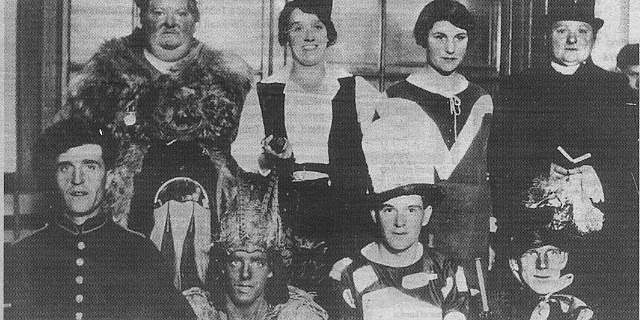
Our look into the pictorial archives this week takes us back to 1926 when mine workers were involved in lengthy strike action against their employers at the Wellesley Pit in Denbeath.
- The woman pictured on the extreme left in the back row is Agnes Flynn and the photograph was loaned to the "East Fife Mail" by her grandson, John Flynn of 'Wateryetts' in Mitchell Street, Leven.
- Mr. Flynn recalls his grandmother telling him that the workers would often don fancy dress during the strike in order to campaign for their cause.
- Despite their hardship the strike period was marked by camaraderie and 'bonhomie', but they eventually returned to work for less pay than they received before the strike.
- Mr. Flynn would love to hear from anyone who knows the names of all the people in the picture.
 |
------------------------------------------------
"A Wellesley Pug"
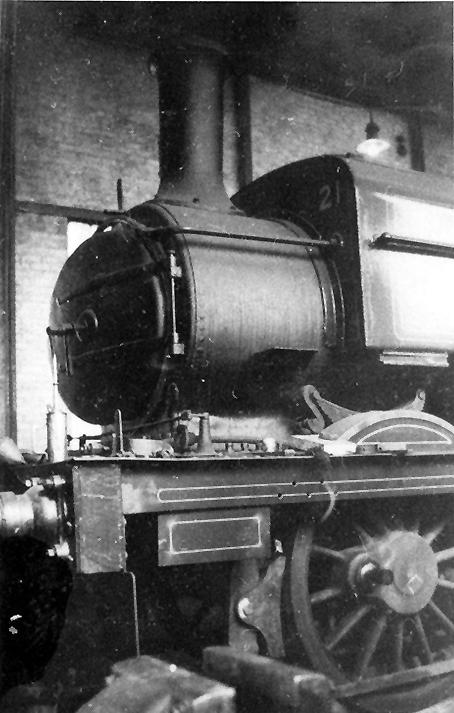
"The No. 6 the subject of my picture at Wellesley was built by the GNR which was absorbed into the LNER at the grouping of 1921. It was sold to a Doncaster firm by the name of J. F. Wake, who sold it to the Wemyss Private Railway in 1920. It came to Wemyss still with its vacuum brake and this made me think in my young days that it might have been used in passenger service on the Earlseat line. However, there seems to be no evidence that such was the case, though I can not imagine how the Board of Trade would allow passenger haulage with a hand-braked locomotive! In fact, however, it seems to have spent much time at Lochhead and latterly at Denbeath Washer where I used to watch it in service. After an incredibly long life it was scrapped at Denbeath in 1956."
William H. MacLeod
9th September 2005
 |
------------------------------------------------
