Owners: Thornton Coal Co. ?
Fife Coal Co. Ltd.
The Engine Pit was located at Middlefield in the
south-east of Thornton village by the River Ore and close to
the Dunfermline and Thornton Section of the N. B. R. which led
in a north-easterly direction to the Balgonie Lochtyside and
Julian pits.
This small nineteenth century pit wrought the Dysart Main
Coal seam up to around the middle of the nineteenth century.
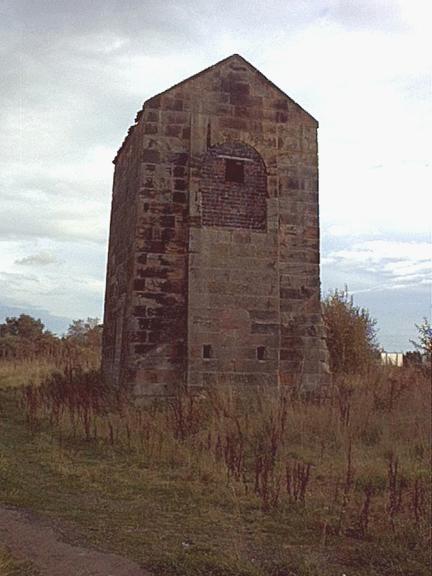
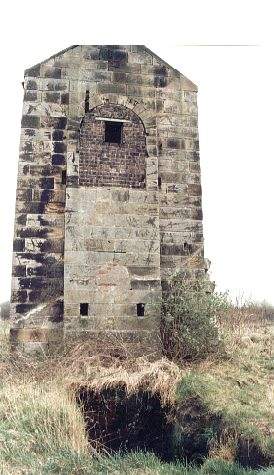
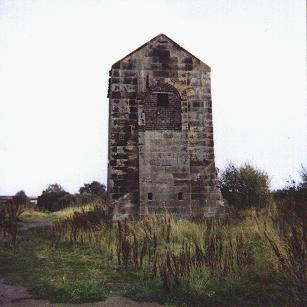
One of the pit structures is still in existence today (see
below). It is quite likely that this is a development of the original Easter Strathore pit which was worked in the 18th century.
 |
 |
 |
 |
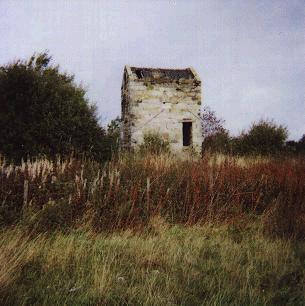 |
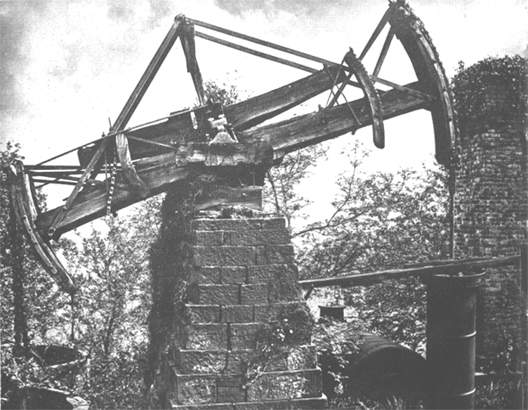
This is the structure which housed the Cornish beam pumping engines that kept mines free of water and allowed deeper mines to be sunk - a big advance in mining technology. Engine-houses like this were once a common sight. This one at Middlefield, Thornton, is close to the present-day station-halt, and is one of only three such buildings still standing in Fife as a reminder of what once made Fife great!
| See also Strathore (Easter) pits and Balgonie Colliery entries |
|---|
| Source Date of Information Supplied | |
|---|---|
| Manager / Under-Manager / Men underground / Men above ground / Coal seams worked | |
| 1842 (James Balfour, Esq.) | |
| Thornton Colliery, parish of Markinch. | |
| 1846 (Charles Balfour, Esq.) | |
| Mr Alexander Welch, about 30 years manager of the Thornton Colliery on the Balgonie estate, retired in November. | |
| 1918 (Fife Coal Co. Ltd.) | |
| Thornton: David Jack / James McCubbery / 26 / 10 | |
| 1920 (Fife Coal Co. Ltd.) | |
| Thornton:---------- / ---------- / 46 / 17 |
| This entry is presently being used to hold any records
and information gathered about the Thornton area
coal-works and once sufficient information is available
for any of these coal-works, they will appear as
individual pit/mine entries in the EAST INDEX. We would
welcome any information on any of the Thornton or Balgonie
pits or mines from site visitors.
M. Martin & Webmasters |
|---|
| Plans of Abandoned Seams for Thornton | Pits or Mines designated in Plans |
|---|---|
| COAL; Seam unnamed | Engine |
| COAL; Dysart Main (1848) | Middlefield (Engine) |
| COAL; Smithy (February, 1903) |
Thornton Nos. 1, 2
(See Maggie Pit entry) |
| COAL; Lower Dysart - Upper and Lower Leaf (March, 1921) | Thornton |
 |
 |
 |
--------------------------------------
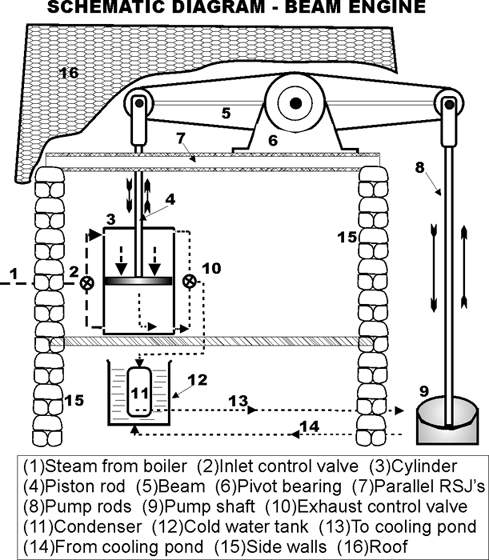
BASIC OPERATION OF BEAM ENGINE
High pressure steam from the boiler (1) passes through a directional control valve (2) into the top or bottom of the cylinder (3) and this forces the piston to move up or down in the cylinder.
The diagram shows the piston at the middle of the down stroke.
A rod (4) is attached to the piston, passes through the cylinder, and is linked to the cast iron beam (5), which pivots on bearings (6) bolted to parallel RSJ's (7).
The motion of the piston causes the beam to rock in a see-saw fashion.
The pump rod (8), linked to the opposite end of the beam, extends vertically through the centre of a pipe column (9) to the bottom of the shaft. The bottom of the pump rod is attached to a bucket pump which raises water to the surface by the up and down motion of the rods.
To improve the efficiency of the system, the exhaust steam flows through the control valve (10) and into the condenser (11). The exhaust steam is condensed by the cold water in tank (12) thus creating a partial vacuum in the cylinder. The mixture of condensed water and steam is piped (13) to a cooling pond and this water may be piped back (14) to replenish the cold-water tank or boiler feed. The machinery is usually housed in a stone or brick built engine house (15) and protected from the elements by a pitched roof (16).
Working examples of beam engines in Scotland may be seen at the Newtongrange Site of the Scottish Mining Museum and the Wanlockhead Lead Mining Museum.
--------------------------------------------
"The Scotsman"
20 August, 1831
TO BE LET.
THE ROTHES COAL FIELD, near Markinch, will be LET, for such a number of
years as may be agreed upon. This coal field contains two seams of coal, named the
Main Coal, which is from five to six feet thick, and the Two Feet Coal, which lies fifteen
feet above the Main Coal. These coals are similar in quality to those of Balbirnie, and
were for several years wrought to great advantage. The sale is wholly inland, but the
demand for coal in this district of Fife is considerable, and the prices received for coal
at the adjoining collieries are encouraging to resume the working of the Rothes coal.
It is ascertained that an engine pit of moderate depth will win a considerable field of the
Main Coal; and the Two Feet Coal can at present be wrought to some extent without
much outlay of capital. The river Leven, which runs through the Rothes Estate,
affords power for driving a water wheel, by which it is expected the Main Coal may be
drained.
2. The COAL FIELD and IRON STONE in the Farm of EASTER STRATHORE, in
the parish of Dysart, situated about three miles from the harbours of Kirkcaldy and Dysart. ...
Mr Robert Mitchell, at Cadham, will show the boundaries of the coal fields, and give local information;
and farther particulars will be learned, by applying to Messrs Robert Bald and John Geddes,
mining-engineers, 17, York Place; or to Messrs Tait and Young, W. S., Park Place, Edinburgh.
Edinburgh, 19th August, 1831.
--------------------------------------------
"Fifeshire Journal"
17 December, 1840
THORNTON - SERIOUS ACCIDENT
On Saturday last, as two of the persons employed at the colliery here were at work, a portion of the roof came down, without giving any warning, and seriously injured two of the colliers. John Wilson, a lad of about 15 years of age, had one of his legs broken above the ankle, and was also much bruised about the body. John Mitchell was a good deal hurt, but none of his bones were broken. We are happy to say that accidents very rarely occur at this work, which we attribute, under Providence, to the cautious and judicious arrangement of the manager, Mr Welch.
--------------------------------------------
"Fifeshire Journal"
9 December, 1841
THORNTON - SERIOUS ACCIDENT
On Thursday last, when Geo. Gilmour, a young lad about 15 years of age, was plying his usual vocation in the pit at Thornton colliery, a large piece was detached from the roof, and falling on him, broke both of his thigh bones. He is now doing as well as could possibly be expected.
--------------------------------------------
"Fifeshire Journal"
30 November, 1843
COAL
GREAT REDUCTION OF PRICE
THE LARGE COAL at THORNTON will be
Reduced from 4s. 7d. to 4s. 2d. per ton;
SMALL, from 3s. to 2s. 6d. per ton; on Saturday
first.
--------------------------------------------
"Fifeshire Journal"
13 February, 1845
THORNTON - COAL
The waste of the coal-work here collapsed on Friday and Saturday last, so as to put a stop to the working. The engine pit is squeezed together at the bottom, and the cast-iron pumps broken, so that the work is at a stand. It will be a great loss to this place and to the whole of Fife, as it may raise the price of coal, upwards of 3000 loads a-week having been sold here. Nobody was hurt.
--------------------------------------------
"Supplement: Dunfermline Saturday
Press"
6 September, 1862
THORNTON - COAL PIT ACCIDENT
The other day, a collier named David Stevenson, when working in a coal-pit in this neighbourhood, was very seriously injured by a heavy stone falling upon him from the roof of the working. He is in a very pitiable condition, and is confined to bed. A number of his ribs are broken.
--------------------------------------------

"Dunfermline Saturday Press"
14 October, 1871
THORNTON - FATAL COLLIERY ACCIDENT
On Thursday, Harry Kerr, a young man belonging to Coalton of Balgonie, was working at a coal seam at Balgonie Coalfield, near Thornton Junction, along with his father and another man, when a heavy stone fell from the roof upon his head, causing immediate death. Kerr was about twenty years of age, and unmarried.
--------------------------------------------
"Dunfermline Saturday Press"
6 July, 1872
THORNTON - ANOTHER RISE IN THE PRICE OF COAL
"Up, still up," is the motto of the coal trade here. Notwithstanding that several advances had recently been made on the price of coal in this district, last week another rise was countenanced, equal to 10d. per ton. Pity the poor who have to pay so dear for the comforts of a blazing ingle when winter closes around them.
--------------------------------------------
